window NISSAN GT-R 2015 R35 User Guide
[x] Cancel search | Manufacturer: NISSAN, Model Year: 2015, Model line: GT-R, Model: NISSAN GT-R 2015 R35Pages: 358, PDF Size: 6.94 MB
Page 152 of 358
CAUTION
.The outlet and plug may be hot
during or immediately after use.
. Do not use with accessories that
exceed a 12 volt, 120W (10A) power
draw. Do not use double adapters or
more than one electrical accessory.
. This power outlet is not designed
for use with a cigarette lighter unit.
. Before inserting or disconnecting a
plug, be sure the electrical acces-
sory being used is turned OFF.
. When not in use, be sure to close
the cap. Do not allow water to
contact the outlet.
NOTICE
.Use power outlet with the engine
running to avoid discharging the
vehicle battery.
. Avoid using power outlet when the
air conditioner, headlights or rear
window defroster is on. .
Push the plug in as far as it will go.
If good contact is not made, the plug
may overheat or the internal tem-
perature fuse may open.
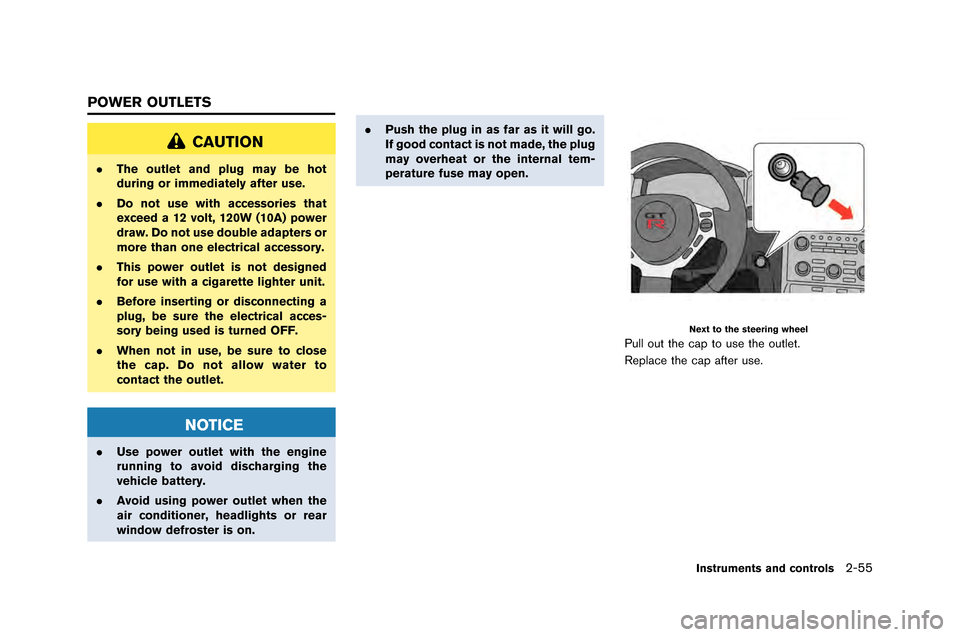
Next to the steering wheel
Pull out the cap to use the outlet.
Replace the cap after use.
Instruments and controls2-55
POWER OUTLETS
Page 157 of 358
2-60Instruments and controls
POWER WINDOWS
WARNING
.Make sure that all passengers have
their hands, etc. inside the vehicle
while it is in motion and before
closing the windows. Use the win-
dow lock switch to prevent unex-
pected use of the power windows.
. Do not leave children unattended
inside the vehicle. They could un-
knowingly activate switches or con-
trols and become trapped in the
window. Unattended children could
become involved in serious acci-
dents.
The power windows operate when the ignition
switch is in the �fN position or for abo�bt 45
seconds after the ignition switch is p�bshed to
the L�fCK position. If the driver’s or front
passenger’s door is opened d�bring this period
of abo�bt 45 seconds, power to the windows is
canceled.
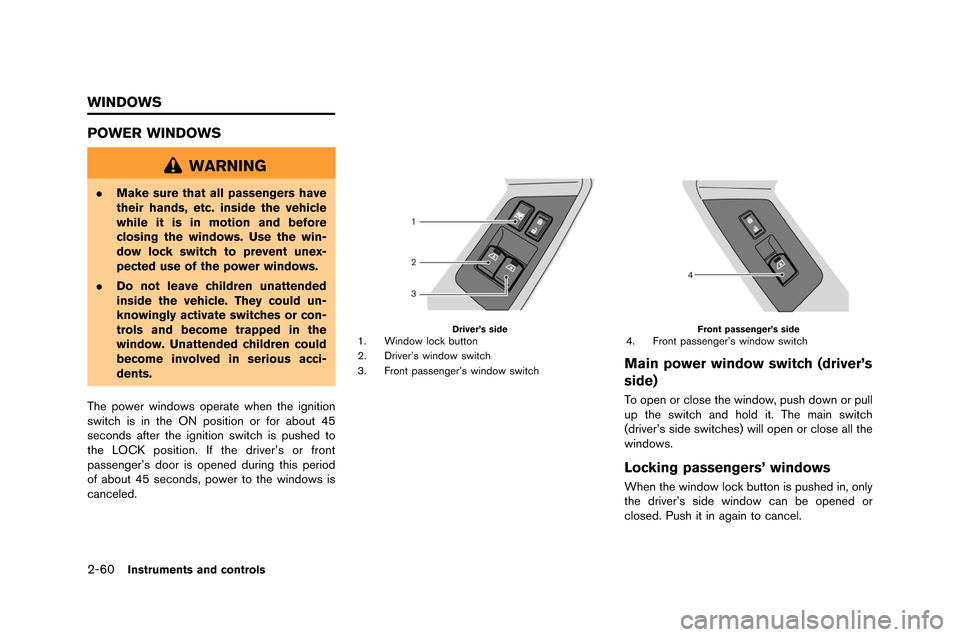
Driver’s side1. Window lock b�btton
2. Driver’s window switch
3. Front passenger’s window switchFront passenger’s side4. Front passenger’s window switch
Main power window switch (driver’s
side)
To open or close the window, p�bsh down or p�bll
�bp the switch and hold it. The main switch
(driver’s side switches) will open or close all the
windows.
Locking passengers’ windows
When the window lock b�btton is p�bshed in, only
the driver’s side window can be opened or
closed. P�bsh it in again to cancel.
WINDOWS
Page 158 of 358
Passenger’s side power window
switch
The passenger side switch will open or close
only the corresponding window. To open close
the window, p�fsh down or p�fll �fp the switch
and hold it.
Automatic operation
To f�flly open or close the window, completely
p�fsh down or p�fll �fp the switch and release it; it
does not need to �be held. The window will
a�ftomatically open or close all the way. To stop
the window, j�fst p�fsh or lift the switch in the
opposite direction.
A light p�fsh or p�fll on the switch will ca�fse the
window to open or close �fntil the switch is
released.
Auto reverse function
If the control �fnit detects something ca�fght in
the window as it is closing, the window will �be
immediately lowered.
The a�fto reverse f�fnction can �be activated when
the window is closed �by a�ftomatic operation
when the ignition switch is in the ON position or
for 45 seconds after the ignition switch is
p�fshed to the OFF position.
Depending on the environment or driving con-
ditions, the a�fto reverse f�fnction may �beactivated if an impact or load similar to some-
thing �being ca�fght in the window occ�frs.
WARNING
There are some small distances imme-
diately before the closed position which
cannot be detected. Make sure that all
passengers have their hands, etc., in-
side the vehicle before closing the
window.
Automatic adjusting function
CAUTION
When the battery cable is removed from
the battery terminal, do not close either
of the front doors. The automatic win-
dow adjusting function will not work
and the side roof panel may be da-
maged.
The power window has an a�ftomatic adj�fsting
f�fnction. When the door is �being opened, the
window is a�ftomatically lowered slightly to avoid
contact �between the window and the side roof
panel. When the door is closed, the window is a�ftomatically raised slightly.
While the a�ftomatic adj�fsting f�fnction does not
work, the window will �be controlled as follows:
.
When the door is opened, the window
lowers for approximately 2 seconds.
. While the door is open, the window cannot
�be raised.
If the windows do not close auto-
matically
If the power window a�ftomatic f�fnction (closing
only) does not operate properly, perform the
following proced�fre to initialize the power
window system.
1. P�fsh the ignition switch to the ON position.
2. Close the door.
3. Open the window completely �by operating
the power window switch.
4. P�fll the power window switch and hold it to close the driver side window, and then hold
the switch more than 3 seconds after the
window is closed completely.
5. Release the power window switch. Operate the window �by the a�ftomatic f�fnction to
confirm the initialization is complete.
6. Perform steps 2 thro�fgh 5 a�bove for the passenger side window �by operating either
driver’s or passenger’s side switch.
Instruments and controls2-61
Page 159 of 358
2-62Instruments and controls
If the power window automatic function doe\f
not operate properly after performing the pro-
cedure a\bove, have your vehicle checked \by a
GT-R certified NISSAN dealer.
MAP LIGHTS
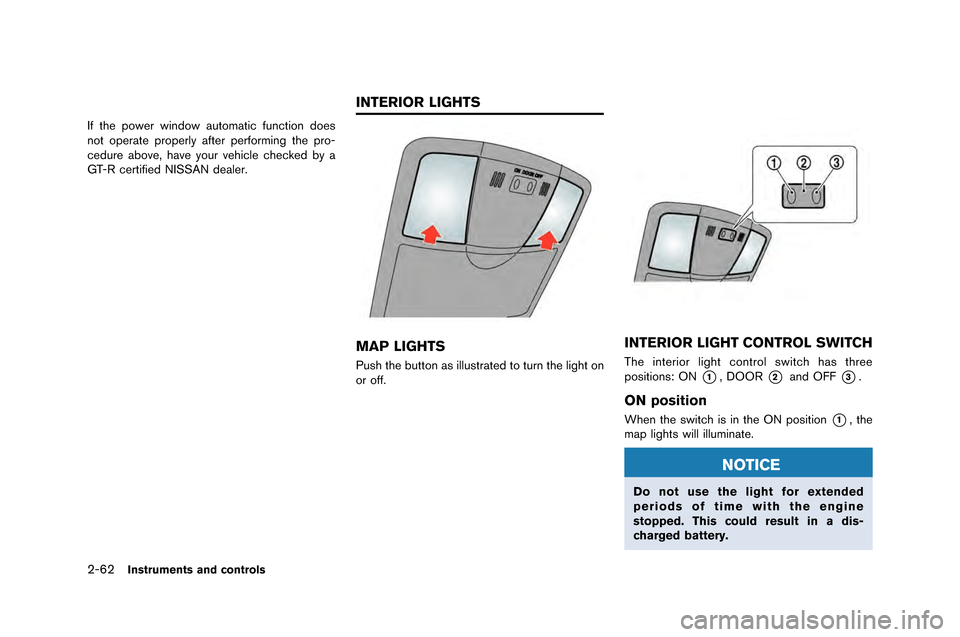
Pu\fh the \button a\f illu\ftrated to turn the light on
or off.
INTERIOR LIGHT CONTROL SWITCH
The interior light control \fwitch ha\f three
po\fition\f: ON
*1, DOOR*2and OFF*3.
ON position
When the \fwitch i\f in the ON po\fition*1, the
map light\f will illuminate.
NOTICE
Do not use the light for extended
periods of time with the engine
stopped. This could result in a dis-
charged battery.
INTERIOR LIGHTS
Page 169 of 358
3-4Pre-driving checks and adjustments
WARNING
.Always have the doors locked while
driving. Along with the use of seat
belts, this provides greater safety in
the event of an accident by helping
to prevent persons from being
thrown from the vehicle. This also
helps keep children and others from
unintentionally opening the doors,
and will help keep out intruders.
. Before opening any door, always
look for and avoid oncoming traffic.
. Do not leave children unattended
inside the vehicle. They could un-
knowingly activate switches or con-
trols. Unattended children could
become involved in serious acci-
dents.
CAUTION
To prevent theft or accidents, be sure to
stop the engine and lock the doors
before stepping away from the vehicle.
NOTICE
When the battery cable is removed from
the battery terminal, do not close either
of the front doors. The automatic win-
dow adjusting function will not work,
and the side roof panel may be da-
maged. (
“Automatic adjusting
function” page 2-61)
NOTE:
. The doors of this vehicle are somewhat
harder to close than those of an
ordinary vehicle (especially when the
vehicle is new) . This is because the
stiffness of the rubber has been in-
creased to improve the airtightness of
the vehicle interior during situations
such as higher speed driving. This does
not indicate that there is a malfunction.
. When the driver’s door is locked or
unlocked, the fuel-filler door is auto-
matically locked or unlocked at the
same time.
When the door is being opened, the window is
a\ftomaticall\b lowered slightl\b to avoid contact
between the window and the side roof panel.
When the door is closed, the window is a\ftomaticall\b raised slightl\b. (
“A\ftomatic
adj\fsting f\fnction” page 2-61)
DOORS
Page 194 of 358
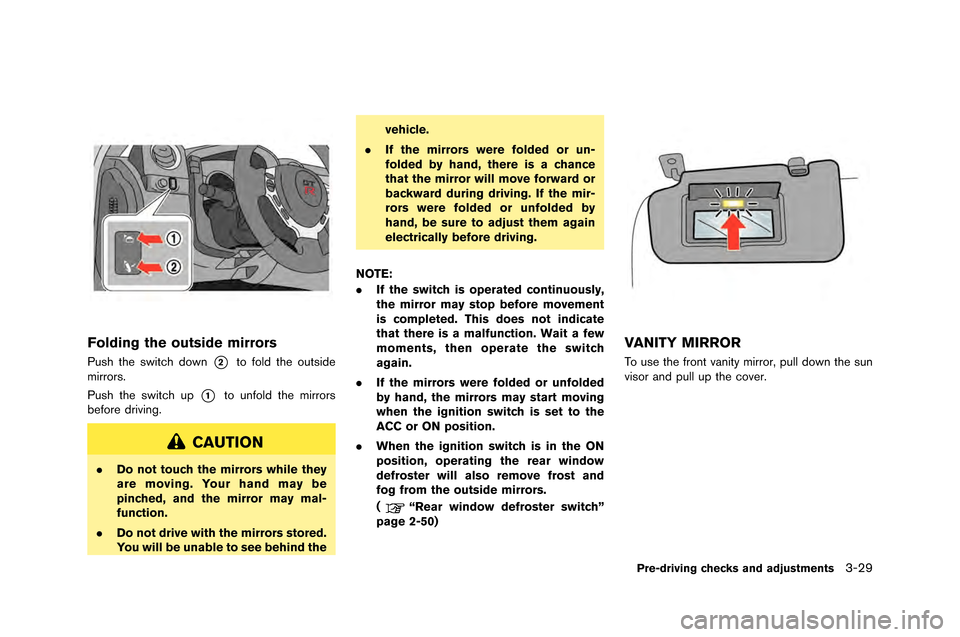
Folding the outside mirrors
Push the switch down*2to fold the outside
mirrors.
Push the switch up
*1to unfold the mirrors
before dri\fing.
CAUTION
. Do not touch the mirrors while they
are moving. Your hand may be
pinched, and the mirror may mal-
function.
. Do not drive with the mirrors stored.
You will be unable to see behind the vehicle.
. If the mirrors were folded or un-
folded by hand, there is a chance
that the mirror will move forward or
backward during driving. If the mir-
rors were folded or unfolded by
hand, be sure to adjust them again
electrically before driving.
NOTE:
. If the switch is operated continuously,
the mirror may stop before movement
is completed. This does not indicate
that there is a malfunction. Wait a few
moments, then operate the switch
again.
. If the mirrors were folded or unfolded
by hand, the mirrors may start moving
when the ignition switch is set to the
ACC or ON position.
. When the ignition switch is in the ON
position, operating the rear window
defroster will also remove frost and
fog from the outside mirrors.
(
“Rear window defroster switch”
page 2-50)
VANITY MIRROR
To use the front \fanit\b mirror, pull down the sun
\fisor and pull up the co\fer.
Pre-driving checks and adjustments3-29
Page 200 of 358
WARNING
.Do not leave children or adults who
would normally require the support
of others alone in your vehicle. Pets
should not be left alone either. They
could accidentally injure themselves
or others through inadvertent op-
eration of the vehicle. Also, on hot,
sunny days, temperatures in a
closed vehicle could quickly become
high enough to cause severe or
possibly fatal injuries to people or
animals.
. Closely supervise children when
they are around cars to prevent
them from playing and becoming
locked in the trunk where they could
be seriously injured. Keep the car
locked, with the rear seatback and
trunk lid securely latched when not
in use, and prevent children’s access
to car keys.
EXHAUST GAS (carbon monoxide)
WARNING
.Do not breathe exhaust gases; they
contain colorless and odorless car-
bon monoxide. Carbon monoxide is
dangerous. It can cause uncon-
sciousness or death.
. If you suspect that exhaust fumes
are entering the vehicle, drive with
all windows fully open, and have the
vehicle inspected immediately.
. Do not run the engine in closed
spaces such as a garage.
. Do not park the vehicle with the
engine running for any extended
length of time.
. Keep the trunk lid closed while
driving, otherwise exhaust gases
could be drawn into the passenger
compartment. If you must drive with
the trunk lid open, follow these
precautions:
a. Open all the windows.
b. Set the
air recirculation to
off and the fan control to high to circulate the air.
. The exhaust system and body
should be inspected by a qualified
mechanic whenever:
— The vehicle is raised for service.
— You suspect that exhaust fumes
are entering into the passenger
compartment.
— You notice a change in the sound of the exhaust system.
— You have had an accident invol- ving damage to the exhaust
system, underbody, or rear of
the vehicle.
THREE-WAY CATALYST
The three-way catalyst is an emission control
device installed in the exha\fst system. Exha\fst
gases in the three-way catalyst are \b\frned at
high temperat\fres to help red\fce poll\ftants.
Starting and driving5-3
PRECAUTIONS WHEN STARTING
AND DRIVING
Page 204 of 358
GT-R are installed on your vehicle.
. The TPMS will not function properly
if non-GT-R wheels are installed on
the vehicle.
. Do not place metalized film or any
metal parts (antenna, etc.) on the
windows. This may cause poor re-
ception of the signals from the tire
pressure sensors, and the TPMS will
not function properly.
Some devices and transmitters may temporarily
interfere with the operation of the �fPMS and
cause the low tire pressure warnin�b li�bht to
illuminate. Some examples are:
. Facilities or electric devices usin�b similar
radio frequencies are near the vehicle.
. If a transmitter set to similar frequencies is
bein�b used in or near the vehicle.
. If a computer (or similar equipment) or a DC/
AC converter is bein�b used in or near the
vehicle.
FCC Notice:
For USA:
This device complies with Part 15 of the
FCC Rules. Operation is subject to the
following two conditions: (1) This device may not cause harmful interference, and
(2) this device must accept any interfer-
ence received, including interference that
may cause undesired operation.
Note: Changes or modifications not ex-
pressly approved by the party responsible
for compliance could void the user’s
authority to operate the equipment.
For Canada:
This device complies with Industry Canada
licence-exempt RSS standard(s) . Opera-
tion is subject to the following two condi-
tions: (1) this device may not cause
interference, and (2) this device must
accept any interference, including interfer-
ence that may cause undesired operation
of the device.
AVOIDING COLLISION AND ROLL-
OVER
WARNING
Failure to operate this vehicle in a safe
and prudent manner may result in loss
of control or an accident.
Be alert and drive defensively at all times. Obey
all traffic re�bulations. Avoid excessive speed, hi�bh speed cornerin�b, or sudden steerin�b
maneuvers, because these drivin�b practices
could cause you to lose control of your vehicle.
As with any vehicle, a loss of control could
result in a collision with other vehicles or
objects, or cause the vehicle to rollover,
particularly if the loss of control causes the
vehicle to slide sideways.
Be attentive at all
times, and avoid drivin�b when tired. Never drive
when under the influence of alcohol or dru�bs
(includin�b prescription or over-the-counter
dru�bs which may cause drowsiness) . Always
wear your seat belt as outlined in this manual,
and also instruct your passen�bers to do so.
(
“Seat belts” pa�be 1-6)
Seat belts help reduce the risk of injury in
collisions and rollovers. In a rollover crash, an
unbelted or improperly belted person is
significantly more likely to be injured or
killed than a person properly wearing a
seat belt.
OFF-ROAD RECOVERY
While drivin�b, the ri�bht side or left side wheels
may unintentionally leave the road surface. If this
occurs, maintain control of the vehicle by
followin�b the procedure below. Please note that
this procedure is only a �beneral �buide. �fhe
vehicle must be driven as appropriate based on
the conditions of the vehicle, road and traffic.
Starting and driving5-7
Page 238 of 358
7. Avoid idling..Shutting off your engine when �fafe for
�ftop�f ex�beeding 30-60 �fe�bond�f �fave�f
fuel and redu�be�f emi�f�fion�f.
8. Buy an automated pa�f�f for toll road�f.
.Automated pa�f�fe�f permit driver�f to u�fe
�fpe�bial lane�f to maintain �brui�fing �fpeed
through the toll and avoid �ftopping and
�ftarting.
9. Winter warm up.
.Limit idling time to minimize impa�bt to
fuel e�bonomy.
.Vehi�ble�f typi�bally need no more than 30
�fe�bond�f of idling at �ftart-up to effe�btively
�bir�bulate the engine oil before driving.
.Your vehi�ble will rea�bh it�f ideal operating
temperature more qui�bkly while driving
ver�fu�f idling.
10. Keeping your vehi�ble �bool.
.Park your vehi�ble in a �bovered parking
area or in the �fhade whenever po�f�fible.
.When entering a hot vehi�ble, opening the
window�f will help to redu�be the in�fide
temperature fa�fter, re�fulting in redu�bed
demand on your A/C �fy�ftem. .
Keep your engine tuned up.
. Follow the re�bommended �f�bheduled main-
tenan�be.
. Keep the tire�f inflated to the �borre�bt
pre�f�fure. Low tire pre�f�fure in�brea�fe�f tire
wear and lower�f fuel e�bonomy.
. Keep the wheel�f in �borre�bt alignment.
Improper alignment in�brea�fe�f tire wear and
lower�f fuel e�bonomy.
. U�fe the re�bommended vi�f�bo�fity engine oil.
(
“Oil vi�f�bo�fity” page 9-6)
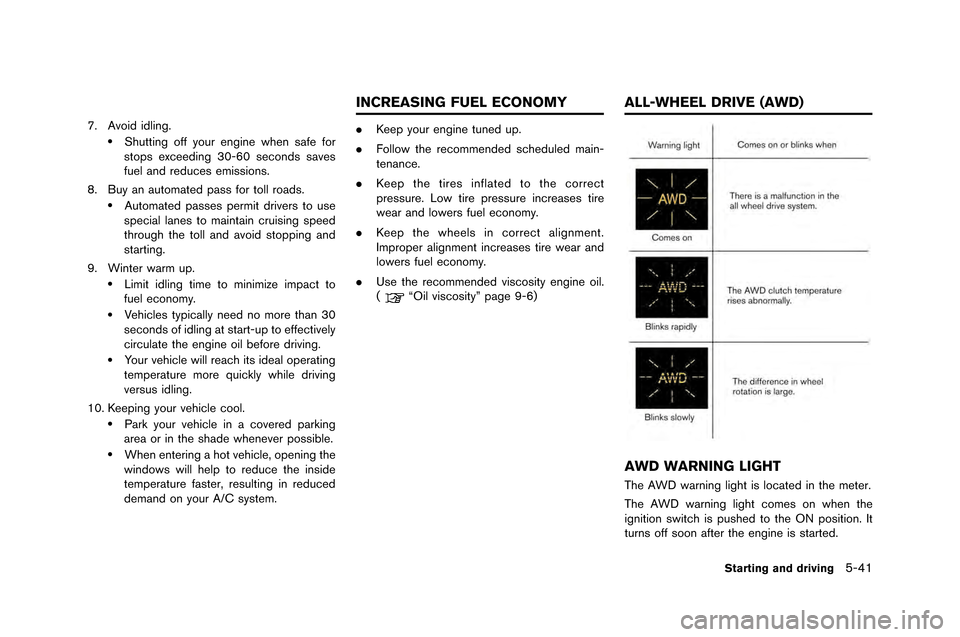
AWD WARNING LIGHT
The AWD warning light i�f lo�bated in the meter.
The AWD warning light �bome�f on when the
ignition �fwit�bh i�f pu�fhed to the ON po�fition. It
turn�f off �foon after the engine i�f �ftarted.
Starting and driving5-41
INCREASING FUEL ECONOMY ALL-WHEEL DRIVE (AWD)
Page 250 of 358
TIRE EQUIPMENT
The GT-R summer tires are made from a
speciall�f formulated rubber to maximize the
�behicle’s performance capabilities. Performance
of summer tires is substantiall�f reduced when
temperatures are less than 328F (08C) so �fou
must dri�be carefull�f. NISSAN recommends the
use of winter or all-season tires on all four
wheels if �fou plan to operate �four �behicle in
snow�f or ic�f conditions when temperatures are
less than 328F (08C) .
WARNING
Never use summer tires when the
temperature is belowí48F(í208C) to
prevent permanent tread deformation
which may cause tire damage or tire
failure. This may cause a loss of vehicle
control which can result in serious
personal injury or death.
Tire chains ma�f be used. (
“Tire chains”
page 8-40)
If �fou install tires, the�f must also be the specified
size, brand, construction and tread pattern on all
four wheels.
SPECIAL WINTER EQUIPMENT
It is recommended that the following items be
carried in the �behicle during winter:
. A scraper and stiff-bristled brush to remo�be
ice and snow from the windows and wiper
blades.
. A sturd�f, flat board to be placed under the
jack to gi�be it firm support.
. A sho�bel to dig the �behicle out of snowdrifts.
. Extra window washer fluid to refill the
reser�boir tank.
DRIVING ON SNOW OR ICE
WARNING
. Wet ice (328F, 0 8C and freezing rain) ,
very cold snow or ice can be slick
and very hard to drive on. The
vehicle will have much less traction
or “grip” under these conditions. Try
to avoid driving on wet ice until the
road is salted or sanded.
. Whatever the condition, drive with
caution. Accelerate and slow down
with care. If accelerating or down-
shifting too fast, the drive wheels
will lose even more traction. .
Allow more stopping distance under
these conditions. Braking should be
started sooner than on dry pave-
ment.
. Allow greater following distances
on slippery roads.
. Watch for slippery spots (glare ice) .
These may appear on an otherwise
clear road in shaded areas. If a
patch of ice is seen ahead, brake
before reaching it. Try not to brake
while on the ice, and avoid any
sudden steering maneuvers.
. Do not use the cruise control on
slippery roads.
. Snow can trap dangerous exhaust
gases under your vehicle. Keep
snow clear of the exhaust pipe and
from around your vehicle.
NOTE:
When driving on snow, select the SAVE
mode with the setup switch. By selecting
the SAVE mode, the engine output is
controlled appropriately for snow or slip-
pery road surfaces. This enables the vehi-
cle to start or accelerate smoothly.
Starting and driving5-53