load NISSAN JUKE 2013 F15 / 1.G Owner's Manual
[x] Cancel search | Manufacturer: NISSAN, Model Year: 2013, Model line: JUKE, Model: NISSAN JUKE 2013 F15 / 1.GPages: 347, PDF Size: 3.26 MB
Page 228 of 347
Black plate (226,1)
[ Edit: 2012/ 6/ 29 Model: F15-D ]
5-20Starting and driving
properly.
. When canceling the manual shift mode,
return the selector lever to the D (Drive)
position. The transmission returns to the
normal driving mode.
M6 (6th):
GUID-3448E018-0BC4-4D17-AD0E-3BB850F23C53Use this position for all normal forward driving at
highway speeds.
M5 (5th):
GUID-3448E018-0BC4-4D17-AD0E-3BB850F23C53Use this position when driving up long slopes, or
for engine braking when driving down long
slopes.
M4 (4th) , M3 (3rd) and M2 (2nd):
GUID-3448E018-0BC4-4D17-AD0E-3BB850F23C53Use for hill climbing or engine braking on
downhill grades.
M1 (1st):
GUID-3448E018-0BC4-4D17-AD0E-3BB850F23C53Use this position when climbing steep hills
slowly or driving slowly through deep snow,
sand or mud, or for maximum engine braking on
steep downhill grades.
. Remember not to drive at high speeds for
extended periods of time in lower than M6
range. This reduces fuel economy.
. In the manual shift mode, the transmis-
sion may not shift to the selected
range. This helps maintain driving per-
formance and reduces the chance of vehicle damage or loss of control.
When this situation occurs, the Con-
tinuously Variable Transmission (CVT)
position indicator light will blink and
the chime will sound.
. In the manual shift mode, the transmis-
sion automatically shifts down to 1st
gear before the vehicle comes to a
stop. When accelerating again, it is
necessary to shift up to the desired
range.
. When the CVT fluid temperature is extre-
mely low, the manual shift mode may not
work and automatically shift as a drive mode.
This is not a malfunction. In this case, return
the selector lever to the D position and drive
for a while and then shift to the manual shift
mode.
. When the CVT fluid temperature is high, the
shift range may upshift at a lower engine
speed than usual. This is not a malfunction.
Accelerator downshift — In D position —GUID-BF3E06A6-2637-42C1-966D-5E30031CA744For passing or hill climbing, fully depress the
accelerator pedal to the floor. This shifts the
transmission down into a lower gear, depending
on the vehicle speed.
High fluid temperature protection modeGUID-CE869FBC-89CE-4D62-AEC8-660F5235AF18This transmission has a high fluid temperature
protection mode. If the fluid temperature be-
comes too high (for example, when climbing
steep grades in high temperature with heavy
loads), engine power and, under some condi-
tions, vehicle speed will be decreased auto-
matically to reduce the chance of transmission
damage. Vehicle speed can be controlled with
the accelerator pedal, but the engine and vehicle
speed may be limited.
Fail-safeGUID-EA910347-92E1-44D4-9256-120D487E42CAIf the vehicle is driven under extreme
conditions, such as excessive wheel spin-
ning and subsequent hard braking, the
fail-safe system may be activated. The MIL
may illuminate to indicate the fail-safe
mode is activated. (See “Malfunction In-
dicator Light (MIL)” (P.2-18) .) This will
occur even if all electrical circuits are
functioning properly. In this case, place
the ignition switch in the OFF position and
wait for 10 seconds. Then turn the switch
back to the ON position. The vehicle
should return to its normal operating
condition. If it does not return to its normal
operating condition, have a NISSAN dealer
check the transmission and repair if ne-
cessary.
Condition:
Page 239 of 347
Black plate (237,1)
[ Edit: 2012/ 6/ 29 Model: F15-D ]
GUID-7C03A534-EF0E-40B7-84F0-13B8CB4EE473Follow these easy-to-use Fuel Efficient Driving
Tips to help you achieve the most fuel economy
from your vehicle.
1. Use smooth accelerator and brake pedalapplication.
.Avoid rapid starts and stops..Use smooth, gentle accelerator andbrake application whenever possible.
.Maintain constant speed while commut-
ing and coast whenever possible.
2. Maintain constant speed
.Look ahead to try and anticipate and minimize stops.
.Synchronizing your speed with traffic
lights allows you to reduce your number
of stops.
.Maintaining a steady speed can minimize red light stops and improve fuel effi-
ciency.
3. Use air conditioning (A/C) at higher vehicle speeds.
.Below 40 MPH (64 km/h), it is moreefficient to open windows to cool the
vehicle due to reduced engine load.
.Above 40 MPH (64 km/h) , it is moreefficient to use A/C to cool the vehicle
due to increased aerodynamic drag.
.Recirculating the cool air in the cabinwhen the A/C is on reduces cooling load.
4. Drive at economical speeds and distances.
.Observing the speed limit and not ex- ceeding 60 MPH (97 km/h) (where
legally allowed) can improve fuel effi-
ciency due to reduced aerodynamic
drag.
.Maintaining a safe following distancebehind other vehicles reduces unneces-
sary braking.
.Safely monitoring traffic to anticipatechanges in speed permits reduced brak-
ing and smooth acceleration changes.
.Select a gear range suitable to road conditions.
5. Use cruise control.
.Using cruise control during highway driving helps maintain a steady speed.
.Cruise control is particularly effective in providing fuel savings when driving on
flat terrains.
6. Plan for the shortest route.
.Utilize a map or navigation system to determine the best route to save time.
7. Avoid idling.
.Shutting off your engine when safe for stops exceeding 30-60 seconds saves fuel and reduces emissions.
8. Buy an automated pass for toll roads.
.Automated passes permit drivers to use special lanes to maintain cruising speed
through the toll and avoid stopping and
starting.
9. Winter warm up.
.Limit idling time to minimize impact to fuel economy.
.Vehicles typically need no more than 30seconds of idling at start-up to effectively
circulate the engine oil before driving.
.Your vehicle will reach its ideal operatingtemperature more quickly while driving
versus idling.
10. Keeping your vehicle cool.
.Park your vehicle in a covered parking area or in the shade whenever possible.
.When entering a hot vehicle, opening thewindows will help to reduce the inside
temperature faster, resulting in reduced
demand on your A/C system.
Starting and driving5-31
FUEL EFFICIENT DRIVING TIPS
Condition:
Page 247 of 347
Black plate (245,1)
[ Edit: 2012/ 6/ 29 Model: F15-D ]
GUID-EC3A4D5C-5B0D-4B05-8797-16078A3BB5CFBRAKE ASSISTGUID-4F7C10AE-4D30-42D8-A185-FF61F97693EEWhen the force applied to the brake pedal
exceeds a certain level, the Brake Assist is
activated generating greater braking force than a
conventional brake booster even with light pedal
force.
WARNING
The Brake Assist is only an aid to assist
braking operation and is not a collision
warning or avoidance device. It is the
driver’s responsibility to stay alert, drive
safely and be in control of the vehicle at
all times.
ANTI-LOCK BRAKING SYSTEM (ABS)GUID-AD934732-3AE5-459A-B8C3-7A014C0C24D9
WARNING
.The Anti-lock Braking System (ABS)
is a sophisticated device, but it
cannot prevent accidents resulting
from careless or dangerous driving
techniques. It can help maintain
vehicle control during braking on
slippery surfaces. Remember that
stopping distances on slippery sur-
faces will be longer than on normal surfaces even with ABS. Stopping
distances may also be longer on
rough, gravel or snow covered
roads, or if you are using tire chains.
Always maintain a safe distance
from the vehicle in front of you.
Ultimately, the driver is responsible
for safety.
. Tire type and condition may also
affect braking effectiveness.
— When replacing tires, install the
specified size of tires on all four
wheels.
— When installing a spare tire, make sure that it is the proper
size and type as specified on the
Tire and Loading Information
label. See “Tire and Loading
Information label” (P.9-10) of
this manual.
— For detailed information, see “Wheels and tires” (P.8-30) of
this manual.
The Anti-lock Braking System (ABS) controls
the brakes so the wheels do not lock during hard
braking or when braking on slippery surfaces.
The system detects the rotation speed at each wheel and varies the brake fluid pressure to
prevent each wheel from locking and sliding. By
preventing each wheel from locking, the system
helps the driver maintain steering control and
helps to minimize swerving and spinning on
slippery surfaces.
Using the systemGUID-597530BD-6BA0-4B9D-B015-6FBB8D66C7EEDepress the brake pedal and hold it down.
Depress the brake pedal with firm steady
pressure, but do not pump the brakes. The
ABS will operate to prevent the wheels from
locking up. Steer the vehicle to avoid obstacles.
WARNING
Do not pump the brake pedal. Doing so
may result in increased stopping dis-
tances.
Self-test featureGUID-A2B20D88-3F8D-458B-A01C-ABFC4E8BBA39The ABS includes electronic sensors, electric
pumps, hydraulic solenoids and a computer. The
computer has a built-in diagnostic feature that
tests the system each time you start the engine
and move the vehicle at a low speed in forward
or reverse. When the self-test occurs, you may
hear a “clunk” noise and/or feel a pulsation in the
brake pedal. This is normal and does not
Starting and driving5-39
BRAKE ASSIST
Condition:
Page 255 of 347
Black plate (253,1)
[ Edit: 2012/ 6/ 29 Model: F15-D ]
GUID-5D64AB92-19AE-4EBB-85E2-0500CB2054C5TIRE PRESSURE MONITORING SYS-
TEM (TPMS)
GUID-E0564C3C-60A2-48DF-92E3-FDD16E11845DThis vehicle is equipped with the Tire Pressure
Monitoring System (TPMS) . It monitors tire
pressure of all tires except the spare. When
the low tire pressure warning light is lit, and the
CHECK TIRE PRES (pressure) warning mes-
sage is displayed in the vehicle information
display, one or more of your tires is significantly
under-inflated. If the vehicle is being driven with
low tire pressure, the TPMS will activate and
warn you of it by the low tire pressure warning
light. This system will activate only when the
vehicle is driven at speeds above 16 MPH (25
km/h). For more details, see “Warning/indicator
lights and audible reminders” (P.2-12) and “Tire
Pressure Monitoring System (TPMS)” (P.5-4) .
WARNING
.If the low tire pressure warning light
illuminates while driving, avoid sud-
den steering maneuvers or abrupt
braking, reduce vehicle speed, pull
off the road to a safe location and
stop the vehicle as soon as possi-
ble. Driving with under-inflated tires
may permanently damage the tires
and increase the likelihood of tire failure. Serious vehicle damage
could occur and may lead to an
accident and could result in serious
personal injury. Check the tire pres-
sure for all four tires. Adjust the tire
pressure to the recommended COLD
tire pressure shown on the Tire and
Loading Information label to turn
the low tire pressure warning light
OFF. If you have a flat tire, replace it
with a spare tire as soon as possi-
ble.
. When a spare tire is mounted or a
wheel is replaced, the TPMS will not
function and the low tire pressure
warning light will flash for approxi-
mately 1 minute. The light will
remain on after 1 minute. Contact
your NISSAN dealer as soon as
possible for tire replacement and/
or system resetting.
. Replacing tires with those not ori-
ginally specified by NISSAN could
affect the proper operation of the
TPMS.
. Do not inject any tire liquid or
aerosol tire sealant into the tires,
as this may cause a malfunction of the tire pressure sensors.
CHANGING A FLAT TIREGUID-8474486F-6C56-450C-B1B8-C91BAAF1ADF3If you have a flat tire, follow the instructions
below.
Stopping the vehicleGUID-C0CA87DA-59C4-4915-AC34-CE46166CC4B81. Safely move the vehicle off the road and
away from traffic.
2. Turn on the hazard warning flashers.
3. Park on a level surface and apply the parking brake.
4. Continuously Variable Transmission
(CVT) models:
Move the selector lever to the P (Park)
position.
Manual Transmission (MT) models:
Move the shift lever to the R (Reverse)
position.
5. Turn off the engine.
6. Raise the hood to warn other traffic, and to signal professional road assistance person-
nel that you need assistance.
7. Have all passengers get out of the vehicle and stand in a safe place, away from traffic
and clear of the vehicle.
In case of emergency6-3
FLAT TIRE
Condition:
Page 259 of 347
Black plate (257,1)
[ Edit: 2012/ 6/ 29 Model: F15-D ]
SCE0933
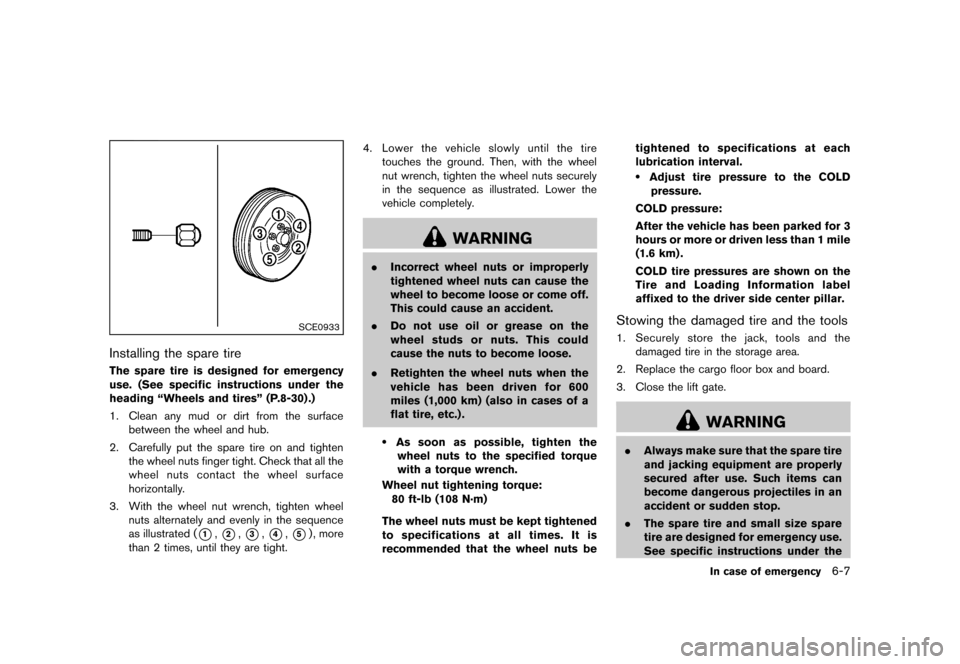
Installing the spare tireGUID-5EA972A8-ECC0-4BA2-9DA3-AA3F89474077The spare tire is designed for emergency
use. (See specific instructions under the
heading “Wheels and tires” (P.8-30) .)
1. Clean any mud or dirt from the surfacebetween the wheel and hub.
2. Carefully put the spare tire on and tighten the wheel nuts finger tight. Check that all the
wheel nuts contact the wheel surface
horizontally.
3. With the wheel nut wrench, tighten wheel nuts alternately and evenly in the sequence
as illustrated (
*1,*2,*3,*4,*5) , more
than 2 times, until they are tight. 4.
Lower the vehicle slowly until the tire
touches the ground. Then, with the wheel
nut wrench, tighten the wheel nuts securely
in the sequence as illustrated. Lower the
vehicle completely.
WARNING
.Incorrect wheel nuts or improperly
tightened wheel nuts can cause the
wheel to become loose or come off.
This could cause an accident.
. Do not use oil or grease on the
wheel studs or nuts. This could
cause the nuts to become loose.
. Retighten the wheel nuts when the
vehicle has been driven for 600
miles (1,000 km) (also in cases of a
flat tire, etc.) .
.As soon as possible, tighten the
wheel nuts to the specified torque
with a torque wrench.
Wheel nut tightening torque: 80 ft-lb (108 N·m)
The wheel nuts must be kept tightened
to specifications at all times. It is
recommended that the wheel nuts be tightened to specifications at each
lubrication interval.
.Adjust tire pressure to the COLD
pressure.
COLD pressure:
After the vehicle has been parked for 3
hours or more or driven less than 1 mile
(1.6 km) .
COLD tire pressures are shown on the
Tire and Loading Information label
affixed to the driver side center pillar.
Stowing the damaged tire and the toolsGUID-91AF6071-9A97-4265-A3F7-ED7B079600F01. Securely store the jack, tools and the
damaged tire in the storage area.
2. Replace the cargo floor box and board.
3. Close the lift gate.
WARNING
. Always make sure that the spare tire
and jacking equipment are properly
secured after use. Such items can
become dangerous projectiles in an
accident or sudden stop.
. The spare tire and small size spare
tire are designed for emergency use.
See specific instructions under the
In case of emergency6-7
Condition:
Page 291 of 347
Black plate (289,1)
[ Edit: 2012/ 6/ 29 Model: F15-D ]
GUID-B29BEC73-37B3-4C87-9A9D-EA809C865599.Keep the battery surface clean and dry.
Clean the battery with a solution of baking
soda and water.
. Make certain the terminal connections are
clean and securely tightened.
. If the vehicle is not to be used for 30 days or
longer, disconnect the negative 7battery
terminal cable to prevent discharging it.
NOTE:
Care should be taken to avoid situations
that can lead to potential battery discharge
and potential no-start conditions such as:
1. Installation or extended use of electro-
nic accessories that consume battery
power when the engine is not running
(Phone chargers, GPS, DVD players,
etc.)
2. Vehicle is not driven regularly and/or
only driven short distances.
In these cases, the battery may need to be
charged to maintain battery health.
WARNING
. Do not expose the battery to flames
or electrical sparks. Hydrogen gas
generated by the battery is explo-
sive. Do not allow battery fluid to contact your skin, eyes, fabrics or
painted surfaces. After touching a
battery or battery cap, do not touch
or rub your eyes. Thoroughly wash
your hands. If the acid contacts your
eyes, skin or clothing, immediately
flush with water for at least 15
minutes and seek medical attention.
. Do not operate the vehicle if the
fluid in the battery is low. Low
battery fluid can cause a higher load
on the battery which can generate
heat, reduce battery life, and in
some cases lead to an explosion.
. When working on or near a battery,
always wear suitable eye protection
and remove all jewelry.
. Battery posts, terminals and related
accessories contain lead and lead
compounds. Wash hands after
handling.
. Keep the battery out of the reach of
children.
DI0137MA
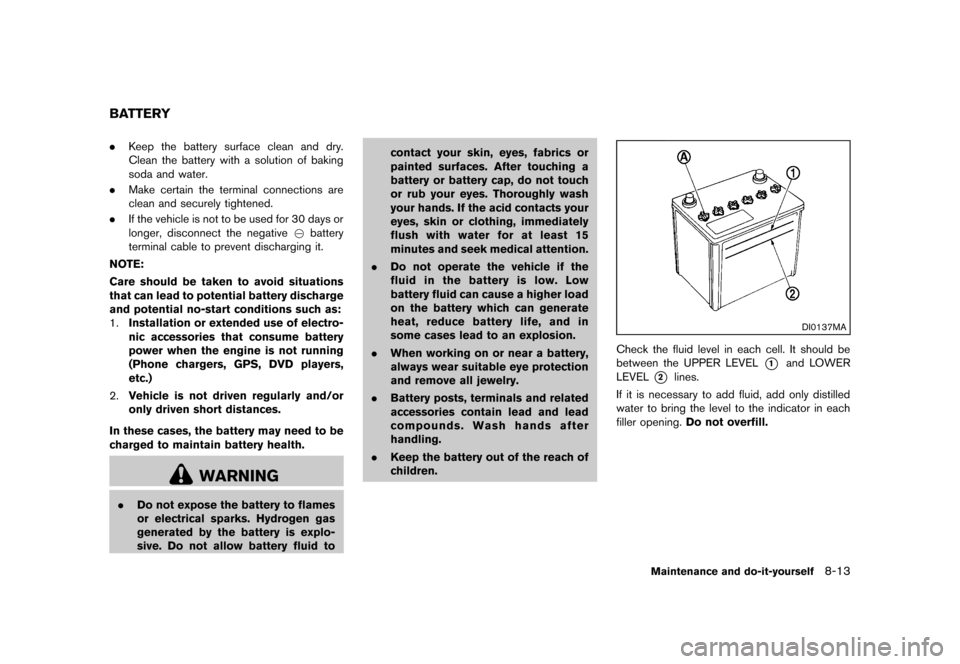
Check the fluid level in each cell. It should be
between the UPPER LEVEL
*1and LOWER
LEVEL
*2lines.
If it is necessary to add fluid, add only distilled
water to bring the level to the indicator in each
filler opening. Do not overfill.
Maintenance and do-it-yourself8-13
BATTERY
Condition:
Page 308 of 347
Black plate (306,1)
[ Edit: 2012/ 6/ 29 Model: F15-D ]
8-30Maintenance and do-it-yourself
GUID-F6BA5101-9D22-47BE-BE64-1C192428380DIf you have a flat tire, see “Flat tire” (P.6-3) .
TIRE PRESSUREGUID-98529D2F-C4E4-455A-AAA8-EA803AC65B24
Tire Pressure Monitoring System (TPMS)GUID-D6EF18B1-2442-473D-A573-60D459B74FC7This vehicle is equipped with the Tire Pressure
Monitoring System (TPMS) . It monitors tire
pressure of all tires except the spare. When
the low tire pressure warning light is lit, and the
CHECK TIRE PRES (pressure) warning mes-
sage is displayed in the vehicle information
display, one or more of your tires is significantly
under-inflated.
The TPMS will activate only when the vehicle is
driven at speeds above 16 MPH (25 km/h).
Also, this system may not detect a sudden drop
in tire pressure (for example a flat tire while
driving) .
For more details, see “Low tire pressure warning
light” (P.2-15) , “Tire Pressure Monitoring Sys-
tem (TPMS)” (P.5-4) and “Tire Pressure Mon-
itoring System (TPMS)” (P.6-3) .
Tire inflation pressureGUID-C57645B5-E413-4FCA-B110-F118428A3D6FCheck the pressure of the tires (including
the spare) often and always prior to long
distance trips. The recommended tire
pressure specifications are shown on the
Tire and Loading Information label under
the “Cold Tire Pressure” heading. The Tireand Loading Information label is affixed to
the driver side center pillar. Tire pressures
should be checked regularly because:
.Most tires naturally lose air over time.
.Tires can lose air suddenly when driven
over potholes or other objects or if the
vehicle strikes a curb while parking.
The tire pressures should be checked
when the tires are cold. The tires are
considered COLD after the vehicle has
been parked for 3 or more hours, or driven
less than 1 mile (1.6 km) at moderate
speeds.
Incorrect tire pressure, including un-
der inflation, may adversely affect tire
life and vehicle handling.
WARNING
.Improperly inflated tires can fail
suddenly and cause an accident.
.The Gross Vehicle Weight rating
(GVWR) is located on the F.M.V.
S.S./C.M.V.S.S. certification la-
bel. The vehicle weight capacity
is indicated on the Tire and Loading Information label. Do
not load your vehicle beyond
this capacity. Overloading your
vehicle may result in reduced
tire life, unsafe operating condi-
tions due to premature tire fail-
ure, or unfavorable handling
characteristics and could also
lead to a serious accident. Load-
ing beyond the specified capa-
city may also result in failure of
other vehicle components.
.Before taking a long trip, or
whenever you heavily load your
vehicle, use a tire pressure
gauge to ensure that the tire
pressures are at the specified
level.
.For additional information re-
garding tires, refer to “Important
Tire Safety Information” (US) or
“Tire Safety Information” (Cana-
da) in the Warranty Information
Booklet.
WHEELS AND TIRES
Condition:
Page 309 of 347
Black plate (307,1)
[ Edit: 2012/ 6/ 29 Model: F15-D ]
SDI2503
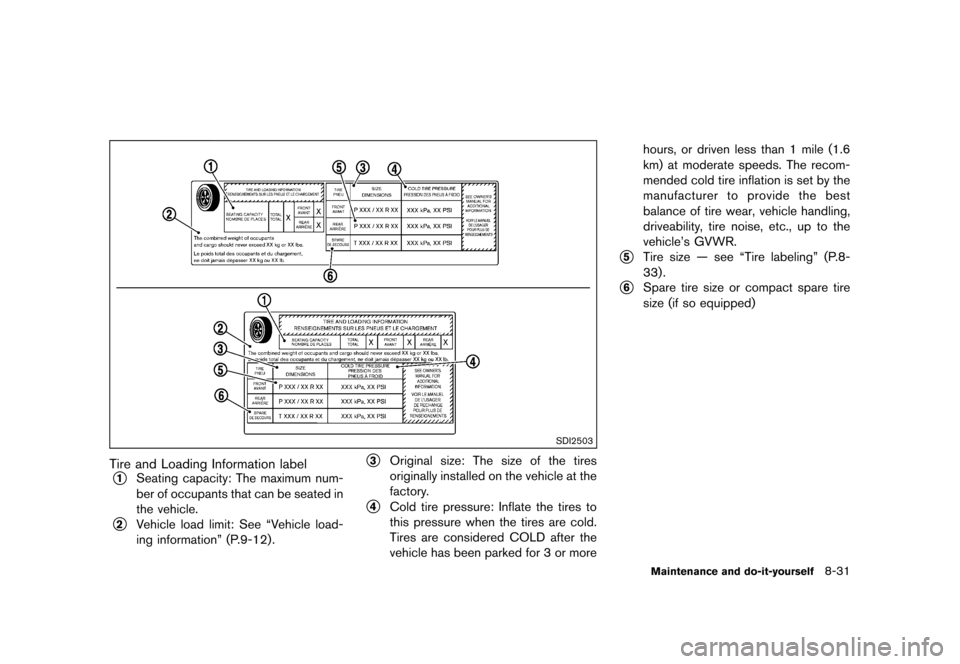
Tire and Loading Information labelGUID-FEE83069-6E19-432C-A83E-475D9C859728*1Seating capacity: The maximum num-
ber of occupants that can be seated in
the vehicle.
*2Vehicle load limit: See “Vehicle load-
ing information” (P.9-12).
*3Original size: The size of the tires
originally installed on the vehicle at the
factory.
*4Cold tire pressure: Inflate the tires to
this pressure when the tires are cold.
Tires are considered COLD after the
vehicle has been parked for 3 or morehours, or driven less than 1 mile (1.6
km) at moderate speeds. The recom-
mended cold tire inflation is set by the
manufacturer to provide the best
balance of tire wear, vehicle handling,
driveability, tire noise, etc., up to the
vehicle’s GVWR.
*5Tire size — see “Tire labeling” (P.8-
33).
*6Spare tire size or compact spare tire
size (if so equipped)
Maintenance and do-it-yourself8-31
Condition:
Page 310 of 347
Black plate (308,1)
[ Edit: 2012/ 6/ 29 Model: F15-D ]
8-32Maintenance and do-it-yourself
SDI1949
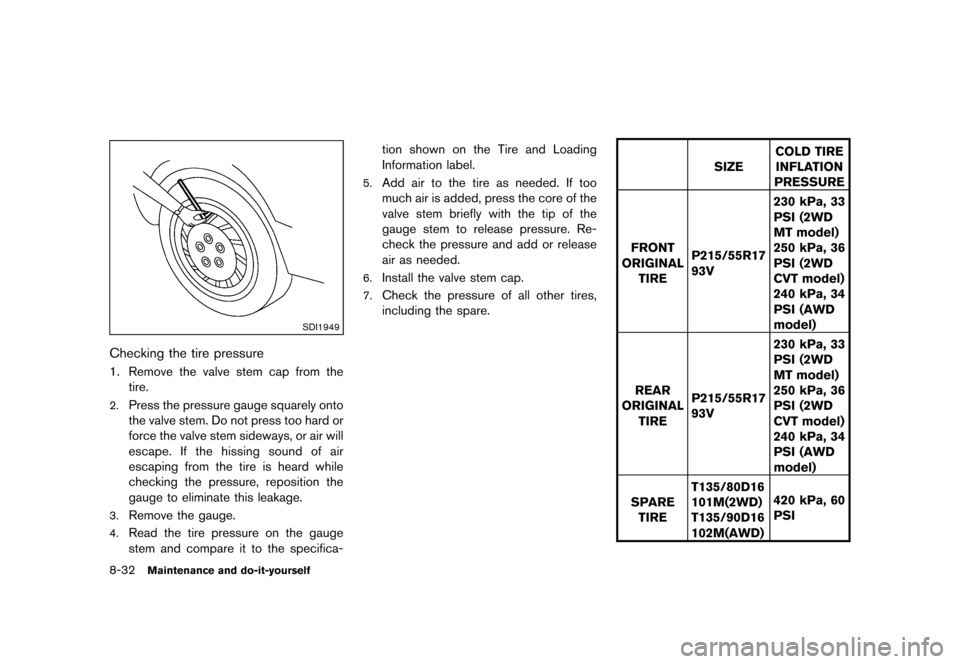
Checking the tire pressureGUID-EAF74098-BED3-48BE-BFDE-9B3D9F2414411. Remove the valve stem cap from thetire.
2.Press the pressure gauge squarely onto
the valve stem. Do not press too hard or
force the valve stem sideways, or air will
escape. If the hissing sound of air
escaping from the tire is heard while
checking the pressure, reposition the
gauge to eliminate this leakage.
3.Remove the gauge.
4.Read the tire pressure on the gauge
stem and compare it to the specifica- tion shown on the Tire and Loading
Information label.
5.Add air to the tire as needed. If too
much air is added, press the core of the
valve stem briefly with the tip of the
gauge stem to release pressure. Re-
check the pressure and add or release
air as needed.
6.Install the valve stem cap.
7.Check the pressure of all other tires,
including the spare.
SIZE
COLD TIRE
INFLATION
PRESSURE
FRONT
ORIGINAL TIRE P215/55R17
93V 230 kPa, 33
PSI (2WD
MT model)
250 kPa, 36
PSI (2WD
CVT model)
240 kPa, 34
PSI (AWD
model)
REAR
ORIGINAL TIRE P215/55R17
93V 230 kPa, 33
PSI (2WD
MT model)
250 kPa, 36
PSI (2WD
CVT model)
240 kPa, 34
PSI (AWD
model)
SPARE TIRE T135/80D16
101M(2WD)
T135/90D16
102M(AWD) 420 kPa, 60
PSI
Condition:
Page 311 of 347
Black plate (309,1)
[ Edit: 2012/ 6/ 29 Model: F15-D ]
SDI1575
Example
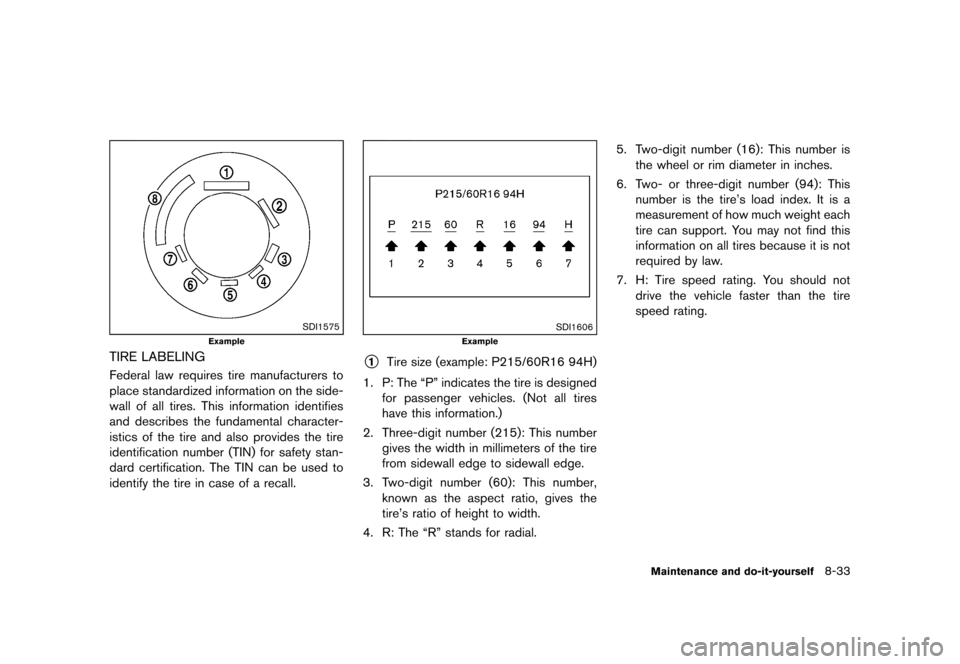
TIRE LABELINGGUID-D4646EC6-4D80-4946-8BC2-0B5C8BADB595Federal law requires tire manufacturers to
place standardized information on the side-
wall of all tires. This information identifies
and describes the fundamental character-
istics of the tire and also provides the tire
identification number (TIN) for safety stan-
dard certification. The TIN can be used to
identify the tire in case of a recall.
SDI1606
Example
*1Tire size (example: P215/60R16 94H)
1. P: The “P” indicates the tire is designed for passenger vehicles. (Not all tires
have this information.)
2. Three-digit number (215): This number gives the width in millimeters of the tire
from sidewall edge to sidewall edge.
3. Two-digit number (60): This number, known as the aspect ratio, gives the
tire’s ratio of height to width.
4. R: The “R” stands for radial. 5. Two-digit number (16): This number is
the wheel or rim diameter in inches.
6. Two- or three-digit number (94): This number is the tire’s load index. It is a
measurement of how much weight each
tire can support. You may not find this
information on all tires because it is not
required by law.
7. H: Tire speed rating. You should not drive the vehicle faster than the tire
speed rating.
Maintenance and do-it-yourself8-33
Condition: