washer fluid NISSAN JUKE 2017 F15 / 1.G User Guide
[x] Cancel search | Manufacturer: NISSAN, Model Year: 2017, Model line: JUKE, Model: NISSAN JUKE 2017 F15 / 1.GPages: 416, PDF Size: 2.62 MB
Page 300 of 416

FREEING A FROZEN DOOR LOCK
To prevent a door lock from freezing, apply
deicer through the key hole. If the lock becomes
frozen, heat the key before inserting it into the
key hole or use the Intelligent Key system.
ANTI-FREEZE
In the winter when it is anticipated that the
outside temperature will drop below 328F(08C) ,
check the anti-freeze to assure proper winter
protection. For additional information, see “En-
gine cooling system” (P.8-4) .
BATTERY
If the battery is not fully charged during
extremely cold weather conditions, the battery
fluid may freeze and damage the battery. To
maintain maximum efficiency, the battery should
be checked regularly. For additional information,
see “Battery” (P.8-10) .
DRAINING OF COOLANT WATER
If the vehicle is to be left outside without anti-
freeze, drain the cooling system, including the
engine block. Refill before operating the vehicle.
For details, see “Engine cooling system” (P.8-4) .
TIRE EQUIPMENT
SUMMER tires have a tread designed to provide
superior performance on dry pavement. How-
ever, the performance of these tires will be
substantially reduced in snowy and icy condi-
tions. If you operate your vehicle on snowy or icy
roads, NISSAN recommends the use of MUD &
SNOW or ALL SEASON tires on all four wheels.
It is recommended you consult a NISSAN dealer
for the tire type, size, speed rating and
availability information.
For additional traction on icy roads, studded
tires may be used. However, some U.S. states
and Canadian provinces prohibit their use.
Check local, state and provincial laws before
installing studded tires.
Skid and traction capabilities of studded
snow tires, on wet or dry surfaces, may be
poorer than that of non-studded snow
tires.
Tire chains may be used. For details, see “Tire
chains” (P.8-37) of this manual.
All-Wheel Drive (AWD) model
If you install snow tires, they must also be the
same size, brand, construction and tread pattern
on all four wheels.
SPECIAL WINTER EQUIPMENT
It is recommended that the following items be
carried in the vehicle during winter:
. A scraper and stiff-bristled brush to remove
ice and snow from the windows and wiper
blades.
. A sturdy, flat board to be placed under the
jack to give it firm support.
. A shovel to dig the vehicle out of snow-
drifts.
. Extra window washer fluid to refill the
reservoir tank.
DRIVING ON SNOW OR ICE
WARNING
.Wet ice (328F, 0 8C and freezing rain) ,
very cold snow or ice can be slick
and very hard to drive on. The
vehicle will have much less traction
or “grip” under these conditions. Try
to avoid driving on wet ice until the
road is salted or sanded.
. Whatever the condition, drive with
caution. Accelerate and slow down
with care. If accelerating or down-
shifting too fast, the drive wheels
will lose even more traction.
Starting and driving5-39
COLD WEATHER DRIVING
Page 326 of 416
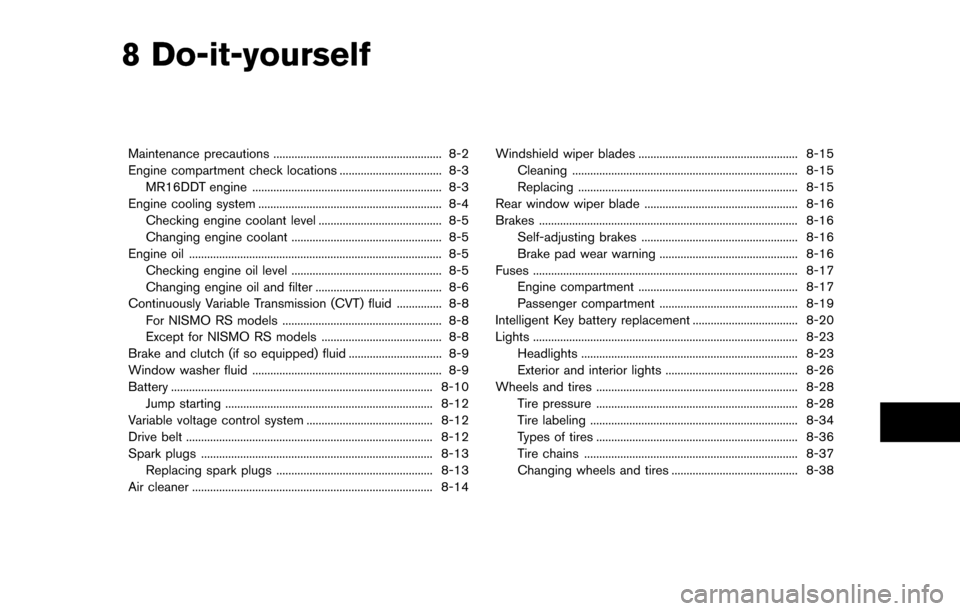
8 Do-it-yourself
Maintenance precautions ........................................................ 8-2
Engine compartment check locations .................................. 8-3MR16DDT engine ............................................................... 8-3
Engine cooling system ............................................................. 8-4 Checking engine coolant level ......................................... 8-5
Changing engine coolant .................................................. 8-5
Engine oil ........................................................................\
............ 8-5 Checking engine oil level .................................................. 8-5
Changing engine oil and filter .......................................... 8-6
Continuously Variable Transmission (CVT) fluid ............... 8-8
For NISMO RS models ..................................................... 8-8
Except for NISMO RS models ........................................ 8-8
Brake and clutch (if so equipped) fluid ............................... 8-9
Window washer fluid ............................................................... 8-9
Battery ........................................................................\
............... 8-10 Jump starting ..................................................................... 8-12
Variable voltage control system .......................................... 8-12
Drive belt ........................................................................\
.......... 8-12
Spark plugs ........................................................................\
..... 8-13 Replacing spark plugs .................................................... 8-13
Air cleaner ........................................................................\
........ 8-14 Windshield wiper blades ..................................................... 8-15
Cleaning ........................................................................\
... 8-15
Replacing ........................................................................\
. 8-15
Rear window wiper blade ................................................... 8-16
Brakes ........................................................................\
.............. 8-16 Self-adjusting brakes .................................................... 8-16
Brake pad wear warning .............................................. 8-16
Fuses ........................................................................\
................ 8-17 Engine compartment ..................................................... 8-17
Passenger compartment .............................................. 8-19
Intelligent Key battery replacement ................................... 8-20
Lights ........................................................................\
................ 8-23 Headlights ........................................................................\
8-23
Exterior and interior lights ............................................ 8-26
Wheels and tires ................................................................... 8-28 Tire pressure ................................................................... 8-28
Tire labeling ..................................................................... 8-34
Types of tires ................................................................... 8-36
Tire chains ....................................................................... 8-37
Changing wheels and tires .......................................... 8-38
Page 328 of 416

improper servicing may result in operating
difficulties or excessive emissions, and could
affect your warranty coverage.If in doubt
about any servicing, it is recommended
you have it done by a NISSAN dealer.
JVC0747X
MR16DDT ENGINE
1. Engine oil filler cap
2. Radiator filler cap
3. Brake and clutch* fluid reservoir
4. Air cleaner
5. Window washer fluid reservoir
6. Engine drive belt location 7. Engine oil dipstick
8. Engine coolant reservoir
9. Fuse/fusible link holder
10. Battery
*: for Manual Transmission (MT) models
Do-it-yourself8-3
ENGINE COMPARTMENT CHECK
LOCATIONS
Page 332 of 416

SDI2651
1. Oil filler cap
2. Oil drain plug
3. Oil filter
Engine oil and filter
1. Place a large drain pan under the drain plug.
2. Remove the oil filler cap.
3. Remove the drain plug with a wrench andcompletely drain the oil.
CAUTION
Be careful not to burn yourself, as the
engine oil is hot.
.Waste oil must be disposed of
properly.
.Check your local regulations.
(Perform steps 4 to 7 only when the engine
oil filter change is needed.)
4. Loosen the oil filter with an oil filter wrench. Remove the oil filter by turning it by hand.
5. Wipe the engine oil filter mounting surface with a clean rag.
CAUTION
Be sure to remove any old gasket
material remaining on the mounting
surface of the engine. Failure to do so
could lead to engine damage.
6. Coat the gasket on the new filter with clean engine oil.
7. Screw in the oil filter clockwise until a slight resistance is felt, then tighten additionally
more than 2/3 turn.
Oil filter tightening torque:11 to 15 ft-lb
(14.7 to 20.5 N·m)
8. Clean and re-install the drain plug with a new washer. Securely tighten the drain plug
with a wrench. Drain plug tightening torque:
22 to 29 ft-lb
(29 to 39 N·m)
Do not use excessive force.
9. Refill the engine with the recommended oil through the oil filler opening, and install the
oil filler cap securely.
See “Capacities and recommended fluids/
lubricants” (P.10-2) for drain and refill
capacity. The drain and refill capacity
depends on the oil temperature and drain
time. Use these specifications for reference
only. Always use the dipstick to determine
the proper amount of oil in the engine.
10. Start the engine and check for leakage around the drain plug and the oil filter.
Correct as required.
11. Turn the engine off and wait more than 10 minutes. Check the oil level with the dipstick.
Add engine oil if necessary.
After the operation
1. Lower the vehicle carefully to the ground.
2. Dispose of waste oil and filter properly.
Do-it-yourself8-7
Page 334 of 416

For additional brake and clutch fluid information,
see “Capacities and recommended fluids/lubri-
cants” (P.10-2) of this manual.
WARNING
.Use only new fluid from a sealed
container. Old, inferior or contami-
nated fluid may damage the brake
and clutch systems. The use of
improper fluids can damage the
brake and clutch systems, and affect
the vehicle’s stopping ability.
. Clean the filler cap before removing.
. Brake and clutch fluid is poisonous
and should be stored carefully in
marked containers out of the reach
of children.
CAUTION
Do not spill the fluid on any painted
surfaces. This will damage the paint. If
fluid is spilled, immediately wash the
surface with water.
SDI2655
Check the fluid level in the reservoir. If the fluid is
below the MIN line
*2or the brake warning
light comes on, add Genuine NISSAN Super
Heavy Duty Brake Fluid or equivalent DOT 3
fluid up to the MAX line
*1. If fluid must be
added frequently, the system should be
checked. It is recommended you visit a NISSAN
dealer for this service.
SDI2429
To fill the window washer fluid reservoir, lift the
cap and pour the window washer fluid into the
reservoir opening.
Add a washer solvent to the washer for better
cleaning. In the winter season, add a windshield
washer antifreeze. Follow the manufacturer’s
instructions for the mixture ratio.
Fill the window washer fluid reservoir periodi-
cally.
Add fluid when the low washer fluid warning
light illuminates (if so equipped) .
Do-it-yourself8-9
BRAKE AND CLUTCH (if so
equipped) FLUID WINDOW WASHER FLUID
Page 335 of 416

8-10Do-it-yourself
To check the fluid level, use your finger to plug
the center hole
*1of the cap/tube assembly,
then remove it from the reservoir. If there is no
fluid in the tube, add fluid.
Refill the reservoir more frequently when driving
conditions require an increased amount of
window washer fluid.
Recommended fluid:
Genuine NISSAN Windshield Washer Concen-
trate Cleaner & Antifreeze or equivalent
CAUTION
. Do not substitute engine anti-freeze
coolant for window washer solution.
This may result in damage to the
paint.
. Do not fill the window washer
reservoir tank with washer fluid
concentrates at full strength. Some
methyl alcohol based washer fluid
concentrates may permanently stain
the grille if spilled while filling the
window washer reservoir tank.
. Pre-mix washer fluid concentrates
with water to the manufacturer’s
recommended levels before pouring
the fluid into the window washer reservoir tank. Do not use the
window washer reservoir tank to
mix the washer fluid concentrate
and water.
.
Keep the battery surface clean and dry.
Clean the battery with a solution of baking
soda and water.
. Make certain the terminal connections are
clean and securely tightened.
. If the vehicle is not to be used for 30 days or
longer, disconnect the negative 7battery
terminal cable to prevent discharging it.
NOTE:
Care should be taken to avoid situations
that can lead to potential battery discharge
and potential no-start conditions such as:
1. Installation or extended use of electro-
nic accessories that consume battery
power when the engine is not running
(Phone chargers, GPS, DVD players,
etc.)
2. Vehicle is not driven regularly and/or
only driven short distances.
In these cases, the battery may need to be
charged to maintain battery health.
WARNING
. Do not expose the battery to flames
or electrical sparks. Hydrogen gas
generated by the battery is explo-
sive. Do not allow battery fluid to
BATTERY
Page 371 of 416

9-4Maintenance and schedules
hard steering or strange noises.
Warning lights and chimes:Make sure that
all warning lights and chimes are operating
properly.
Windshield defroster: Check that the air
comes out of the defroster outlets properly and
in sufficient quantity when operating the heater
or air conditioner.
Windshield wiper and washer*: Check that
the wipers and washers operate properly and
that the wipers do not streak.
Under the hood and vehicle
The maintenance items listed here should be
checked periodically (for example, each time you
check the engine oil or refuel) .
Battery*: Check the fluid level in each cell.
It should be between the MAX and MIN lines.
Vehicles operated in high temperatures or under
severe condition require frequent checks of the
battery fluid level.
NOTE:
Care should be taken to avoid situations
that can lead to potential battery discharge
and potential no-start conditions such as:
1. Installation or extended use of electro-
nic accessories that consume battery
power when the engine is not running (Phone chargers, GPS, DVD players,
etc.)
2. Vehicle is not driven regularly and/or
only driven short distances.
In these cases, the battery may need to be
charged to maintain battery health.
Brake and clutch fluid level*: Make sure that
the brake and clutch fluid level is between the
MAX and MIN lines on the reservoir.
Engine coolant level*: Check the coolant level
when the engine is cold.
Engine drive belt*: Make sure that the drive
belt is not frayed, worn, cracked or oily.
Engine oil level*: Check the level after parking
the vehicle on a level surface and turning off the
engine. Wait more than 10 minutes for the oil to
drain back into the oil pan.
Exhaust system: Make sure there are no loose
supports, cracks or holes. If the sound of the
exhaust seems unusual or there is a smell of
exhaust fumes, immediately have the exhaust
system inspected. It is recommended you visit a
NISSAN dealer for this service. (See “Precau-
tions when starting and driving” (P.5-2) for
exhaust gas (carbon monoxide) .)
Fluid leaks: Check under the vehicle for fuel,
oil, water or other fluid leaks after the vehicle has
been parked for a while. Water dripping from the air conditioner after use is normal. If you should
notice any leaks or if gasoline fumes are evident,
check for the cause and have it corrected
immediately.
Radiator and hoses:
Check the front of the
radiator and clean off any dirt, insects, leaves,
etc., that may have accumulated. Make sure the
hoses have no cracks, deformation, rot or loose
connections.
Underbody: The underbody is frequently ex-
posed to corrosive substances such as those
used on icy roads or to control dust. It is very
important to remove these substances, other-
wise rust will form on the floor pan, frame, fuel
lines and around the exhaust system. At the end
of winter, the underbody should be thoroughly
flushed with plain water, being careful to clean
those areas where mud and dirt may accumu-
late. For additional information, see “Cleaning
exterior” (P.7-2).
Windshield washer fluid*: Check that there is
adequate fluid in the reservoir.
Page 388 of 416

Fluid typeCapacity (Approximate)
Recommended Fluids/Lubricants
Metric
Measure US
Measure Imperial
Measure
Manual Transmission (MT) gear oil — — — For NISMO RS models
ÂGenuine NISSAN Manual Transmission Fluid (MTF) HQ Multi 75W-85 or equivalent
 If Genuine NISSAN Manual Transmission Fluid (MTF) HQ Multi is not available, API GL-4,
Viscosity SAE 75W-85 may be used as a temporary replacement. However, use Genuine
NISSAN Manual Transmission Fluid (MTF) HQ Multi as soon as it is available.
Except for NISMO RS models
ÂGenuine NISSAN Manual Transmission Fluid (MTF) TL/JR Type 75W-80 or equivalent
 If Genuine NISSAN Manual Transmission Fluid (MTF) TL/JR Type is not available, API GL-4+,
Viscosity SAE 75W-80 may be used as a temporary replacement. However, use Genuine
NISSAN Manual Transmission Fluid (MTF) TL/JR Type as soon as it is available.
Differential gear oil — — —ÂGenuine NISSAN Differential Oil Hypoid Super GL-5 80W-90 or equivalent conventional
(non-synthetic) oil
Transfer fluid — — —
Brake and clutch fluid Refill to the proper oil level according
to the instructions in the “8. Do-it-
yourself” section. Â
Genuine NISSAN Super Heavy Duty Brake Fluid
*6or equivalent DOT 3*6: Available in mainland U.S.A. through a NISSAN dealer.
Multi-purpose grease — — —ÂNLGI No. 2 (Lithium soap base)
Air conditioning system refrigerant — — —ÂFor additional information, see “Vehicle identification” (P.10-11) for air conditioner
specification label.
 HFC-134a (R-134a)
Air conditioning system lubricants — — —ÂNISSAN A/C System Oil Type R or exact equivalent
Window washer fluid 4.5 1-1/4 gal 1 galÂGenuine NISSAN Windshield Washer Concentrate Cleaner & Antifreeze or equivalent
Technical and consumer information10-3
Page 409 of 416

11-2
Corrosion protection .................................................... 7-7
Cover, Cargo cover ................................................... 2-49
Cruise control .............................................................. 5-26
Cup holders ................................................................. 2-47
CVT, Driving with CVT (Continuously
Variable Transmission) .............................................. 5-14
D
Daytime running light system .................................. 2-42
Defroster switch, Rear window and outside
mirror defroster switch .............................................. 2-38
Dimensions and weights ....................................... 10-10
Displaying Climate control ....................................... 4-34
Door open warning light ........................................... 2-17
Drive belt ...................................................................... 8-12
DrivingAll-wheel drive (AWD) ....................................... 5-29
Cold weather driving .......................................... 5-39
Driving with CVT (Continuously
Variable Transmission) ....................................... 5-14
Driving with manual transmission .................... 5-19
Precautions when starting and driving ............. 5-2
Safety precautions ................................................. 5-7
E
Economy, Fuel ............................................................. 5-29
Elapsed time .................................................... 2-13, 2-30
Electric power steering ............................................. 5-34
Electric power steering warning light .................... 2-17
Emission control information label ...................... 10-12
Emission control system maintenance .................... 9-8
Emission control system warranty ....................... 10-20
EngineBefore starting the engine ................................ 5-12
Break-in schedule ................................................ 5-27 Capacities and
recommended fluids/lubricants ........................ 10-2
Changing engine coolant ..................................... 8-5
Changing engine oil and filter ............................. 8-6
Checking engine coolant level ............................ 8-5
Checking engine oil level ..................................... 8-5
Coolant temperature gauge .............................. 2-10
Emergency engine shut off ...................... 5-11, 6-3
Engine block heater ............................................ 5-40
Engine compartment check locations ............... 8-3
Engine cooling system .......................................... 8-4
Engine oil .................................................................. 8-5
Engine oil and oil filter recommendation ....... 10-7
Engine oil viscosity .............................................. 10-8
Engine serial number ........................................ 10-11
Engine specifications .......................................... 10-9
High temperature warning light ....................... 2-18
If your vehicle overheats .................................... 6-11
Starting the engine ............................................. 5-13
Event Data Recorders (EDR) ............................... 10-22
Exhaust gas (carbon monoxide) ............................... 5-2
Explanation of scheduled maintenance items ....... 9-5
Extended storage fuse warning ................................ 2-9
F
F.M.V.S.S./C.M.V.S.S. certification label ............ 10-12
Filter Air cleaner housing filter .................................... 8-14
Changing engine oil and filter ............................. 8-6
Flashers (See hazard warning flasher switch) ...... 6-2
Flat tire ............................................................................ 6-3
Flat towing ................................................................. 10-18
Floor mat cleaning ........................................................ 7-5
Fluid Brake and clutch fluid ........................................... 8-9 Capacities and
recommended fluids/lubricants ........................ 10-2
Continuously Variable Transmission
(CVT) fluid ................................................................ 8-8
Engine coolant ........................................................ 8-4
Engine oil .................................................................. 8-5
Window washer fluid ............................................. 8-9
FM-AM radio with Compact Disc (CD) player .... 4-45
FM-AM-SAT radio with Compact Disc (CD)
player (Type A) ............................................................ 4-53
FM-AM-SAT radio with Compact Disc (CD)
player (Type B) ............................................................ 4-62
Fog light switch .......................................................... 2-44
Front manual seat adjustment ................................... 1-3
Front passenger air bag and status light ............. 1-46
Front seat, Front seat adjustment ............................ 1-3
Front-seat active head restraints .............................. 1-9
Fuel Capacities and
recommended fluids/lubricants ........................ 10-2
Distance to empty ............................................... 2-13
Fuel economy ....................................................... 5-29
Fuel information .................................................... 10-4
Fuel octane rating ............................................... 10-4
Fuel-filler cap ........................................................ 3-18
Fuel-filler door ...................................................... 3-18
Gauge ..................................................................... 2-11
Fuel Efficient Driving Tips ........................................ 5-28
Fuses ............................................................................. 8-17
Fusible links ................................................................. 8-18
G
Gas cap ........................................................................ 3-18
Gauge .............................................................................. 2-5 Engine coolant temperature gauge ................ 2-10
Fuel gauge ............................................................ 2-11
Page 411 of 416

11-4
Inside the vehicle .................................................... 9-3
Maintenance log .................................................. 9-15
Maintenance precautions ..................................... 8-2
Maintenance requirements ................................... 9-2
Maintenance schedules ........................................ 9-7
Maintenance under severe
driving conditions ................................................ 9-14
Outside the vehicle ................................................ 9-2
Seat belt maintenance ....................................... 1-15
Standard maintenance .......................................... 9-7
Maintenance schedules .............................................. 9-7
Making a call ................................................................ 4-92
Malfunction indicator light (MIL) ............................. 2-22
Manual air conditioner ............................................... 4-29
Manual front seat adjustment .................................... 1-3
Map lights ..................................................................... 2-54
Mechanical key (Intelligent Key system) ................. 3-3
Meter Trip computer ....................................................... 2-13
Meters and gauges ...................................................... 2-5 Instrument brightness control ........................... 2-43
Mirror Inside mirror .......................................................... 3-21
Outside mirrors .................................................... 3-22
Vanity mirror .......................................................... 3-23
Monitor, RearView Monitor ........................................ 4-8
Moonroof ...................................................................... 2-52
Moving Object Detection (MOD) ........................... 4-24
N
Navigation system voice commands ..................... 4-99
New vehicle break-in ................................................. 5-27
NISSAN Vehicle Immobilizer System .................... 2-34
NISSAN Voice Recognition System ...................... 4-96
NissanConnect App smartphone integration ...... 4-75
O
Odometer ....................................................................... 2-7
Off-road recovery ......................................................... 5-6
Oil Capacities and
recommended fluids/lubricants ........................ 10-2
Changing engine oil and filter ............................. 8-6
Checking engine oil level ..................................... 8-5
Engine oil .................................................................. 8-5
Engine oil viscosity .............................................. 10-8
One Shot Call ............................................................. 4-91
Outside air temperature display.............................. 2-12
Outside mirrors ........................................................... 3-22
Overheat, If your vehicle overheats ....................... 6-11
Owner’s Manual/Service Manual
order information ...................................................... 10-22
P
Panic alarm .................................................................. 3-13
Parking Brake break-in ...................................................... 5-35
Parking brake operation ..................................... 5-25
Parking on hills ..................................................... 5-33
Phone Car phone or CB radio ...................................... 4-80
Phone settings ............................................................ 4-96
Power Electric power steering ...................................... 5-34
Moonroof ............................................................... 2-52
Power door lock ..................................................... 3-4
Power outlet .......................................................... 2-46
Power windows .................................................... 2-50
Precautions Audio operation .................................................... 4-35
Braking precautions ............................................ 5-35 Child restraints ..................................................... 1-19
Cruise control ....................................................... 5-26
Driving safety ........................................................... 5-7
Maintenance ............................................................. 8-2
Seat belt usage .................................................... 1-10
Supplemental restraint system ......................... 1-38
When starting and driving .................................... 5-2
Push starting ................................................................ 6-11
Push-button ignition switch ............................ 5-9, 5-10
R
Radio ............................................................................. 4-35 Car phone or CB radio ...................................... 4-80
Steering wheel audio controls ......................... 4-73
Rapid air pressure loss ............................................... 5-6
Readiness for inspection/maintenance
(I/M) test .................................................................... 10-21
Rear door lock, Child safety rear door lock .......... 3-6
Rear seats ...................................................................... 1-4
Rear window and outside mirror
defroster switch .......................................................... 2-38
Rear window wiper and washer switch ............... 2-37
RearView Monitor ......................................................... 4-8
Recorders, Event data ............................................ 10-22
Registering in another country ............................. 10-10
Registering with NissanConnect App ................... 4-75
Remote keyless entry function, For Intelligent
Key system ................................................................... 3-12
Reporting safety defects ....................................... 10-20
Roadside assistance program ................................... 6-2
Rollover ........................................................................... 5-6
Roof, Moonroof ........................................................... 2-53