tow NISSAN KICKS 2020 Owner´s Manual
[x] Cancel search | Manufacturer: NISSAN, Model Year: 2020, Model line: KICKS, Model: NISSAN KICKS 2020Pages: 500, PDF Size: 3.43 MB
Page 447 of 500
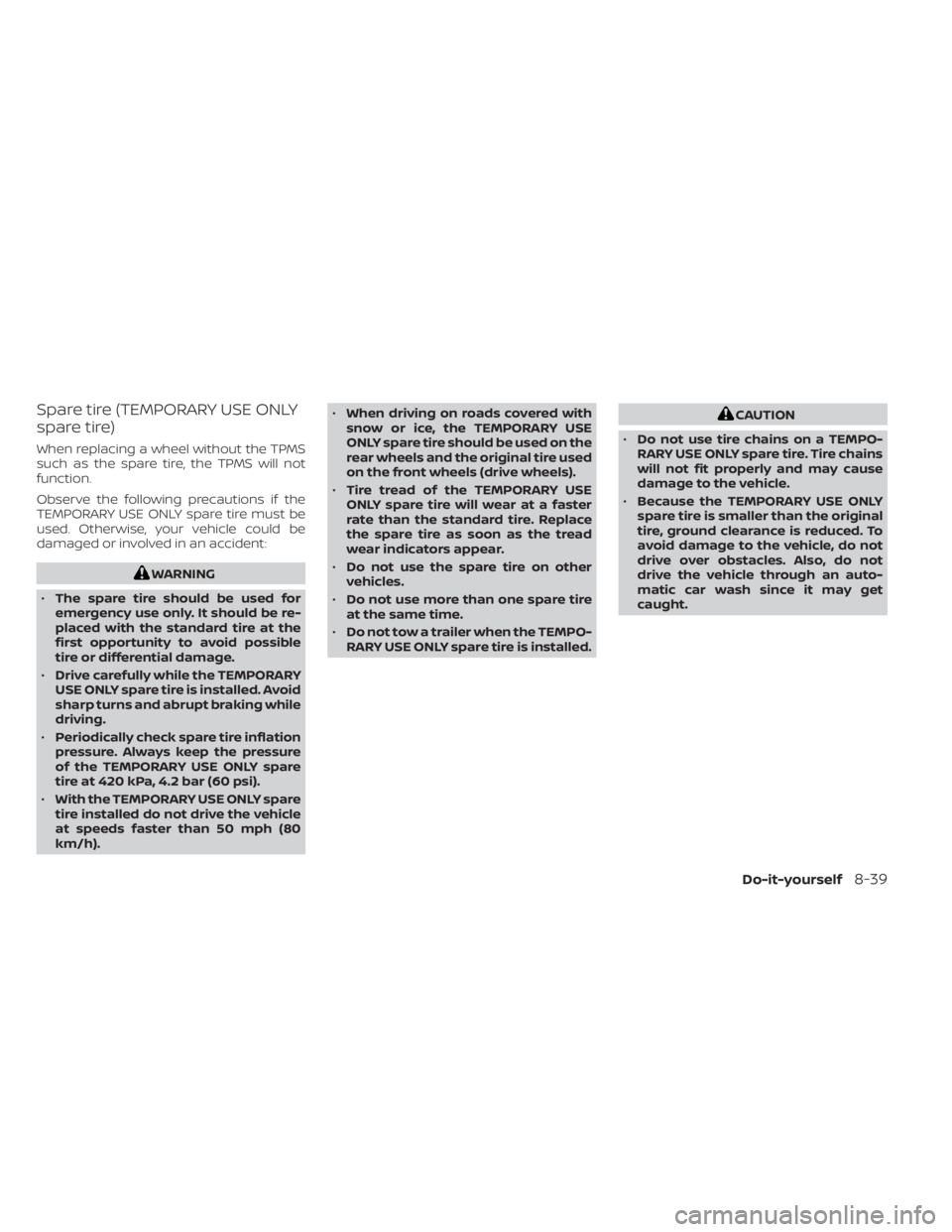
Spare tire (TEMPORARY USE ONLY
spare tire)
When replacing a wheel without the TPMS
such as the spare tire, the TPMS will not
function.
Observe the following precautions if the
TEMPORARY USE ONLY spare tire must be
used. Otherwise, your vehicle could be
damaged or involved in an accident:
WARNING
• The spare tire should be used for
emergency use only. It should be re-
placed with the standard tire at the
first opportunity to avoid possible
tire or differential damage.
• Drive carefully while the TEMPORARY
USE ONLY spare tire is installed. Avoid
sharp turns and abrupt braking while
driving.
• Periodically check spare tire inflation
pressure. Always keep the pressure
of the TEMPORARY USE ONLY spare
tire at 420 kPa, 4.2 bar (60 psi).
• With the TEMPORARY USE ONLY spare
tire installed do not drive the vehicle
at speeds faster than 50 mph (80
km/h). •
When driving on roads covered with
snow or ice, the TEMPORARY USE
ONLY spare tire should be used on the
rear wheels and the original tire used
on the front wheels (drive wheels).
• Tire tread of the TEMPORARY USE
ONLY spare tire will wear at a faster
rate than the standard tire. Replace
the spare tire as soon as the tread
wear indicators appear.
• Do not use the spare tire on other
vehicles.
• Do not use more than one spare tire
at the same time.
• Do not tow a trailer when the TEMPO-
RARY USE ONLY spare tire is installed.
CAUTION
• Do not use tire chains on a TEMPO-
RARY USE ONLY spare tire. Tire chains
will not fit properly and may cause
damage to the vehicle.
• Because the TEMPORARY USE ONLY
spare tire is smaller than the original
tire, ground clearance is reduced. To
avoid damage to the vehicle, do not
drive over obstacles. Also, do not
drive the vehicle through an auto-
matic car wash since it may get
caught.
Do-it-yourself8-39
Page 463 of 500
10 Technical and consumer information
Recommended fluids/lubricants and
capacities...................................... 10-2
Fuel recommendation ......................10-3
Engine oil and oil filter
recommendations .......................... 10-6
Air conditioner system refrigerant and
oil recommendations ....................... 10-7
Specifications .................................. 10-8
Engine ...................................... 10-8
Wheels and tires ............................ 10-8
Dimensions and weights ....................10-9
When traveling or registering in another
country ....................................... 10-10
Vehicle identification .......................... 10-10
Vehicle Identification Number (VIN)
plate ....................................... 10-10
Vehicle identification number
(chassis number) ........................... 10-10
Engine serial number .......................10-11
F.M.V.S.S./C.M.V.S.S. certification label .........10-11
Emission control information label ..........10-11 Tire and Loading Information label
.........10-12
Air conditioner specification label ..........10-12
Installing front license plate ...................10-12
Vehicle loading information ...................10-13
Terms ...................................... 10-13
Vehicle load capacity ....................... 10-14
Securing the load .......................... 10-15
Loading tips ................................ 10-16
Measurement of weights ...................10-16
Towing a trailer ................................ 10-17
Flat towing ................................. 10-17
Uniform tire quality grading ...................10-18
Emission control system warranty ............10-19
Reporting safety defects ......................10-19
Readiness for Inspection/Maintenance (I/M)
test ........................................... 10-20
Event Data Recorders (EDR) ...................10-20
Owner's Manual/Service Manual order
information ................................... 10-21
Page 466 of 500
Gasoline specifications
NISSAN recommends using gasoline that
meets the World-Wide Fuel Charter (WWFC)
specifications where it is available. Many of
the automobile manufacturers developed
this specification to improve emission con-
trol system and vehicle performance. Ask
your service station manager if the gaso-
line meets the WWFC specifications.
Reformulated gasoline
Some fuel suppliers are now producing re-
formulated gasolines. These gasolines are
specially designed to reduce vehicle emis-
sions. NISSAN supports efforts towards
cleaner air and suggests that you use re-
formulated gasoline when available.
Gasoline containing oxygenates
Some fuel suppliers sell gasoline contain-
ing oxygenates such as ethanol, Methyl
Tert-butyl Ether (MTBE) and methanol with
or without advertising their presence.
NISSAN does not recommend the use of
fuels of which the oxygenate content and
the fuel compatibility for your NISSAN can-
not be readily determined. If in doubt, ask
your service station manager.If you use oxygenate-blend gasoline,
please take the following precautions as
the usage of such fuels may cause vehicle
performance problems and/or fuel system
damage.
•
The fuel should be unleaded and have
an octane rating no lower than that
recommended for unleaded gasoline.
• If an oxygenate-blend other than
methanol blend is used, it should con-
tain no more than 15% oxygenate.
• If a methanol blend is used, it should
contain no more than 5% methanol
(methyl alcohol, wood alcohol). It
should also contain a suitable amount
of appropriate cosolvents and corro-
sion inhibitors. If not properly formu-
lated with appropriate cosolvents and
corrosion inhibitors, such methanol
blends may cause fuel system damage
and/or vehicle performance problems.
At this time, sufficient data is not avail-
able to ensure that all methanol blends
are suitable for use in NISSAN vehicles.
If any driveability problems such as engine
stalling and difficult hot-starting are expe-
rienced af ter using oxygenate-blend fuels,
immediately change to a non-oxygenate
fuel or a fuel with a low blend of MTBE. Take care not to spill gasoline during re-
fueling. Gasoline containing oxygenates
can cause paint damage.
E–15 fuel
E-15 fuel is a mixture of approximately 15%
fuel ethanol and 85% unleaded gasoline.
E-15 can only be used in vehicles designed
to run on E-15 fuel. U.S. government regula-
tions require fuel ethanol dispensing
pumps to be identified with small, square,
orange and black label with the common
abbreviation or the appropriate percent-
age for that region.
E–85 fuel
E-85 fuel is a mixture of approximately 85%
fuel ethanol and 15% unleaded gasoline.
E-85 can only be used in a Flexible Fuel
Vehicle (FFV). Do not use E-85 in your ve-
hicle. U.S. government regulations require
fuel ethanol dispensing pumps to be iden-
tified by a small, square, orange and black
label with the common abbreviation or the
appropriate percentage for that region.
10-4Technical and consumer information
Page 475 of 500
WARNING
• It is extremely dangerous to
ride in a cargo area inside a ve-
hicle. In a collision, people rid-
ing in these areas are more
likely to be seriously injured or
killed.
• Do not allow people to ride in
any area of your vehicle that is
not equipped with seats and
seat belts.
• Be sure everyone in your ve-
hicle is in a seat and using a
seat belt properly.
TERMS
It is important to familiarize yourself
with the following terms before
loading your vehicle: • Curb Weight (actual weight of your
vehicle) - vehicle weight including:
standard parts, fluids, emergency
tools, and spare tire assembly. This
weight does not include passen-
gers and cargo.
• GVW (Gross Vehicle Weight) - curb weight plus the combined weight
of passengers and cargo.
• GVWR (Gross Vehicle Weight Rat- ing) - maximum total combined
weight of the unloaded vehicle,
passengers, luggage, hitch, trailer
tongue load and any other op-
tional equipment. This information
is located on the F.M.V.S.S. certifica-
tion label.
• GAWR (Gross Axle Weight Rating) - maximum weight (load) limit
specified for the front or rear axle.
This information is located on the
F.M.V.S.S. certification label. • GCWR (Gross Combined Weight
rating) - The maximum total
weight rating of the vehicle, pas-
sengers, cargo, and trailer.
• Vehicle Capacity Weight, Load limit, Total load capacity - maximum to-
tal weight limit specified of the load
(passengers and cargo) for the ve-
hicle. This is the maximum com-
bined weight of occupants and
cargo that can be loaded into the
vehicle. If the vehicle is used to tow
a trailer, the trailer tongue weight
must be included as part of the
cargo load. This information is lo-
cated on the Tire and Loading In-
formation label.
• Cargo capacity - permissible weight of cargo, the subtracted
weight of occupants from the load
limit.
VEHICLE LOADING INFORMATION
Technical and consumer information10-13
Page 479 of 500
ratings are given on the vehicle cer-
tification label. If weight ratings are
exceeded, move or remove items to
bring all weights below the ratings.Do not tow a trailer with your vehicle.
FLAT TOWING
Towing your vehicle with all four wheels on
the ground is sometimes called flat towing.
This method is sometimes used when
towing a vehicle behind a recreational ve-
hicle, such as a motor home.
CAUTION
• Failure to follow these guidelines can
result in severe transmission
damage.
• Whenever flat towing your vehicle,
always tow forward, never backward.
• Never tow your front wheel drive ve-
hicle with the front tires on the
ground. Doing so may cause serious
and expensive damage to the
powertrain.
• DO NOT tow any continuously vari-
able transmission vehicle with all
four wheels on the ground (flat tow-
ing). Doing so WILL DAMAGE internal
transmission parts due to lack of
transmission lubrication. •
For emergency towing procedures
refer to “Towing recommended by
NISSAN” in the “In case of emer-
gency ” section of this manual.
Continuously Variable
Transmission
To tow a vehicle equipped with a continu-
ously variable transmission, an appropriate
vehicle dolly MUSTbe placed under the
towed vehicle's drive wheels. Alwaysfollow
the dolly manufacturer's recommenda-
tions when using their product.
TOWING A TRAILER
Technical and consumer information10-17
Page 491 of 500
Turn signal switch.............2-51
T
Tachometer...................2-7Thef t (NISSAN Anti-Thef t System), engine
start....................2-39, 5-14Thef t (NISSAN Vehicle Immobilizer System),
engine start...............2-40, 5-14Three-way catalyst...............5-4Tire
Flat tire................. .6-3, 6-4Spare tire...............6-5, 8-39Tire and Loading Information label. .10-12Tire chains.................8-35Tire pressure................8-28Tire rotation.................8-36Types of tires................8-34Uniform tire quality grading.......10-18Wheels and tires..........8-28,10-9Wheel/tire size...............10-9Tire pressure
Low tire pressure warning light.....2-15Tire Pressure Monitoring System (TPMS). .5-5Top tether strap child restraint.......1-25Towing4-wheel drive models...........6-13Flat towing................ .10-17Trailer towing................10-17Towing a trailer................10-17Towing your vehicle..............6-12
Transmission
Continuously Variable Transmission (CVT)
fluid
..................... .8-9Driving with Continuously Variable
Transmission (CVT).............5-17Travel (See registering a vehicle in another
country)....................10-10Trip odometer...............2-5, 2-6Trunk light....................2-73Turn signal switch...............2-51
U
Uniform tire quality grading........10-18USB/iPod® Charging Ports.........4-63USB (Universal Serial Bus) Connection Port
(models without Navigation System). . .4-54
V
Vanity mirror..................3-27Variable voltage control system......8-14Vehicle dimensions and weights......10-9Vehicle Dynamic Control (VDC) OFF
switch..................... .2-55Vehicle Dynamic Control (VDC)
system.....................5-100Vehicle identification............10-10Vehicle identification number (VIN). . . .10-10Vehicle identification number (VIN)
(Chassis number)..............10-10Vehicle identification number (VIN)
plate......................10-10
Vehicle immobilizer system.....2-40, 5-14Vehicle information display.........2-23Vehicle loading information........10-13Vehicle recovery................6-14Vehicle security system...........2-38Vehicle security system
(NISSAN Anti-Thef t System),
engine start
...............2-39, 5-14Vehicle security system (NISSAN Vehicle
Immobilizer System), engine
start
....................2-40, 5-14Vents..................... .4-32Visors......................3-27Voice Prompt Interrupt............4-70
W
Warning
Air bag warning light........1-62, 2-18Battery charge warning light......2-13Brake warning light............2-13Door open warning light.........2-14Engine oil pressure warning light. . . .2-14Hazard warning flasher switch......6-2Low fuel warning light. . . .2-15, 2-16, 2-33Low tire pressure warning light.....2-15Low windshield-washer fluid warning
light......................2-16Passenger air bag and status light. . .1-51Seat belt warning light.......1-13,2-18Supplemental air bag warning
light.................. .1-62, 2-18Vehicle security system.........2-38
Index11-7