air condition NISSAN KICKS 2020 Owner´s Manual
[x] Cancel search | Manufacturer: NISSAN, Model Year: 2020, Model line: KICKS, Model: NISSAN KICKS 2020Pages: 500, PDF Size: 3.43 MB
Page 422 of 500
CAUTION
• Do not ground accessories directly to
the battery terminal. Doing so will
bypass the variable voltage control
system and the vehicle battery may
not charge completely.
• Use electrical accessories with the
engine running to avoid discharging
the vehicle battery. Your vehicle is equipped with a variable
voltage control system. This system mea-
sures the amount of electrical discharge
from the battery and controls voltage gen-
erated by the generator.
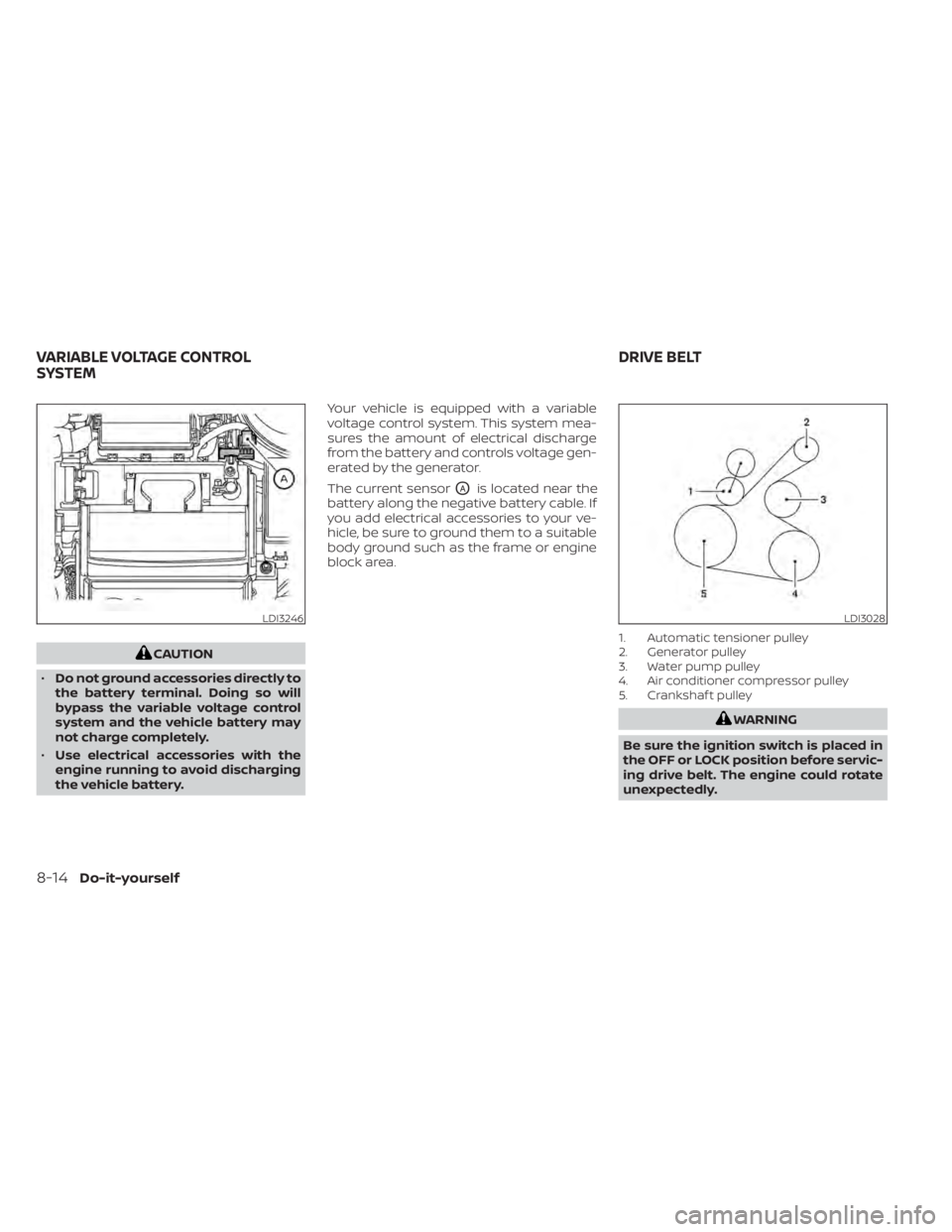
The current sensor
OAis located near the
battery along the negative battery cable. If
you add electrical accessories to your ve-
hicle, be sure to ground them to a suitable
body ground such as the frame or engine
block area.
1. Automatic tensioner pulley
2. Generator pulley
3. Water pump pulley
4. Air conditioner compressor pulley
5. Crankshaf t pulley
WARNING
Be sure the ignition switch is placed in
the OFF or LOCK position before servic-
ing drive belt. The engine could rotate
unexpectedly.
LDI3246LDI3028
VARIABLE VOLTAGE CONTROL
SYSTEM DRIVE BELT
8-14Do-it-yourself
Page 428 of 500
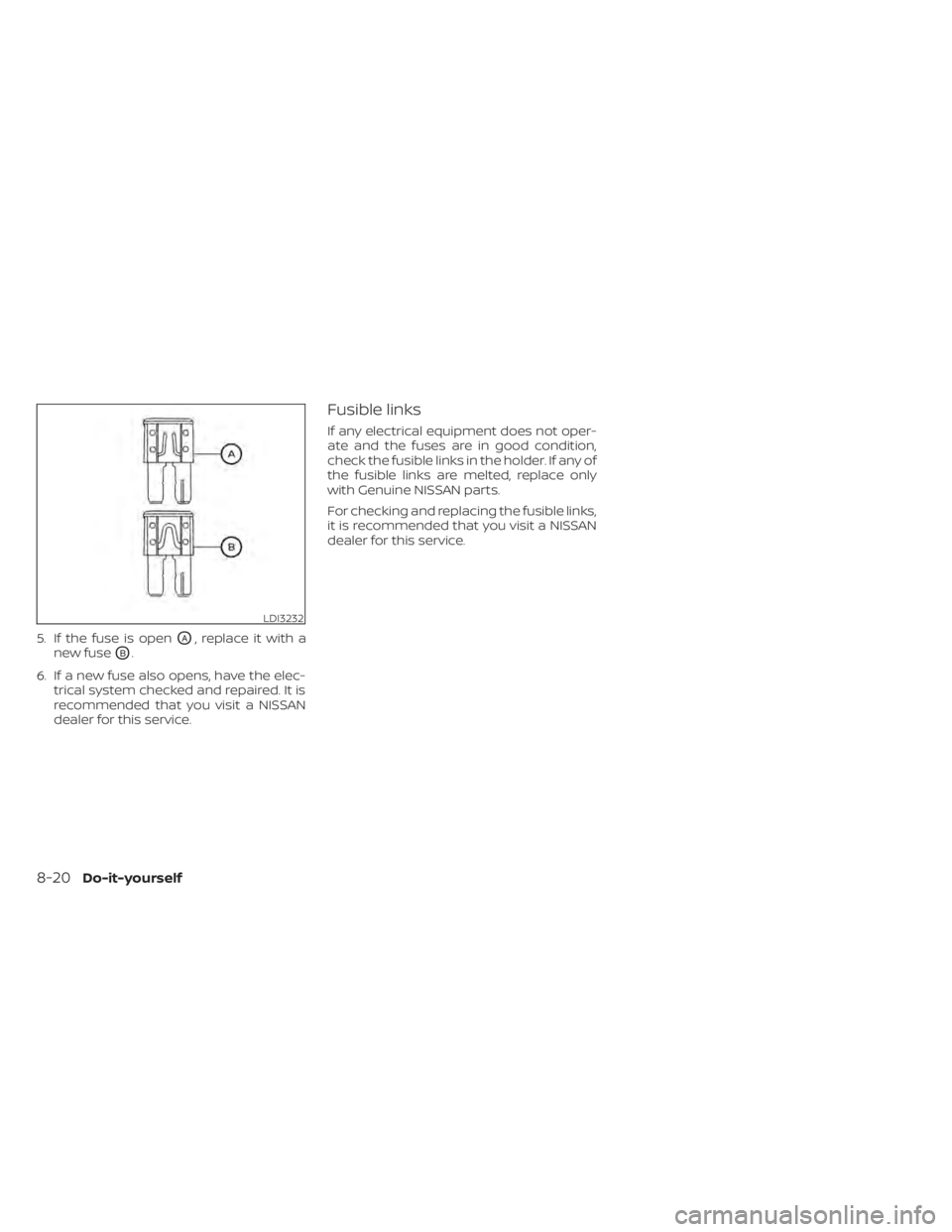
5. If the fuse is openOA, replace it with a
new fuse
OB.
6. If a new fuse also opens, have the elec- trical system checked and repaired. It is
recommended that you visit a NISSAN
dealer for this service.
Fusible links
If any electrical equipment does not oper-
ate and the fuses are in good condition,
check the fusible links in the holder. If any of
the fusible links are melted, replace only
with Genuine NISSAN parts.
For checking and replacing the fusible links,
it is recommended that you visit a NISSAN
dealer for this service.
LDI3232
8-20Do-it-yourself
Page 445 of 500
WARNING
• Tires should be periodically in-
spected for wear, cracking,
bulging or objects caught in
the tread. If excessive wear,
cracks, bulging or deep cuts
are found, the tire(s) should be
replaced.
• The original tires have built-in
tread wear indicators. When
the wear indicators are visible,
the tire(s) should be replaced.
• Tires degrade with age and
use. Have tires, including the
spare, over 6 years old checked
by a qualified technician be-
cause some tire damage may
not be obvious. Replace the
tires as necessary to prevent
tire failure and possible per-
sonal injury. •
Improper service of the spare
tire may result in serious per-
sonal injury. If it is necessary to
repair the spare tire, it is rec-
ommended that you visit a
NISSAN dealer for this service.
• For additional information re-
garding tires, refer to “Impor-
tant Tire Safety Information”
(US) or “Tire Safety Informa-
tion” (Canada) in the Warranty
Information Booklet.
Replacing wheels and tires
When replacing a tire, use the same size,
tread design, speed rating and load carry-
ing capacity as originally equipped. For ad-
ditional information, refer to “Wheels and
tires” in the “Technical and consumer infor-
mation” section of this manual.
WARNING
• The use of tires other than those rec-
ommended or the mixed use of tires
of different brands, construction
(bias, bias-belted or radial), or tread
patterns can adversely affect the
ride, braking, handling, Vehicle Dy-
namic Control (VDC) system, ground
clearance, body-to-tire clearance,
tire chain clearance, speedometer
calibration, headlight aim and bum-
per height. Some of these effects
may lead to accidents and could re-
sult in serious personal injury.
• If your vehicle was originally
equipped with four tires that were
the same size and you are only re-
placing two of the four tires, install
the new tires on the rear axle. Placing
new tires on the front axle may cause
loss of vehicle control in some driving
conditions and cause an accident
and personal injury.
Do-it-yourself8-37
Page 450 of 500
Some day-to-day and regular mainte-
nance is essential to maintain your vehicle
good mechanical condition, as well as its
emissions and engine performance.
It is the owner's responsibility to make sure
that the scheduled maintenance, as well as
general maintenance, is performed.
As the vehicle owner, you are the only one
who can ensure that your vehicle receives
proper maintenance. You are a vital link in
the maintenance chain.
GENERAL MAINTENANCE
General maintenance includes those items
which should be checked during normal
day-to-day operation. They are essential
for proper vehicle operation. It is your re-
sponsibility to perform these procedures
regularly as prescribed.
Performing general maintenance checks
requires minimal mechanical skill and only
a few general automotive tools.
These checks or inspections can be done
by yourself, a qualified technician or, if you
prefer, a NISSAN dealer.
SCHEDULED MAINTENANCE
The maintenance items listed in this sec-
tion are required to be serviced at regular
intervals. However under severe driving
conditions, additional or more frequent
maintenance will be required.
WHERE TO GO FOR SERVICE
If maintenance service is required or your
vehicle appears to malfunction, have the
systems checked and serviced. It is recom-
mended that you visit a NISSAN dealer for
this service.
NISSAN technicians are well-trained spe-
cialists and are kept up-to-date with the
latest service information through techni-
cal bulletins, service tips and training pro-
grams. They are fully qualified to work on
NISSAN vehiclesbeforework begins.
If your vehicle is involved in a collision, it is
recommended that you ask your NISSAN
dealer where the nearest NISSAN Certified
Collision Center is located, or go to http://
collision.nissanusa.com.
You can be confident that a NISSAN deal-
er's service department can perform the
service needed to meet the maintenance
requirements on your vehicle. During the normal day-to-day operation of
the vehicle, general maintenance should
be performed regularly as prescribed in
this section. If you detect any unusual
sounds, vibrations or smells, be sure to
check for the cause or have it checked
promptly. In addition, it is recommended
that you visit a NISSAN dealer if you think
that repairs are required.
When performing any checks or mainte-
nance work, closely observe the “Mainte-
nance precautions” in the “Do-it-yourself ”
section of this manual.
EXPLANATION OF GENERAL
MAINTENANCE ITEMS
Additional information on the following
items with“*”isf
ound in the “Do-it-
yourself ” section of this manual.
Outside the vehicle
The maintenance items listed here should
be performed from time to time, unless
otherwise specified.
Doors and engine hood: Check that the
doors and engine hood operate properly.
Also ensure that all latches lock securely.
Lubricate hinges, latches, latch pins, rollers
and links if necessary. Make sure that the
MAINTENANCE REQUIREMENTS GENERAL MAINTENANCE
9-2Maintenance and schedules
Page 452 of 500
Parking brake:Check the parking brake
operation regularly. The vehicle should be
securely held on a fairly steep hill with only
the parking brake applied. If the parking
brake needs adjustment, it is recom-
mended that you visit a NISSAN dealer for
this service.
Seats: Check seat position controls such
as seat adjusters, seatback recliner, etc., to
ensure they operate smoothly and all
latches lock securely in every position.
Check that the head restraints/headrests
move up and down smoothly and the locks
(if so equipped) hold securely in all latched
positions.
Seat belts: Check that all parts of the seat
belt system (for example, buckles, anchors,
adjusters and retractors) operate properly
and smoothly, and are installed securely.
Check the belt webbing for cuts, fraying,
wear or damage.
Steering wheel: Check for changes in the
steering system, such as excessive free
play, hard steering or strange noises.
Warning lights and chimes: Make sure all
warning lights and chimes are operating
properly. Windshield defroster:
Check that the air
comes out of the defroster outlets properly
and in sufficient quantity when operating
the heater or air conditioner.
Windshield wiper and washer*: Check
that the wipers and washer operate prop-
erly and that the wipers do not streak.
Under the hood and vehicle
The maintenance items listed here should
be checked periodically (for example, each
time you check the engine oil or refuel).
Battery*:This vehicle is equipped with a
sealed maintenance free battery. It is rec-
ommended that you visit a NISSAN dealer
for service.
NOTE:
Care should be taken to avoid situa-
tions that can lead to potential bat-
tery discharge and potential no-start
conditions such as:
1. Installation or extended use of elec- tronic accessories that consume bat-
tery power when the engine is not
running (Phone chargers, GPS, DVD
players, etc.).
2. Vehicle is not driven regularly and/or only driven short distances. In these cases, the battery may need to
be charged to maintain battery health.
Brake fluid level*:
Make sure that the brake
fluid level is between the MIN and MAX lines
on the reservoir.
Engine coolant level*: Check the coolant
level when the engine is cold.
Engine drive belt*: Make sure the drive belt
is not frayed, worn, cracked or oily.
Engine oil level*: Check the level af ter
parking the vehicle on a level surface with
the engine off. Wait more than 15 minutes
for the oil to drain back into the oil pan.
Exhaust system: Make sure there are no
loose supports, cracks or holes. If the
sound of the exhaust seems unusual or
there is a smell of exhaust fumes, immedi-
ately have the exhaust system inspected. It
is recommended that you visit a NISSAN
dealer for this service. For additional infor-
mation, refer to “Exhaust gas (carbon mon-
oxide)” in the “Starting and driving” section
of this manual.
9-4Maintenance and schedules
Page 453 of 500
Fluid leaks:Check under the vehicle for
fuel, oil, water or other fluid leaks af ter the
vehicle has been parked for a while. Water
dripping from the air conditioner af ter use
is normal. If you should notice any leaks or if
fuel fumes are evident, check for the cause
and have it corrected immediately.
Radiator and hoses: Check the front of the
radiator and clean off any dirt, insects,
leaves, etc., that may have accumulated.
Make sure the hoses have no cracks, defor-
mation, rot or loose connections.
Underbody: The underbody is frequently
exposed to corrosive substances such as
those used on icy roads or to control dust. It
is very important to remove these sub-
stances from the underbody, otherwise
rust may form on the floor pan, frame, fuel
lines and exhaust system. At the end of
winter, the underbody should be thor-
oughly flushed with plain water, in those
areas where mud and dirt may have accu-
mulated. For additional information, refer
to the “Appearance and care” section of this
manual.
Windshield-washer fluid*: Check that
there is adequate fluid in the reservoir. The following descriptions are provided to
give you a better understanding of the
scheduled maintenance items that should
be regularly checked or replaced. The
maintenance schedule indicates at which
mileage/time intervals each item requires
service.
In addition to scheduled maintenance,
your vehicle requires that some items be
checked during normal day-to-day opera-
tion. For additional information, refer to
“General maintenance” in this section.
Items marked with
“*”are recommended
by NISSAN for reliable vehicle operation.
You are not required to perform mainte-
nance on these items in order to maintain
the warranties which come with your
NISSAN. Other maintenance items and in-
tervals are required.
When applicable, additional information
can be found in the “Do-it-yourself ” section
of this manual.NOTE:
NISSAN does not advocate the use of
non-OEM approved af termarket flush-
ing systems and strongly advises
against performing these services on a
NISSAN product. Many of the af termar-
ket flushing systems use non-OEM ap-
proved chemicals or solvents, the use of
which has not been validated by NISSAN.
For recommended fuel, lubricants, fluids,
grease, and refrigerant, refer to “Recom-
mended fluids/lubricants and capaci-
ties” in the “Technical and consumer in-
formation” section of this manual.
EMISSION CONTROL SYSTEM
MAINTENANCE:
Drive belt*: Check engine drive belt for
wear, fraying or cracking and for proper
tension. Replace any damaged drive belt.
Engine air filter: Replace at specified inter-
vals. When driving for prolonged periods in
dusty conditions, check/replace the filter
more frequently.
Engine coolant*: Replace coolant at the
specified interval. When adding or replac-
ing coolant, be sure to use only Genuine
NISSAN Long Life Antifreeze/Coolant (blue)
or equivalent with the proper mixture. (For
EXPLANATION OF SCHEDULED
MAINTENANCE ITEMS
Maintenance and schedules9-5
Page 463 of 500
10 Technical and consumer information
Recommended fluids/lubricants and
capacities...................................... 10-2
Fuel recommendation ......................10-3
Engine oil and oil filter
recommendations .......................... 10-6
Air conditioner system refrigerant and
oil recommendations ....................... 10-7
Specifications .................................. 10-8
Engine ...................................... 10-8
Wheels and tires ............................ 10-8
Dimensions and weights ....................10-9
When traveling or registering in another
country ....................................... 10-10
Vehicle identification .......................... 10-10
Vehicle Identification Number (VIN)
plate ....................................... 10-10
Vehicle identification number
(chassis number) ........................... 10-10
Engine serial number .......................10-11
F.M.V.S.S./C.M.V.S.S. certification label .........10-11
Emission control information label ..........10-11 Tire and Loading Information label
.........10-12
Air conditioner specification label ..........10-12
Installing front license plate ...................10-12
Vehicle loading information ...................10-13
Terms ...................................... 10-13
Vehicle load capacity ....................... 10-14
Securing the load .......................... 10-15
Loading tips ................................ 10-16
Measurement of weights ...................10-16
Towing a trailer ................................ 10-17
Flat towing ................................. 10-17
Uniform tire quality grading ...................10-18
Emission control system warranty ............10-19
Reporting safety defects ......................10-19
Readiness for Inspection/Maintenance (I/M)
test ........................................... 10-20
Event Data Recorders (EDR) ...................10-20
Owner's Manual/Service Manual order
information ................................... 10-21
Page 464 of 500
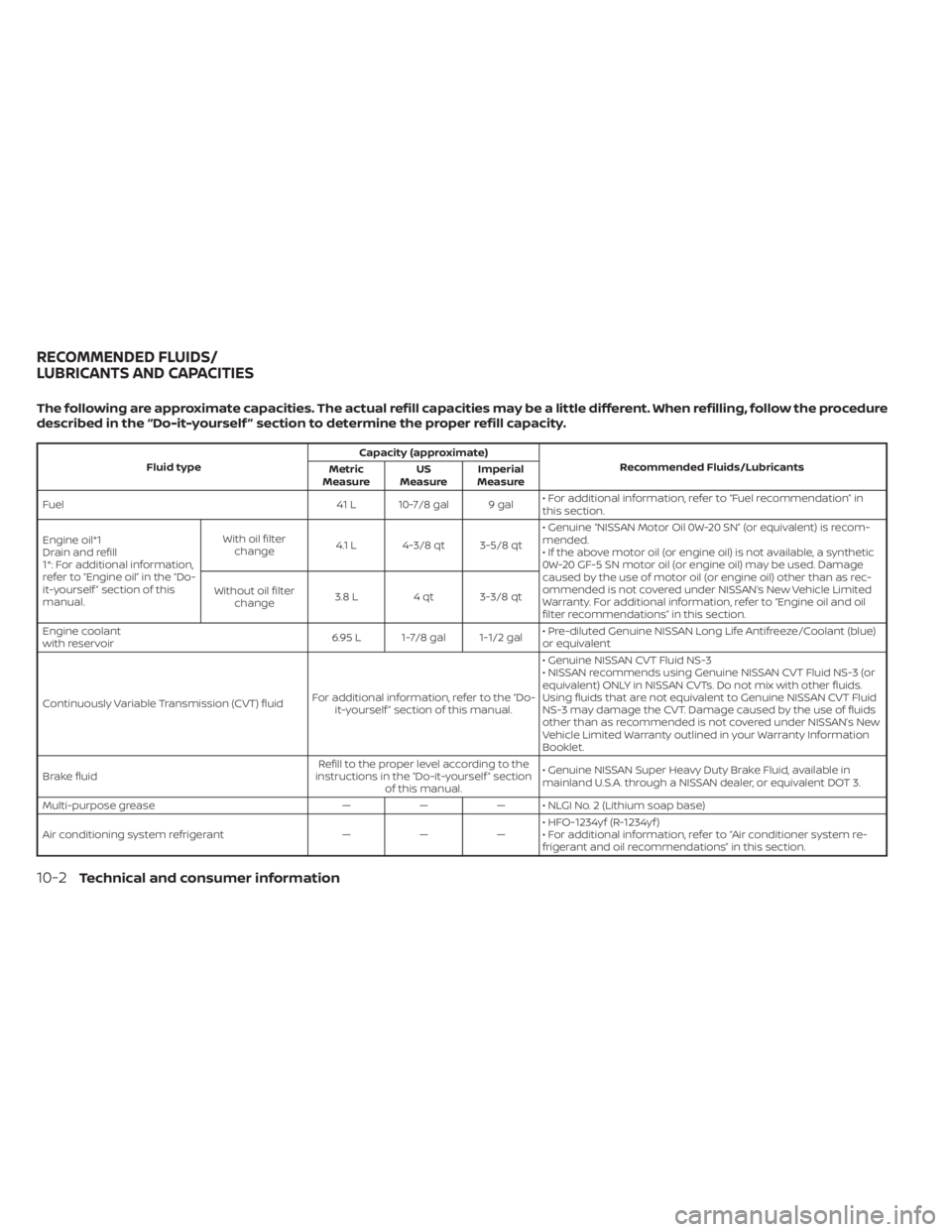
The following are approximate capacities. The actual refill capacities may be a little different. When refilling, follow the procedure
described in the “Do-it-yourself ” section to determine the proper refill capacity.
Fluid typeCapacity (approximate)
Recommended Fluids/Lubricants
Metric
Measure US
Measure Imperial
Measure
Fuel 41 L 10-7/8 gal 9 gal • For additional information, refer to “Fuel recommendation” in
this section.
Engine oil*1
Drain and refill
1*: For additional information,
refer to “Engine oil” in the “Do-
it-yourself ” section of this
manual. With oil filter
change 4.1 L 4-3/8 qt 3-5/8 qt • Genuine “NISSAN Motor Oil 0W-20 SN” (or equivalent) is recom-
mended.
• If the above motor oil (or engine oil) is not available, a synthetic
0W-20 GF-5 SN motor oil (or engine oil) may be used. Damage
caused by the use of motor oil (or engine oil) other than as rec-
ommended is not covered under NISSAN’s New Vehicle Limited
Warranty. For additional information, refer to “Engine oil and oil
filter recommendations” in this section.
Without oil filter
change 3.8 L 4 qt 3-3/8 qt
Engine coolant
with reservoir 6.95 L 1-7/8 gal 1-1/2 gal• Pre-diluted Genuine NISSAN Long Life Antifreeze/Coolant (blue)
or equivalent
Continuously Variable Transmission (CVT) fluid For additional information, refer to the “Do-
it-yourself ” section of this manual. • Genuine NISSAN CVT Fluid NS-3
• NISSAN recommends using Genuine NISSAN CVT Fluid NS-3 (or
equivalent) ONLY in NISSAN CVTs. Do not mix with other fluids.
Using fluids that are not equivalent to Genuine NISSAN CVT Fluid
NS-3 may damage the CVT. Damage caused by the use of fluids
other than as recommended is not covered under NISSAN’s New
Vehicle Limited Warranty outlined in your Warranty Information
Booklet.
Brake fluid Refill to the proper level according to the
instructions in the “Do-it-yourself ” section of this manual. • Genuine NISSAN Super Heavy Duty Brake Fluid, available in
mainland U.S.A. through a NISSAN dealer, or equivalent DOT 3.
Multi-purpose grease — — — • NLGI No. 2 (Lithium soap base)
Air conditioning system refrigerant — — — • HFO-1234yf (R-1234yf )
• For additional information, refer to “Air conditioner system re-
frigerant and oil recommendations” in this section.
RECOMMENDED FLUIDS/
LUBRICANTS AND CAPACITIES
10-2Technical and consumer information
Page 465 of 500
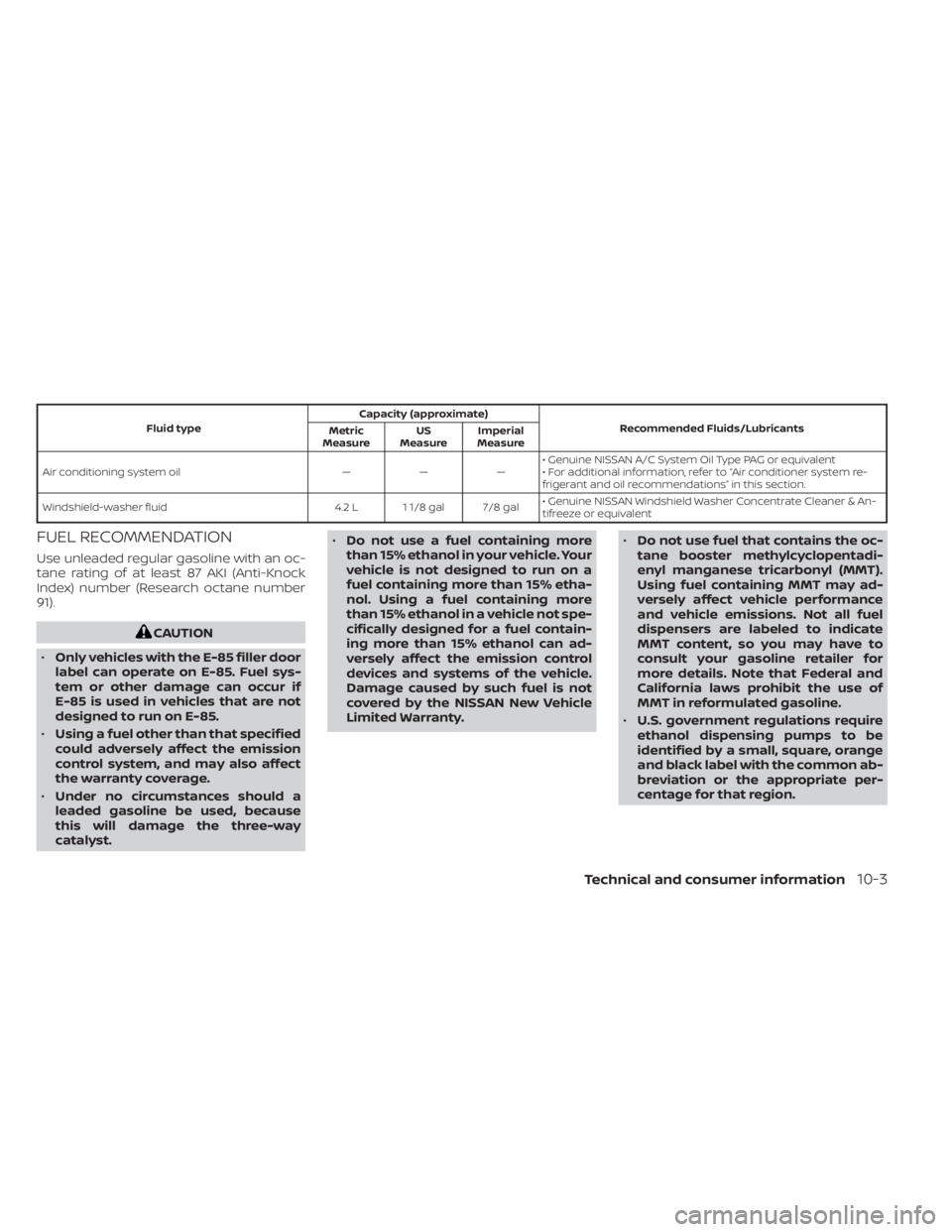
Fluid typeCapacity (approximate)
Recommended Fluids/Lubricants
Metric
Measure US
Measure Imperial
Measure
Air conditioning system oil — — — • Genuine NISSAN A/C System Oil Type PAG or equivalent
• For additional information, refer to “Air conditioner system re-
frigerant and oil recommendations” in this section.
Windshield-washer fluid 4.2 L 1 1/8 gal 7/8 gal • Genuine NISSAN Windshield Washer Concentrate Cleaner & An-
tifreeze or equivalent
FUEL RECOMMENDATION
Use unleaded regular gasoline with an oc-
tane rating of at least 87 AKI (Anti-Knock
Index) number (Research octane number
91).
CAUTION
• Only vehicles with the E-85 filler door
label can operate on E-85. Fuel sys-
tem or other damage can occur if
E-85 is used in vehicles that are not
designed to run on E-85.
• Using a fuel other than that specified
could adversely affect the emission
control system, and may also affect
the warranty coverage.
• Under no circumstances should a
leaded gasoline be used, because
this will damage the three-way
catalyst. •
Do not use a fuel containing more
than 15% ethanol in your vehicle. Your
vehicle is not designed to run on a
fuel containing more than 15% etha-
nol. Using a fuel containing more
than 15% ethanol in a vehicle not spe-
cifically designed for a fuel contain-
ing more than 15% ethanol can ad-
versely affect the emission control
devices and systems of the vehicle.
Damage caused by such fuel is not
covered by the NISSAN New Vehicle
Limited Warranty. •
Do not use fuel that contains the oc-
tane booster methylcyclopentadi-
enyl manganese tricarbonyl (MMT).
Using fuel containing MMT may ad-
versely affect vehicle performance
and vehicle emissions. Not all fuel
dispensers are labeled to indicate
MMT content, so you may have to
consult your gasoline retailer for
more details. Note that Federal and
California laws prohibit the use of
MMT in reformulated gasoline.
• U.S. government regulations require
ethanol dispensing pumps to be
identified by a small, square, orange
and black label with the common ab-
breviation or the appropriate per-
centage for that region.
Technical and consumer information10-3
Page 469 of 500
Change intervals
The oil and oil filter change intervals for
your engine are based on the use of the
specified quality oils and filters. Using en-
gine oil and filters that are not of the speci-
fied quality, or exceeding recommended oil
and filter change intervals could reduce
engine life. Damage to the engine caused
by improper maintenance or use of incor-
rect oil and filter quality and/or viscosity is
not covered by the NISSAN New Vehicle
Limited Warranty.
Your engine was filled with a high-quality
engine oil when it was built. You do not have
to change the oil before the first recom-
mended change interval. Oil and filter
change intervals depend upon how you
use your vehicle.
Operation under the following conditions
may require more frequent oil and filter
changes:
• repeated short distance driving at coldoutside temperatures
• driving in dusty conditions
• extensive idling
• stop and go commuting For additional information, refer to the
“Maintenance and schedules” section of
this manual.
AIR CONDITIONER SYSTEM
REFRIGERANT AND OIL
RECOMMENDATIONS
The air conditioner system in your
NISSAN vehicle must be charged with the
refrigerant HFO-1234yf (R-1234yf ) and
NISSAN A/C system oil Type PAG or the
exact equivalents.
CAUTION
The use of any other refrigerant or oil
will cause severe damage to the air
conditioning system and will require
the replacement of all air conditioner
system components. The refrigerant HFO-1234yf (R-1234yf ) in
your NISSAN vehicle does not harm the
earth's ozone layer. Although this refriger-
ant does not affect the earth's atmo-
sphere, certain government regulations re-
quire the recovery and recycling of any
refrigerant during automotive air condi-
tioner system service. A NISSAN dealer has
the trained technicians and equipment
needed to recover and recycle your air con-
ditioner system refrigerant.
It is recommended that you visit a NISSAN
dealer when servicing your air conditioner
system.
Technical and consumer information10-7