sensor NISSAN LATIO 2008 Service Repair Manual
[x] Cancel search | Manufacturer: NISSAN, Model Year: 2008, Model line: LATIO, Model: NISSAN LATIO 2008Pages: 2771, PDF Size: 60.61 MB
Page 1437 of 2771
DTC P0453 EVAP CONTROL SYSTEM PRESSURE SENSOR
EC-363
< SERVICE INFORMATION >
C
D
E
F
G
H
I
J
K
L
MA
EC
N
P O
If DTC Confirmation Procedure has been previously conducted, always turn ignition switch OFF and wait at
least 10 seconds before conducting the next test.
TESTING CONDITION:
Always perform test at a temperature of 5°C (41°F) or more.
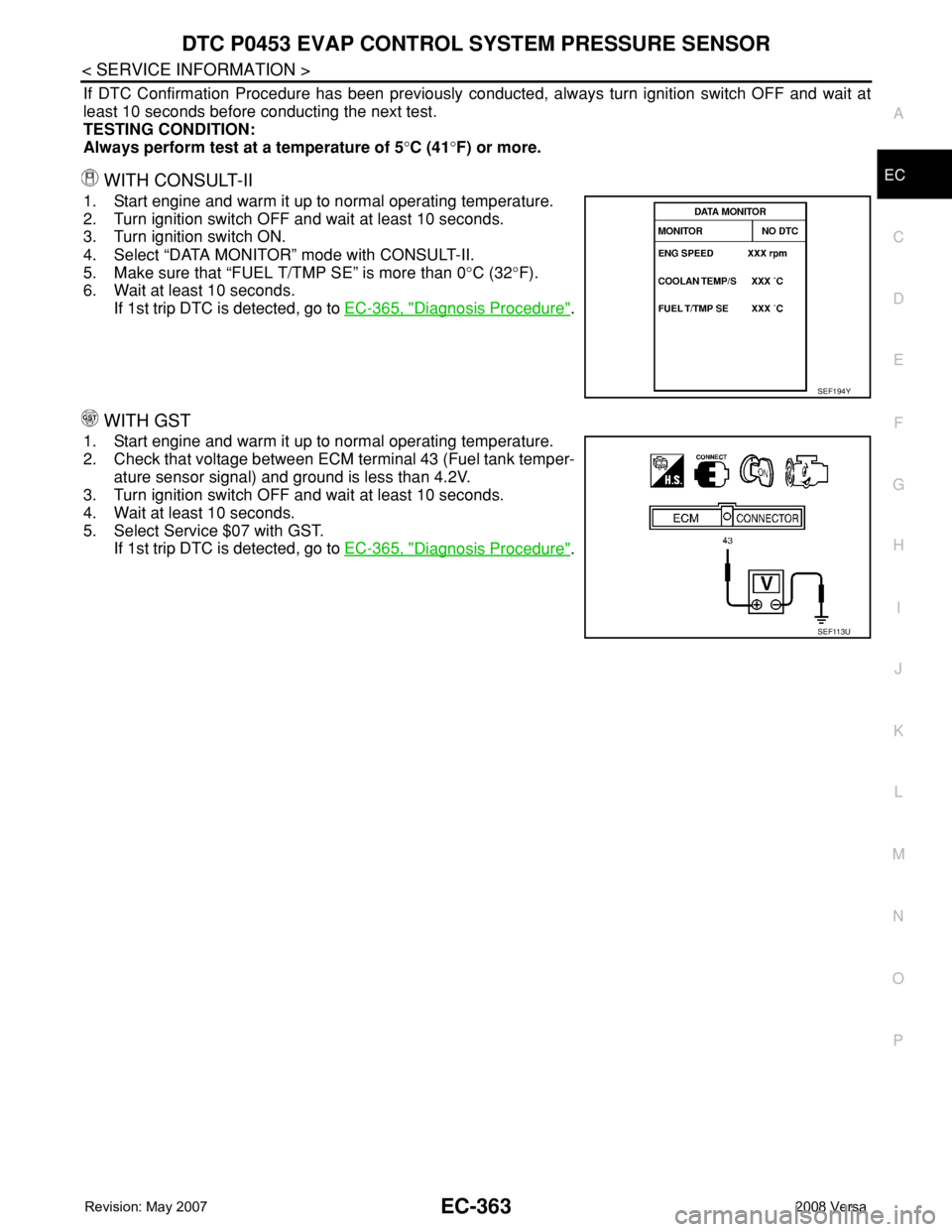
WITH CONSULT-II
1. Start engine and warm it up to normal operating temperature.
2. Turn ignition switch OFF and wait at least 10 seconds.
3. Turn ignition switch ON.
4. Select “DATA MONITOR” mode with CONSULT-II.
5. Make sure that “FUEL T/TMP SE” is more than 0°C (32°F).
6. Wait at least 10 seconds.
If 1st trip DTC is detected, go to EC-365, "
Diagnosis Procedure".
WITH GST
1. Start engine and warm it up to normal operating temperature.
2. Check that voltage between ECM terminal 43 (Fuel tank temper-
ature sensor signal) and ground is less than 4.2V.
3. Turn ignition switch OFF and wait at least 10 seconds.
4. Wait at least 10 seconds.
5. Select Service $07 with GST.
If 1st trip DTC is detected, go to EC-365, "
Diagnosis Procedure".
SEF194Y
SEF113U
Page 1438 of 2771
EC-364
< SERVICE INFORMATION >
DTC P0453 EVAP CONTROL SYSTEM PRESSURE SENSOR
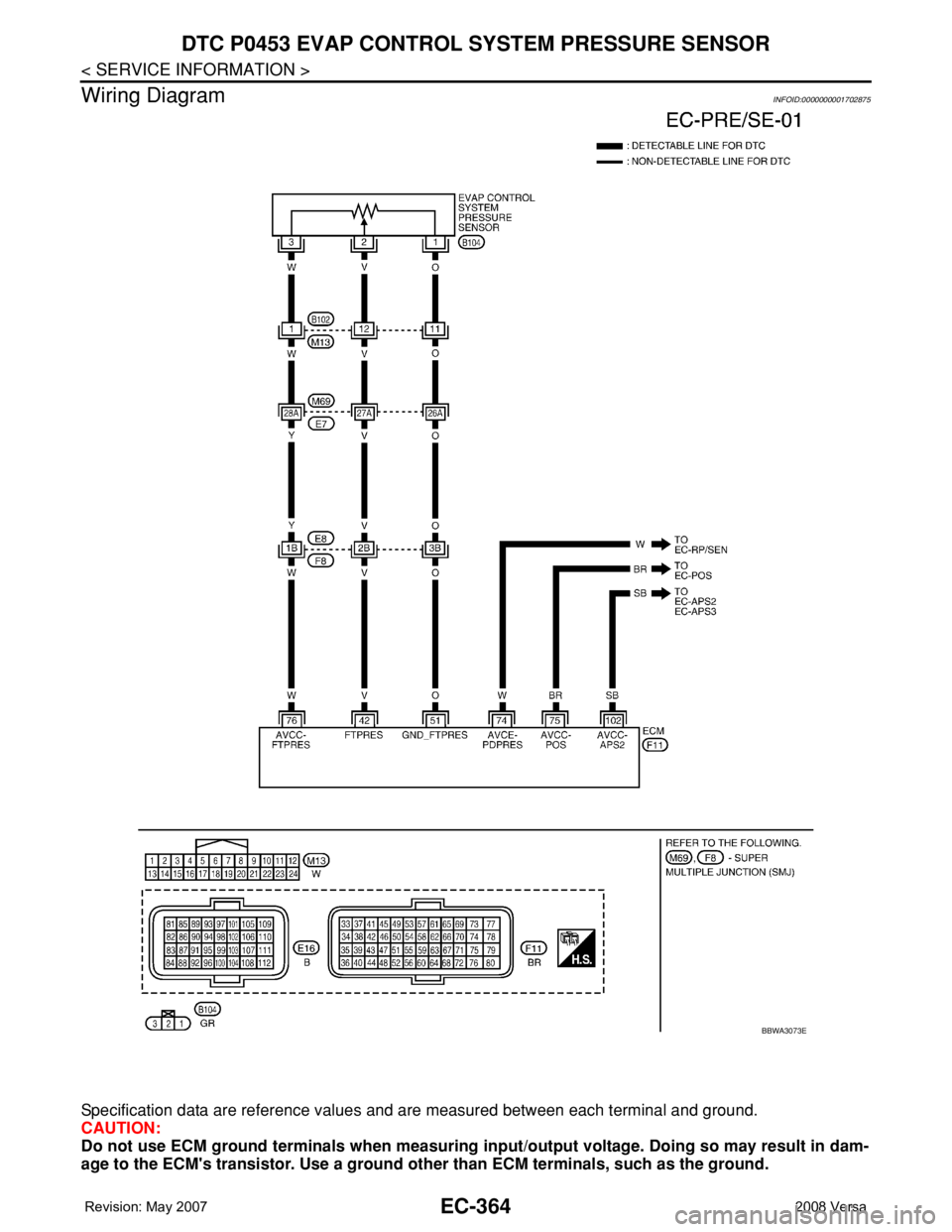
Wiring Diagram
INFOID:0000000001702875
Specification data are reference values and are measured between each terminal and ground.
CAUTION:
Do not use ECM ground terminals when measuring input/output voltage. Doing so may result in dam-
age to the ECM's transistor. Use a ground other than ECM terminals, such as the ground.
BBWA3073E
Page 1439 of 2771
DTC P0453 EVAP CONTROL SYSTEM PRESSURE SENSOR
EC-365
< SERVICE INFORMATION >
C
D
E
F
G
H
I
J
K
L
MA
EC
N
P O
Diagnosis ProcedureINFOID:0000000001702876
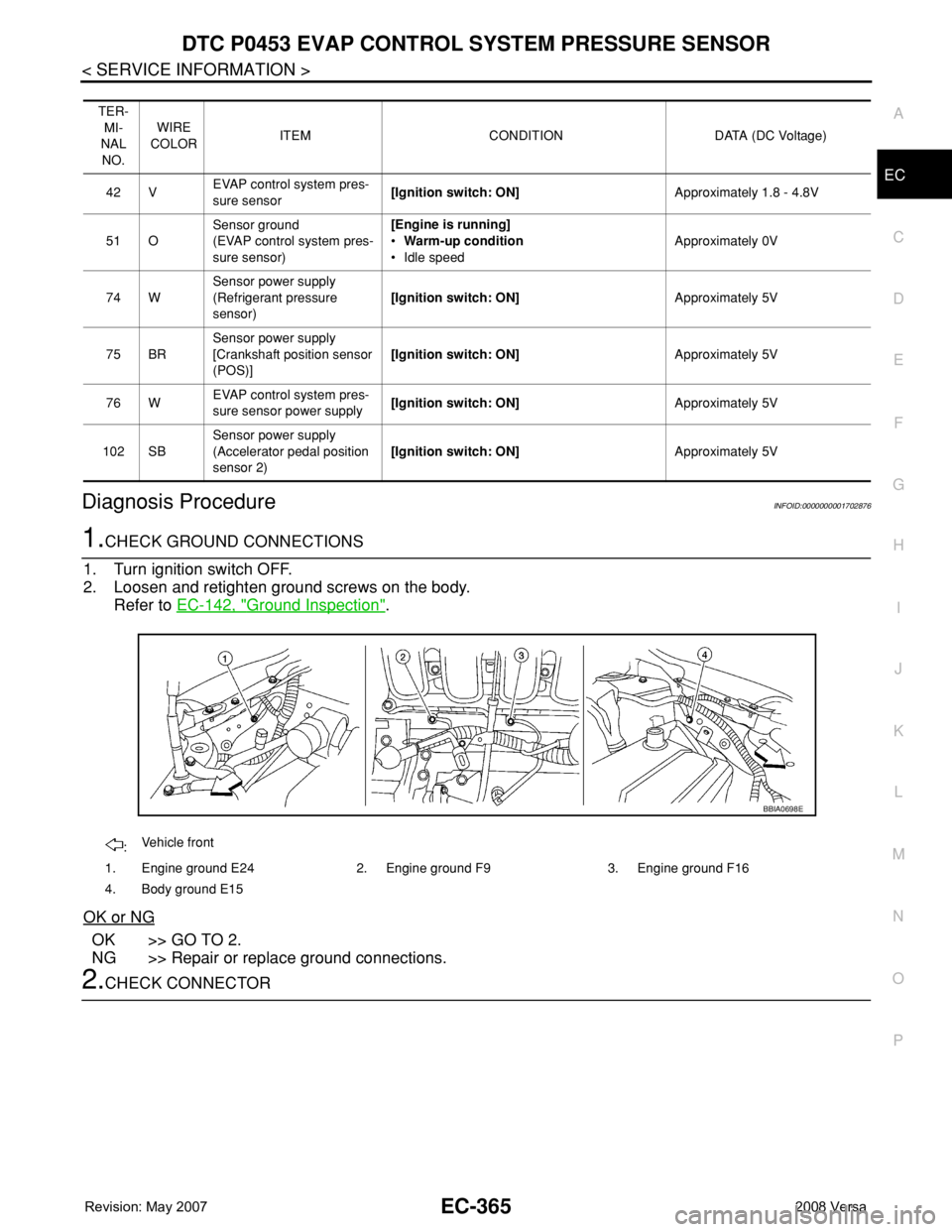
1.CHECK GROUND CONNECTIONS
1. Turn ignition switch OFF.
2. Loosen and retighten ground screws on the body.
Refer to EC-142, "
Ground Inspection".
OK or NG
OK >> GO TO 2.
NG >> Repair or replace ground connections.
2.CHECK CONNECTOR
TER-
MI-
NAL
NO.WIRE
COLORITEM CONDITION DATA (DC Voltage)
42 VEVAP control system pres-
sure sensor[Ignition switch: ON]Approximately 1.8 - 4.8V
51 OSensor ground
(EVAP control system pres-
sure sensor)[Engine is running]
•Warm-up condition
• Idle speedApproximately 0V
74 WSensor power supply
(Refrigerant pressure
sensor)[Ignition switch: ON]Approximately 5V
75 BRSensor power supply
[Crankshaft position sensor
(POS)][Ignition switch: ON]Approximately 5V
76 WEVAP control system pres-
sure sensor power supply[Ignition switch: ON]Approximately 5V
102 SBSensor power supply
(Accelerator pedal position
sensor 2)[Ignition switch: ON]Approximately 5V
:Vehicle front
1. Engine ground E24 2. Engine ground F9 3. Engine ground F16
4. Body ground E15
BBIA0698E
Page 1440 of 2771
EC-366
< SERVICE INFORMATION >
DTC P0453 EVAP CONTROL SYSTEM PRESSURE SENSOR
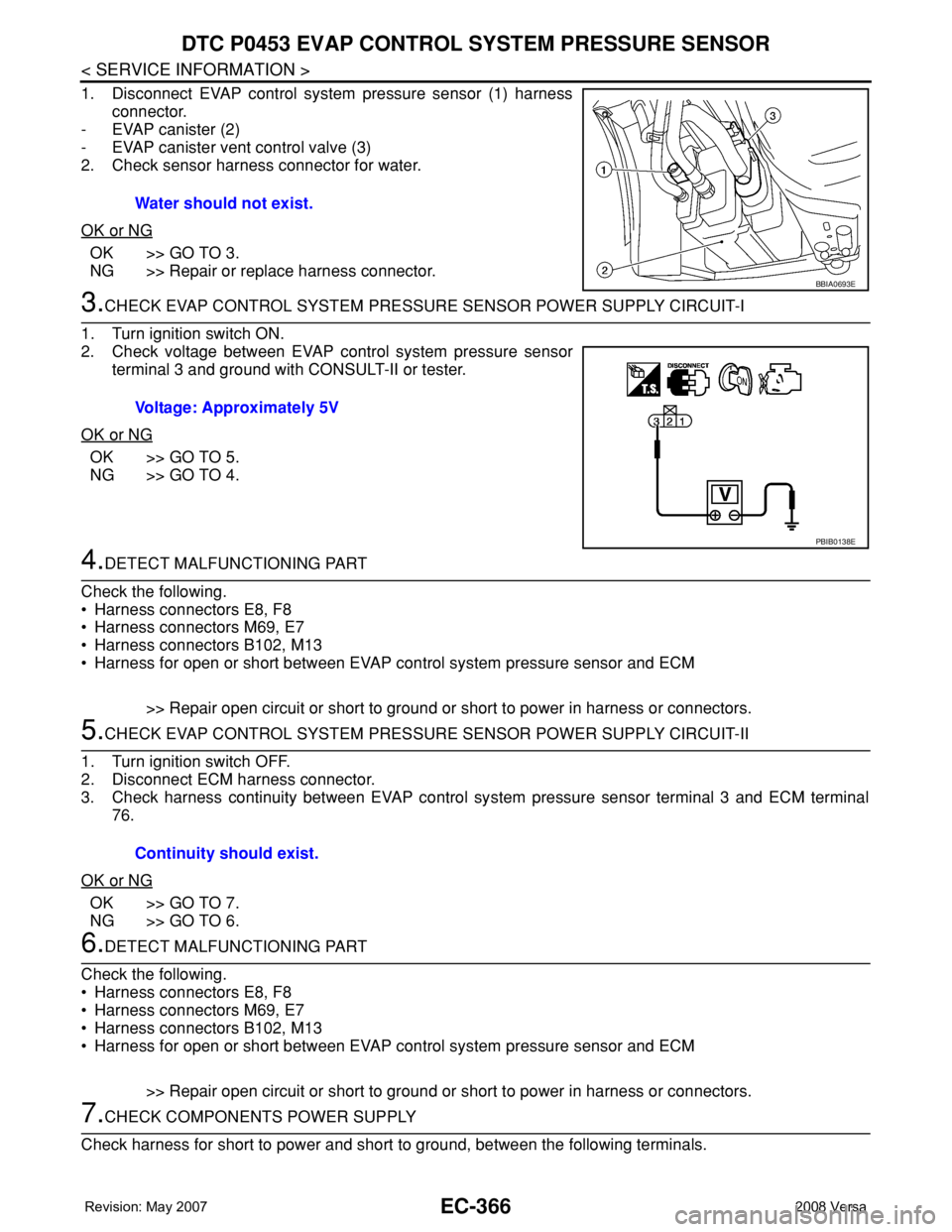
1. Disconnect EVAP control system pressure sensor (1) harness
connector.
- EVAP canister (2)
- EVAP canister vent control valve (3)
2. Check sensor harness connector for water.
OK or NG
OK >> GO TO 3.
NG >> Repair or replace harness connector.
3.CHECK EVAP CONTROL SYSTEM PRESSURE SENSOR POWER SUPPLY CIRCUIT-I
1. Turn ignition switch ON.
2. Check voltage between EVAP control system pressure sensor
terminal 3 and ground with CONSULT-II or tester.
OK or NG
OK >> GO TO 5.
NG >> GO TO 4.
4.DETECT MALFUNCTIONING PART
Check the following.
• Harness connectors E8, F8
• Harness connectors M69, E7
• Harness connectors B102, M13
• Harness for open or short between EVAP control system pressure sensor and ECM
>> Repair open circuit or short to ground or short to power in harness or connectors.
5.CHECK EVAP CONTROL SYSTEM PRESSURE SENSOR POWER SUPPLY CIRCUIT-II
1. Turn ignition switch OFF.
2. Disconnect ECM harness connector.
3. Check harness continuity between EVAP control system pressure sensor terminal 3 and ECM terminal
76.
OK or NG
OK >> GO TO 7.
NG >> GO TO 6.
6.DETECT MALFUNCTIONING PART
Check the following.
• Harness connectors E8, F8
• Harness connectors M69, E7
• Harness connectors B102, M13
• Harness for open or short between EVAP control system pressure sensor and ECM
>> Repair open circuit or short to ground or short to power in harness or connectors.
7.CHECK COMPONENTS POWER SUPPLY
Check harness for short to power and short to ground, between the following terminals.Water should not exist.
BBIA0693E
Voltage: Approximately 5V
PBIB0138E
Continuity should exist.
Page 1441 of 2771
DTC P0453 EVAP CONTROL SYSTEM PRESSURE SENSOR
EC-367
< SERVICE INFORMATION >
C
D
E
F
G
H
I
J
K
L
MA
EC
N
P O
OK or NG
OK >> GO TO 8.
NG >> Repair short to ground or short to power in harness or connectors.
8.CHECK COMPONENTS
Check the following.
• Refrigerant pressure sensor (Refer to MTC-22
.)
• Crankshaft position sensor (POS) (Refer to EC-301, "
Component Inspection".)
OK or NG
OK >> GO TO 9.
NG >> Replace malfunctioning components.
9.CHECK APP SENSOR
Refer to EC-485, "
Component Inspection".
OK or NG
OK >> GO TO 11.
NG >> GO TO 10.
10.REPLACE ACCELERATOR PEDAL ASSEMBLY
1. Replace accelerator pedal assembly.
2. Perform EC-76, "
Accelerator Pedal Released Position Learning".
3. Perform EC-76, "
Throttle Valve Closed Position Learning".
4. Perform EC-76, "
Idle Air Volume Learning".
>>INSPECTION END
11 .CHECK EVAP CONTROL SYSTEM PRESSURE SENSOR GROUND CIRCUIT FOR OPEN AND SHORT
1. Turn ignition switch OFF.
2. Disconnect ECM harness connector.
3. Check harness continuity between EVAP control system pressure sensor terminal 1 and ECM terminal
51. Refer to Wiring Diagram.
4. Also check harness for short to ground and short to power.
OK or NG
OK >> GO TO 13.
NG >> GO TO 12.
12.DETECT MALFUNCTIONING PART
Check the following.
• Harness connectors E85, F8
• Harness connectors M69, E7
• Harness connectors B102, M13
• Harness for open or short between EVAP control system pressure sensor and ECM
>> Repair open circuit or short to ground or short to power in harness or connectors.
13.CHECK EVAP CONTROL SYSTEM PRESSURE SENSOR INPUT SIGNAL CIRCUIT FOR OPEN AND
SHORT
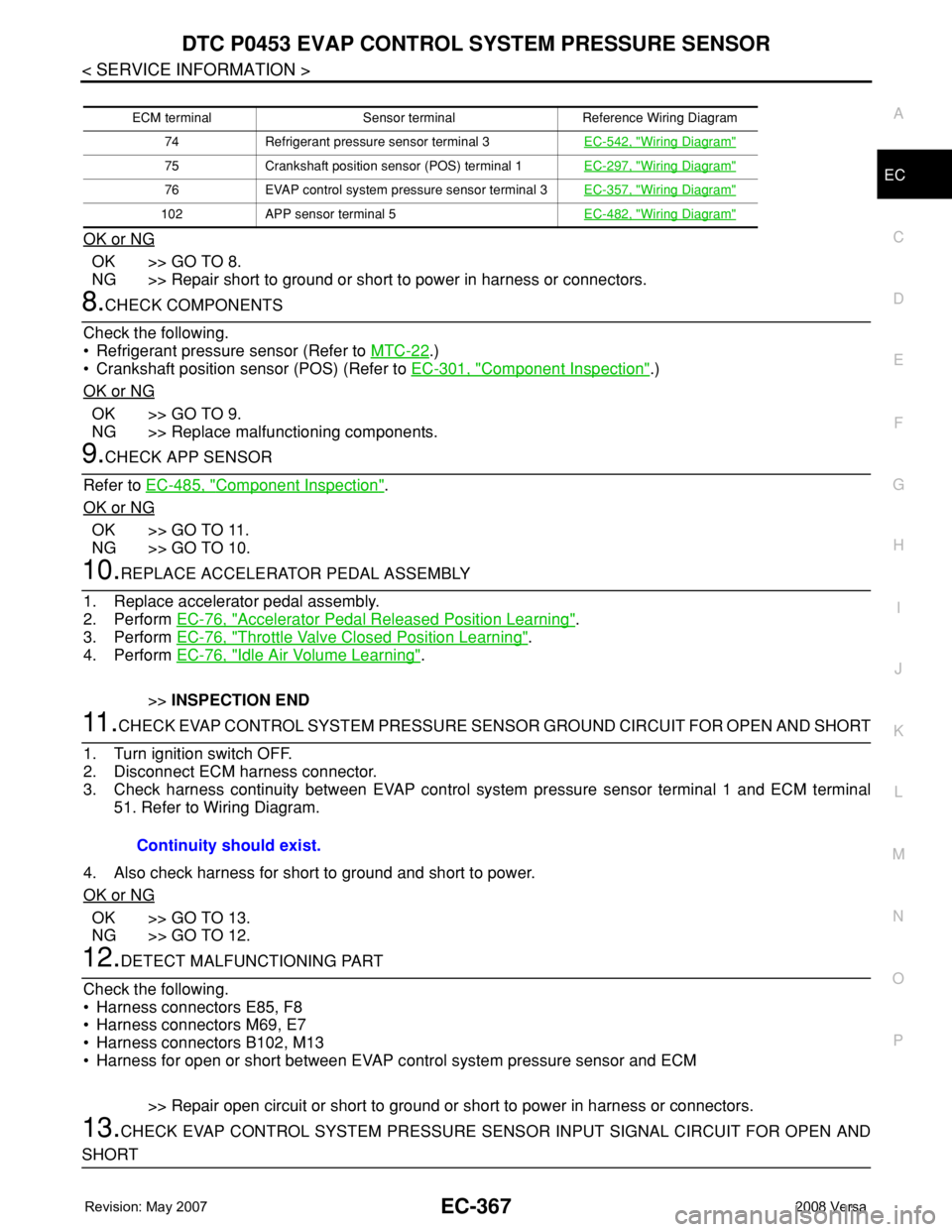
ECM terminal Sensor terminal Reference Wiring Diagram
74 Refrigerant pressure sensor terminal 3EC-542, "
Wiring Diagram"
75 Crankshaft position sensor (POS) terminal 1EC-297, "Wiring Diagram"
76 EVAP control system pressure sensor terminal 3EC-357, "Wiring Diagram"
102 APP sensor terminal 5EC-482, "Wiring Diagram"
Continuity should exist.
Page 1442 of 2771
EC-368
< SERVICE INFORMATION >
DTC P0453 EVAP CONTROL SYSTEM PRESSURE SENSOR
1. Check harness continuity between ECM terminal 42 and EVAP control system pressure sensor terminal
2. Refer to Wiring Diagram.
2. Also check harness for short to ground and short to power.
OK or NG
OK >> GO TO 15.
NG >> GO TO 14.
14.DETECT MALFUNCTIONING PART
Check the following.
• Harness connectors E8, F8
• Harness connectors M69, E7
• Harness connectors B102, M13
• Harness for open or short between ECM and EVAP control system pressure sensor
>> Repair open circuit or short to ground or short to power in harness or connectors.
15.CHECK RUBBER TUBE
1. Disconnect rubber tube connected to EVAP canister vent control valve.
2. Check the rubber tube for clogging, vent and kinked.
OK or NG
OK >> GO TO 16.
NG >> Clean the rubber tube using an air blower, repair or replace rubber tube.
16.CHECK EVAP CANISTER VENT CONTROL VALVE
Refer to EC-343, "
Component Inspection".
OK or NG
OK >> GO TO 17.
NG >> Replace EVAP canister vent control valve.
17.CHECK EVAP CONTROL SYSTEM PRESSURE SENSOR
Refer to EC-369, "
Component Inspection".
OK or NG
OK >> GO TO 18.
NG >> Replace EVAP control system pressure sensor.
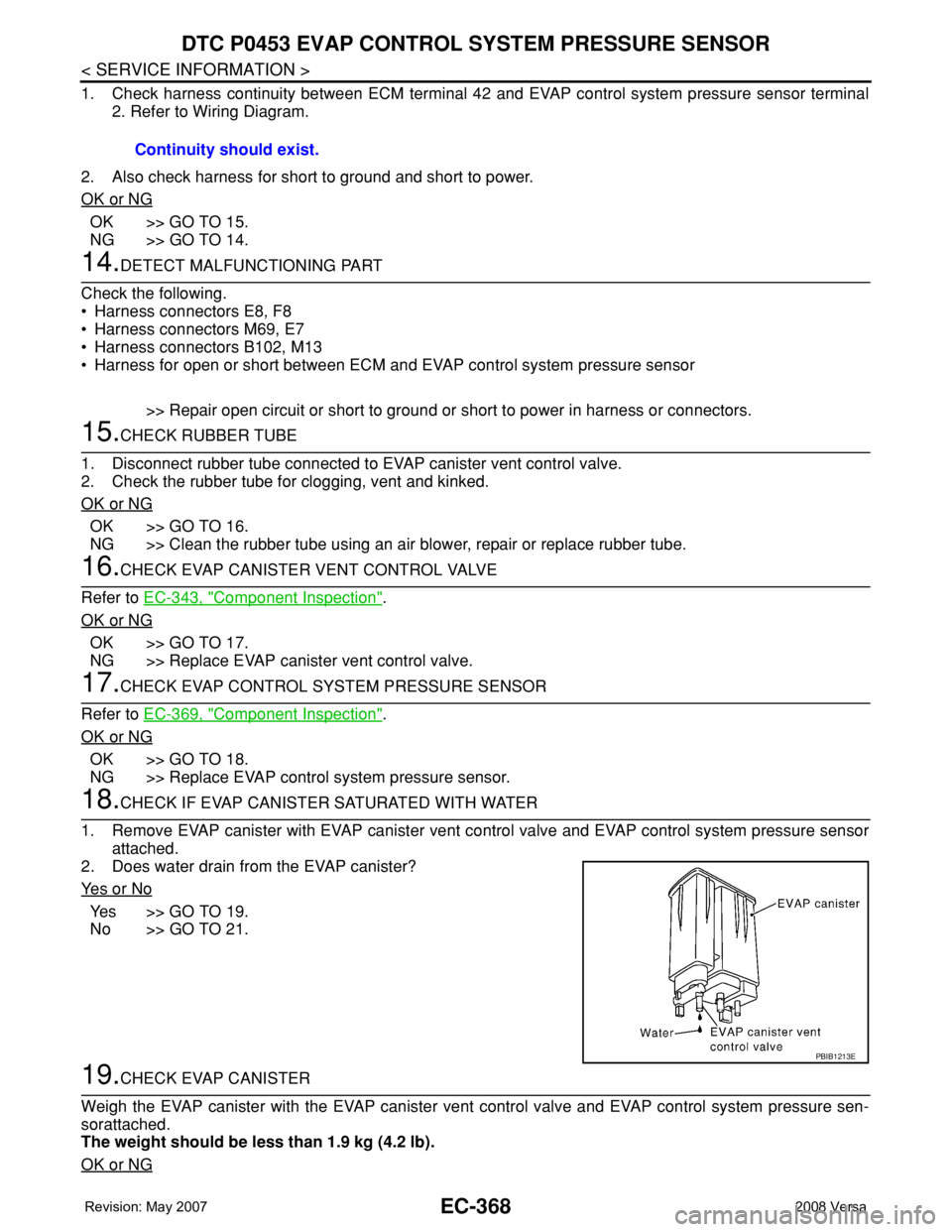
18.CHECK IF EVAP CANISTER SATURATED WITH WATER
1. Remove EVAP canister with EVAP canister vent control valve and EVAP control system pressure sensor
attached.
2. Does water drain from the EVAP canister?
Ye s o r N o
Yes >> GO TO 19.
No >> GO TO 21.
19.CHECK EVAP CANISTER
Weigh the EVAP canister with the EVAP canister vent control valve and EVAP control system pressure sen-
sorattached.
The weight should be less than 1.9 kg (4.2 lb).
OK or NG
Continuity should exist.
PBIB1213E
Page 1443 of 2771
DTC P0453 EVAP CONTROL SYSTEM PRESSURE SENSOR
EC-369
< SERVICE INFORMATION >
C
D
E
F
G
H
I
J
K
L
MA
EC
N
P O
OK >> GO TO 21.
NG >> GO TO 20.
20.DETECT MALFUNCTIONING PART
Check the following.
• EVAP canister for damage
• EVAP hose connected to EVAP canister for clogging or poor connection
>> Repair hose or replace EVAP canister.
21.CHECK INTERMITTENT INCIDENT
Refer to EC-136
.
>>INSPECTION END
Component InspectionINFOID:0000000001702877
EVAP CONTROL PRESSURE SENSOR
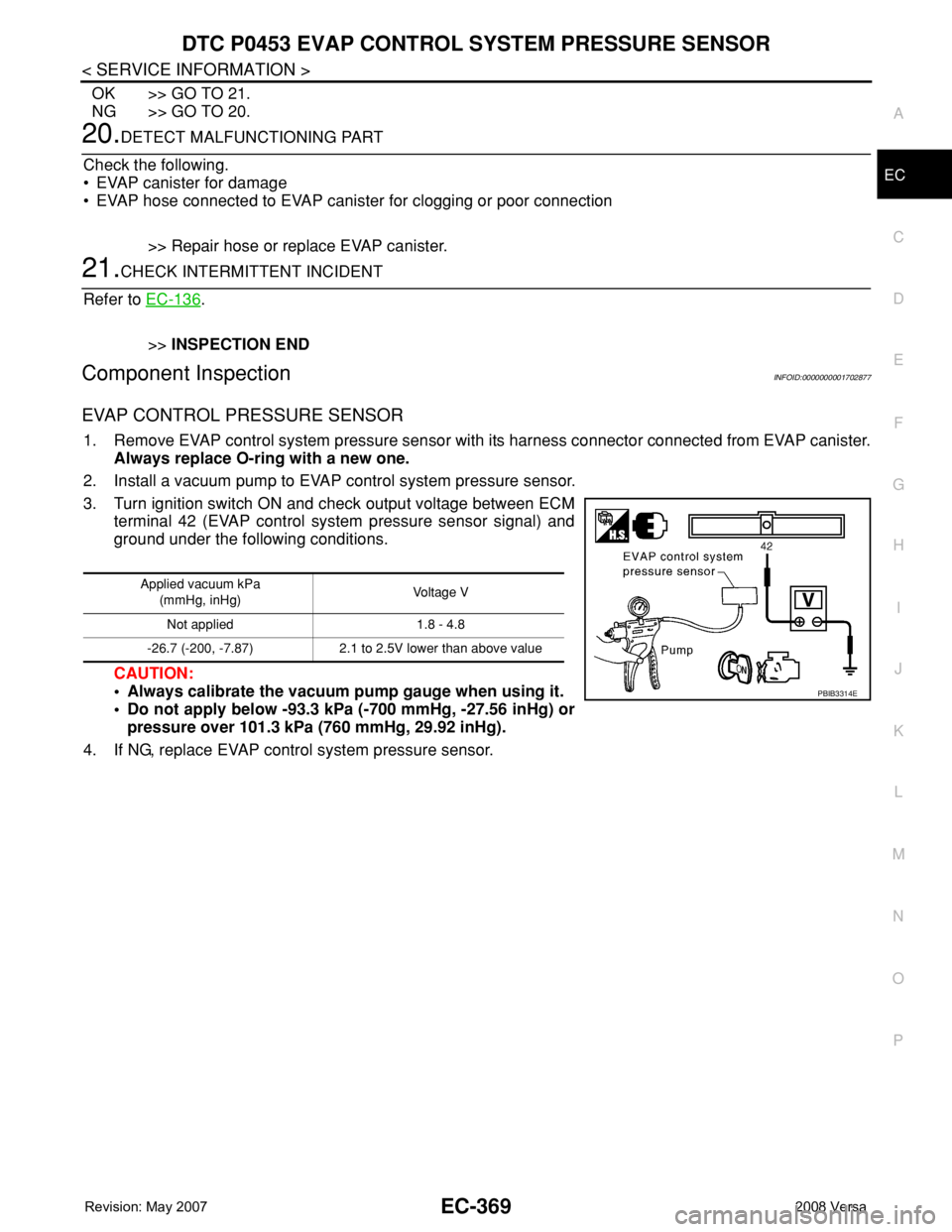
1. Remove EVAP control system pressure sensor with its harness connector connected from EVAP canister.
Always replace O-ring with a new one.
2. Install a vacuum pump to EVAP control system pressure sensor.
3. Turn ignition switch ON and check output voltage between ECM
terminal 42 (EVAP control system pressure sensor signal) and
ground under the following conditions.
CAUTION:
• Always calibrate the vacuum pump gauge when using it.
• Do not apply below -93.3 kPa (-700 mmHg, -27.56 inHg) or
pressure over 101.3 kPa (760 mmHg, 29.92 inHg).
4. If NG, replace EVAP control system pressure sensor.
Applied vacuum kPa
(mmHg, inHg)Voltage V
Not applied 1.8 - 4.8
-26.7 (-200, -7.87) 2.1 to 2.5V lower than above value
PBIB3314E
Page 1444 of 2771
EC-370
< SERVICE INFORMATION >
DTC P0455 EVAP CONTROL SYSTEM
DTC P0455 EVAP CONTROL SYSTEM
On Board Diagnosis LogicINFOID:0000000001702878
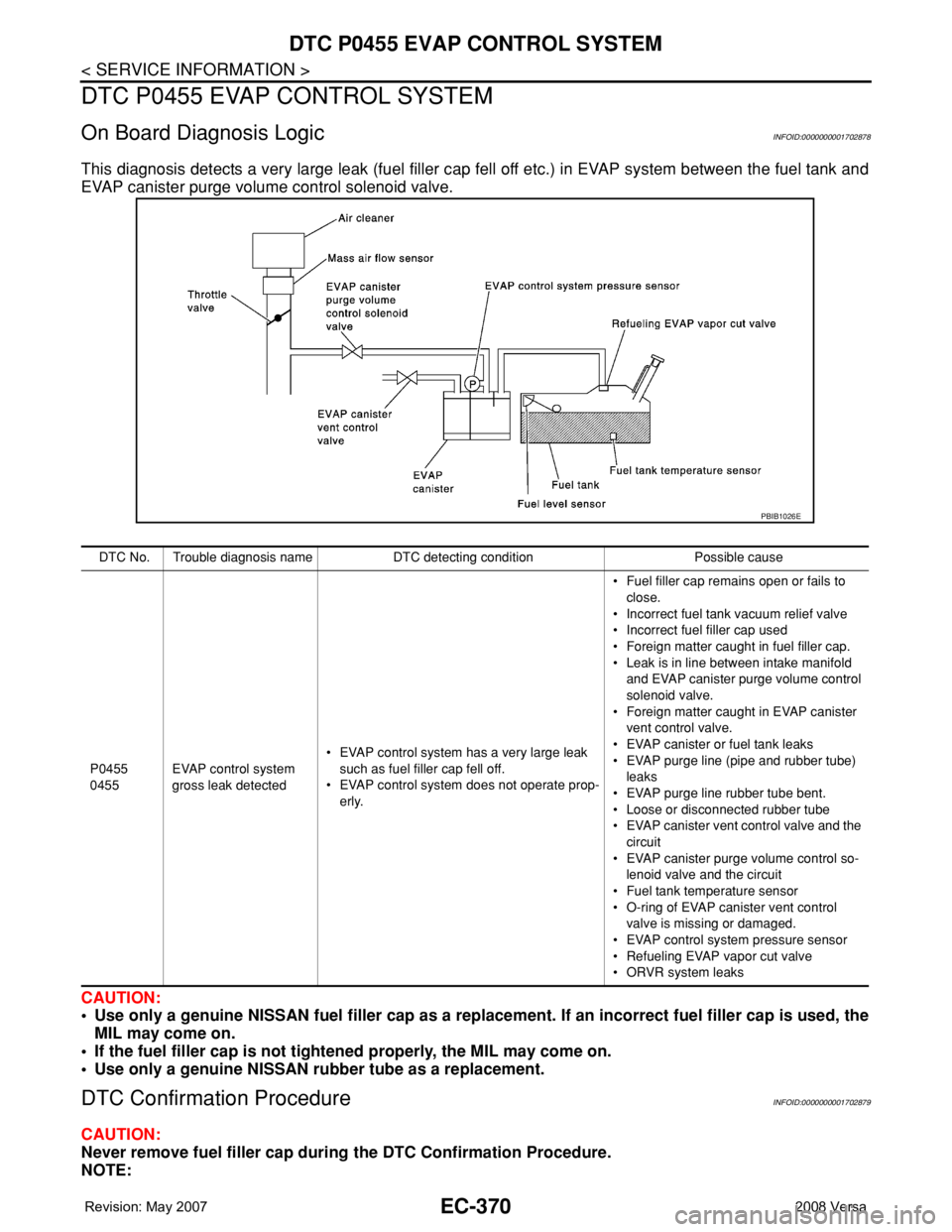
This diagnosis detects a very large leak (fuel filler cap fell off etc.) in EVAP system between the fuel tank and
EVAP canister purge volume control solenoid valve.
CAUTION:
• Use only a genuine NISSAN fuel filler cap as a replacement. If an incorrect fuel filler cap is used, the
MIL may come on.
• If the fuel filler cap is not tightened properly, the MIL may come on.
• Use only a genuine NISSAN rubber tube as a replacement.
DTC Confirmation ProcedureINFOID:0000000001702879
CAUTION:
Never remove fuel filler cap during the DTC Confirmation Procedure.
NOTE:
DTC No. Trouble diagnosis name DTC detecting condition Possible cause
P0455
0455EVAP control system
gross leak detected• EVAP control system has a very large leak
such as fuel filler cap fell off.
• EVAP control system does not operate prop-
erly.• Fuel filler cap remains open or fails to
close.
• Incorrect fuel tank vacuum relief valve
• Incorrect fuel filler cap used
• Foreign matter caught in fuel filler cap.
• Leak is in line between intake manifold
and EVAP canister purge volume control
solenoid valve.
• Foreign matter caught in EVAP canister
vent control valve.
• EVAP canister or fuel tank leaks
• EVAP purge line (pipe and rubber tube)
leaks
• EVAP purge line rubber tube bent.
• Loose or disconnected rubber tube
• EVAP canister vent control valve and the
circuit
• EVAP canister purge volume control so-
lenoid valve and the circuit
• Fuel tank temperature sensor
• O-ring of EVAP canister vent control
valve is missing or damaged.
• EVAP control system pressure sensor
• Refueling EVAP vapor cut valve
• ORVR system leaks
PBIB1026E
Page 1448 of 2771
EC-374
< SERVICE INFORMATION >
DTC P0455 EVAP CONTROL SYSTEM
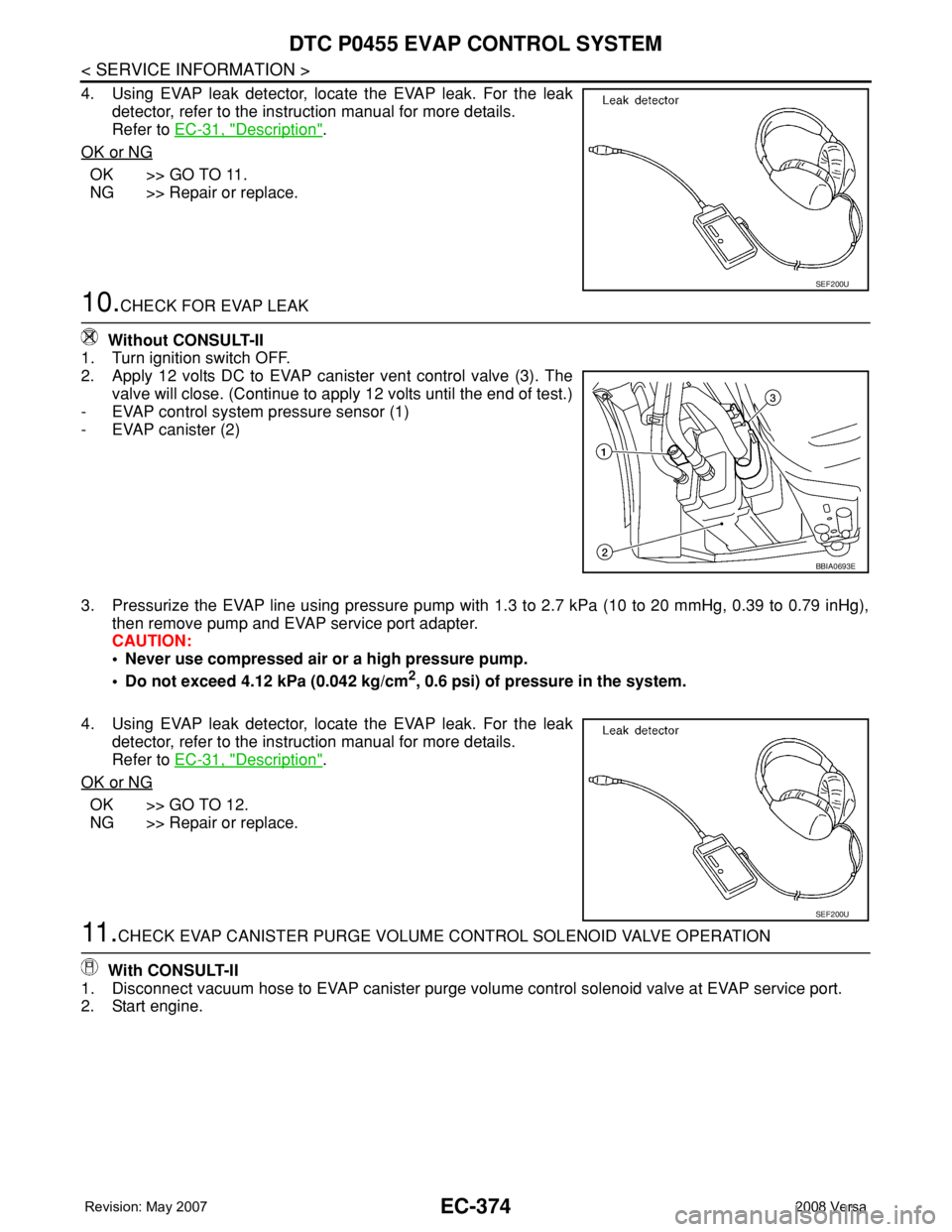
4. Using EVAP leak detector, locate the EVAP leak. For the leak
detector, refer to the instruction manual for more details.
Refer to EC-31, "
Description".
OK or NG
OK >> GO TO 11.
NG >> Repair or replace.
10.CHECK FOR EVAP LEAK
Without CONSULT-II
1. Turn ignition switch OFF.
2. Apply 12 volts DC to EVAP canister vent control valve (3). The
valve will close. (Continue to apply 12 volts until the end of test.)
- EVAP control system pressure sensor (1)
- EVAP canister (2)
3. Pressurize the EVAP line using pressure pump with 1.3 to 2.7 kPa (10 to 20 mmHg, 0.39 to 0.79 inHg),
then remove pump and EVAP service port adapter.
CAUTION:
• Never use compressed air or a high pressure pump.
• Do not exceed 4.12 kPa (0.042 kg/cm
2, 0.6 psi) of pressure in the system.
4. Using EVAP leak detector, locate the EVAP leak. For the leak
detector, refer to the instruction manual for more details.
Refer to EC-31, "
Description".
OK or NG
OK >> GO TO 12.
NG >> Repair or replace.
11 .CHECK EVAP CANISTER PURGE VOLUME CONTROL SOLENOID VALVE OPERATION
With CONSULT-II
1. Disconnect vacuum hose to EVAP canister purge volume control solenoid valve at EVAP service port.
2. Start engine.
SEF200U
BBIA0693E
SEF200U
Page 1449 of 2771
DTC P0455 EVAP CONTROL SYSTEM
EC-375
< SERVICE INFORMATION >
C
D
E
F
G
H
I
J
K
L
MA
EC
N
P O
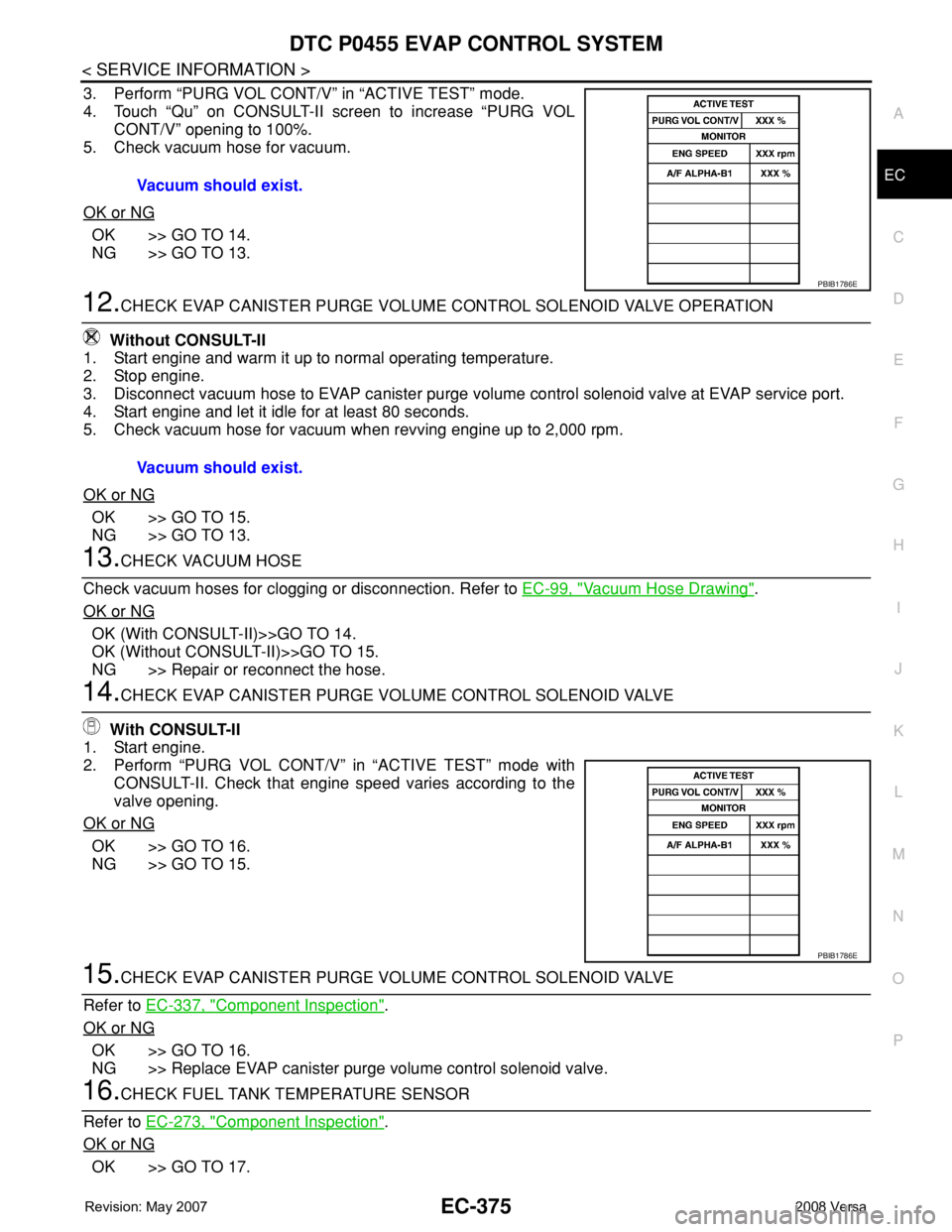
3. Perform “PURG VOL CONT/V” in “ACTIVE TEST” mode.
4. Touch “Qu” on CONSULT-II screen to increase “PURG VOL
CONT/V” opening to 100%.
5. Check vacuum hose for vacuum.
OK or NG
OK >> GO TO 14.
NG >> GO TO 13.
12.CHECK EVAP CANISTER PURGE VOLUME CONTROL SOLENOID VALVE OPERATION
Without CONSULT-II
1. Start engine and warm it up to normal operating temperature.
2. Stop engine.
3. Disconnect vacuum hose to EVAP canister purge volume control solenoid valve at EVAP service port.
4. Start engine and let it idle for at least 80 seconds.
5. Check vacuum hose for vacuum when revving engine up to 2,000 rpm.
OK or NG
OK >> GO TO 15.
NG >> GO TO 13.
13.CHECK VACUUM HOSE
Check vacuum hoses for clogging or disconnection. Refer to EC-99, "
Vacuum Hose Drawing".
OK or NG
OK (With CONSULT-II)>>GO TO 14.
OK (Without CONSULT-II)>>GO TO 15.
NG >> Repair or reconnect the hose.
14.CHECK EVAP CANISTER PURGE VOLUME CONTROL SOLENOID VALVE
With CONSULT-II
1. Start engine.
2. Perform “PURG VOL CONT/V” in “ACTIVE TEST” mode with
CONSULT-II. Check that engine speed varies according to the
valve opening.
OK or NG
OK >> GO TO 16.
NG >> GO TO 15.
15.CHECK EVAP CANISTER PURGE VOLUME CONTROL SOLENOID VALVE
Refer to EC-337, "
Component Inspection".
OK or NG
OK >> GO TO 16.
NG >> Replace EVAP canister purge volume control solenoid valve.
16.CHECK FUEL TANK TEMPERATURE SENSOR
Refer to EC-273, "
Component Inspection".
OK or NG
OK >> GO TO 17.Vacuum should exist.
PBIB1786E
Vacuum should exist.
PBIB1786E