engine NISSAN LATIO 2008 Service Repair Manual
[x] Cancel search | Manufacturer: NISSAN, Model Year: 2008, Model line: LATIO, Model: NISSAN LATIO 2008Pages: 2771, PDF Size: 60.61 MB
Page 1363 of 2771
DTC P0300 - P0304 MULTIPLE CYLINDER MISFIRE, NO. 1 - 4 CYLINDER MIS-
FIRE
EC-289
< SERVICE INFORMATION >
C
D
E
F
G
H
I
J
K
L
MA
EC
N
P O
6. Also check harness for short to power.
OK or NG
OK >> GO TO 14.
NG >> Repair open circuit or short to ground or short to power in harness or connectors.
14.CHECK AIR FUEL RATIO (A/F) SENSOR 1 HEATER
Refer to EC-154, "
Component Inspection".
OK or NG
OK >> GO TO 16.
NG >> GO TO 15.
15.REPLACE AIR FUEL RATIO (A/F) SENSOR 1
Replace air fuel ratio (A/F) sensor 1.
CAUTION:
• Discard any A/F sensor which has been dropped from a height of more than 0.5 m (19.7 in) onto a
hard surface such as a concrete floor; use a new one.
• Before installing new A/F sensor, clean exhaust system threads using Oxygen Sensor Thread
Cleaner tool J-43897-18 or J-43897-12 and approved anti-seize lubricant.
>>INSPECTION END
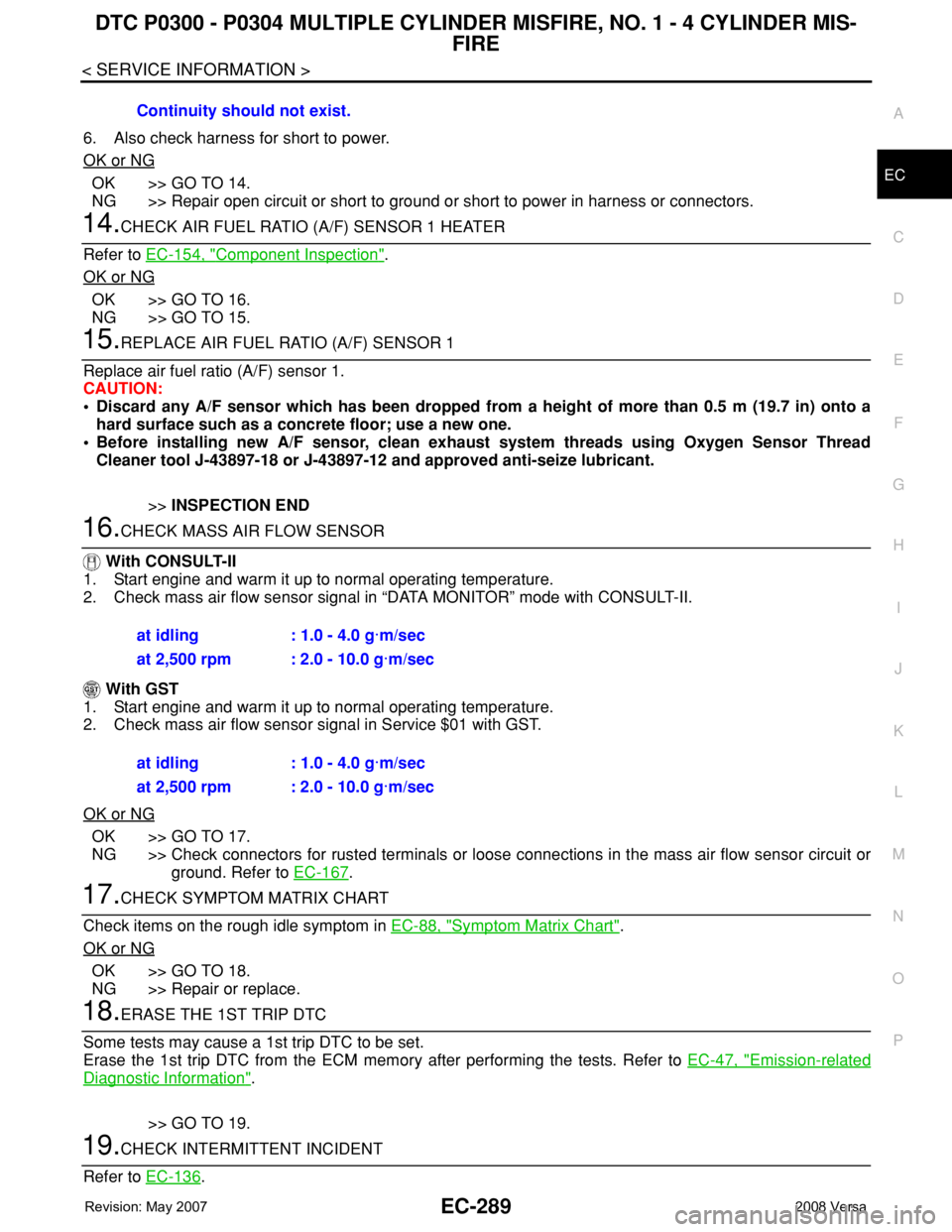
16.CHECK MASS AIR FLOW SENSOR
With CONSULT-II
1. Start engine and warm it up to normal operating temperature.
2. Check mass air flow sensor signal in “DATA MONITOR” mode with CONSULT-II.
With GST
1. Start engine and warm it up to normal operating temperature.
2. Check mass air flow sensor signal in Service $01 with GST.
OK or NG
OK >> GO TO 17.
NG >> Check connectors for rusted terminals or loose connections in the mass air flow sensor circuit or
ground. Refer to EC-167
.
17.CHECK SYMPTOM MATRIX CHART
Check items on the rough idle symptom in EC-88, "
Symptom Matrix Chart".
OK or NG
OK >> GO TO 18.
NG >> Repair or replace.
18.ERASE THE 1ST TRIP DTC
Some tests may cause a 1st trip DTC to be set.
Erase the 1st trip DTC from the ECM memory after performing the tests. Refer to EC-47, "
Emission-related
Diagnostic Information".
>> GO TO 19.
19.CHECK INTERMITTENT INCIDENT
Refer to EC-136
. Continuity should not exist.
at idling : 1.0 - 4.0 g·m/sec
at 2,500 rpm : 2.0 - 10.0 g·m/sec
at idling : 1.0 - 4.0 g·m/sec
at 2,500 rpm : 2.0 - 10.0 g·m/sec
Page 1365 of 2771
DTC P0327, P0328 KS
EC-291
< SERVICE INFORMATION >
C
D
E
F
G
H
I
J
K
L
MA
EC
N
P O
DTC P0327, P0328 KS
Component DescriptionINFOID:0000000001702793
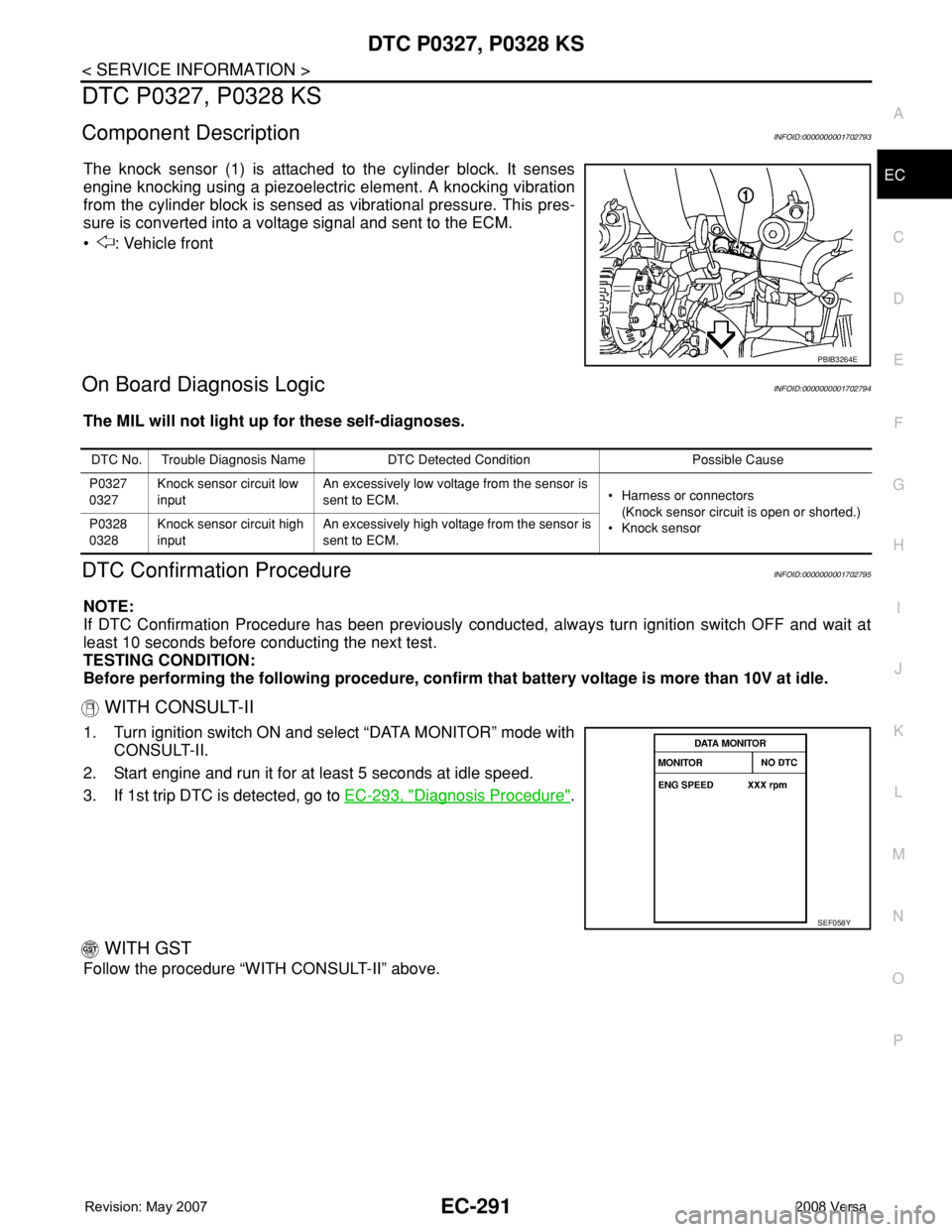
The knock sensor (1) is attached to the cylinder block. It senses
engine knocking using a piezoelectric element. A knocking vibration
from the cylinder block is sensed as vibrational pressure. This pres-
sure is converted into a voltage signal and sent to the ECM.
• : Vehicle front
On Board Diagnosis LogicINFOID:0000000001702794
The MIL will not light up for these self-diagnoses.
DTC Confirmation ProcedureINFOID:0000000001702795
NOTE:
If DTC Confirmation Procedure has been previously conducted, always turn ignition switch OFF and wait at
least 10 seconds before conducting the next test.
TESTING CONDITION:
Before performing the following procedure, confirm that battery voltage is more than 10V at idle.
WITH CONSULT-II
1. Turn ignition switch ON and select “DATA MONITOR” mode with
CONSULT-II.
2. Start engine and run it for at least 5 seconds at idle speed.
3. If 1st trip DTC is detected, go to EC-293, "
Diagnosis Procedure".
WITH GST
Follow the procedure “WITH CONSULT-II” above.
PBIB3264E
DTC No. Trouble Diagnosis Name DTC Detected Condition Possible Cause
P0327
0327Knock sensor circuit low
inputAn excessively low voltage from the sensor is
sent to ECM.• Harness or connectors
(Knock sensor circuit is open or shorted.)
• Knock sensor P0328
0328Knock sensor circuit high
inputAn excessively high voltage from the sensor is
sent to ECM.
SEF058Y
Page 1367 of 2771
DTC P0327, P0328 KS
EC-293
< SERVICE INFORMATION >
C
D
E
F
G
H
I
J
K
L
MA
EC
N
P O
Diagnosis ProcedureINFOID:0000000001702797
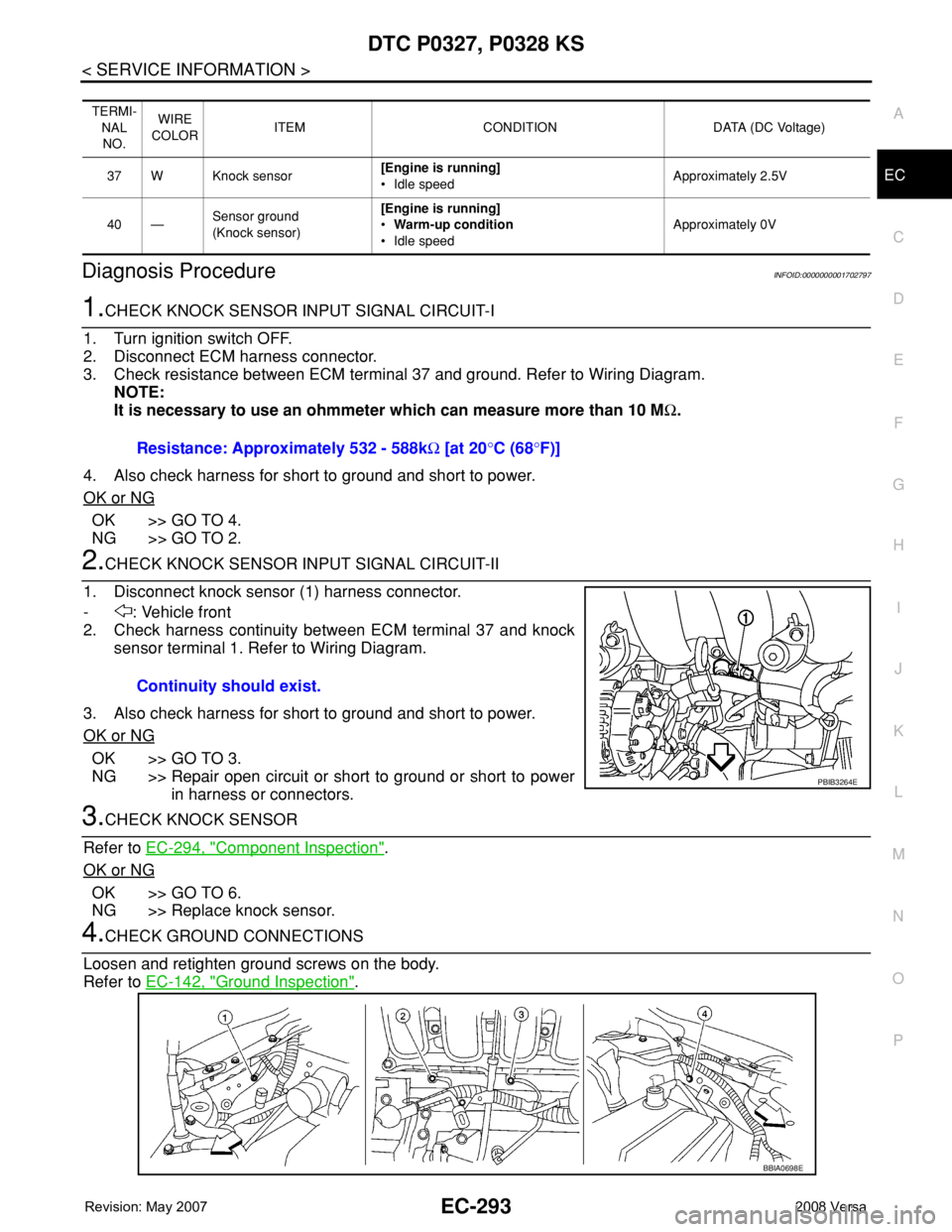
1.CHECK KNOCK SENSOR INPUT SIGNAL CIRCUIT-I
1. Turn ignition switch OFF.
2. Disconnect ECM harness connector.
3. Check resistance between ECM terminal 37 and ground. Refer to Wiring Diagram.
NOTE:
It is necessary to use an ohmmeter which can measure more than 10 MΩ.
4. Also check harness for short to ground and short to power.
OK or NG
OK >> GO TO 4.
NG >> GO TO 2.
2.CHECK KNOCK SENSOR INPUT SIGNAL CIRCUIT-II
1. Disconnect knock sensor (1) harness connector.
- : Vehicle front
2. Check harness continuity between ECM terminal 37 and knock
sensor terminal 1. Refer to Wiring Diagram.
3. Also check harness for short to ground and short to power.
OK or NG
OK >> GO TO 3.
NG >> Repair open circuit or short to ground or short to power
in harness or connectors.
3.CHECK KNOCK SENSOR
Refer to EC-294, "
Component Inspection".
OK or NG
OK >> GO TO 6.
NG >> Replace knock sensor.
4.CHECK GROUND CONNECTIONS
Loosen and retighten ground screws on the body.
Refer to EC-142, "
Ground Inspection".
TERMI-
NAL
NO.WIRE
COLORITEM CONDITION DATA (DC Voltage)
37 W Knock sensor[Engine is running]
• Idle speedApproximately 2.5V
40 —Sensor ground
(Knock sensor)[Engine is running]
•Warm-up condition
• Idle speedApproximately 0V
Resistance: Approximately 532 - 588kΩ [at 20°C (68°F)]
Continuity should exist.
PBIB3264E
BBIA0698E
Page 1368 of 2771
EC-294
< SERVICE INFORMATION >
DTC P0327, P0328 KS
OK or NG
OK >> GO TO 5.
NG >> Repair or replace ground connections.
5.CHECK KNOCK SENSOR SHIELD CIRCUIT FOR OPEN AND SHORT
1. Reconnect knock sensor harness connector.
2. Check harness continuity between ECM terminal 40 and knock sensor terminal 2.
Refer to Wiring Diagram.
3. Also check harness for short to ground and short to power.
OK or NG
OK >> GO TO 6.
NG >> Repair open circuit or short to ground or short to power in harness or connectors.
6.CHECK INTERMITTENT INCIDENT
Refer to EC-136
.
>>INSPECTION END
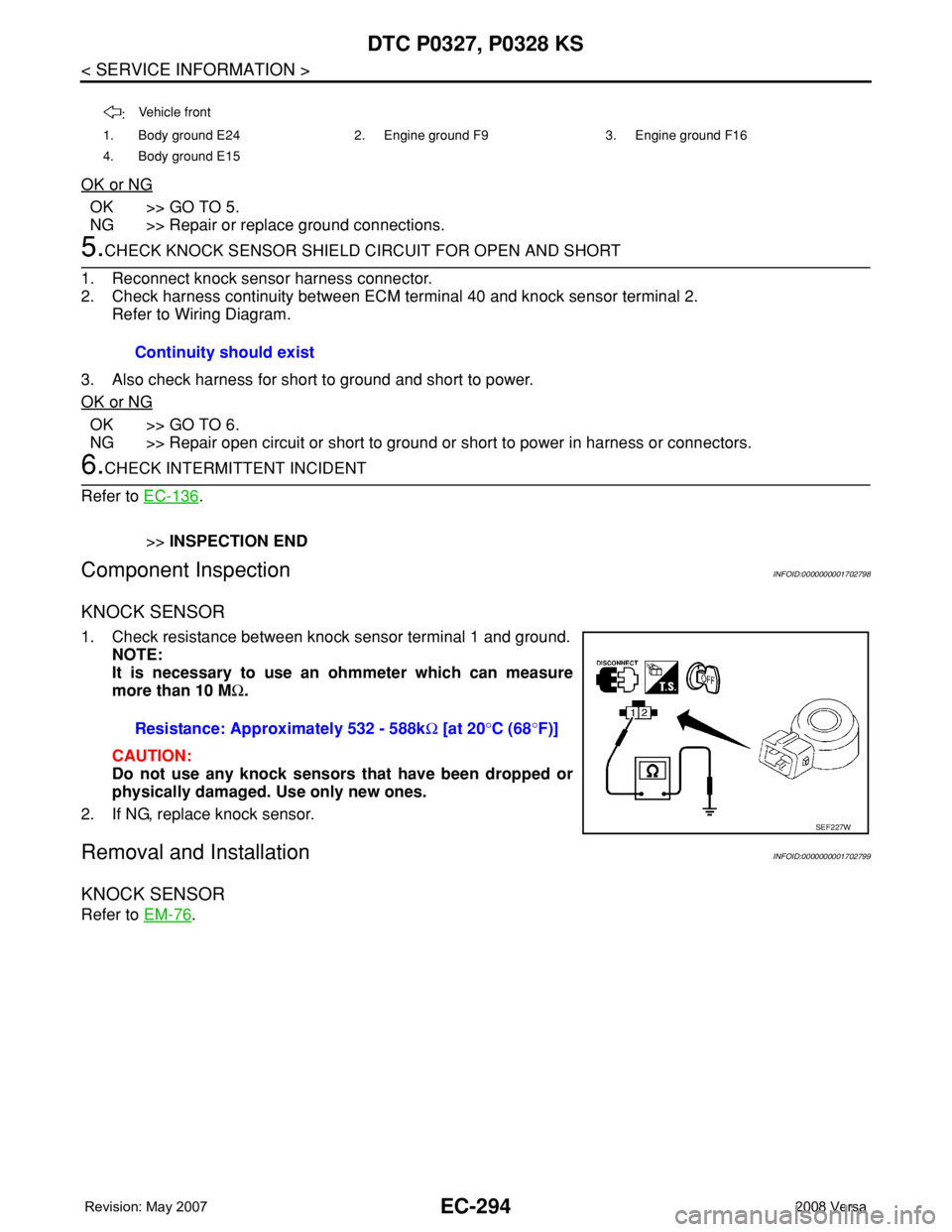
Component InspectionINFOID:0000000001702798
KNOCK SENSOR
1. Check resistance between knock sensor terminal 1 and ground.
NOTE:
It is necessary to use an ohmmeter which can measure
more than 10 MΩ.
CAUTION:
Do not use any knock sensors that have been dropped or
physically damaged. Use only new ones.
2. If NG, replace knock sensor.
Removal and InstallationINFOID:0000000001702799
KNOCK SENSOR
Refer to EM-76.
:Vehicle front
1. Body ground E24 2. Engine ground F9 3. Engine ground F16
4. Body ground E15
Continuity should exist
Resistance: Approximately 532 - 588kΩ [at 20°C (68°F)]
SEF227W
Page 1369 of 2771
DTC P0335 CKP SENSOR (POS)
EC-295
< SERVICE INFORMATION >
C
D
E
F
G
H
I
J
K
L
MA
EC
N
P O
DTC P0335 CKP SENSOR (POS)
Component DescriptionINFOID:0000000001702800
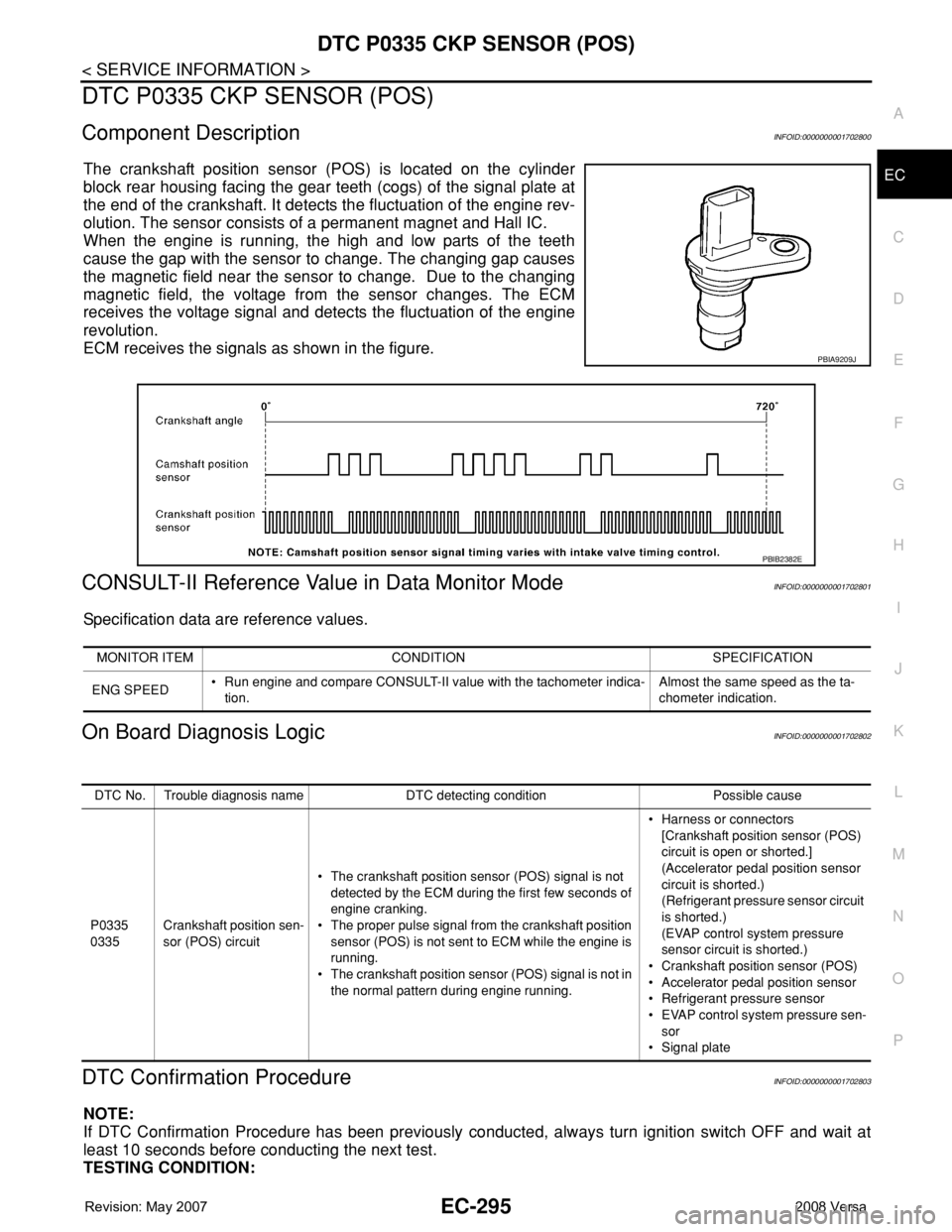
The crankshaft position sensor (POS) is located on the cylinder
block rear housing facing the gear teeth (cogs) of the signal plate at
the end of the crankshaft. It detects the fluctuation of the engine rev-
olution. The sensor consists of a permanent magnet and Hall IC.
When the engine is running, the high and low parts of the teeth
cause the gap with the sensor to change. The changing gap causes
the magnetic field near the sensor to change. Due to the changing
magnetic field, the voltage from the sensor changes. The ECM
receives the voltage signal and detects the fluctuation of the engine
revolution.
ECM receives the signals as shown in the figure.
CONSULT-II Reference Value in Data Monitor ModeINFOID:0000000001702801
Specification data are reference values.
On Board Diagnosis LogicINFOID:0000000001702802
DTC Confirmation ProcedureINFOID:0000000001702803
NOTE:
If DTC Confirmation Procedure has been previously conducted, always turn ignition switch OFF and wait at
least 10 seconds before conducting the next test.
TESTING CONDITION:
PBIA9209J
PBIB2382E
MONITOR ITEM CONDITION SPECIFICATION
ENG SPEED• Run engine and compare CONSULT-II value with the tachometer indica-
tion.Almost the same speed as the ta-
chometer indication.
DTC No. Trouble diagnosis name DTC detecting condition Possible cause
P0335
0335Crankshaft position sen-
sor (POS) circuit• The crankshaft position sensor (POS) signal is not
detected by the ECM during the first few seconds of
engine cranking.
• The proper pulse signal from the crankshaft position
sensor (POS) is not sent to ECM while the engine is
running.
• The crankshaft position sensor (POS) signal is not in
the normal pattern during engine running.• Harness or connectors
[Crankshaft position sensor (POS)
circuit is open or shorted.]
(Accelerator pedal position sensor
circuit is shorted.)
(Refrigerant pressure sensor circuit
is shorted.)
(EVAP control system pressure
sensor circuit is shorted.)
• Crankshaft position sensor (POS)
• Accelerator pedal position sensor
• Refrigerant pressure sensor
• EVAP control system pressure sen-
sor
• Signal plate
Page 1370 of 2771
EC-296
< SERVICE INFORMATION >
DTC P0335 CKP SENSOR (POS)
Before performing the following procedure, confirm that battery voltage is more than 10.5V with igni-
tion switch ON.
WITH CONSULT-II
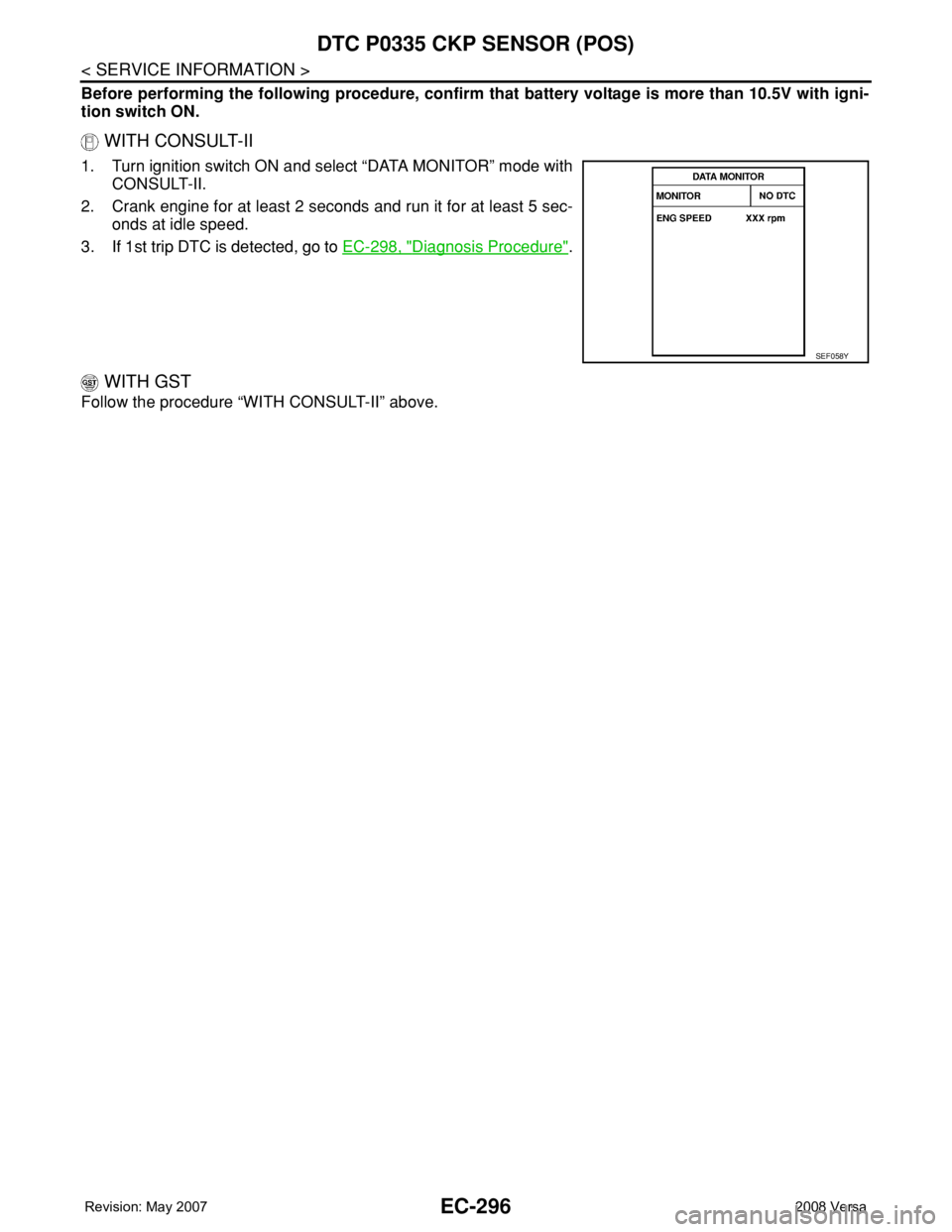
1. Turn ignition switch ON and select “DATA MONITOR” mode with
CONSULT-II.
2. Crank engine for at least 2 seconds and run it for at least 5 sec-
onds at idle speed.
3. If 1st trip DTC is detected, go to EC-298, "
Diagnosis Procedure".
WITH GST
Follow the procedure “WITH CONSULT-II” above.
SEF058Y
Page 1372 of 2771
EC-298
< SERVICE INFORMATION >
DTC P0335 CKP SENSOR (POS)
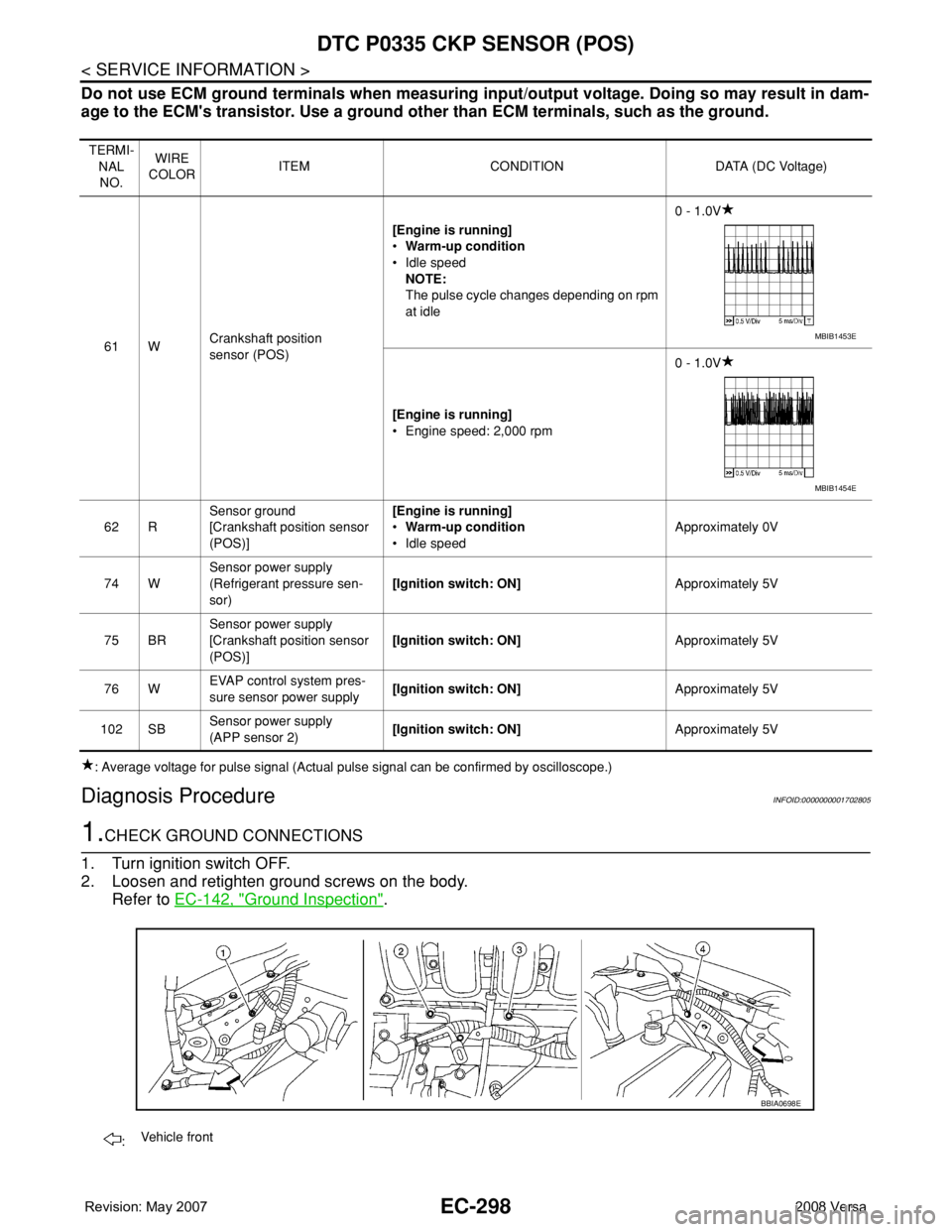
Do not use ECM ground terminals when measuring input/output voltage. Doing so may result in dam-
age to the ECM's transistor. Use a ground other than ECM terminals, such as the ground.
: Average voltage for pulse signal (Actual pulse signal can be confirmed by oscilloscope.)
Diagnosis ProcedureINFOID:0000000001702805
1.CHECK GROUND CONNECTIONS
1. Turn ignition switch OFF.
2. Loosen and retighten ground screws on the body.
Refer to EC-142, "
Ground Inspection".
TERMI-
NAL
NO.WIRE
COLORITEM CONDITION DATA (DC Voltage)
61 WCrankshaft position
sensor (POS)[Engine is running]
•Warm-up condition
• Idle speed
NOTE:
The pulse cycle changes depending on rpm
at idle0 - 1.0V
[Engine is running]
• Engine speed: 2,000 rpm0 - 1.0V
62 RSensor ground
[Crankshaft position sensor
(POS)][Engine is running]
•Warm-up condition
• Idle speedApproximately 0V
74 WSensor power supply
(Refrigerant pressure sen-
sor)[Ignition switch: ON]Approximately 5V
75 BRSensor power supply
[Crankshaft position sensor
(POS)][Ignition switch: ON]Approximately 5V
76 WEVAP control system pres-
sure sensor power supply[Ignition switch: ON]Approximately 5V
102 SBSensor power supply
(APP sensor 2)[Ignition switch: ON]Approximately 5V
MBIB1453E
MBIB1454E
:Vehicle front
BBIA0698E
Page 1373 of 2771
DTC P0335 CKP SENSOR (POS)
EC-299
< SERVICE INFORMATION >
C
D
E
F
G
H
I
J
K
L
MA
EC
N
P O
OK or NG
OK >> GO TO 2.
NG >> Repair or replace ground connections.
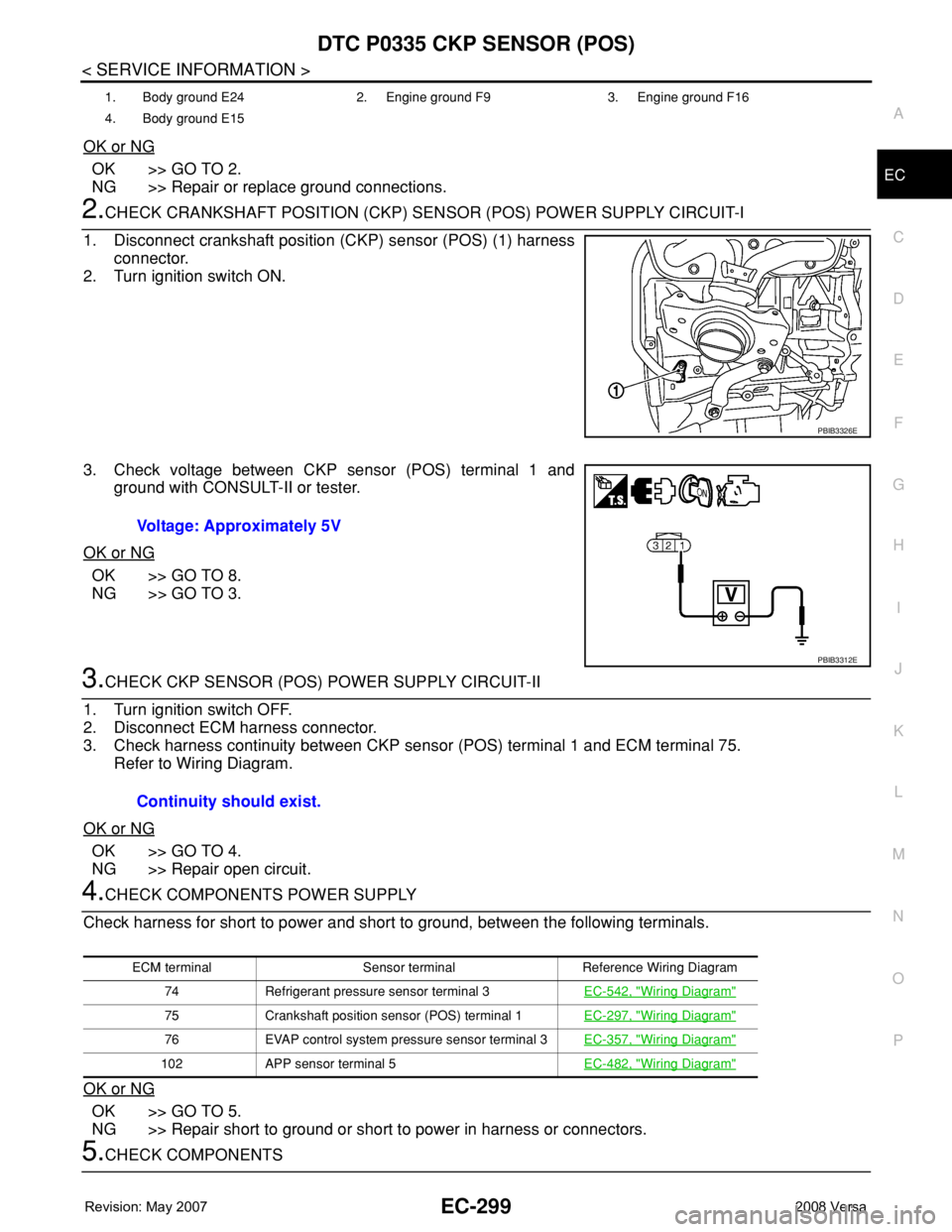
2.CHECK CRANKSHAFT POSITION (CKP) SENSOR (POS) POWER SUPPLY CIRCUIT-I
1. Disconnect crankshaft position (CKP) sensor (POS) (1) harness
connector.
2. Turn ignition switch ON.
3. Check voltage between CKP sensor (POS) terminal 1 and
ground with CONSULT-II or tester.
OK or NG
OK >> GO TO 8.
NG >> GO TO 3.
3.CHECK CKP SENSOR (POS) POWER SUPPLY CIRCUIT-II
1. Turn ignition switch OFF.
2. Disconnect ECM harness connector.
3. Check harness continuity between CKP sensor (POS) terminal 1 and ECM terminal 75.
Refer to Wiring Diagram.
OK or NG
OK >> GO TO 4.
NG >> Repair open circuit.
4.CHECK COMPONENTS POWER SUPPLY
Check harness for short to power and short to ground, between the following terminals.
OK or NG
OK >> GO TO 5.
NG >> Repair short to ground or short to power in harness or connectors.
5.CHECK COMPONENTS
1. Body ground E24 2. Engine ground F9 3. Engine ground F16
4. Body ground E15
PBIB3326E
Voltage: Approximately 5V
PBIB3312E
Continuity should exist.
ECM terminal Sensor terminal Reference Wiring Diagram
74 Refrigerant pressure sensor terminal 3EC-542, "
Wiring Diagram"
75 Crankshaft position sensor (POS) terminal 1EC-297, "Wiring Diagram"
76 EVAP control system pressure sensor terminal 3EC-357, "Wiring Diagram"
102 APP sensor terminal 5EC-482, "Wiring Diagram"
Page 1376 of 2771
EC-302
< SERVICE INFORMATION >
DTC P0340 CMP SENSOR (PHASE)
DTC P0340 CMP SENSOR (PHASE)
Component DescriptionINFOID:0000000001702808
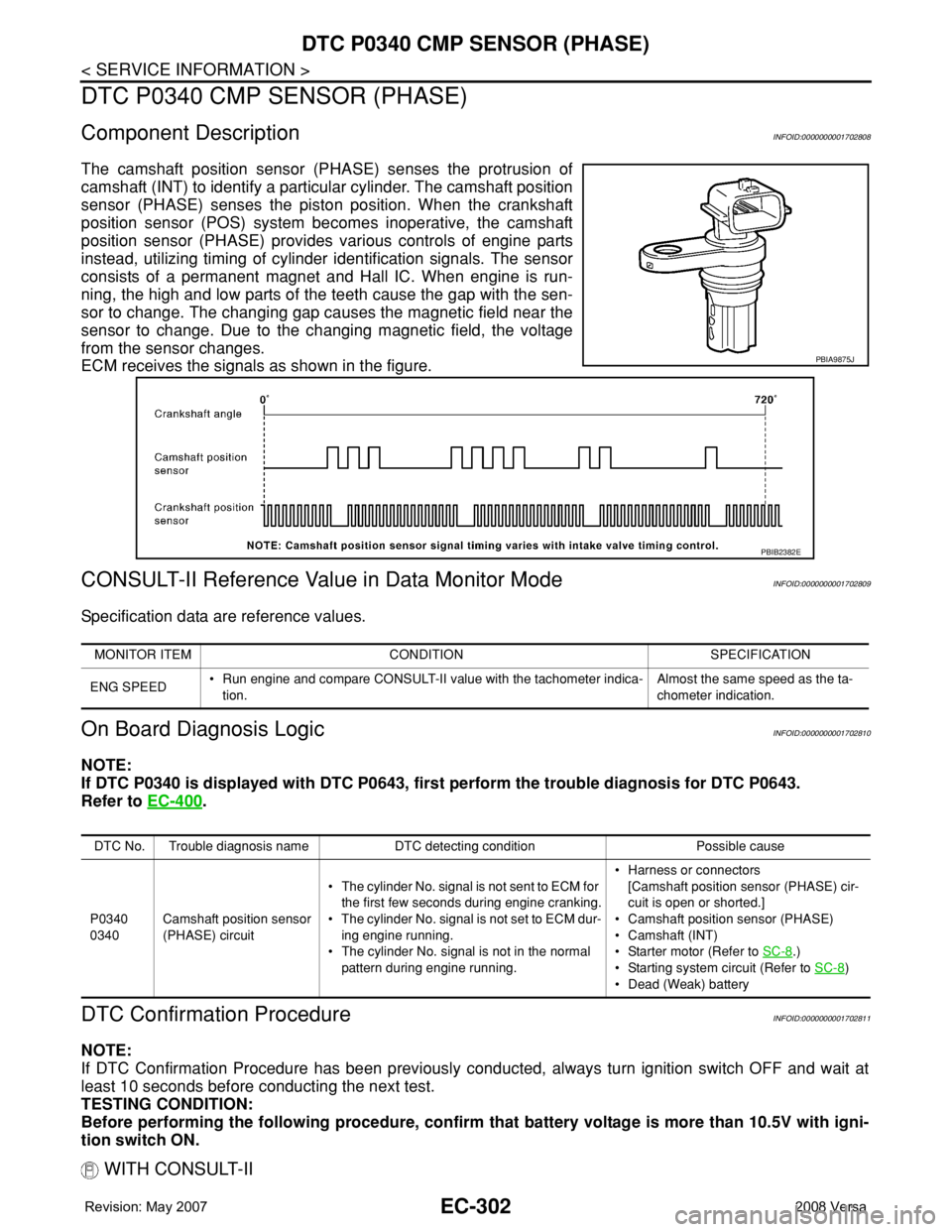
The camshaft position sensor (PHASE) senses the protrusion of
camshaft (INT) to identify a particular cylinder. The camshaft position
sensor (PHASE) senses the piston position. When the crankshaft
position sensor (POS) system becomes inoperative, the camshaft
position sensor (PHASE) provides various controls of engine parts
instead, utilizing timing of cylinder identification signals. The sensor
consists of a permanent magnet and Hall IC. When engine is run-
ning, the high and low parts of the teeth cause the gap with the sen-
sor to change. The changing gap causes the magnetic field near the
sensor to change. Due to the changing magnetic field, the voltage
from the sensor changes.
ECM receives the signals as shown in the figure.
CONSULT-II Reference Value in Data Monitor ModeINFOID:0000000001702809
Specification data are reference values.
On Board Diagnosis LogicINFOID:0000000001702810
NOTE:
If DTC P0340 is displayed with DTC P0643, first perform the trouble diagnosis for DTC P0643.
Refer to EC-400
.
DTC Confirmation ProcedureINFOID:0000000001702811
NOTE:
If DTC Confirmation Procedure has been previously conducted, always turn ignition switch OFF and wait at
least 10 seconds before conducting the next test.
TESTING CONDITION:
Before performing the following procedure, confirm that battery voltage is more than 10.5V with igni-
tion switch ON.
WITH CONSULT-II
PBIA9875J
PBIB2382E
MONITOR ITEM CONDITION SPECIFICATION
ENG SPEED• Run engine and compare CONSULT-II value with the tachometer indica-
tion.Almost the same speed as the ta-
chometer indication.
DTC No. Trouble diagnosis name DTC detecting condition Possible cause
P0340
0340Camshaft position sensor
(PHASE) circuit• The cylinder No. signal is not sent to ECM for
the first few seconds during engine cranking.
• The cylinder No. signal is not set to ECM dur-
ing engine running.
• The cylinder No. signal is not in the normal
pattern during engine running.• Harness or connectors
[Camshaft position sensor (PHASE) cir-
cuit is open or shorted.]
• Camshaft position sensor (PHASE)
• Camshaft (INT)
• Starter motor (Refer to SC-8
.)
• Starting system circuit (Refer to SC-8
)
• Dead (Weak) battery
Page 1377 of 2771
DTC P0340 CMP SENSOR (PHASE)
EC-303
< SERVICE INFORMATION >
C
D
E
F
G
H
I
J
K
L
MA
EC
N
P O
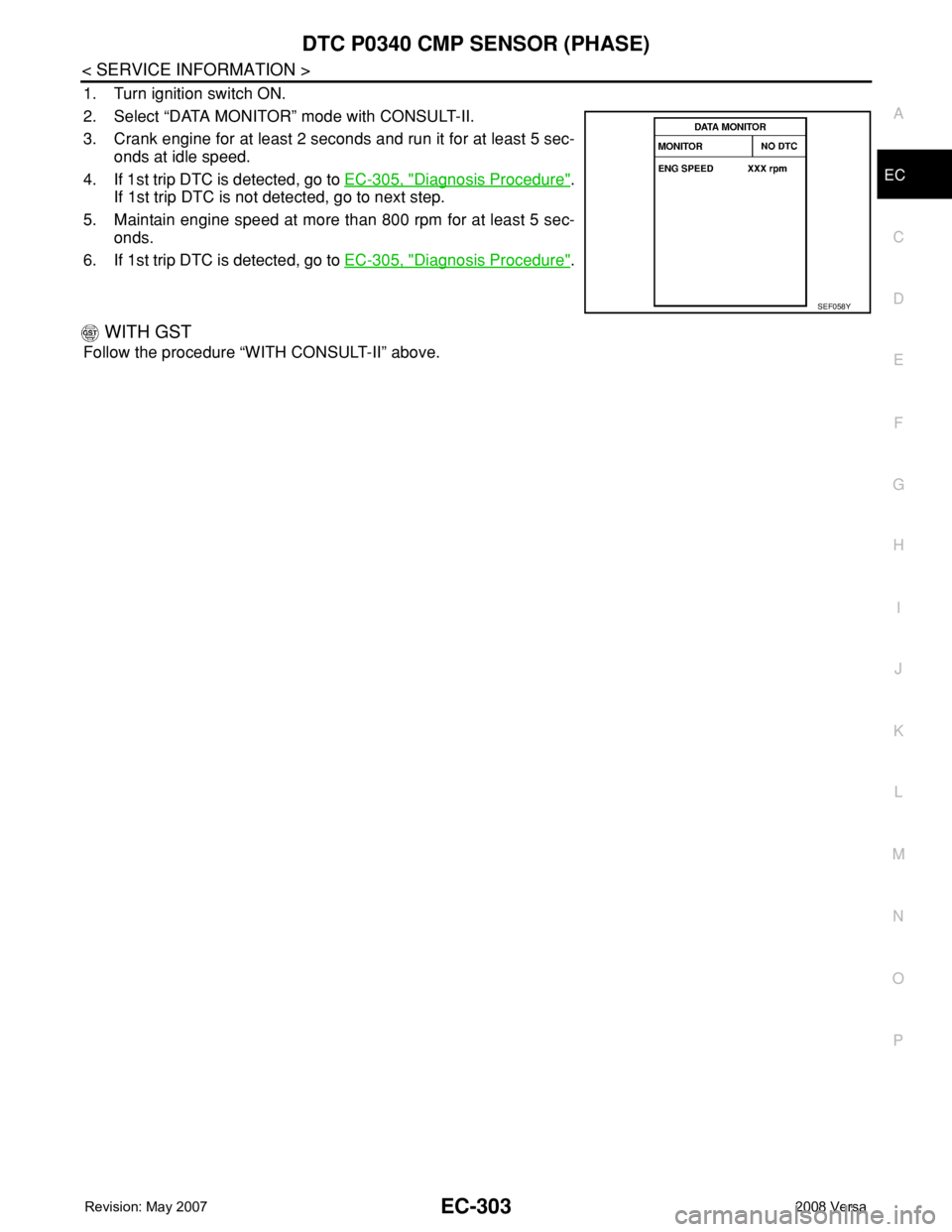
1. Turn ignition switch ON.
2. Select “DATA MONITOR” mode with CONSULT-II.
3. Crank engine for at least 2 seconds and run it for at least 5 sec-
onds at idle speed.
4. If 1st trip DTC is detected, go to EC-305, "
Diagnosis Procedure".
If 1st trip DTC is not detected, go to next step.
5. Maintain engine speed at more than 800 rpm for at least 5 sec-
onds.
6. If 1st trip DTC is detected, go to EC-305, "
Diagnosis Procedure".
WITH GST
Follow the procedure “WITH CONSULT-II” above.
SEF058Y