tires NISSAN LEAF 2012 User Guide
[x] Cancel search | Manufacturer: NISSAN, Model Year: 2012, Model line: LEAF, Model: NISSAN LEAF 2012Pages: 1062, PDF Size: 3.63 MB
Page 74 of 1062
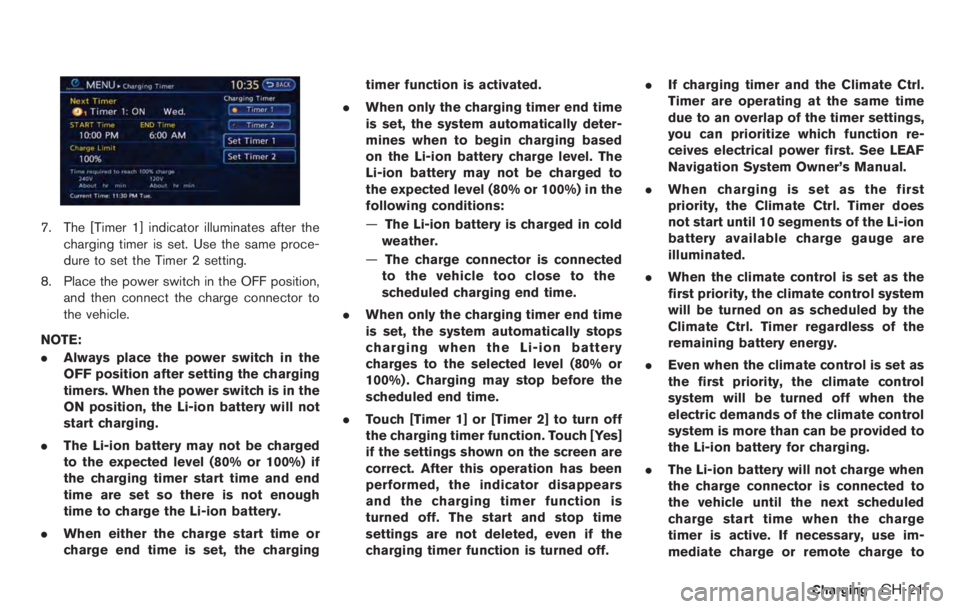
TIRE EQUIPMENT
SUMMER tires have a tread designed to provide
superior performance on dry pavement. How-
ever, the performance of these tires will be
substantially reduced in snowy and icy condi-
tions. If you operate your vehicle on snowy or icy
roads, NISSAN recommends the use of MUD &
SNOW or ALL SEASON tires on all four wheels.
Consult a NISSAN certified LEAF dealer for the
tire type, size, speed rating and availability
information.
For additional traction on icy roads, studded
tires may be used. However, some U.S. states
and Canadian provinces prohibit their use.
Check local, state and provincial laws before
installing studded tires.
Skid and traction capabilities of studded
snow tires, on wet or dry surfaces, may be
poorer than that of non-studded snow
tires.
Tire chains may be used. For details, see “Tire
chains” in the “8. Maintenance and do-it-
yourself” section.
SPECIAL WINTER EQUIPMENT
It is recommended that the following items be
carried in the vehicle during winter:
.A scraper and stiff-bristled brush to remove
ice and snow from the windows and wiper
blades.
. A shovel to dig the vehicle out of snow-
drifts.
. Extra window washer fluid to refill the
reservoir tank.
DRIVING ON SNOW OR ICE
Page 78 of 1062
and increase the likelihood of tire
failure. Serious vehicle damage
could occur and may lead to an
accident and could result in serious
personal injury. Check the tire pres-
sure for all four tires. Adjust the tire
pressure to the recommended COLD
tire pressure shown on the Tire and
Loading Information label to turn
the low tire pressure warning light
OFF. If the light still illuminates
while driving after adjusting the tire
pressure, a tire may be flat. If you
have a flat tire, repair it as soon as
possible.
. When a wheel is replaced, the TPMS
will not function and the low tire
pressure warning light will flash for
approximately 1 minute. The light
will remain on after 1 minute. Con-
tact a NISSAN certified LEAF dealer
as soon as possible for tire replace-
ment and/or system resetting.
. Replacing tires with those not ori-
ginally specified by NISSAN could
affect the proper operation of the
TPMS. .
If you used the Emergency Tire
Sealant to repair a minor tire punc-
ture, your NISSAN certified LEAF
dealer will also need to replace the
TPMS sensor in addition to repair-
ing or replacing the tire.
. NISSAN recommends using only
NISSAN Genuine Emergency Tire
Sealant provided with your vehicle.
Other tire sealants may damage the
valve stem seal which can cause the
tire to lose air pressure.
REPAIRING FLAT TIRE
Page 101 of 1062
5.Three-digit code: Date of Manufacture
6.Four numbers represent the week and
year the tire was built. For example, the
numbers 3103 means the 31st week of
2003. If these numbers are missing,
then look on the other sidewall of the
tire.
*3Tire ply composition and material
The number of layers or plies of rubber-
coated fabric in the tire.
Tire manufacturers also must indicate
the materials in the tire, which include
steel, nylon, polyester, and others.
*4Maximum permissible inflation pressure
This number is the greatest amount of
air pressure that should be put in the
tire. Do not exceed the maximum
permissible inflation pressure.
*5Maximum load rating
This number indicates the maximum
load in kilograms and pounds that can
be carried by the tire. When replacing
the tires on the vehicle, always use a
tire that has the same load rating as the
factory installed tire.
*6Term of “tubeless” or “tube type”
Indicates whether the tire requires aninner tube (“tube type”) or not (“tube-
less”) .
*7The word “radial”
The word “radial” is shown, if the tire
has radial structure.
*8Manufacturer or brand name
Manufacturer or brand name is shown.
Other tire-related terminology:
In addition to the many terms that are
defined throughout this section, Intended
Outboard Sidewall is (1) the sidewall that
contains a whitewall, bears white lettering
or bears manufacturer, brand and/or model
name molding that is higher or deeper than
the same molding on the other sidewall of
the tire, or (2) the outward facing sidewall
of an asymmetrical tire that has a particular
side that must always face outward when
mounted on a vehicle.
TYPES OF TIRES
Page 103 of 1062
CHANGING WHEELS AND TIRES
Tire rotation
NISSAN recommends rotating the tires
every 7,500 miles (12,000 km) .
As soon as possible, tighten the wheel
nuts to the specified torque using a
torque wrench.
Wheel nut tightening torque:80 ft-lb (108 N·m)
The wheel nuts must be kept tigh-
tened to the specification at all times.
It is recommended that wheel nuts be
tightened to the specification at each
tire rotation interval.
Page 104 of 1062
.The original tires have built-in
tread wear indicators. When
wear indicators are visible, the
tire(s) should be replaced.
.Tires degrade with age and use.
Have tires, over 6 years old
checked by a qualified techni-
cian, because some tire damage
may not be obvious. Replace the
tires as necessary to prevent tire
failure and possible personal
injury.
.For additional information re-
garding tires, refer to “Important
Tire Safety Information” (US) or
“Tire Safety Information” (Cana-
da) in the Warranty Information
Booklet.
Replacing wheels and tires
When replacing a tire, use the same size, tread
design, speed rating and load carrying capacity
as originally equipped. See “Specifications” in
the “9. Technical and consumer information”
section for recommended types and sizes of
tires and wheels.
Page 106 of 1062
9 Technical and consumer information
Capacities and recommended lubricants .......................... 9-2Air conditioning system refrigerant and
lubricant recommendations .............................................. 9-3
Specifications ............................................................................ 9-4 Charging system ................................................................ 9-4
Motor ..................................................................................... 9-5
Wheels and tires ................................................................ 9-5
Dimensions and weights .................................................. 9-5
When traveling or registering your vehicle in
another country ......................................................................... 9-6
Vehicle identification ................................................................ 9-6 Vehicle Identification Number (VIN) plate .................... 9-6
Vehicle identification number (chassis number) ........ 9-6
Traction motor serial number .......................................... 9-7
F.M.V.S.S./C.M.V.S.S certification label ....................... 9-7
Emission control information label ................................. 9-7
Tire and Loading Information label ................................ 9-8
Air conditioner specification label .................................. 9-8 Installing front license plate .................................................. 9-9
Vehicle loading information ................................................ 9-10 Terms ................................................................................ 9-10
Vehicle load capacity ................................................... 9-11
Securing the load ......................................................... 9-12
Loading tips .................................................................... 9-13
Measurement of weights ............................................. 9-13
Towing a trailer ...................................................................... 9-13
Flat towing .............................................................................. 9-14
Uniform tire quality grading ................................................ 9-14
Treadwear ....................................................................... 9-14
Traction AA, A, B and C ............................................. 9-14
Temperature A, B and C ............................................. 9-14
Reporting safety defects .................................................... 9-15
Telematics overview ............................................................. 9-16
Event Data Recorder (EDR) .............................................. 9-18
Owner’s Manual/Service Manual order information .... 9-19
Page 117 of 1062

4.The resulting figure equals the available
amount of cargo and luggage load
capacity. For example, if the XXX
amount equals 1400 lbs. and there will
be five 150 lb. passengers in your
vehicle, the amount of available cargo
and luggage load capacity is 650 lbs.
(1400−750 (5 x 150) = 650 lbs) or
(640 −340 (5 x 70) = 300 kg.)
5.Determine the combined weight of
luggage and cargo being loaded on
the vehicle. That weight may not safely
exceed the available cargo and luggage
load capacity calculated in Step 4.
Before driving a loaded vehicle, confirm
that you do not exceed the Gross Vehicle
Weight Rating (GVWR) or the Gross Axle
Weight Rating (GAWR) for your vehicle.
(See “Measurement of weights” later in this
section.)
Also check tires for proper inflation pres-
sures. See the Tire and Loading Information
label.
Page 130 of 1062

Precautions on supplemental
restraint system..................................................... 1-36
Switch Autolight switch.................................................... 2-42
Fog light switch.................................................... 2-44
Hazard warning flasher switch.......................... 2-45
Headlight Aiming Control ................................. 2-44
Headlight switch................................................... 2-41
Power door lock switch......................................... 3-5
Rear window and outside mirror
defroster switch.................................................... 2-40
Turn signal switch ................................................ 2-44
Vehicle dynamic control (VDC) off switch..... 2-48
T
Telematics overview.................................................... 9-16
Temperature Li-ion battery temperature gauge........................ 2-7
Theft (NISSAN Vehicle Immobilizer System) ,
traction motor start ..................................................... 2-36
Tilt steering column .................................................... 3-19
Tire Low tire pressure warning light........................ 2-16
Tires Flat tire....................................................................... 6-2
Low tire pressure warning system...................... 5-2
Tire and Loading information label ......... 8-27, 9-8
Tire chains.............................................................. 8-31
Tire dressing............................................................. 7-4
Tire pressure ......................................................... 8-28
Tire pressure monitoring
system (TPMS) ............................................... 5-2, 6-2
Tire rotation............................................................ 8-32
Types of tires......................................................... 8-30
Uniform tire quality grading ............................... 9-14
Wheel/tire size......................................................... 9-5 Wheels and tires.................................................. 8-25
Tools............................................................................... 6-13
To p Tether strap child restraints............................... 1-22
Towing Flat towing ............................................................. 9-14
Tow truck towing.................................................. 6-13
Towing a trailer ..................................................... 9-13
TPMS, Tire pressure monitoring system................. 5-2
TPMS, Tire pressure warning system...................... 6-2
Traction motor Traction motor serial number ............................... 9-7
Trailer towing................................................................ 9-13
Transceiver, HomeLink
®Universal
Transceiver............................................................. 2-58
Transmitter, With Intelligent Key system
(See Intelligent Key system)..................................... 3-13
Trickle charge........................................................... CH-11
Trip computer............................................................... 2-27
Turn signal switch ....................................................... 2-44
Type of charge and how to charge the
Li-ion battery................................................................ CH-5
U
Underbody cleaning ..................................................... 7-3
Uniform tire quality grading ...................................... 9-14
Unplugged status.................................................... CH-25
V
Vanity mirror.................................................................. 3-22
Vehicle Dimensions and weights....................................... 9-5
Identification number (VIN)................................... 9-6
Loading information ............................................. 9-10
Recovery (freeing stuck vehicle) ...................... 6-15 Security system .................................................... 2-35
Vehicle dynamic control (VDC) off switch..... 2-48
Vehicle dynamic control (VDC) system.......... 5-24
Vehicle Dynamic Control (VDC)
warning light.......................................................... 2-19
Vehicle Dynamic Control (VDC) warning light .... 2-19
Vehicle security system ............................................. 2-35
Ventilators........................................................................ 4-2
W
Warning Hazard warning flasher switch.......................... 2-45
Indicators for operation....................................... 2-23
Tire pressure monitoring
system (TPMS) ............................................... 5-2, 6-2
Warning information displays............................ 2-31
Warning lights....................................................... 2-13
Warning/indicator lights and
audible reminders................................................. 2-12
Warning and indicator lights.................................... 0-10
Warning information displays................................... 2-31
Warning labels, Air bag warning labels................. 1-50
Warning light Air bag warning light................................ 1-50, 2-18
Anti-lock braking system (ABS)
warning light.......................................................... 2-14
BRAKE system warning light (yellow) ............ 2-14
BRAKE warning light (red) ................................ 2-15
Low tire pressure warning light........................ 2-16
Seat belt warning light........................................ 2-18
Vehicle Dynamic Control (VDC)
warning light.......................................................... 2-19
Washer switch Rear window wiper and washer switch ......... 2-39
Windshield wiper and washer switch............. 2-38
Washing........................................................................... 7-2
Index10-5
Page 160 of 1062

4.The resulting figure equals the available
amount of cargo and luggage load
capacity. For example, if the XXX
amount equals 1400 lbs. and there will
be five 150 lb. passengers in your
vehicle, the amount of available cargo
and luggage load capacity is 650 lbs.
(1400−750 (5 x 150) = 650 lbs) or
(640 −340 (5 x 70) = 300 kg.)
5.Determine the combined weight of
luggage and cargo being loaded on
the vehicle. That weight may not safely
exceed the available cargo and luggage
load capacity calculated in Step 4.
Before driving a loaded vehicle, confirm
that you do not exceed the Gross Vehicle
Weight Rating (GVWR) or the Gross Axle
Weight Rating (GAWR) for your vehicle.
(See “Measurement of weights” later in this
section.)
Also check tires for proper inflation pres-
sures. See the Tire and Loading Information
label.
Page 167 of 1062

.The original tires have built-in
tread wear indicators. When
wear indicators are visible, the
tire(s) should be replaced.
.Tires degrade with age and use.
Have tires, over 6 years old
checked by a qualified techni-
cian, because some tire damage
may not be obvious. Replace the
tires as necessary to prevent tire
failure and possible personal
injury.
.For additional information re-
garding tires, refer to “Important
Tire Safety Information” (US) or
“Tire Safety Information” (Cana-
da) in the Warranty Information
Booklet.
Replacing wheels and tires
When replacing a tire, use the same size, tread
design, speed rating and load carrying capacity
as originally equipped. See “Specifications” in
the “9. Technical and consumer information”
section for recommended types and sizes of
tires and wheels.