battery NISSAN LEAF 2012 Owner's Manual
[x] Cancel search | Manufacturer: NISSAN, Model Year: 2012, Model line: LEAF, Model: NISSAN LEAF 2012Pages: 1062, PDF Size: 3.63 MB
Page 150 of 1062
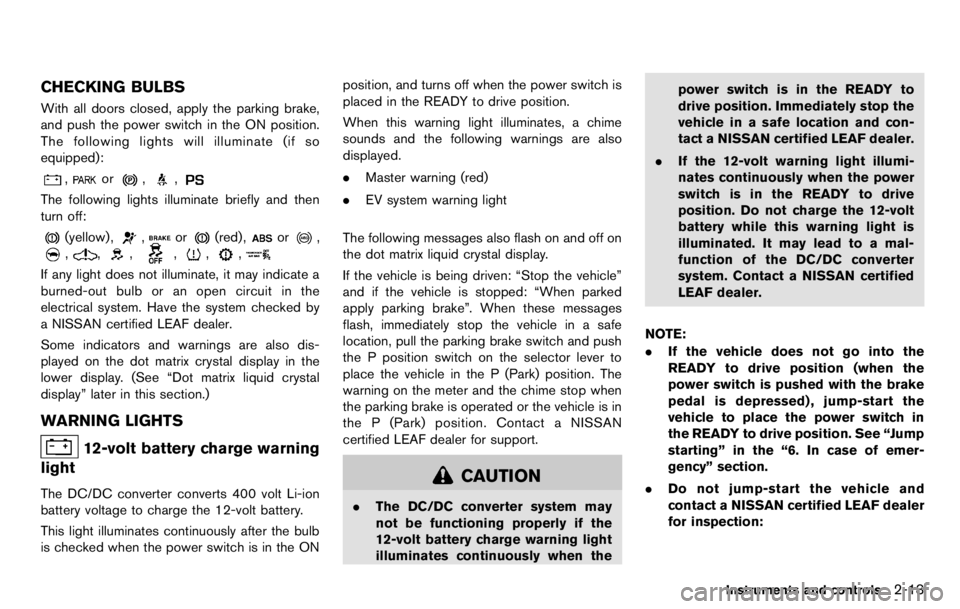
position to prevent the 12-volt bat-
tery automatically being charged by
the Li-ion battery. See “Charging
the 12-volt battery” in the “EV.
Overview” section.
This “8. Maintenance and do-it-yourself” section
gives instructions regarding only those items
that are relatively easy for an owner to perform.
A genuine NISSAN Service Manual is also
available. See “Owner’s Manual/Service Manual
order information” in the “9. Technical and
consumer information” section.
You should be aware that incomplete or
improper servicing may result in operating
difficulties and could affect your warranty cover-
age. If in doubt about any servicing, we
recommend that it be done by a NISSAN
certified LEAF dealer.
Page 156 of 1062

1. Remove the cell plugs*A.
2. Add distilled water up to the UPPER LEVEL
*1line.
If the side of the 12-volt battery is not clear,
check the distilled water level by looking
directly above the cell; the condition
*1
indicates OK and the condition*2needs
more to be added.
3. Tighten cell plugs
*A.
Vehicles operated in high temperatures or under
severe conditions require frequent checks of the
12-volt battery fluid level.
JUMP STARTING
Jump starting provides power to the 12 volt
system to allow the electrical systems to
operate. The electrical systems must be operat-
ing to allow the Li-ion battery to be charged.
Jump starting does not charge the Li-ion battery.
The Li-ion battery must be charged before the
vehicle can be driven.
If jump starting is necessary, see “Jump starting”
in the “6. In case of emergency” section. If the
power switch does not switch to READY to drive
position by jump starting, the 12-volt battery
may have to be replaced. Contact a NISSAN
certified LEAF dealer.
Page 203 of 1062

2 Instruments and controls
Cockpit ....................................................................................... 2-3
Instrument panel ....................................................................... 2-4
Meters and gauges .................................................................. 2-5Speedometer and odometer ........................................... 2-6
Li-ion battery temperature gauge ................................... 2-7
Power meter ........................................................................ 2-7
Driving range ....................................................................... 2-8
Li-ion battery available charge gauge ........................... 2-9
Li-ion battery capacity level gauge ............................. 2-10
Outside air temperature ................................................ 2-10
ECO indicator .................................................................. 2-10
Clock .................................................................................. 2-11
Warning/indicator lights and audible reminders ........... 2-12
Checking bulbs ................................................................ 2-13
Warning lights .................................................................. 2-13
Indicator lights .................................................................. 2-19
Audible reminders ........................................................... 2-21
Dot matrix liquid crystal display ......................................... 2-22 Indicators for operation .................................................. 2-23
Trip computer ................................................................... 2-27
Warning information displays ....................................... 2-31
Indicators for maintenance ........................................... 2-33
Indicator for timer ............................................................ 2-34
Security systems ................................................................... 2-35 Vehicle security system ................................................. 2-35 NISSAN Vehicle Immobilizer System ....................... 2-36
Windshield wiper and washer switch ............................. 2-38 Washer operation ......................................................... 2-39
Rear window wiper and washer switch ........................ 2-39
Rear window and outside mirror defroster switch ...... 2-40
Instrument brightness control ............................................ 2-41
Headlight and turn signal switch ...................................... 2-41 Headlight switch ........................................................... 2-41
Turn signal switch ......................................................... 2-44
Fog light switch (if so equipped) ..................................... 2-44
Hazard warning flasher switch .......................................... 2-45
Heated steering wheel ........................................................ 2-45
Horn ......................................................................................... 2-46
Heated seats ......................................................................... 2-46
Vehicle Dynamic Control (VDC) OFF switch ................ 2-48
Power outlet ........................................................................... 2-48
Storage ................................................................................... 2-49 Cup holders .................................................................... 2-49
Sunglasses holder ........................................................ 2-50
Glove box ........................................................................ 2-51
Console box ................................................................... 2-51
Cargo cover (if so equipped) .................................... 2-51
Stowing golf bags ........................................................ 2-53
Luggage side hook ....................................................... 2-53
Page 207 of 1062

illuminates, the Li-ion battery charge is too low
for travel. See “Low battery charge warning
light” in the “2. Instruments and controls”
section. Charge the Li-ion battery as soon as
possible.
EV OverviewEV-19
Page 221 of 1062

CAUTION
.Be sure to carry the Intelligent Key
with you when operating the vehi-
cle.
. Never leave the Intelligent Key in
the vehicle when you leave the
vehicle.
The Intelligent Key is always communicating with
the vehicle because it receives radio waves. The
Intelligent Key system transmits weak radio
waves. Environmental conditions may interfere
with the operation of the Intelligent Key system
under the following operating conditions.
. When operating near a location where
strong radio waves are transmitted, such
as a TV tower, power station or broad-
casting station.
. When in possession of wireless equipment,
such as a cellular phone, transceiver or CB
radio.
. When the Intelligent Key is in contact with or
covered by metallic materials.
. When any type of radio wave remote control
is used nearby. .
When the Intelligent Key is placed near an
electric appliance such as a personal
computer.
. When the vehicle is parked near a parking
meter.
In such cases, correct the operating conditions
before using the Intelligent Key function or use
the mechanical key.
Although the life of the battery varies depending
on the operating conditions, the battery’s life is
approximately 2 years. If the battery is dis-
charged, replace it with a new one.
When the Intelligent Key battery is almost
discharged, firmly apply the foot brake and
touch the power switch with the Intelligent Key.
Then push the power switch while depressing
the brake pedal within 10 seconds after the
chime sound.
Since the Intelligent Key is continuously receiv-
ing radio waves, if the key is left near equipment
that transmits strong radio waves, such as
signals from a TV or personal computer, the
battery life may become shorter.
For information regarding replacement of a
battery, see “Intelligent Key battery replacement”
in the “8. Maintenance and do-it-yourself”
section. Pay special attention that the vehicle battery is
not completely discharged.
As many as 4 Intelligent Keys can be registered
and used with one vehicle. For information about
the purchase and use of additional Intelligent
Keys, contact a NISSAN certified LEAF dealer.
Page 228 of 1062

12-volt battery charge
warning light2-13
Page 229 of 1062
EV Overview
The EV (Electric Vehicle) system ...................................... EV-2
Li-ion battery .......................................................................... EV-2 Driving with a discharged Li-ion battery ................... EV-3
Charging the 12-volt battery ........................................ EV-5
Li-ion battery heater ....................................................... EV-5
High voltage precautions .................................................... EV-7
High-voltage components ............................................. EV-7
Road accident precautions ................................................ EV-8 Emergency shut-off system .......................................... EV-9
EV (Electric Vehicle) characteristics ................................ EV-9
Noise and vibration ...................................................... EV-10
Life with an EV (scene guide) ........................................ EV-10 Charging the Li-ion battery ........................................ EV-10
Before driving your vehicle ........................................ EV-13
Starting your vehicle .................................................... EV-16
Driving the vehicle ........................................................ EV-17 At home after driving ................................................. EV-21
Efficient use of your vehicle ............................................ EV-22 Range ............................................................................ EV-22
Improve driving range ............................................... EV-22
Li-ion battery life ......................................................... EV-23
Li-ion battery maintenance ...................................... EV-24
EV unique information ...................................................... EV-24 Meters and indicators ............................................... EV-24
Approaching Vehicle Sound for Pedestrians
(VSP) system .............................................................. EV-27
Electric shift control system .................................... EV-28
Electric parking brake ............................................... EV-28
LED headlight (low beam) ....................................... EV-29
Solar cell module (if so equipped) ........................ EV-29
Driving range button ................................................ EV-29
Page 230 of 1062
WARNING
Your vehicle contains a sealed Li-ion
high voltage battery. If the Li-ion bat-
tery is disposed of improperly, there is a
risk of severe burns and electrical
shock that may result in serious injury
or death and there is also a risk of
environmental damage.
Page 232 of 1062

illuminates, traction motor output is
limited resulting in reduced vehicle speed.
Stop the vehicle in a safe location before the
Li-ion battery becomes completely dis-
charged and there is no power available to
drive the vehicle. Contact Roadside assis-
tance service shown in your NISSAN
Warranty Information Booklet. See “If the
Li-ion battery becomes completely dis-
charged” in the “6. In case of emergency”
section.
Page 233 of 1062

CHARGING THE 12-VOLT BATTERY
The 12-volt battery is charged automatically
using electricity stored in the Li-ion battery.
When the 12-volt battery is being charged, the
charge status indicator light on the instrument
panel flashes. (except when charging the Li-ion
battery or the power switch is in the READY to
drive position.) See “Charging status indicator
lights” in the “CH. Charging” section.
While vehicle is in use
The Li-ion battery charges the 12-volt battery as
necessary when the power switch is in the
READY to drive position or ON position.
The 12-volt battery is not charged in the
following conditions.
.When the power switch is in ACC position.
. When the power switch is in ON position
and shift position is in the N (Neutal)
position.
While the vehicle is not in use
When the EV (Electric Vehicle) system is off for
an extended time, the 12-volt battery may be
automatically charged for a short period of time
on a regular basis.
LI-ION BATTERY HEATER
CAUTION
The Li-ion battery heater does not
operate if the available Li-ion battery
charge is less than approximately 30%
and the charger is not connected to the
vehicle. To help prevent the Li-ion
battery from freezing, do not leave the
vehicle in an environment if tempera-
tures may go below -48F (-208C) unless
the vehicle is connected to a charger.
The Li-ion battery heater helps to prevent the Li-
ion battery from freezing and helps to prevent
significant reductions in the Li-ion battery output
when the temperature is cold. The Li-ion battery
heater automatically turns on when the Li-ion
battery temperature is approximately -48 F
(-208C) or colder. The Li-ion battery heater
automatically turns off when the Li-ion battery
temperture is approximately 148F (-108C) or
higher.
The Li-ion battery heater uses electrical power
from an external source when a charger is
connected to the vehicle. The Li-ion battery
heater uses electrical power from the Li-ion
battery when the charger is not connected to the vehicle.
NOTE:
.
Connect the charger to the vehicle and
place the power switch in the OFF
position when parking the vehicle if
temperatures may go below -48 F
(-208C) . This provides external power
to the Li-ion battery heater when it
operates and does not discharge the
Li-ion battery.
. The charging status indicator lights
illuminate in a specific pattern when
the Li-ion battery heater operates. The
charging status indicator lights use the
same pattern to indicate 12-volt battery
charging, Climate Ctrl. Timer operation
or Remote Climate Control operation.
The charging status indicator lights do
not change if the Li-ion battery heater
operates at the same time as the above
features. See “Charging status indica-
tor lights” in the “CH. Charging” sec-
tion.
. The Li-ion battery heater uses Li-ion
battery power to operate, even if the
vehicle is connected to a charger when:
EV OverviewEV-5