belt NISSAN LEAF 2012 Owner's Manual
[x] Cancel search | Manufacturer: NISSAN, Model Year: 2012, Model line: LEAF, Model: NISSAN LEAF 2012Pages: 1062, PDF Size: 3.63 MB
Page 261 of 1062
.Pass the lower side belt of the EVSE
(Electric Vehicle Supply Equipment)
case securely through the fastener
on the bottom of the luggage board.
If the case suddenly becomes loose,
it may cause serious injury or death.
CAUTION
.To prevent damage to the charging
equipment:
— Do not close the charge port lid
without closing the cap. — Do not subject the charging
equipment to impact.
— Do not pull or twist the charge cable.
— Do not drag the charge cable.
— Do not store and use charging equipment in locations where
the temperature is over 1858F
(858C) .
— Do not place the charging equip- ment close to a heater or other
heat source.
. Make sure the cap is closed on the
charge port when charging is fin-
ished. If the charge port lid is closed
when the cap is open, water or
foreign materials may enter the
charge port.
. Do not charge when a vehicle body
cover is in use. This may cause
damage to the charge connector.
. Do not attempt to perform a jump
start on the 12-volt battery at the
same time that the Li-ion battery is
being charged. Doing so may da-
mage the vehicle or charging equip- ment and could cause an injury. See
“Jump starting” in the “6. In case of
emergency” section.
. Trickle charging is performed using
the EVSE (Electric Vehicle Supply
Equipment) provided with the vehi-
cle. NISSAN recommends using an
AC 110 - 120 volt, 15A, dedicated
electrical circuit and outlet. The
dedicated circuit is used to help
prevent circuit damage or the circuit
breaker from tripping due to the
high draw of charging the Li-ion
battery. If the dedicated circuit is
not used, the circuit may cause
adverse interference on MCB
(Moulded Circuit Board) and house-
hold electrical appliances such as
televisions and audio systems. If the
circuit is shared, and another elec-
trical device is being used at the
same time the vehicle is charging,
the breaker may trip. A licensed
professional electrician should in-
stall a dedicated circuit if one is not
already available.
ChargingCH-3
Page 291 of 1062

1 Safety—Seats, seat belts and supple-mental restraint system
Seats ........................................................................................... 1-2
Front seats ........................................................................... 1-3
Rear seats ........................................................................... 1-4
Head restraints ................................................................... 1-4
Adjustable headrests ......................................................... 1-7
Seat belts ................................................................................ 1-10
Precautions on seat belt usage ................................... 1-10
Pregnant women ............................................................. 1-12
Injured persons ................................................................ 1-12
Three-point type seat belt with retractor .................. 1-12
Seat belt extenders ......................................................... 1-16
Seat belt maintenance ................................................... 1-16
Child safety ............................................................................. 1-17
Infants ................................................................................. 1-17
Small children ................................................................... 1-18
Larger children ................................................................. 1-18
Child restraints ....................................................................... 1-19 Precautions on child restraints .................................... 1-19
Lower Anchors and Tethers for CHildren System
(LATCH) ........................................................................... 1-20
Rear-facing child restraint installation using latch ... 1-23 Rear-facing child restraint installation using the
seat belts ......................................................................... 1-25
Forward-facing child restraint installation
using latch ...................................................................... 1-27
Forward-facing child restraint installation using the
seat belts ......................................................................... 1-29
Installing top tether strap ............................................ 1-32
Booster seats ........................................................................ 1-33 Precautions on booster seats .................................... 1-33
Booster seat installation .............................................. 1-34
Supplemental restraint system .......................................... 1-36 Precautions on supplemental restraint system ...... 1-36
NISSAN Advanced Air Bag System
(front seats) .................................................................... 1-42
Front seat-mounted side-impact supplemental
air bag and roof-mounted curtain side-impact
supplemental air bag systems ................................... 1-47
Seat belts with pretensioners (front seats) ............ 1-49
Supplemental air bag warning labels ...................... 1-50
Supplemental air bag warning light ......................... 1-50
Repair and replacement procedure ......................... 1-51
Page 294 of 1062
REAR SEATS
Folding
Before folding the rear seats:
.Secure the seat belts on the seat belt hooks
located on the side wall. See “Seat belt
hooks ” later in this section.
To fold down the seatback, pull the release
knob.
To return the seatback to the seating position, lift
up each seatback and push it to the upright
position until it is latched.
Page 301 of 1062
WARNING
.Every person who drives or rides in
this vehicle should use a seat belt at
all times. Children should be prop-
erly restrained in the rear seat and,
if appropriate, in a child restraint.
. The seat belt should be properly
adjusted to a snug fit. Failure to do
so may reduce the effectiveness of
the entire restraint system and in-
crease the chance or severity of
injury in an accident. Serious injury
or death can occur if the seat belt is
not worn properly.
. Always route the shoulder belt over
your shoulder and across your
chest. Never put the belt behind
your back, under your arm or across
your neck. The belt should be away
from your face and neck, but not
falling off your shoulder.
. Position the lap belt as low and
snug as possible AROUND THE
HIPS, NOT THE WAIST. A lap belt
worn too high could increase the
risk of internal injuries in an acci-
dent. .
Be sure the seat belt tongue is
securely fastened to the proper
buckle.
. Do not wear the seat belt inside out
or twisted. Doing so may reduce its
effectiveness.
. Do not allow more than one person
to use the same seat belt.
. Never carry more people in the
vehicle than there are seat belts.
. If the seat belt warning light glows
continuously while the power switch
is turned ON with all doors closed
and all seat belts fastened, it may
indicate a malfunction in the sys-
tem. Have the system checked by a
NISSAN certified LEAF dealer.
. No changes should be made to the
seat belt system. For example, do
not modify the seat belt, add mate-
rial, or install devices that may
change the seat belt routing or
tension. Doing so may affect the
operation of the seat belt system.
Modifying or tampering with the
seat belt system may result in
serious personal injury.
Safety—Seats, seat belts and supplemental restraint system1-11
Page 302 of 1062
.Once a seat belt pretensioner has
activated, it cannot be reused and
must be replaced together with the
retractor. See a NISSAN certified
LEAF dealer.
. Removal and installation of the
pretensioner system components
should be done by a NISSAN certi-
fied LEAF dealer.
. All seat belt assemblies, including
retractors and attaching hardware,
should be inspected after any colli-
sion by a NISSAN certified LEAF
dealer. NISSAN recommends that
all seat belt assemblies in use
during a collision be replaced un-
less the collision was minor and the
belts show no damage and continue
to operate properly. Seat belt as-
semblies not in use during a colli-
sion should also be inspected and
replaced if either damage or impro-
per operation is noted.
. All child restraints and attaching
hardware should be inspected after
any collision. Always follow the
restraint manufacturer’s inspection
instructions and replacement re- commendations. The child restraints
should be replaced if they are
damaged.
PREGNANT WOMEN
NISSAN recommends that pregnant women use
seat belts. The seat belt should be worn snug,
and always position the lap belt as low as
possible around the hips, not the waist. Place
the shoulder belt over your shoulder and across
your chest. Never put the lap/shoulder belt over
your abdominal area. Contact your doctor for
specific recommendations.
INJURED PERSONS
NISSAN recommends that injured persons use
seat belts, depending on the injury. Check with
your doctor for specific recommendations.
THREE-POINT TYPE SEAT BELT
WITH RETRACTOR
Page 303 of 1062
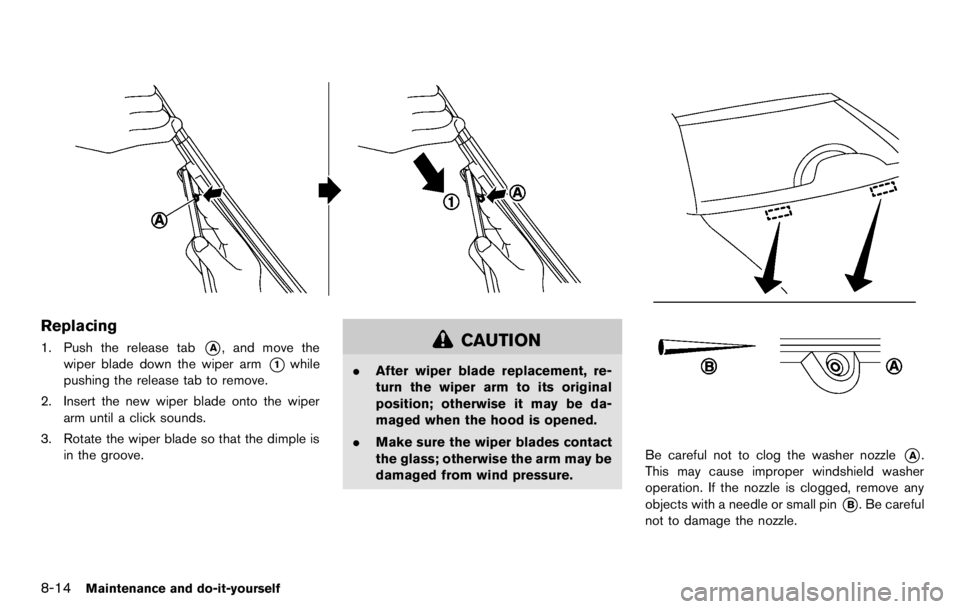
by cutting the seat belt with a
suitable tool (such as a knife or
scissors) to release the seat belt.
Fastening the seat belts
1. Adjust the seat. See “Seats” earlier in thissection.
Page 304 of 1062
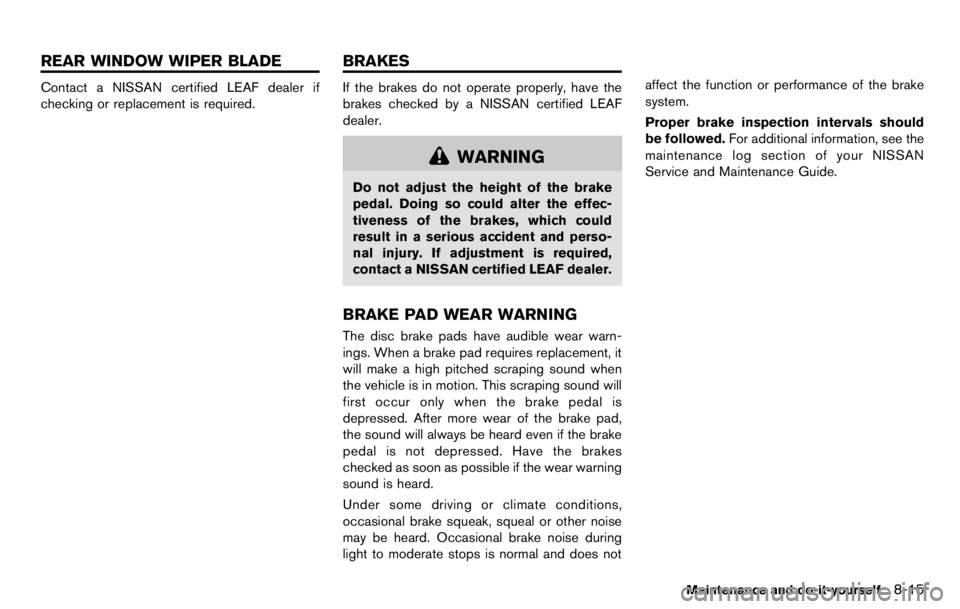
of movement in the seat. The ELR locks the seat
belt when the vehicle slows down rapidly or
during certain impacts.
The Automatic Locking Retractor (ALR) mode
(child restraint mode) locks the seat belt for
child restraint installation.
When ALR mode is activated the seat belt
cannot be extended again until the seat belt
tongue is detached from the buckle and fully
retracted. The seat belt returns to the ELR mode
after the seat belt fully retracts. For additional
information, see “Child restraints” later in this
section.
The ALR mode should be used only for
child restraint installation. During normal
seat belt use by an occupant, the ALR
mode should not be activated. If it is
activated, it may cause uncomfortable seat
belt tension.
Page 305 of 1062
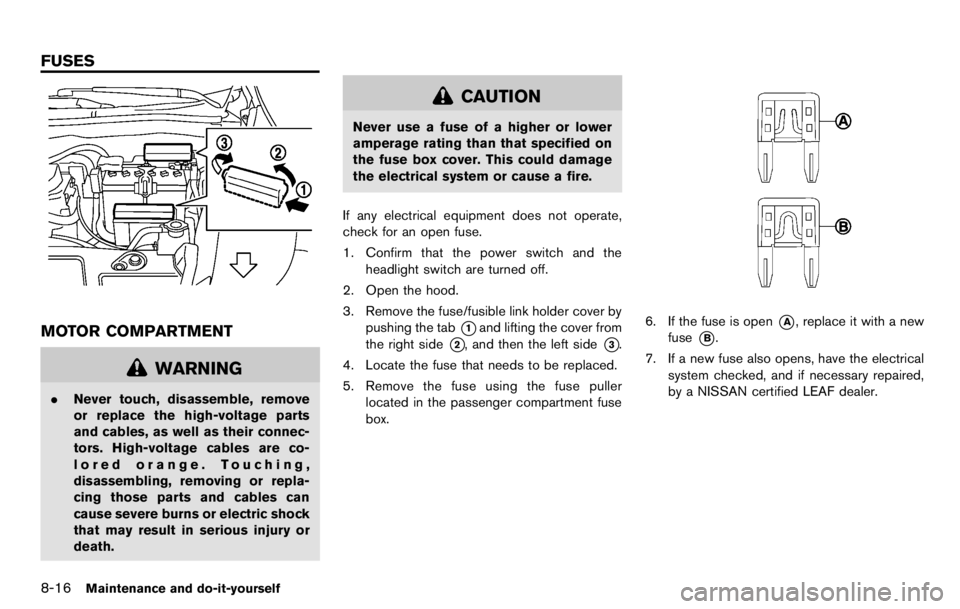
Shoulder belt height adjustment (for
front seats)
The shoulder belt anchor height should be
adjusted to the position that is best for you.
See “Precautions on seat belt usage” earlier in
this section.
To adjust, pull the adjustment button
*1, and
then move the shoulder belt anchor to the
preferred position
*2so that the belt passes
over the center of the shoulder. The belt should
be away from your face and neck, but not falling
off of your shoulder. Release the adjustment
button to lock the shoulder belt anchor into
position.
Page 306 of 1062
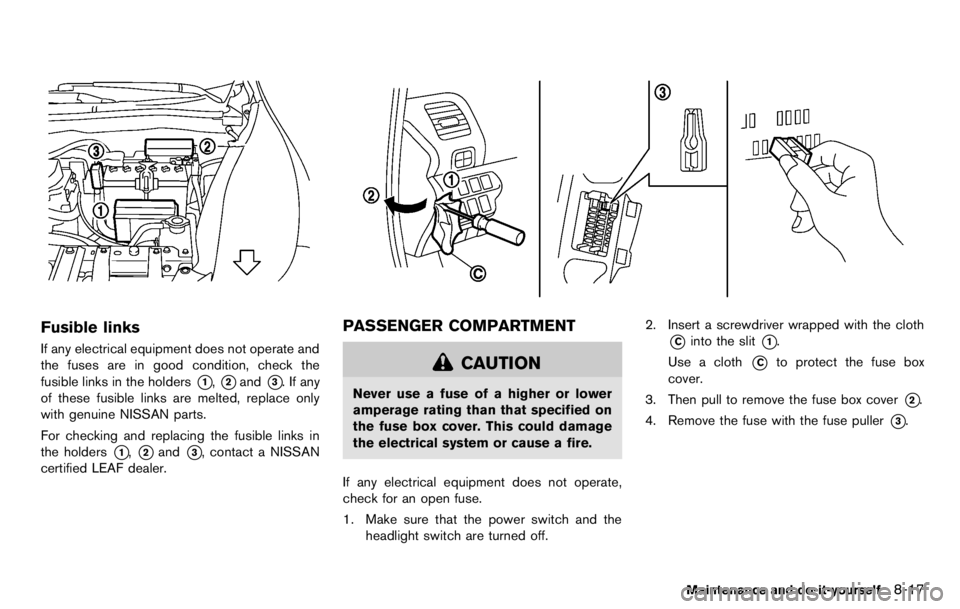
Center of rear seat
Selecting correct set of seat belts:
The center seat belt buckle is identified by the
CENTER mark
*A. The center seat belt tongue
can be fastened onlyinto the center seat belt
buckle.
SEAT BELT EXTENDERS
If, because of body size or driving position, it is
not possible to properly fit the lap-shoulder belt
and fasten it, an extender that is compatible with
the installed seat belts is available that can be
purchased. The extender adds approximately 8
in (200 mm) of length and may be used for either the driver or front passenger seating position.
See a NISSAN certified LEAF dealer for
assistance with purchasing an extender if an
extender is required.
Page 317 of 1062

WARNING
.The front air bags ordinarily will not
inflate in the event of a side impact,
rear impact, rollover or lower sever-
ity frontal collision. Always wear
your seat belts to help reduce the
risk or severity of injury in various
kinds of accidents.
. The front passenger air bag will not
inflate if the passenger air bag
status light is lit or if the front
passenger seat is unoccupied. See
“Front passenger air bag and status
light” later in this section.
. The seat belts and the front air bags
are most effective when you are
sitting well back and upright in the
seat with both feet on the floor. The
front air bags inflate with great
force. Even with the NISSAN Ad-
vanced Air Bag System, if you are
unrestrained, leaning forward, sit-
ting sideways or out of position in
any way, you are at greater risk of
injury or death in a crash. You may
also receive serious or fatal injuries
from the front air bag if you are up
Safety—Seats, seat belts and supplemental restraint system1-37