parking brake NISSAN LEAF 2012 Owner's Manual
[x] Cancel search | Manufacturer: NISSAN, Model Year: 2012, Model line: LEAF, Model: NISSAN LEAF 2012Pages: 1062, PDF Size: 3.63 MB
Page 236 of 1062
WARNING
In case of a collision:
.If your vehicle is drivable, pull your
vehicle off the road, push the P
(Park) position switch on the selec-
tor lever, apply the parking brake
and turn the EV (Electric Vehicle)
system off.
. Check your vehicle to see if there
are exposed high-voltage parts or
cables. For their locations, see
“High-voltage components” earlier
in this section. To avoid personal
injury, never touch high-voltage wir-
ing, connectors, and other high-
voltage parts, such as inverter unit
and Li-ion battery. An electric shock
may occur if exposed electric wires
are visible when viewed from inside
or outside of your vehicle. There-
fore, never touch exposed electric
wires.
. If the vehicle receives a strong
impact to the floor while driving,
stop the vehicle in a safe location
and check the floor. .
Leaks or damage to the Li-ion
battery may result in a fire. If you
discover them, contact emergency
services immediately. Since the
fluid leak may be lithium manga-
nate from the Li-ion battery, never
touch the fluid leak inside or out-
side the vehicle. If the fluid contacts
your skin or eyes, wash it off
immediately with a large amount of
water and receive immediate medi-
cal attention to help avoid serious
injury.
. If a fire occurs in the EV (Electric
Vehicle) , leave the vehicle as soon
as possible. Only use a type ABC,
BC or C fire extinguisher that is
meant for use on electrical fires.
Using a small amount of water or
the incorrect fire extinguisher can
result in serious injury or death from
electrical shock.
. If your vehicle needs to be towed,
do it with the front wheels raised. If
the front wheels are on the ground
when towing, the traction motor
may generate electricity. This may
damage the components of the EV
(Electric Vehicle) system and cause a fire.
. If you are not able to safely assess
the vehicle due to vehicle damage,
do not touch the vehicle. Leave the
vehicle and contact emergency ser-
vices. Advise 1st responders that
this is an electric vehicle.
. In the event of an accident that
requires body repair and painting,
the vehicle should be delivered to a
NISSAN certified LEAF dealer to
have the Li-ion battery pack and
high voltage parts such as the
inverter, including the wiring har-
ness, removed prior to painting. Li-
ion battery packs exposed to heat in
the paint booth will experience
capacity loss. Damaged Li-ion bat-
tery packs may also pose safety
risks to untrained mechanics and
repair personnel.
ROAD ACCIDENT PRECAUTIONS
Page 341 of 1062

CAUTION
.Be sure to carry the Intelligent Key
with you when operating the vehi-
cle.
. Never leave the Intelligent Key in
the vehicle when you leave the
vehicle.
The Intelligent Key is always communicating with
the vehicle because it receives radio waves. The
Intelligent Key system transmits weak radio
waves. Environmental conditions may interfere
with the operation of the Intelligent Key system
under the following operating conditions.
. When operating near a location where
strong radio waves are transmitted, such
as a TV tower, power station or broad-
casting station.
. When in possession of wireless equipment,
such as a cellular phone, transceiver or CB
radio.
. When the Intelligent Key is in contact with or
covered by metallic materials.
. When any type of radio wave remote control
is used nearby. .
When the Intelligent Key is placed near an
electric appliance such as a personal
computer.
. When the vehicle is parked near a parking
meter.
In such cases, correct the operating conditions
before using the Intelligent Key function or use
the mechanical key.
Although the life of the battery varies depending
on the operating conditions, the battery’s life is
approximately 2 years. If the battery is dis-
charged, replace it with a new one.
When the Intelligent Key battery is almost
discharged, firmly apply the foot brake and
touch the power switch with the Intelligent Key.
Then push the power switch while depressing
the brake pedal within 10 seconds after the
chime sound.
Since the Intelligent Key is continuously receiv-
ing radio waves, if the key is left near equipment
that transmits strong radio waves, such as
signals from a TV or personal computer, the
battery life may become shorter.
For information regarding replacement of a
battery, see “Intelligent Key battery replacement”
in the “8. Maintenance and do-it-yourself”
section. Pay special attention that the vehicle battery is
not completely discharged.
As many as 4 Intelligent Keys can be registered
and used with one vehicle. For information about
the purchase and use of additional Intelligent
Keys, contact a NISSAN certified LEAF dealer.
Page 371 of 1062

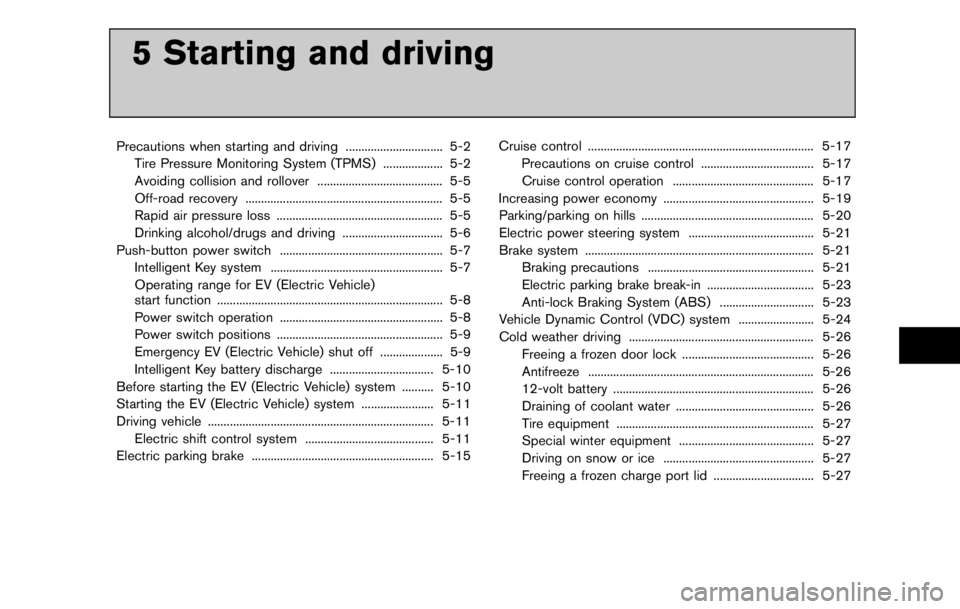
5 Starting and driving
Precautions when starting and driving ............................... 5-2Tire Pressure Monitoring System (TPMS) ................... 5-2
Avoiding collision and rollover ........................................ 5-5
Off-road recovery ............................................................... 5-5
Rapid air pressure loss ..................................................... 5-5
Drinking alcohol/drugs and driving ................................ 5-6
Push-button power switch .................................................... 5-7 Intelligent Key system ....................................................... 5-7
Operating range for EV (Electric Vehicle)
start function ........................................................................ 5-8
Power switch operation .................................................... 5-8
Power switch positions ..................................................... 5-9
Emergency EV (Electric Vehicle) shut off .................... 5-9
Intelligent Key battery discharge ................................. 5-10
Before starting the EV (Electric Vehicle) system .......... 5-10
Starting the EV (Electric Vehicle) system ....................... 5-11
Driving vehicle ........................................................................ 5-11 Electric shift control system ......................................... 5-11
Electric parking brake .......................................................... 5-15 Cruise control ........................................................................ 5-17
Precautions on cruise control .................................... 5-17Cruise control operation ............................................. 5-17
Increasing power economy ................................................ 5-19 Parking/parking on hills ....................................................... 5-20
Electric power steering system ........................................ 5-21
Brake system ......................................................................... 5-21 Braking precautions ..................................................... 5-21
Electric parking brake break-in .................................. 5-23
Anti-lock Braking System (ABS) .............................. 5-23
Vehicle Dynamic Control (VDC) system ........................ 5-24
Cold weather driving ........................................................... 5-26 Freeing a frozen door lock .......................................... 5-26
Antifreeze ........................................................................ 5-26
12-volt battery ................................................................ 5-26
Draining of coolant water ............................................ 5-26
Tire equipment ............................................................... 5-27
Special winter equipment ........................................... 5-27
Driving on snow or ice ................................................ 5-27
Freeing a frozen charge port lid ................................ 5-27
Page 374 of 1062

.Do not place metalized film or any
metal parts (antenna, etc.) on the
windows. This may cause poor re-
ception of the signals from the tire
pressure sensors, and the TPMS will
not function properly.
Some devices and transmitters may temporarily
interfere with the operation of the TPMS and
cause the low tire pressure warning light to
illuminate. Some examples are:
. Facilities or electric devices using similar
radio frequencies that are near the vehicle.
. If a transmitter set to similar frequencies is
being used in or near the vehicle.
. If a computer (or similar equipment) or a DC/
AC converter is being used in or near the
vehicle.
FCC Notice:
For USA:
This device complies with Part 15 of the
FCC Rules. Operation is subject to the
following two conditions: (1) This device
may not cause harmful interference, and
(2) this device must accept any interfer-
ence received, including interference that
may cause undesired operation. NOTE:
Changes or modifications not expressly
approved by the party responsible for
compliance could void the user’s authority
to operate the equipment.
For Canada:
This device complies with RSS-210 of
Industry Canada. Operation is subject to
the following two conditions: (1) this
device may not cause interference, and
(2) this device must accept any interfer-
ence, including interference that may
cause undesired operation of the device.
TPMS with Easy Fill Tire Alert
When tire pressure is low, the low tire pressure
warning light illuminates.
This vehicle provides visual and audible signals
to help you inflate the tires to the recommended
COLD tire pressure.
Vehicle set-up:
1. Park the vehicle in a safe and level place.
2. Apply the parking brake and push the P
position switch on the selector lever.
3. Place the power switch in the ON position. Do not place in the READY to drive mode. Operation:
1. Add air to the tire.
2. After a few seconds, the hazard indicators
will start flashing.
3. When the designated pressure is reached, the horn beeps once and the hazard
indicators stop flashing.
4. Perform the above steps for each tire.
. If the tire is over-inflated more than approxi-
mately 4 psi (30 kPa), the horn beeps and
the hazard indicators flash 3 times. To
correct the pressure, push the core of the
valve stem on the tire briefly to release
pressure. When the pressure reaches the
designated pressure, the horn beeps once.
. If the hazard indicator does not flash within
approximately 15 seconds after starting to
inflate the tire, it indicates that the Easy Fill
Tire Alert is not operating.
. The TPMS will not activate the Easy Fill Tire
Alert under the following conditions:
— If there is interference from an external
device or transmitter.
— The air pressure from the inflation device is not sufficient to inflate the tire such as
those using a power socket.
Page 382 of 1062

.Do not hang items on the selector
lever. This may cause an accident
due to a sudden start.
. Do not shift to the ECO position
abruptly on slippery roads. This may
cause a loss of control.
NOTE:
If the accelerator pedal is depressed when
the vehicle is in the D (Drive) or ECO
position and the driver’s seat belt is
securely fastened, the parking brake will
be released automatically. See “Electric
parking brake” later in this section.
Page 386 of 1062

NOTE:
.While the electric parking brake is
applied or released, an operating
sound is heard from the lower side of
the rear seat. However, this is not a
malfunction.
. When the electric parking brake is
frequently applied and released in a
short period of time, the electric park-
ing brake may not operate in order to
prevent the electric parking brake sys-
tem from overheating. If this occurs,
operate the electric parking brake
again after approximately 1 minute.
. The electric parking brake can be
released with the power switch in the
ON or READY to drive position.
. If the electric parking brake must be
applied while driving in an emergency,
pull up and hold the electric parking
brake switch. When you release the
parking brake switch, the parking
brake will be released.
. While pulling up on the electric parking
brake switch, the electric parking brake
is applied and a chime sounds. The
electric parking brake indicator light in
the meter and parking brake switch operation indicator illuminate. This
does not indicate a malfunction. The
electric parking brake indicator light
and parking switch operation indicator
turn off when the electric parking brake
switch is released.
. Pull up on the electric parking brake
switch twice so that the maximum
electric parking brake force can be
applied to the vehicle.
. When operating the electric parking
brake switch with the power switch in
the ON position, the electric parking
brake indicator light in the meter and
the electric parking brake switch op-
eration indicator turn on.
. Do not start driving while the parking
brake is applied. Doing so may cause
the parking brake to overheat or re-
duce its effectiveness, which could
result in an accident.
. When pulling the electric parking brake
switch with the power switch in the
OFF or ACC position, the electric park-
ing brake switch operation indicator
will continue to illuminate for a short
period of time.
Page 393 of 1062

ELECTRIC PARKING BRAKE
BREAK-IN
Break in the parking brake shoes whenever the
holding effect of the parking brake is weakened
or whenever the parking brake shoes and/or
drums are replaced, in order to maintain
optimum braking performance.
This procedure is described in the vehicle
Service Manual, and it can be performed by a
NISSAN certified LEAF dealer.
ANTI-LOCK BRAKING SYSTEM
(ABS)
Page 399 of 1062

6 In case of emergency
Roadside assistance program .............................................. 6-2
Emergency EV (Electric Vehicle) shut off .......................... 6-2 Flat tire ........................................................................................ 6-2
Tire Pressure Monitoring System (TPMS) ................... 6-2
Repairing flat tire ................................................................ 6-3
Jump starting ............................................................................. 6-9
If the Li-ion battery becomes completely discharged ... 6-12 Push starting .......................................................................... 6-12
Tools ........................................................................................ 6-13
Towing your vehicle ............................................................. 6-13
Towing recommended by NISSAN .......................... 6-14
Vehicle recovery (freeing stuck vehicle) ................. 6-15
Parking brake mechanical release ................................... 6-16
Page 409 of 1062

Do not allow the two vehicles to touch.
2. Apply the parking brake.
If the 12-volt battery is discharged, the
power switch cannot be moved from
the OFF position. Connect the jumper
cables to the booster vehicle
*Bbefore
pushing the power switch.
3. Push the P position switch to place the vehicle in the P (Park) position.
4. Switch off all unnecessary electrical systems (headlights, heater, air conditioner, etc.).
5. Place the power switch in the OFF position.
6. Remove the vent caps on the 12-volt battery (if so equipped) . Cover the battery with a
firmly wrung out moist cloth to reduce the
hazard of an explosion.
7. Connect jumper cables in the sequence as illustrated (
*1?*2?*3?*4).
Page 415 of 1062

If the electric parking brake cannot be released
by operating the electric parking brake switch,
the parking brake can be mechanically released.
Note that the following procedure must be
performed only when the parking brake needs
to be released in an emergency.
NOTE:
.Depending on the type of parking
brake system malfunction, the parking
brake switch operation indicator may
blink and the electric shift control
system warning light may illuminate in
the meter.
. If the electric shift control system
warning light illuminates in the meter,
stop the vehicle in a safe location and
contact a NISSAN certified LEAF dealer
immediately.
. The mechanical release of the parking
brake should only be done if there is a
malfunction of the electric parking
brake system. After the parking brake
mechanical release has been done, the
vehicle needs to be repaired. Have your
vehicle inspected by a NISSAN certified
LEAF dealer.
To release the parking brake mechanically,
perform the following procedure. 1. Confirm that the vehicle is in the P (Park)
position. If the vehicle cannot be placed in
the P (Park) position, contact a NISSAN
certified LEAF dealer.
2. Check that the parking brake switch opera- tion indicator does not illuminate.
3. Place power switch in the OFF position.
4. Open the rear hatch.
5. Remove the tool for mechanical release from the tool set that is located in the cargo area.
6. Remove the luggage floor board from the cargo area.
7. Remove the cap by turning counterclock- wise.
8. Insert the tool and turn it counterclockwise while pushing it in.
9. Continue to turn it until it stops and then release your hand. The tool will then return
approximately the same position it was in
before it was turned and release of the
parking brake will be completed. Do not turn
the tool beyond the point at which it stops.
Doing so may result in damage.
10. Store the tool for mechanical release by performing the procedure for removing it in
reverse.