service NISSAN LEAF 2013 1.G Dismantling Guide
[x] Cancel search | Manufacturer: NISSAN, Model Year: 2013, Model line: LEAF, Model: NISSAN LEAF 2013 1.GPages: 44, PDF Size: 1.62 MB
Page 35 of 44
![NISSAN LEAF 2013 1.G Dismantling Guide If LEAF needs to be stored or left unattended, the high voltage system must be shut down by removing the
service
plug [refer to 3-3.6 Alternate Procedure 2 (Remove Service Plug)] and a sign put on the](/img/5/322/w960_322-34.png "NISSAN LEAF 2013 1.G Dismantling Guide If LEAF needs to be stored or left unattended, the high voltage system must be shut down by removing the
service
plug [refer to 3-3.6 Alternate Procedure 2 (Remove Service Plug)] and a sign put on the")
If LEAF needs to be stored or left unattended, the high voltage system must be shut down by removing the
service
plug [refer to 3-3.6 Alternate Procedure 2 (Remove Service Plug)] and a sign put on the vehicle indi-
cating
it is an electric vehicle with high voltage dangers. For example: AAYIA0020GB
35
Page 36 of 44
5. Dismantling Information
Removal
or repair of the high voltage battery requires special tools and specific training. NISSAN strongly
recommends that only certified NISSAN dealer technicians perform these operations.
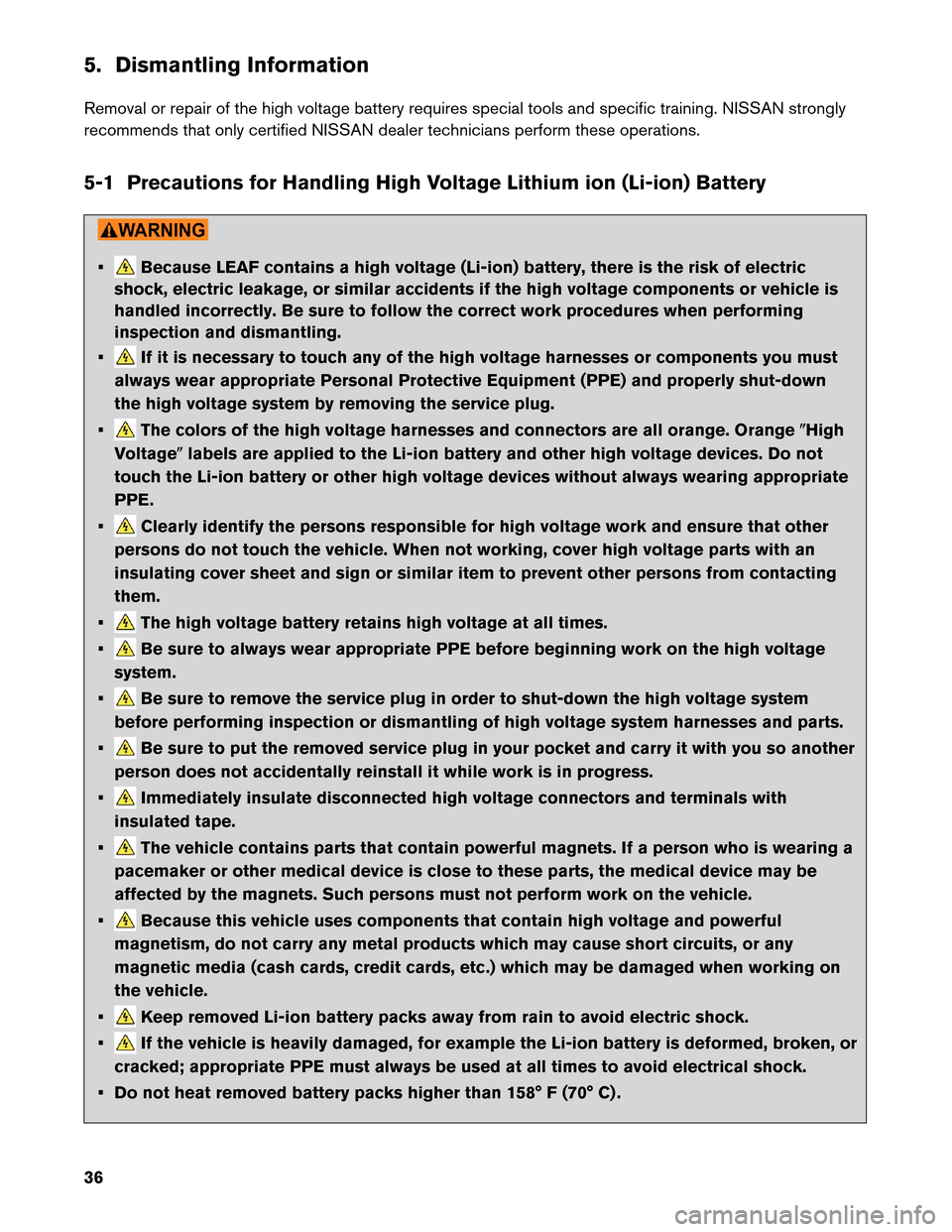
5-1 Precautions for Handling High Voltage Lithium ion (Li-ion) Battery •
Because LEAF contains a high voltage (Li-ion) battery, there is the risk of electric
shock,
electric leakage, or similar accidents if the high voltage components or vehicle is
handled incorrectly. Be sure to follow the correct work procedures when performing
inspection and dismantling.
• If it is necessary to touch any of the high voltage harnesses or components you must
always
wear appropriate Personal Protective Equipment (PPE) and properly shut-down
the high voltage system by removing the service plug.
• The colors of the high voltage harnesses and connectors are all orange. Orange
High
V
oltage labels are applied to the Li-ion battery and other high voltage devices. Do not
touch the Li-ion battery or other high voltage devices without always wearing appropriate
PPE.
• Clearly identify the persons responsible for high voltage work and ensure that other
persons
do not touch the vehicle. When not working, cover high voltage parts with an
insulating cover sheet and sign or similar item to prevent other persons from contacting
them.
• The high voltage battery retains high voltage at all times.
• Be sure to always wear appropriate PPE before beginning work on the high voltage
system.
• Be sure to remove the service plug in order to shut-down the high voltage system
before
performing inspection or dismantling of high voltage system harnesses and parts.
• Be sure to put the removed service plug in your pocket and carry it with you so another
person
does not accidentally reinstall it while work is in progress.
• Immediately insulate disconnected high voltage connectors and terminals with
insulated
tape.
• The vehicle contains parts that contain powerful magnets. If a person who is wearing a
pacemaker
or other medical device is close to these parts, the medical device may be
affected by the magnets. Such persons must not perform work on the vehicle.
• Because this vehicle uses components that contain high voltage and powerful
magnetism,
do not carry any metal products which may cause short circuits, or any
magnetic media (cash cards, credit cards, etc.) which may be damaged when working on
the vehicle.
• Keep removed Li-ion battery packs away from rain to avoid electric shock.
• If the vehicle is heavily damaged, for example the Li-ion battery is deformed, broken, or
cracked;
appropriate PPE must always be used at all times to avoid electrical shock.
• Do not heat removed battery packs higher than 158° F (70° C) .
36
Page 37 of 44
There is the possibility of a malfunction occurring if the vehicle is changed to READY
status while the service plug is removed.
5-2 Personal Protective Equipment (PPE) and Insulated Tools
5-2.1 Personal Protective Equipment (PPE) Protective Wear Control
Perform an inspection of the Personal Protective Equipment (PPE) items before beginning work. Do not use
any damaged PPE items.
5-2.2 Daily Inspection
This inspection is performed before and after use. The worker who will be using the items should perform
the inspection and check for deterioration and damage. • Insulated rubber gloves should be inspected for scratches, holes and tears. (Visual check and airleakage test)
• Insulated safety boots should be inspected for holes, damage, nails, metal pieces, wear or other problems on the soles. (Visual check)
• Insulated rubber sheet should be inspected for tears. (Visual check)
5-2.3 Insulated Tools
When performing work at locations where high voltage is applied (such as terminals) , use insulated tools
meeting 1,000V/300A specifications.
37
Page 43 of 44
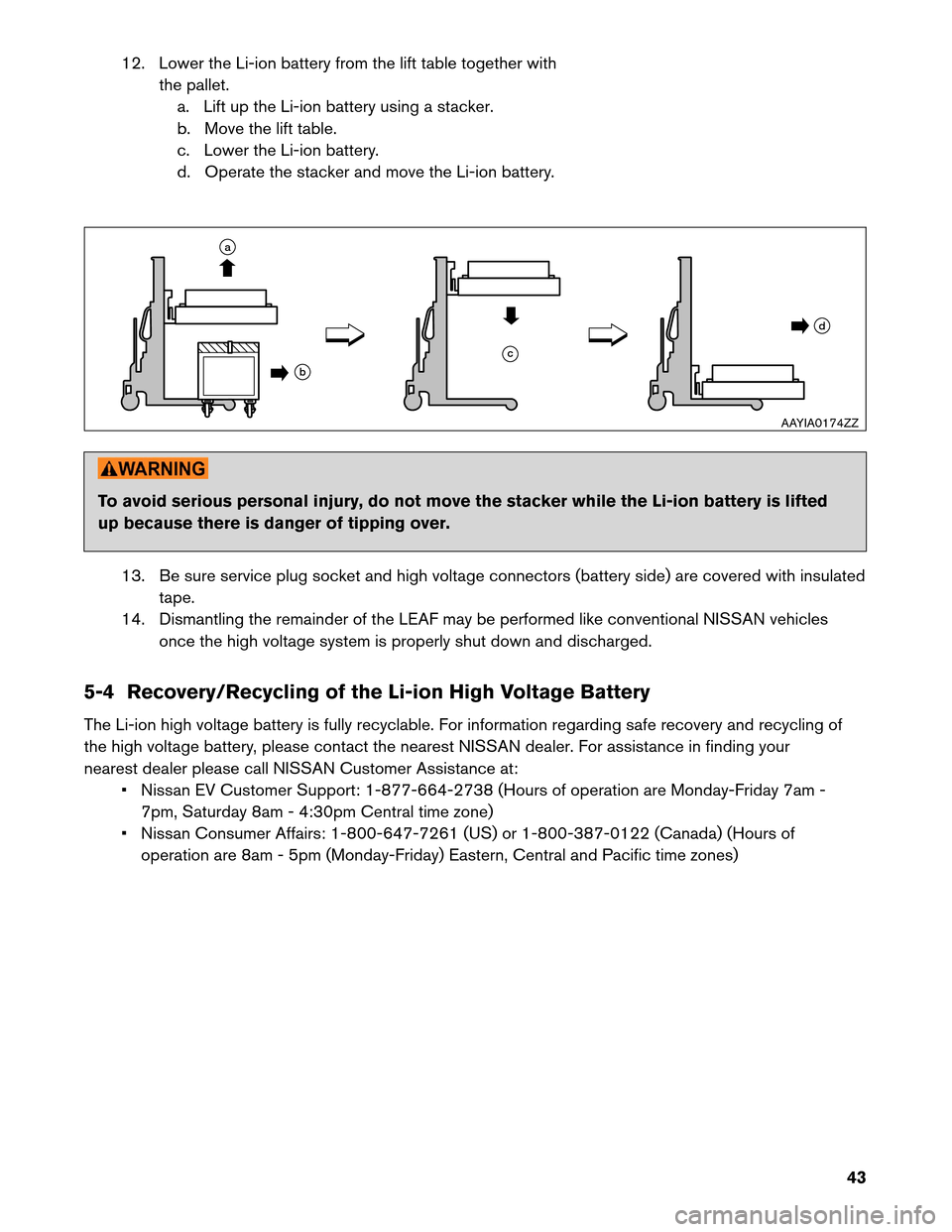
12. Lower the Li-ion battery from the lift table together with
the pallet.
a. Lift up the Li-ion battery using a stacker.
b. Move the lift table.
c. Lower the Li-ion battery.
d. Operate the stacker and move the Li-ion battery. To avoid serious personal injury, do not move the stacker while the Li-ion battery is lifted
up
because there is danger of tipping over.
13. Be sure service plug socket and high voltage connectors (battery side) are covered with insulated tape.
14. Dismantling the remainder of the LEAF may be performed like conventional NISSAN vehicles once the high voltage system is properly shut down and discharged.
5-4 Recovery/Recycling of the Li-ion High Voltage Battery
The Li-ion high voltage battery is fully recyclable. For information regarding safe recovery and recycling of
the high voltage battery, please contact the nearest NISSAN dealer. For assistance in finding your
nearest dealer please call NISSAN Customer Assistance at: • Nissan EV Customer Support: 1-877-664-2738 (Hours of operation are Monday-Friday 7am -7pm, Saturday 8am - 4:30pm Central time zone)
• Nissan Consumer Affairs: 1-800-647-7261 (US) or 1-800-387-0122 (Canada) (Hours of operation are 8am - 5pm (Monday-Friday) Eastern, Central and Pacific time zones) a
b c d
AAYIA0174ZZ
43