break NISSAN LEAF 2017 1.G User Guide
[x] Cancel search | Manufacturer: NISSAN, Model Year: 2017, Model line: LEAF, Model: NISSAN LEAF 2017 1.GPages: 424, PDF Size: 4.51 MB
Page 405 of 424
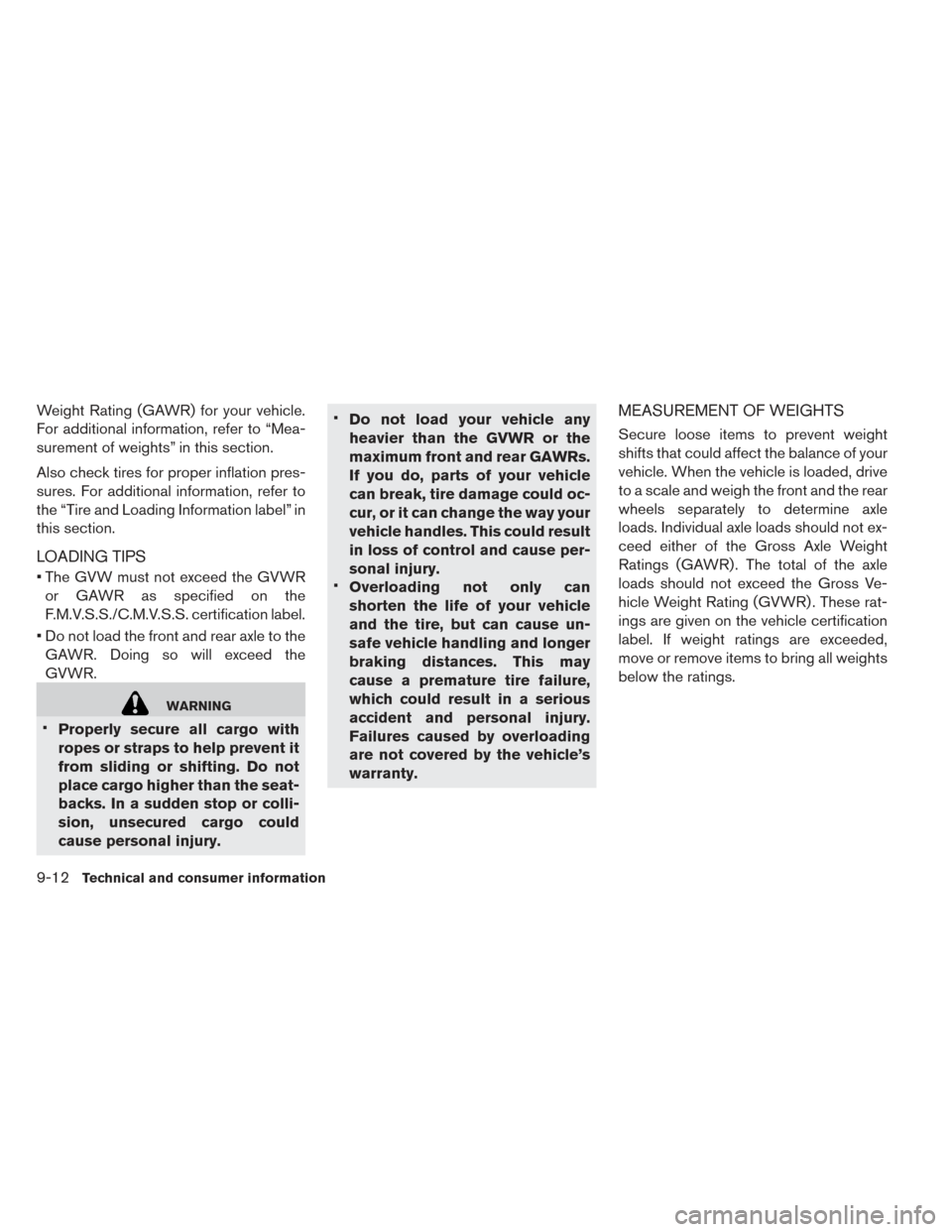
Weight Rating (GAWR) for your vehicle.
For additional information, refer to “Mea-
surement of weights” in this section.
Also check tires for proper inflation pres-
sures. For additional information, refer to
the “Tire and Loading Information label” in
this section.
LOADING TIPS
• The GVW must not exceed the GVWRor GAWR as specified on the
F.M.V.S.S./C.M.V.S.S. certification label.
• Do not load the front and rear axle to the GAWR. Doing so will exceed the
GVWR.
WARNING
•
Properly secure all cargo with
ropes or straps to help prevent it
from sliding or shifting. Do not
place cargo higher than the seat-
backs. In a sudden stop or colli-
sion, unsecured cargo could
cause personal injury.
•Do not load your vehicle any
heavier than the GVWR or the
maximum front and rear GAWRs.
If you do, parts of your vehicle
can break, tire damage could oc-
cur, or it can change the way your
vehicle handles. This could result
in loss of control and cause per-
sonal injury.
•Overloading not only can
shorten the life of your vehicle
and the tire, but can cause un-
safe vehicle handling and longer
braking distances. This may
cause a premature tire failure,
which could result in a serious
accident and personal injury.
Failures caused by overloading
are not covered by the vehicle’s
warranty.
MEASUREMENT OF WEIGHTS
Secure loose items to prevent weight
shifts that could affect the balance of your
vehicle. When the vehicle is loaded, drive
to a scale and weigh the front and the rear
wheels separately to determine axle
loads. Individual axle loads should not ex-
ceed either of the Gross Axle Weight
Ratings (GAWR) . The total of the axle
loads should not exceed the Gross Ve-
hicle Weight Rating (GVWR) . These rat-
ings are given on the vehicle certification
label. If weight ratings are exceeded,
move or remove items to bring all weights
below the ratings.
9-12
Technical and consumer information
Page 417 of 424
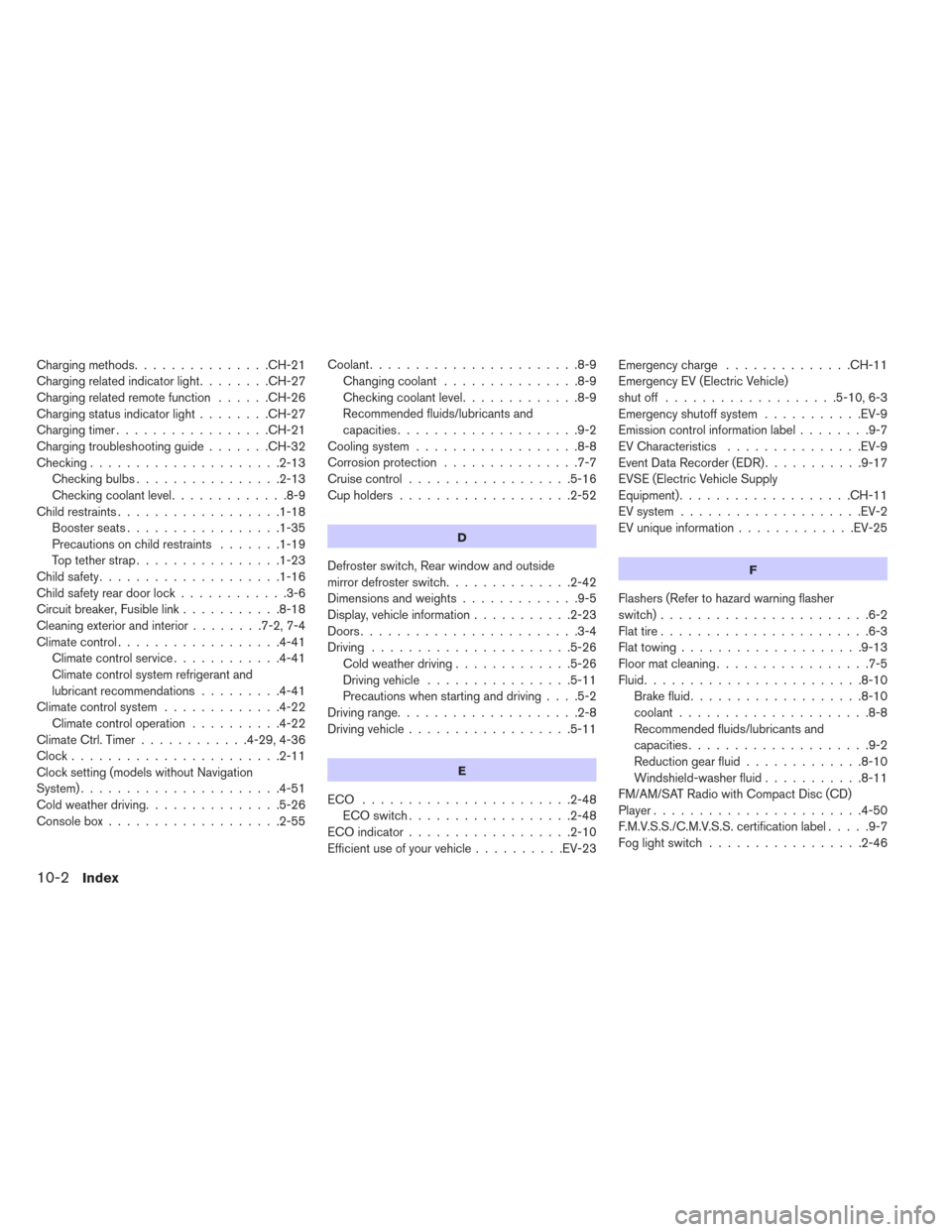
Charging methods...............CH-21
Chargingrelatedindicatorlight........CH-27
Charging related remote function ......CH-26
Charging status indicator light ........CH-27
Chargingtimer.................CH-21
Charging troubleshooting guide .......CH-32
Checking .....................2-13
Checkingbulbs................2-13
Checkingcoolantlevel.............8-9
Child restraints ..................1-18
Boosterseats.................1-35
Precautions on child restraints .......1-19
Top tether strap ................1-23
Childsafety....................1-16
Child safety rear door lock ............3-6
Circuit breaker, Fusible link ...........8-18
Cleaning exterior and interior ........7-2,7-4
Climatecontrol..................4-41 Climate control service ............4-41
Climate control system refrigerant and
lubricant recommendations .........4-41
Climate control system .............4-22
Climate control operation ..........4-22
Climate Ctrl. Timer ............4-29,4-36
Clock.......................2-11
Clock setting (models without Navigation
System) ......................4-51
Cold weather driving ...............5-26
Consolebox...................2-55 Coolant
.......................8-9
Changingcoolant ...............8-9
Checking coolant level .............8-9
Recommended fluids/lubricants and
capacities ....................9-2
Cooling system ..................8-8
Corrosion protection ...............7-7
Cruisecontrol..................5-16
Cupholders...................2-52
D
Defroster switch, Rear window and outside
mirror defroster switch ..............2-42
Dimensionsandweights.............9-5
Display, vehicle information ...........2-23
Doors ........................3-4
Driving ......................5-26
Cold weather driving .............5-26
Driving vehicle ................5-11
Precautions when starting and driving ....5-2
Driving range ....................2-8
Driving vehicle ..................5-11
E
ECO .......................2-48
ECO switch ..................2-48
ECOindicator..................2-10
Efficient use of your vehicle ..........EV-23Emergencycharge ..............CH-11
Emergency EV (Electric Vehicle)
shutoff ...................5-10,6-3
Emergency shutoff system
...........EV-9
Emission control information label ........9-7
EV Characteristics ...............EV-9
Event Data Recorder (EDR) ...........9-17
EVSE (Electric Vehicle Supply
Equipment) ...................CH-11
EV system ....................EV-2
EV unique information .............EV-25
F
Flashers (Refer to hazard warning flasher
switch).......................6-2
Flat tire .......................6-3
Flattowing....................9-13
Floormatcleaning.................7-5
Fluid ........................8-10
Brake fluid ...................8-10
coolant.....................8-8
Recommended fluids/lubricants and
capacities ....................9-2
Reduction gear fluid .............8-10
Windshield-washer fluid ...........8-11
FM/AM/SAT Radio with Compact Disc (CD)
Player .......................4-50
F.M.V.S.S./C.M.V.S.S. certification label .....9-7
Foglightswitch .................2-46
10-2Index
Page 419 of 424
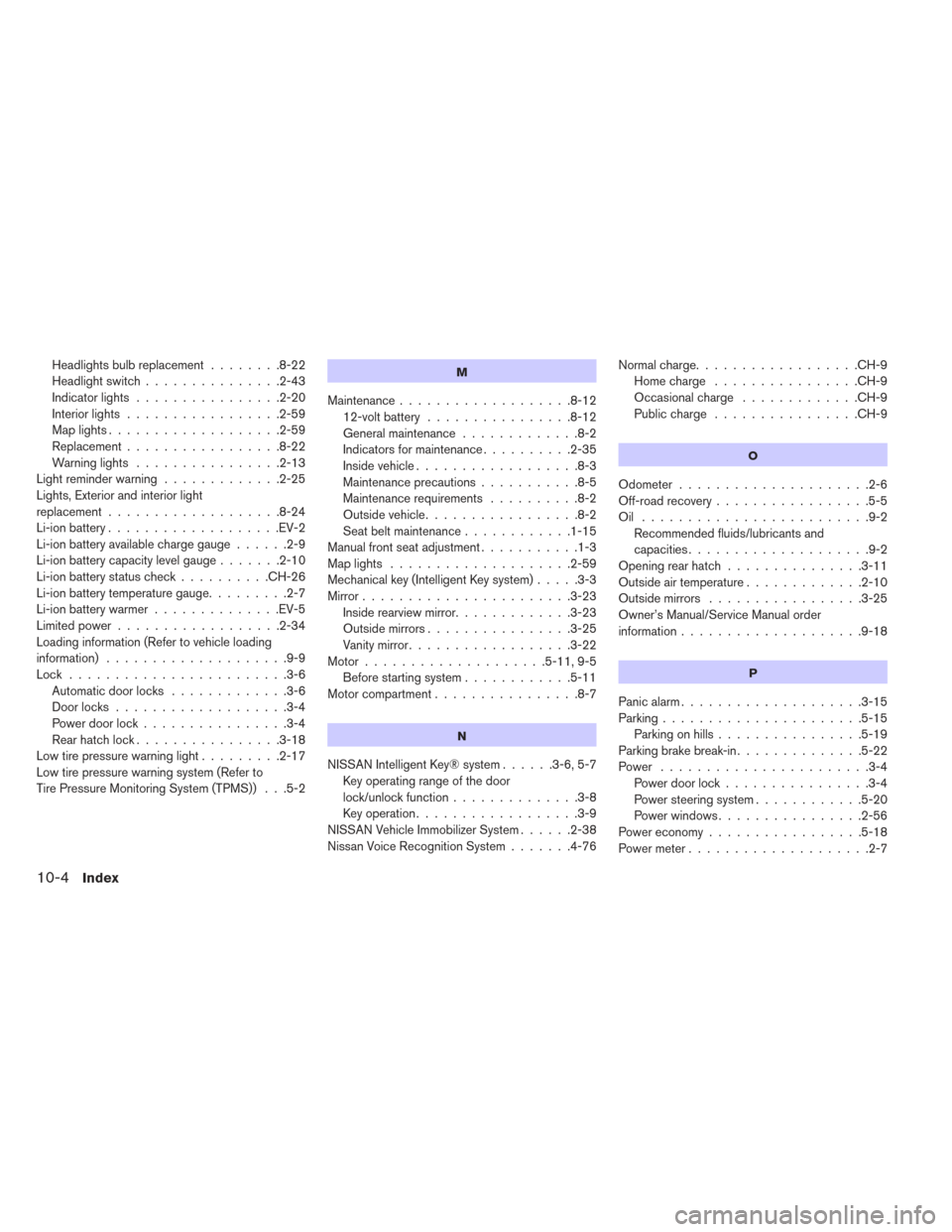
Headlights bulb replacement........8-22
Headlightswitch...............2-43
Indicatorlights ................2-20
Interior lights .................2-59
Maplights...................2-59
Replacement .................8-22
Warninglights ................2-13
Light reminder warning .............2-25
Lights, Exterior and interior light
replacement ...................8-24
Li-ion battery ...................EV-2
Li-ion battery available charge gauge ......2-9
Li-ion battery capacity level gauge .......2-10
Li-ion battery status check ..........CH-26
Li-ion battery temperature gauge .........2-7
Li-ion battery warmer ..............EV-5
Limited power ..................2-34
Loading information (Refer to vehicle loading
information) ....................9-9
Lock ........................3-6
Automatic door locks .............3-6
Door locks ...................3-4
Power door lock ................3-4
Rearhatchlock................3-18
Low tire pressure warning light .........2-17
Low tire pressure warning system (Refer to
Tire Pressure Monitoring System (TPMS)) . . .5-2M
Maintenance...................8-12 12-volt battery ................8-12
General maintenance .............8-2
Indicators for maintenance ..........2-35
Insidevehicle..................8-3
Maintenanceprecautions...........8-5
Maintenance requirements ..........8-2
Outside vehicle .................8-2
Seat belt maintenance ............1-15
Manual front seat adjustment ...........1-3
Maplights ....................2-59
Mechanical key (Intelligent Key system) .....3-3
Mirror .......................3-23
Inside rearview mirror.............3-23
Outside mirrors ................3-25
Vanity mirror ..................3-22
Motor....................5-11,9-5 Before starting system ............5-11
Motor compartment ................8-7
N
NISSAN Intelligent Key® system ......3-6,5-7
Key operating range of the door
lock/unlock function ..............3-8
Key operation ..................3-9
NISSAN Vehicle Immobilizer System ......2-38
Nissan Voice Recognition System .......4-76Normal charge..................CH-9
Home charge ................CH-9
Occasional charge .............CH-9
Publiccharge ................CH-9
O
Odometer .....................2-6
Off-road recovery .................5-5
Oil .........................9-2 Recommended fluids/lubricants and
capacities ....................9-2
Openingrearhatch...............3-11
Outside air temperature .............2-10
Outside mirrors .................3-25
Owner’s Manual/Service Manual order
information ....................9-18
P
Panic alarm....................3-15
Parking ......................5-15
Parking on hills ................5-19
Parking brake break-in ..............5-22
Power .......................3-4 Power door lock ................3-4
Power steering system ............5-20
Power windows ................2-56
Powereconomy.................5-18
Powermeter....................2-7
10-4Index