park assist NISSAN LEAF 2018 Owner´s Manual
[x] Cancel search | Manufacturer: NISSAN, Model Year: 2018, Model line: LEAF, Model: NISSAN LEAF 2018Pages: 435, PDF Size: 5.48 MB
Page 320 of 435
The brake system has two separate hy-
draulic circuits. If one circuit malfunctions,
you will still have braking at two wheels.
BRAKE PRECAUTIONS
Vacuum assisted brakes
The brake booster aids braking by using
engine vacuum. If the engine stops, you
can stop the vehicle by depressing the
brake pedal. However, greater foot pres-
sure on the brake pedal will be required to
stop the vehicle and stopping distance will
be longer.
Using the brakes
Avoid resting your foot on the brake pedal
while driving. This will overheat the brakes,
wear out the brake pads faster, and reduce
gas mileage.
To help reduce brake wear and to prevent
the brakes from overheating, reduce speed
and downshif t to a lower gear before going
down a slope or long grade. Overheated
brakes may reduce braking performance
and could result in loss of vehicle control.
WARNING
∙ While driving on a slippery surface, becareful when braking, accelerating or
downshif ting. Abrupt braking or ac-
celerating could cause the wheels to
skid and result in an accident.
∙ If the engine is not running or is turned off while driving, the power as-
sist for the brakes will not work. Brak-
ing will be harder.
Wet brakes
When the vehicle is washed or driven
through water, the brakes may get wet. As
a result, your braking distance will be lon-
ger and the vehicle may pull to one side
during braking.
To dry the brakes, drive the vehicle at a safe
speed while lightly pressing the brake
pedal to heat up the brakes. Do this until
the brakes return to normal. Avoid driving
the vehicle at high speeds until the brakes
function correctly.
Parking brake break-in
Break in the parking brake shoes whenever
the stopping effect of the parking brake is
weakened or whenever the parking brake shoes and/or drums/rotors are replaced,
in order to assure the best braking perfor-
mance.
This procedure is described in the vehicle
service manual. It is recommended that
you visit a NISSAN dealer for this service.
ANTI-LOCK BRAKING SYSTEM (ABS)
WARNING
∙ The ABS is a sophisticated device, but
it cannot prevent accidents resulting
from careless or dangerous driving
techniques. It can help maintain ve-
hicle control during braking on slip-
pery surfaces. Remember that stop-
ping distances on slippery surfaces
will be longer than on normal sur-
faces even with ABS. Stopping dis-
tances may also be longer on rough,
gravel or snow covered roads, or if you
are using tire chains. Always maintain
a safe distance from the vehicle in
front of you. Ultimately, the driver is
responsible for safety.
∙ Tire type and condition may also af- fect braking effectiveness.
BRAKE SYSTEM
5-54Starting and driving
Page 327 of 435
The hill start assist system automatically
keeps the brakes applied to help prevent
the vehicle from rolling backwards in the
time it takes the driver to release the brake
pedal and apply the accelerator when the
vehicle is stopped on a hill.
The hill start assist system will operate au-
tomatically under the following conditions:∙ The transmission is shif ted to a forward or reverse gear.
∙ The vehicle is stopped completely on a hill by applying the brake.
The maximum holding time is 2 seconds.
Af ter 2 seconds the vehicle will begin to roll
back and the hill start assist system will
stop operating completely.
The hill start assist system will not operate
when the transmission is shif ted to the N
(Neutral) or P (Park) position or on a flat and
level road.
When the Vehicle Dynamic Control (VDC)
indicator light illuminates in the meter, the
hill start assist system will not operate. For
additional information, refer to “Vehicle Dy-
namic Control (VDC) indicator light” in the
“Instruments and controls” section of this
manual.FREEING A FROZEN DOOR LOCK
To prevent a door lock from freezing, apply
de-icer through the key hole. If the lock
becomes frozen, heat the key before in-
serting it into the key hole or use the re-
mote keyless entry function on the Intelli-
gent Key.
ANTIFREEZE
In the winter when it is anticipated that the
temperature will drop below 32°F (0°C),
check the antifreeze to assure proper win-
ter protection. For additional information,
refer to “Engine cooling system” in the “Do-
it-yourself ” section of this manual.
BATTERY
If the battery is not fully charged during
extremely cold weather conditions, the
battery fluid may freeze and damage the
battery. To maintain maximum efficiency,
the battery should be checked regularly.
For additional information, refer to “Battery”
in the “Do-it-yourself ” section of this
manual.
DRAINING OF COOLANT WATER
If the vehicle is to be lef t outside without
anti-freeze, drain the cooling system, in-
cluding the engine block. Refill before oper-
ating the vehicle. For additional informa-
tion, refer to “Changing engine coolant” in
the “Do-it-yourself ” section of this manual.
TIRE EQUIPMENT
1. SUMMER tires have a tread designed to provide superior performance on dry
pavement. However, the performance
of these tires will be substantially re-
duced in snowy and icy conditions. If
you operate your vehicle on snowy or
icy roads, NISSAN recommends the use
of MUD & SNOW or ALL SEASON TIRES
on all four wheels. It is recommended
that you visit a NISSAN dealer for the tire
type, size, speed rating and availability
information.
2. For additional traction on icy roads, studded tires may be used. However,
some states, provinces and territories
prohibit their use. Check local laws be-
fore installing studded tires.
COLD WEATHER DRIVING
Starting and driving5-61
Page 332 of 435
4. Turn off the engine.
5. Raise the hood to warn other trafficand to signal professional road assis-
tance personnel that you need assis-
tance.
6. Have all passengers get out of the ve- hicle and stand in a safe place, away
from traffic and clear of the vehicle.
WARNING
∙ Make sure the parking brake is se-curely applied and the Continuously
Variable Transmission (CVT) is shif ted
into P (Park).
∙ Never change tires when the vehicle is on a slope, ice or slippery areas. This is
hazardous.
∙ Never change tires if oncoming traffic is close to your vehicle. Wait for pro-
fessional road assistance.
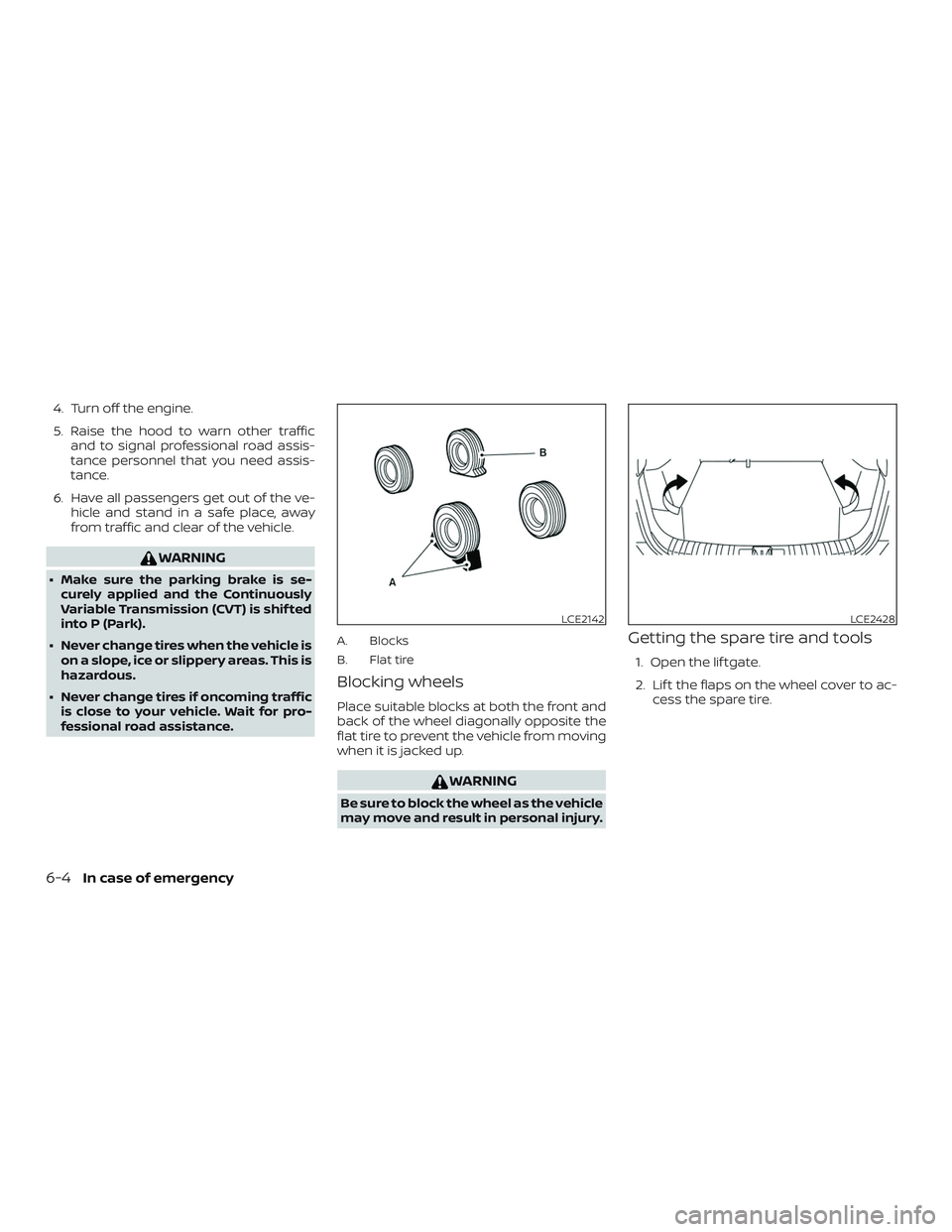
A. Blocks
B. Flat tire
Blocking wheels
Place suitable blocks at both the front and
back of the wheel diagonally opposite the
flat tire to prevent the vehicle from moving
when it is jacked up.
WARNING
Be sure to block the wheel as the vehicle
may move and result in personal injury.
Getting the spare tire and tools
1. Open the lif tgate.
2. Lif t the flaps on the wheel cover to ac- cess the spare tire.
LCE2142LCE2428
6-4In case of emergency
Page 344 of 435
In order to maintain the appearance of
your vehicle, it is important to take proper
care of it.
To protect the paint surfaces, wash your
vehicle as soon as you can:∙ Af ter a rainfall to prevent possible dam- age from acid rain.
∙ Af ter driving on coastal roads.
∙ When contaminants such as soot, bird droppings, tree sap, metal particles or
bugs get on the paint surface.
∙ When dust or mud builds up on the sur- face.
Whenever possible, store or park your ve-
hicle inside a garage or in a covered area.
When it is necessary to park outside, park in
a shady area or protect the vehicle with a
body cover.
Be careful not to scratch the paint sur-
face when putting on or removing the
body cover.WASHING
Wash dirt off with a wet sponge and plenty
of water. Clean the vehicle thoroughly us-
ing a mild soap, a special vehicle soap or
general purpose dishwashing liquid mixed
with clean, lukewarm (never hot) water.
CAUTION
∙ Do not use car washes that use acid in the detergent. Some car washes, es-
pecially brushless ones, use some
acid for cleaning. The acid may react
with some plastic vehicle compo-
nents, causing them to crack. This
could affect their appearance, and
also could cause them not to function
properly. Always check with your car
wash to confirm that acid is not used.
∙ Do not wash the vehicle with strong household soap, strong chemical de-
tergents, gasoline or solvents.
∙ Do not wash the vehicle in direct sun- light or while the vehicle body is hot,
as the surface may become
water-spotted. ∙ Avoid using tight-napped or rough
cloths, such as washing mitts. Care
must be taken when removing
caked-on dirt or other foreign sub-
stances so the paint surface is not
scratched or damaged.
Rinse the vehicle thoroughly with plenty of
clean water.
Inside edges, seams and folds on the
doors, hatches and hood are particularly
vulnerable to the effects of road salt. There-
fore, these areas must be cleaned regularly.
Take care that the drain holes in the lower
edge of the door are open. Spray water
under the body and in the wheel wells to
loosen the dirt and wash away road salt.
A damp chamois can be used to dry the
vehicle to avoid water spots.
WAXING
Regular waxing protects the paint surface
and helps retain new vehicle appearance.
Polishing is recommended to remove
built-up wax residue and to avoid a weath-
ered appearance before re-applying wax.
A NISSAN dealer can assist you in choosing
the proper product.
CLEANING EXTERIOR
7-2Appearance and care
Page 427 of 435
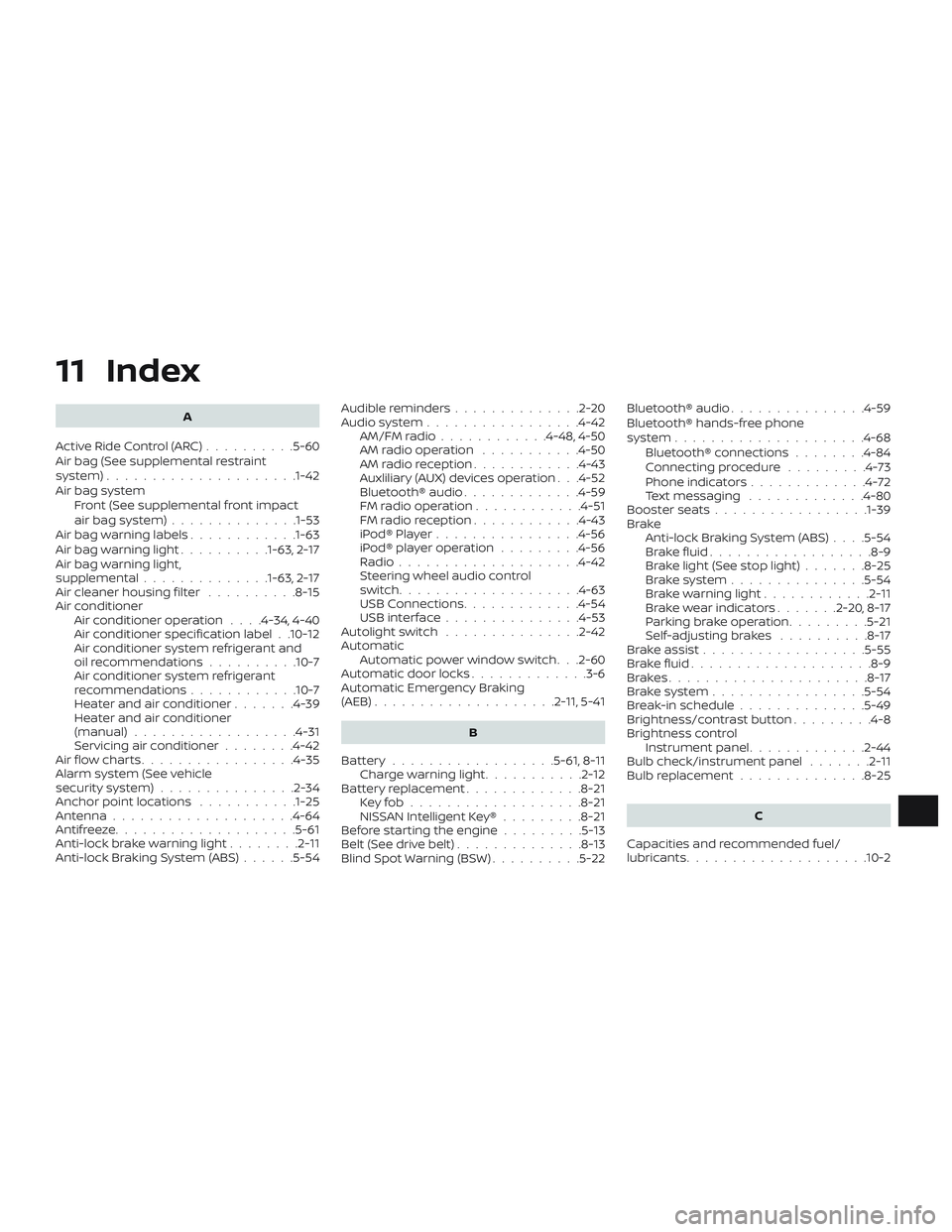
11 Index
A
ActiveRideControl(ARC)..........5-60
Air bag (See supplemental restraint
system) .................... .1-42
Air bag system Front (See supplemental front impact
airbagsystem)..............1-53
Air bag warning labels ............1-63
Airbagwarninglight..........1-63, 2-17
Air bag warning light,
supplemental ..............1-63, 2-17
Air cleaner housing filter ..........8-15
Air conditioner Air conditioner operation ....4-34,4-40
Air conditioner specification label . .10-12
Air conditioner system refrigerant and
oil recommendations ..........10-7
Air conditioner system refrigerant
recommendations ............10-7
Heater and air conditioner .......4-39
Heater and air conditioner
(manual) ..................4-31
Servicing air conditioner ........4-42
Air flow charts .................4-35
Alarm system (See vehicle
security system) ...............2-34
Anchor point locations ...........1-25
Antenna ....................4-64
Antifreeze ....................5-61
Anti-lock brake warning light ........2-11
Anti-lock Braking System (ABS) ......5-54Audible reminders
..............2-20
Audiosystem.................4-42 AM/FMradio............4-48,4-50
AM radio operation ...........4-50
AMradioreception............4-43
Auxliliary (AUX) devices operation . . .4-52
Bluetooth® audio .............4-59
FM radio operation ............4-51
FMradioreception............4-43
iPod®Player................4-56
iPod® player operation .........4-56
Radio ....................4-42
Steering wheel audio control
switch....................4-63
USB Connections .............4-54
USBinterface...............4-53
Autolightswitch ...............2-42
Automatic Automatic power window switch . . .2-60
Automatic door locks .............3-6
Automatic Emergency Braking
(AEB) ....................2 -11, 5-41
B
Battery..................5-61,8-11 Charge warning light ...........2-12
Battery replacement .............8-21
Keyfob...................8-21
NISSAN Intelligent Key® .........8-21
Before starting the engine .........5-13
Belt(Seedrivebelt)..............8-13
Blind Spot Warning (BSW) ..........5-22Bluetooth® audio
...............4-59
Bluetooth® hands-free phone
system .....................4-68
Bluetooth® connections ........4-84
Connecting procedure .........4-73
Phone indicators .............4-72
Text messaging .............4-80
Booster seats .................1-39
Brake Anti-lock Braking System (ABS) ....5-54
Brakefluid..................8-9
Brakelight(Seestoplight).......8-25
B
rakesystem...............5-54
Brakewarninglight............2-11
Brakewearindicators.......2-20,8-17
Parking brake operation .........5-21
Self-adjustingbrakes ..........8-17
Brakeassist................. .5-55
Brakefluid....................8-9
Brakes......................8-17
Brakesystem.................5-54
Break-in schedule ..............5-49
Brightness/contrast button .........4-8
Brightness control Instrument panel .............2-44
Bulb check/instrument panel .......2-11
Bulb replacement ..............8-25
C
Capacities and recommended fuel/
lubricants....................10-2