belt NISSAN LEAF 2019 Owner´s Manual
[x] Cancel search | Manufacturer: NISSAN, Model Year: 2019, Model line: LEAF, Model: NISSAN LEAF 2019Pages: 610, PDF Size: 7.11 MB
Page 446 of 610
• When the Vehicle Dynamic Control (VDC)system is off. For additional information,
refer to “Vehicle Dynamic Control (VDC)
system” in this section.
• When the VDC system (including the trac- tion control system) is operating
• When a wheel is slipping
• When any door is open
• When the driver’s seat belt is not fastened
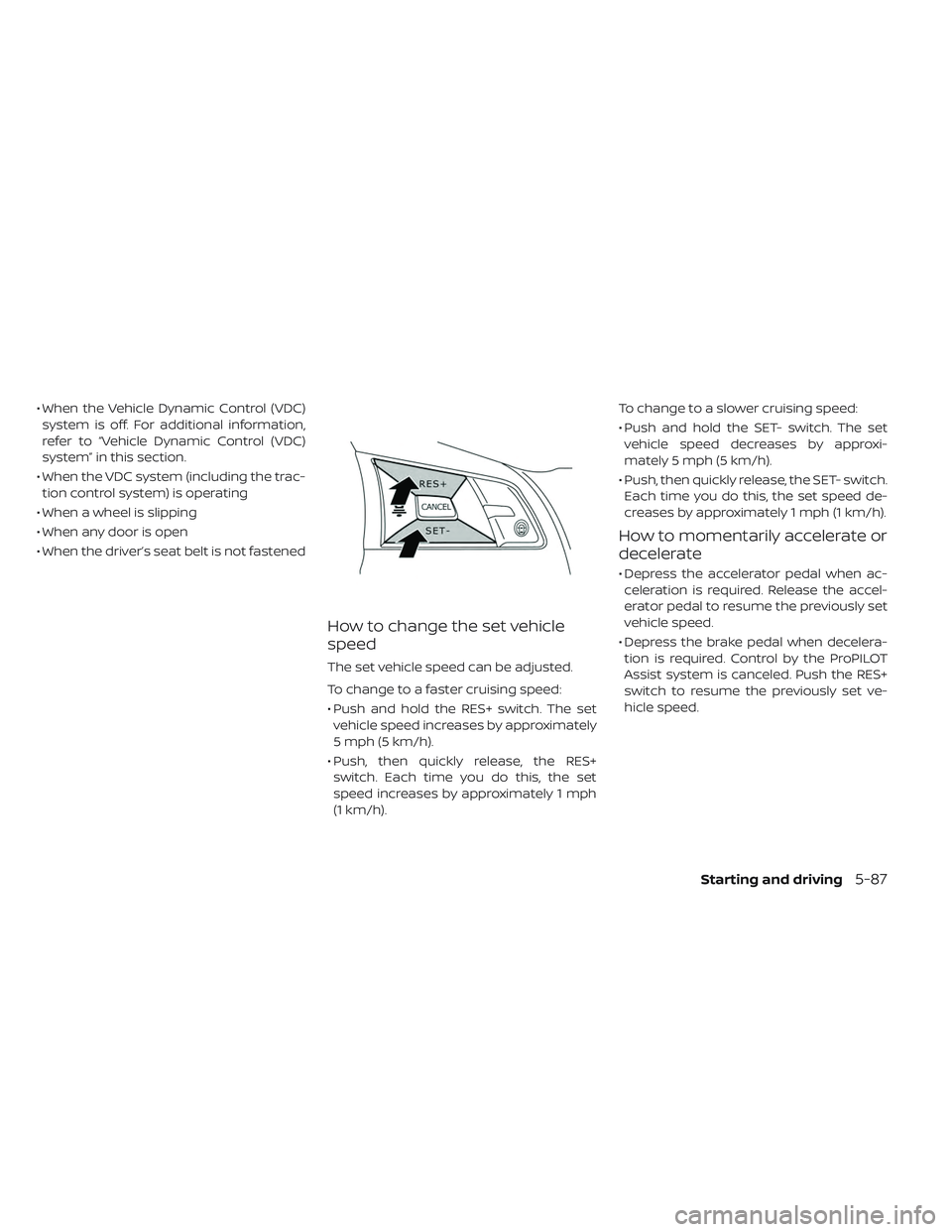
How to change the set vehicle
speed
The set vehicle speed can be adjusted.
To change to a faster cruising speed:
• Push and hold the RES+ switch. The set vehicle speed increases by approximately
5 mph (5 km/h).
• Push, then quickly release, the RES+ switch. Each time you do this, the set
speed increases by approximately 1 mph
(1 km/h). To change to a slower cruising speed:
• Push and hold the SET- switch. The set
vehicle speed decreases by approxi-
mately 5 mph (5 km/h).
• Push, then quickly release, the SET- switch. Each time you do this, the set speed de-
creases by approximately 1 mph (1 km/h).
How to momentarily accelerate or
decelerate
• Depress the accelerator pedal when ac-celeration is required. Release the accel-
erator pedal to resume the previously set
vehicle speed.
• Depress the brake pedal when decelera- tion is required. Control by the ProPILOT
Assist system is canceled. Push the RES+
switch to resume the previously set ve-
hicle speed.
Starting and driving5-87
Page 459 of 610
Condition A
Under the following conditions, the ICC sys-
tem is automatically canceled. A chime will
sound and the system will not be able to be
set:
• Any door is open.
• The driver’s seat belt is not fastened.
• The vehicle ahead is not detected andyour vehicle is traveling below the speed
of 15 mph (24 km/h).
• Your vehicle has been stopped by the ICC system for approximately 3 minutes or
longer.
• The shif t lever is not in the D (Drive) posi- tion or B mode.
• The electronic parking brake is applied.
• The Vehicle Dynamic Control (VDC) sys- tem is turned off.
• The Automatic Emergency Braking ap- plies harder braking.
• VDC (including the traction control sys- tem) operates.
• A wheel slips.
• When distance measurement becomes impaired due to adhesion of dirt or ob-
struction to the sensor. • When the radar signal is temporarily
interrupted.
Action to take:
When the conditions listed above are no lon-
ger present, turn the system off using the
ProPILOT Assist switch. Turn the ProPILOT
Assist system back on to use the system.
NOTE:
When the ICC system is canceled un-
der the following conditions at a
standstill, the electronic parking brake
is automatically activated:
• Any door is open.
• The driver’s seat belt is not fastened.
• Your vehicle has been stopped by the
ICC system for approximately 3 minutes
or longer.
• The shif t lever is not in the D (Drive) po-
sition or B mode.
• The VDC system is turned off.
• When distance measurement becomes
impaired due to adhesion of dirt or ob-
struction to the sensor.
• When the radar signal is temporarily in-
terrupted. Condition B
When the radar sensor of the front bumper
is covered with dirt or is obstructed, the ICC
system will automatically be canceled.
The chime will sound and the “Not Avail-
able: Front Radar Blocked” warning mes-
sage will appear in the vehicle information
display.
Action to take:
If the warning message appears, stop the
vehicle in a safe place, place the shif t lever
in the P (Park) position, and turn the EV
system off. When the radar signal is tempo-
rarily interrupted, clean the sensor area of
the front bumper and restart the EV sys-
tem. If the “Not Available: Front Radar
Blocked” warning message continues to
be displayed, have the system checked. It is
recommended that you visit a NISSAN cer-
tified LEAF dealer for this service.
5-100Starting and driving
Page 532 of 610
7 Appearance and care
Cleaning exterior......................7-2
Washing ..........................7-2
Waxing ...........................7-2
Removing spots .....................7-3
Underbody ........................7-3
Glass ............................7-3
Wheels ...........................7-3
Chromeparts......................7-4
Tire dressing .......................7-4
Cleaning interior ......................7-4 Air fresheners
......................7-5
Floor mats (if so equipped) ..............7-5
Seatbelts.........................7-7
Corrosion protection ....................7-7
Most common factors contributing to vehicle
corrosion .........................7-7
Environmental factors influence the rate of
corrosion .........................7-7
Protect your vehicle from corrosion ........7-7
Page 538 of 610
SEAT BELTS
The seat belts can be cleaned by wiping
them with a sponge dampened in a mild
soap solution. Allow the belts to dry com-
pletely in the shade before using them.
For additional information, refer to “Seat
belts” in the “Safety—Seats, seat belts and
supplemental restraint system” section of
this manual.
WARNING
Do not allow wet seat belts to roll up in
the retractor. NEVER use bleach, dye, or
chemical solvents to clean the seat
belts, since these materials may se-
verely weaken the seat belt webbing.
MOST COMMON FACTORS
CONTRIBUTING TO VEHICLE
CORROSION
• The accumulation of moisture-retaining dirt and debris in body panel sections,
cavities, and other areas.
• Damage to paint and other protective coatings caused by gravel and stone
chips or minor traffic accidents.
ENVIRONMENTAL FACTORS
INFLUENCE THE RATE OF
CORROSION
Moisture
Accumulation of sand, dirt and water on
the vehicle body underside can accelerate
corrosion. Wet floor coverings will not dry
completely inside the vehicle, and should
be removed for drying to avoid floor panel
corrosion.
Relative humidity
Corrosion will be accelerated in areas of
high relative humidity, especially those ar-
eas where the temperatures stay above
freezing, where atmospheric pollution ex-
ists, or where road salt is used.
Temperature
A temperature increase will accelerate the
rate of corrosion to those parts which are
not well ventilated.
Air pollution
Industrial pollution, the presence of salt in
the air in coastal areas, or heavy road salt
use will accelerate the corrosion process.
Road salt will also accelerate the disinte-
gration of paint surfaces.
PROTECT YOUR VEHICLE FROM
CORROSION
• Wash and wax your vehicle of ten to keepthe vehicle clean.
• Always check for minor damage to the paint and repair it as soon as possible.
• Keep drain holes at the bottom of the doors open to avoid water accumulation.
• Check the underbody for accumulation of sand, dirt or salt. If present, wash with wa-
ter as soon as possible.
CORROSION PROTECTION
Appearance and care7-7
Page 543 of 610
Inside vehicle
The maintenance items listed here should
be checked on a regular basis, such as
when performing scheduled maintenance,
cleaning the vehicle, etc.
Accelerator pedal:Check the pedal for
smooth operation and make sure that the
pedal does not catch or require uneven
effort. Keep the floor mat away from the
pedal.
Brake pedal: Check the pedal for smooth
operation. If the brake pedal suddenly goes
down further than normal, the pedal feels
spongy or the vehicle seems to take longer
to stop, it is recommended that you visit a
NISSAN certified LEAF dealer immediately.
Keep the floor mat away from the pedal.
Brakes: Check that the brakes do not pull
the vehicle to one side when applied.
Electric shif t P (Park) position mecha-
nism: On a steep hill, check that the vehicle
is held securely while the vehicle is in the P
(Park) position without applying the brakes. Parking brake:
Check the parking brake
operation regularly. The vehicle should be
securely held on a steep hill with only the
parking brake applied. If the parking brake
cannot keep a vehicle position, it is recom-
mended that you visit a NISSAN certified
LEAF dealer for this service.
Seat: Check seat position controls such as
the seat adjusters, seatback recliners, etc.
to ensure that they operate smoothly and
that all latches lock securely in every posi-
tion. Check that the head restraints/
headrests move up and down smoothly
and that the locks (if so equipped) hold
securely in all latched positions.
Seat belts: Check that all parts of the seat
belt system (for example, buckles, anchors,
adjusters and retractors) operate properly
and smoothly, and are installed securely.
Check the belt webbing for cuts, fraying,
wear or damage.
Steering wheel: Check for changes in the
steering conditions, such as excessive free
play, hard steering or strange noises. Warning lights and chimes:
Make sure
that all warning lights and chimes are op-
erating properly.
Windshield defroster: Check that the air
emits from the defroster outlets properly
and in sufficient quantity when operating
the heater or air conditioner.
Windshield wiper and washer*: Check
that the wipers and washers operate prop-
erly and that the wipers do not streak.
Under hood and vehicle
The maintenance items listed here should
be checked periodically.
12-volt battery (except for maintenance
free batteries)*: Check the fluid level in
each cell. The fluid should be at the bottom
of the filler opening. Vehicles operated in
high temperatures or under severe condi-
tions require frequent checks of the 12–volt
battery fluid level.
8-4Maintenance and do-it yourself
Page 578 of 610
•The original tires have built-in
tread wear indicators. When
wear indicators are visible, the
tire(s) should be replaced.
•Tires degrade with age and
use. Have tires, over 6 years old
checked by a qualified techni-
cian, because some tire dam-
age may not be obvious. Re-
place the tires as necessary to
prevent tire failure and pos-
sible personal injury.
•For additional information re-
garding tires, refer to “Impor-
tant Tire Safety Information”
(US) or “Tire Safety Informa-
tion” (Canada) in the Warranty
Information Booklet.
Replacing wheels and tires
When replacing a tire, use the same size,
tread design, speed rating and load carry-
ing capacity as originally equipped. For ad-
ditional information, refer to “Specifica-
tions” in the “Technical and consumerinformation” section of this manual for rec-
ommended types and sizes of tires and
wheels.
WARNING
• The use of tires other than those rec- ommended or the mixed use of tires
of different brands, construction
(bias, bias-belted or radial), or tread
patterns can adversely affect the
ride, braking, handling, Vehicle Dy-
namic Control (VDC) system, ground
clearance, body-to-tire clearance,
tire chain clearance, speedometer
calibration, headlight aim and bum-
per height. Some of these effects
may lead to accidents and could re-
sult in serious personal injury.
• If your vehicle was originally equipped with four tires that were
the same size and you are only re-
placing two of the four tires, install
the new tires on the rear axle. Plac-
ing new tires on the front axle may
cause loss of vehicle control in some
driving conditions and cause an ac-
cident and personal injury. • If the wheels are changed for any
reason, always replace with wheels
which have the same off-set dimen-
sion. Wheels of a different off-set
could cause premature tire wear, de-
grade vehicle handling characteris-
tics, affect the VDC system and/or
interference with the brake discs.
Such interference can lead to de-
creased braking efficiency and/or
early brake pad/shoe wear. For ad-
ditional information on wheel-off
set dimensions, refer to “Wheels and
tires” in the “Technical and con-
sumer information” section of this
manual.
• When replacing a wheel without the TPMS such as the spare tire, the
TPMS will not function when a wheel
is replaced, the TPMS will not func-
tion and the low tire pressure warn-
ing light will flash for approximately
1 minute. The light will remain on af-
ter 1 minute. It is recommended that
you visit a NISSAN certified LEAF
dealer for this service.
• Replacing tires with those not origi- nally specified by NISSAN could af-
fect the proper operation of the
TPMS.
Maintenance and do-it yourself8-39
Page 589 of 610
WARNING
•
It is extremely dangerous to ride
in the cargo area inside the ve-
hicle. In a collision, people riding
in these areas are more likely to
be seriously injured or killed.
•Do not allow people to ride in
any area of your vehicle that is
not equipped with seats and
seat belts.
•Be sure everyone in your ve-
hicle is in a seat and using a
seat belt properly.
TERMS
It is important to familiarize yourself
with the following terms before
loading your vehicle:
• Curb Weight (actual weight of your vehicle) - vehicle weight including:
standard and optional equipment,
fluids and emergency tools. This
weight does not
include passengers
and cargo.
• GVW (Gross Vehicle Weight) - curb weight plus the combined weight
of passengers and cargo.
•
GVWR (Gross Vehicle Weight Rating) -
maximum total combined weight of
the unloaded vehicle, passengers,
luggage, hitch, trailer tongue load
and any other optional equipment.
• GAWR (Gross Axle Weight Rating) - maximum weight (load) limit speci-
fied for the front or rear axle.
•This information is located on the
F.M.V.S.S./C.M.V.S.S. label.
•
GCWR (Gross Combined Weight
Rating) - The maximum total weight
rating of the vehicle, passengers,
cargo, and trailer.
• Vehicle Capacity Weight, Load limit, Total load capacity - maximum to-
tal weight limit specified of the load
(passengers and cargo) for the ve-
hicle. This is the maximum com-
bined weight of occupants and
cargo that can be loaded into the vehicle. If the vehicle is used to tow
a trailer, the trailer tongue weight
must be included as part of the
cargo load. This information is lo-
cated on the Tire and Loading Infor-
mation label.
•
Cargo capacity - permissible weight
of cargo, the subtracted weight of
occupants from the load limit.
VEHICLE LOAD CAPACITY
Do not exceed the load limit of your
vehicle shown as “The combined
weight of occupants and cargo” on
the Tire and Loading Information
label. Do not exceed the number
of occupants shown as “Seating
Capacity” on the Tire and Loading
Information label.
To get “the combined weight of occu-
pants and cargo”, add the weight of all
occupants, then add the total lug-
gage weight. Examples are shown in
the following illustration.
VEHICLE LOADING INFORMATION
9-10Technical and consumer information
Page 598 of 610
B. LICENSING ANC COPYRIGHT NOTICE
INFORMATION
The sof tware classified as (5) above con-
tains various open sourced sof tware
(“OSS”) listed in the below website. Please
see the website indicted next for the terms
and conditions of the licenses (OSS Li-
censes) and other information regarding
the OSS contained this Product:
https://www.ficosa.com/sof tware/
opensource/This vehicle is equipped with an Event Data
Recorder (EDR). The main purpose of an
EDR is to record, in certain crash or near
crash-like situations, such as an air bag
deployment or hitting a road obstacle, data
that will assist in understanding how a ve-
hicle’s systems performed. The EDR is de-
signed to record data related to vehicle dy-
namics and safety systems for a short
period of time, typically 30 seconds or less.
The EDR in this vehicle is designed to re-
cord such data as:
• How various systems in your vehicle were
operating;
• Whether or not the driver and passenger safety belts were buckled/fastened;
• How far (if at all) the driver was depressing the accelerator and/or brake pedal; and,
• How fast the vehicle was traveling.
• Sounds are not recorded.
These data can help provide a better un-
derstanding of the circumstances in which
crashes and injuries occur.NOTE:
EDR data are recorded by your vehicle
only if a nontrivial crash situation occurs;
no data are recorded by the EDR under
normal driving conditions and no per-
sonal data (for example, name, gender,
age and crash location) are recorded.
However, other parties, such as law en-
forcement, could combine the EDR data
with the type of personally identif ying
data routinely acquired during a crash
investigation.
To read data recorded by an EDR, special
equipment is required and access to the
vehicle or the EDR is needed. In addition
to the vehicle manufacturer and NISSAN
certified LEAF dealer, other parties, such
as law enforcement, that have the spe-
cial equipment, can read the information
if they have access to the vehicle or the
EDR. EDR data will only be accessed with
the consent of the vehicle owner or les-
see or as otherwise required or permit-
ted by law.
EVENT DATA RECORDERS (EDR)
Technical and consumer information9-19
Page 605 of 610
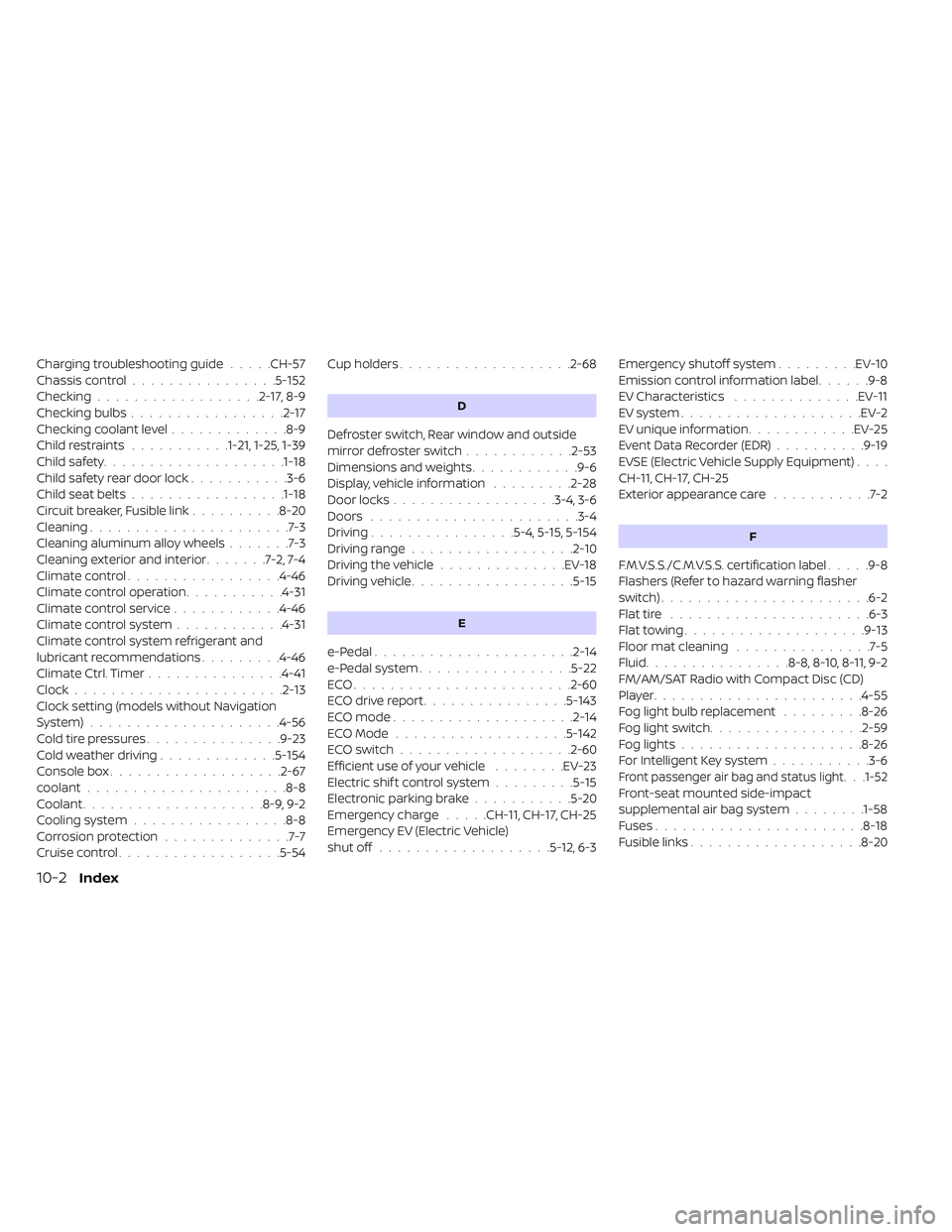
Charging troubleshooting guide.....CH-57
Chassis control ................5-152
Checking ..................2-17, 8-9
Checking bulbs .................2-17
Checking coolant level .............8-9
Child restraints ...........1-21, 1-25, 1-39
Child safety ....................1-18
Child safety rear door lock ...........3-6
Child seat belts .................1-18
Circuit breaker, Fusible link ..........8-20
Cleaning ......................7-3
Cleaning aluminum alloy wheels .......7-3
Cleaning exterior and interior .......7-2,7-4
Climate control .................4-46
Climate control operation ...........4-31
Climate control service ............4-46
Climate control system ............4-31
Climate control system refrigerant and
lubricant recommendations .........4-46
Climate Ctrl. Timer ...............4-41
Clock .......................2-13
Clock setting (models without Navigation
System) .....................4-56
Cold tire pressures ...............9-23
Cold weather driving .............5-154
Console box ...................2-67
coolant ......................8-8
Coolant ....................8-9, 9-2
Cooling system .................8-8
Corrosion protection ..............7-7
Cruise control ..................5-54 Cup holders
...................2-68
D
Defroster switch, Rear window and outside
mirror defroster switch ............2-53
Dimensions and weights ............9-6
Display, vehicle information .........2-28
Door locks ..................3-4, 3-6
Doors .......................3-4
Driving ................5-4, 5-15, 5-154
Driving range ..................2-10
Driving the vehicle ..............EV-18
Driving vehicle ..................5-15
E
e-Pedal......................2-14
e-Pedal system .................5-22
ECO........................2-60
ECO drive report ................5-143
ECO mode ....................2-14
ECO Mode ...................5-142
ECO switch ...................2-60
Efficient use of your vehicle ........EV-23
Electric shif t control system .........5-15
Electronic parking brake ...........5-20
Emergency charge .....CH-11, CH-17, CH-25
Emergency EV (Electric Vehicle)
shut off ...................5-12, 6-3 Emergency shutoff system
.........EV-10
Emission control information label ......9-8
EV Characteristics ..............EV-11
EV system ....................EV-2
EV unique information ............EV-25
Event Data Recorder (EDR) ..........9-19
EVSE (Electric Vehicle Supply Equipment) ....
CH-11, CH-17, CH-25
Exterior appearance care ...........7-2
F
F.M.V.S.S./C.M.V.S.S. certification label .....9-8
Flashers (Refer to hazard warning flasher
switch) .......................6-2
Flat tire ......................6-3
Flat towing ....................9-13
Floor mat cleaning ...............7-5
Fluid ................8-8, 8-10, 8-11, 9-2
FM/AM/SAT Radio with Compact Disc (CD)
Player.......................4-55
Fog light bulb replacement .........8-26
Fog light switch .................2-59
Fog lights ....................8-26
For Intelligent Key system ...........3-6
Front passenger air bag and status light. . .1-52
Front-seat mounted side-impact
supplemental air bag system ........1-58
Fuses .......................8-18
Fusible links ...................8-20
10-2Index
Page 607 of 610
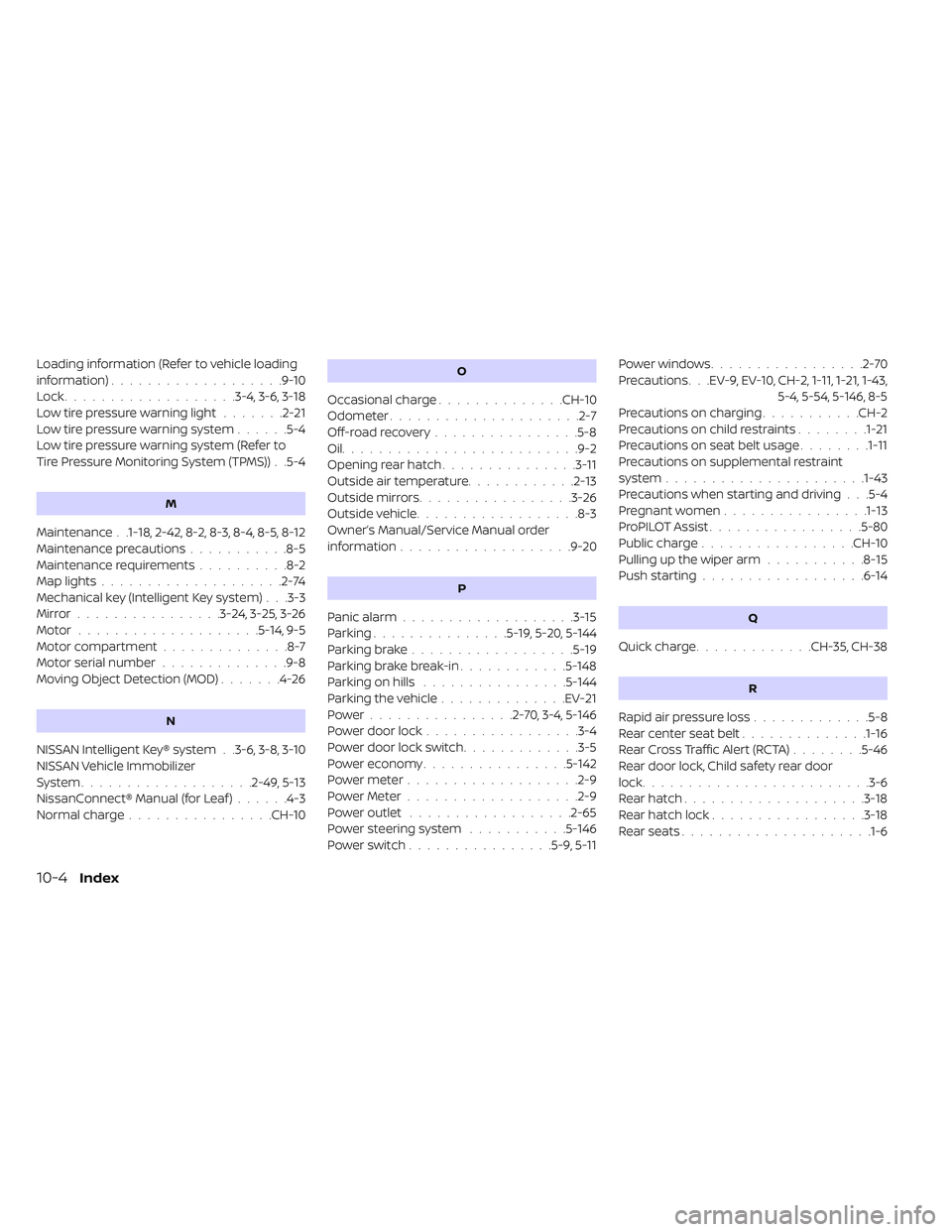
Loading information (Refer to vehicle loading
information)...................9-10
Lock...................3-4, 3-6, 3-18
Low tire pressure warning light .......2-21
Low tire pressure warning system ......5-4
Low tire pressure warning system (Refer to
Tire Pressure Monitoring System (TPMS)) . .5-4
M
Maintenance . .1-18, 2-42, 8-2, 8-3, 8-4, 8-5, 8-12
Maintenance precautions ...........8-5
Maintenance requirements ..........8-2
Map lights ....................2-74
Mechanical key (Intelligent Key system) . . .3-3
Mirror ................3-24, 3-25, 3-26
Motor ....................5-14, 9-5
Motor compartment ..............8-7
Motor serial number ..............9-8
Moving Object Detection (MOD) .......4-26
N
NISSAN Intelligent Key® system . .3-6, 3-8, 3-10
NISSAN Vehicle Immobilizer
System...................2-49, 5-13
NissanConnect® Manual (for Leaf ) ......4-3
Normal charge ................CH-10
O
Occasional charge ..............CH-10
Odometer .....................2-7
Off-roadrecovery................5-8
Oil..........................9-2
Opening rear hatch ...............3-11
Outside air temperature ............2-13
Outside mirrors .................3-26
Outside vehicle ..................8-3
Owner’s Manual/Service Manual order
information ...................9-20
P
Panic alarm ...................3-15
Parking ...............5-19, 5-20, 5-144
Parking brake ..................5-19
Parking brake break-in ............5-148
Parking on hills ................5-144
Parking the vehicle ..............EV-21
Power................2-70, 3-4, 5-146
Power door lock .................3-4
Power door lock switch .............3-5
Power economy ................5-142
Power meter ...................2-9
Power Meter ...................2-9
Power outlet ..................2-65
Power steering system ...........5-146
Power switch ................5-9, 5-11 Power windows
.................2-70
Precautions. . .EV-9, EV-10, CH-2, 1-11, 1-21, 1-43, 5-4, 5-54, 5-146, 8-5
Precautions on charging ...........CH-2
Precautions on child restraints ........1-21
Precautions on seat belt usage ........1-11
Precautions on supplemental restraint
system ......................1-43
Precautions when starting and driving . . .5-4
Pregnant women ................1-13
ProPILOT Assist .................5-80
Public charge .................CH-10
Pulling up the wiper arm ...........8-15
Push starting ..................6-14Q
Quick charge.............CH-35, CH-38
R
Rapid air pressure loss .............5-8
Rear center seat belt ..............1-16
RearCrossTrafficAlert(RCTA)........5-46
Rear door lock, Child safety rear door
lock .........................3-6
Rear hatch ....................3-18
Rear hatch lock .................3-18
Rearseats.....................1-6
10-4Index