belt NISSAN LEAF 2019 Owner´s Manual
[x] Cancel search | Manufacturer: NISSAN, Model Year: 2019, Model line: LEAF, Model: NISSAN LEAF 2019Pages: 610, PDF Size: 7.11 MB
Page 77 of 610
– If you use the EVSE holder, handleit with care to avoid injuries due to
contact with its edges or other
parts.
– Do not use the EVSE if the cable or cord is frayed, has broken insula-
tion, or shows any other indica-
tions of damage.
– Stop using the EVSE immediately if charging stops before comple-
tion when you move the plug or
cord.
– Do not use the EVSE if the control box, plug, the EVSE or charge con-
nector is broken, cracked, open,
corroded or shows any other indi-
cations of damage.
– Do not use the EVSE if the plug has a loose connection with the outlet
or if the outlet is damaged or
rusted.
– Before you connect the EVSE, be sure to check the rated current
shown on the EVSE to ensure that
the outlet and circuit have enough
current capacity to charge your
vehicle safely. If the capacity of
the outlet and circuit is not
enough, wiring may cause over-
heating or a fire. – If in any doubt about the outlet
and circuit, consult a qualified
electrician.
– The EVSE has parts that may spark inside. Do not use it where
gasoline, paint, or flammable liq-
uids are used or stored.
– Do not use if a malfunction occurs or if the EVSE has been damaged
in any manner. It is recommended
that you visit a NISSAN certified
LEAF dealer for replacement.
– The EVSE contains no user ser- viceable parts. Do not attempt to
repair the EVSE, doing so will void
your warranty.
• Pass the lower side belt of the EVSE case securely through the fastener
on the bottom of the luggage board.
If the case suddenly becomes loose,
it may cause serious injury or death.CAUTION
• Only charge using a standard AC 220 - 240 volt, 50A dedicated electrical
outlet (for example, do not use an
electric generator). Failure to do so
may cause charging to fail and could
cause damage to the vehicle or the
EVSE due to power surges.
• NISSAN recommends using Genuine NISSAN charging equipment to
charge the vehicle. Using non-
NISSAN equipment could cause the
Li-ion battery to not charge cor-
rectly and may damage the vehicle
or the EVSE.
CH-26Charging
Page 85 of 610
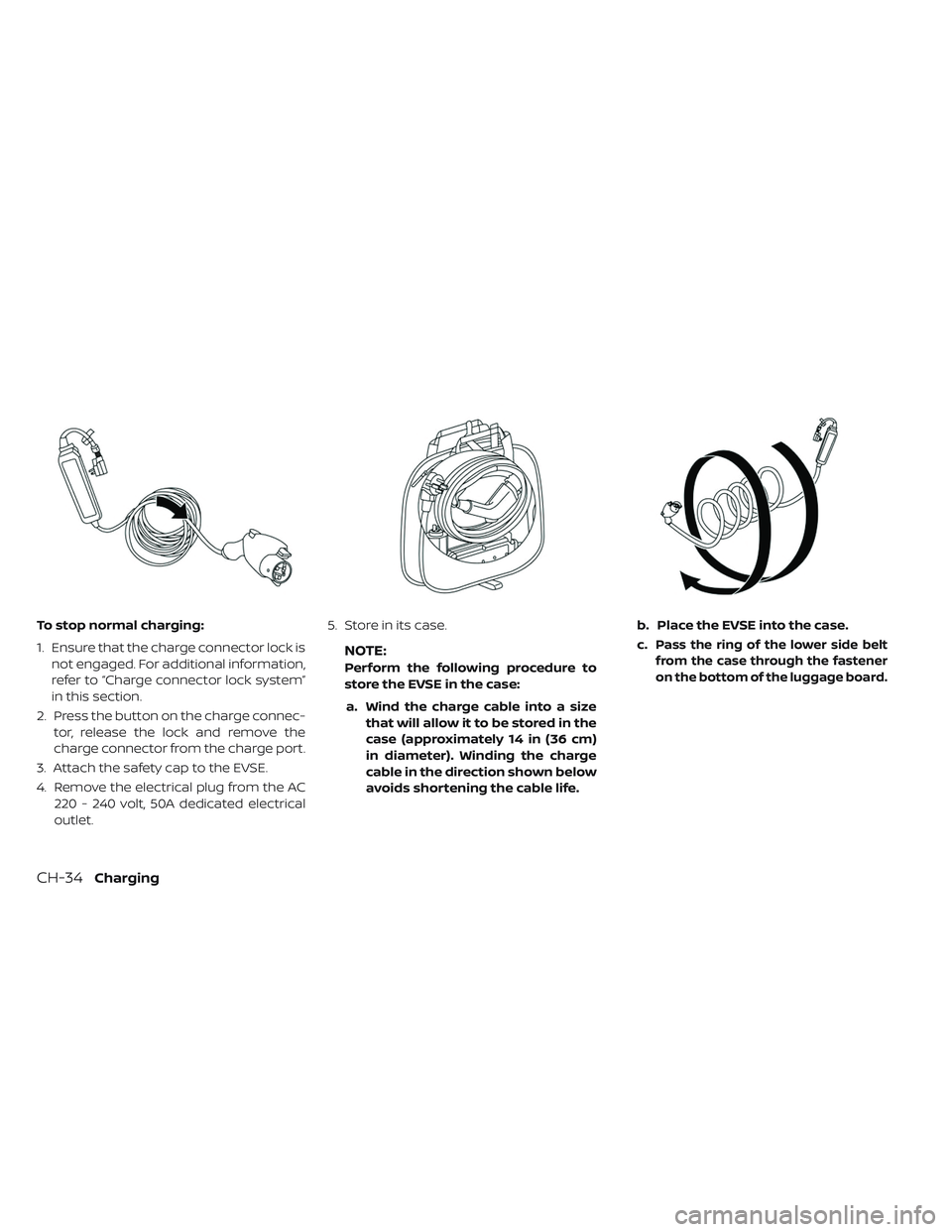
To stop normal charging:
1. Ensure that the charge connector lock isnot engaged. For additional information,
refer to “Charge connector lock system”
in this section.
2. Press the button on the charge connec- tor, release the lock and remove the
charge connector from the charge port.
3. Attach the safety cap to the EVSE.
4. Remove the electrical plug from the AC 220 - 240 volt, 50A dedicated electrical
outlet. 5. Store in its case.
NOTE:
Perform the following procedure to
store the EVSE in the case:
a. Wind the charge cable into a size that will allow it to be stored in the
case (approximately 14 in (36 cm)
in diameter). Winding the charge
cable in the direction shown below
avoids shortening the cable life. b. Place the EVSE into the case.
c.
Pass the ring of the lower side belt
from the case through the fastener
on the bottom of the luggage board.
CH-34Charging
Page 86 of 610
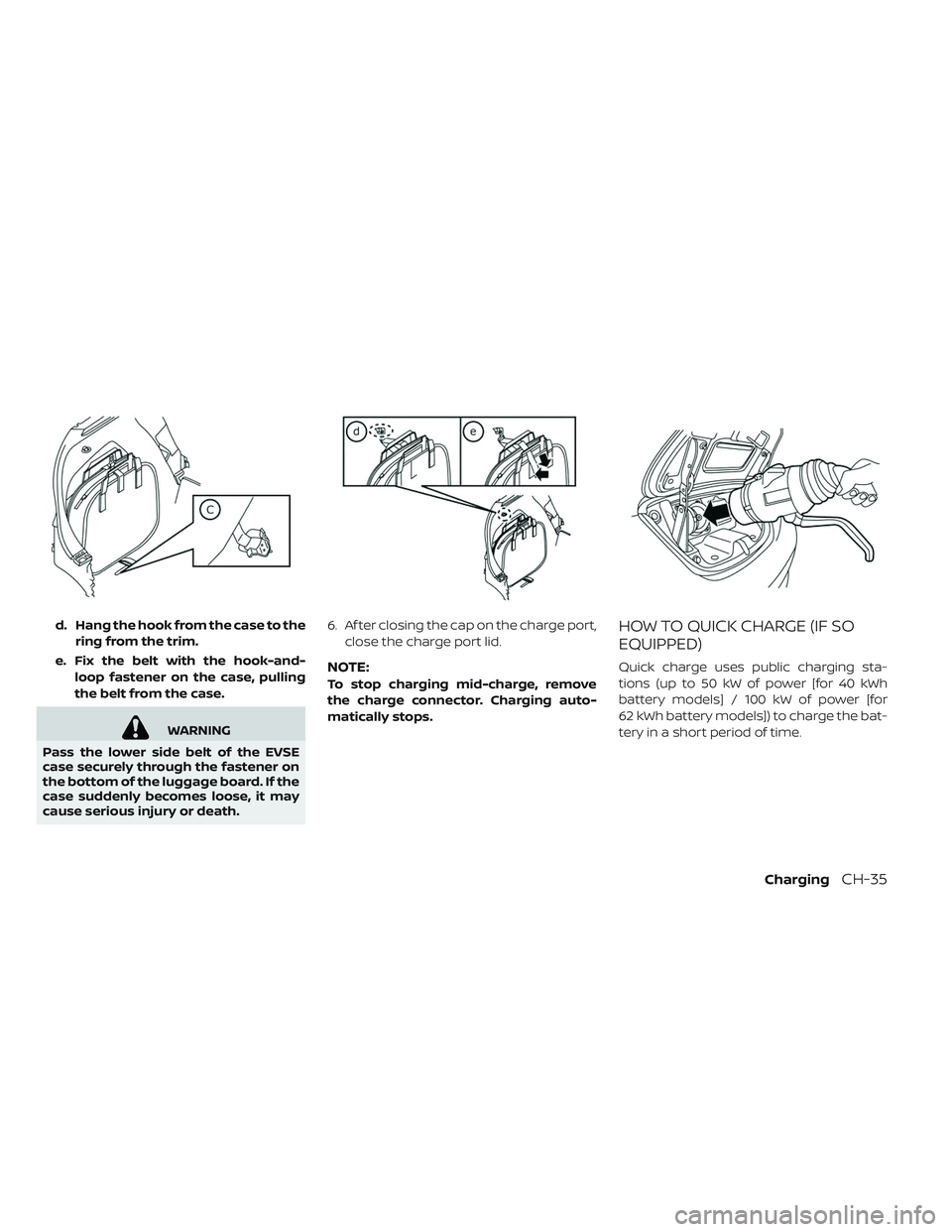
d. Hang the hook from the case to thering from the trim.
e. Fix the belt with the hook-and- loop fastener on the case, pulling
the belt from the case.
WARNING
Pass the lower side belt of the EVSE
case securely through the fastener on
the bottom of the luggage board. If the
case suddenly becomes loose, it may
cause serious injury or death. 6. Af ter closing the cap on the charge port,
close the charge port lid.
NOTE:
To stop charging mid-charge, remove
the charge connector. Charging auto-
matically stops.
HOW TO QUICK CHARGE (IF SO
EQUIPPED)
Quick charge uses public charging sta-
tions (up to 50 kW of power [for 40 kWh
battery models] / 100 kW of power [for
62 kWh battery models]) to charge the bat-
tery in a short period of time.
ChargingCH-35
Page 112 of 610
1 Safety–Seats, seat belts and
supplemental restraint system
Seats..............................1-2Front manual seat adjustment (for passenger’s
seat and if so equipped for driver’s seat) .....1-3
Front power seat adjustment
(if so equipped for driver’s seat) ...........1-4
Rearseats ....................... .1-6
Head restraints/headrests ................1-7
Adjustable head restraint/headrest
components .......................1-8
Non-adjustable head restraint/headrest
components .......................1-8
Remove..........................1-9
Install ........................... .1-9
Adjust .......................... .1-9
Seatbelts.......................... .1-11
Precautions on seat belt usage ..........1-11
Seat belt warning light ................1-13
Pregnant women .................. .1-13
Injured persons .................... .1-13
Three-point type seat belt with retractor . . . .1-14
Seat belt extenders ................. .1-17
Seat belt maintenance ................1-18 Child safety
.........................1-18
Infants ......................... .1-19
Small children ......................1-19
Larger children .................... .1-20
Child restraints .......................1-21
Precautions on child restraints ...........1-21
LATCH (Lower Anchors and Tethers for CHildren)
system ......................... .1-23
Rear-facing child restraint installation using
LATCH.......................... .1-26
Rear-facing child restraint installation using
theseatbelts..................... .1-28
Forward-facing child restraint installation
using LATCH .......................1-31
Forward-facing child restraint installation
using the seat belts ................. .1-34
Booster seats ......................1-39
Supplemental Restraint System (SRS) ........1-43
Precautions on SRS ................. .1-43
Supplemental air bag warning labels ......1-61
Supplemental air bag warning light .......1-61
Page 113 of 610
WARNING
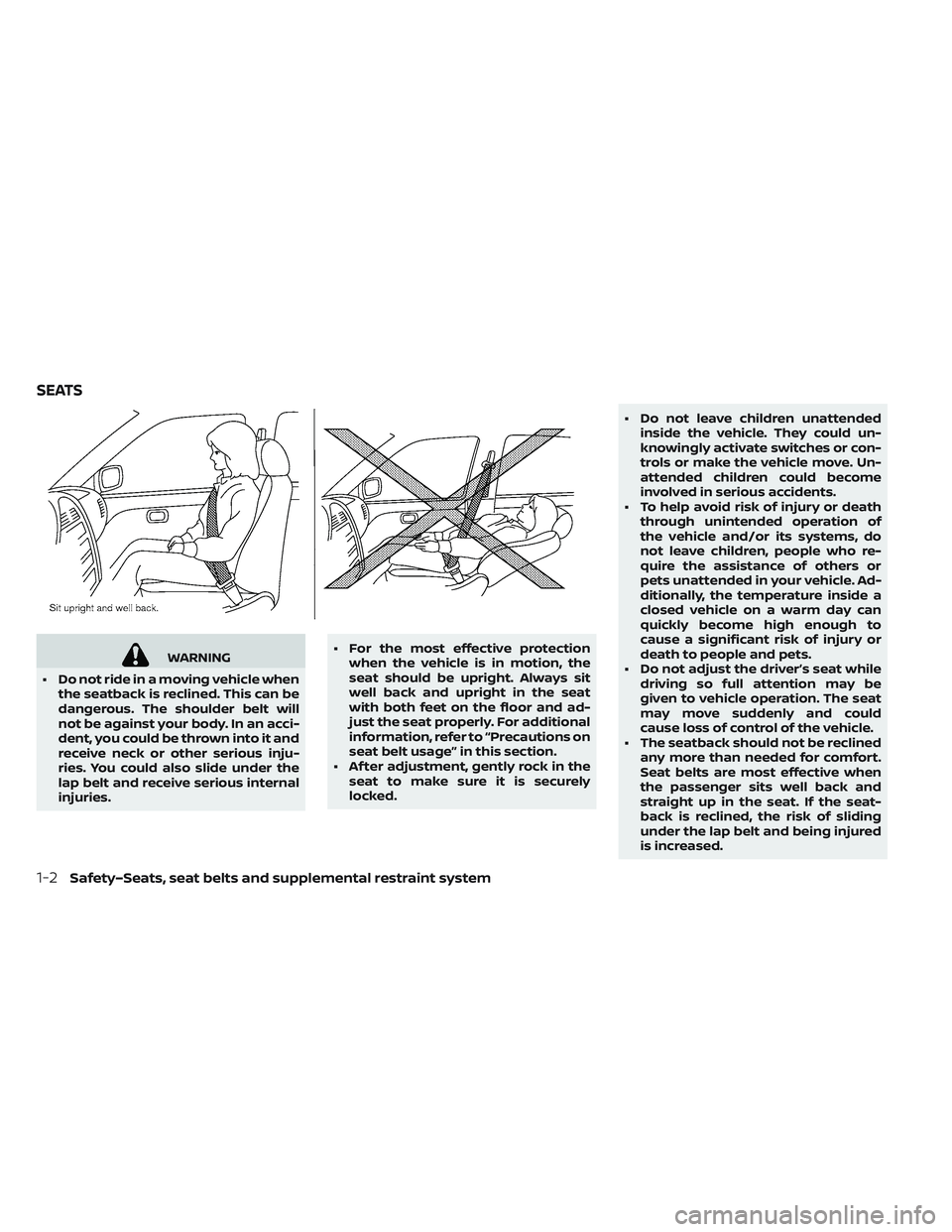
• Do not ride in a moving vehicle when the seatback is reclined. This can be
dangerous. The shoulder belt will
not be against your body. In an acci-
dent, you could be thrown into it and
receive neck or other serious inju-
ries. You could also slide under the
lap belt and receive serious internal
injuries. • For the most effective protection
when the vehicle is in motion, the
seat should be upright. Always sit
well back and upright in the seat
with both feet on the floor and ad-
just the seat properly. For additional
information, refer to “Precautions on
seat belt usage” in this section.
• Af ter adjustment, gently rock in the seat to make sure it is securely
locked. • Do not leave children unattended
inside the vehicle. They could un-
knowingly activate switches or con-
trols or make the vehicle move. Un-
attended children could become
involved in serious accidents.
• To help avoid risk of injury or death through unintended operation of
the vehicle and/or its systems, do
not leave children, people who re-
quire the assistance of others or
pets unattended in your vehicle. Ad-
ditionally, the temperature inside a
closed vehicle on a warm day can
quickly become high enough to
cause a significant risk of injury or
death to people and pets.
• Do not adjust the driver’s seat while driving so full attention may be
given to vehicle operation. The seat
may move suddenly and could
cause loss of control of the vehicle.
• The seatback should not be reclined any more than needed for comfort.
Seat belts are most effective when
the passenger sits well back and
straight up in the seat. If the seat-
back is reclined, the risk of sliding
under the lap belt and being injured
is increased.
SEATS
1-2Safety–Seats, seat belts and supplemental restraint system
Page 114 of 610
CAUTION
When adjusting the seat positions, be
sure not to contact any moving parts
to avoid possible injuries and/or dam-
age.
FRONT MANUAL SEAT ADJUSTMENT
(FOR PASSENGER’S SEAT AND IF SO
EQUIPPED FOR DRIVER’S SEAT)
Your vehicle seats can be adjusted manu-
ally. For additional information about ad-
justing the seats, refer to the steps outlined
in this section.
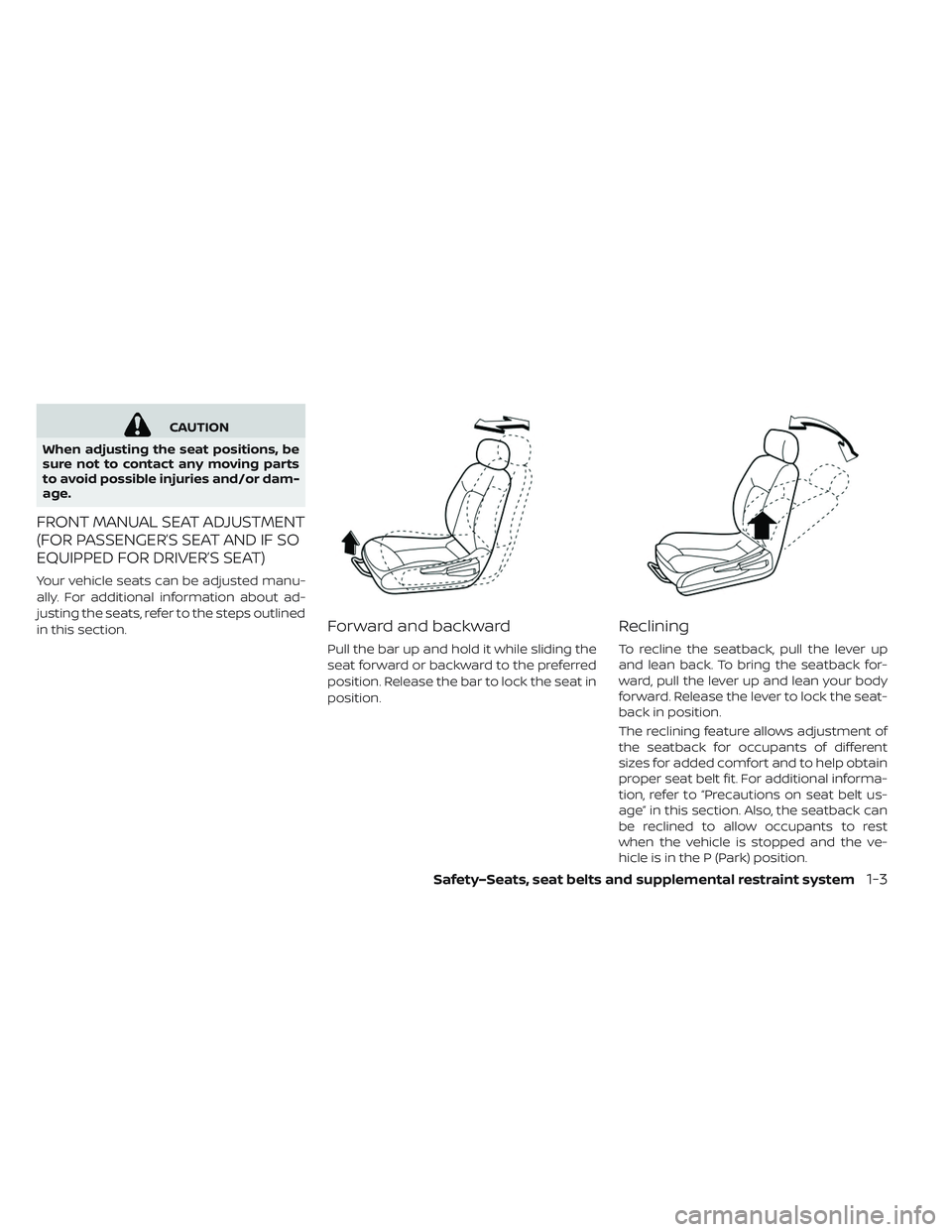
Forward and backward
Pull the bar up and hold it while sliding the
seat forward or backward to the preferred
position. Release the bar to lock the seat in
position.
Reclining
To recline the seatback, pull the lever up
and lean back. To bring the seatback for-
ward, pull the lever up and lean your body
forward. Release the lever to lock the seat-
back in position.
The reclining feature allows adjustment of
the seatback for occupants of different
sizes for added comfort and to help obtain
proper seat belt fit. For additional informa-
tion, refer to “Precautions on seat belt us-
age” in this section. Also, the seatback can
be reclined to allow occupants to rest
when the vehicle is stopped and the ve-
hicle is in the P (Park) position.
Safety–Seats, seat belts and supplemental restraint system1-3
Page 115 of 610
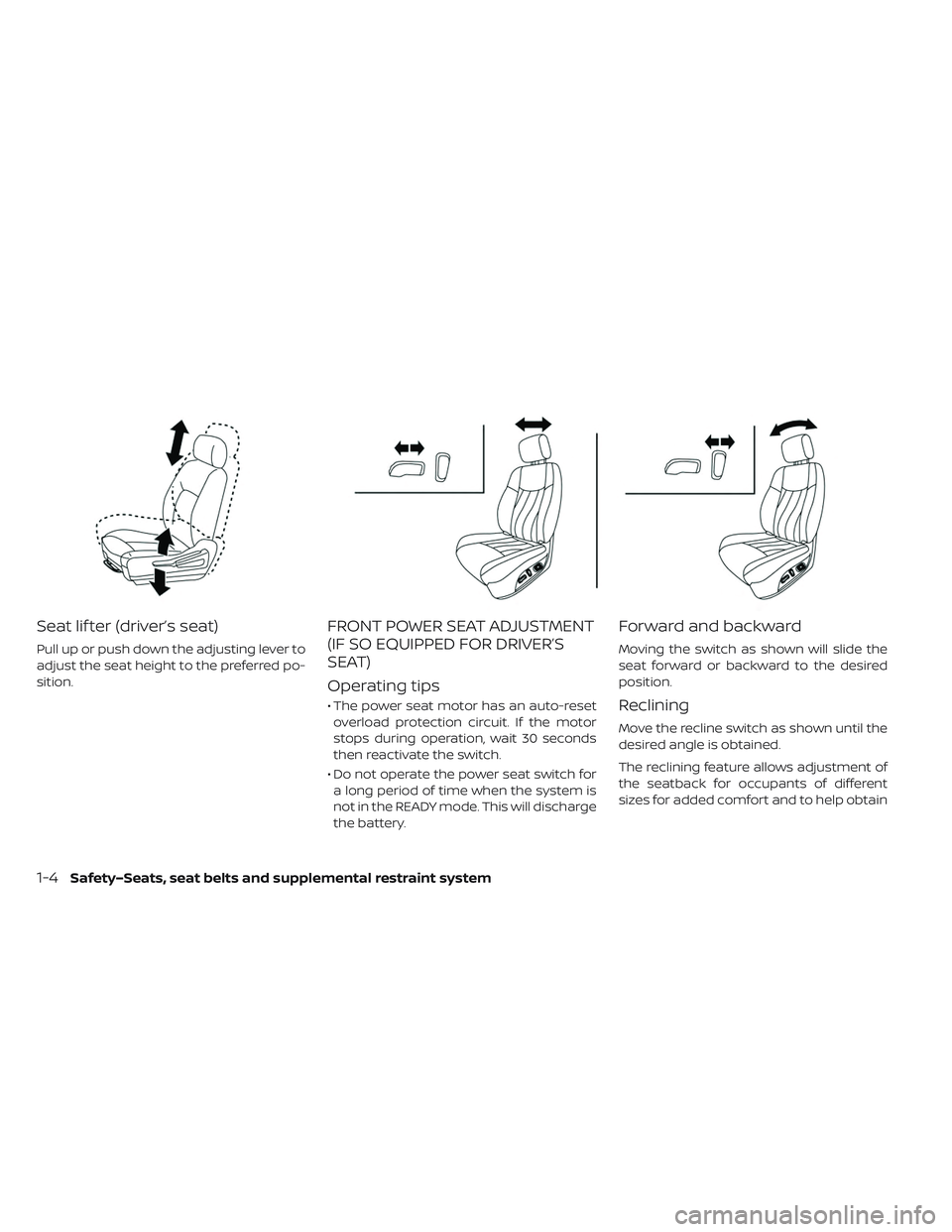
Seat lif ter (driver’s seat)
Pull up or push down the adjusting lever to
adjust the seat height to the preferred po-
sition.
FRONT POWER SEAT ADJUSTMENT
(IF SO EQUIPPED FOR DRIVER’S
SEAT)
Operating tips
• The power seat motor has an auto-resetoverload protection circuit. If the motor
stops during operation, wait 30 seconds
then reactivate the switch.
• Do not operate the power seat switch for a long period of time when the system is
not in the READY mode. This will discharge
the battery.
Forward and backward
Moving the switch as shown will slide the
seat forward or backward to the desired
position.
Reclining
Move the recline switch as shown until the
desired angle is obtained.
The reclining feature allows adjustment of
the seatback for occupants of different
sizes for added comfort and to help obtain
1-4Safety–Seats, seat belts and supplemental restraint system
Page 116 of 610
proper seat belt fit. For additional informa-
tion, refer to “Precautions on seat belt us-
age” in this section. Also, the seatback can
be reclined to allow occupants to rest
when the vehicle is stopped and the shif t
lever is in P (Park).
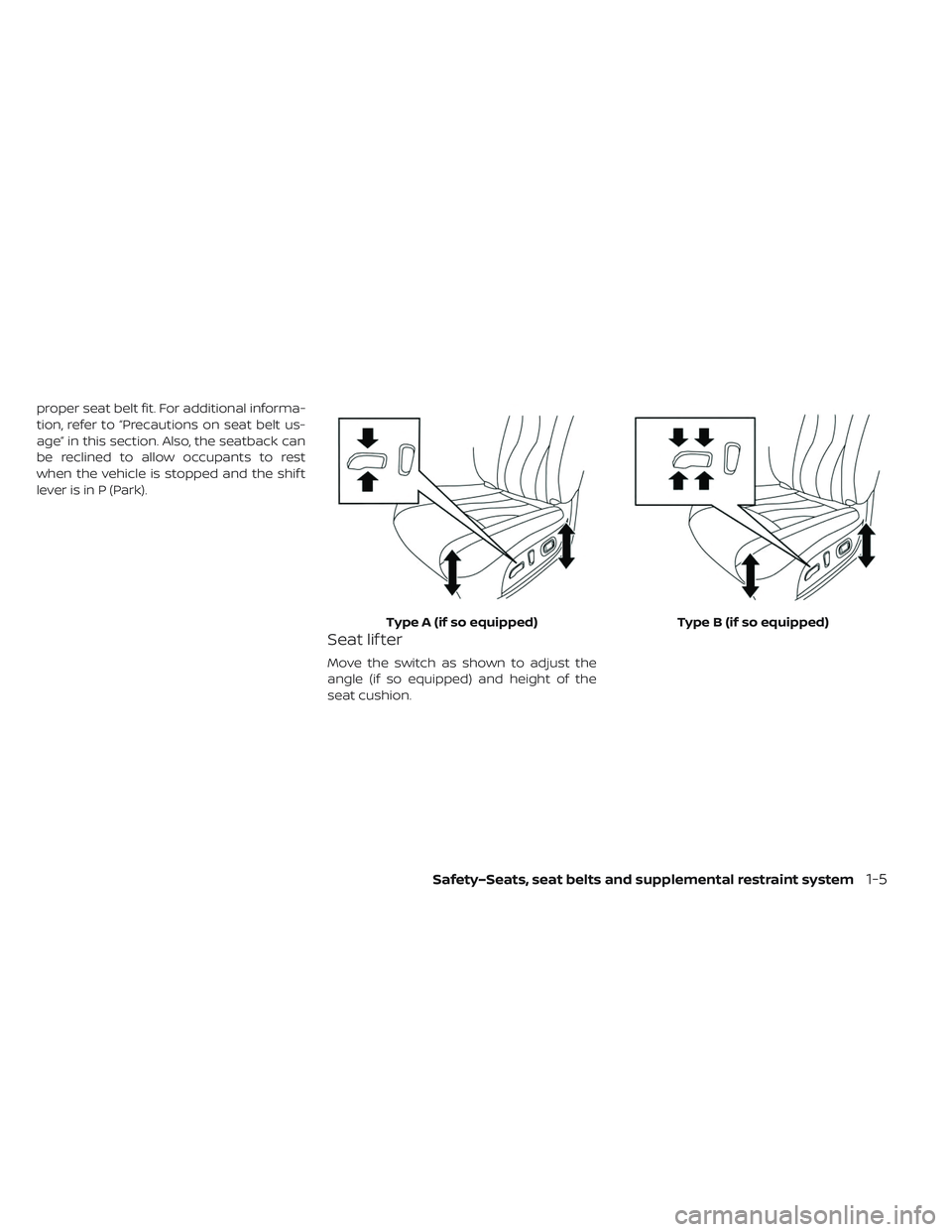
Seat lif ter
Move the switch as shown to adjust the
angle (if so equipped) and height of the
seat cushion.Type A (if so equipped)
Type B (if so equipped)
Safety–Seats, seat belts and supplemental restraint system1-5
Page 117 of 610
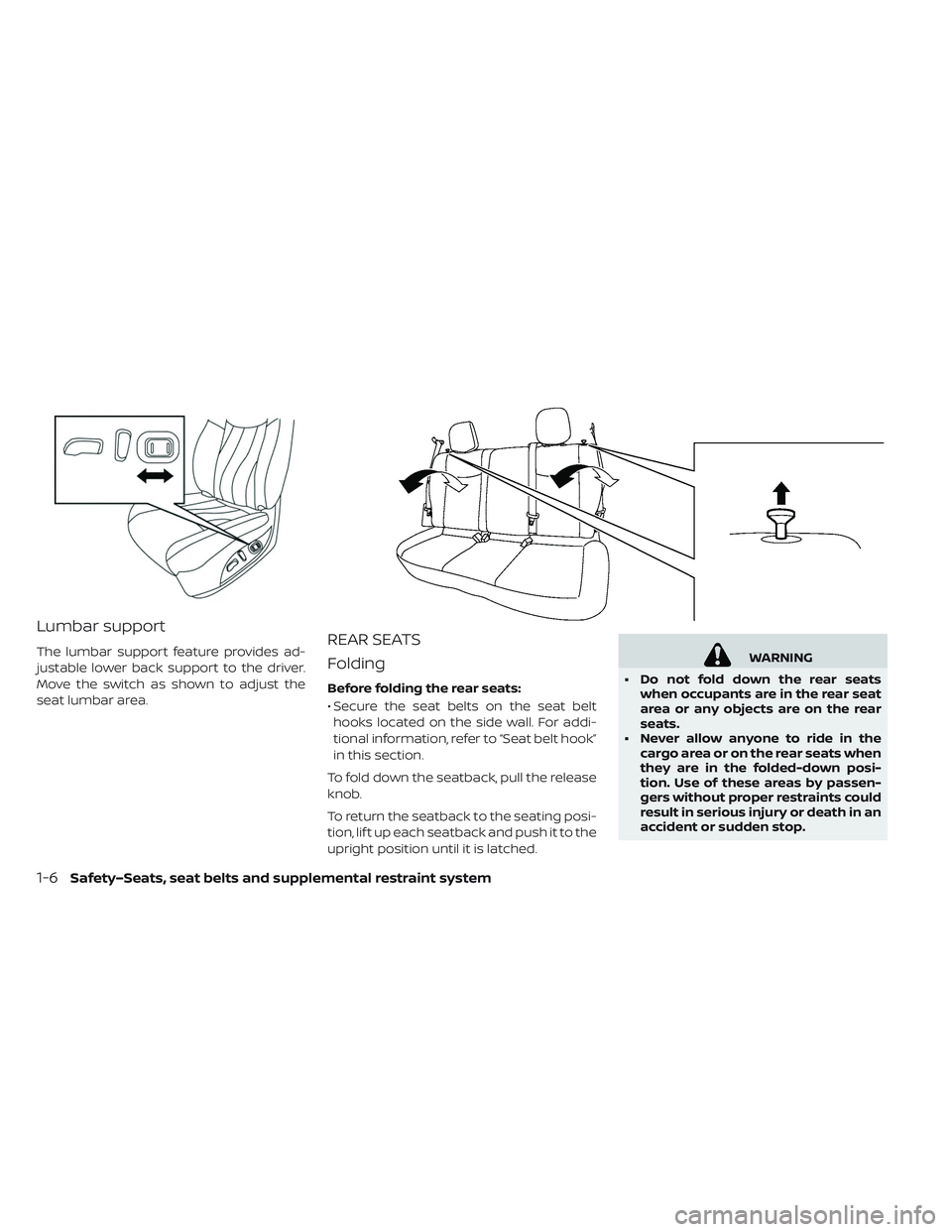
Lumbar support
The lumbar support feature provides ad-
justable lower back support to the driver.
Move the switch as shown to adjust the
seat lumbar area.REAR SEATS
Folding
Before folding the rear seats:
• Secure the seat belts on the seat belthooks located on the side wall. For addi-
tional information, refer to “Seat belt hook”
in this section.
To fold down the seatback, pull the release
knob.
To return the seatback to the seating posi-
tion, lif t up each seatback and push it to the
upright position until it is latched.
WARNING
• Do not fold down the rear seats when occupants are in the rear seat
area or any objects are on the rear
seats.
• Never allow anyone to ride in the cargo area or on the rear seats when
they are in the folded-down posi-
tion. Use of these areas by passen-
gers without proper restraints could
result in serious injury or death in an
accident or sudden stop.
1-6Safety–Seats, seat belts and supplemental restraint system
Page 118 of 610
• Properly secure all cargo with ropesor straps to help prevent it from slid-
ing or shif ting. Do not place cargo
higher than the seatbacks. In a sud-
den stop or collision, unsecured
cargo could cause personal injury.
• When returning the seatbacks to the upright position, be certain they are
completely secured in the latched
position. If they are not completely
secured, passengers may be injured
in an accident or sudden stop.WARNING
Head restraints/headrests supple-
ment the other vehicle safety systems.
They may provide additional protec-
tion against injury in certain rear end
collisions. Adjustable head restraints/
headrests must be adjusted properly,
as specified in this section. Check the
adjustment af ter someone else uses
the seat. Do not attach anything to the
head restraint/headrest stalks or re-
move the head restraints/headrests.
Do not use the seat if the head
restraint/headrest has been removed.
If the head restraint/headrest was re-
moved, reinstall and properly adjust
the head restraint/headrest before an
occupant uses the seating position.
Failure to follow these instructions can
reduce the effectiveness of the head
restraint/headrest. This may increase
the risk of serious injury or death in a
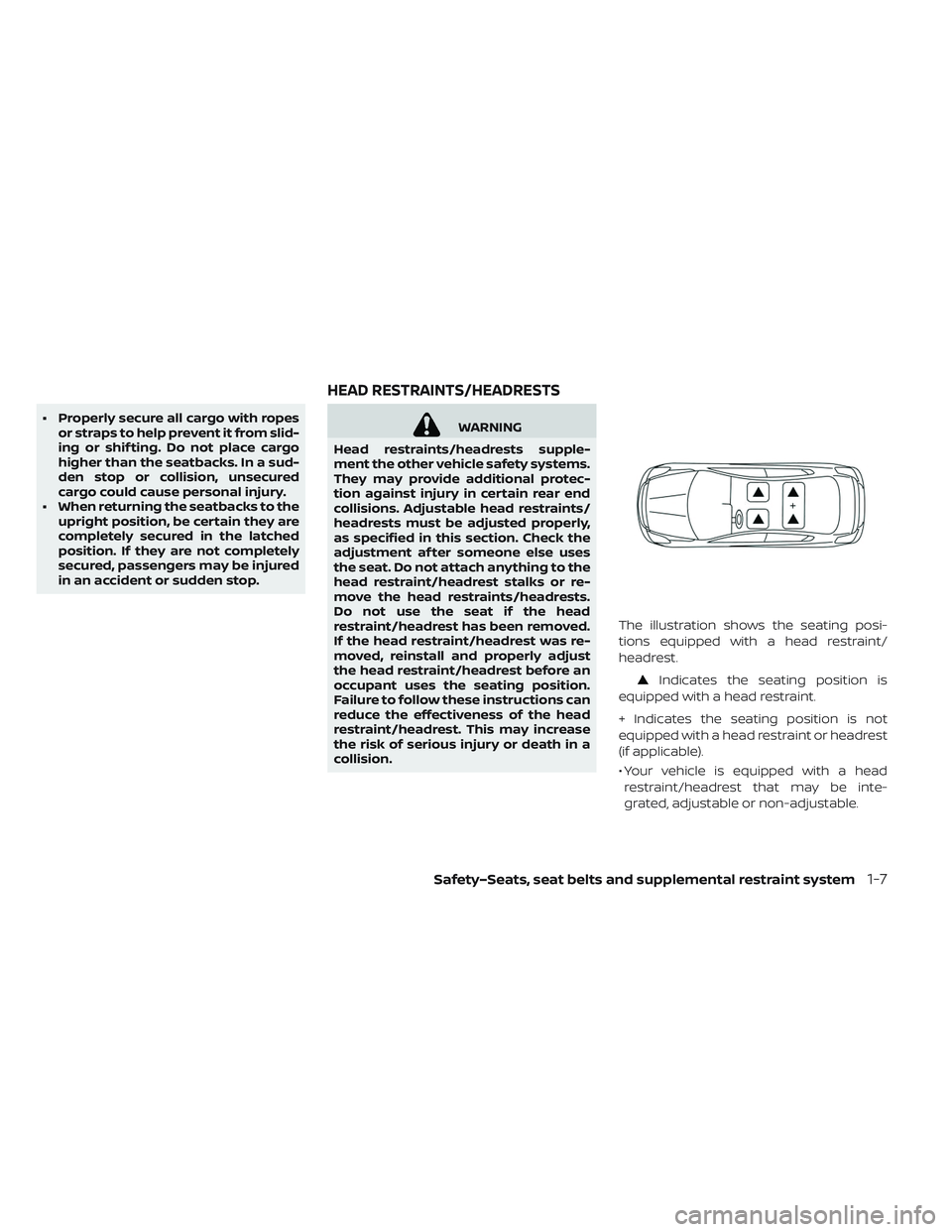
collision. The illustration shows the seating posi-
tions equipped with a head restraint/
headrest.
Indicates the seating position is
equipped with a head restraint.
+ Indicates the seating position is not
equipped with a head restraint or headrest
(if applicable).
• Your vehicle is equipped with a head restraint/headrest that may be inte-
grated, adjustable or non-adjustable.
HEAD RESTRAINTS/HEADRESTS
Safety–Seats, seat belts and supplemental restraint system1-7