towing NISSAN LEAF 2019 Owner´s Manual
[x] Cancel search | Manufacturer: NISSAN, Model Year: 2019, Model line: LEAF, Model: NISSAN LEAF 2019Pages: 610, PDF Size: 7.11 MB
Page 516 of 610
6 In case of emergency
Hazard warning flasher switch.............6-2
Roadside assistance program .............6-2
Emergency EV (Electric Vehicle) shut off .......6-3
Flat tire ........................... .6-3
Tire Pressure Monitoring System (TPMS) .....6-3
Repairing flat tire ................... .6-5
Jump starting .......................6-10 If the Li-ion battery becomes completely
discharged
.........................6-13
Push starting ........................6-14
Towing your vehicle ................... .6-14
Towing recommended by NISSAN ........6-15
Vehicle recovery (freeing a stuck vehicle) . . . .6-16
Page 524 of 610
using the emergency tire puncture re-
pair kit:
• Securely tighten the compressorhose to the tire valve. Failure to do so
can cause the sealant to spray into
the air and get into your eyes or on
the skin.
• Do not stand directly beside the dam- aged tire while it is being inflated be-
cause of the risk of the rupture. If
there are any cracks or bumps, turn
the compressor off immediately.
If the tire pressure does not increase to
26 psi (180 kPa) within 10 minutes, the
tire may be seriously damaged and the
tire cannot be repaired with this tire
repair kit. It is recommended that you
visit a NISSAN certified LEAF dealer.
7. When the tire pressure is at the specified amount, turn the air compressor off. If
the tire cannot be inflated to the speci-
fied amount, the air compressor can be
turned off at the minimum of 26 psi
(180 kPa). Remove the power plug from
the power outlet and quickly remove the
hose from the tire valve. Attach the pro-
tective cap and valve cap. Properly stow the emergency tire puncture repair kit in
the cargo area.
CAUTION
To avoid serious personal injury when
stowing the emergency tire puncture
repair kit:
• Keep the sealant bottle screwed into the compressor. Failure to do so can
cause the sealant to spray into the air
and get into your eyes or on the skin.
8. Immediately drive the vehicle for 10 min- utes or 2 miles (3 km) at a speed below
50 mph (80 km/h).
9. Af ter driving, make sure that the air compressor switch is in the OFF posi-
tion, then screw the hose securely onto
the tire valve. Check the tire pressure
with the pressure gauge. Temporary re-
pair is completed if the tire pressure
does not drop. Make sure the pressure is adjusted to
the pressure that is specified on the Tire
and Loading Information label before
driving.
10. If the tire pressure drops, repeat the steps from 5 to 9. If the pressure drops
again or under 19 psi (130 kPa), the tire
cannot be repaired with this tire re-
pair kit. If the tire cannot be repaired,
the driver should not drive on it any
further. The car should be towed to the
nearest dealership.
The sealant bottle and hose cannot be
reused to repair another punctured tire.
It is recommended that you visit a
NISSAN certified LEAF dealer to pur-
chase replacements.
Af ter repairing tire:
It is recommended that you visit a NISSAN
certified LEAF dealer for tire repair/
replacement as soon as possible.
In case of emergency6-9
Page 529 of 610
Do not attempt to start the system by
pushing the vehicle.
CAUTION
An EV cannot be push-started or tow-
started. Attempting to do so may
cause traction motor damage. When towing your vehicle, all State (Provin-
cial in Canada) and local regulations for
towing must be followed.
Incorrect towing equipment could dam-
age your vehicle. Towing instructions are
available from a NISSAN certified LEAF
dealer. Local service operators are familiar
with the applicable laws and procedures
for towing. To assure proper towing and to
prevent accidental damage to your vehicle,
NISSAN recommends that you have a ser-
vice operator tow your vehicle. It is advis-
able to have the service operator carefully
read the following precautions.
WARNING
• Never ride in a vehicle that is being towed.
• Never get under your vehicle af ter it has been lif ted by a tow truck.
CAUTION
• When towing, make sure that the ax- les, steering system and power train
are in working condition. If any unit
is damaged, dollies must be used.
• Always attach safety chains before towing.
For additional information about towing
your vehicle behind a Recreational Vehicle
(RV), refer to “Flat towing” in the “Technical
and consumer information” section of this
manual.
PUSH STARTING TOWING YOUR VEHICLE
6-14In case of emergency
Page 530 of 610
TOWING RECOMMENDED BY
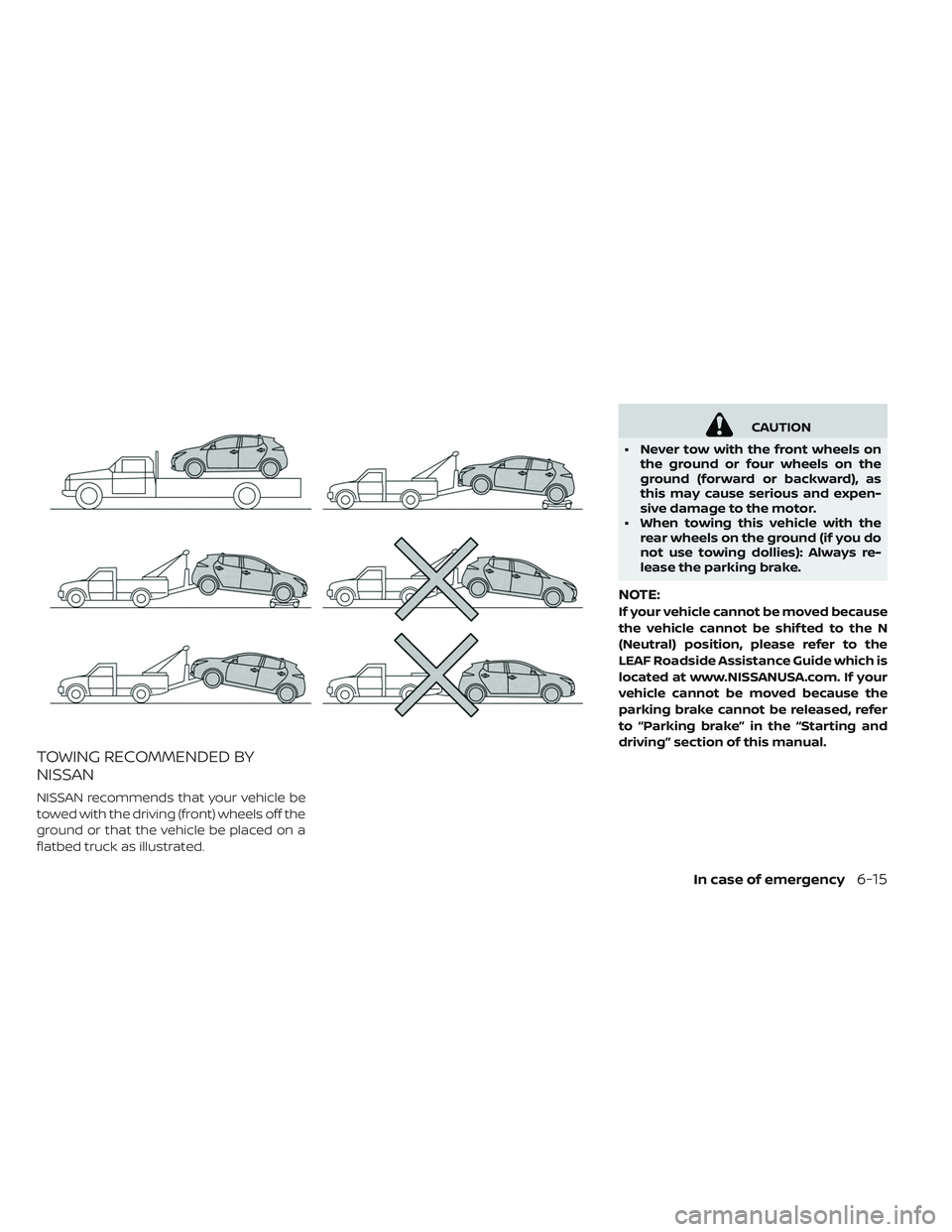
NISSAN
NISSAN recommends that your vehicle be
towed with the driving (front) wheels off the
ground or that the vehicle be placed on a
flatbed truck as illustrated.
CAUTION
• Never tow with the front wheels on the ground or four wheels on the
ground (forward or backward), as
this may cause serious and expen-
sive damage to the motor.
• When towing this vehicle with the rear wheels on the ground (if you do
not use towing dollies): Always re-
lease the parking brake.
NOTE:
If your vehicle cannot be moved because
the vehicle cannot be shif ted to the N
(Neutral) position, please refer to the
LEAF Roadside Assistance Guide which is
located at www.NISSANUSA.com. If your
vehicle cannot be moved because the
parking brake cannot be released, refer
to “Parking brake” in the “Starting and
driving” section of this manual.
In case of emergency6-15
Page 531 of 610
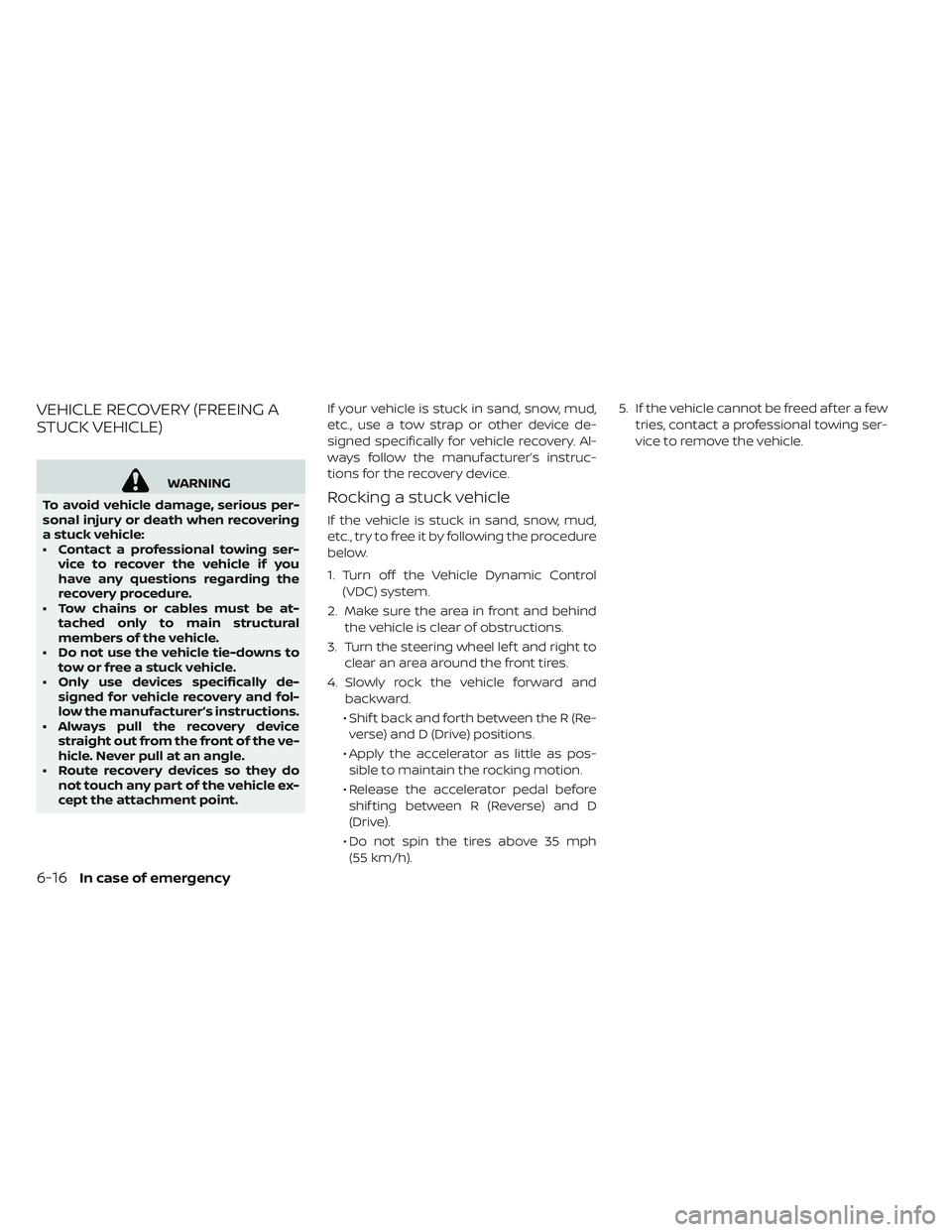
VEHICLE RECOVERY (FREEING A
STUCK VEHICLE)
WARNING
To avoid vehicle damage, serious per-
sonal injury or death when recovering
a stuck vehicle:
• Contact a professional towing ser- vice to recover the vehicle if you
have any questions regarding the
recovery procedure.
• Tow chains or cables must be at- tached only to main structural
members of the vehicle.
• Do not use the vehicle tie-downs to tow or free a stuck vehicle.
• Only use devices specifically de- signed for vehicle recovery and fol-
low the manufacturer’s instructions.
• Always pull the recovery device straight out from the front of the ve-
hicle. Never pull at an angle.
• Route recovery devices so they do not touch any part of the vehicle ex-
cept the attachment point. If your vehicle is stuck in sand, snow, mud,
etc., use a tow strap or other device de-
signed specifically for vehicle recovery. Al-
ways follow the manufacturer’s instruc-
tions for the recovery device.Rocking a stuck vehicle
If the vehicle is stuck in sand, snow, mud,
etc., try to free it by following the procedure
below.
1. Turn off the Vehicle Dynamic Control
(VDC) system.
2. Make sure the area in front and behind the vehicle is clear of obstructions.
3. Turn the steering wheel lef t and right to clear an area around the front tires.
4. Slowly rock the vehicle forward and backward.
• Shif t back and forth between the R (Re- verse) and D (Drive) positions.
• Apply the accelerator as little as pos- sible to maintain the rocking motion.
• Release the accelerator pedal before shif ting between R (Reverse) and D
(Drive).
• Do not spin the tires above 35 mph (55 km/h). 5. If the vehicle cannot be freed af ter a few
tries, contact a professional towing ser-
vice to remove the vehicle.
6-16In case of emergency
Page 580 of 610
9 Technical and consumer information
Recommended fluids/lubricants and
capacities.......................... .9-2
Air conditioning system refrigerant and
lubricant recommendations ............9-3
Specifications ........................9-4
Charging system ................... .9-4
Motor .......................... .9-5
Wheels and tires ................... .9-5
Dimensions and weights ...............9-6
When traveling or registering in another
country ........................... .9-7
Vehicle identification ................... .9-7
Vehicle Identification Number (VIN) plate . . . .9-7
Vehicle identification number
(chassis number) ................... .9-7
Traction motor serial number ...........9-8
F.M.V.S.S./C.M.V.S.S Certification label .......9-8
Emission control information label ........9-8
Tire and Loading Information label ........9-9
Air conditioner specification label .........9-9
Installing front license plate ...............9-9
Vehicle loading information ..............9-10 Terms
.......................... .9-10
Vehicle load capacity ................ .9-10
Loading tips .......................9-12
Measurement of weights ..............9-12
Towing a trailer .......................9-13
Flat towing .........................9-13
Uniform tire quality grading ..............9-13
Treadwear........................9-13
Traction AA, A, B and C ................9-14
Temperature A, B and C ...............9-14
Reporting safety defects ................9-14
Telematics overview (models with Navigation
System) .......................... .9-15
Telematic Control Unit Gen2K .............9-17
Event Data Recorders (EDR) ..............9-19
Additional Data Recording (on vehicles
equipped with optional ProPILOT Assist) . . . .9-20
Owner's Manual/Service Manual order
information .........................9-20
Char ging
information ................. .9-21
Cold tire pressures ................... .9-23
Page 592 of 610
Do not tow a trailer with your vehicle.Towing your vehicle with all four wheels on
the ground is sometimes called flat towing.
This method is typically used when towing
a vehicle behind a recreational vehicle,
such as a motor home.
CAUTION
• Failure to follow these guidelines can result in severe reduction gear
damage.
• DO NOT tow this vehicle with all four wheels on the ground (flat towing).
• For emergency towing procedures refer to “Towing your vehicle” in the
“In case of emergency ” section of
this manual. DOT (Department Of Transportation) Qual-
ity Grades: All passenger car tires must
conform to federal safety requirements in
addition to these grades.
Quality grades can be found where appli-
cable on the tire sidewall between tread
shoulder and maximum section width. For
example:
Treadwear 200 Traction AA Temperature A
TREADWEAR
The treadwear grade is a comparative rat-
ing based on the wear rate of the tire when
tested under controlled conditions on a
specified government test course. For ex-
ample, a tire graded 150 would wear one
and one-half (1 1/2) times as well on the
government course as a tire graded 100.
The relative performance of tires depends
upon actual conditions of their use how-
ever, and may depart significantly from the
norm due to variations in driving habits,
service practices and differences in road
characteristics and climate.
TOWING A TRAILER
FLAT TOWINGUNIFORM TIRE QUALITY GRADING
Technical and consumer information9-13
Page 605 of 610
Charging troubleshooting guide.....CH-57
Chassis control ................5-152
Checking ..................2-17, 8-9
Checking bulbs .................2-17
Checking coolant level .............8-9
Child restraints ...........1-21, 1-25, 1-39
Child safety ....................1-18
Child safety rear door lock ...........3-6
Child seat belts .................1-18
Circuit breaker, Fusible link ..........8-20
Cleaning ......................7-3
Cleaning aluminum alloy wheels .......7-3
Cleaning exterior and interior .......7-2,7-4
Climate control .................4-46
Climate control operation ...........4-31
Climate control service ............4-46
Climate control system ............4-31
Climate control system refrigerant and
lubricant recommendations .........4-46
Climate Ctrl. Timer ...............4-41
Clock .......................2-13
Clock setting (models without Navigation
System) .....................4-56
Cold tire pressures ...............9-23
Cold weather driving .............5-154
Console box ...................2-67
coolant ......................8-8
Coolant ....................8-9, 9-2
Cooling system .................8-8
Corrosion protection ..............7-7
Cruise control ..................5-54 Cup holders
...................2-68
D
Defroster switch, Rear window and outside
mirror defroster switch ............2-53
Dimensions and weights ............9-6
Display, vehicle information .........2-28
Door locks ..................3-4, 3-6
Doors .......................3-4
Driving ................5-4, 5-15, 5-154
Driving range ..................2-10
Driving the vehicle ..............EV-18
Driving vehicle ..................5-15
E
e-Pedal......................2-14
e-Pedal system .................5-22
ECO........................2-60
ECO drive report ................5-143
ECO mode ....................2-14
ECO Mode ...................5-142
ECO switch ...................2-60
Efficient use of your vehicle ........EV-23
Electric shif t control system .........5-15
Electronic parking brake ...........5-20
Emergency charge .....CH-11, CH-17, CH-25
Emergency EV (Electric Vehicle)
shut off ...................5-12, 6-3 Emergency shutoff system
.........EV-10
Emission control information label ......9-8
EV Characteristics ..............EV-11
EV system ....................EV-2
EV unique information ............EV-25
Event Data Recorder (EDR) ..........9-19
EVSE (Electric Vehicle Supply Equipment) ....
CH-11, CH-17, CH-25
Exterior appearance care ...........7-2
F
F.M.V.S.S./C.M.V.S.S. certification label .....9-8
Flashers (Refer to hazard warning flasher
switch) .......................6-2
Flat tire ......................6-3
Flat towing ....................9-13
Floor mat cleaning ...............7-5
Fluid ................8-8, 8-10, 8-11, 9-2
FM/AM/SAT Radio with Compact Disc (CD)
Player.......................4-55
Fog light bulb replacement .........8-26
Fog light switch .................2-59
Fog lights ....................8-26
For Intelligent Key system ...........3-6
Front passenger air bag and status light. . .1-52
Front-seat mounted side-impact
supplemental air bag system ........1-58
Fuses .......................8-18
Fusible links ...................8-20
10-2Index
Page 608 of 610
Rear window and outside mirror defroster
switch......................2-53
Rear window wiper and washer switch . .2-52
Rear window wiper and washer switch . .2-52
Rear window wiper blade ...........8-17
RearView Monitor ................4-4
Recommended fluids/lubricants and
capacities .....................9-2
Reduction gear fluid ..............8-10
Remote charge ...............CH-50
Remote climate control ............4-44
Remote keyless entry function,
For Intelligent Key system ...........3-14
Remote keyless operation ..........3-14
Repairing flat tire.................6-4
Repairing tire ...................6-6
Replacement ..................8-25
Reporting safety defects ...........9-14
Road accident precautions .........EV-10
Roadside assistance program ........6-2
Rollover......................5-7
Roof-mounted curtain side-impact
supplemental air bag system ........1-58
S
Safety....................1-18, 9-14
Scene guide......EV-12, EV-15, EV-17, EV-18,
EV-21, EV-22
Seat belt cleaning ................7-7 Seat belt extenders
...............1-17
Seat belt hook ..................1-17
Seat belt maintenance .............1-18
Seat belt usage .................1-11
Seat belt warning light ............2-23
Seat belt(s) . . .1-11, 1-13, 1-14, 1-16, 1-17, 1-18, 1-19, 1-20, 1-60, 2-23, 7-7
Seatbelts.....................1-11
Seat belts with pretensioners ........1-60
Seat(s), Seats ................1-2, 2-60
Security system ................2-48
Security system (NISSAN Vehicle Immobilizer
System), EV system start ........2-49, 5-13
Servicing climate control ...........4-46
Shif ting ......................5-15
Shoulder belt height adjustment .......1-17
Shoulder belt height adjustment,
Forfrontseats..................1-17
Small children ..................1-19
Specifications ..................9-4
Speedometer ...................2-7
Starting .............5-4, 5-14, 6-10, 6-14
Starting your vehicle .............EV-17
Status light, Front passenger air bag . . . .1-52
Steering ..............2-62, 3-23, 5-146
Steering wheel switch for audio control . .4-66
Stopping the vehicle ..............6-5
Storage .....................2-66
Stowing golf bags ...............2-70
Sun visors ....................3-23
Supplemental air bag warning labels . . . .1-61Supplemental air bag warning light. .1-61, 2-24
Supplemental restraint system
.......1-43
Switch . . . .2-53, 2-54, 2-59, 2-60, 2-63, 3-5, 6-2
T
Telematic Control Unit Gen2K ........9-17
Telematics overview ..............9-15
Temperature ...................2-8
Tether strap child restraints .........1-25
Thef t (NISSAN Vehicle Immobilizer System),
traction motor start ...........2-49, 5-13
Three-point type ................1-14
Tilt steering column ..............3-23
Tilting steering column ............3-23
Tire........................2-21
Tire and Loading information label ......9-9
Tire and Loading Information label .....8-32
Tire chains ....................8-37
Tire dressing ...................7-4
Tire pressure ..................8-33
Tire pressure monitoring system (TPMS) . .6-3
Tire Pressure Monitoring System (TPMS) . .5-4
Tire rotation ...................8-38
Tires. . .5-4, 6-3, 7-4, 8-30, 8-32, 8-33, 8-36, 8-37, 8-38, 9-5, 9-9, 9-13
Tonneau cover .................2-69
Top........................1-25
Top tether strap .................1-25
Tow truck towing ................6-14
Index10-5
Page 609 of 610
Towing...................6-14, 9-13
Towing a trailer .................9-13
TPMS, Tire Pressure Monitoring System . . .5-4
TPMS, Tire pressure warning system .....6-3
Traction motor ..................9-8
Traction motor serial number .........9-8
Trailer towing ..................9-13
Transceiver ...................2-75
Transceiver, HomeLink® Universal ......2-75
Transmitter, With Intelligent Key system
(Refer to Intelligent Key system) .......3-14
Trickle charge .........CH-11, CH-17, CH-25
Turn signal switch ...............2-59
Type of charge and how to charge the Li-ion
battery .....................CH-5
Types of tires ..................8-36
U
Underbody cleaning ...............7-3
Uniform tire quality grading ..........9-13
Unplugged status ..............CH-50
USB (Universal Serial Bus) connection
port........................4-61
V
Vanity mirror ..................3-24
Vehicle ..........2-48, 5-150, 9-6, 9-7, 9-10
Vehicle dynamic control (VDC) system . .5-150
Vehicle identification number (VIN) ......9-7
Vehicle information display .........2-28
Vehicle security system ............2-48
Vents .......................4-30
W
Warning ........2-15, 2-17, 2-37, 5-4, 6-2, 6-3
Warning and indicator lights .........0-12
Warning labels, Air bag warning labels . . .1-61
Warning light .........1-61, 2-18, 2-19, 2-20,
2-21, 2-23, 2-24
Warning lights ..................2-17
Warning lights, indicator lights and audible
reminders ....................2-15
Washer switch ..............2-50, 2-52
Washing ......................7-2
Waxing .......................7-2 Weights (Refer to Dimensions and
weights)
......................9-6
Wheel/tire size ..................9-5
Wheels and tires ..............7-3, 8-30
When starting and driving ...........5-4
When traveling or registering your vehicle in
another country .................9-7
Window(s) ..................2-70, 7-3
Windshield wiper and washer switch . . . .2-50
Windshield-washer fluid ............8-11
Wiper ..........2-50, 2-52, 8-15, 8-16, 8-17
Wiper blades ...............8-15, 8-16
With Intelligent Key system
(Refer to Intelligent Key system) .......3-14
10-6Index