battery NISSAN LEAF 2020 Owner´s Manual
[x] Cancel search | Manufacturer: NISSAN, Model Year: 2020, Model line: LEAF, Model: NISSAN LEAF 2020Pages: 596, PDF Size: 4.33 MB
Page 42 of 596

CHARGING AFTER DRIVING
Charging the Li-ion battery
When you return home, connect the ve-
hicle to the charging device installed at
your home or the EVSE plugged to outlet
using the normal charge connector.
Charge the vehicle or set the charging
timer function to have the vehicle charge
at a specific time. For additional informa-
tion, refer to “Charging timer” in the “Charg-
ing” section of this manual.1. When the power switch is turned off, the
settings of the charging timer, and the
Climate Ctrl. Timer and the charge con-
nector lock functions are displayed on
the vehicle information display. For addi-
tional information, refer to “Vehicle infor-
mation display” in the “Instruments and
controls” section of this manual.
2. Open the charge port lid and charge port cap. For additional information, re-
fer to “Charge port lid” in the “Pre-driving
checks and adjustments” section of this
manual. 3. Connect the charge connector to the
vehicle.
4. When the charging timer is turned on, charging starts at the set time. When the
charging timer is not turned on, charg-
ing starts immediately.
NOTE:
• Charging can be started remotely, evenif the charging timer is set up.
• When you have forgotten to connect the charge connector at home, there is
a function that can notif y you via a text
message capable cellular phone, inter-
net enabled smart phone or personal
computer. For additional information,
refer to “Charging related remote func-
tion” in the “Charging” section of this
manual (models with Navigation Sys-
tem).
• NISSAN recommends that you connect the normal charge cable when getting
out of the vehicle, even if it is not going
to be used. By doing this, you can get
the most out of the remote climate
control (models with Navigation Sys-
tem) and Climate Ctrl. Timer functions
the next time you use the vehicle.
LEV2099
EV OverviewEV-21
Page 43 of 596
RANGE
The distance you can drive the vehicle
(range) varies considerably depending
upon available charge, weather, tempera-
ture, usage, battery age, topography, and
driving style.
Refer to the Monroney label (window
sticker) for the official EPA range. Your ac-
tual range will vary and could be signifi-
cantly less, either initially or as the battery
ages and with use over time. For additional
information, refer to “Improve driving
range” in this section for information on the
factors that affect vehicle range and how
to use the vehicle to maximize vehicle
range.
IMPROVE DRIVING RANGE
Vehicle range depends on a number of fac-
tors.
Actual vehicle range will vary depending
upon:
• Speed,
• Vehicle load,
• Electrical load from vehicle accessories,
• Traffic and road conditions,
• Distance driven without stopping,
• Usage,• Driving style,
• Battery age,
• Weather or temperature,
• Topography,
• Charging habits.
NISSAN recommends the following driv-
ing habits to help maximize vehicle
range:
Before driving:
• Follow recommended periodic mainte-
nance.
• Keep tires inflated to correct pressure.
• Keep wheels in correct alignment.
• Pre-heat or pre-cool the interior cabin while the vehicle is charging.
• Remove unnecessary cargo from the ve- hicle.
While driving:
• Drive in ECO mode –– The ECO mode helps reduce power
consumption by reducing acceleration
when compared to the same accelera-
tor pedal position in the D (Drive) posi-
tion (normal mode). • Drive at a constant speed. Maintain cruis-
ing speeds with constant accelerator po-
sitions or by using cruise control when
appropriate.
• Accelerate slowly and smoothly. Gently press and release the accelerator pedal
for acceleration and deceleration.
• Drive at moderate speeds on the high- way.
• Avoid extending highway driving with multiple quick charges.
• Avoid frequent stopping and braking. Maintain a safe distance behind other ve-
hicles.
• Turn off the air conditioner/heater when it is not necessary.
• Select a moderate temperature setting for heating or cooling to help reduce
power consumption.
• Use the air conditioner/heater and close windows to reduce drag when cruising at
highway speed.
• Vehicle range may be substantially re- duced in extremely cold conditions (for
example, -4°F (-20°C)).
EFFICIENT USE OF YOUR VEHICLE
EV-22EV Overview
Page 44 of 596
• Using the climate control system to heatthe cabin when the outside temperature
is below 32°F (0°C) uses more electricity
and affects vehicle range more than
when using the heater when the tem-
perature is above 32°F (0°C).
• When it is cold, use the steering wheel heater in substitution for the heater/air
conditioner. The steering wheel heater
consumes less power than the heater/
air conditioner.
• Release the accelerator pedal to slow down and do not apply the brakes when
traffic and road conditions allow.– – This vehicle is equipped with a regen-
erative brake system. The primary pur-
pose of the regenerative brake system
is to provide some power to recharge
the Li-ion battery and extend driving
range. A secondary benefit is “engine
braking” that operates based on Li-ion
battery conditions. In the D (Drive) posi-
tion, when the accelerator is released,
the regenerative brake system pro-
vides some deceleration and some
power to the Li-ion battery.LI-ION BATTERY LIFE
The Li-ion battery's ability to hold a charge,
like all batteries, decreases with battery
age and usage which results in decreased
vehicle range when compared to the ve-
hicle range when the vehicle was new. This
is normal and expected, and does not indi-
cate a malfunction of the vehicle or Li-ion
battery.
The Li-ion battery's ability to hold a charge
can be affected by how you drive the ve-
hicle, store the vehicle, how you charge the
Li-ion battery and Li-ion battery tempera-
ture during vehicle operation and charging.
To maximize the battery's useful life, use
the following driving and charging habits
where possible:
• Avoid exposing a vehicle to extreme am- bient temperatures for extended periods.
• Avoid storing a vehicle in temperatures below −13°F (−25°C) for more than seven
days.
• Avoid leaving your vehicle for more than 14 days where the Li-ion battery available
charge gauge reaches a zero or near zero
(state of charge).
• Allow the vehicle and Li-ion battery to cool down af ter use before charging. • Park/store your vehicle in cool locations
out of direct sunlight and away from heat
sources.
• Avoid sustained high battery tempera- tures (caused, for example, by exposure
to very high ambient temperatures or ex-
tending highway driving with multiple
quick charges [if so equipped]) .
• Use the normal charging or trickle charg- ing methods to charge the Li-ion battery
and minimize the use of public Fast
Charge or Quick Charger.
• Moderate driving.
• Use of ECO mode.
• Do not operate the charging timer re- peatedly while the charge connector is
connected to the vehicle af ter the Li-ion
battery charging is completed. Doing so
may discharge the 12-volt battery.
• The power of the Li-ion battery can be checked on the Li-ion battery available
charge gauge. For additional information,
refer to “Li-ion battery available charge
gauge” in the “Instruments and controls”
section of this manual.
EV OverviewEV-23
Page 45 of 596
LI-ION BATTERY MAINTENANCE
In addition to the regular maintenance rec-
ommended by NISSAN, the LEAF requires
some special Li-ion battery inspections.
• For additional information, refer to theNISSAN Warranty Information Booklet for
significant limitations, exclusions and
possible voiding of your warranty result-
ing from failure to have these necessary
inspections, repairs and/or adjustments
performed.
• For additional information, refer to the NISSAN Service and Maintenance Guide
for a detailed explanation of the Li-ion
battery inspection and intervals.
METERS AND INDICATORS
Various meters and gauges related to the
EV functions are displayed in the vehicle
information display.
Meter
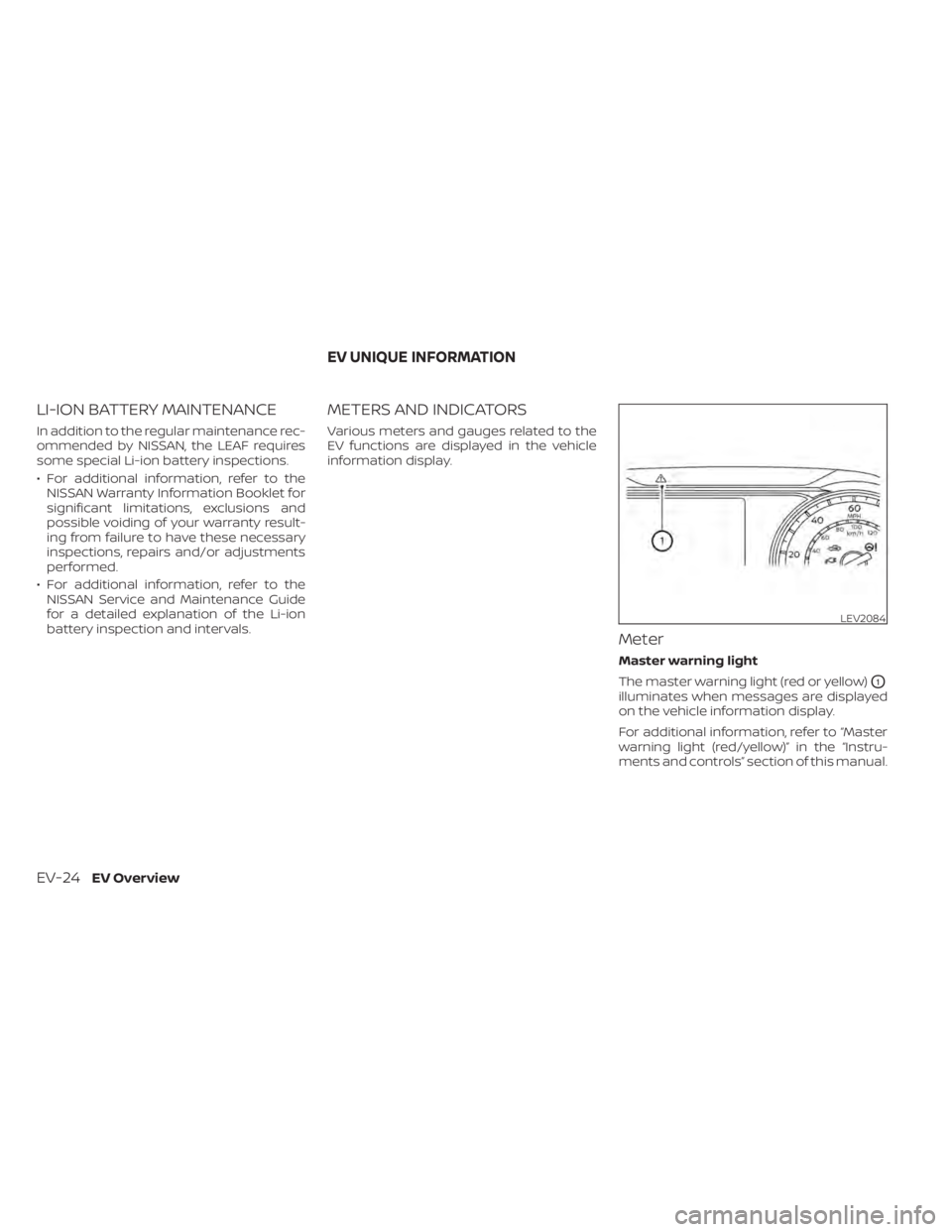
Master warning light
The master warning light (red or yellow)
O1
illuminates when messages are displayed
on the vehicle information display.
For additional information, refer to “Master
warning light (red/yellow)” in the “Instru-
ments and controls” section of this manual.
LEV2084
EV UNIQUE INFORMATION
EV-24EV Overview
Page 46 of 596
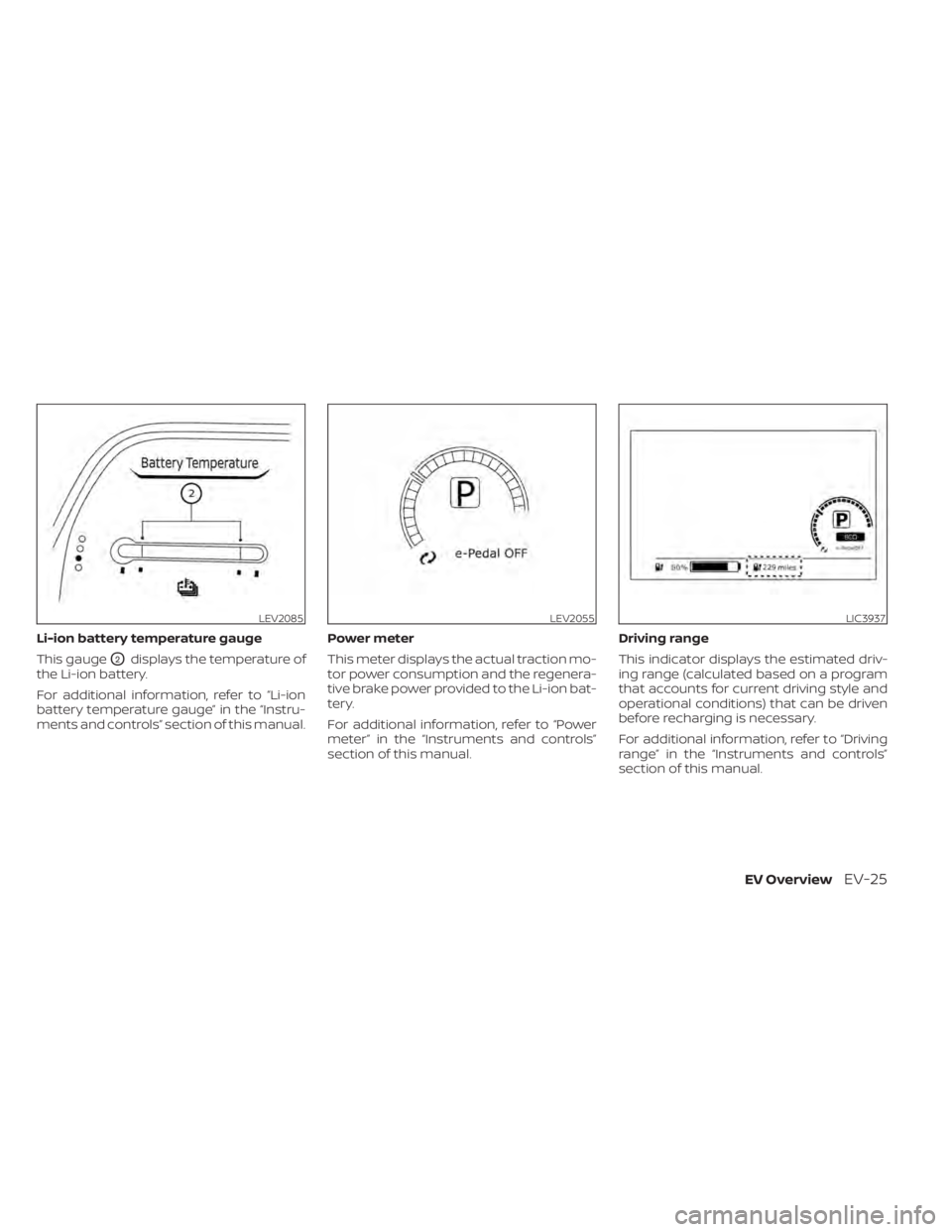
Li-ion battery temperature gauge
This gauge
O2displays the temperature of
the Li-ion battery.
For additional information, refer to “Li-ion
battery temperature gauge” in the “Instru-
ments and controls” section of this manual. Power meter
This meter displays the actual traction mo-
tor power consumption and the regenera-
tive brake power provided to the Li-ion bat-
tery.
For additional information, refer to “Power
meter” in the “Instruments and controls”
section of this manual.Driving range
This indicator displays the estimated driv-
ing range (calculated based on a program
that accounts for current driving style and
operational conditions) that can be driven
before recharging is necessary.
For additional information, refer to “Driving
range” in the “Instruments and controls”
section of this manual.
LEV2085LEV2055LIC3937
EV OverviewEV-25
Page 47 of 596
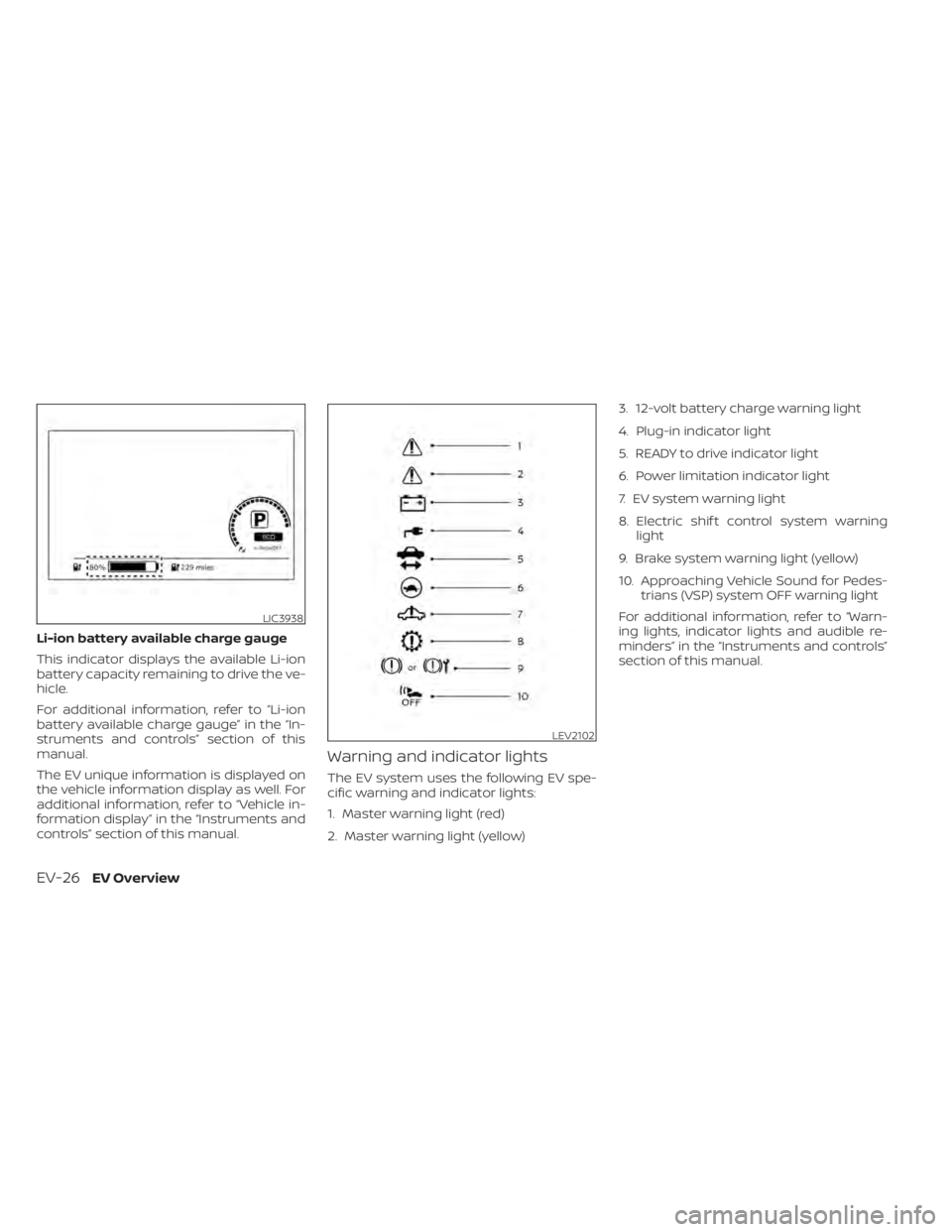
Li-ion battery available charge gauge
This indicator displays the available Li-ion
battery capacity remaining to drive the ve-
hicle.
For additional information, refer to “Li-ion
battery available charge gauge” in the “In-
struments and controls” section of this
manual.
The EV unique information is displayed on
the vehicle information display as well. For
additional information, refer to “Vehicle in-
formation display” in the “Instruments and
controls” section of this manual.
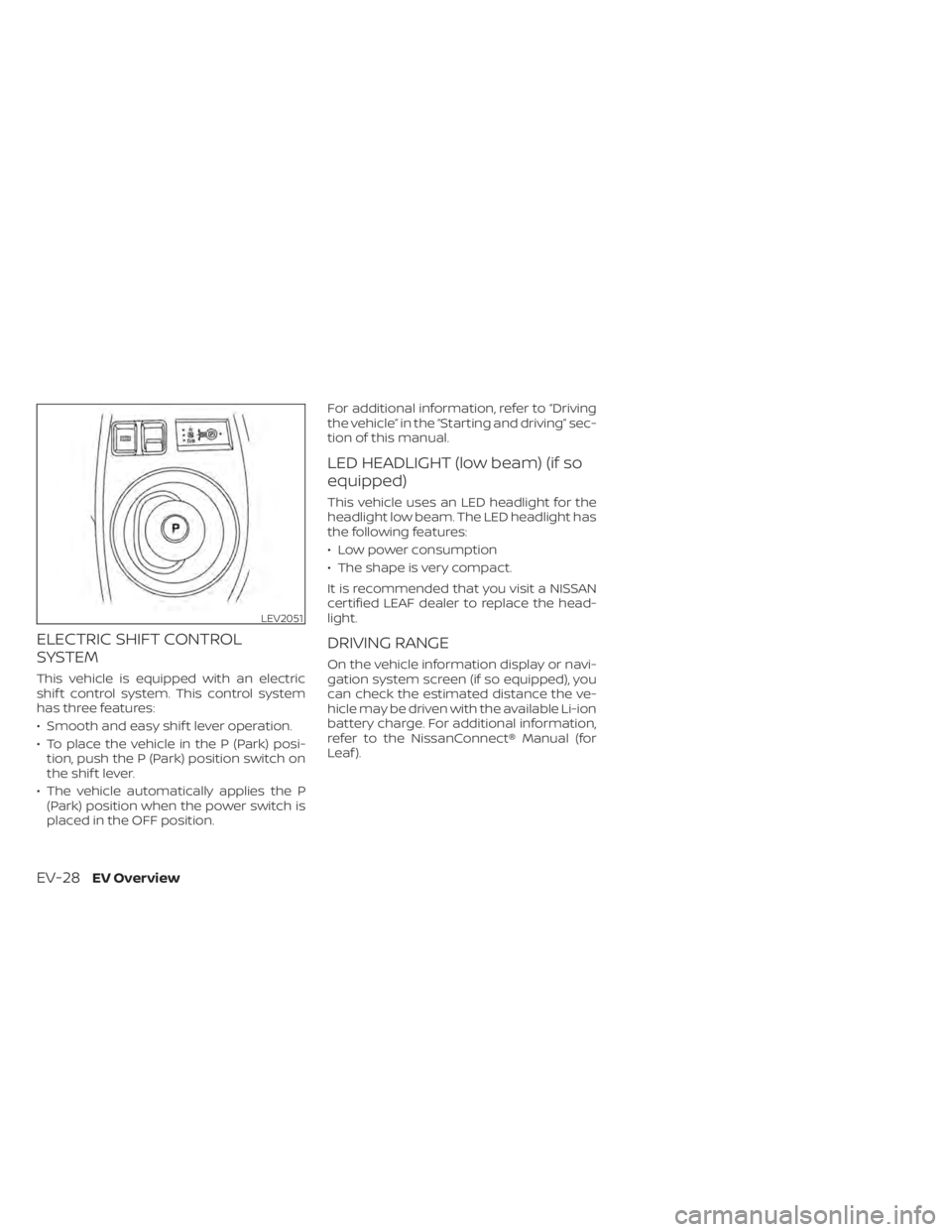
Warning and indicator lights
The EV system uses the following EV spe-
cific warning and indicator lights:
1. Master warning light (red)
2. Master warning light (yellow)3. 12-volt battery charge warning light
4. Plug-in indicator light
5. READY to drive indicator light
6. Power limitation indicator light
7. EV system warning light
8. Electric shif t control system warning
light
9. Brake system warning light (yellow)
10. Approaching Vehicle Sound for Pedes- trians (VSP) system OFF warning light
For additional information, refer to “Warn-
ing lights, indicator lights and audible re-
minders” in the “Instruments and controls”
section of this manual.
LIC3938
LEV2102
EV-26EV Overview
Page 49 of 596
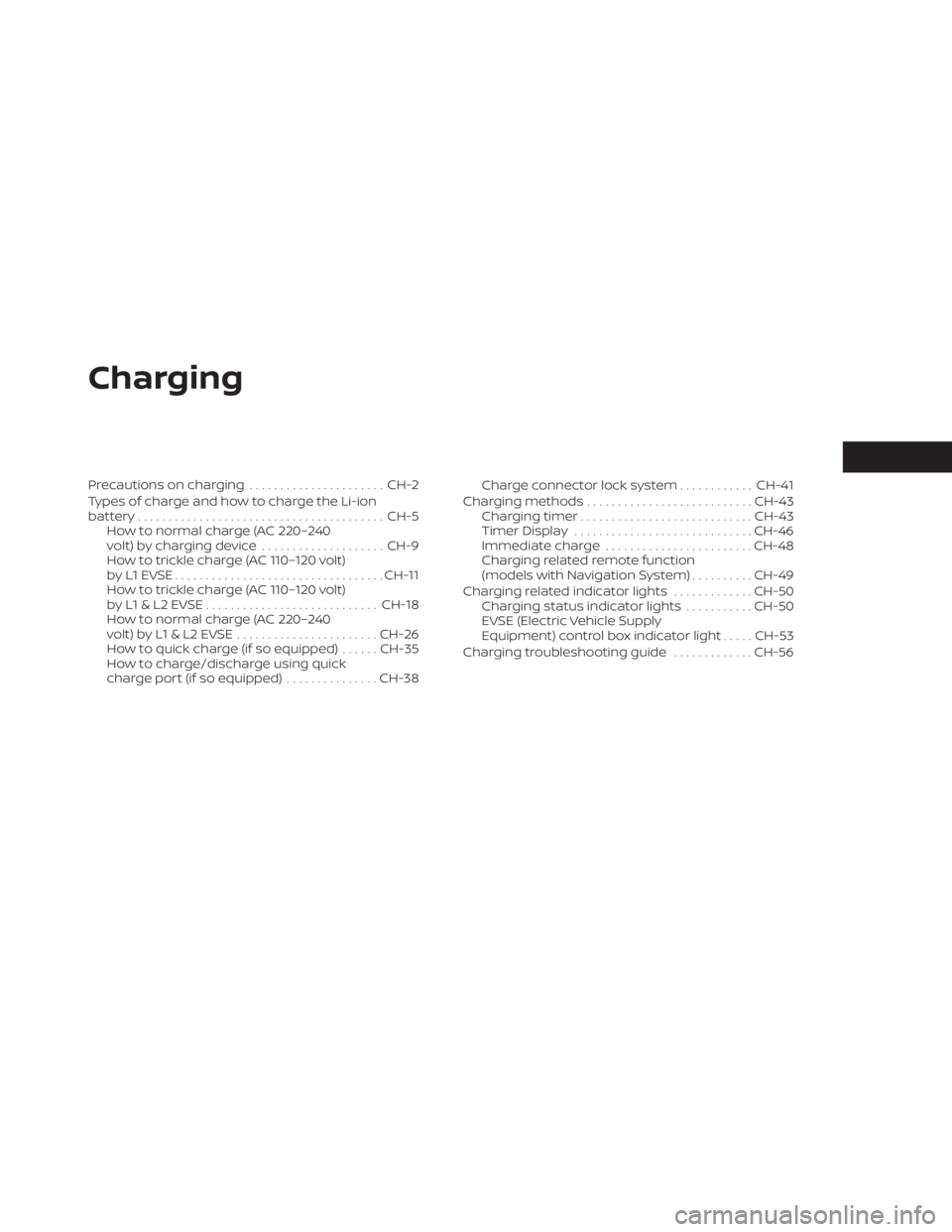
ELECTRIC SHIFT CONTROL
SYSTEM
This vehicle is equipped with an electric
shif t control system. This control system
has three features:
• Smooth and easy shif t lever operation.
• To place the vehicle in the P (Park) posi-tion, push the P (Park) position switch on
the shif t lever.
• The vehicle automatically applies the P (Park) position when the power switch is
placed in the OFF position. For additional information, refer to “Driving
the vehicle” in the “Starting and driving” sec-
tion of this manual.
LED HEADLIGHT (low beam) (if so
equipped)
This vehicle uses an LED headlight for the
headlight low beam. The LED headlight has
the following features:
• Low power consumption
• The shape is very compact.
It is recommended that you visit a NISSAN
certified LEAF dealer to replace the head-
light.
DRIVING RANGE
On the vehicle information display or navi-
gation system screen (if so equipped), you
can check the estimated distance the ve-
hicle may be driven with the available Li-ion
battery charge. For additional information,
refer to the NissanConnect® Manual (for
Leaf ).
LEV2051
EV-28EV Overview
Page 50 of 596
Charging
Precautions on charging......................CH-2
Types of charge and how to charge the Li-ion
battery........................................ CH-5
How to normal charge (AC 220–240
volt) by charging device ....................CH-9
How to trickle charge (AC 110–120 volt)
byL1EVSE.................................. CH-11
How to trickle charge (AC 110–120 volt)
byL1&L2EVSE............................ CH-18
How to normal charge (AC 220–240
volt)byL1&L2EVSE....................... CH-26
How to quick charge (if so equipped) ......CH-35
How to charge/discharge using quick
charge port (if so equipped) ...............CH-38 Charge connector lock system
............CH-41
Charging methods ........................... CH-43
Charging timer ............................ CH-43
Timer Display ............................. CH-46
Immediate charge ........................ CH-48
Charging related remote function
(models with Navigation System) ..........CH-49
Charging related indicator lights .............CH-50
Charging status indicator lights ...........CH-50
EVSE (Electric Vehicle Supply
Equipment) control box indicator light .....CH-53
Charging troubleshooting guide .............CH-56
Page 51 of 596
WARNING
• If you use any medical electric de-
vices, such as an implantable cardiac
pacemaker or an implantable cardio-
vascular defibrillator, check with the
electric medical device manufac-
turer concerning the effects that
charging may have on implanted de-
vices before starting the charge op-
eration. Charging may affect the
operation.
• Make sure there is no water or for-
eign materials in the charge port,
charge connector, or electrical plug,
and that they are not damaged or
affected by rust or corrosion. If any of
these conditions are noticeable, do
not charge the Li-ion battery. This
may result in a short circuit or electric
shock and could cause a fire which
may result in serious personal injury
or death.
• To avoid serious personal injury or
death when the Li-ion battery is
charging, be aware of the following
precautions. –
Do not touch the metal contacts of
the charge port, charge connec-
tor, electrical plug or Genuine
NISSAN Adapter.
– Do not touch the vehicle and EVSE
when there is lightning.
– Do not pull, twist, bend, step on, or
drag the cable.
• Make sure the charge connector is
removed from the charge port before
starting your vehicle. If the charge
connector is only partially engaged
and the connector latch is unlocked,
it is possible to place the EV in the
READY to drive position.
• Do not touch the plug or the Genuine
NISSAN Adapter if they are wet or
with wet hands. Do not put the plug
or the Genuine NISSAN Adapter in
water, liquid or snow. This may cause
an electric shock which may result in
serious personal injury or death.
• Do not disassemble or modif y the
charge port, the EVSE or the Genuine
NISSAN Adapter. This may cause a
fire or an electric shock which may
result in serious personal injury or
death. •
If you notice an unusual odor, smoke
or abnormal noises coming from the
vehicle, stop charging immediately.
• Be careful not to allow your hands,
hair, jewelry or clothing to come into
contact with, or get caught in, the
traction motor cooling fan. The cool-
ing fan can start at any time during
charging.
• Do not use extension cords or adapt-
ers unless they are Genuine NISSAN
parts.
• Do not use the Genuine NISSAN
Adapter with any devices except the
Genuine NISSAN EVSE.
• Do not allow an unattended child to
handle or use this product.
• Use the EVSE with outlet and wiring
installed according to the
regulations/standards.
• Pass the lower side belt of the EVSE
case securely through the fastener
on the bottom of the luggage board.
If the case suddenly becomes loose,
it may cause serious injury or death.
PRECAUTIONS ON CHARGING
CH-2Charging
Page 52 of 596
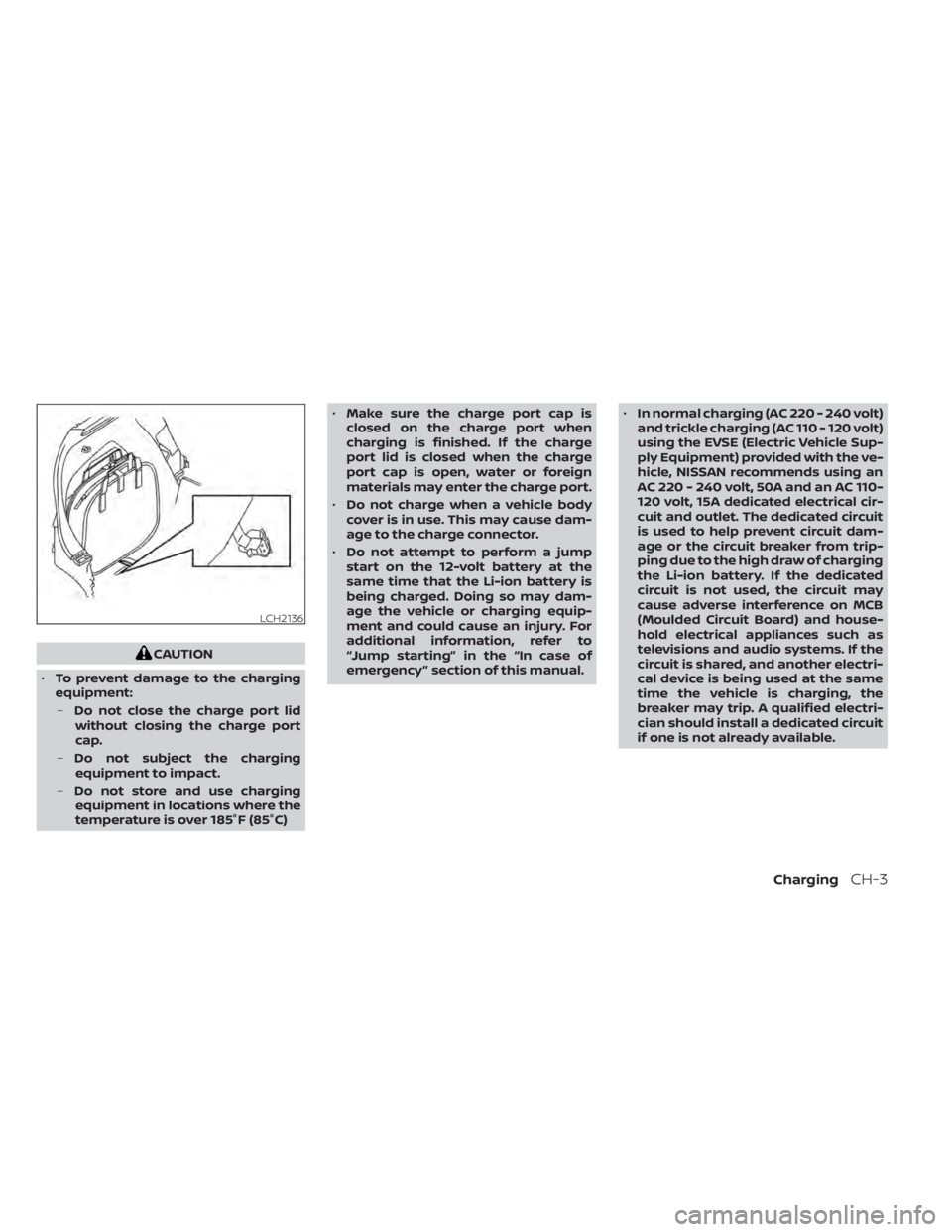
CAUTION
• To prevent damage to the charging
equipment:
– Do not close the charge port lid
without closing the charge port
cap.
– Do not subject the charging
equipment to impact.
– Do not store and use charging
equipment in locations where the
temperature is over 185°F (85°C) •
Make sure the charge port cap is
closed on the charge port when
charging is finished. If the charge
port lid is closed when the charge
port cap is open, water or foreign
materials may enter the charge port.
• Do not charge when a vehicle body
cover is in use. This may cause dam-
age to the charge connector.
• Do not attempt to perform a jump
start on the 12-volt battery at the
same time that the Li-ion battery is
being charged. Doing so may dam-
age the vehicle or charging equip-
ment and could cause an injury. For
additional information, refer to
“Jump starting” in the “In case of
emergency ” section of this manual. •
In normal charging (AC 220 - 240 volt)
and trickle charging (AC 110 - 120 volt)
using the EVSE (Electric Vehicle Sup-
ply Equipment) provided with the ve-
hicle, NISSAN recommends using an
AC 220 - 240 volt, 50A and an AC 110-
120 volt, 15A dedicated electrical cir-
cuit and outlet. The dedicated circuit
is used to help prevent circuit dam-
age or the circuit breaker from trip-
ping due to the high draw of charging
the Li-ion battery. If the dedicated
circuit is not used, the circuit may
cause adverse interference on MCB
(Moulded Circuit Board) and house-
hold electrical appliances such as
televisions and audio systems. If the
circuit is shared, and another electri-
cal device is being used at the same
time the vehicle is charging, the
breaker may trip. A qualified electri-
cian should install a dedicated circuit
if one is not already available.
LCH2136
ChargingCH-3