heater NISSAN LEAF 2020 Owner´s Manual
[x] Cancel search | Manufacturer: NISSAN, Model Year: 2020, Model line: LEAF, Model: NISSAN LEAF 2020Pages: 596, PDF Size: 4.33 MB
Page 492 of 596
CAUTION
To prevent damage to the Li-ion bat-
tery: Do not store the vehicle in tem-
peratures below -13°F (-25°C) for over
seven days. If the outside temperature
is -13°F (-25°C) or less, the Li-ion battery
may freeze and it cannot be charged or
provide power to run the vehicle. Move
the vehicle to a warm location.
NOTE:
• Connect the charger to the vehicle and place the power switch in the OFF po-
sition when parking the vehicle if tem-
peratures may go below -4°F (-20°C).
For models with 40 kWh battery
model, this provides external power to
the Li-ion battery warmer (if so
equipped) when it operates and does
not discharge the Li-ion battery. Ve-
hicle driving range is reduced if the Li-
ion battery warmer (if so equipped) op-
erates (Li-ion battery temperature
approximately -4°F (-20°C) or colder)
while driving the vehicle. You may need
to charge the Li-ion battery sooner
than in warmer temperatures.
• The Li-ion battery requires more time to charge when the Li-ion battery
warmer (if so equipped) operates. • The predicted charging time displayed
on the meter and navigation system (if
so equipped) increases when the Li-ion
battery warmer (if so equipped) oper-
ates.
• Vehicle range may be substantially re- duced in extremely cold conditions (for
example under -4°F (-20°C)).
• Using the climate control system to heat the cabin when outside tempera-
ture is below 32°F (0°C) uses more elec-
tricity and affects vehicle range more
than when using the heater when the
temperature is above 32°F (0°C).
• Climate control performance is re- duced when using the Climate Ctrl.
Timer or Remote Climate Control while
the Li-ion battery warmer (if so
equipped) operates (for models with
40 kWh battery model). Set only the
charging timer [End Time] when charg-
ing in cold weather. The vehicle auto-
matically determines when to start
charging to fully charge the Li-ion bat-
tery, even if the Li-ion battery warmer
operates. Charging ends before the set
end time if the Li-ion battery is fully
charged.
FREEING A FROZEN DOOR LOCK
To prevent a door lock from freezing, apply
deicer through the key hole. If the lock be-
comes frozen, heat the key before inserting
it into the key hole or use the remote key-
less entry key fob.
ANTIFREEZE
In the winter when it is possible that the
outside temperature will drop below 32°F
(0°C), check the antifreeze to ensure proper
winter protection. For additional informa-
tion, refer to “Cooling system” in the “Main-
tenance and do-it-yourself ” section of this
manual.
12-VOLT BATTERY
If the 12-volt battery is not fully charged
during extremely cold weather conditions,
the 12-volt battery fluid may freeze and
damage the 12-volt battery. To maintain
maximum efficiency, the 12-volt battery
should be checked regularly. For additional
information, refer to “12-volt battery” in the
“Maintenance and do-it-yourself ” section
of this manual.
COLD WEATHER DRIVING
Starting and driving5-169
Page 506 of 596
CAUTION
LEAF cannot be used as a booster ve-
hicle because it cannot supply enough
power to start a gasoline engine. How-
ever, a gasoline engine vehicle can be
used to jump start LEAF's 12-volt bat-
tery.
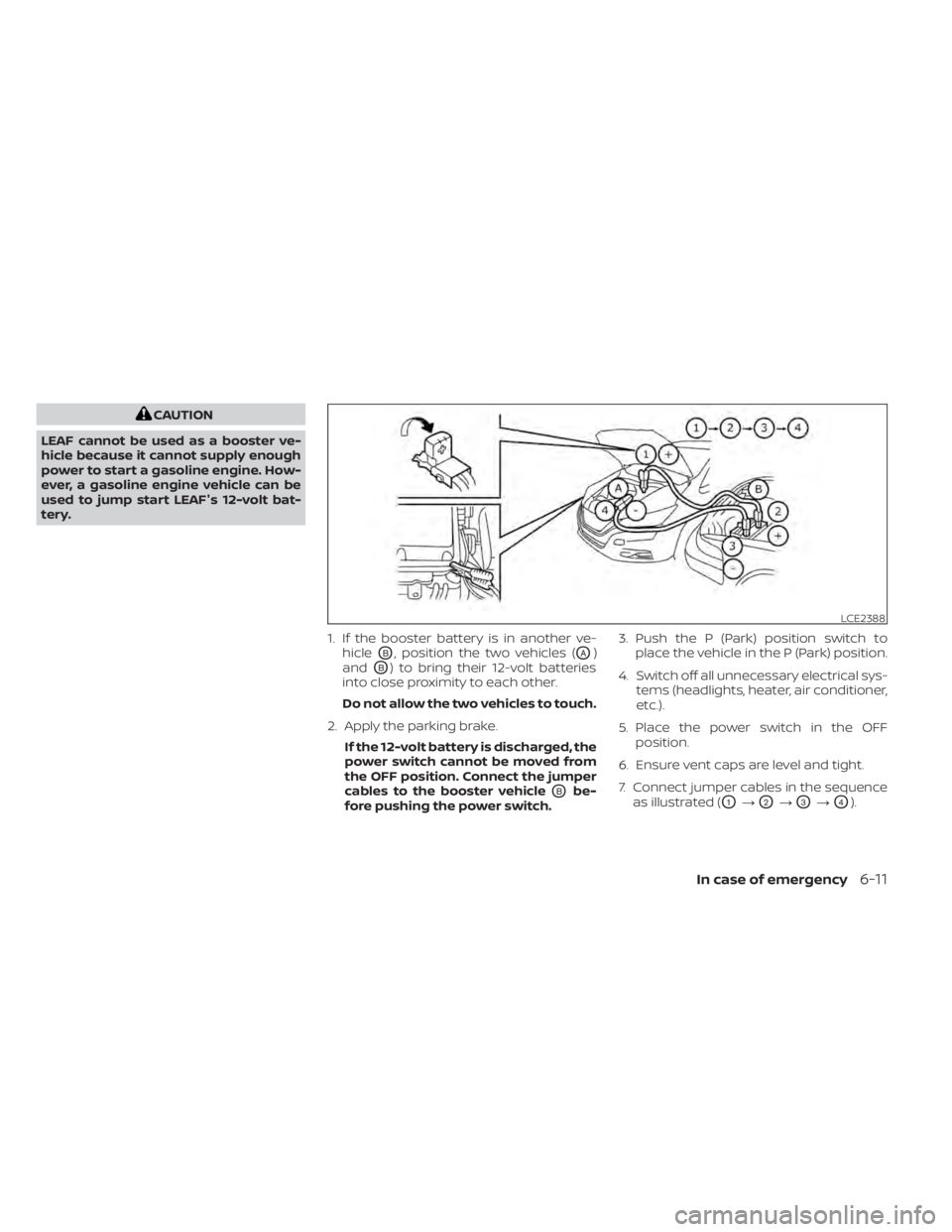
1. If the booster battery is in another ve-hicle
OB, position the two vehicles (OA)
and
OB) to bring their 12-volt batteries
into close proximity to each other.
Do not allow the two vehicles to touch.
2. Apply the parking brake. If the 12-volt battery is discharged, the
power switch cannot be moved from
the OFF position. Connect the jumper
cables to the booster vehicle
OBbe-
fore pushing the power switch. 3. Push the P (Park) position switch to
place the vehicle in the P (Park) position.
4. Switch off all unnecessary electrical sys- tems (headlights, heater, air conditioner,
etc.).
5. Place the power switch in the OFF position.
6. Ensure vent caps are level and tight.
7. Connect jumper cables in the sequence as illustrated (O1→O2→O3→O4).
LCE2388
In case of emergency6-11
Page 523 of 596
and that the locks (if so equipped) hold
securely in all latched positions.
Seat belts:Check that all parts of the seat
belt system (for example, buckles, anchors,
adjusters and retractors) operate properly
and smoothly, and are installed securely.
Check the belt webbing for cuts, fraying,
wear or damage.
Steering wheel: Check for changes in the
steering conditions, such as excessive free
play, hard steering or strange noises.
Warning lights and chimes: Make sure
that all warning lights and chimes are op-
erating properly.
Windshield defroster: Check that the air
emits from the defroster outlets properly
and in sufficient quantity when operating
the heater or air conditioner.
Windshield wiper and washer*: Check
that the wipers and washers operate prop-
erly and that the wipers do not streak.
Under hood and vehicle
The maintenance items listed here should
be checked periodically.
12-volt battery (except for maintenance
free batteries)*: Check the fluid level in
each cell. The fluid should be at the bottom of the filler opening. Vehicles operated in
high temperatures or under severe condi-
tions require frequent checks of the 12–volt
battery fluid level.
NOTE:
Care should be taken to avoid situations
that can lead to potential battery dis-
charge and potential no-start conditions
such as:
1. Installation or extended use of elec-
tronic accessories that consume bat-
tery power when the EV system is not
running (Phone chargers, GPS, DVD
players, etc.)
2. Vehicle is not driven regularly and/or only driven short distances.
In these cases, the battery may need to
be charged to maintain battery health.
Brake fluid level*: Make sure that the brake
fluid level is between the MAX and MIN lines
on the reservoir.
Coolant level*: Check the coolant level
when the high voltage parts are cold. Make
sure that the coolant level is between the
MAX and MIN lines on the reservoir.
Fluid leaks: Check under the vehicle for
water or other fluid leaks af ter the vehicle
has been parked for a while. Water dripping from the air conditioner af ter use is normal.
If you should notice any leaks, check for
cause and have it corrected immediately.
Radiator and hoses:
Check the front of the
radiator and clean off any dirt, insects,
leaves, etc., that may have accumulated.
Make sure that the hoses have no cracks,
deformation, rot or loose connections.
Underbody: The underbody is frequently
exposed to corrosive substances such as
those used on icy roads or to control dust. It
is very important to remove these sub-
stances, otherwise rust will form on the
floor pan and frame. At the end of winter,
the underbody should be thoroughly
flushed with plain water, being careful to
clean those areas where mud and dirt may
accumulate. For additional information, re-
fer to “Cleaning exterior” in the “Appearance
and care” section of this manual.
Windshield-washer fluid*: Check that
there is an adequate amount of fluid in the
reservoir.
8-4Maintenance and do-it yourself
Page 528 of 596
CHECKING COOLANT LEVEL
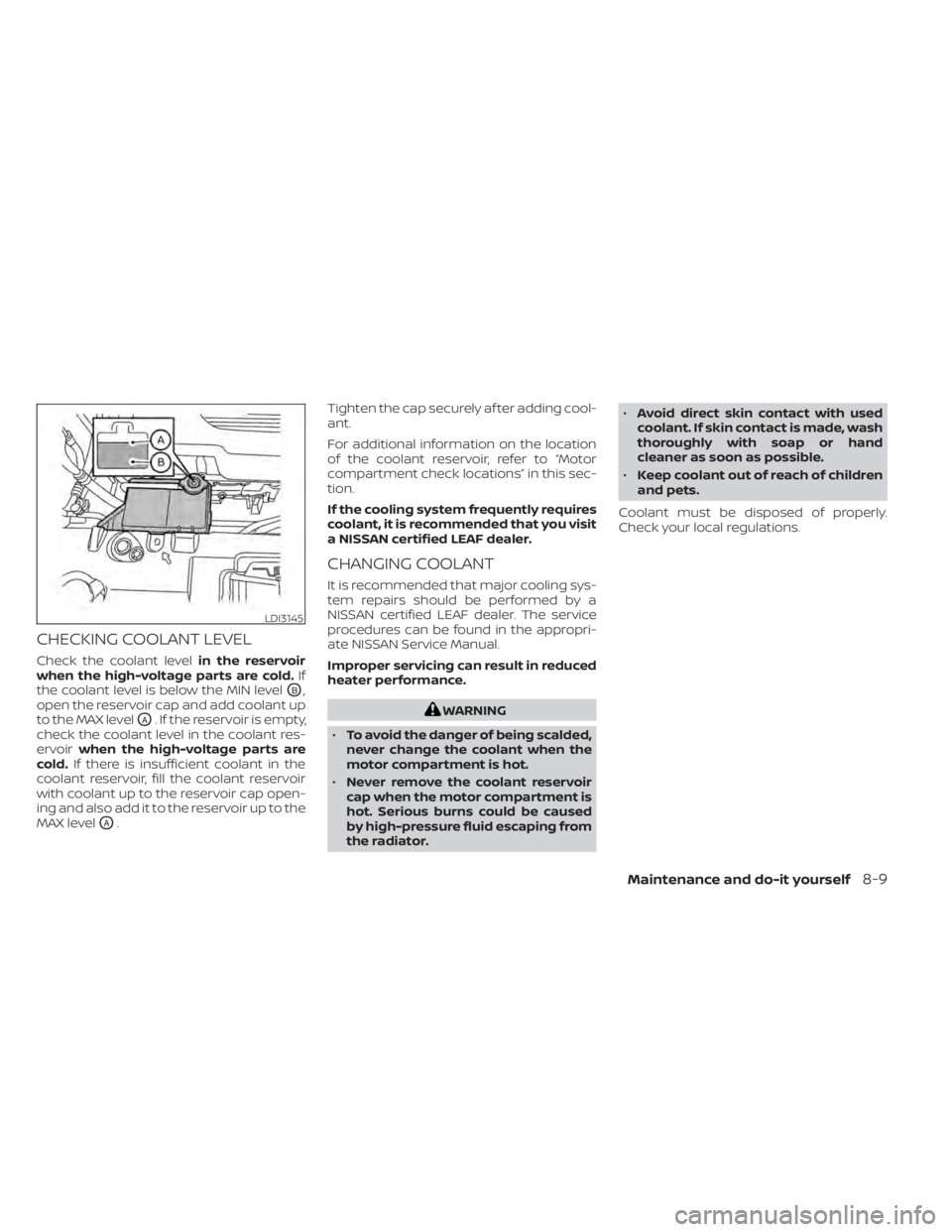
Check the coolant levelin the reservoir
when the high-voltage parts are cold. If
the coolant level is below the MIN level
OB,
open the reservoir cap and add coolant up
to the MAX level
OA. If the reservoir is empty,
check the coolant level in the coolant res-
ervoir when the high-voltage parts are
cold. If there is insufficient coolant in the
coolant reservoir, fill the coolant reservoir
with coolant up to the reservoir cap open-
ing and also add it to the reservoir up to the
MAX level
OA. Tighten the cap securely af ter adding cool-
ant.
For additional information on the location
of the coolant reservoir, refer to “Motor
compartment check locations” in this sec-
tion.
If the cooling system frequently requires
coolant, it is recommended that you visit
a NISSAN certified LEAF dealer.
CHANGING COOLANT
It is recommended that major cooling sys-
tem repairs should be performed by a
NISSAN certified LEAF dealer. The service
procedures can be found in the appropri-
ate NISSAN Service Manual.
Improper servicing can result in reduced
heater performance.
WARNING
• To avoid the danger of being scalded,
never change the coolant when the
motor compartment is hot.
• Never remove the coolant reservoir
cap when the motor compartment is
hot. Serious burns could be caused
by high-pressure fluid escaping from
the radiator. •
Avoid direct skin contact with used
coolant. If skin contact is made, wash
thoroughly with soap or hand
cleaner as soon as possible.
• Keep coolant out of reach of children
and pets.
Coolant must be disposed of properly.
Check your local regulations.
LDI3145
Maintenance and do-it yourself8-9
Page 561 of 596
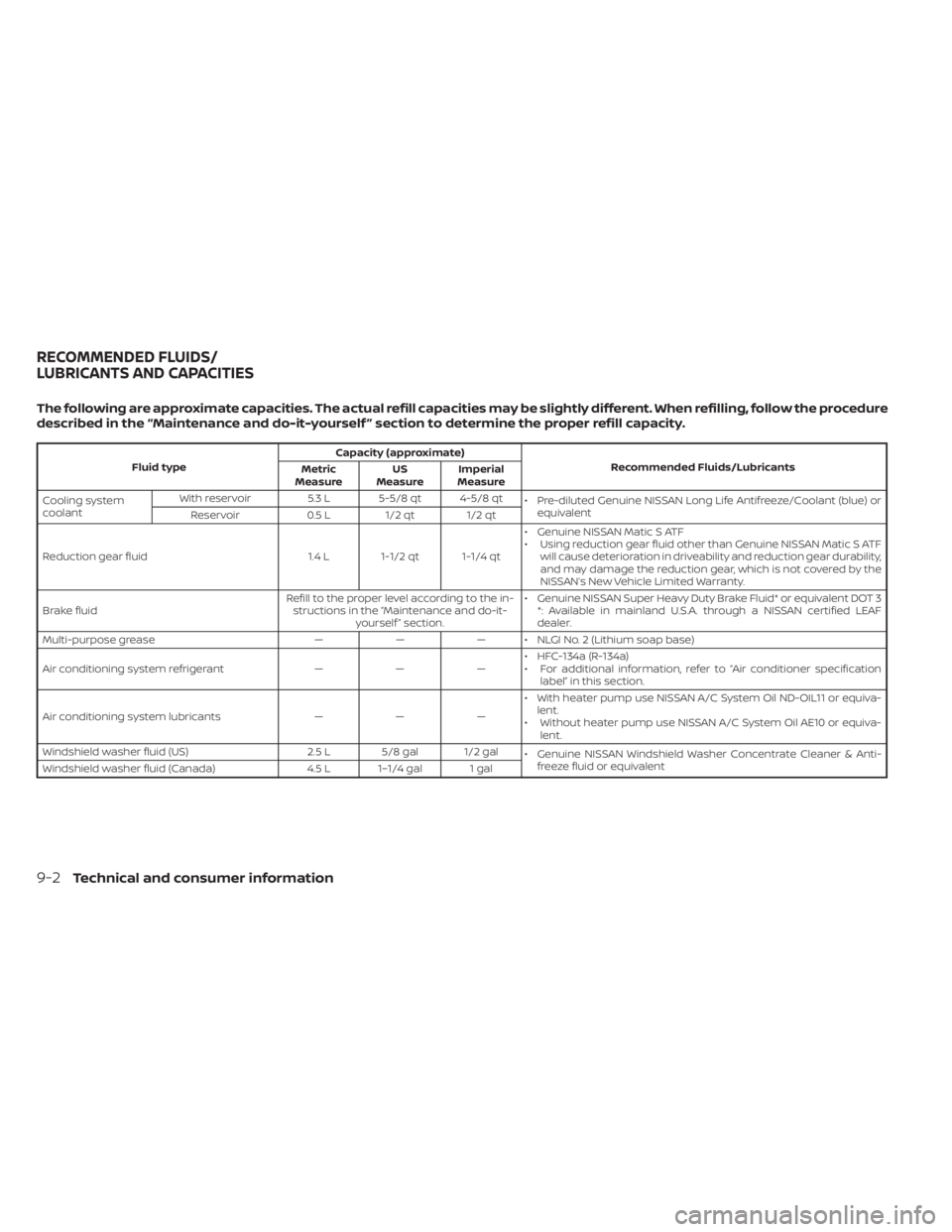
The following are approximate capacities. The actual refill capacities may be slightly different. When refilling, follow the procedure
described in the “Maintenance and do-it-yourself ” section to determine the proper refill capacity.
Fluid typeCapacity (approximate)
Recommended Fluids/Lubricants
Metric
Measure US
Measure Imperial
Measure
Cooling system
coolant With reservoir 5.3 L 5-5/8 qt 4-5/8 qt
• Pre-diluted Genuine NISSAN Long Life Antifreeze/Coolant (blue) or
equivalent
Reservoir 0.5 L 1/2 qt 1/2 qt
Reduction gear fluid 1.4 L 1-1/2 qt 1-1/4 qt • Genuine NISSAN Matic S ATF
• Using reduction gear fluid other than Genuine NISSAN Matic S ATF
will cause deterioration in driveability and reduction gear durability,
and may damage the reduction gear, which is not covered by the
NISSAN’s New Vehicle Limited Warranty.
Brake fluid Refill to the proper level according to the in-
structions in the “Maintenance and do-it- yourself ” section. • Genuine NISSAN Super Heavy Duty Brake Fluid* or equivalent DOT 3
*: Available in mainland U.S.A. through a NISSAN certified LEAF
dealer.
Multi-purpose grease — — — • NLGI No. 2 (Lithium soap base)
Air conditioning system refrigerant — — — • HFC-134a (R-134a)
• For additional information, refer to “Air conditioner specification
label” in this section.
Air conditioning system lubricants — — — • With heater pump use NISSAN A/C System Oil ND-OIL11 or equiva-
lent.
• Without heater pump use NISSAN A/C System Oil AE10 or equiva- lent.
Windshield washer fluid (US) 2.5 L 5/8 gal 1/2 gal • Genuine NISSAN Windshield Washer Concentrate Cleaner & Anti-
freeze fluid or equivalent
Windshield washer fluid (Canada) 4.5 L 1–1/4 gal 1 gal
RECOMMENDED FLUIDS/
LUBRICANTS AND CAPACITIES
9-2Technical and consumer information
Page 562 of 596
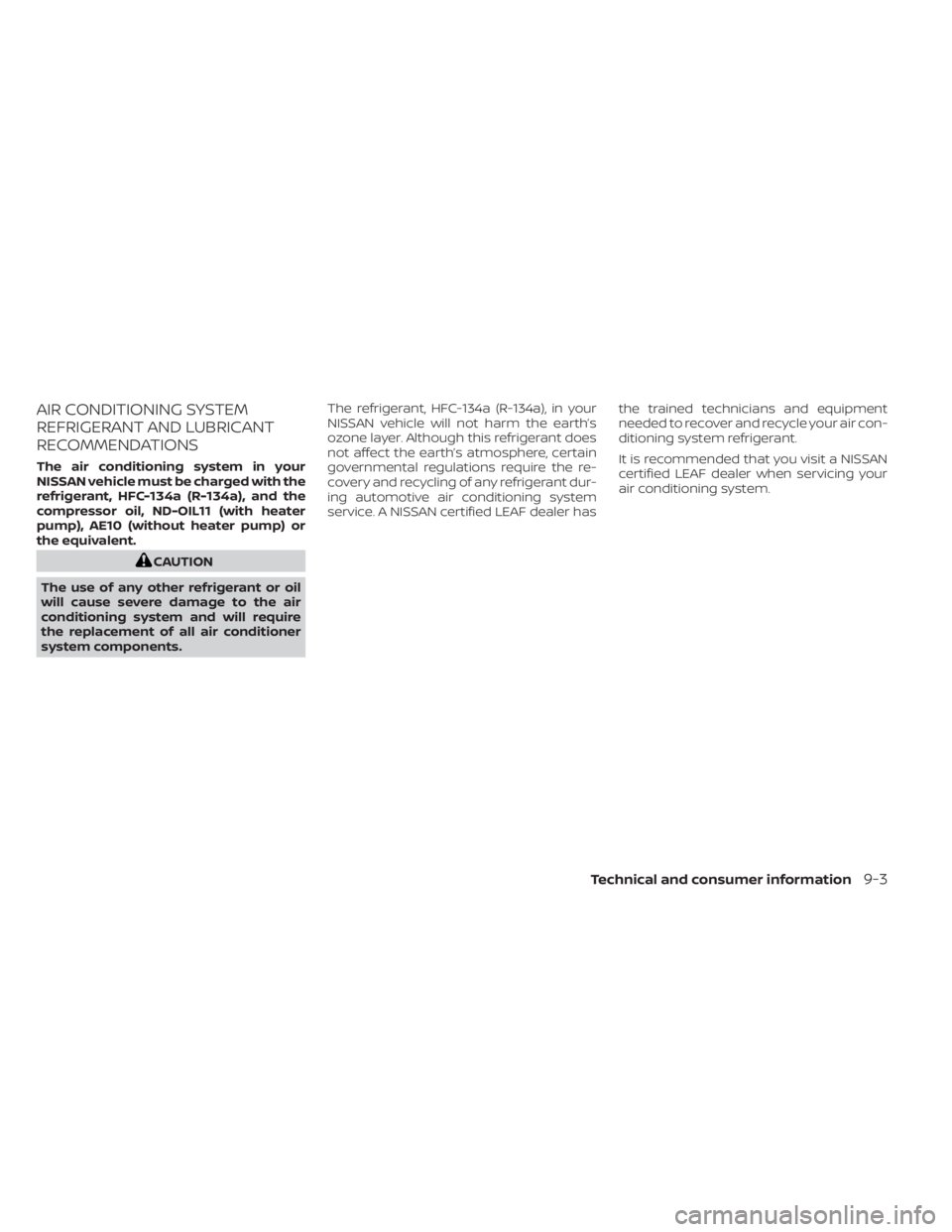
AIR CONDITIONING SYSTEM
REFRIGERANT AND LUBRICANT
RECOMMENDATIONS
The air conditioning system in your
NISSAN vehicle must be charged with the
refrigerant, HFC-134a (R-134a), and the
compressor oil, ND-OIL11 (with heater
pump), AE10 (without heater pump) or
the equivalent.
CAUTION
The use of any other refrigerant or oil
will cause severe damage to the air
conditioning system and will require
the replacement of all air conditioner
system components. The refrigerant, HFC-134a (R-134a), in your
NISSAN vehicle will not harm the earth’s
ozone layer. Although this refrigerant does
not affect the earth’s atmosphere, certain
governmental regulations require the re-
covery and recycling of any refrigerant dur-
ing automotive air conditioning system
service. A NISSAN certified LEAF dealer has
the trained technicians and equipment
needed to recover and recycle your air con-
ditioning system refrigerant.
It is recommended that you visit a NISSAN
certified LEAF dealer when servicing your
air conditioning system.
Technical and consumer information9-3
Page 585 of 596
Car phone or CB radio............4-44Ceiling light...................2-70Center console................2-63Charge port lid.................3-21Charge port lid switch............2-58ChargingCharge port lid...............3-21Charging related indicator light. . .CH-50Normal charge..............CH-9Precautions on charging........CH-2Quick charge..........CH-35, CH-38Specifications................9-4Trickle charge...............CH-11Charging information............9-22Charging methods.............CH-43Charging related indicator light.....CH-50Charging related remote function. . .CH-49Charging status indicator light.....CH-50Charging the Li-ion battery........EV-12Charging troubleshooting guide. . . .CH-56CheckingChecking bulbs...............2-15Checking coolant level...........8-9Child restraints.................1-21Booster seats................1-39LATCH (Lower Anchors and Tethers for
CHildren) System..............1-23Precautions on child restraints.....1-21Top tether strap..............1-25Child restraint with top tether strap. . . .1-25Child safety...................1-18Child safety rear door lock..........3-6Chimes, audible reminders.........2-24Circuit breaker, fusible link..........8-20
Cleaning exterior and interior......7-2,7-4ClimateClimate control system refrigerant and
lubricant recommendations
......4-43Climate controlClimate control service..........4-43Climate control systemAir conditioner...............4-28Climate control operation........4-28Heater....................4-28Climate Ctrl. Timer..............4-38Clock.......................2-13Cold tire pressures..............9-24Cold weather driving............5-169ConsoleCenter console...............2-63CoolantCapacities and recommended
fuel/lubricants
................9-2Changing coolant..............8-9Checking coolant level...........8-9Cooling system................ .8-8Corrosion protection..............7-7Cruise control.................5-66Cup holders................. .2-64
D
Defroster switch
Rear window and outside mirror defroster
switch
................... .2-48Dimensions and weights...........9-6Dimmer switch for instrument panel. . .2-54
Display
Information display............2-25Door locks................... .3-4Doors...................... .3-4Driving
Cold weather driving...........5-169Driving vehicle...............5-15Precautions when starting and
driving.................... .5-4Driving range..................2-9Driving the vehicle..............EV-18Driving vehicle.................5-15Dynamic driver assistance switch.....2-59
E
ECO
ECO switch................ .2-55Eco Drive Report...............5-154ECO mode...............2-13,5-152ECO switch.................. .2-55Efficient use of your vehicle........EV-22Electric shif t control system.........5-15Electronic parking brake...........5-20Emergency charge.............CH-11Emergency EV (Electric Vehicle) shut
off......................5-13,6-3Emergency shutoff system........EV-10Emission control information label.....9-8e-Pedal......................2-13e-Pedal system................5-22EV Characteristics..............EV-11Event Data recorders.............9-20
10-2Index
Page 586 of 596
EVSE
(Electric Vehicle Supply Equipment). . .CH-11EV system...................EV-2EV unique information...........EV-24Extended storage switch..........8-22
F
Flashers (See hazard warning flasher
switch)......................6-2Flat tire..................... .6-3Flat towing...................9-14Floor mat cleaning...............7-5Fluid
Brake fluid..................8-10Capacities and recommended
fuel/lubricants................9-2Coolant................... .8-8Reduction gear fluid............8-10Windshield-washer fluid..........8-11F.M.V.S.S./C.M.V.S.S. certification label. . . .9-8Fog lights
Bulb replacement.............8-25Fog light switch................2-55Front and rear sonar system.......5-163Front passenger air bag status light. . .1-52Front-seat mounted side-impact
supplemental air bag system.......1-58Fuses.......................8-18Fusible links..................8-20
G
Garage door opener, HomeLink® Universal
Transceiver.........2-71,2-73,2-74,2-75GaugeDriving range................ .2-9Li-ion battery available charge gauge.2-9Li-ion battery temperature gauge. . . .2-7Odometer.................. .2-6Power meter.................2-8Speedometer................2-6General maintenance.............8-2Glove box................... .2-62
H
Hazard warning flasher switch........6-2Headlights...................8-25Bulb replacement.............8-25Headlight switch..............2-49Head restraints
Headrests...................1-7Heated seats................. .2-56Heated seat switches............2-56Heated steering wheel............2-57Heated steering wheel switch.......2-57Heater......................4-28High voltage precautions..........EV-8Hill start....................5-168Hill start assist................5-168Home charge.................CH-9HomeLink® Universal
Transceiver.........2-71,2-73,2-74,2-75
Hood release..................3-18Horn...................... .2-55How to normal charge...........CH-9How to quick charge.......CH-35, CH-38How to trickle charge............CH-11
I
If the Li-ion battery becomes completely
discharged...................6-12Immediate charge.........CH-48, 2-58Immediate charge switch.....CH-48, 2-58Immobilizer system..........2-44, 5-14Indicator lights.................2-22Indicator lights and audible reminders
(See warning/indicator lights and audible
reminders)
...................2-14Indicators for maintenance.........2-38Indicators for operation...........2-33Infants......................1-19Inside automatic anti-glare mirror. . . .3-25Instrument brightness control.......2-54Instrument panel dimmer switch.....2-54Intelligent Around View Monitor (I-AVM). .4-11Intelligent Cruise Control (ICC) (for vehicles
without ProPILOT Assist)...........5-69Intelligent Driver Alertness (I-DA).....5-150Intelligent Forward Collision Warning
(I-FCW).....................5-139Intelligent Key battery............8-22Intelligent Key system
Key operation................3-10Remote keyless entry operation. . . .3-14
Index10-3