air condition NISSAN LEAF 2020 Owner´s Manual
[x] Cancel search | Manufacturer: NISSAN, Model Year: 2020, Model line: LEAF, Model: NISSAN LEAF 2020Pages: 596, PDF Size: 4.33 MB
Page 500 of 596
CAUTION
• To avoid the emergency tire puncture
kit being damaged during storage or
use:
– Only use the emergency tire punc-
ture repair kit on your vehicle. Do
not use it on other vehicles.
– Only use the kit to inflate the tires
of your vehicle and to check the
vehicle’s tire pressure.
– Only plug the compressor into a
12-volt DC car power point.
– Keep the kit free of water and dirt.
– Do not disassemble or modif y the
kit.
– Do not drop the kit or allow hard
impacts to the kit.
• Do not use the emergency tire punc-
ture repair kit under the following
conditions. It is recommended that
you visit a NISSAN certified LEAF
dealer or professional road
assistance.
– when the sealant has passed its
expiration date (shown on the la-
bel attached to the bottle) –
when the cut or the puncture is
approximately 0.25 in (6 mm) or
longer
– when the tire sidewall is damaged
– when the vehicle has been driven
with extremely low tire pressure
– when the tire has come off the in-
side or the outside of the wheel
– when the tire wheel is damaged
– when two or more tires are flat
If you have a flat tire, follow the instructions
below.
Stopping the vehicle
1. Safely move the vehicle off the road and away from traffic.
2. Turn on the hazard warning flashers.
3. Park on a level surface and apply the parking brake.
4. Push the P (Park) position switch on the shif t lever to the P (Park) position.
5. Turn off the EV system.
6. Raise the hood to warn other traffic and to signal professional road assistance
personnel that you need assistance. 7. Have all passengers get out of the ve-
hicle and stand in a safe place, away
from traffic and clear of the vehicle.
WARNING
• Make sure the parking brake is se-
curely applied and the vehicle is
placed into the P (Park) position.
• Never repair tires when the vehicle is
on a slope, ice or slippery areas. This
is hazardous.
• Never repair tires if oncoming traffic
is close to your vehicle. Wait for pro-
fessional road assistance.
In case of emergency6-5
Page 506 of 596
CAUTION
LEAF cannot be used as a booster ve-
hicle because it cannot supply enough
power to start a gasoline engine. How-
ever, a gasoline engine vehicle can be
used to jump start LEAF's 12-volt bat-
tery.
1. If the booster battery is in another ve-hicle
OB, position the two vehicles (OA)
and
OB) to bring their 12-volt batteries
into close proximity to each other.
Do not allow the two vehicles to touch.
2. Apply the parking brake. If the 12-volt battery is discharged, the
power switch cannot be moved from
the OFF position. Connect the jumper
cables to the booster vehicle
OBbe-
fore pushing the power switch. 3. Push the P (Park) position switch to
place the vehicle in the P (Park) position.
4. Switch off all unnecessary electrical sys- tems (headlights, heater, air conditioner,
etc.).
5. Place the power switch in the OFF position.
6. Ensure vent caps are level and tight.
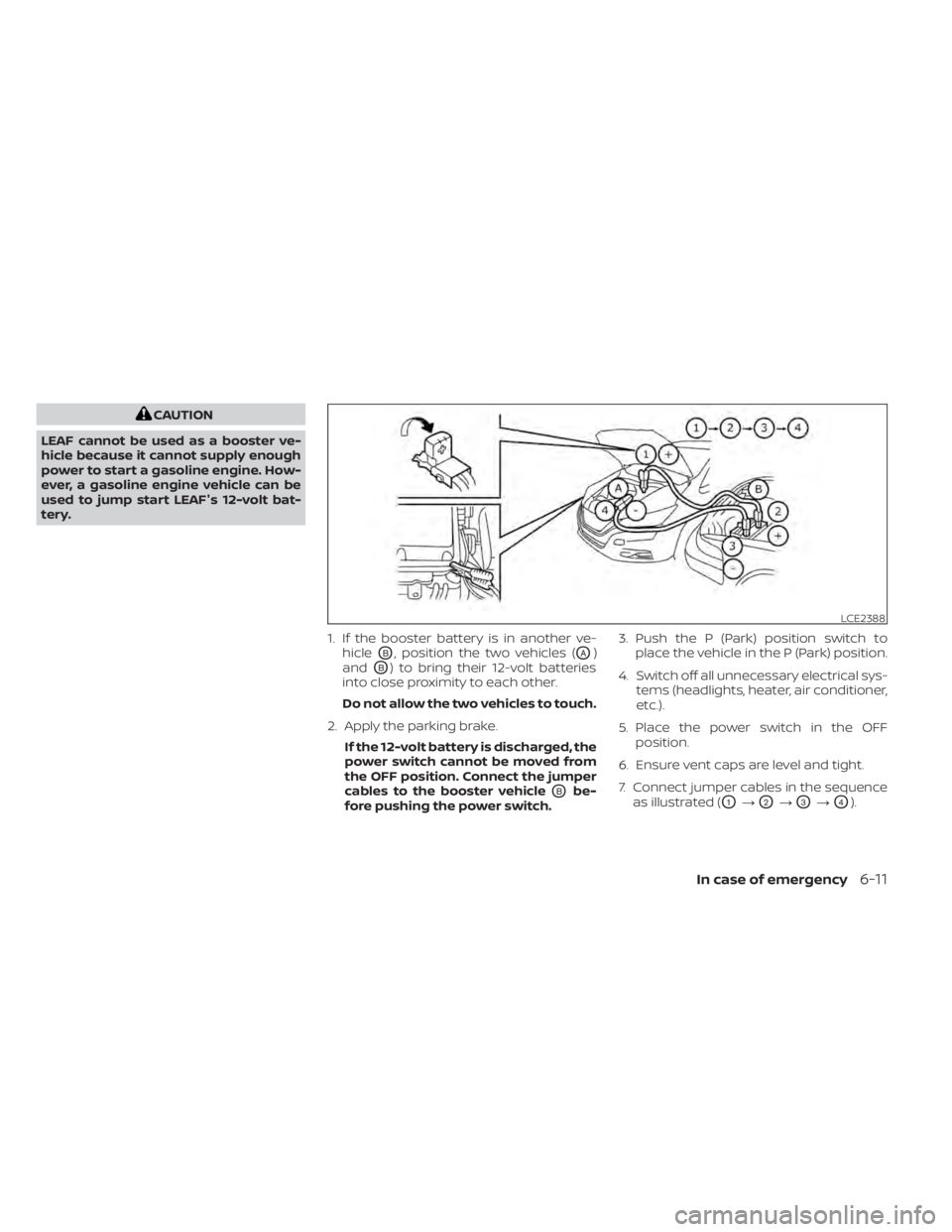
7. Connect jumper cables in the sequence as illustrated (O1→O2→O3→O4).
LCE2388
In case of emergency6-11
Page 521 of 596
Your new NISSAN has been designed to
have minimum maintenance require-
ments with long service intervals to save
you both time and money. However, some
day-to-day and regular maintenance is es-
sential to maintain your NISSAN’s fine me-
chanical condition, and its Electric Vehicle
(EV) system performance.
It is the owner’s responsibility to make sure
that the scheduled maintenance, and gen-
eral maintenance, is performed.
As the vehicle owner, you are the only one
who can ensure that your vehicle receives
the proper maintenance care. You are a
vital link in the maintenance chain.
SCHEDULED MAINTENANCE
For your convenience, both required and
optional scheduled maintenance items
are described and listed in your “NISSAN
Service and Maintenance Guide”. You must
refer to that guide to ensure that neces-
sary maintenance is performed on your
NISSAN at regular intervals.
GENERAL MAINTENANCE
General maintenance includes those items
which should be checked during normal
day-to-day operation. They are essential
for proper vehicle operation. It is your re-sponsibility to perform these procedures
regularly as prescribed.
Performing general maintenance checks
requires minimal mechanical skill and only
a few general automotive tools.
These checks or inspections can be done
by yourself, a qualified technician or, if you
prefer, a NISSAN certified LEAF dealer.
WHERE TO GO FOR SERVICE
If maintenance service is required or your
vehicle appears to malfunction, have the
systems checked and serviced. It is recom-
mended that you visit a NISSAN certified
LEAF dealer for this service.
NISSAN technicians are well-trained spe-
cialists and are kept up-to-date with the
latest service information through techni-
cal bulletins, service tips, and in-dealership
information systems. They are completely
qualified to work on NISSAN vehicles
be-
fore work begins.
You can be confident that a NISSAN certi-
fied LEAF dealer’s service department per-
forms the best job to meet the mainte-
nance requirements on your vehicle — in a
reliable and economical way. During the normal day-to-day operation of
the vehicle, general maintenance should
be performed regularly as prescribed in
this section. If you detect any unusual
sounds, vibrations or smell, be sure to
check for the cause or have a NISSAN cer-
tified LEAF dealer do it promptly. In addition,
it is recommended that you visit a NISSAN
certified LEAF dealer if you think that re-
pairs are required.
When performing any checks or mainte-
nance work, refer to “Maintenance precau-
tions” in this section.
EXPLANATION OF MAINTENANCE
ITEMS
Additional information on the following
items with “*” is found in this section.
Outside vehicle
The maintenance items listed here should
be performed from time to time, unless
otherwise specified.
Doors and motor hood:
Check that all
doors and the motor hood operate prop-
erly. Also ensure that all latches lock se-
curely. Lubricate hinges, latches, latch pins,
rollers and links if necessary. Make sure
MAINTENANCE REQUIREMENT GENERAL MAINTENANCE
8-2Maintenance and do-it yourself
Page 523 of 596
and that the locks (if so equipped) hold
securely in all latched positions.
Seat belts:Check that all parts of the seat
belt system (for example, buckles, anchors,
adjusters and retractors) operate properly
and smoothly, and are installed securely.
Check the belt webbing for cuts, fraying,
wear or damage.
Steering wheel: Check for changes in the
steering conditions, such as excessive free
play, hard steering or strange noises.
Warning lights and chimes: Make sure
that all warning lights and chimes are op-
erating properly.
Windshield defroster: Check that the air
emits from the defroster outlets properly
and in sufficient quantity when operating
the heater or air conditioner.
Windshield wiper and washer*: Check
that the wipers and washers operate prop-
erly and that the wipers do not streak.
Under hood and vehicle
The maintenance items listed here should
be checked periodically.
12-volt battery (except for maintenance
free batteries)*: Check the fluid level in
each cell. The fluid should be at the bottom of the filler opening. Vehicles operated in
high temperatures or under severe condi-
tions require frequent checks of the 12–volt
battery fluid level.
NOTE:
Care should be taken to avoid situations
that can lead to potential battery dis-
charge and potential no-start conditions
such as:
1. Installation or extended use of elec-
tronic accessories that consume bat-
tery power when the EV system is not
running (Phone chargers, GPS, DVD
players, etc.)
2. Vehicle is not driven regularly and/or only driven short distances.
In these cases, the battery may need to
be charged to maintain battery health.
Brake fluid level*: Make sure that the brake
fluid level is between the MAX and MIN lines
on the reservoir.
Coolant level*: Check the coolant level
when the high voltage parts are cold. Make
sure that the coolant level is between the
MAX and MIN lines on the reservoir.
Fluid leaks: Check under the vehicle for
water or other fluid leaks af ter the vehicle
has been parked for a while. Water dripping from the air conditioner af ter use is normal.
If you should notice any leaks, check for
cause and have it corrected immediately.
Radiator and hoses:
Check the front of the
radiator and clean off any dirt, insects,
leaves, etc., that may have accumulated.
Make sure that the hoses have no cracks,
deformation, rot or loose connections.
Underbody: The underbody is frequently
exposed to corrosive substances such as
those used on icy roads or to control dust. It
is very important to remove these sub-
stances, otherwise rust will form on the
floor pan and frame. At the end of winter,
the underbody should be thoroughly
flushed with plain water, being careful to
clean those areas where mud and dirt may
accumulate. For additional information, re-
fer to “Cleaning exterior” in the “Appearance
and care” section of this manual.
Windshield-washer fluid*: Check that
there is an adequate amount of fluid in the
reservoir.
8-4Maintenance and do-it yourself
Page 560 of 596
9 Technical and consumer information
Recommended fluids/lubricants and
capacities.......................................9-2
Air conditioning system refrigerant and
lubricant recommendations .................9-2
Specifications ...................................9-4
Charging system .............................9-4
Motor ........................................9-4
Wheels and tires .............................9-5
Dimensions and weights .....................9-5
When traveling or registering in another
country .........................................9-6
Vehicle identification ............................9-7
Vehicle Identification Number (VIN)
plate .........................................9-7
Vehicle identification number
(chassis number) .............................9-7
Traction motor serial number ................9-8
F.M.V.S.S./C.M.V.S.S Certification label ..........9-8
Emission control information label ...........9-8
Tire and Loading Information label ...........9-9
Air conditioner specification label ............9-9
Installing front license plate .....................9-9
Vehicle loading information ....................9-10Terms
....................................... 9-10
Vehicle load capacity ......................... 9-11
Loading tips ................................. 9-13
Measurement of weights ....................9-13
Towing a trailer ................................. 9-14
Flat towing ..................................... 9-14
Uniform tire quality grading ....................9-14
Treadwear .................................. 9-14
Traction AA, A, B and C ....................... 9-15
Temperature A, B and C .....................9-15
Reporting safety defects .......................9-15
Telematics overview (models with Navigation
System) ........................................ 9-16
Telematic Control Unit Gen2K ..................9-18
Event Data Recorders (EDR) ....................9-20
Additional Data Recording (on vehicles
equipped with optional ProPILOT
Assist) ....................................... 9-20
Owner's Manual/Service Manual order
information .................................... 9-21
Charging information .......................... 9-22
Cold tire pressures ............................. 9-24
Page 561 of 596
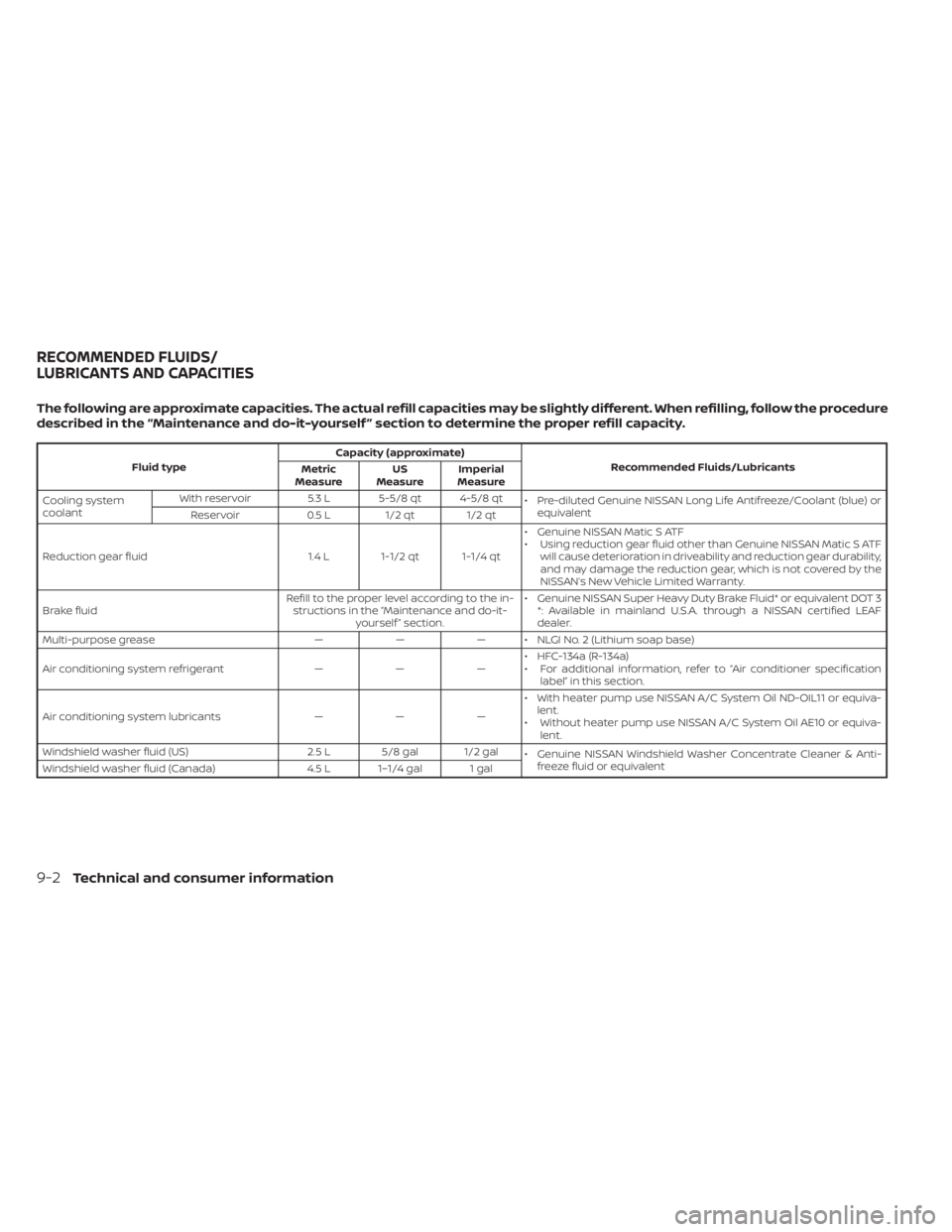
The following are approximate capacities. The actual refill capacities may be slightly different. When refilling, follow the procedure
described in the “Maintenance and do-it-yourself ” section to determine the proper refill capacity.
Fluid typeCapacity (approximate)
Recommended Fluids/Lubricants
Metric
Measure US
Measure Imperial
Measure
Cooling system
coolant With reservoir 5.3 L 5-5/8 qt 4-5/8 qt
• Pre-diluted Genuine NISSAN Long Life Antifreeze/Coolant (blue) or
equivalent
Reservoir 0.5 L 1/2 qt 1/2 qt
Reduction gear fluid 1.4 L 1-1/2 qt 1-1/4 qt • Genuine NISSAN Matic S ATF
• Using reduction gear fluid other than Genuine NISSAN Matic S ATF
will cause deterioration in driveability and reduction gear durability,
and may damage the reduction gear, which is not covered by the
NISSAN’s New Vehicle Limited Warranty.
Brake fluid Refill to the proper level according to the in-
structions in the “Maintenance and do-it- yourself ” section. • Genuine NISSAN Super Heavy Duty Brake Fluid* or equivalent DOT 3
*: Available in mainland U.S.A. through a NISSAN certified LEAF
dealer.
Multi-purpose grease — — — • NLGI No. 2 (Lithium soap base)
Air conditioning system refrigerant — — — • HFC-134a (R-134a)
• For additional information, refer to “Air conditioner specification
label” in this section.
Air conditioning system lubricants — — — • With heater pump use NISSAN A/C System Oil ND-OIL11 or equiva-
lent.
• Without heater pump use NISSAN A/C System Oil AE10 or equiva- lent.
Windshield washer fluid (US) 2.5 L 5/8 gal 1/2 gal • Genuine NISSAN Windshield Washer Concentrate Cleaner & Anti-
freeze fluid or equivalent
Windshield washer fluid (Canada) 4.5 L 1–1/4 gal 1 gal
RECOMMENDED FLUIDS/
LUBRICANTS AND CAPACITIES
9-2Technical and consumer information
Page 562 of 596
AIR CONDITIONING SYSTEM
REFRIGERANT AND LUBRICANT
RECOMMENDATIONS
The air conditioning system in your
NISSAN vehicle must be charged with the
refrigerant, HFC-134a (R-134a), and the
compressor oil, ND-OIL11 (with heater
pump), AE10 (without heater pump) or
the equivalent.
CAUTION
The use of any other refrigerant or oil
will cause severe damage to the air
conditioning system and will require
the replacement of all air conditioner
system components. The refrigerant, HFC-134a (R-134a), in your
NISSAN vehicle will not harm the earth’s
ozone layer. Although this refrigerant does
not affect the earth’s atmosphere, certain
governmental regulations require the re-
covery and recycling of any refrigerant dur-
ing automotive air conditioning system
service. A NISSAN certified LEAF dealer has
the trained technicians and equipment
needed to recover and recycle your air con-
ditioning system refrigerant.
It is recommended that you visit a NISSAN
certified LEAF dealer when servicing your
air conditioning system.
Technical and consumer information9-3
Page 568 of 596
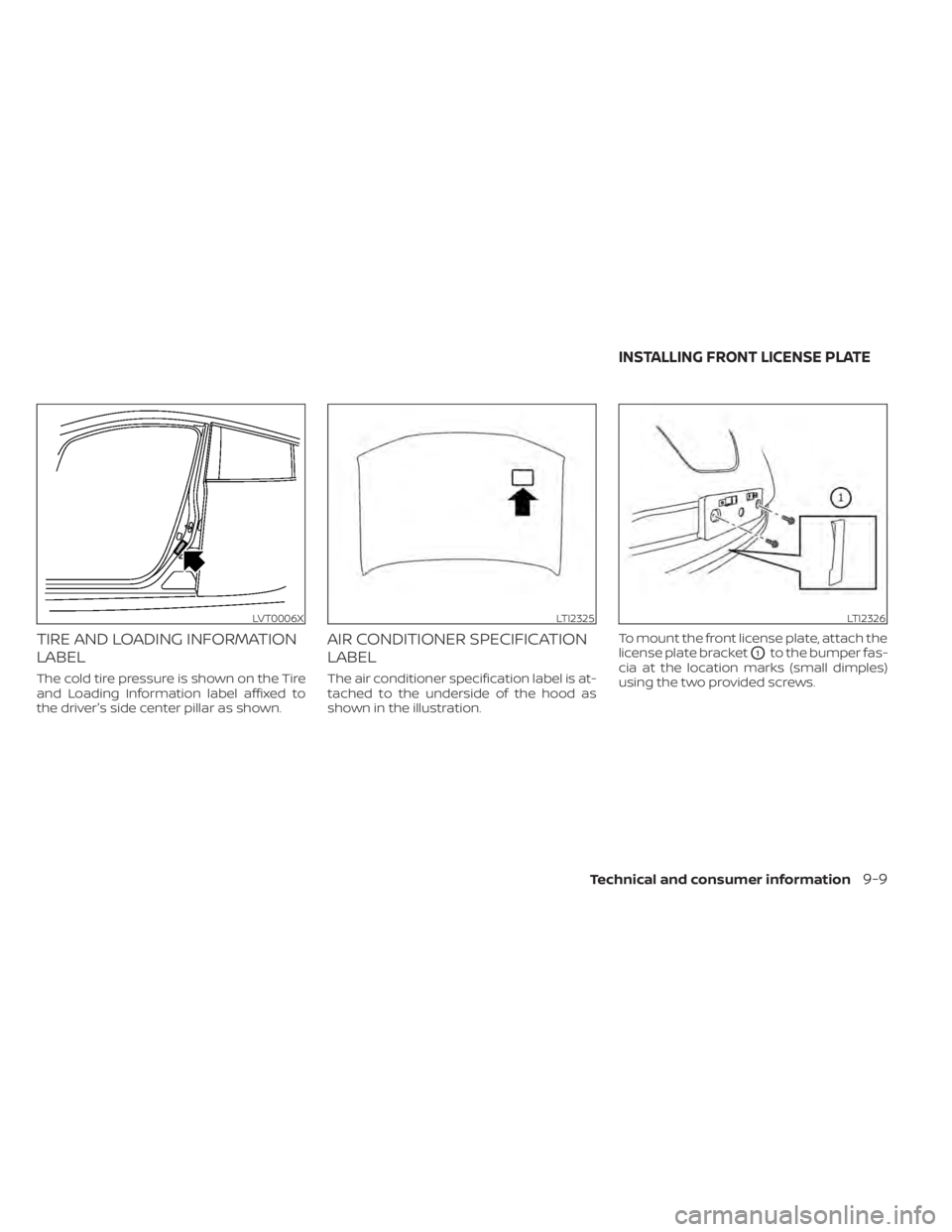
TIRE AND LOADING INFORMATION
LABEL
The cold tire pressure is shown on the Tire
and Loading Information label affixed to
the driver's side center pillar as shown.
AIR CONDITIONER SPECIFICATION
LABEL
The air conditioner specification label is at-
tached to the underside of the hood as
shown in the illustration.To mount the front license plate, attach the
license plate bracket
O1to the bumper fas-
cia at the location marks (small dimples)
using the two provided screws.
LVT0006XLTI2325LTI2326
INSTALLING FRONT LICENSE PLATE
Technical and consumer information9-9
Page 575 of 596
20590. You can also obtain other in-
formation about motor vehicle safety
from http://www.safercar.gov.
You may notif y NISSAN by contact-
ing our Consumer Affairs Depart-
ment, toll-free, at 1-800-NISSAN-1.
For Canada
If you believe that your vehicle has a
defect which could cause a crash or
could cause injury or death, you
should immediately inform Trans-
port Canada in addition to notif ying
NISSAN.
If Transport Canada receives com-
plaints, it may open an investigation,
and if it finds that a safety defect
exists in a group of vehicles, it may
request that NISSAN conduct a recall
campaign. However, Transport
Canada cannot become involved in
individual problems between you,
your dealer, or NISSAN.You may contact Transport Cana-
da's Defect Investigations and Re-
calls Division toll free at 1-800-333-
0510. You may also report safety
defects online at: https://
wwwapps.tc.gc.ca/Saf-Sec-Sur/7/
PCDB-BDPP/fc-cp.aspx?lang=eng
(English speakers) or https://
wwwapps.tc.gc.ca/Saf-Sec-Sur/7/
PCDB-BDPP/fc-cp.aspx?lang=fra
(French speakers)
Additional information concerning
motor vehicle safety may be ob-
tained from Transport Canada's
Road Safety Information Centre at
1-800-333-0371 or online at
www.tc.gc.ca/roadsafety (English
speakers) or www.tc.gc.ca/
securiteroutiere (French speakers).
To notif y NISSAN of any safety con-
cerns please contact our Consumer
Information Centre toll free at 1-800-
387-0122.
In addition to Event Data Recorders (EDRs)
mentioned in this Owner's Manual, this ve-
hicle is equipped with electronic modules
that monitor, control and record data con-
cerning various vehicle systems, including
the motor, batteries, braking and electrical
systems. Other electronic modules record
information concerning driving conditions,
including idling, braking, acceleration, trip
and other related data, information about
your use of the car and its features such as
air conditioner or headlight usage, diag-
nostic trouble codes, vehicle charging, ve-
hicle speed, direction and/or location.
Some of this data is stored by the vehicle
for use during vehicle servicing. Other data
concerning your vehicle's operation and
performance is wirelessly transmitted by
cellular connection through the vehicle on-
board telematics system upon vehicle
start-up or at other intervals to NISSAN.
This data may be used by NISSAN for vari-
ous purposes, including: to provide you
with NissanConnect® EV & Services or
NissanConnect® Services (For additional
information, refer to “NissanConnect®
Manual (for Leaf )”.); troubleshooting; evalu-
ation of your vehicle's quality, functionality
and performance; analysis and research
by NISSAN designed to, among other
things, optimize performance of future
TELEMATICS OVERVIEW (models
with Navigation System)
9-16Technical and consumer information
Page 579 of 596
This vehicle is equipped with an Event Data
Recorder (EDR). The main purpose of an
EDR is to record, in certain crash or near
crash-like situations, such as an air bag
deployment or hitting a road obstacle, data
that will assist in understanding how a ve-
hicle’s systems performed. The EDR is de-
signed to record data related to vehicle dy-
namics and safety systems for a short
period of time, typically 30 seconds or less.
The EDR in this vehicle is designed to re-
cord such data as:
• How various systems in your vehicle wereoperating;
• Whether or not the driver and passenger safety belts were buckled/fastened;
• How far (if at all) the driver was depress- ing the accelerator and/or brake pedal;
and,
• How fast the vehicle was traveling.
• Sounds are not recorded.
These data can help provide a better un-
derstanding of the circumstances in which
crashes and injuries occur.NOTE:
• EDR data are recorded by your vehicle only if a nontrivial crash situation oc-
curs; no data are recorded by the EDR
under normal driving conditions and
no personal data (for example, name,
gender, age and crash location) are re-
corded. However, other parties, such as
law enforcement, could combine the
EDR data with the type of personally
identif ying data routinely acquired
during a crash investigation.
• To read data recorded by an EDR, spe- cial equipment is required and access
to the vehicle or the EDR is needed. In
addition to the vehicle manufacturer
and NISSAN certified LEAF dealer, other
parties, such as law enforcement, that
have the special equipment, can read
the information if they have access to
the vehicle or the EDR. EDR data will
only be accessed with the consent of
the vehicle owner or lessee or as other-
wise required or permitted by law.
ADDITIONAL DATA RECORDING (on
vehicles equipped with optional
ProPILOT Assist)
If your vehicle is equipped with the optional
ProPILOT Assist, it will also be equipped
with supplemental data recording function
intended to assist in understanding how
ProPILOT Assist performs in certain non-
trival crash or near-crash scenarios. Spe-
cifically, supplemental recording is de-
signed to capture the following:
• Driver operational status of the accelera-tor, brakes, steering, etc.
• Detection status of a vehicle ahead and lane markers
• Vehicle information including distance to vehicle ahead and lateral position
• Information on the operation of the Pro- PILOT Assist and other crash avoidance
features
• ProPILOT Assist malfunction diagnosis information
• External images from the multi-sensing front camera (Available only when the
SRS air bag or IEB system is activated)
The ProPILOT Assist does not record con-
versations, sounds or images of the inside
of the vehicle.
EVENT DATA RECORDERS (EDR)
9-20Technical and consumer information