charge NISSAN LEAF 2022 Owner´s Manual
[x] Cancel search | Manufacturer: NISSAN, Model Year: 2022, Model line: LEAF, Model: NISSAN LEAF 2022Pages: 618, PDF Size: 4.3 MB
Page 76 of 618
–Do not use the EVSE if the control
box, plug, the EVSE or charge con-
nector is broken, cracked, open,
corroded or shows any other indi-
cations of damage.
–
Do not use the EVSE if the plug has a loose connection with the outlet or
if the outlet is damaged or rusted.
– Before you connect the EVSE, be
sure to check the rated current
shown on the EVSE to ensure that
the outlet and circuit have enough
current capacity to charge your
vehicle safely. If the capacity of
the outlet and circuit is not
enough, wiring may cause over-
heating or a fire.
– If in any doubt about the outlet
and circuit, consult a qualified
electrician.
– The EVSE has parts that may
spark inside. Do not use it where
gasoline, paint, or flammable liq-
uids are used or stored.
– Do not use if a malfunction occurs
or if the EVSE has been damaged
in any manner. It is recommended
that you visit a NISSAN certified
LEAF dealer for replacement. –
The EVSE contains no user ser-
viceable parts. Do not attempt to
repair the EVSE, doing so will void
your warranty.
• Pass the lower side belt of the EVSE
case securely through the fastener
on the bottom of the luggage board.
If the case suddenly becomes loose,
it may cause serious injury or death.
CAUTION
• Only charge using a standard AC 220
- 240 volt, 50A dedicated electrical
outlet (for example, do not use an
electric generator). Failure to do so
may cause charging to fail and could
cause damage to the vehicle or the
EVSE due to power surges.
• NISSAN recommends using Genuine
NISSAN charging equipment to
charge the vehicle. Using non-
NISSAN equipment could cause the
Li-ion battery to not charge correctly
and may damage the vehicle or the
EVSE.
Precautions on storage
• Do not store the EVSE in a place exposed to direct sunlight.
• Do not store the EVSE in a place exposed to wind or rain.
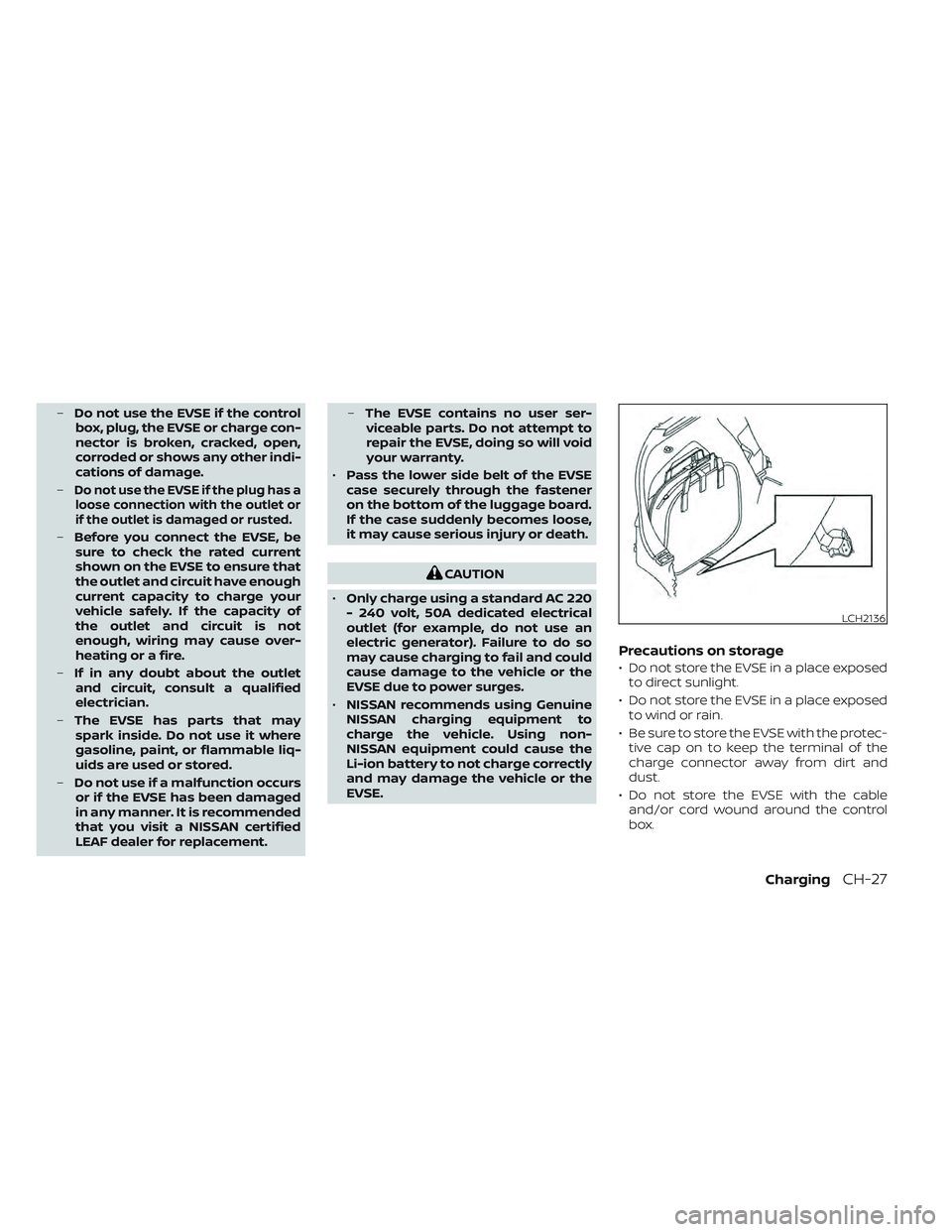
• Be sure to store the EVSE with the protec- tive cap on to keep the terminal of the
charge connector away from dirt and
dust.
• Do not store the EVSE with the cable and/or cord wound around the control
box.
LCH2136
ChargingCH-27
Page 77 of 618
• Do not store the EVSE in a condition inwhich the cable and/or cord are twisted.
• The control box will become hot while the EVSE is charging. This is not a
malfunction.
• Normal charge (AC 220–240 volt) by L1 & L2 EVSE is performed using an AC 220 —
240 volt, 50A dedicated electrical outlet
using the L1 & L2 EVSE provided with the
vehicle.
LHA5095
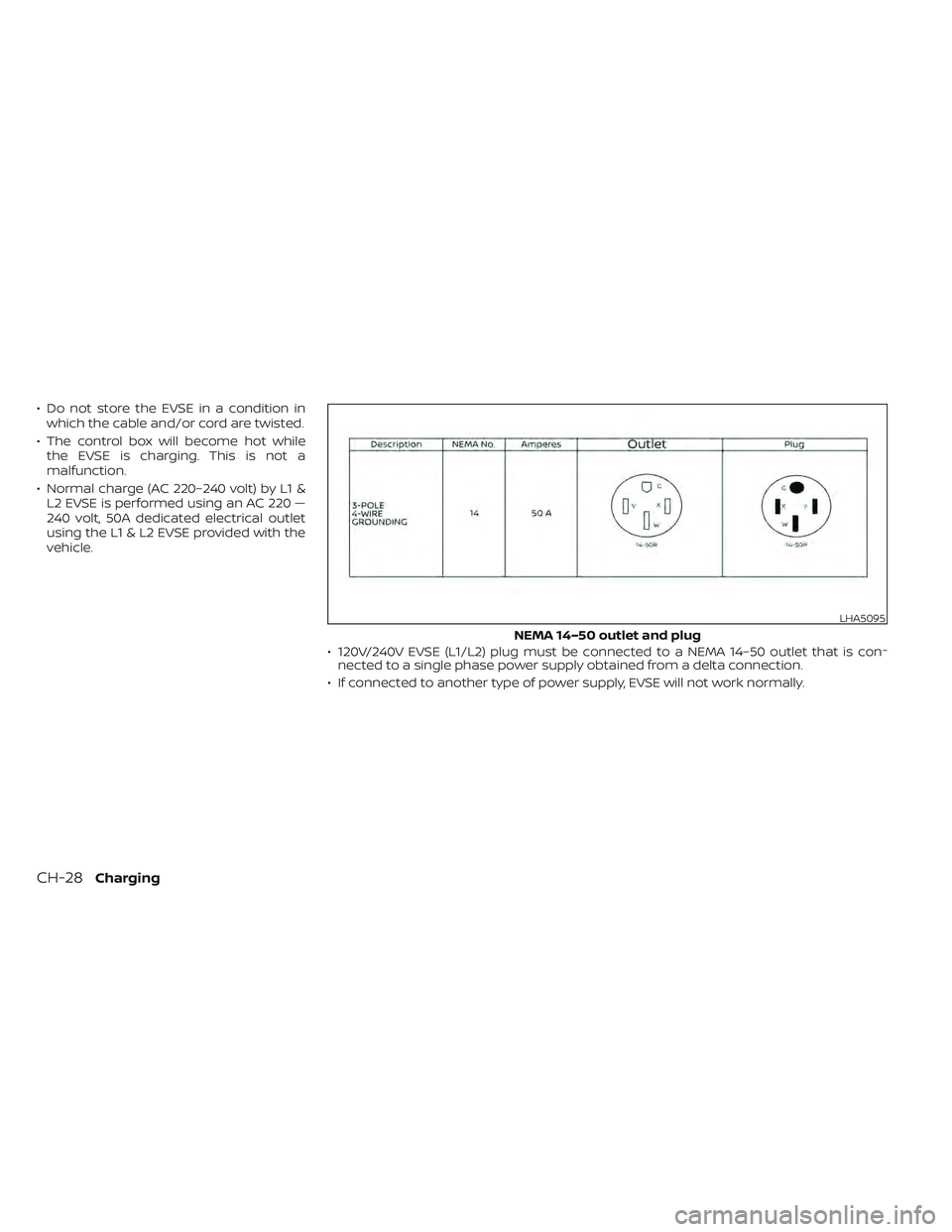
NEMA 14–50 outlet and plug
• 120V/240V EVSE (L1/L2) plug must be connected to a NEMA 14–50 outlet that is con -
nected to a single phase power supply obtained from a delta connection.
• If connected to another type of power supply, EVSE will not work normally.
CH-28Charging
Page 79 of 618
To start normal charging
NOTE:
Charging timer, remote charge (models
with navigation system) and immediate
charge can be performed in the normal
charge mode. For additional informa-
tion, see “Charging methods” (P. CH-43)
1. Push the P (Park) position switch to placethe vehicle in the P (Park) position and
apply the parking brake. 2. When charging the Li-ion battery, place
the power switch in the OFF position.
When the power switch is in the ON po-
sition, the Li-ion battery will not start
charging.
3. Open the charge port lid. For additional information, see “Charge port lid”
(P. 3-20).
LHA5094
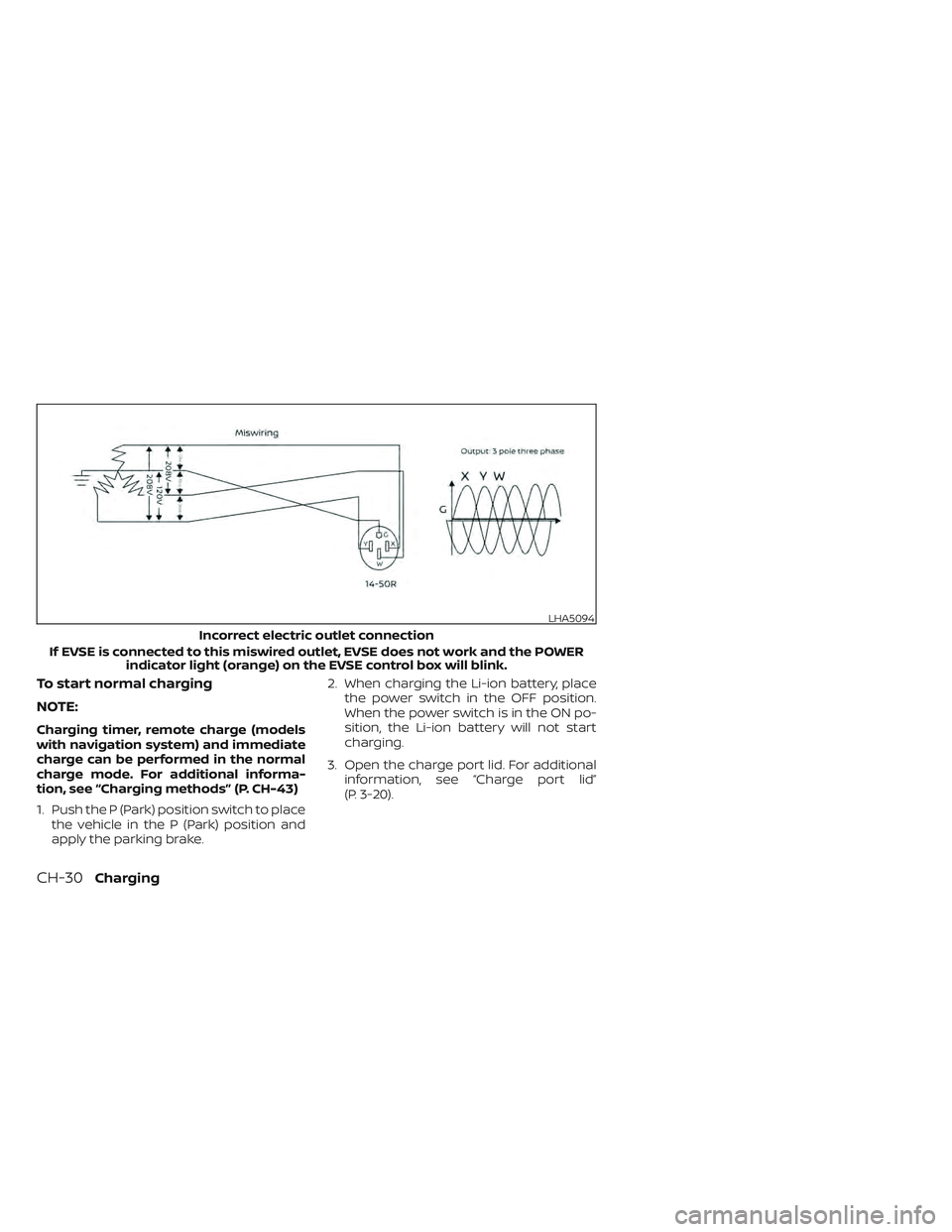
Incorrect electric outlet connection
If EVSE is connected to this miswired outlet, EVSE does not work and the POWER indicator light (orange) on the EVSE control box will blink.
CH-30Charging
Page 80 of 618
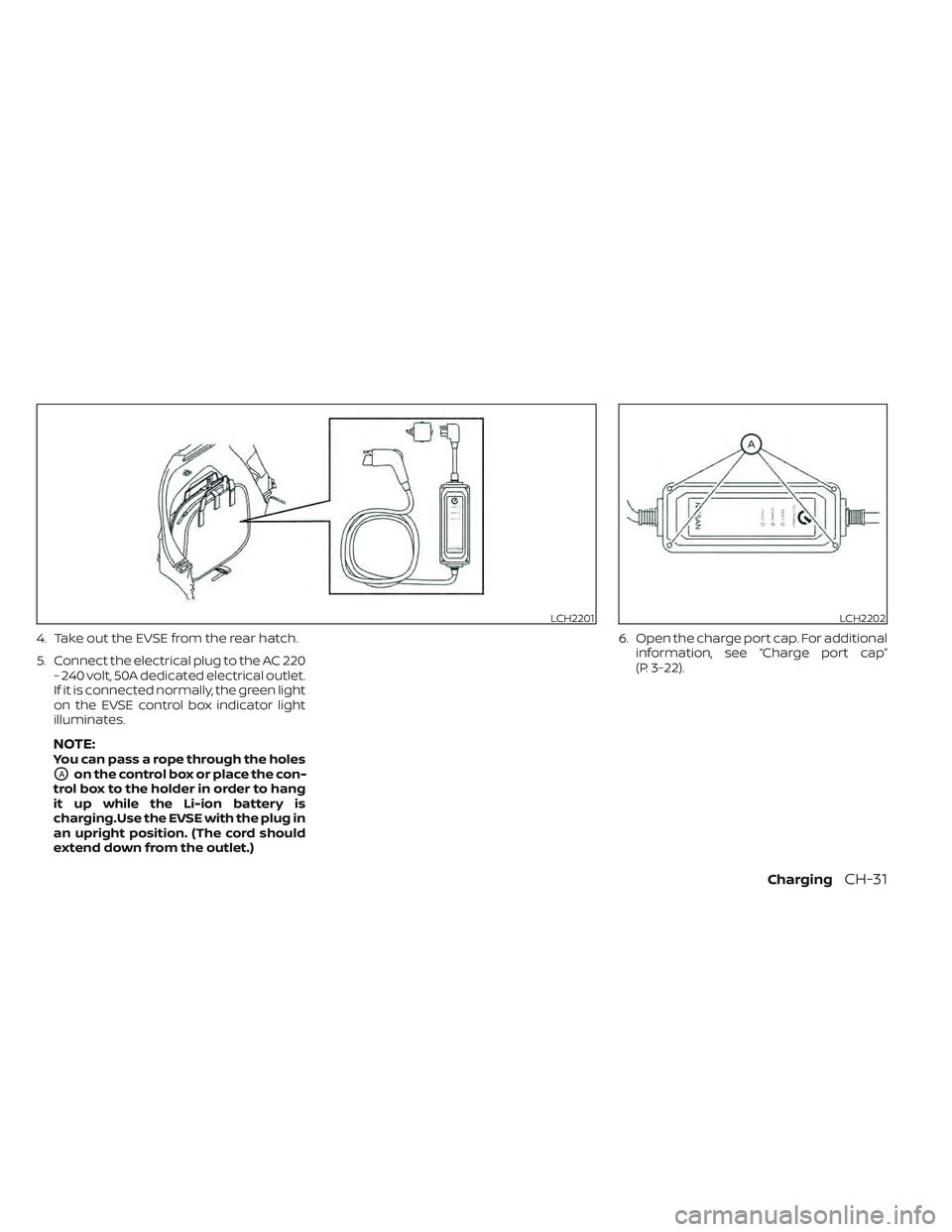
4. Take out the EVSE from the rear hatch.
5. Connect the electrical plug to the AC 220- 240 volt, 50A dedicated electrical outlet.
If it is connected normally, the green light
on the EVSE control box indicator light
illuminates.
NOTE:You can pass a rope through the holes
OAon the control box or place the con-
trol box to the holder in order to hang
it up while the Li-ion battery is
charging.Use the EVSE with the plug in
an upright position. (The cord should
extend down from the outlet.) 6. Open the charge port cap. For additional
information, see “Charge port cap”
(P. 3-22).
LCH2201LCH2202
ChargingCH-31
Page 81 of 618
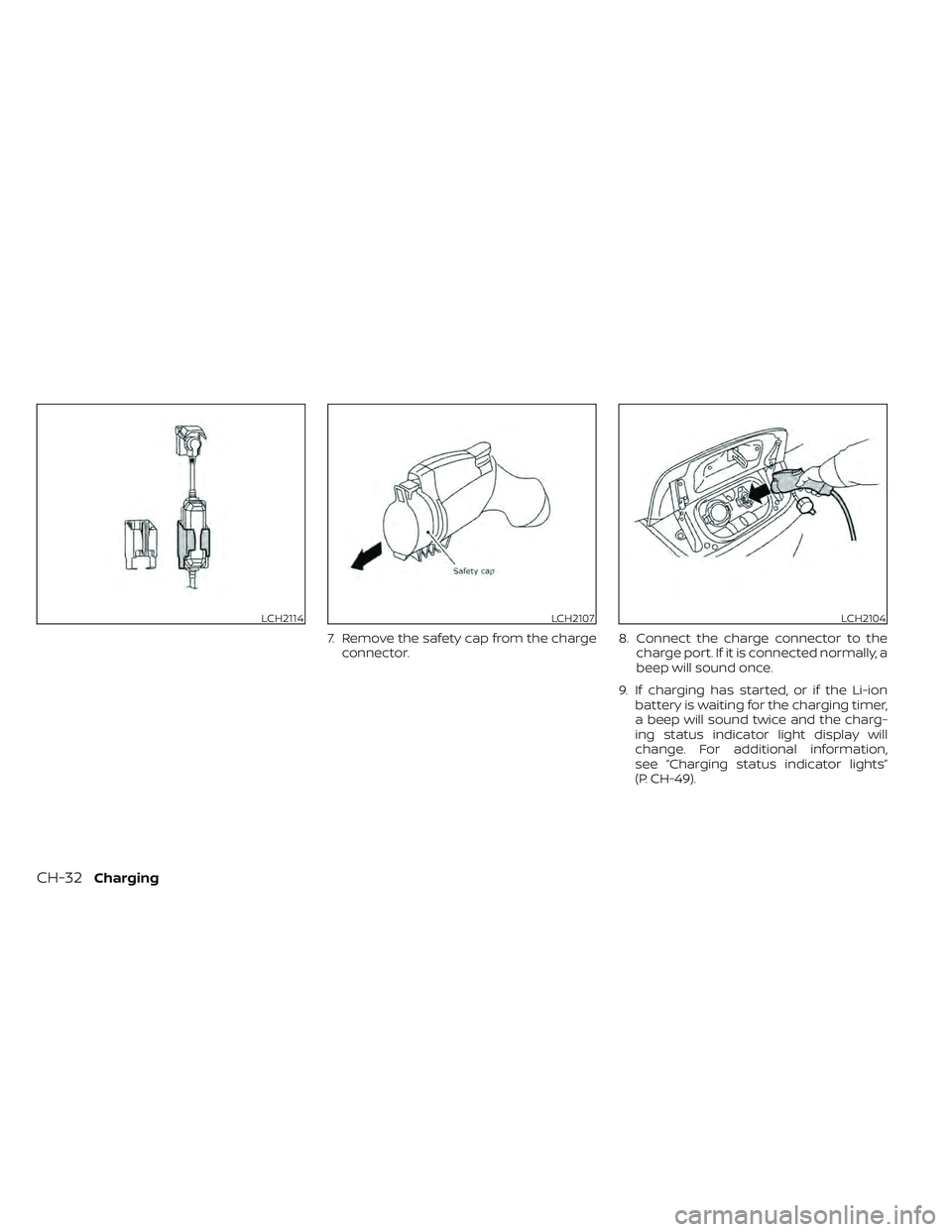
7. Remove the safety cap from the chargeconnector. 8. Connect the charge connector to the
charge port. If it is connected normally, a
beep will sound once.
9. If charging has started, or if the Li-ion battery is waiting for the charging timer,
a beep will sound twice and the charg-
ing status indicator light display will
change. For additional information,
see “Charging status indicator lights”
(P. CH-49).
LCH2114LCH2107LCH2104
CH-32Charging
Page 82 of 618
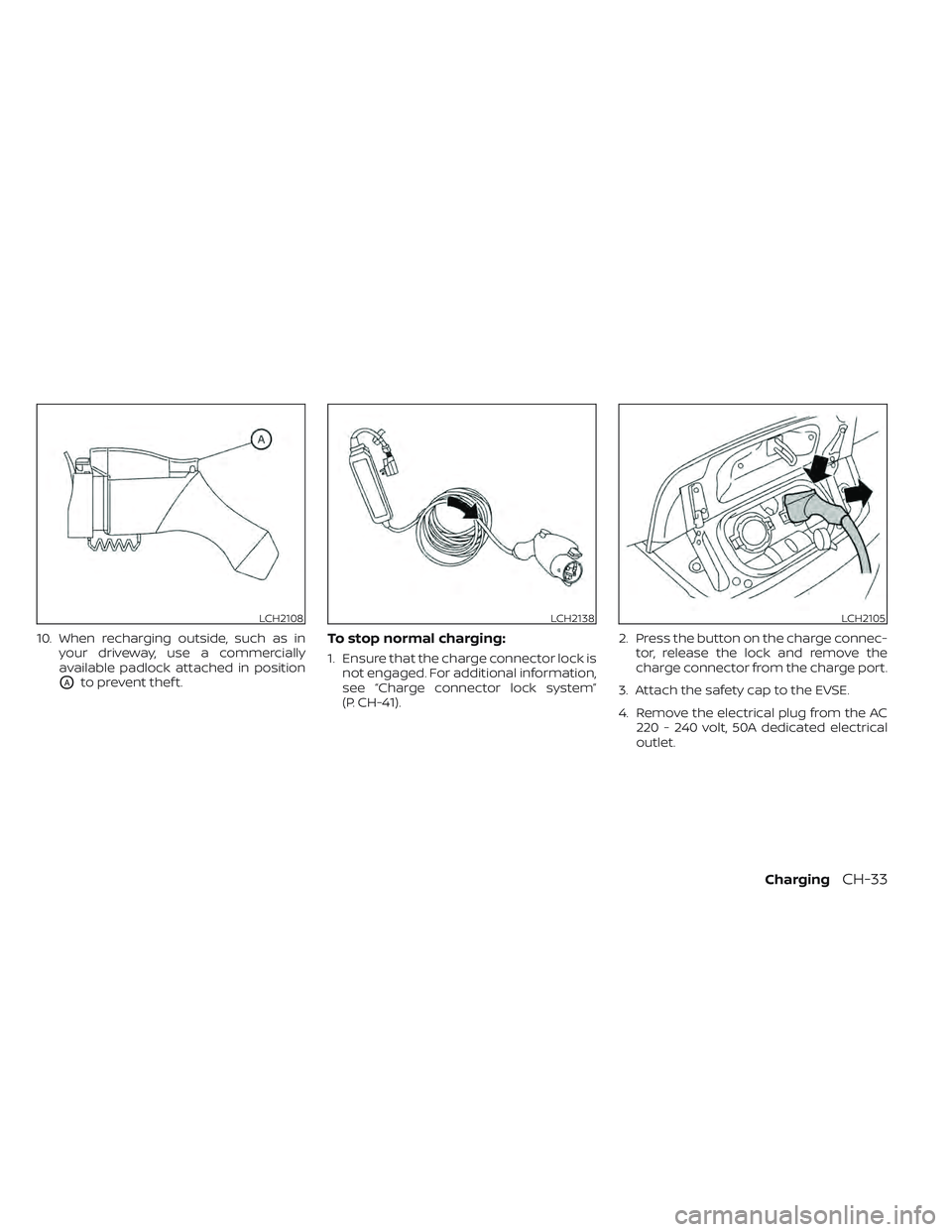
10. When recharging outside, such as inyour driveway, use a commercially
available padlock attached in position
OAto prevent thef t.
To stop normal charging:
1. Ensure that the charge connector lock isnot engaged. For additional information,
see “Charge connector lock system”
(P. CH-41). 2. Press the button on the charge connec-
tor, release the lock and remove the
charge connector from the charge port.
3. Attach the safety cap to the EVSE.
4. Remove the electrical plug from the AC 220 - 240 volt, 50A dedicated electrical
outlet.
LCH2108LCH2138LCH2105
ChargingCH-33
Page 83 of 618
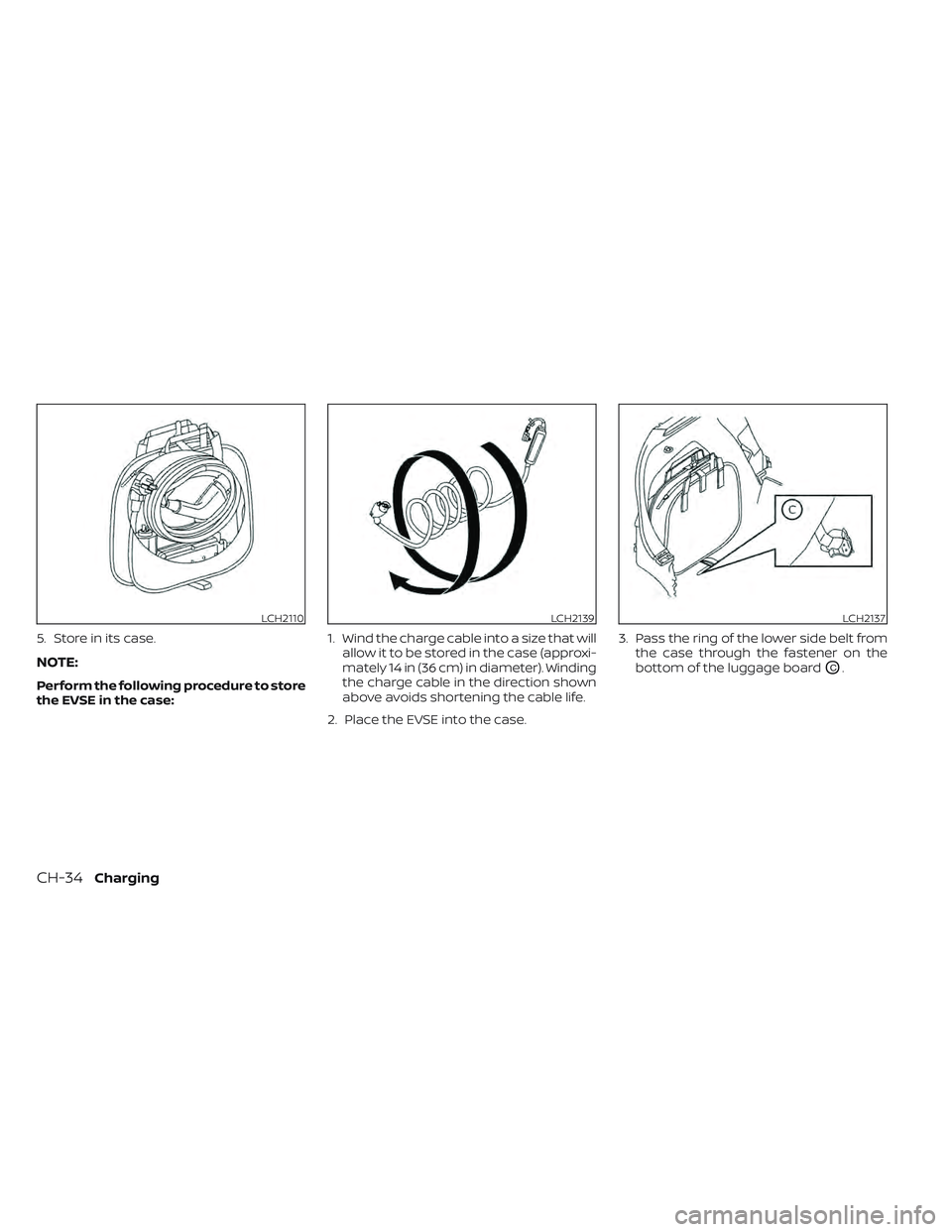
5. Store in its case.
NOTE:
Perform the following procedure to store
the EVSE in the case:1. Wind the charge cable into a size that will
allow it to be stored in the case (approxi-
mately 14 in (36 cm) in diameter). Winding
the charge cable in the direction shown
above avoids shortening the cable life.
2. Place the EVSE into the case. 3. Pass the ring of the lower side belt from
the case through the fastener on the
bottom of the luggage board
OC.
LCH2110LCH2139LCH2137
CH-34Charging
Page 84 of 618
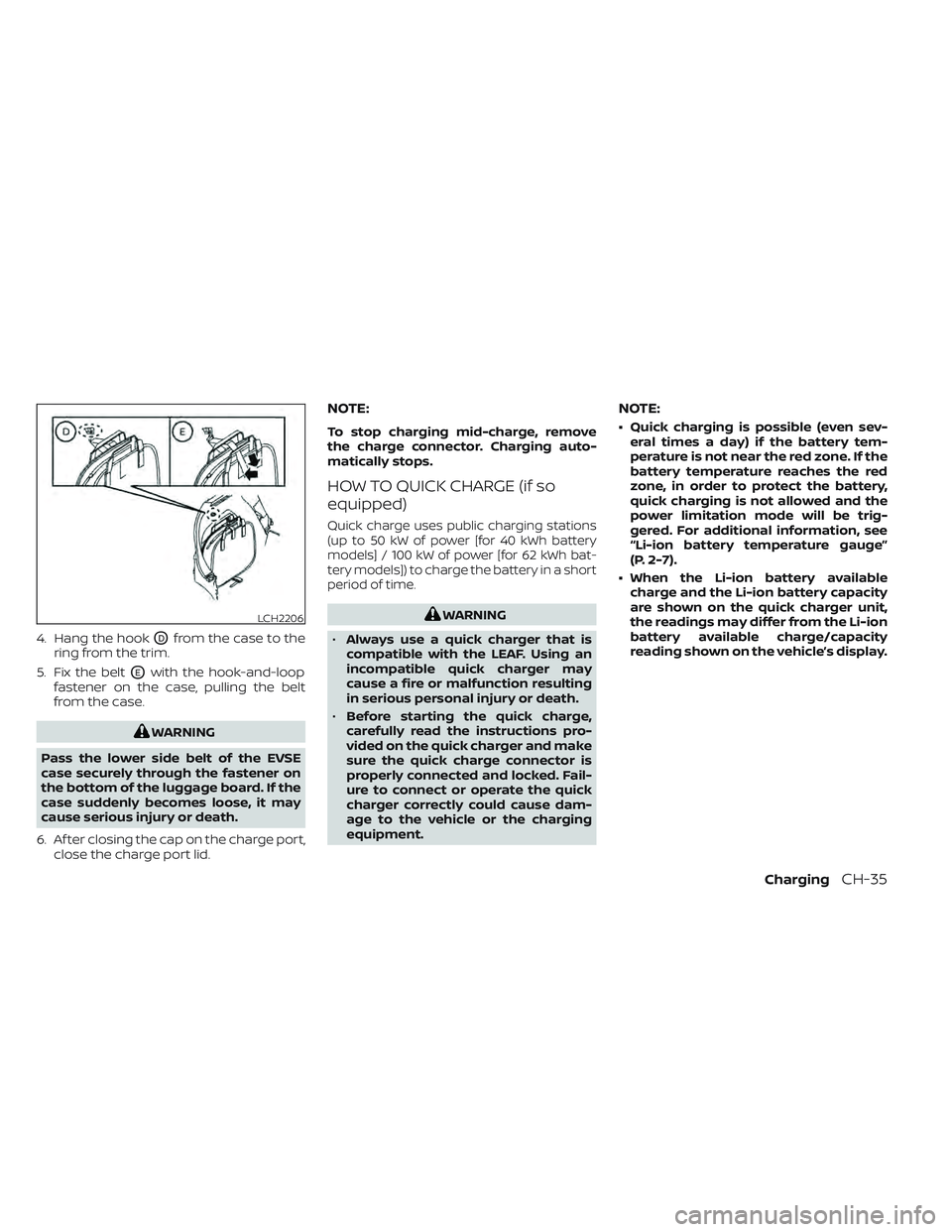
4. Hang the hookODfrom the case to the
ring from the trim.
5. Fix the belt
OEwith the hook-and-loop
fastener on the case, pulling the belt
from the case.
WARNING
Pass the lower side belt of the EVSE
case securely through the fastener on
the bottom of the luggage board. If the
case suddenly becomes loose, it may
cause serious injury or death.
6. Af ter closing the cap on the charge port, close the charge port lid.
NOTE:
To stop charging mid-charge, remove
the charge connector. Charging auto-
matically stops.
HOW TO QUICK CHARGE (if so
equipped)
Quick charge uses public charging stations
(up to 50 kW of power [for 40 kWh battery
models] / 100 kW of power [for 62 kWh bat-
tery models]) to charge the battery in a short
period of time.
WARNING
• Always use a quick charger that is
compatible with the LEAF. Using an
incompatible quick charger may
cause a fire or malfunction resulting
in serious personal injury or death.
• Before starting the quick charge,
carefully read the instructions pro-
vided on the quick charger and make
sure the quick charge connector is
properly connected and locked. Fail-
ure to connect or operate the quick
charger correctly could cause dam-
age to the vehicle or the charging
equipment.
NOTE:
• Quick charging is possible (even sev- eral times a day) if the battery tem-
perature is not near the red zone. If the
battery temperature reaches the red
zone, in order to protect the battery,
quick charging is not allowed and the
power limitation mode will be trig-
gered. For additional information, see
“Li-ion battery temperature gauge”
(P. 2-7).
• When the Li-ion battery available charge and the Li-ion battery capacity
are shown on the quick charger unit,
the readings may differ from the Li-ion
battery available charge/capacity
reading shown on the vehicle’s display.
LCH2206
ChargingCH-35
Page 85 of 618
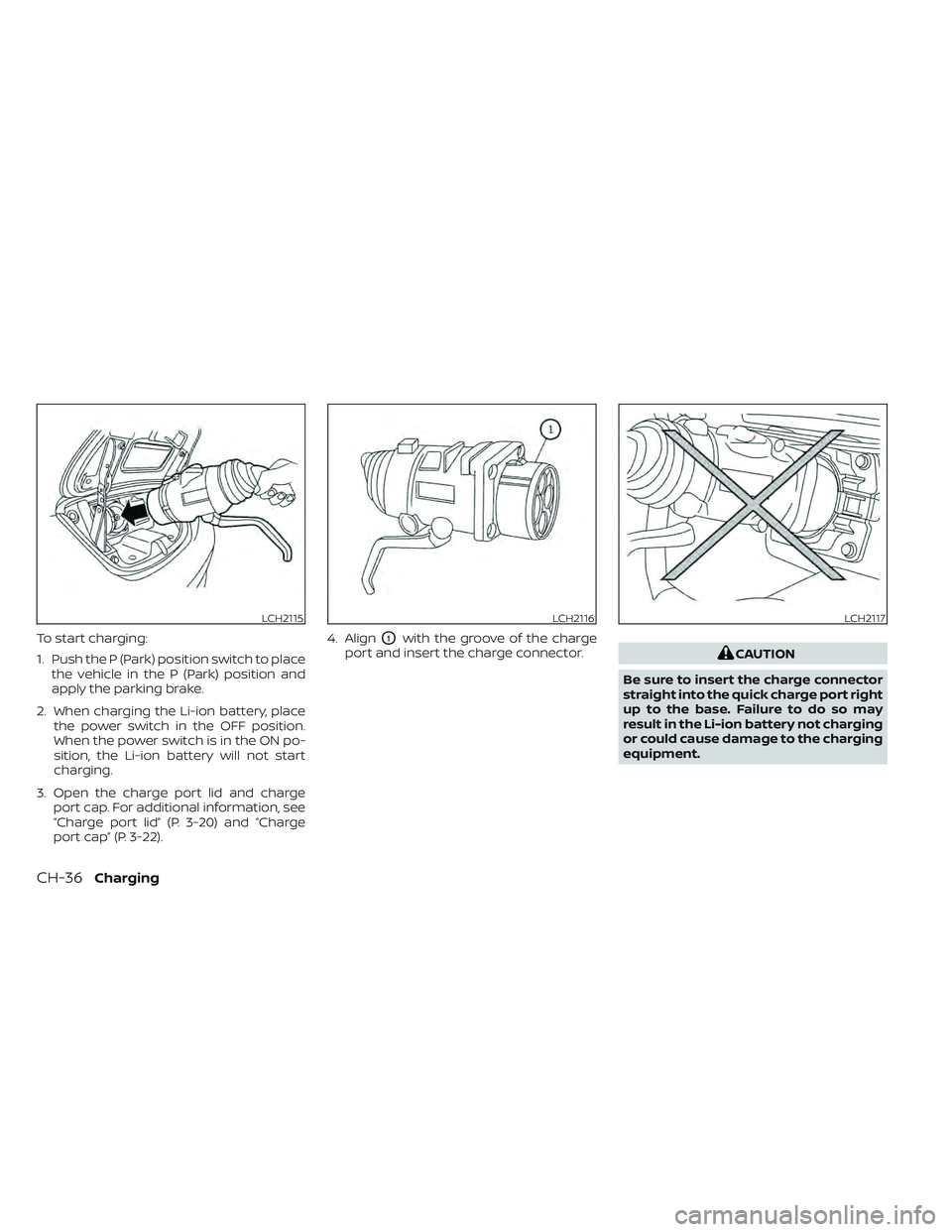
To start charging:
1. Push the P (Park) position switch to placethe vehicle in the P (Park) position and
apply the parking brake.
2. When charging the Li-ion battery, place the power switch in the OFF position.
When the power switch is in the ON po-
sition, the Li-ion battery will not start
charging.
3. Open the charge port lid and charge port cap. For additional information, see
“Charge port lid” (P. 3-20) and “Charge
port cap” (P. 3-22). 4. AlignO1with the groove of the charge
port and insert the charge connector.
CAUTION
Be sure to insert the charge connector
straight into the quick charge port right
up to the base. Failure to do so may
result in the Li-ion battery not charging
or could cause damage to the charging
equipment.
LCH2115LCH2116LCH2117
CH-36Charging
Page 86 of 618
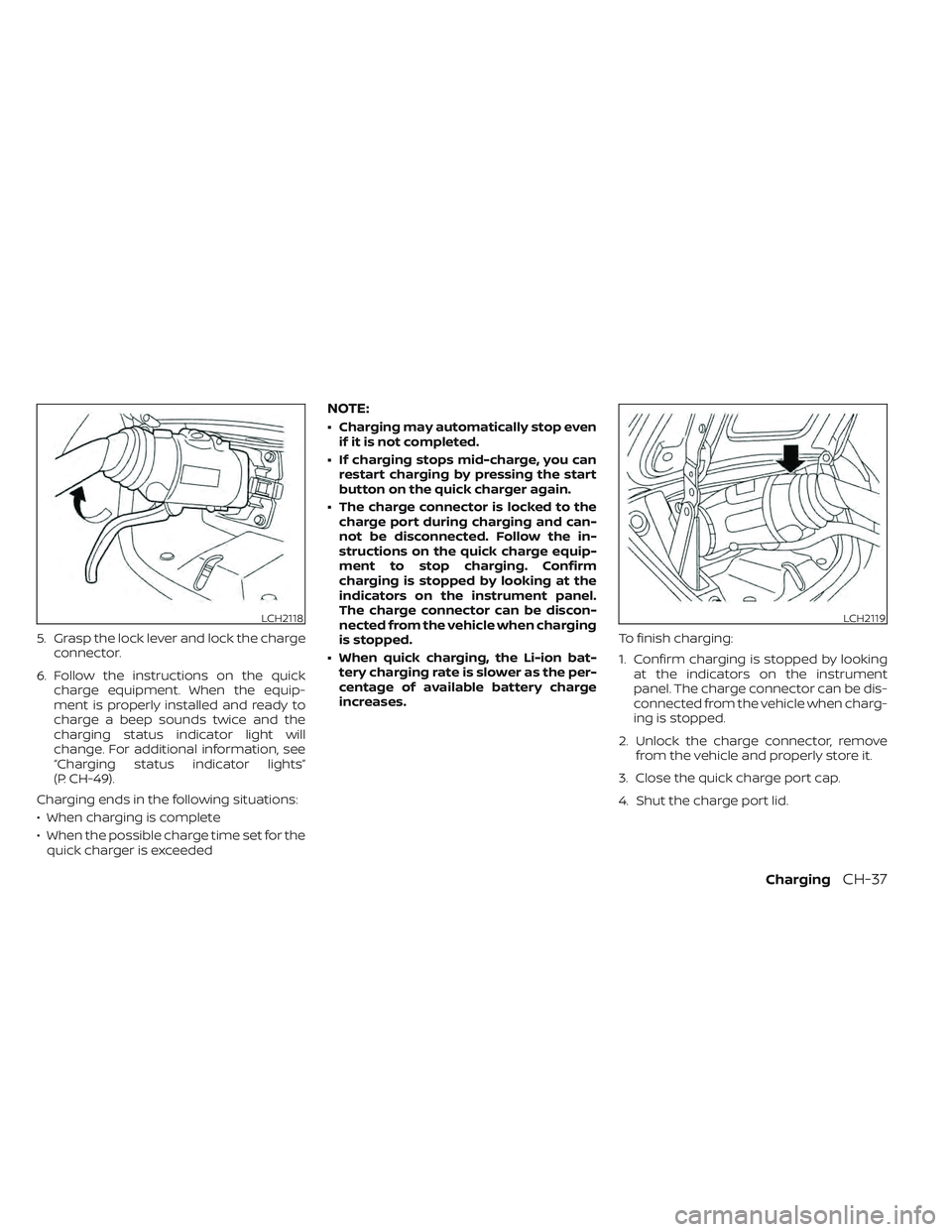
5. Grasp the lock lever and lock the chargeconnector.
6. Follow the instructions on the quick charge equipment. When the equip-
ment is properly installed and ready to
charge a beep sounds twice and the
charging status indicator light will
change. For additional information, see
“Charging status indicator lights”
(P. CH-49).
Charging ends in the following situations:
• When charging is complete
• When the possible charge time set for the quick charger is exceeded
NOTE:
• Charging may automatically stop even if it is not completed.
• If charging stops mid-charge, you can restart charging by pressing the start
button on the quick charger again.
• The charge connector is locked to the charge port during charging and can-
not be disconnected. Follow the in-
structions on the quick charge equip-
ment to stop charging. Confirm
charging is stopped by looking at the
indicators on the instrument panel.
The charge connector can be discon-
nected from the vehicle when charging
is stopped.
• When quick charging, the Li-ion bat- tery charging rate is slower as the per-
centage of available battery charge
increases. To finish charging:
1. Confirm charging is stopped by looking
at the indicators on the instrument
panel. The charge connector can be dis-
connected from the vehicle when charg-
ing is stopped.
2. Unlock the charge connector, remove from the vehicle and properly store it.
3. Close the quick charge port cap.
4. Shut the charge port lid.
LCH2118LCH2119
ChargingCH-37