ECU NISSAN MAXIMA 1996 A32 / 4.G Owners Manual
[x] Cancel search | Manufacturer: NISSAN, Model Year: 1996, Model line: MAXIMA, Model: NISSAN MAXIMA 1996 A32 / 4.GPages: 197, PDF Size: 1.53 MB
Page 12 of 197

Do not continue driving if the belt is
loose, broken or missing.
Door open warning light
This light comes on when any of the doors are
not closed securely while the ignition key is
ªONº.
Seat belt warning light and
buzzer
The light and buzzer remind you to fasten seat
belts. The light illuminates whenever the igni-
tion key is turned to ªONº, and will remain
illuminated until the driver's seat belt is fas-
tened. At the same time, the buzzer will sound
for about six seconds unless the driver's seat
belt is securely fastened.
Refer to ªSeat beltsº in the ªPre-driving checks
and adjustmentsº section for precautions on
seat belt usage.
Air bag warning light
When the ignition key is in the ªONº or
ªSTARTº position, the air bag light will illumi-
nate for about 7 seconds and then turn off.This means the system is operational.
If any of the following conditions occur, the air
bag needs servicing and your vehicle must be
taken to your nearest authorized NISSAN
dealer.
1. The air bag light does not come on for 7
seconds and then go off as described
above.
2. The air bag light flashes intermittently or
remains on.
3. The air bag light does not come on at all.
Unless checked and repaired, the Supplemen-
tal Restraint System may not function properly.
For additional details on the Air Bag System,
see Section 2.
Low washer fluid warning
light
This light comes on when the washer tank fluid
is at a low level. Add washer fluid as neces-
sary. See the ªDo-it-yourself operationsº sec-
tion.
orBrake warning light
This light functions for both the parking brake
and the foot brake systems.Parking brake indicator
The light comes on when the parking brake is
applied.
Low brake fluid warning
The light warns of a low brake fluid level. If the
light comes on while the engine is running with
the parking brake not applied, stop the vehicle
and perform the following:
1. Check the brake fluid level. Add brake fluid
as necessary. See ªBrake and clutch fluidº
in the ªDo-it-yourself operationsº section.
If the level is below the MINIMUM mark
on the brake fluid reservoir, do not drive
until the brake system has been
checked at a NISSAN dealer.
2. If the brake fluid level is correct:
Have the warning system checked by a
NISSAN dealer.
IEven if you judge it to be safe, have
your vehicle towed because driving it
1-7
Z01.2.1/A32-DX
Page 14 of 197

Malfunction indicator light
(MIL)
If the MIL comes on or blinks while the
engine is running, it may indicate a poten-
tial emission control problem.
IContinued operation without having
the emission control system checked
and repaired as necessary could lead
to poor driveability, reduced fuel
economy, and possible damage to
the emission control system which
may affect your warranty coverage.
IAlthough the vehicle is still driveable,
see your nearest NISSAN dealer as
soon as possible. To avoid system
damage, do not drive at speeds
above 45 MPH (72 km/h). If possible,
avoid hard acceleration or
deceleration.
If the fuel filler cap is not tightened prop-
erly, the MIL may come on. Check and
securely tighten the fuel filler cap, and have
your vehicle checked as noted above.
The theft warning system provides visual and
audio alarm signals if parts of the vehicle are
disturbed.
How to activate the theft warning
system
1. Remove the key from the ignition switch.
2. Close all windows. Close and lock all doors,
hood and trunk lid. The doors can be locked
either with or without the key.
The system can be activated even if the
windows are open.
IC0005
THEFT WARNING
1-9
Z01.2.1/A32-DX
Page 36 of 197

BATTERY REPLACEMENT
Replace the battery as follows:
1. Open the lid using a suitable tool.
2. Replace the battery with a new one.Recommended battery: Sanyo CR2025 or
equivalent
3. Close the lid securely.
4. Push the remote controller button two or
three times to check its operation.
If the battery is removed for any reason
other than replacement, perform step 4
above.
IAn improperly disposed battery can
harm the environment. Always confirm
local regulations for battery disposal.
IThe remote controller is water-proof;
however, if it does get wet, immediately
wipe completely dry.
IWhen changing batteries, do not let dust
or oil get on the controller.
FCC Notice:
This device complies with FCC rules part
15. Operation is subject to the following
two conditions: (1) This device may not
cause harmful interference and (2) this de-
vice must accept any interference that may
be received, including interference that
may cause undesired operation.
This device has been tested and complies
with FCC and DOC/MDC rules. Changes ormodifications not expressly approved by
the party responsible for compliance could
void the user's authority to operate the
device.
SPA0090
2-7
Z01.2.1/A32-DX
Page 38 of 197
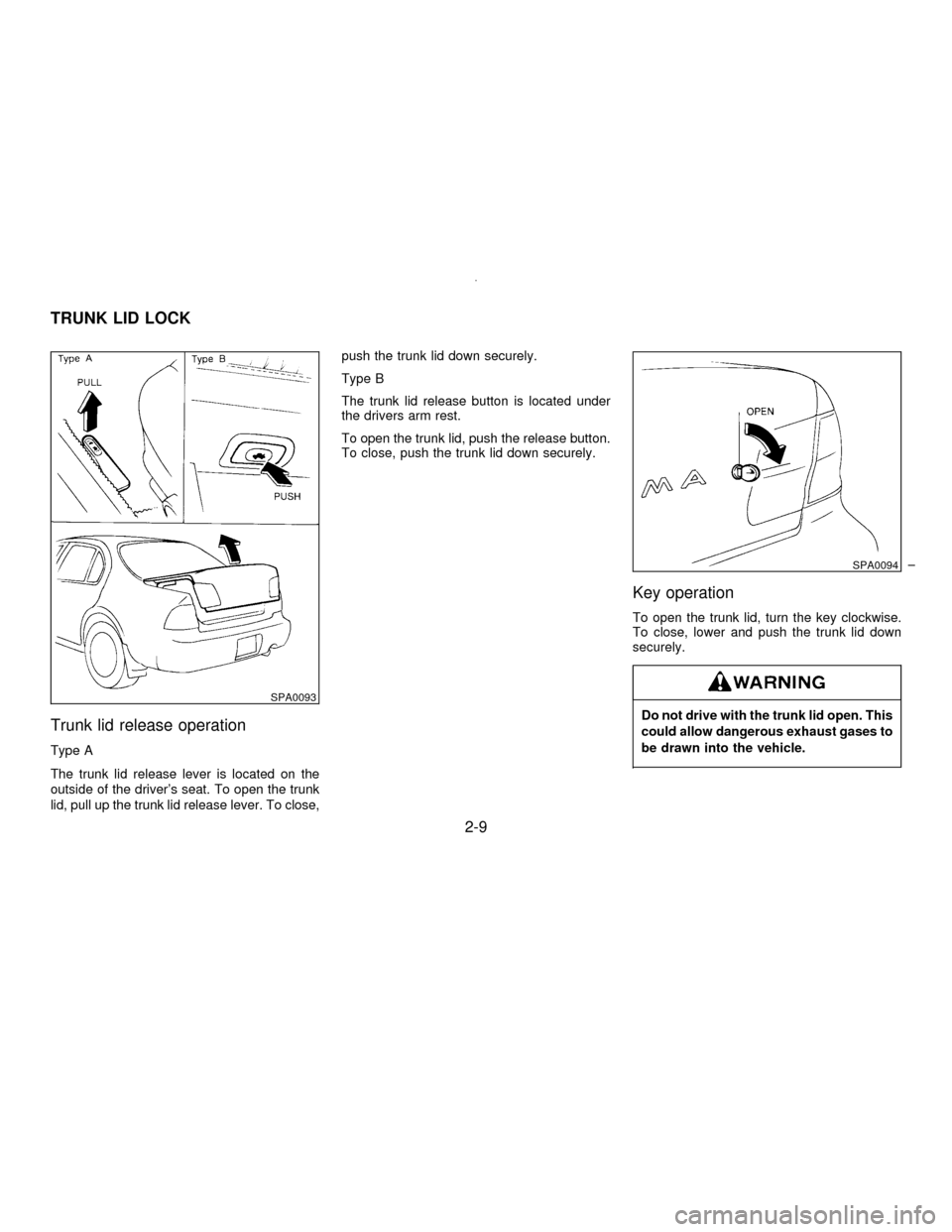
Trunk lid release operation
Type A
The trunk lid release lever is located on the
outside of the driver's seat. To open the trunk
lid, pull up the trunk lid release lever. To close,push the trunk lid down securely.
Type B
The trunk lid release button is located under
the drivers arm rest.
To open the trunk lid, push the release button.
To close, push the trunk lid down securely.
Key operation
To open the trunk lid, turn the key clockwise.
To close, lower and push the trunk lid down
securely.
Do not drive with the trunk lid open. This
could allow dangerous exhaust gases to
be drawn into the vehicle.
SPA0093
SPA0094
TRUNK LID LOCK
2-9
Z01.2.1/A32-DX
Page 39 of 197
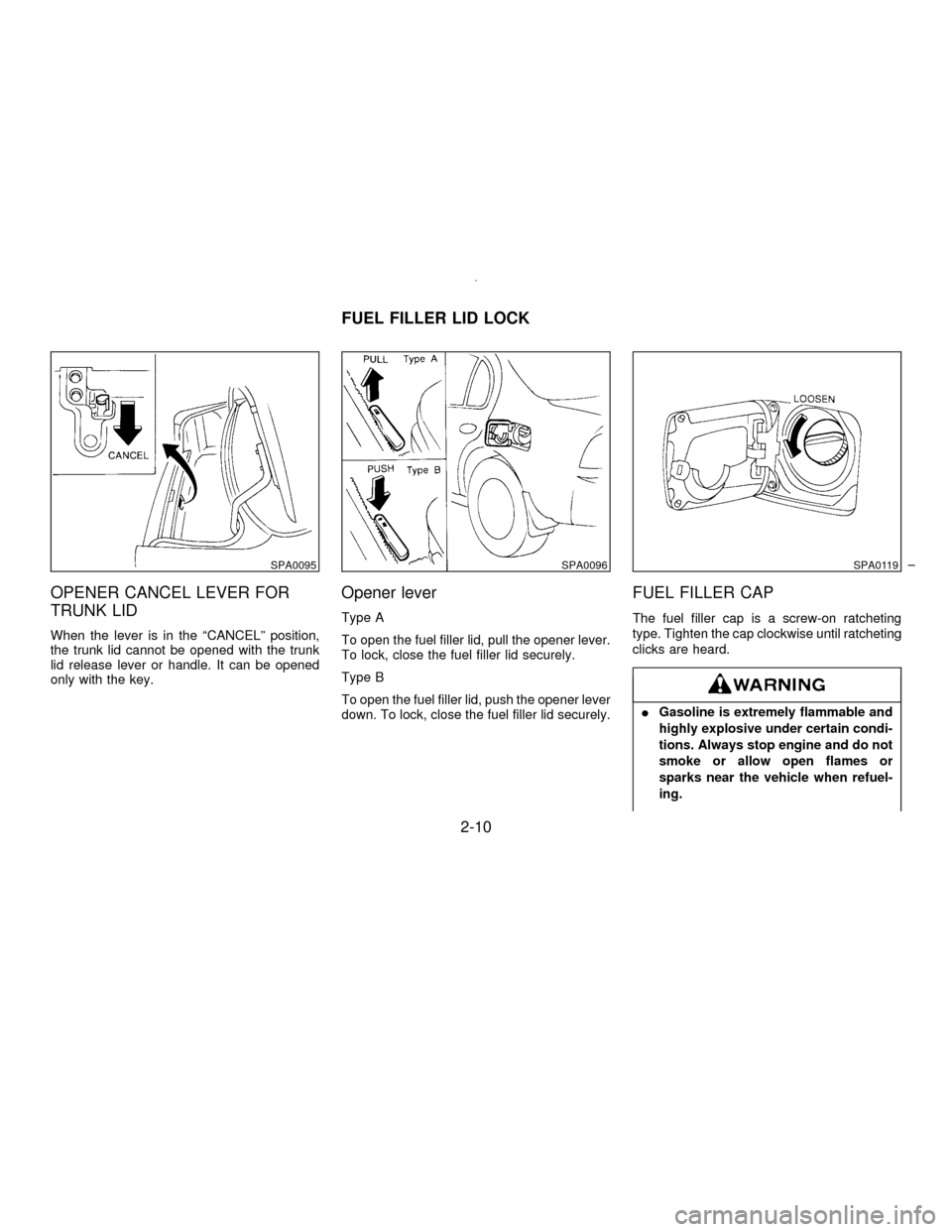
OPENER CANCEL LEVER FOR
TRUNK LID
When the lever is in the ªCANCELº position,
the trunk lid cannot be opened with the trunk
lid release lever or handle. It can be opened
only with the key.
Opener lever
Type A
To open the fuel filler lid, pull the opener lever.
To lock, close the fuel filler lid securely.
Type B
To open the fuel filler lid, push the opener lever
down. To lock, close the fuel filler lid securely.
FUEL FILLER CAP
The fuel filler cap is a screw-on ratcheting
type. Tighten the cap clockwise until ratcheting
clicks are heard.
IGasoline is extremely flammable and
highly explosive under certain condi-
tions. Always stop engine and do not
smoke or allow open flames or
sparks near the vehicle when refuel-
ing.
SPA0095SPA0096SPA0119
FUEL FILLER LID LOCK
2-10
Z01.2.1/A32-DX
Page 41 of 197

SEAT ADJUSTMENT
IDo not adjust the driver's seat while
driving. The seat may move suddenly
and could cause loss of control of the
vehicle.
IAfter adjustment, gently rock in the
seat to make sure it is securely
locked.
IThe seatback should not be reclinedany more than needed for comfort.
Seat belts are most effective when
the passenger sits well back and
straight up in the seat. If the seat is
reclined, the risk of sliding under the
lap belt and being injured is
increased.
Forward and backward
Pull the lever up while you slide the seat
forward or backward to the desired position.
Release the lever to lock the seat in position.
Reclining
Pull the lever up and lean back until the
desired angle is obtained. To bring the seat
back forward again, pull the lever and move
your body forward. The seat back will move
forward.
SPA0097
SEATS
2-12
Z01.2.1/A32-DX
Page 52 of 197

PRECAUTIONS ON SEAT BELT
USAGE
Your chances of being injured or killed in an
accident and/or the severity of injury may be
greatly reduced if you are wearing your seat
belt and it is properly adjusted. NISSAN
strongly encourages you and all of your pas-
sengers to buckle up every time you drive,
even if your seating position includes an air
bag.
Some states, provinces or territories re-
quire that seat belts be worn at all times
when a vehicle is being driven.
IEvery person who drives or rides in
this vehicle should use a seat belt at
all times. Children should be in ap-
propriate child restraints.
IThe belt should be adjusted properly
and to a snug fit. Failure to do so will
reduce the effectiveness of the entire
restraint system and increase the
chance or severity of injury in an
accident.
IDo not wear the belt inside out ortwisted. Be sure the seat belt tongue
is securely fastened to the proper
buckle.
IDo not allow more than one person to
use the same belt.
IAll seat belt assemblies including re-
tractors and attaching hardware
should be inspected by your NISSAN
dealer after any collision. NISSAN
recommends that all seat belt assem-
blies in use during a collision be
replaced unless the collision was mi-
nor and the belts show no damage
and continue to operate properly.
Seat belt assemblies not in use dur-
ing a collision should also be in-
spected and replaced if either dam-
age or improper operation is noted.
INever carry more people in the ve-
hicle than there are seat belts.
If the seat belt warning lamp glows con-
tinuously while the ignition is turned
ªONº with all doors closed and all seat
belts fastened, it may indicate a mal-
function in the system. Have the system
checked by your NISSAN dealer.Be sure to observe the following cau-
tions when using seat belts. Failure to
do so could increase the chance and/or
severity of injury in an accident.
IAlways route the shoulder belt over
your shoulder and across your chest.
Never run the belt under your arm or
across your neck. The belt should be
away from your face and neck, but
not falling off your shoulder.
IPosition the lap belt as low as pos-
sible AROUND THE HIPS, NOT THE
WAIST.
ISerious injury or death can occur if
the seat belt is not worn properly.
CHILD SAFETY
Children need adults to help protect them.
All U.S. states and provinces of Canada re-
quire the use of approved child restraints for
infants and small children. (See ªChild re-
straints for infants and small childrenº later in
this section.)
In addition, there are many types of child
restraints available for larger children which
should be used for maximum protection.
SEAT BELTS
2-23
Z01.2.1/A32-DX
Page 56 of 197
After adjustment, release the button and
move it up and down to make sure the
shoulder belt anchor is securely fixed in
position.
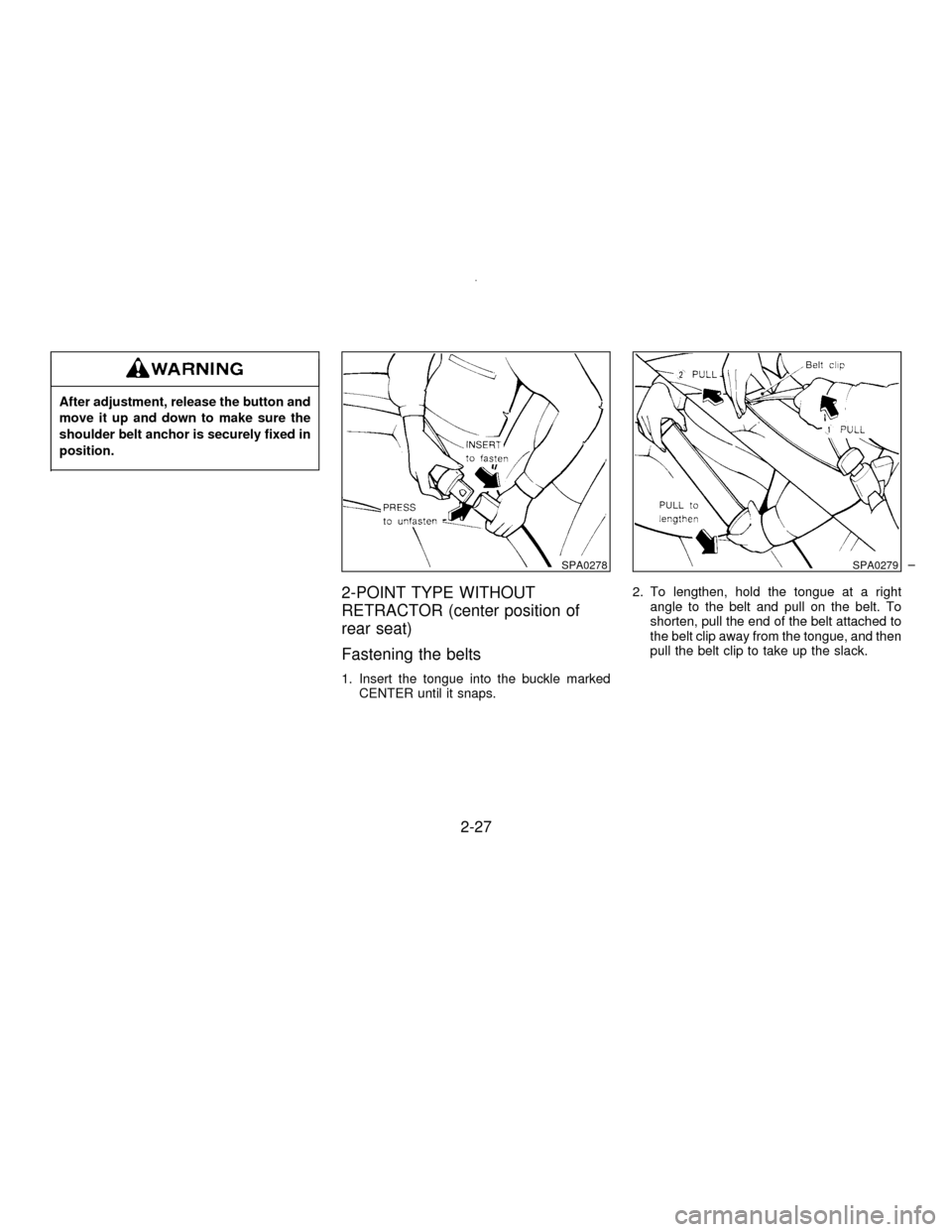
2-POINT TYPE WITHOUT
RETRACTOR (center position of
rear seat)
Fastening the belts
1. Insert the tongue into the buckle marked
CENTER until it snaps.2. To lengthen, hold the tongue at a right
angle to the belt and pull on the belt. To
shorten, pull the end of the belt attached to
the belt clip away from the tongue, and then
pull the belt clip to take up the slack.
SPA0278SPA0279
2-27
Z01.2.1/A32-DX
Page 59 of 197

not be possible to properly install
some types of child restraints in your
vehicle.
Improper use of a child restraint can
result in increased injuries for both
the infant or child and other occu-
pants in the vehicle.
IWhen your child restraint is not in
use, store it in the trunk or keep it
secured with a seat belt to prevent it
from being thrown forward in case of
a sudden stop or accident.
IAfter attaching a child restraint, test
the restraint before you place the
child in it. Tilt it from side to side. Try
to tug it forward and check to see if
the belt holds it in place. If the re-
straint is not secure, tighten the belt
as necessary, or put the restraint in
another seat and test it again.
IIf the child restraint is not anchored
properly, the risk of a child being
injured in a collision or a sudden stop
greatly increases.
IAdjustable seatbacks should be posi-
tioned to fit the child restraint, but asupright as possible.
IRemember that a child restraint left in
a closed vehicle can become very
hot. Check the seating surface and
buckles before placing your child in
the child restraint.
IAll U.S. states and provinces of
Canada require that infants and small
children be restrained in approved
child restraints at all times while the
vehicle is being operated.
IFor a front facing child restraint, if the
seat position where it is installed has
a 3-point type lap/shoulder belt,
check to make sure the shoulder belt
does not go in front of the child's face
or neck. If it does, put the shoulder
belt behind the child restraint.
Installation on rear seat
Center lap belt
Secure the child restraint with the lap belt as
illustrated. Remove all slack in the lap belt for
a very tight fit by pulling forcefully on the lap
belt adjustment.
After attaching the child restraint, test it before
you place the child in it. Tilt the restraint from
side to side. If it is not secure, try to tighten the
belt again, or put the restraint in another seat.
SPA0276
2-30
Z01.2.1/A32-DX
Page 60 of 197
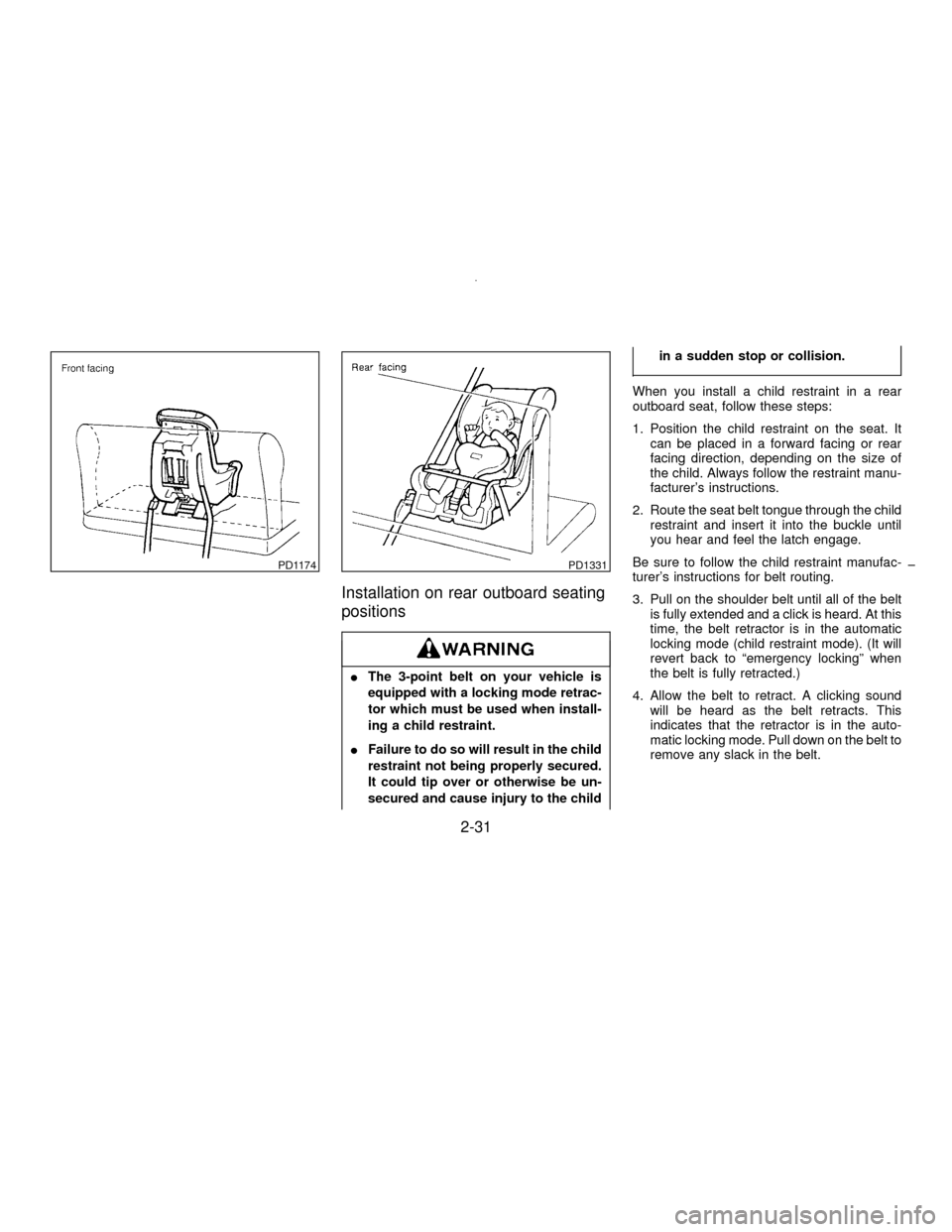
Installation on rear outboard seating
positions
IThe 3-point belt on your vehicle is
equipped with a locking mode retrac-
tor which must be used when install-
ing a child restraint.
IFailure to do so will result in the child
restraint not being properly secured.
It could tip over or otherwise be un-
secured and cause injury to the childin a sudden stop or collision.
When you install a child restraint in a rear
outboard seat, follow these steps:
1. Position the child restraint on the seat. It
can be placed in a forward facing or rear
facing direction, depending on the size of
the child. Always follow the restraint manu-
facturer's instructions.
2. Route the seat belt tongue through the child
restraint and insert it into the buckle until
you hear and feel the latch engage.
Be sure to follow the child restraint manufac-
turer's instructions for belt routing.
3. Pull on the shoulder belt until all of the belt
is fully extended and a click is heard. At this
time, the belt retractor is in the automatic
locking mode (child restraint mode). (It will
revert back to ªemergency lockingº when
the belt is fully retracted.)
4. Allow the belt to retract. A clicking sound
will be heard as the belt retracts. This
indicates that the retractor is in the auto-
matic locking mode. Pull down on the belt to
remove any slack in the belt.
PD1174PD1331
2-31
Z01.2.1/A32-DX