Cruise control NISSAN MAXIMA 1999 A32 / 4.G Owners Manual
[x] Cancel search | Manufacturer: NISSAN, Model Year: 1999, Model line: MAXIMA, Model: NISSAN MAXIMA 1999 A32 / 4.GPages: 233, PDF Size: 1.96 MB
Page 45 of 233

Windshield wiper/washer switch (P.2-15)
Instrument brightness control switch (P.2-17)
Meters/gauges (P.2-3)
Theft warning light (P.2-12) (if so equipped)
Cruise control main switch (P.5-14)
Headlight, fog light (if so equipped) and
turn signal switch (P.2-17)
Hood release handle (P.3-8)
Outside mirror remote control (P.3-13)
Fuse box cover (P.8-23)
Tilting steering wheel lock lever (P.3-12)
Driver supplemental air bag (P.1-6)
Ignition switch/steering lock (P.5-4)
Cruise control set switch (P.5-14)
Cigarette lighter (accessory) (P.2-21)Hazard warning flasher switch (P.2-19)
Ventilator (P.4-2)
Heater/air conditioner control (P.4-3)
Clock (P.2-27)
Radio/cassette player (P.4-13)/CD player (P.4-19)
Rear window and outside mirror (if so equipped) defogger switch (P.2-16)
Passenger supplemental air bag (P.1-6)
Glove box (P.2-24)
Ashtray (P.2-21)
Heated seat switch (P.2-20) (if so equipped)
SIC1064
See the page indicated in parentheses for operating details.
Traction control system (TCS) cancel switch (if so equipped) (P.2-21)
INSTRUMENT PANEL2-2
Instruments and controls
Z
01.1.22/A32-D/V5.0
X
Page 50 of 233

Engine oil pressure warning light
or
Brake warning light
High beam indicator light (Blue)
Charge warning light
or
Anti-lock brake warning light
(if so equipped)
Cruise indicator light
Door open warning light
Low fuel warning light
Malfunction indicator light (MIL)
Seat belt warning light
Overdrive off indicator light
Traction control system indicator light (if
so equipped)
Supplemental air bag warning light
Turn signal/hazard indicator light
Slip indicator light (if so equipped)
Low washer fluid warning light (if so
equipped)
CHECKING BULBSApply the parking brake and turn the ignition
key to ON without starting the engine. The
following lights will come on:
,
or
,
,
,
,
The following lights come on briefly and then
go off:
or
,
,
If any light fails to come on, it may indicate a
burned-out bulb or an open circuit in the elec-
trical system. Have the system repaired
promptly.
WARNING LIGHTS
Engine oil pressure warning
light
This light warns of low engine oil pressure. If
the light flickers or comes on during normal
driving, pull off the road in a safe area, stop the
engineimmediatelyand call a NISSAN dealer
or other authorized repair shop.
The oil pressure warning light is not de-
signed to indicate a low oil level. Use the
dipstick to check the oil level.See ªEngine
oilº in the ª8. Do-it-yourselfº section.
Running the engine with the oil pressure
warning light on could cause serious
damage to the engine almost immedi-
ately. Turn off the engine as soon as it is
safe to do so.
Charge warning light
If the light comes on while the engine is
running, it may indicate that there is something
wrong with the charging system. Turn the
WARNING/INDICATOR LIGHTS
AND CHIMES
Instruments and controls
2-7
Z
01.1.22/A32-D/V5.0
X
Page 53 of 233

lows the vehicle to be driven even in the event
of damage to the electrical circuits. If this
occurs, the gears automatically engage and
lock into third gear.
See the ªDriving the vehicleº in the ª5. Starting
and drivingº section for fail-safe before visiting
your NISSAN dealer.
Turn signal/hazard indicator
lights
The light flashes when the turn signal switch
lever or hazard switch is turned on.
High beam indicator light
(Blue)
This light comes on when the headlight high
beam is on and goes out when the low beam is
selected.
Cruise indicator light
The light comes on while the vehicle speed is
controlled by the cruise control system. If the
light flickers while the engine is running, it may
indicate there is something wrong with the
cruise control system. Have the system
checked by your NISSAN dealer.
Malfunction indicator light
(MIL)
If the malfunction indicator light comes on
steady or blinks while the engine is running, it
may indicate a potential emission control prob-
lem.
The malfunction indicator light may also come
on steady or blink if the fuel filler cap has not
been closed tightly or if the fuel tank is nearly
empty. Check to make sure the fuel cap is
secure and that you have at least 3 US gallons
(14 liters) of fuel in the fuel tank.
After driving for a while, the light should remain
off if no other potential emission control sys-
tem problem exists.
Operation
The malfunction indicator light will come on in
one of two ways:
IMalfunction indicator light on steady Ð An
emission control system malfunction has
been detected. Have the vehicle inspected
by an authorized NISSAN dealer. You do
not need to have your vehicle towed to the
dealer.
IMalfunction indicator light blinking Ð An
engine misfire has been detected which
may damage the emission control system.To reduce or avoid emission control system
damage:
a) Do not drive at speeds above 45 MPH
(72 km/h).
b) Avoid hard acceleration or deceleration.
c) Avoid steep uphill grades.
d) If possible, reduce the amount of cargo
being hauled or towed.
The malfunction indicator light may stop
blinking and come on steady.
Have the vehicle inspected by an autho-
rized NISSAN dealer. You do not need to
have your vehicle towed to the dealer.
Continued vehicle operation without
having the emission control system
checked and repaired as necessary
could lead to poor driveability, reduced
fuel economy, and possible damage to
the emission control system.
Traction control system
indicator light (if so equipped)
The traction control system indicator light
should come on when you turn the ignition key
2-10
Instruments and controls
Z
01.1.22/A32-D/V5.0
X
Page 118 of 233

5 Starting and drivingPrecautions when starting and driving ...................... 5-2
Exhaust gas (Carbon monoxide) .............................. 5-2
Three way catalyst .................................................... 5-2
Avoiding collision and rollover................................... 5-3
Drinking alcohol/drugs and driving ............................ 5-3
Ignition switch............................................................ 5-4
Automatic transmission ............................................. 5-4
Manual transmission ................................................. 5-5
Key positions ............................................................. 5-6
Nissan Vehicle Immobilizer System (if so
equipped) .................................................................. 5-6
Before starting the engine ......................................... 5-6
Starting the engine .................................................... 5-7
Driving the vehicle ..................................................... 5-7
Automatic transmission ............................................. 5-7
Manual transmission ............................................... 5-11
Parking brake .......................................................... 5-12
Cruise control .......................................................... 5-13
Precautions on cruise control.................................. 5-13Cruise control operations ........................................ 5-14
Break-in schedule ................................................... 5-15
Increasing fuel economy ......................................... 5-15
Parking/parking on hills ........................................... 5-16
Power steering ........................................................ 5-17
Brake system .......................................................... 5-18
Anti-lock brake system (ABS)
(if so equipped) ....................................................... 5-18
Traction control system (if so equipped)................. 5-19
Cold weather driving ............................................... 5-20
Freeing a frozen door lock ...................................... 5-20
Anti-freeze ............................................................... 5-20
Battery ..................................................................... 5-20
Draining of coolant water ........................................ 5-20
Tire equipment ........................................................ 5-20
Special winter equipment ........................................ 5-21
Driving on snow or ice ............................................ 5-21
Engine block heater (if so equipped) ...................... 5-21
Z
01.1.22/A32-D/V5.0
X
Page 128 of 233

MANUAL TRANSMISSION
ShiftingTo change gears, fully depress the clutch
pedal, then move the shift lever. After shifting,
release the clutch slowly.
On the five-speed transmission model, you
cannot shift directly from fifth gear into the R
(Reverse) position. First shift into the N (Neu-
tral) position, then into the R (Reverse) posi-
tion.
If it is difficult to move the shift lever into R
(Reverse) or 1 (Low gear), shift into N (Neu-
tral), then release the clutch pedal and shiftinto R (Reverse) or 1 (Low gear) again.
IDo not downshift abruptly on slippery
roads. This may cause a loss of con-
trol.
IDo not over-rev the engine when
shifting to a lower gear. This may
cause a loss of control or engine
damage.IDo not rest your foot on the clutch
pedal while driving. This may cause
clutch damage.
IStop your vehicle completely before
shifting into R (Reverse).
IWhen the vehicle is stopped for a
duration, for example at a stop light,
shift to N (Neutral) and release the
clutch pedal with the foot brake
applied.
Suggested up-shift speedsShown below are suggested vehicle speeds
for shifting into a higher gear. These sugges-
tions relate to fuel economy and vehicle per-
formance. Actual up-shift speeds will vary ac-
cording to road conditions, the weather and
individual driving habits.
For normal acceleration in low altitude areas
[less than 4,000 ft (1,219 m)]:
Gear changeACCEL shift
point
MPH (km/h)CRUISE shift
point
MPH (km/h)
1st to 2nd 13 (21) 13 (21)
2nd to 3rd 23 (37) 16 (26)
3rd to 4th 33 (53) 27 (43)
4th to 5th 39 (63) 36 (58)
For quick acceleration when the engine is cold
or in high altitude areas [over 4,000 ft (1,219
m)]:
Gear change MPH (km/h)
1st to 2nd 15 (24)
2nd to 3rd 25 (40)
3rd to 4th 40 (64)
4th to 5th 45 (72)
SSD0002
Starting and driving
5-11
Z
01.1.22/A32-D/V5.0
X
Page 130 of 233

Do not use the cruise control when driv-
ing under the following conditions:
Iit is not possible to keep the vehicle
at a set speed.
Iin heavy traffic or in traffic that varies
in speed.
Ion winding or hilly roads.
Ion slippery roads (rain, snow, ice,
etc.).
Iin very windy areas.
Doing so could cause a loss of vehicle
control and result in an accident.On manual transmission models, do not
shift into N (Neutral) without depressing
the clutch pedal when the cruise control
is on. This could cause engine damage.
If this happens, depress the clutch pedal
and turn the main switch off
immediately.
PRECAUTIONS ON CRUISE
CONTROLIIf the cruise control system malfunctions, it
cancels automatically. The cruise indicator
light in the instrument panel then blinks to
warn the driver.
IIf the cruise indicator light blinks, turn the
cruise control main switch off and have the
system checked by your NISSAN dealer.
IThe cruise indicator light may blink when
the cruise control main switch is turned on
while pushing the RES/ACCEL, COAST/
SET, or CANCEL switch (located on the
steering wheel). To properly set the cruise
control system, perform the preceding
steps in the order indicated.
CRUISE CONTROL
Starting and driving
5-13
Z
01.1.22/A32-D/V5.0
X
Page 131 of 233
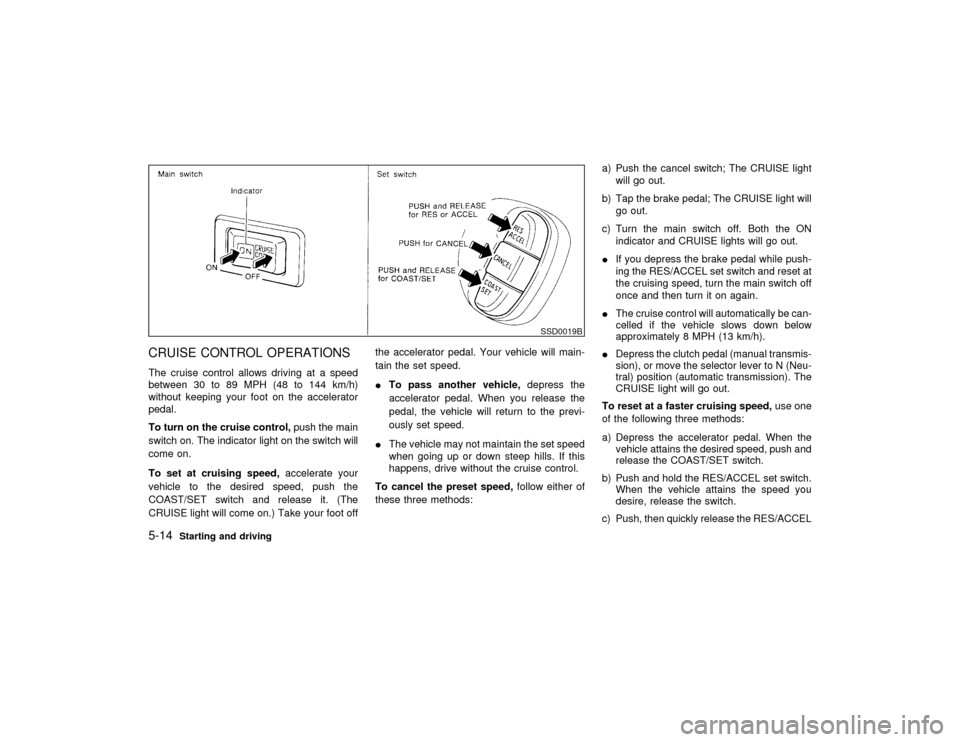
CRUISE CONTROL OPERATIONSThe cruise control allows driving at a speed
between 30 to 89 MPH (48 to 144 km/h)
without keeping your foot on the accelerator
pedal.
To turn on the cruise control,push the main
switch on. The indicator light on the switch will
come on.
To set at cruising speed,accelerate your
vehicle to the desired speed, push the
COAST/SET switch and release it. (The
CRUISE light will come on.) Take your foot offthe accelerator pedal. Your vehicle will main-
tain the set speed.
ITo pass another vehicle,depress the
accelerator pedal. When you release the
pedal, the vehicle will return to the previ-
ously set speed.
IThe vehicle may not maintain the set speed
when going up or down steep hills. If this
happens, drive without the cruise control.
To cancel the preset speed,follow either of
these three methods:a) Push the cancel switch; The CRUISE light
will go out.
b) Tap the brake pedal; The CRUISE light will
go out.
c) Turn the main switch off. Both the ON
indicator and CRUISE lights will go out.
IIf you depress the brake pedal while push-
ing the RES/ACCEL set switch and reset at
the cruising speed, turn the main switch off
once and then turn it on again.
IThe cruise control will automatically be can-
celled if the vehicle slows down below
approximately 8 MPH (13 km/h).
IDepress the clutch pedal (manual transmis-
sion), or move the selector lever to N (Neu-
tral) position (automatic transmission). The
CRUISE light will go out.
To reset at a faster cruising speed,use one
of the following three methods:
a) Depress the accelerator pedal. When the
vehicle attains the desired speed, push and
release the COAST/SET switch.
b) Push and hold the RES/ACCEL set switch.
When the vehicle attains the speed you
desire, release the switch.
c) Push, then quickly release the RES/ACCEL
SSD0019B
5-14
Starting and driving
Z
01.1.22/A32-D/V5.0
X
Page 138 of 233

installing tire chains. When installing tire
chains, make sure they are of proper size
for the tires on your vehicle and are in-
stalled according to the chain manufactur-
er's suggestions.Use only SAE Class S
chains.Other types may damage your
vehicle. Use chain tensioners when recom-
mended by the tire chain manufacturer to
ensure a tight fit. Loose end links of the tire
chain must be secured or removed to pre-
vent the possibility of whipping action dam-
age to the fenders or underbody. If pos-
sible, avoid fully loading your vehicle when
using tire chains. In addition, drive at a
reduced speed. Otherwise, your vehicle
may be damaged and/or vehicle handling
and performance may be adversely af-
fected.
Never install tire chains on a T-type spare
tire. Do not use tire chains on dry roads.
SPECIAL WINTER EQUIPMENTIt is recommended that the following items be
carried in the vehicle during winter:
Ia scraper and stiff-bristled brush to remove
ice and snow from the windows and wiper
blades.
Ia sturdy, flat board to be placed under the
jack to give it firm support.Ia shovel to dig the vehicle out of snow-
drifts.
Iextra window washer fluid to refill the res-
ervoir tank.
DRIVING ON SNOW OR ICEIWet ice (32ÉF, 0ÉC and freezing rain),
very cold snow or ice can be slick and
very hard to drive on. The vehicle will
have a lot less traction or grip under
these conditions. Try to avoid driving
on wet ice until the road is salted or
sanded.
IWhatever the condition, drive with
caution. Accelerate and slow down
with care. If accelerating or down-
shifting too fast, the drive wheels will
lose even more traction.
IAllow more stopping distance under
these conditions. Braking should be
started sooner than on dry pavement.
IAllow greater following distances on
slippery roads.
IWatch for slippery spots (glare ice).
These may appear on an otherwiseclear road in shaded areas. If a patch
of ice is seen ahead, brake before
reaching it. Try not to brake while
actually on the ice, and avoid any
sudden steering maneuvers.
IDo not use cruise control on slippery
roads.
ISnow can trap dangerous exhaust
gases under your vehicle. Keep snow
clear of the exhaust pipe and from
around your vehicle.
ENGINE BLOCK HEATER (if so
equipped)An engine block heater to assist extreme cold
temperature starting is available through your
NISSAN dealer.Do not use your heater with an un-
grounded electrical system or two-
pronged (cheater) adapters. You can be
injured by an electrical shock if you use
an ungrounded connection.
Starting and driving
5-21
Z
01.1.22/A32-D/V5.0
X
Page 227 of 233

Cleaning exterior and interior ........................... 7-4
Clock ............................................................... 2-27
Clutch
Clutch pedal .............................................. 8-21
Fluid ........................................................... 8-12
Cold weather driving ....................................... 5-20
Compact Disc (CD) player (See audio
system) ........................................................... 4-23
Compact disc (CD) player operation .............. 4-12
Compact spare tire ......................................... 8-35
Console box .................................................... 2-25
Controls
Audio controls............................................ 4-12
Audio controls (rear).................................. 4-12
Audio controls (steering wheel)................. 4-12
Heater and air conditioner controls ............. 4-3
Heater and air conditioner controls
(automatic)................................................... 4-9
Heater and semiautomatic air
conditioner ................................................... 4-3
Coolant
Capacities and recommended fuel/
lubricants ................................................... 10-2
Changing engine coolant ............................ 8-6
Checking engine coolant level .................... 8-5
Corrosion protection ......................................... 7-5
Cruise control.................................................. 5-13
Cup holder ...................................................... 2-24
DDaytime running light system ......................... 2-18
Defogger switch, Rear window and outside
mirror defogger switch .................................... 2-16Dimensions and weights ................................. 10-8
Door ajar warning light...................................... 2-8
Drive belts ....................................................... 8-15
Driving
Cold weather driving ................................. 5-20
Driving with automatic transmission............ 5-7
Driving with manual transmission ............. 5-11
Precautions when starting and driving ........ 5-2
E
Economy, Fuel ................................................ 5-15
Emission control information label ................ 10-10
Emission control system warranty ................ 10-18
Engine
Before starting the engine ........................... 5-6
Block heater .............................................. 5-21
Capacities and recommended fuel/
lubricants ................................................... 10-2
Changing engine coolant ............................ 8-6
Changing engine oil .................................... 8-8
Changing engine oil filter ............................ 8-9
Checking engine coolant ............................. 8-5
Checking engine oil level ............................ 8-7
Coolant temperature gauge ........................ 2-5
Engine compartment check locations ......... 8-4
Engine cooling system ................................ 8-5
Engine oil..................................................... 8-7
Engine oil and oil filter recommendation... 10-5
Engine oil viscosity .................................... 10-5
Engine serial number .............................. 10-10
Engine specifications................................. 10-7
If your engine overheats ........................... 6-10
Starting the engine ...................................... 5-7Exhaust gas (Carbon monoxide) ...................... 5-2
F
F.M.V.S.S. certification label......................... 10-10
Filter, Air cleaner housing filter ....................... 8-17
Flashers (See hazard warning flasher
switch) ............................................................. 2-19
Flat tire .............................................................. 6-2
Floor mat cleaning ............................................ 7-4
Fluid
Automatic transmission fluid (ATF) ........... 8-10
Brake and clutch fluid................................ 8-12
Capacities and recommended fuel/
lubricants ................................................... 10-2
Engine coolant............................................. 8-5
Engine oil..................................................... 8-7
Power steering fluid................................... 8-11
Window washer fluid ................................. 8-12
Fog light switch ............................................... 2-18
Front manual seat adjustment .......................... 1-2
Front power seat adjustment ............................ 1-4
Fuel
Capacities and recommended fuel/
lubricants ................................................... 10-2
Filler cap .................................................... 3-10
Filler lid ...................................................... 3-10
Filler lid and cap ........................................ 3-10
Filler lid opener lever................................. 3-10
Fuel economy ............................................ 5-15
Fuel octane rating ..................................... 10-3
Fuel recommendation................................ 10-3
Gauge .......................................................... 2-5
Fuses .............................................................. 8-21
Z
01.1.22/A32-D/V5.0
X
11-2
Page 229 of 233

M
Maintenance
Battery ....................................................... 8-13
Explanation of maintenance items..... 9-3, 9-10
General maintenance........................... 9-2, 9-3
Inside the vehicle ................................. 9-2, 9-3
Maintenance precautions ............................ 8-2
Outside the vehicle .............................. 9-2, 9-3
Periodic maintenance schedules ................ 9-5
Seat belt maintenance .............................. 1-23
Manual antenna .............................................. 4-24
Manual front seat adjustment ........................... 1-2
Meters and gauges ........................................... 2-3
Mirror
Inside mirror .............................................. 3-12
Outside mirror............................................ 3-13
Outside mirror control................................ 3-13
Outside mirrors .......................................... 3-13
Multi-remote control system.............................. 3-5
NNew vehicle break-in ...................................... 5-15
OOdometer .......................................................... 2-4
Oil
Capacities and recommended fuel/
lubricants ................................................... 10-2
Changing engine oil .................................... 8-8
Changing engine oil filter ............................ 8-9
Checking engine oil level ............................ 8-7Engine oil..................................................... 8-7
Engine oil viscosity .................................... 10-5
Outside mirror ................................................. 3-13
Outside mirror control ..................................... 3-13
Outside mirrors ............................................... 3-13
Overdrive switch ............................................. 5-10
Overheat, If your vehicle overheats................ 6-10
P
Parking
Brake check............................................... 8-20
Parking brake check.................................. 5-12
Parking brake operation ............................ 5-12
Parking/parking on hills ............................. 5-12
Parking/parking on hills .................................. 5-16
Periodic maintenance schedules ...................... 9-5
Personal light .................................................. 2-28
Power
Front seat adjustment ................................. 1-4
Power antenna .......................................... 4-24
Power door lock .......................................... 3-3
Power steering fluid................................... 8-11
Power steering system .............................. 5-17
Power windows ......................................... 2-25
Pre-tensioner seat belt system ....................... 1-14
Precautions
Cruise control precautions ........................ 5-13
Maintenance precautions ............................ 8-2
On child restraints ..................................... 1-24
On seat belt usage .................................... 1-17
On supplemental restraint system .............. 1-6
Precautions when starting and driving ........ 5-2Push starting ..................................................... 6-9
R
Radio
AM-FM radio with cassette player ............ 4-12
AM-FM radio with cassette player and
compact disc player .................................. 4-12
AM-FM radio with compact disc player..... 4-12
Cassette player operation ......................... 4-12
CB radio or car phone ..................... 4-12, 4-25
Compact disc (CD) player operation......... 4-12
Readiness for inspection/maintenance (I/M) test
(USA only) .................................................... 10-18
Rear door lock, Child safety rear door lock...... 3-4
Rear window and outside mirror defogger
switch .............................................................. 2-16
Registering your vehicle in another country ... 10-9
Remote keyless entry, (See multi-remote
control system) ................................................. 3-5
Reporting safety defects (USA only) ............ 10-18
Rollover ............................................................. 5-3
SSafety
Child seat belts.......................................... 1-19
Reporting safety defects (USA only)....... 10-18
Towing safety .......................................... 10-14
Seat adjustment
Front manual seat adjustment .................... 1-2
Front power seat adjustment ...................... 1-4
Seat belt extenders......................................... 1-23
Seat belt maintenance .................................... 1-23
Z
01.1.22/A32-D/V5.0
X
11-4