warning NISSAN MAXIMA 2000 A33 / 5.G Owners Manual
[x] Cancel search | Manufacturer: NISSAN, Model Year: 2000, Model line: MAXIMA, Model: NISSAN MAXIMA 2000 A33 / 5.GPages: 239, PDF Size: 1.97 MB
Page 1 of 239

ForewordWelcome to the growing family of new
NISSAN owners. This vehicle is delivered to
you with confidence. It was produced using
the latest techniques and strict quality control.
This manual was prepared to help you under-
stand the operation and maintenance of your
vehicle so that you may enjoy many miles of
driving pleasure. Please read through this
manual before operating your vehicle.
A separate Warranty Information and Main-
tenance Log Booklet (in U.S.), Warranty
and Roadside Assistance Information
booklet (in Canada) explains details about
the warranties covering your vehicle and
vehicle maintenance schedules. Addition-
ally, a separate Customer Care/Lemon Law
Booklet (U.S. only) will explain how to
resolve any concerns you may have with
your vehicle, as well as clarify your rights
under your state's lemon law.
Your NISSAN dealer knows your vehicle best.
When you require any service or have any
questions, he will be glad to assist you with
the extensive resources available to him.READ FIRST Ð THEN DRIVE
SAFELYBefore driving your vehicle please read
your Owner's Manual carefully. This will
ensure familiarity with controls and main-tenance requirements, assisting you in the
safe operation of your vehicle.
WARNING
IMPORTANT SAFETY INFORMA-
TION
REMINDERS FOR SAFETY!Follow these important driving rules to
help ensure a safe and comfortable trip
for you and your passengers!
INever drive under the influence of al-
cohol or drugs.
IAlways observe posted speed limits
and never drive too fast for condi-
tions.
IAlways use your seat belts and appro-
priate child restraint systems. Preteen
children should be seated in the rear
seat.
IAlways provide information about the
proper use of vehicle safety features
to all occupants of the vehicle.
IAlways review this Owner's Manual
for important safety information.
MODIFICATION OF YOUR
VEHICLEThis vehicle should not be modified. Modi-
fication could affect its performance,
safety or durability, and may even violate
governmental regulations. In addition,
damage or performance problems result-
ing from modification may not be covered
under NISSAN warranties.WHEN READING THE MANUALThis manual includes information for all
options available on this model. Therefore,
you may find some information that does
not apply to your vehicle.
All information, specifications and illustrations
in this manual are those in effect at the time of
printing. NISSAN reserves the right to change
specifications or design at any time without
notice.
Z
00.1.17/A33-D/V5.0
X
Page 2 of 239

IMPORTANT INFORMATION
ABOUT THIS MANUALYou will see various symbols in this manual.
They are used in the following ways:
WARNING
This is used to indicate the presence of a
hazard that could cause death or serious
personal injury. To avoid or reduce the
risk, the procedures must be followed
precisely.
CAUTION
This is used to indicate the presence of a
hazard that could cause minor or moder-
ate personal injury or damage to your
vehicle. To avoid or reduce the risk, the
procedures must be followed carefully.If you see this symbol, it meansDo not do
thisorDo not let this happen.
CALIFORNIA PROPOSITION 65
WARNING
WARNING
Engine Exhaust, some of its constitu-
ents, and certain vehicle components
contain or emit chemicals known to State
of California to cause cancer and birth
defects or other reproductive harm.
2000 NISSAN MOTOR CO., LTD.
TOKYO, JAPANAll rights reserved. No part of this Owner's Manual may
be reproduced or stored in a retrieval system, or trans-
mitted in any form, or by any means, electronic, me-
chanical, photocopying, recording or otherwise, without
the prior written permission of Nissan Motor Co., Ltd.
SIC0697Z
00.1.17/A33-D/V5.0
X
Page 6 of 239

1 Seats, restraints and supplemental air bag
systemsSeats ......................................................................... 1-2
Front manual seat adjustment .................................. 1-2
Front power seat adjustment .................................... 1-4
Folding rear seat ...................................................... 1-6
Head restraint adjustment ......................................... 1-7
Armrest ...................................................................... 1-8
Supplemental restraint system .................................. 1-8
Precautions on supplemental restraint system ......... 1-8
Supplemental air bag warning labels ...................... 1-18
Supplemental air bag warning light......................... 1-19
Seat belts ................................................................ 1-20
Precautions on seat belt usage .............................. 1-20Child safety ............................................................. 1-22
Pregnant women ..................................................... 1-23
Injured persons ....................................................... 1-24
Three-point type seat belt with retractor ................. 1-24
Seat belt extenders ................................................. 1-27
Seat belt maintenance ............................................ 1-27
Child restraints ........................................................ 1-28
Precautions on child restraints ................................ 1-28
Installation on rear seat outboard or center
positions .................................................................. 1-30
Top tether strap child restraint (if so equipped)...... 1-35
Installation on front passenger seat ........................ 1-36
Z
00.1.17/A33-D/V5.0
X
Page 7 of 239
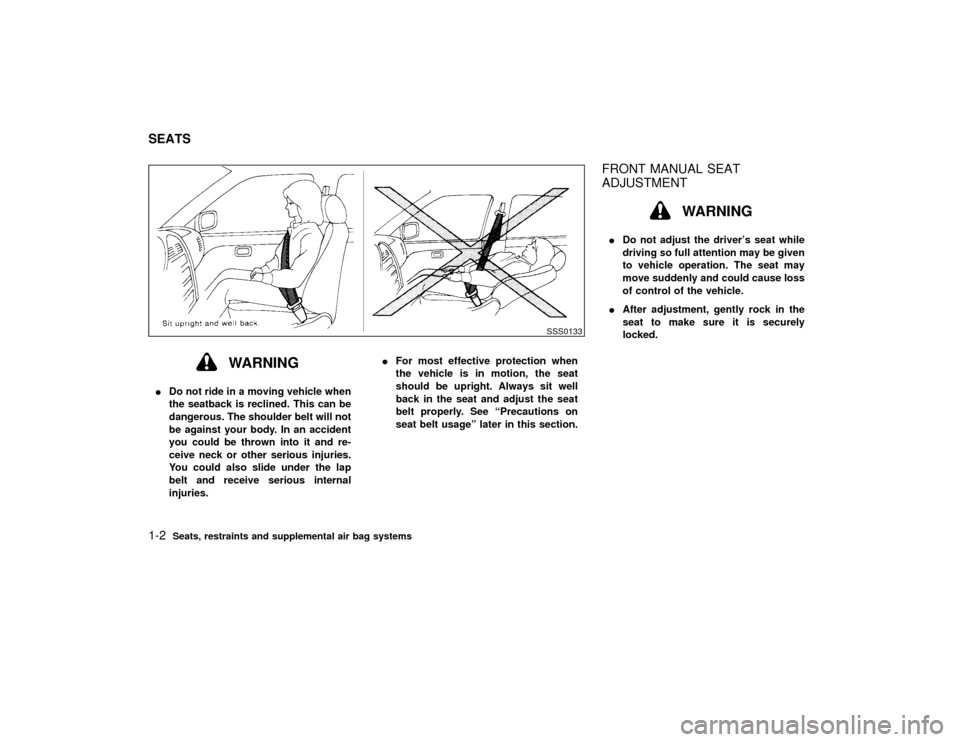
WARNING
IDo not ride in a moving vehicle when
the seatback is reclined. This can be
dangerous. The shoulder belt will not
be against your body. In an accident
you could be thrown into it and re-
ceive neck or other serious injuries.
You could also slide under the lap
belt and receive serious internal
injuries.IFor most effective protection when
the vehicle is in motion, the seat
should be upright. Always sit well
back in the seat and adjust the seat
belt properly. See ªPrecautions on
seat belt usageº later in this section.
FRONT MANUAL SEAT
ADJUSTMENT
WARNING
IDo not adjust the driver's seat while
driving so full attention may be given
to vehicle operation. The seat may
move suddenly and could cause loss
of control of the vehicle.
IAfter adjustment, gently rock in the
seat to make sure it is securely
locked.
SSS0133
SEATS1-2
Seats, restraints and supplemental air bag systems
Z
00.1.17/A33-D/V5.0
X
Page 9 of 239

Lumbar support (Driver's seat)The lumbar support feature provides lower
back support to the driver. Move the lever up
or down to adjust the seat lumbar area.
FRONT POWER SEAT
ADJUSTMENT
WARNING
IDo not adjust the driver's seat while
driving so full attention may be given
to vehicle operation.
IDo not leave children unattended in-
side the vehicle. They could unknow-
ingly activate switches or controls.
Unattended children could become
involved in serious accidents.Operating tipsIThe motor has an auto-reset overload pro-
tection circuit. If the motor stops during
operation, wait 30 seconds, then reactivate
the switch.
IDo not operate the power support seat
for a long period of time when the engine is
off. This will discharge the battery.
SPA0467
1-4
Seats, restraints and supplemental air bag systems
Z
00.1.17/A33-D/V5.0
X
Page 11 of 239
Lumbar support (Driver's seat)The lumbar support feature provides lower
back support to the driver. Move the lever up
or down to adjust the seat lumbar area.
FOLDING REAR SEAT
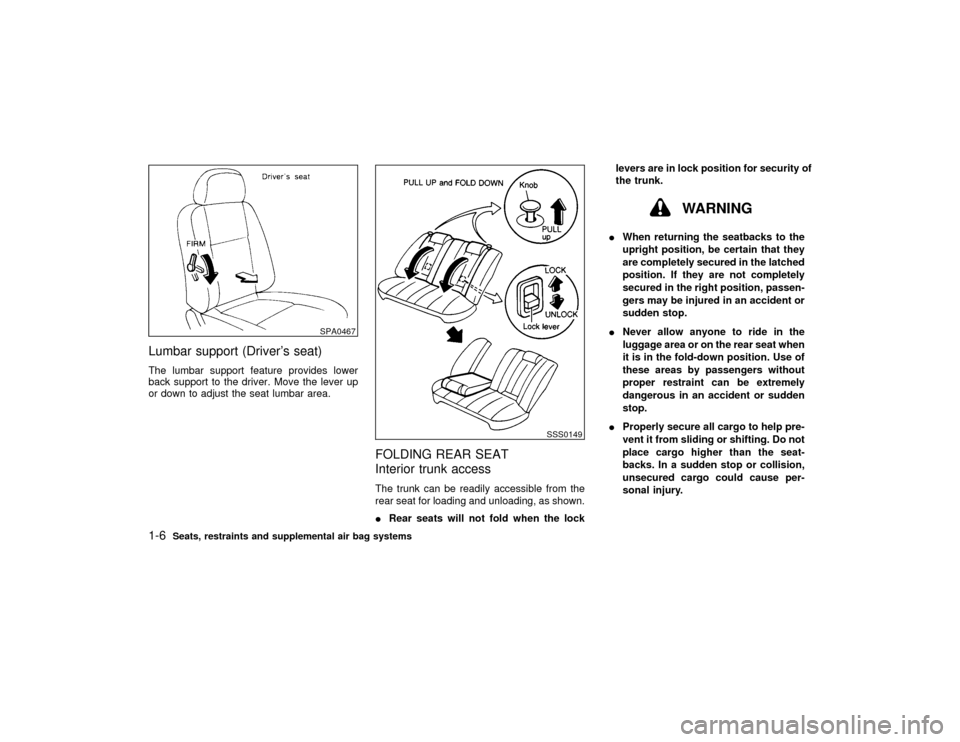
Interior trunk accessThe trunk can be readily accessible from the
rear seat for loading and unloading, as shown.
IRear seats will not fold when the locklevers are in lock position for security of
the trunk.
WARNING
IWhen returning the seatbacks to the
upright position, be certain that they
are completely secured in the latched
position. If they are not completely
secured in the right position, passen-
gers may be injured in an accident or
sudden stop.
INever allow anyone to ride in the
luggage area or on the rear seat when
it is in the fold-down position. Use of
these areas by passengers without
proper restraint can be extremely
dangerous in an accident or sudden
stop.
IProperly secure all cargo to help pre-
vent it from sliding or shifting. Do not
place cargo higher than the seat-
backs. In a sudden stop or collision,
unsecured cargo could cause per-
sonal injury.
SPA0467
SSS0149
1-6
Seats, restraints and supplemental air bag systems
Z
00.1.17/A33-D/V5.0
X
Page 12 of 239

IClosely supervise children when they
are around cars to prevent them from
playing and becoming locked in the
trunk where they could be seriously
injured. Keep the car locked with the
rear seatback securely latched when
not in use, and prevent children's
access to car keys.
HEAD RESTRAINT ADJUSTMENTTo raise the head restraint, just pull it up. To
lower, push the lock knob and push the head
restraint down.
WARNING
Head restraints should be adjusted
properly as they may provide significant
protection against injury in an accident.
Do not remove them. Check the adjust-ment after someone else uses the seat.
SSS0125Seats, restraints and supplemental air bag systems
1-7
Z
00.1.17/A33-D/V5.0
X
Page 14 of 239

instructions and precautions on seat belt us-
age.)
After turning the ignition key to the ON
position, the supplemental air bag warning
light illuminates. The supplemental air bag
warning light will turn off after about 7
seconds if the system is operational.
WARNING
IThe supplemental front air bags ordi-
narily will not inflate in the event of a
side impact, rear impact, roll over, or
lower severity frontal collision. Al-
ways wear your seat belts to help
reduce the risk or severity of injury in
various kinds of accidents.
IThe seat belts and the supplemental
front air bags are most effective whenyou are sitting well back and upright
in the seat. Front air bags inflate with
great force. If you are unrestrained,
leaning forward, sitting sideways or
out of position in any way, you are at
greater risk of injury or death in a
crash and may also receive serious
or fatal injuries from the supplemen-
tal front air bag if you are up against
it when it inflates. Always sit back
against the seatback and as far away
as practical from the steering
SSS0131
Seats, restraints and supplemental air bag systems
1-9
Z
00.1.17/A33-D/V5.0
X
Page 17 of 239

WARNING
INever let children ride unrestrained
or extend their hands or face out of
the window. Do not attempt to hold
them in your lap or arms. Some ex-
amples of dangerous riding positions
are shown in the previous illustra-
tions.
IChildren may be severely injured or
killed when the supplemental front air
bag or supplemental side air bag in-
flates if they are not properly re-
strained.
IAlso never install a rear facing child
restraint in the front seat. An inflating
supplemental front air bag could se-
riously injure or kill your child. For
additional information, see ªChild re-
straintsº later in this section.
WARNING
Supplemental side air bag (if so
equipped):
IThe supplemental side air bag ordi-
narily will not inflate in the event of a
frontal impact, rear impact or lower
severity side collision. Always wear
your seat belts to help reduce the risk
or severity of injury in various kinds
of accidents.IThe seat belts and the supplemental
side air bag are most effective when
you are sitting well back and upright
in the seat. The side air bag inflates
with great force. Do not allow anyone
to place their hand, leg or face near
the side air bag on the side of the
seatback of the front seat. Do not
allow anyone sitting in the front seat
to extend their hand out of the win-
dow or lean against the door. Some
examples of dangerous riding posi-
tions are shown in the previous illus-
SSS0101
SSS0140
1-12
Seats, restraints and supplemental air bag systems
Z
00.1.17/A33-D/V5.0
X
Page 19 of 239
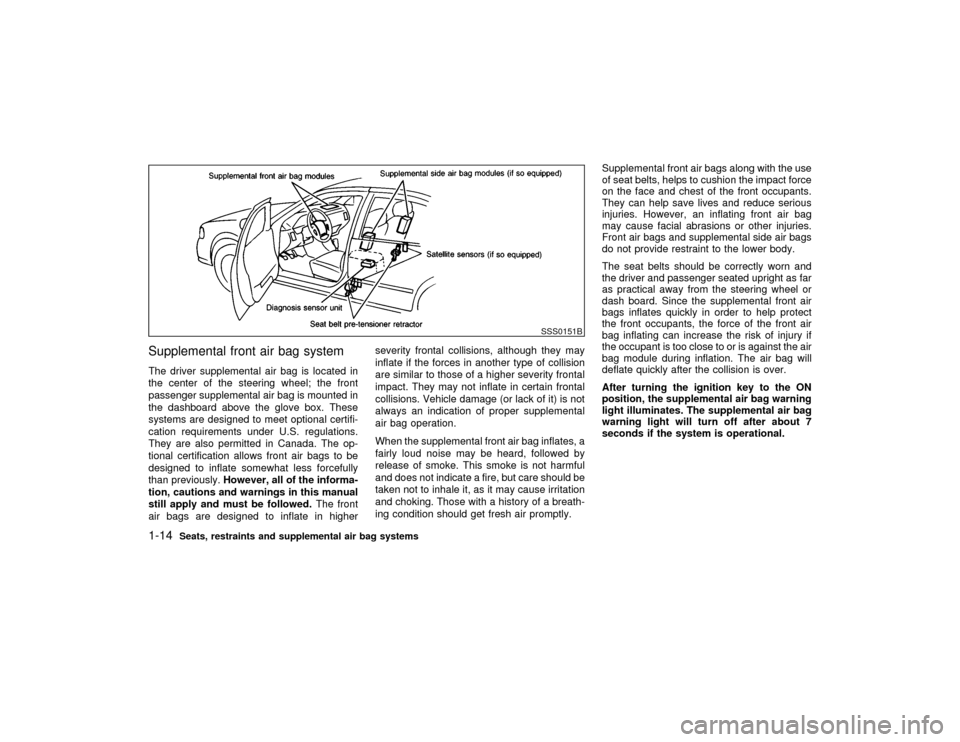
Supplemental front air bag systemThe driver supplemental air bag is located in
the center of the steering wheel; the front
passenger supplemental air bag is mounted in
the dashboard above the glove box. These
systems are designed to meet optional certifi-
cation requirements under U.S. regulations.
They are also permitted in Canada. The op-
tional certification allows front air bags to be
designed to inflate somewhat less forcefully
than previously.However, all of the informa-
tion, cautions and warnings in this manual
still apply and must be followed.The front
air bags are designed to inflate in higherseverity frontal collisions, although they may
inflate if the forces in another type of collision
are similar to those of a higher severity frontal
impact. They may not inflate in certain frontal
collisions. Vehicle damage (or lack of it) is not
always an indication of proper supplemental
air bag operation.
When the supplemental front air bag inflates, a
fairly loud noise may be heard, followed by
release of smoke. This smoke is not harmful
and does not indicate a fire, but care should be
taken not to inhale it, as it may cause irritation
and choking. Those with a history of a breath-
ing condition should get fresh air promptly.Supplemental front air bags along with the use
of seat belts, helps to cushion the impact force
on the face and chest of the front occupants.
They can help save lives and reduce serious
injuries. However, an inflating front air bag
may cause facial abrasions or other injuries.
Front air bags and supplemental side air bags
do not provide restraint to the lower body.
The seat belts should be correctly worn and
the driver and passenger seated upright as far
as practical away from the steering wheel or
dash board. Since the supplemental front air
bags inflates quickly in order to help protect
the front occupants, the force of the front air
bag inflating can increase the risk of injury if
the occupant is too close to or is against the air
bag module during inflation. The air bag will
deflate quickly after the collision is over.
After turning the ignition key to the ON
position, the supplemental air bag warning
light illuminates. The supplemental air bag
warning light will turn off after about 7
seconds if the system is operational.
SSS0151B
1-14
Seats, restraints and supplemental air bag systems
Z
00.1.17/A33-D/V5.0
X