heater NISSAN MAXIMA 2001 A33 / 5.G Owner's Guide
[x] Cancel search | Manufacturer: NISSAN, Model Year: 2001, Model line: MAXIMA, Model: NISSAN MAXIMA 2001 A33 / 5.GPages: 247, PDF Size: 1.99 MB
Page 129 of 247

WARNING
IDo not leave children, impaired
adults, or pets alone in your vehicle.
They could accidentally injure them-
selves or others through inadvertent
operation of the vehicle. Also, on hot,
sunny days, temperatures in a closed
vehicle could quickly become high
enough to cause severe or possibly
fatal injuries to people or animals.
IClosely supervise children when they
are around cars to prevent them from
playing and becoming locked in the
trunk where they could be seriously
injured. Keep the car locked with the
trunk closed when not in use, and
prevent children's access to car keys.EXHAUST GAS (Carbon monoxide)
WARNING
Do not breathe exhaust gases; they con-tain colorless and odorless carbon mon-
oxide. Carbon monoxide is dangerous. It
can cause unconsciousness or death.
IIf you suspect that exhaust fumes are
entering the vehicle, drive with all
windows fully open, and have the
vehicle inspected immediately.
IDo not run the engine in closed
spaces such as a garage.
IDo not park the vehicle with the en-
gine running for any extended length
of time.
IKeep the trunk lid closed while driv-
ing, otherwise exhaust gases could
be drawn into the passenger com-
partment. If you must drive with the
trunk lid open, follow these precau-
tions:
1. Open all the windows.
2. Set the air recirculation switch
OFF and the fan control at 4 (high)
to circulate the air.
IIf electrical wiring or other cable con-nections must pass to a trailer
through the seal on the trunk lid or
the body, follow the manufacturer's
recommendation to prevent carbon
monoxide entry into the vehicle.
IIf a special body or other equipment
is added for recreational or other us-
age, follow the manufacturer's rec-
ommendation to prevent carbon
monoxide entry into the vehicle.
(Some recreational vehicle appli-
ances such as stoves, refrigerator,
heaters, etc. may also generate car-
bon monoxide.)
IThe exhaust system and body should
be inspected by a qualified mechanic
whenever:
a. The vehicle is raised for service.
b. You suspect that exhaust fumes
are entering into the passenger
compartment.
c. You notice a change in the sound
of the exhaust system.PRECAUTIONS WHEN STARTING
AND DRIVING5-2
Starting and driving
Z
00.1.17/A33-D/V5.0
X
Page 149 of 247

Ia shovel to dig the vehicle out of snow-
drifts.
Iextra window washer fluid to refill the res-
ervoir tank.DRIVING ON SNOW OR ICE
WARNING
IWet ice (32ÉF, 0ÉC and freezing rain),
very cold snow or ice can be slick and
very hard to drive on. The vehicle will
have a lot less traction or grip under
these conditions. Try to avoid driving
on wet ice until the road is salted or
sanded.
IWhatever the condition, drive with
caution. Accelerate and slow down
with care. If accelerating or down-
shifting too fast, the drive wheels will
lose even more traction.
IAllow more stopping distance under
these conditions. Braking should be
started sooner than on dry pavement.
IAllow greater following distances on
slippery roads.IWatch for slippery spots (glare ice).
These may appear on an otherwise
clear road in shaded areas. If a patch
of ice is seen ahead, brake before
reaching it. Try not to brake while
actually on the ice, and avoid any
sudden steering maneuvers.
IDo not use cruise control on slippery
roads.
ISnow can trap dangerous exhaust
gases under your vehicle. Keep snow
clear of the exhaust pipe and from
around your vehicle.
ENGINE BLOCK HEATER (if so
equipped)An engine block heater to assist extreme cold
temperature starting is available through your
NISSAN dealer.
WARNING
Do not use your heater with an un-
grounded electrical system or two-pronged (cheater) adapters. You can be
injured by an electrical shock if you use
an ungrounded connection.
5-22
Starting and driving
Z
00.1.17/A33-D/V5.0
X
Page 157 of 247
IThe booster battery must be rated at
12 volts. Use of an improperly rated
battery can damage your vehicle.
IWhenever working on or near a bat-
tery, always wear suitable eye protec-
tors (for example, goggles or indus-
trial safety spectacles) and remove
rings, metal bands, or any other jew-
elry. Do not lean over the battery
when jump starting.
IDo not attempt to jump start a frozen
battery. It could explode and cause
serious injury.
IYour vehicle has an automatic engine
cooling fan. It could come on at any
time. Keep hands and other objects
away from it.
WARNING
Always follow the instructions below.
Failure to do so could result in damage
to the charging system and cause per-
sonal injury.
1. If the booster battery is in another vehicle,
position the two vehicles to bring their bat-
teries into close proximity to each other.
Do not allow the two vehicles to touch.
2. Apply parking brake. Move the shift lever tothe N (Neutral) position (On automatic
transmission models, move the selector
lever to the P (Park) position). Switch off all
unnecessary electrical systems (light,
heater, air conditioner, etc.).
3. Remove vent caps on the battery (if so
equipped). Cover the battery with an old
cloth to reduce explosion hazard.
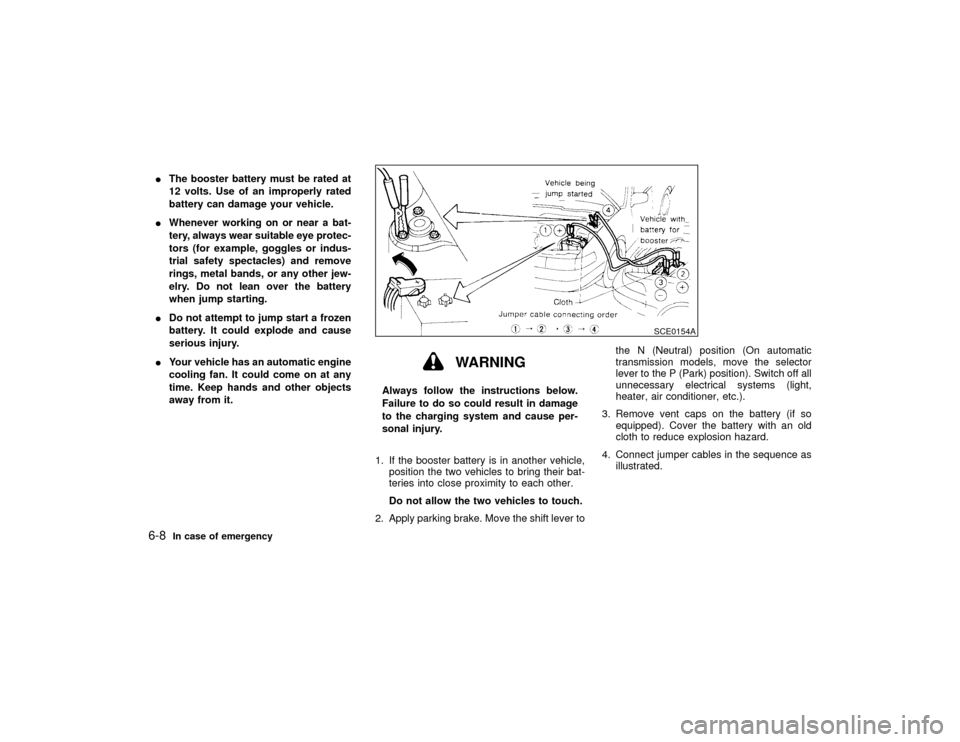
4. Connect jumper cables in the sequence as
illustrated.
SCE0154A
6-8
In case of emergency
Z
00.1.17/A33-D/V5.0
X
Page 159 of 247
WARNING
IDo not continue to drive if your ve-
hicle overheats. Doing so could
cause a vehicle fire.
ITo avoid the danger of being scalded,
never remove the radiator cap while
the engine is still hot. When the radia-
tor cap is removed, pressurized hot
water will spurt out, possibly causing
serious injury.
IDo not open the hood if steam is
coming out.
If your vehicle is overheating (indicated by an
extremely high temperature gauge reading), or
if you feel a lack of engine power, detect
abnormal noise, etc., take the following steps:
1. Move the vehicle safely off the road, apply
the parking brake and move the shift lever
to the N (Neutral) position (automatic trans-
mission to the P (Park) position).
Do not stop the engine.
2. Turn off the air conditioner switch. Open all
the windows, move the heater or air condi-tioner temperature control to maximum hot
and fan control to high speed.
3. Get out of the vehicle. Look and listen for
steam or coolant escaping from the radiator
before opening the hood. Wait until no
steam or coolant can be seen before pro-
ceeding.
4. Open the engine hood.
WARNING
If steam or water is coming from the
engine, stand clear to prevent getting
burned.
5. Visually check if the cooling fan is running.
The radiator hoses and radiator should not
leak water.
If coolant is leaking or the cooling fan does
not run, stop the engine.
WARNING
IBe careful not to allow your hands,
hair, jewelry or clothing to come intocontact with, or to get caught in the
cooling fan, or drive belt.
IThe engine cooling fan can start at
any time when the coolant tempera-
ture is high.
6. After the engine cools down, check the
coolant level in the reservoir tank with the
engine running. Add coolant to the reservoir
tank if necessary. Have your vehicle re-
paired at the nearest NISSAN dealer.
IF YOUR VEHICLE OVERHEATS6-10
In case of emergency
Z
00.1.17/A33-D/V5.0
X
Page 175 of 247
CHANGING ENGINE COOLANTIMajor cooling system repairs should be
performed by your NISSAN dealer. The
service procedures can be found in the
appropriate NISSAN Service Manual.IImproper servicing can result in reduced
heater performance and engine overheat-
ing.
WARNING
ITo avoid the danger of being scalded,
never change the coolant when the
engine is hot.
INever remove the radiator cap when
the engine is hot. Serious burns
could be caused by high pressure
fluid escaping from the radiator.
IAvoid direct skin contact with used
coolant. If skin contact is made, wash
thoroughly with soap or hand cleaner
as soon as possible.
IKeep coolant out of reach of children
and pets.
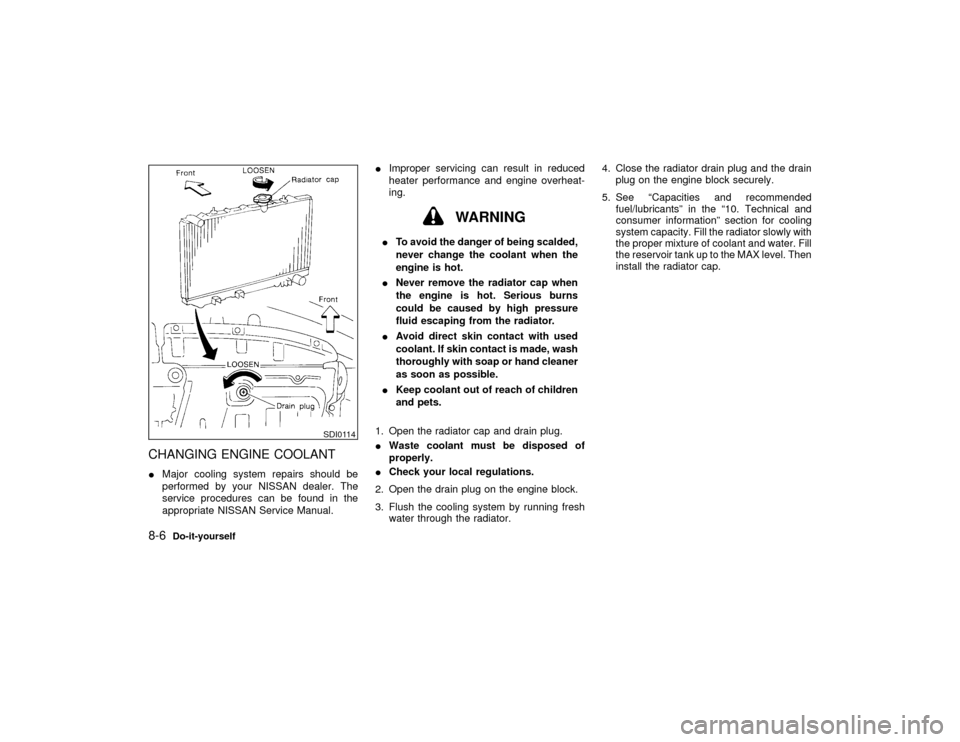
1. Open the radiator cap and drain plug.
IWaste coolant must be disposed of
properly.
ICheck your local regulations.
2. Open the drain plug on the engine block.
3. Flush the cooling system by running fresh
water through the radiator.4. Close the radiator drain plug and the drain
plug on the engine block securely.
5. See ªCapacities and recommended
fuel/lubricantsº in the ª10. Technical and
consumer informationº section for cooling
system capacity. Fill the radiator slowly with
the proper mixture of coolant and water. Fill
the reservoir tank up to the MAX level. Then
install the radiator cap.
SDI0114
8-6
Do-it-yourself
Z
00.1.17/A33-D/V5.0
X
Page 208 of 247
During the normal day-to-day operation of the
vehicle, general maintenance should be per-
formed regularly as prescribed in this section.
If you detect any unusual sounds, vibrations or
smell, be sure to check for the cause or have
your NISSAN dealer do it promptly. In addition,
you should notify your NISSAN dealer if you
think that repairs are required.
When performing any checks or maintenance
work, see ªMaintenance precautionsº in the ª8.
Do-it-yourselfº section.EXPLANATION OF MAINTENANCE
ITEMSAdditional information on the following
items with ª*º is found in the ª8. Do-it-
yourselfº section.Outside the vehicleThe maintenance items listed here should be
performed from time to time, unless otherwise
specified.
Tires*:Check the pressure with a gauge pe-
riodically when at a service station, including
the spare, and adjust to the specified pressure
if necessary. Check carefully for damage, cuts
or excessive wear.
Wheel nuts*:When checking the tires, make
sure no nuts are missing, and check for anyloose nuts. Tighten if necessary.
Tire rotation*:Tires should be rotated every
7,500 miles (12,000 km).
Wheel alignment and balance:If the vehicle
pulls to either side while driving on a straight
and level road, or if you detect uneven or
abnormal tire wear, there may be a need for
wheel alignment.
If the steering wheel or seat vibrates at normal
highway speeds, wheel balancing may be
needed.
Windshield wiper blades*:Check for cracks
or wear if they do not wipe properly.
Doors and engine hood:Check that all doors
and the engine hood operate smoothly as well
as the trunk lid or back hatch. Also make sure
that all latches lock securely. Lubricate if nec-
essary. Make sure that the secondary latch
keeps the hood from opening when the pri-
mary latch is released.
When driving in areas using road salt or other
corrosive materials, check lubrication fre-
quently.
Inside the vehicleThe maintenance items listed here should be
checked on a regular basis, such as whenperforming periodic maintenance, cleaning the
vehicle, etc.
Lights*:Make sure that the headlights, stop
lights, tail lights, turn signal lights, and other
lights are all operating properly and installed
securely. Also check headlight aim.
Warning lights and chimes:Make sure that
all warning lights and chimes are operating
properly.
Windshield wiper and washer*:Check that
the wipers and washer operate properly and
that the wipers do not streak.
Windshield defroster:Check that the air
comes out of the defroster outlets properly and
in good quantity when operating the heater or
air conditioner.
Steering wheel:Check for changes in the
steering conditions, such as excessive free
play, hard steering or strange noises.
Seats:Check seat position controls such as
seat adjusters, seatback recliner, etc. to en-
sure they operate smoothly and that all latches
lock securely in every position. Check that the
head restraints move up and down smoothly
and that the locks (if equipped) hold securely
in all latched positions.
Seat belts:Check that all parts of the seat belt
GENERAL MAINTENANCE
Maintenance
9-3
Z
00.1.17/A33-D/V5.0
X
Page 240 of 247

11 Index
A
ABS (Anti-lock brake system) ......................... 5-19
Air bag system
Front (See supplemental front airbag
system) ...................................................... 1-14
Side (See supplemental side air bag
system) ...................................................... 1-16
Air bag warning labels .................................... 1-19
Air bag warning light................................ 1-19, 2-8
Air cleaner housing filter ................................. 8-16
Air conditioner
Air conditioner operation ............................. 4-3
Air conditioner service ....................... 4-3, 4-11
Air conditioner specification label .... 4-3, 10-12
Air conditioner system refrigerant and
lubrication recommendations ...................... 4-3
Heater and air conditioner controls ............. 4-3
Servicing air conditioner .............................. 4-3
Air conditioning system refrigerant and lubricant
recommendations ........................................... 10-6
Air flow charts ................................................... 4-6
Alcohol, drugs and driving ................................ 5-4
AM-FM radio with cassette player .................. 4-12
AM-FM radio with cassette player and compact
disc player....................................................... 4-12
AM-FM radio with compact disc player .......... 4-12
Ambient temperature switch (AMB), Air
conditioner ...................................................... 4-11Anchor point locations
Top tether strap ......................................... 1-36
Antenna
Manual ....................................................... 4-25
Power ........................................................ 4-25
Anti-lock Brake System (ABS) ........................ 5-19
Anti-lock brake warning light............................. 2-9
Appearance care
Exterior appearance care ............................ 7-2
Interior appearance care ............................. 7-4
Armrest ............................................................. 1-9
Audible reminders ........................................... 2-11
Audio system .................................................. 4-12
Automatic
Automatic transmission fluid (ATF) ........... 8-10
Driving with automatic transmission............ 5-8
Transmission selector lever lock
release ....................................................... 5-10
Avoiding collision and rollover .......................... 5-3
B
Battery............................................................. 8-13
Battery saver system................................. 2-17
Battery replacement, (See multi-remote control
system) ............................................................. 3-8
Before starting the engine ................................ 5-7
Belts (See drive belts) .................................... 8-15Brake
Anti-lock brake system (ABS) ................... 5-19
Brake and clutch fluid................................ 8-12
Brake booster ............................................ 8-19
Brake pedal ............................................... 8-18
Brake pedal check..................................... 8-18
Parking brake check ........................ 5-13, 8-18
Parking brake operation ............................ 5-13
System....................................................... 5-18
Warning light ............................................... 2-8
Break-in schedule ........................................... 5-15
Bulb check/instrument panel ............................ 2-7
Bulb replacement ............................................ 8-23
C
Capacities and recommended
fuel/lubricants .................................................. 10-2
Car phone ....................................................... 4-25
Car phone or CB radio ................................... 4-25
Cargo (See vehicle loading information) ........ 2-25
Cargo net ........................................................ 2-25
Cassette player (See audio system) .............. 4-16
Cassette tape operation ................................. 4-12
Catalytic converter, Three way catalyst............ 5-3
CD care and cleaning ..................................... 4-24
Child restraints ................................................ 1-28
Installation on front passenger seat .......... 1-37
Precautions on child restraints .................. 1-28
Z
00.1.17/A33-D/V5.0
X
Page 241 of 247

Top tether strap anchor point locations .... 1-36
With top tether strap.................................. 1-36
Child safety ..................................................... 1-23
Child safety rear door lock................................ 3-4
Chimes ............................................................ 2-11
Circuit breaker, Fusible link ............................ 8-21
Cleaning exterior and interior .................... 7-2, 7-4
Clock ............................................................... 2-29
Clutch
Clutch pedal .............................................. 8-19
Fluid ........................................................... 8-12
Cold weather driving ....................................... 5-21
Compact Disc (CD) player (See audio
system) ........................................................... 4-22
Compact disc (CD) player operation .............. 4-12
Compact spare tire ......................................... 8-33
Console box .................................................... 2-25
Controls
Audio controls............................................ 4-12
Audio controls (rear).................................. 4-12
Audio controls (steering wheel)................. 4-12
Heater and air conditioner controls ............. 4-3
Heater and semiautomatic air
conditioner ................................................... 4-3
Coolant
Capacities and recommended fuel/
lubricants ................................................... 10-2
Changing engine coolant ............................ 8-6
Checking engine coolant level .................... 8-5
Corrosion protection ......................................... 7-5
Cruise control.................................................. 5-13
Cup holder ...................................................... 2-23D
Daytime running light system ......................... 2-18
Defogger switch, Rear window and outside mirror
defogger switch............................................... 2-15
Dimensions and weights ................................. 10-9
Door open warning light ................................... 2-8
Drive belts ....................................................... 8-15
Driving
Cold weather driving ................................. 5-21
Driving with automatic transmission............ 5-8
Driving with manual transmission ............. 5-11
Precautions when starting and driving ........ 5-2
E
Economy, Fuel ................................................ 5-16
Emission control information label ................ 10-11
Emission control system warranty ................ 10-20
Engine
Before starting the engine ........................... 5-7
Block heater .............................................. 5-22
Capacities and recommended fuel/
lubricants ................................................... 10-2
Changing engine coolant ............................ 8-6
Changing engine oil .................................... 8-8
Changing engine oil filter ............................ 8-9
Checking engine coolant level .................... 8-5
Checking engine oil level ............................ 8-7
Coolant temperature gauge ........................ 2-5
Engine compartment check locations ......... 8-4
Engine cooling system ................................ 8-5
Engine oil..................................................... 8-7Engine oil and oil filter recommendation... 10-5
Engine oil viscosity .................................... 10-5
Engine serial number .............................. 10-11
Engine specifications................................. 10-7
If your engine overheats ........................... 6-10
Starting the engine ...................................... 5-7
Exhaust gas (Carbon monoxide) ...................... 5-2
F
F.M.V.S.S. certification label......................... 10-11
Filter, Air cleaner housing filter ....................... 8-16
Flashers (See hazard warning flasher
switch) ............................................................. 2-19
Flat tire .............................................................. 6-2
Floor mat cleaning ............................................ 7-4
Fluid
Automatic transmission fluid (ATF) ........... 8-10
Brake and clutch fluid................................ 8-12
Capacities and recommended fuel/
lubricants ................................................... 10-2
Engine coolant............................................. 8-5
Engine oil..................................................... 8-7
Power steering fluid................................... 8-11
Window washer fluid ................................. 8-12
Folding rear seat............................................... 1-6
Front air bag system (See supplemental restraint
system) ........................................................... 1-14
Front manual seat adjustment .......................... 1-2
Front power seat adjustment ............................ 1-4
Fuel
Capacities and recommended fuel/
lubricants ................................................... 10-2
Filler cap .................................................... 3-12
Z
00.1.17/A33-D/V5.0
X
11-2
Page 242 of 247

Filler lid ...................................................... 3-12
Filler lid and cap ........................................ 3-12
Filler lid opener lever................................. 3-12
Fuel economy ............................................ 5-16
Fuel octane rating ..................................... 10-3
Fuel recommendation................................ 10-3
Gauge .......................................................... 2-5
Fuses .............................................................. 8-20
Fusible links .................................................... 8-21
G
Garage door opener, Integrated HomeLink
Universal Transceiver ..................................... 2-32
Gas cap .......................................................... 3-12
Gauge ............................................................... 2-3
Engine coolant temperature gauge ............. 2-5
Fuel gauge .................................................. 2-5
Odometer..................................................... 2-4
Speedometer ............................................... 2-4
Tachometer ................................................. 2-4
General maintenance ................................ 9-2, 9-3
Glasses case .................................................. 2-23
Glove box........................................................ 2-24
Glove box lock ................................................ 2-24
H
Hazard warning flasher switch........................ 2-19
Head restraints ................................................. 1-7
Headlamps, (Bulb replacement) ..................... 8-24
Headlights
(Bulb replacement) .................................... 8-24Headlight switch ........................................ 2-16
Heated seats................................................... 2-20
Heater
Engine coolant heater ............................... 5-22
Heater and air conditioner controls ............. 4-3
Heater operation.......................................... 4-3
Heater operation, Semiautomatic air
conditioner ........................................................ 4-4
HomeLink
Universal Transceiver .................. 2-32
Hood, release ................................................... 3-9
Horn ................................................................ 2-19
How to stop alarm, Vehicle security
system............................................................. 2-13
I
Ignition switch ................................................... 5-4
Automatic transmission models .................. 5-4
Key positions ............................................... 5-6
Manual transmission models....................... 5-5
Immobilizer system ......................................... 2-13
Indicator lights and chimes (See warning/indicator
lights and chimes) ............................................. 2-9
Inside mirror .................................................... 3-14
Inspection/maintenance (I/M) test................. 10-21
Instrument panel ............................................... 2-2
Integrated HomeLink
Universal
Transceiver ..................................................... 2-32
Interior and cargo light .................................... 2-29
Interior light ..................................................... 2-29
Interior light replacement ................................ 8-25J
Jump starting .................................................... 6-7
K
Keyless entry, (See multi-remote control
system) ............................................................. 3-4
Keys .................................................................. 3-2
L
Label, Air conditioner specification label ...... 10-12
Label, Emission control information label ..... 10-11
Label, F.M.V.S.S. certification label.............. 10-11
Labels
Air bag warning labels............................... 1-19
Air conditioner specification label................ 4-3
Engine serial number .............................. 10-11
Vehicle identification number (VIN)......... 10-10
License plate, Installing front license plate... 10-13
Light
Air bag warning light ................................. 1-19
Bulb replacement ...................................... 8-23
Headlamps (Bulb replacement)................. 8-24
Headlight switch ........................................ 2-16
Headlights (Bulb replacement) .................. 8-24
Interior and cargo light .............................. 2-29
Interior light................................................ 2-29
Personal light............................................. 2-30
Replacement ............................................. 8-23
Trunk light.................................................. 2-32
Vanity mirror light ...................................... 2-31
Z
00.1.17/A33-D/V5.0
X
11-3