Maintenance NISSAN MAXIMA 2002 A33 / 5.G Workshop Manual
[x] Cancel search | Manufacturer: NISSAN, Model Year: 2002, Model line: MAXIMA, Model: NISSAN MAXIMA 2002 A33 / 5.GPages: 247, PDF Size: 1.98 MB
Page 214 of 247

MEMO
Maintenance and do-it-yourself
8-39
Z
01.9.21/A33-D/V5.0
X
Page 215 of 247

MEMO8-40
Maintenance and do-it-yourself
Z
01.9.21/A33-D/V5.0
X
Page 216 of 247

9 Technical and consumer informationCapacities and recommended fuel/lubricants ........... 9-2
Fuel recommendation........................................... 9-3
Engine oil and oil filter recommendation .............. 9-5
Recommended SAE viscosity number ................. 9-6
Air conditioning system refrigerant and lubricant
recommendations ................................................. 9-6
Specifications ............................................................ 9-7
Engine .................................................................. 9-7
Wheels and tires .................................................. 9-9
Dimensions and weights ...................................... 9-9
When traveling or registering your vehicle in
another country ....................................................... 9-10
Vehicle identification ............................................... 9-10
Vehicle identification number (VIN) plate ........... 9-10
Vehicle identification number
(Chassis number) ............................................... 9-10
Engine serial number ......................................... 9-11
F.M.V.S.S. certification label .............................. 9-11
Emission control information label ..................... 9-11Tire placard ........................................................ 9-12
Air conditioner specification label ....................... 9-12
Installing front license plate..................................... 9-13
Vehicle loading information ..................................... 9-14
Terms ................................................................. 9-14
Determining vehicle load capacity...................... 9-14
Loading tips ........................................................ 9-15
Towing a trailer ....................................................... 9-15
Maximum load limits ........................................... 9-16
Towing safety ..................................................... 9-17
Uniform tire quality grading ..................................... 9-19
Emission control system warranty .......................... 9-20
Reporting safety defects (US only) ......................... 9-20
Readiness for inspection/maintenance (I/M) test
(US only) ................................................................. 9-21
Owner's Manual/Service Manual order
information............................................................... 9-22
In the event of a collision ........................................ 9-22
Z
01.9.21/A33-D/V5.0
X
Page 217 of 247

The following are approximate capacities. The actual refill capacities may be a little different. When refilling, follow the procedure
instructed in the ª8. Maintenance and do-it-yourselfº section to determine the proper refill capacity.
Capacity (Approximate)
Recommended
specifications US
measureImp
measureLiter
Fuel 18-1/2 gal 15-3/8 gal 70 Unleaded gasoline with an octane rating of at least 91 AKI (RON 96)*1
Engine oil*6
Drain and refill
With oil filter change 4-1/4 qt 3-1/2 qt 4.0IAPI Certification Mark*2, *3
IAPI grade SG/SH, Energy ConservingI&IIorAPIgrade SJ, Energy
Conserving*2, *3
IILSAC grade GF-I & GF-II*2, *3 Without oil filter change 3-7/8 qt 3-1/4 qt 3.7
Cooling system
With reservoir 8-1/8 qt 6-3/4 qt 7.7
Genuine NISSAN anti-freeze coolant or equivalent
Reservoir 7/8 qt 3/5 qt 0.8
Manual transmission gear oil Ð Ð Ð API GL-4, Viscosity SAE 75W-90 only
Automatic transmission fluid
Refill to the proper oil level according to the instructions
in the ª8. Maintenance and do-it-yourselfº section.Nissan Matic ªDº (Continental U.S. and Alaska) or Canada NISSAN Auto-
matic Transmission Fluid*4
Power steering fluidGenuine Nissan PSFII or equivalent*8
Brake and clutch fluidGenuine Nissan Brake Fluid*5 or equivalent DOT 3 (US FMVSS No. 116)
Multi-purpose grease Ð Ð Ð NLGI No. 2 (Lithium soap base)
Air conditioning system refrigerant Ð Ð Ð HFC-134a (R-134a)*7
Air conditioning system lubricants Ð Ð ÐNissan A/C System Oil
Type S or exact equivalent
*1: For additional information, see later in this paragraph for fuel recommendation.
*2: For additional information, see later in this paragraph for engine oil and oil filter recommendation.
*3: For additional information, see later in this paragraph for recommended SAE viscosity number.
*4: Dexron
TMIII/Mercon
TM
or equivalent may also be used. Outside the continental United States and Alaska contact a NISSAN dealer for more information regarding
suitable fluids, including recommended brand(s) of Dexron
TMIII/Mercon
TM
automatic transmission fluid.
*5: Available in mainland US through your NISSAN dealer.
*6: For additional information, see ªEngine oilº in the ª8. Maintenance and do-it-yourselfº section for changing engine oil.
*7: For additional information, see ªVehicle identificationº in this section for air conditioner specification label.
*8: Genuine Nissan PSFII, Canada Nissan Automatic Transmission fluid, Dexron
TMIII/Mercon
TM
or equivalent ATF may also be used.
CAPACITIES AND
RECOMMENDED
FUEL/LUBRICANTS9-2
Technical and consumer information
Z
01.9.21/A33-D/V5.0
X
Page 220 of 247

ENGINE OIL AND OIL FILTER
RECOMMENDATION
Selecting the correct oilIt is essential to choose the correct quality, and
viscosity oil to ensure satisfactory engine life
and performance. NISSAN recommends the
use of a low friction oil (energy conserving oil)
in order to improve fuel economy and con-
serve energy. Oils which do not have the
specified quality label should not be used as
they could cause engine damage.
Only those engine oils with the American Pe-
troleum Institute (API) certification mark on thefront of the container should be used. This type
of oil supersedes the existing API SG, SH, or
SJ and Energy ConservingI&IIcategories.
If you cannot find engine oil with the API
certification mark, use an API grade SG/SH,
Energy ConservingI&IIorAPIgrade SJ,
Energy conserving oil. An oil with a single
designation SG or SH, or in combination with
other categories (for example, SG/CC or
SG/CD) may also be used if one with the API
certification mark cannot be found. An ILSAC
grade GF-I & GF-II oil can also be used.
Mineral based or synthetic type oils may be
used in your NISSAN vehicle. These oils musthowever, meet the API quality and SAE vis-
cosity ratings specified for your vehicle. Do not
mix mineral based and synthetic type oils in
the engine at the same time.
Oil additivesNISSAN does not recommend the use of oil
additives. The use of an oil additive is not
necessary when the proper oil type is used
and maintenance intervals are followed.
Oil which may contain foreign matter or has
been previously used should not be used.Oil viscosityThe engine oil viscosity or thickness changes
with temperature. Because of this, it is impor-
tant that the engine oil viscosity be selected
based on the temperatures at which the ve-
hicle will be operated before the next oil
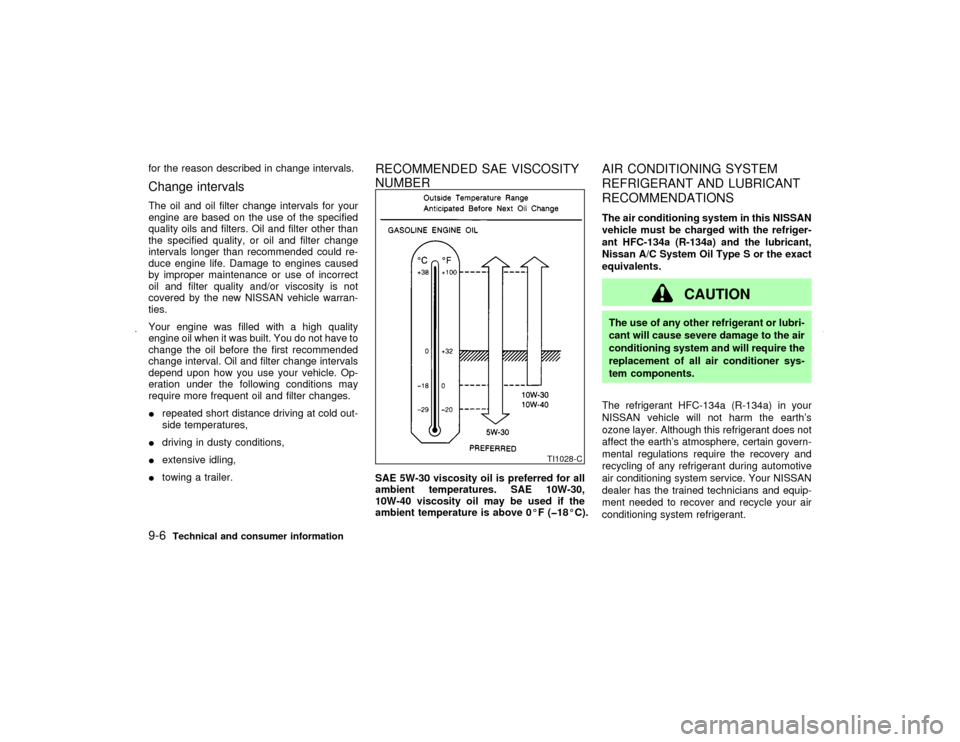
change. The recommended SAE viscosity
number chart shows the recommended oil
viscosities for the expected ambient tempera-
tures. Choosing an oil viscosity other than that
recommended could cause serious engine
damage.Selecting the correct oil filterYour new vehicle is equipped with a high-
quality genuine NISSAN oil filter. When replac-
ing, use the genuine oil filter or its equivalent
STI0293
Technical and consumer information
9-5
Z
01.9.21/A33-D/V5.0
X
Page 221 of 247
for the reason described in change intervals.Change intervalsThe oil and oil filter change intervals for your
engine are based on the use of the specified
quality oils and filters. Oil and filter other than
the specified quality, or oil and filter change
intervals longer than recommended could re-
duce engine life. Damage to engines caused
by improper maintenance or use of incorrect
oil and filter quality and/or viscosity is not
covered by the new NISSAN vehicle warran-
ties.
Your engine was filled with a high quality
engine oil when it was built. You do not have to
change the oil before the first recommended
change interval. Oil and filter change intervals
depend upon how you use your vehicle. Op-
eration under the following conditions may
require more frequent oil and filter changes.
Irepeated short distance driving at cold out-
side temperatures,
Idriving in dusty conditions,
Iextensive idling,
Itowing a trailer.
RECOMMENDED SAE VISCOSITY
NUMBERSAE 5W-30 viscosity oil is preferred for all
ambient temperatures. SAE 10W-30,
10W-40 viscosity oil may be used if the
ambient temperature is above 0ÉF (þ18ÉC).
AIR CONDITIONING SYSTEM
REFRIGERANT AND LUBRICANT
RECOMMENDATIONSThe air conditioning system in this NISSAN
vehicle must be charged with the refriger-
ant HFC-134a (R-134a) and the lubricant,
Nissan A/C System Oil Type S or the exact
equivalents.
CAUTION
The use of any other refrigerant or lubri-
cant will cause severe damage to the air
conditioning system and will require the
replacement of all air conditioner sys-
tem components.
The refrigerant HFC-134a (R-134a) in your
NISSAN vehicle will not harm the earth's
ozone layer. Although this refrigerant does not
affect the earth's atmosphere, certain govern-
mental regulations require the recovery and
recycling of any refrigerant during automotive
air conditioning system service. Your NISSAN
dealer has the trained technicians and equip-
ment needed to recover and recycle your air
conditioning system refrigerant.
TI1028-C
9-6
Technical and consumer information
Z
01.9.21/A33-D/V5.0
X
Page 233 of 247

trailer is hitched. Do not drive the vehicle if
it has an abnormal nose-up or nose-down
condition; check for improper tongue load,
overload, worn suspension or other pos-
sible causes of either condition.
IAlways secure items in the trailer to prevent
load shifts while driving.
IBe certain your rear view mirrors conform to
all federal, state or local regulations. If not,
install any mirrors required for towing be-
fore driving the vehicle.
Trailer towing tipsIn order to gain skill and an understanding of
the vehicle's behavior, you should practice
turning, stopping and backing up in an area
which is free from traffic. Steering stability, and
braking performance will be somewhat differ-
ent than under normal driving conditions.
IAlways secure items in the trailer to prevent
load shift while driving.
IAvoid abrupt starts, acceleration or stops.
IAvoid sharp turns or lane changes.
IAlways drive your vehicle at a moderate
speed.
IAlways block the wheels on both vehicle
and trailer when parking. Parking on aslope is not recommended; however, if you
must do so, and if your vehicle is equipped
with automatic transmission, first block the
wheels and apply the parking brake, and
then move the transmission selector lever
into the P (Park) position. If you move the
selector lever to the P (Park) position be-
fore blocking the wheels and applying the
parking brake, transmission damage could
occur.
IWhen going down a hill, shift into a lower
gear and use the engine braking effect.
When ascending a long grade, downshift
the transmission to a lower gear and reduce
speed to reduce chances of engine over-
loading and/or overheating.
IIf the engine coolant rises to an extremely
high temperature when the air conditioning
system is on, turn off the air conditioner.
Coolant heat can be additionally vented by
opening the windows, switching the fan
control to high and setting the temperature
control to the HOT position.
ITrailer towing requires more fuel than nor-
mal circumstances.
IAvoid towing a trailer for the first 500 miles
(800 km).
IHave your vehicle serviced more often thanat intervals specified in the recommended
maintenance schedule.
IWhen making a turn, your trailer wheels will
be closer to the inside of the turn than your
vehicle wheels. To compensate for this,
make a larger than normal turning radius
during the turn.
ICrosswinds and rough roads will adversely
affect vehicle/trailer handling, possibly
causing vehicle sway. When being passed
by larger vehicles, be prepared for possible
changes in crosswinds that could affect
vehicle handling. If swaying does occur,
firmly grip the steering wheel, steer straight
ahead, and immediately (but gradually) re-
duce vehicle speed. This combination will
help stabilize the vehicle. Never increase
speed.
IBe careful when passing other vehicles.
Passing while towing a trailer requires con-
siderably more distance than normal pass-
ing. Remember the length of the trailer
must also pass the other vehicle before you
can safely change lanes.
ITo maintain engine braking efficiency and
electrical charging performance, do not use
fifth gear (manual transmission) or over-
drive (automatic transmission).9-18
Technical and consumer information
Z
01.9.21/A33-D/V5.0
X
Page 234 of 247
IAvoid holding the brake pedal down too
long or too frequently. This could cause the
brakes to overheat, resulting in reduced
braking efficiency.
When towing a trailer, change oil in the
transmission more frequently. See the
ªService and Maintenance Guideº.DOT (Department Of Transportation) Quality
Grades: All passenger car tires must conform
to federal safety requirements in addition to
these grades.
Quality grades can be found where applicable
on the tire sidewall between tread shoulder
and maximum section width. For example:
Treadwear 200 Traction AA Temperature A
TreadwearTreadwear grade is a comparative rating
based on tire wear rate when tested under
controlled conditions on specified government
test courses. For example, a tire graded 150
would wear one and a half (1-1/2) times as well
on the government course as a tire graded
100. However, relative tire performance de-
pends on actual driving conditions, and may
vary significantly from the norm due to varia-
tions in driving habits, service practices and
differences in road characteristics and climate.Traction AA, A, B and CThe traction grades, from highest to lowest,
are AA, A, B, and C. Those grades represent
the tire's ability to stop on wet pavement as
measured under controlled conditions on
specified government test surfaces of asphaltand concrete. A tire marked C may have poor
traction performance.
WARNING
The traction grade assigned to your ve-
hicle tires is based on straight-ahead
braking traction tests, and does not in-
clude acceleration, cornering, hydro-
planing, or peak traction characteristics.Temperature A, B and CTemperature grades are A (the highest), B,
and C. They represent a tire's resistance to
heat build-up, and its ability to dissipate heat
when tested under controlled conditions on a
specified indoor laboratory test wheel. Sus-
tained high temperature can cause tire mate-
rial to degenerate, reducing tire life. Excessive
temperatures can lead to sudden tire failure.
Grade C corresponds to a performance level
which all passenger car tires must meet under
the Federal Motor Vehicle Safety Standard No.
109. Grades A and B represent higher levels of
performance on laboratory test wheels than
the minimum required by law.
UNIFORM TIRE QUALITY
GRADING
Technical and consumer information
9-19
Z
01.9.21/A33-D/V5.0
X
Page 236 of 247

Due to legal requirements in some states/
areas, your vehicle may be required to be in
what is called the ready condition for an
Inspection/Maintenance (I/M) test of the emis-
sion control system.
The vehicle is set to the ready condition when
it is driven through certain driving patterns.
Usually, the ready condition can be obtained
by ordinary usage of the vehicle.
If a powertrain system component is repaired
or the battery is disconnected, the vehicle may
be reset to a not ready condition. Before taking
the I/M test, drive the vehicle through the
following pattern to set the vehicle to the ready
condition. If you cannot or do not want to
perform the driving pattern, an NISSAN dealer
can conduct it for you.
WARNING
Always drive the vehicle in a safe and
prudent manner according to traffic con-
ditions, and obey all traffic laws.
1. Start the engine when the engine coolant
temperature gauge needle points to C. Al-
low the engine to idle until the gauge needlepoints between the C and H (normal oper-
ating temperature).
2. Accelerate the vehicle to 55 MPH (88
km/h), then quickly release the accelerator
pedal completely and keep it released for at
least 6 seconds.
3. Quickly depress the accelerator pedal for a
moment, then drive the vehicle at a speed
of 53 to 60 MPH (86 to 96 km/h) for at least
5 minutes.
4. Stop the vehicle.
5. Accelerate the vehicle to 35 MPH (55 km/h)
and maintain the speed for 20 seconds.
6. Repeat steps 4 and 5 at least 3 times.
7. Accelerate the vehicle to 55 MPH (88 km/h)
and maintain the speed for at least 3 min-
utes.
8. Stop the vehicle (shift lever in the ªPº or ªNº
position).
9. Rev the engine up between 2,500 and
3,500 rpm and hold it for 3 consecutive
minutes, then release the accelerator pedal
completely.
10.Wait 5 second at idle.
11.Rev the engine up between 2,000 and3,000 rpm and maintain it for 5 consecutive
minutes.
12.Turn the engine off.
13.Repeat steps 1 through 8 at least one more
time.
If step 1 through 7 is interrupted, repeat the
preceding step. Any safe driving mode is ac-
ceptable between steps. Do not stop the en-
gine until step 7 is completed.READINESS FOR INSPECTION/
MAINTENANCE (I/M) TEST (US
only)
Technical and consumer information
9-21
Z
01.9.21/A33-D/V5.0
X
Page 242 of 247

Engine coolant temperature gauge ............. 2-5
Fuel gauge .................................................. 2-5
Odometer..................................................... 2-4
Speedometer ............................................... 2-4
Tachometer ................................................. 2-4
General maintenance ....................................... 8-2
Glasses case .................................................. 2-24
Glove box........................................................ 2-25
Glove box lock ................................................ 2-25
H
Hazard warning flasher switch........................ 2-19
Head restraints ................................................. 1-6
Headlights
Bulb replacement ...................................... 8-27
Headlight switch ........................................ 2-17
Xenon headlights....................................... 2-16
Heated seats................................................... 2-20
Heated steering wheel (if so equipped).......... 2-21
Heater
Engine coolant heater ............................... 5-21
Heater and air conditioner controls ............. 4-3
Heater operation.......................................... 4-3
Heater operation, Semiautomatic air
conditioner ........................................................ 4-4
Hood, release ................................................. 3-10
Horn ................................................................ 2-20
How to stop alarm, Vehicle security ............... 2-13
I
Ignition switch ................................................... 5-4Automatic transmission models ........... 5-4, 5-8
Key positions ............................................... 5-6
Manual transmission models ............. 5-5, 5-11
Immobilizer system ......................................... 2-13
Indicator lights................................................. 2-10
Inspection/maintenance (I/M) test................... 9-21
Instrument panel ............................................... 2-2
Interior light ..................................................... 2-32
Interior light replacement ................................ 8-28
Interior trunk lid release .................................. 3-12
ISOFIX child restraint ..................................... 1-34
J
Jump starting .................................................... 6-6
K
Keys .................................................................. 3-2
L
Label, Air conditioner specification label ........ 9-12
Label, Emission control information label ....... 9-11
Label, F.M.V.S.S. certification label................ 9-11
Labels
Air bag warning labels............................... 1-18
Engine serial number ................................ 9-11
Vehicle identification number (VIN)........... 9-10
LATCH system................................................ 1-34
License plate, Installing front license plate..... 9-13
Light
Air bag warning light ................................. 1-18Bulb replacement ...................................... 8-26
Fog light switch ......................................... 2-19
Headlight switch ........................................ 2-17
Headlights Bulb replacement .................... 8-27
Interior light................................................ 2-32
Personal light............................................. 2-33
Replacement ............................................. 8-26
Trunk light.................................................. 2-34
Vanity mirror light ...................................... 2-34
Warning/indicator lights and audible
reminders ........................................... 2-7, 2-10
Xenon headlights....................................... 2-16
Lights, Exterior and interior light
replacement .................................................... 8-28
Loading information (See vehicle loading
information) ..................................................... 9-14
Lock
Door locks ................................................... 3-2
Glove box lock........................................... 2-25
Power door lock .......................................... 3-2
Trunk lid lock opener lever........................ 3-10
Low fuel warning light ....................................... 2-9
M
Maintenance
Battery ....................................................... 8-15
General maintenance .................................. 8-2
Inside the vehicle ........................................ 8-3
Maintenance precautions ............................ 8-5
Outside the vehicle...................................... 8-2
Seat belt maintenance .............................. 1-26
Meters and gauges ........................................... 2-3
Z
01.9.21/A33-D/V5.0
X
10-3