child restraint NISSAN MAXIMA 2005 A34 / 6.G Owner's Guide
[x] Cancel search | Manufacturer: NISSAN, Model Year: 2005, Model line: MAXIMA, Model: NISSAN MAXIMA 2005 A34 / 6.GPages: 288, PDF Size: 4.71 MB
Page 55 of 288
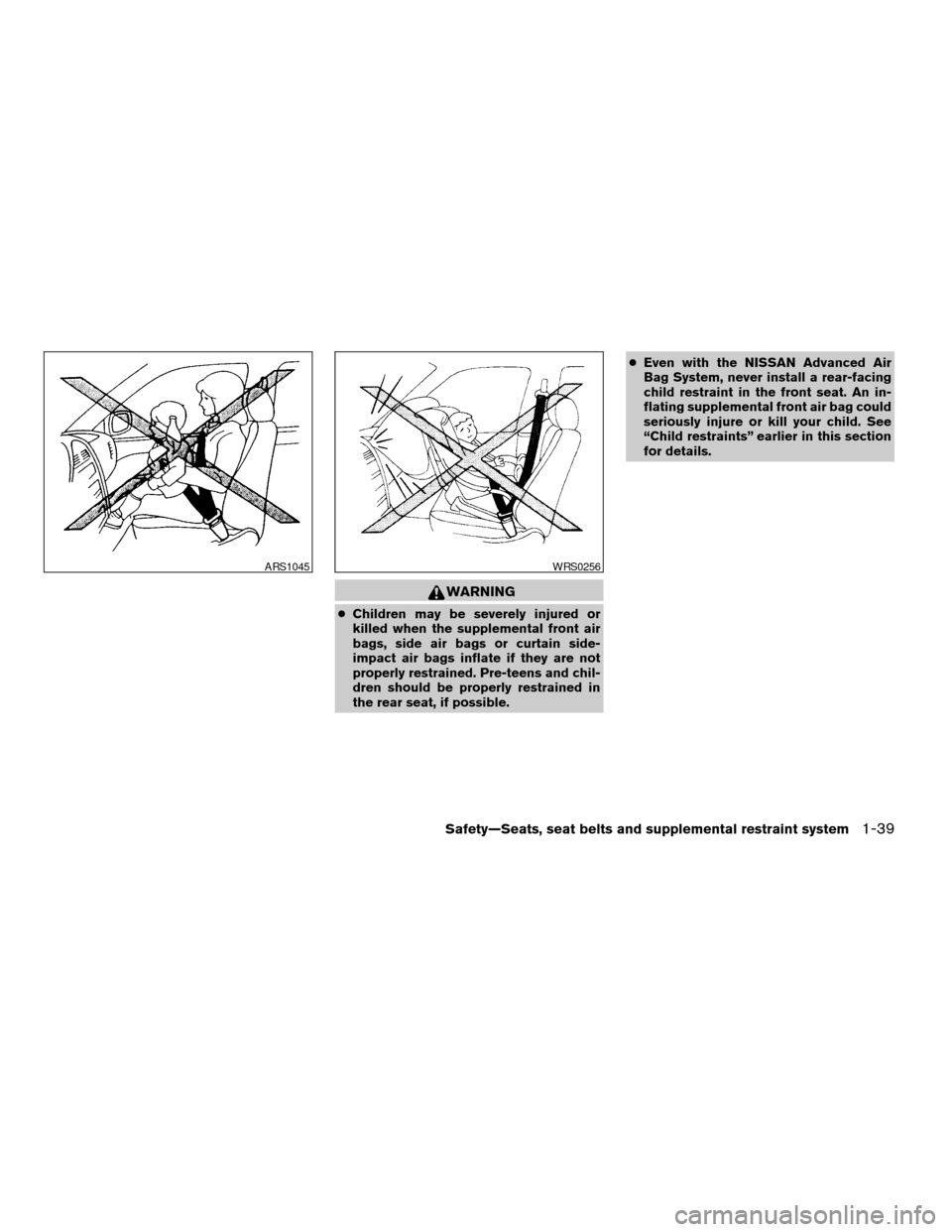
WARNING
cChildren may be severely injured or
killed when the supplemental front air
bags, side air bags or curtain side-
impact air bags inflate if they are not
properly restrained. Pre-teens and chil-
dren should be properly restrained in
the rear seat, if possible.cEven with the NISSAN Advanced Air
Bag System, never install a rear-facing
child restraint in the front seat. An in-
flating supplemental front air bag could
seriously injure or kill your child. See
“Child restraints” earlier in this section
for details.
ARS1045WRS0256
Safety—Seats, seat belts and supplemental restraint system1-39
ZREVIEW COPYÐ2005 Maxima(max)
Owners ManualÐUSA_English(nna)
09/01/04Ðtbrooks
X
Page 57 of 288
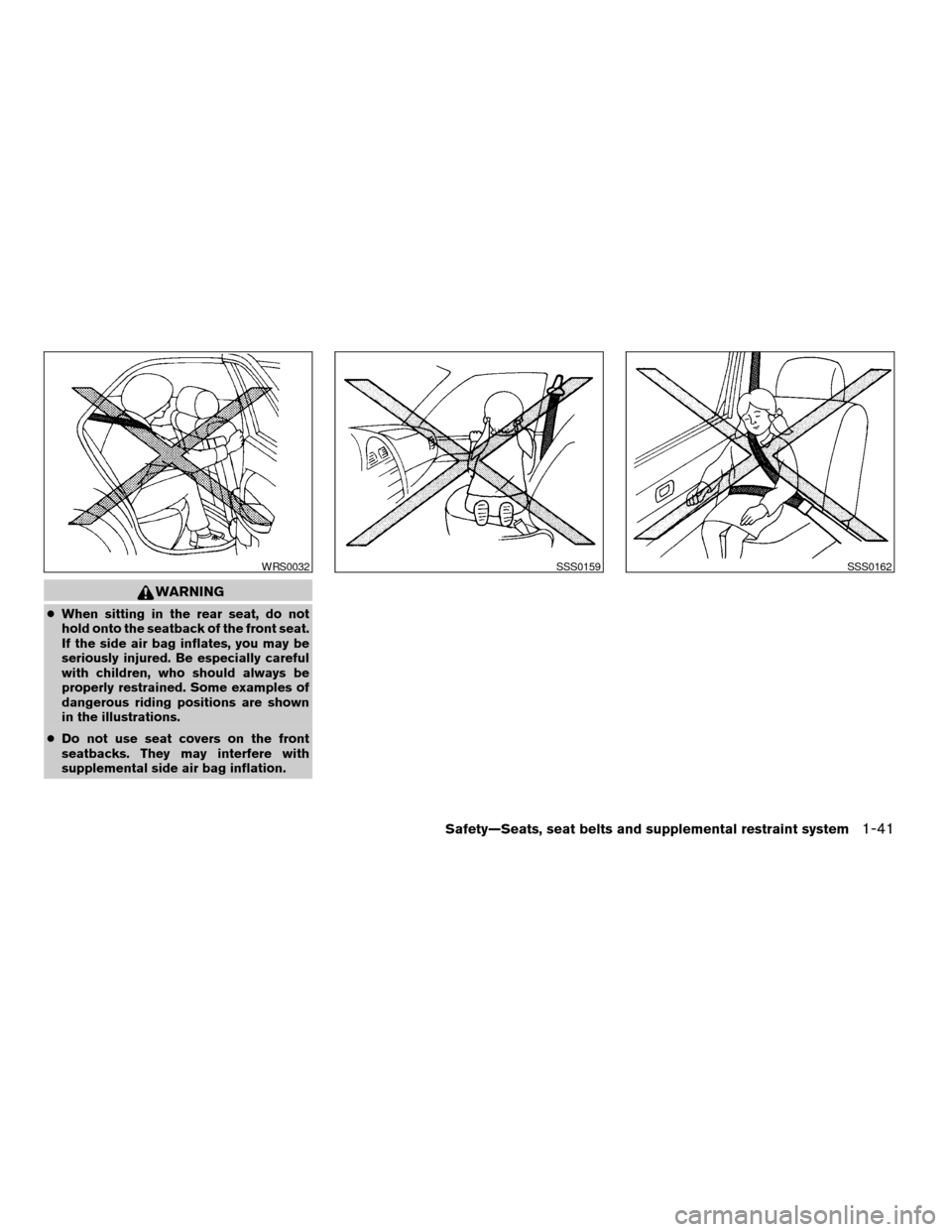
WARNING
cWhen sitting in the rear seat, do not
hold onto the seatback of the front seat.
If the side air bag inflates, you may be
seriously injured. Be especially careful
with children, who should always be
properly restrained. Some examples of
dangerous riding positions are shown
in the illustrations.
cDo not use seat covers on the front
seatbacks. They may interfere with
supplemental side air bag inflation.
WRS0032SSS0159SSS0162
Safety—Seats, seat belts and supplemental restraint system1-41
ZREVIEW COPYÐ2005 Maxima(max)
Owners ManualÐUSA_English(nna)
09/01/04Ðtbrooks
X
Page 59 of 288
tension sensor. Inflator operation is based on the
severity of a collision and seat belt usage for the
driver. For the front passenger, it additionally
monitors the weight of an occupant or object on
the seat and seat belt tension. Based on informa-
tion from the sensors, only one front air bag may
inflate in a crash, depending on the crash severity
and whether the front occupants are belted or
unbelted. Additionally, the front passenger air
bag may be automatically turned OFF under
some conditions, depending on the weight de-
tected on the passenger seat and how the seat
belt is used. If the front passenger air bag is OFF,
the passenger air bag status light will be illumi-
nated. See “Front passenger air bag and status
light” later in this section for further details. One
front air bag inflating does not indicate improper
performance of the system.
If you have any questions about your air bag
system, please contact NISSAN or your NISSAN
dealer. If you are considering modification of your
vehicle due to a disability, you may also contact
NISSAN. Contact information is contained in the
front of this Owner’s Manual.
When a supplemental front air bag inflates, a
fairly loud noise may be heard, followed by the
release of smoke. This smoke is not harmful and
does not indicate a fire. Care should be taken to
not inhale it, as it may cause irritation and chok-ing. Those with a history of a breathing condition
should get fresh air promptly.
Supplemental front air bags, along with the use of
seat belts, help to cushion the impact force on
the face and chest of the front occupants. They
can help save lives and reduce serious injuries.
However, an inflating front air bag may cause
facial abrasions or other injuries. Front air bags
do not provide restraint to the lower body.
Even with NISSAN advanced air bags, seat belts
should be correctly worn and the driver and pas-
senger seated upright as far as practical away
from the steering wheel or instrument panel. The
supplemental front air bags inflate quickly in order
to help protect the front occupants. Because of
this, the force of the front air bag inflating can
increase the risk of injury if the occupant is too
close to, or is against, the front air bag module
during inflation.
The front air bags deflate quickly after a collision.
The supplemental front air bags operate
only when the ignition switch is in the ON
or START position.
After turning the ignition key to the ON
position, the supplemental air bag warning
light illuminates. The supplemental air bag
warning light will turn off after about 7
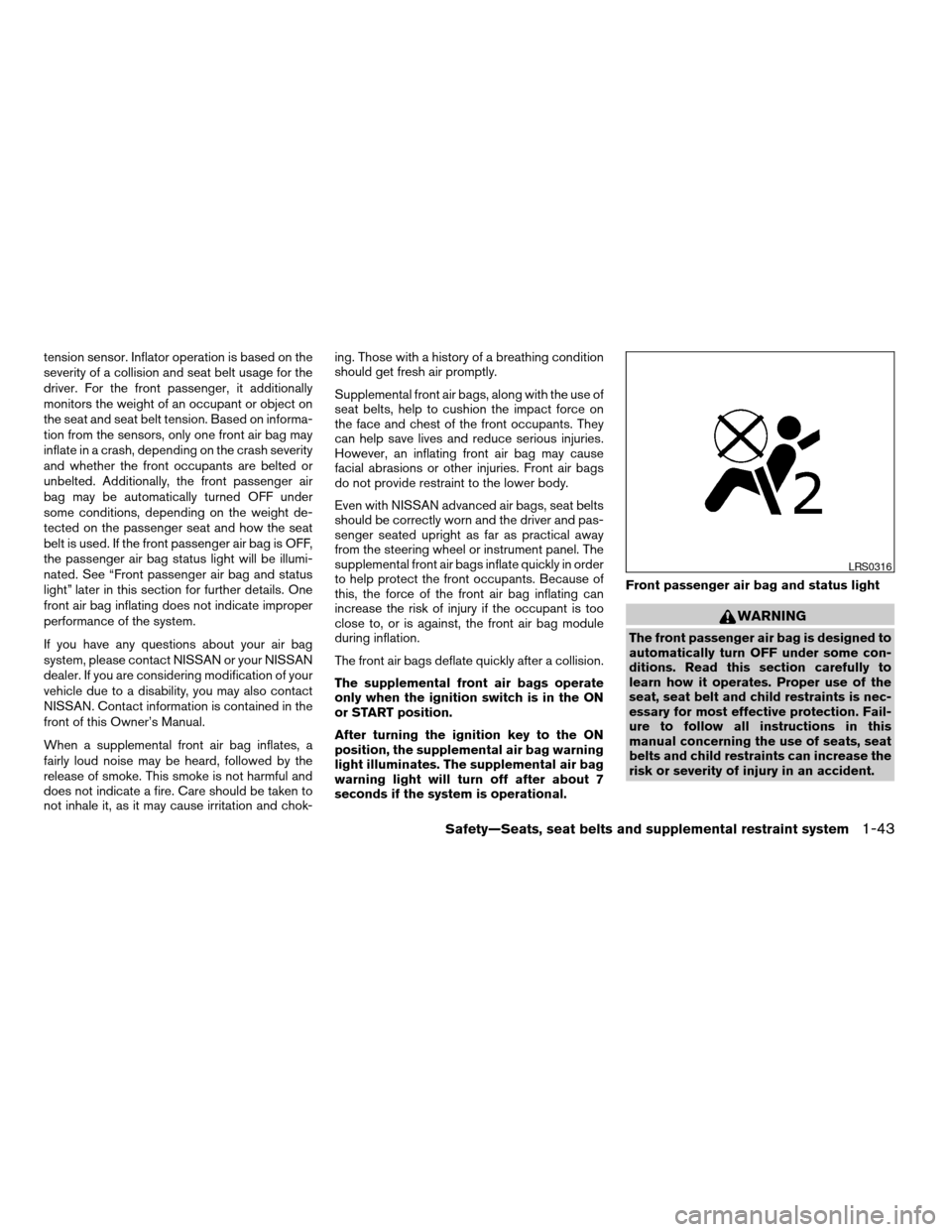
seconds if the system is operational.Front passenger air bag and status light
WARNING
The front passenger air bag is designed to
automatically turn OFF under some con-
ditions. Read this section carefully to
learn how it operates. Proper use of the
seat, seat belt and child restraints is nec-
essary for most effective protection. Fail-
ure to follow all instructions in this
manual concerning the use of seats, seat
belts and child restraints can increase the
risk or severity of injury in an accident.
LRS0316
Safety—Seats, seat belts and supplemental restraint system1-43
ZREVIEW COPYÐ2005 Maxima(max)
Owners ManualÐUSA_English(nna)
09/01/04Ðtbrooks
X
Page 60 of 288

Status light
The front passenger air bag status light
is
located on the dash next to the security light near
the windshield. The light operates as follows:
cUnoccupied passenger seat or when other
conditions are met as outlined in this sec-
tion: The
illuminates to indicate that
the front passenger air bag is OFF and will
not inflate in a crash.
cOccupied passenger seat and the passen-
ger meets the conditions outlined in this
section: The light
is OFF to indicate
that the front passenger air bag is opera-
tional.
Front passenger air bag
The front passenger air bag is designed to auto-
matically turn OFF when the vehicle is operated
under some conditions as described below in
accordance with U.S. regulations. If the front
passenger air bag is OFF, it will not inflate in a
crash. The driver air bag and other air bags in your
vehicle are not part of this system.
The purpose of the regulation is to help reduce
the risk of injury or death from an inflating air bag
to certain front passenger seat occupants, such
as children, by requiring the air bag to be auto-
matically turned OFF. Certain sensors are used
to meet the requirements.One sensor used is the occupant classification
sensor (weight sensor) . It is in the bottom of the
front passenger seat cushion and is designed to
detect an occupant and objects on the seat by
weight. It works together with seat belt sensors
described later. For example, if a child is in the
front passenger seat, the advanced air bag sys-
tem is designed to turn the passenger air bag
OFF in accordance with the regulations. Also, if a
child restraint of the type specified in the regula-
tions is on the seat, its weight and the child’s
weight can be detected and cause the air bag to
turn OFF. Weight sensor operation can vary de-
pending on the front passenger seat belt sen-
sors.
The front passenger seat belt sensors are de-
signed to detect if the seat belt is buckled and the
amount of tension on the seat belt, such as when
it is in the automatic locking mode (child restraint
mode) . Based on the weight on the seat detected
by the weight sensor and the belt tension de-
tected on the seat belt, the advanced air bag
system determines whether the front passenger
air bag should be automatically turned OFF as
required by the regulations.
Front passenger seat adult occupants who are
properly seated and using the seat belt as out-
lined in this manual should not cause the passen-
ger air bag to be automatically turned OFF. For
small adults it may be turned OFF. Also, if theoccupant takes his/her weight off the seat cush-
ion (for example, by not sitting upright, by sitting
on an edge of the seat, or by otherwise being out
of position) , this could cause the sensor to turn
the air bag OFF. In addition, if the occupant
improperly uses the seat belt in the automatic
locking mode (child restraint mode) , this could
cause the air bag to be turned OFF. Always be
sure to be seated and wearing the seat belt
properly for the most effective protection by the
seat belt and supplemental air bag.
NISSAN recommends that pre-teens and chil-
dren be properly restrained in a rear seat.
NISSAN also recommends that appropriate child
restraints and booster seats be properly installed
in a rear seat. If this is not possible, the weight
sensor and seat belt sensors are designed to
operate as described above to turn the front
passenger air bag OFF for specified child re-
straints as required by the regulations. Failing to
properly secure child restraints and to use the
automatic locking mode (child restraint mode)
may allow the restraint to tip or move in an acci-
dent or sudden stop. This can also result in the
passenger air bag inflating in a crash instead of
being OFF. See “Child restraints” earlier in this
section for proper use and installation.
If the front passenger seat is not occupied and
the seat belt is not buckled, the passenger air bag
is designed not to inflate in a crash. However,
1-44Safety—Seats, seat belts and supplemental restraint system
ZREVIEW COPYÐ2005 Maxima(max)
Owners ManualÐUSA_English(nna)
09/01/04Ðtbrooks
X
Page 61 of 288
heavy objects placed on the seat could result in
air bag inflation, because of the object’s weight
detected by the weight sensor. Other conditions
could also result in air bag inflation, such as if a
child is standing on the seat, or if two children are
on the seat, contrary to the instructions in this
manual. Always be sure that you and all vehicle
occupants are seated and restrained properly.
Using the passenger air bag status light, you can
monitor when the front passenger air bag is au-
tomatically turned OFF. The light will illuminate
(indicating the air bag is OFF and will not inflate)
when the front passenger seat is not occupied.
If an adult occupant is in the seat and the pas-
senger air bag status light is illuminated (indicat-
ing that the air bag is OFF) , it could be that the
person is a small adult, or is not sitting on the seat
or not using the seat belt properly. If a child
restraint must be used in the front seat, but the
status light is not lit (indicating that the air bag
might inflate in a crash) , it could be that the child
restraint or seat belt is not being used properly. If
such situations happen, properly position and
restrain the occupant or child restraint. Other-
wise reposition the occupant or child restraint in
a rear seat.
If a malfunction occurs in the front passenger air
bag system, the supplemental air bag warning
light
, located in the meter and gauges areain the center of the instrument panel, will blink.
Have the system checked by a NISSAN dealer.
Other supplemental front air bag precau-
tions
WARNING
cDo not place any objects on the steer-
ing wheel pad or on the instrument
panel. Also, do not place any objects
between any occupant and the steering
wheel or instrument panel. Such ob-
jects may become dangerous projec-
tiles and cause injury if the supplemen-
tal front air bag inflates.
cImmediately after inflation, several
front air bag system components will be
hot. Do not touch them; you may se-
verely burn yourself.
cNo unauthorized changes should be
made to any components or wiring of
the supplemental air bag system. This is
to prevent accidental inflation of the
supplemental air bag or damage to the
supplemental air bag system.cDo not make unauthorized changes to
your vehicle’s electrical system, sus-
pension system or front end structure.
This could affect proper operation of
the supplemental front air bag system.
cTampering with the supplemental front
air bag system may result in serious
personal injury. Tampering includes
changes to the steering wheel and the
instrument panel assembly by placing
material over the steering wheel pad
and above the instrument panel or by
installing additional trim material
around the air bag system.
cModifying or tampering with the front
passenger seat may result in serious
personal injury. For example, do not
change the front seats by placing mate-
rial on the seat cushion or by installing
additional trim material, such as seat
covers, on the seat that are not specifi-
cally designed to assure proper air bag
operation. Additionally, do not stow any
objects under the front passenger seat
or the seat cushion and seatback. Such
objects may interfere with the proper
operation of the occupant classifica-
tion system (weight sensor) .
Safety—Seats, seat belts and supplemental restraint system1-45
ZREVIEW COPYÐ2005 Maxima(max)
Owners ManualÐUSA_English(nna)
09/01/04Ðtbrooks
X
Page 107 of 288
Auto reverse function (when closing or
tilting down the sunroof)
The auto reverse function can be activated when
the sunroof is closed or tilted down by automatic
operation when the ignition key is in the ON
position or for about 45 seconds after the ignition
key is turned to the OFF position.
Depending on the environment or driving
conditions, the auto reverse function may
be activated if an impact or load similar to
something being caught in the sunroof oc-
curs.
WARNING
There are some small distances immedi-
ately before the closed position which
cannot be detected. Make sure that all
passengers have their hands, etc., inside
the vehicle before closing the sunroof.
When closing:
If the control unit detects something caught in the
sunroof as it moves to the front, the sunroof will
immediately open backward.
When tilting down:
If the control unit detects something caught in the
sunroof as it tilts down, the sunroof will immedi-
ately tilt up.If the auto reverse function malfunctions and re-
peats opening or tilting up the sunroof, keep
pushing the tilt down switch within 5 seconds
after it happens, then the sunroof will fully close
gradually. In this case, make sure nothing is
caught in the sunroof.
WARNING
cIn an accident you could be thrown from
the vehicle through an open sunroof.
Always use seat belts and child
restraints.
cDo not allow anyone to stand up or
extend any portion of their body out of
the sunroof opening while the vehicle is
in motion or while the sunroof is
closing.
CAUTION
cRemove water drops, snow, ice or sand
from the sunroof before opening.
cDo not place heavy objects on the sun-
roof or surrounding area.
Sunshade
Open and close the sunshade by sliding it for-
ward or backward.
If the sunroof does not close
Have your NISSAN dealer check and repair the
sunroof.
Instruments and controls2-39
ZREVIEW COPYÐ2005 Maxima(max)
Owners ManualÐUSA_English(nna)
09/01/04Ðtbrooks
X
Page 279 of 288

10 Index
A
Active head restraint...............1-9
Air bag (See supplemental restraint
system).....................1-35
Air bag system
Front (See supplemental front impact
air bag system)...............1-42
Air bag warning light...........1-49, 2-11
Air cleaner housing filter............8-16
Air conditioner
Air conditioner service...........4-20
Air conditioner specification label.....9-11
Air conditioner system refrigerant and
lubrication recommendations........9-6
Servicing air conditioner..........4-20
Alarm system
(See vehicle security system).........2-14
Anchor point locations.............1-27
Antenna.....................4-33
Anti-lock brake system (ABS).........5-18
Anti-lock brake warning light..........2-9
Armrests.....................1-7
Audible reminders................2-14
Audio system..................4-20
AM-FM radio with cassette player.....4-27
Cassette player...............4-27
Compact Disc (CD) changer.......4-30
Compact disc (CD) player.........4-28
FM-AM-SAT radio with cassette player and
compact disc (CD) changer........4-24FM-AM-SAT radio with cassette player and
compact disc (CD) player.........4-24
Radio....................4-20
Steering wheel audio control switch. . . .4-32
Autolight switch.................2-20
Automatic
Automatic drive positioner.........3-19
Automatic power window switch.....2-37
Driving with automatic transmission.....5-7
Transmission selector lever lock release .5-10
B
Battery......................8-13
Charge warning light............2-10
Battery replacement
(See remote keyless entry system)......8-25
Before starting the engine............5-6
Belts (See drive belts).............8-15
Brake
Anti-lock brake system (ABS).......5-18
Brake booster................8-21
Brake fluid..................8-11
Brake light (See stop light).........8-26
Brake pedal.................8-20
Brake system................5-17
Brake warning light.............2-10
Brake wear indicators........2-14, 8-21
Parking brake check............8-20
Parking brake operation..........5-12
Self-adjusting brakes............8-21Break-in schedule................5-14
Brightness control
Instrument panel..............2-22
Brightness/Contrast button........4-6, 4-16
Control panel buttons.........4-6, 4-16
Bulb check/instrument panel..........2-9
Bulb replacement................8-26
C
Capacities and recommended fuel/lubricants. .9-2
Car phone or CB radio.............4-33
Cargo (See vehicle loading information) . . .9-12
Cassette player (See audio system)......4-27
CD care and cleaning.............4-31
CD changer (See audio system)........4-30
CD player (See audio system).........4-28
Check engine indicator light
(See malfunction indicator lamp).......2-12
Child restraint with top tether strap......1-26
Child restraints.......1-12, 1-13, 1-18, 1-25
Precautions on child restraints . . .1-18, 1-31
Top tether strap anchor point locations . .1-27
Child safety rear door lock............3-5
Chimes, audible reminders...........2-14
Cigarette lighter.................2-28
Cleaning exterior and interior..........7-2
Clock
(models with navigation system)......4-14
(models without navigation system).....4-4
Clock set
Control panel buttons.........4-4, 4-14
ZREVIEW COPYÐ2005 Maxima(max)
Owners ManualÐUSA_English(nna)
09/01/04Ðtbrooks
X
Page 281 of 288

Fuel recommendation............9-3
FUEL ECON button............4-4, 4-9
Fuel Econ button
Control panel buttons..........4-4, 4-9
Fuses......................8-21
Fusible links...................8-23
G
Garage door opener, HomeLinkTUniversal
Transceiver...................2-43
Gascap.....................3-12
Gauge
Engine coolant temperature gauge.....2-5
Fuel gauge..................2-6
Odometer...................2-4
Speedometer.................2-4
Tachometer..................2-5
Trip odometer.................2-4
General maintenance..............8-2
Glove box....................2-32
Glove box lock.................2-32
Grocery hooks.................2-34
H
Hazard warning flasher switch.........2-24
Head restraints..................1-8
Active head restraint.............1-9
Headlight and turn signal switch........2-19
Heated seats..................2-25
Heated steering wheel.............2-26
Heater
Heater operation..............4-18HomeLinkTUniversal Transceiver.......2-43
Hood release...................3-9
Horn.......................2-24
I
Ignition switch..................5-4
Immobilizer system..........2-16, 3-2, 5-5
Important vehicle information label.......9-10
In-cabin microfilter...............8-16
Increasing fuel economy............5-15
Indicator lights and audible reminders
(See warning/indicator lights and audible
reminders).....................2-9
Instrument brightness control.........2-22
Instrument panel.................2-2
Interior light...................2-41
Interior trunk lid release.............3-11
ISOFIX child restraints.............1-25
J
Jump starting...................6-6
K
Key ........................3-2
Keyless entry system (See remote keyless entry
system)......................3-5L
Labels
Air conditioner specification label.....9-11
Emission control information label.....9-10
Engine serial number............9-10
F.M.V.S.S. certification label........9-10
Vehicle identification number (VIN) plate . .9-9
Warning labels (for SRS)..........1-49
LATCH (Lower Anchors and Tethers for CHildren)
System......................1-25
License plate
Installing the license plate.........9-11
Light
Air bag warning light.........1-49, 2-11
Brake light (See stop light).........8-26
Bulb check/instrument panel........2-9
Bulb replacement..............8-26
Charge warning light............2-10
Cornering light...............2-23
Fog light switch...............2-23
Headlight and turn signal switch......2-19
Interior light.................2-41
Light bulbs..................8-26
Low washer fluid warning light.......2-11
Passenger air bag and status light.....1-43
Personal lights...............2-42
Security indicator light...........1-43
Trunk light..................2-43
Warning/indicator lights and audible
reminders...................2-9
Lock
Child safety rear door lock..........3-5
Door locks..................3-3
Glove box lock...............2-32
10-3
ZREVIEW COPYÐ2005 Maxima(max)
Owners ManualÐUSA_English(nna)
09/01/04Ðtbrooks
X
Page 282 of 288

Power door locks...............3-4
Trunk lid lock opener lever..........3-9
Low fuel warning light.............2-11
Low washer fluid warning light.........2-11
Luggage (See vehicle loading information) . .9-12
M
Maint (maintenance) button
Control panel buttons..........4-5, 4-9
Maint (Maintenance) button, control panel
display....................4-5, 4-9
Maintenance
General maintenance............8-2
Inside the vehicle...............8-3
Maintenance precautions..........8-5
Outside the vehicle..............8-2
Seat belt maintenance...........1-17
Under the hood and vehicle.........8-4
Malfunction indicator lamp (MIL)........2-12
Manual front seat adjustment..........1-2
Map pocket...................2-29
Meters and gauges................2-3
Instrument brightness control.......2-22
Mirror
Outside mirror control...........3-17
Outside mirrors...............3-17
Vanity mirror.................3-16
Multi-remote control system
(See remote keyless entry system).......3-5N
Nissan vehicle immobilizer system (NVIS) . .2-16,
3-2, 5-5
O
Octane rating (See fuel octane rating).....9-4
Odometer.....................2-4
Oil
Capacities and recommended
fuel/lubricants.................9-2
Changing engine oil.............8-9
Changing engine oil filter..........8-10
Checking engine oil level..........8-8
Engine oil...................8-8
Engine oil and oil filter recommendation . .9-5
Engine oil pressure low/engine coolant
temperature high warning light.......2-10
Engine oil viscosity..............9-5
Outside mirror control.............3-17
Outside mirrors.................3-17
Overheat
If your vehicle overheats...........6-9
Owner’s manual order form..........9-22
Owner’s manual/service manual order
information....................9-22
P
Parking
Parking brake check............8-20
Parking brake operation..........5-12Parking/parking on hills...........5-16
Personal lights.................2-42
Power
Power door locks...............3-4
Power outlet.................2-27
Power rear windows............2-37
Power steering fluid.............8-11
Power steering system...........5-17
Power windows...............2-36
Rear power windows............2-37
Precautions
Maintenance precautions..........8-5
Precautions on child restraints . . .1-18, 1-31
Precautions on seat belt usage......1-10
Precautions on supplemental restraint
system....................1-35
Precautions when starting and driving . . .5-2
PREV button.................4-3, 4-8
Prev button
Control panel buttons..........4-3, 4-8
Programmable features.......4-8, 4-5, 4-11
Push starting...................6-8
R
Radio
AM-FM radio with cassette player.....4-27
Car phone or CB radio...........4-33
Compact Disc (CD) changer.......4-30
Steering wheel audio control switch. . . .4-32
Readiness for inspection maintenance (I/M)
test........................9-20
Rear power windows..............2-37
Rear seat.....................1-6
Rear sun shade.................2-40
10-4
ZREVIEW COPYÐ2005 Maxima(max)
Owners ManualÐUSA_English(nna)
09/01/04Ðtbrooks
X
Page 283 of 288

Rear window and outside mirror defroster
switch......................2-19
Recorders
Event data..................9-21
Refrigerant recommendation..........9-6
Registering your vehicle in another country. . .9-9
Remote keyless entry system..........3-5
Reporting safety defects (US only)......9-19
S
Safety
Child safety rear door lock..........3-5
Child seat belts...........1-18, 1-31
Reporting safety defects (US only). . . .9-19
Seat adjustment
Front manual seat adjustment........1-2
Front power seat adjustment........1-4
Seat belt
Child safety.................1-12
Infants and small children.........1-13
Injured Person................1-14
Larger children...............1-13
Precautions on seat belt usage......1-10
Pregnant women..............1-14
Seat belt extenders.............1-17
Seat belt maintenance...........1-17
Seat belts..................1-10
Shoulder belt height adjustment......1-16
Three-point type with retractor.......1-14
Seat belt warning light.............2-11
Seatback pockets................2-29
Seats
Adjustment..................1-2
Automatic drive positioner.........3-19Front seats..................1-2
Heated seats................2-25
Manual front seat adjustment........1-2
Rear seat...................1-6
Security indicator light.............1-43
Security system (Nissan vehicle immobilizer
system) , engine start.........2-16, 3-2, 5-5
Self-adjusting brakes..............8-21
Service manual order form...........9-22
Servicing air conditioner............4-20
Setting button
SETTING button............4-5, 4-11
Shift lock release................5-10
Shifting
Automatic transmission...........5-8
Manual transmission............5-11
Shoulder belt height adjustment........1-16
Spark plug replacement............8-15
Speedometer...................2-4
SRS warning label...............1-49
Starting
Before starting the engine..........5-6
Jump starting.................6-6
Precautions when starting and driving . . .5-2
Push starting.................6-8
Starting the engine..............5-6
Startup Screen
Control panel buttons............4-8
Startup screen display..............4-8
Steering
Heated steering wheel...........2-26
Power steering fluid.............8-11
Power steering system...........5-17
Steering wheel audio control switch......4-32
Stop light....................8-26
Storage.....................2-29Sun visors....................3-15
Sunglasses case................2-30
Sunglasses holder...............2-30
Sunroof.....................2-38
Supplemental air bag warning light . . .1-49, 2-11
Supplemental front impact air bag system . .1-42
Supplemental restraint system
Information and warning labels.......1-49
Precautions on supplemental restraint
system....................1-35
Supplemental restraint system
(Supplemental air bag system).........1-35
Switch
Autolight switch...............2-20
Automatic power window switch.....2-37
Fog light switch...............2-23
Hazard warning flasher switch.......2-24
Headlight and turn signal switch......2-19
Ignition switch................5-4
Power door lock switch...........3-4
Rear window and outside mirror defroster
switch....................2-19
Traction control system (TCS) off
switch....................2-26
Vehicle dynamic control (VDC) off
switch....................2-27
Windshield wiper and washer switch . . .2-18
T
Tachometer....................2-5
Temperature gauge
Engine coolant temperature gauge.....2-5
Engine oil pressure low/engine coolant
temperature high warning light.......2-10
10-5
ZREVIEW COPYÐ2005 Maxima(max)
Owners ManualÐUSA_English(nna)
09/01/04Ðtbrooks
X