manual transmission NISSAN MAXIMA 2013 A35 / 7.G User Guide
[x] Cancel search | Manufacturer: NISSAN, Model Year: 2013, Model line: MAXIMA, Model: NISSAN MAXIMA 2013 A35 / 7.GPages: 444, PDF Size: 3.18 MB
Page 424 of 444
Temperature conditions also can affect towing.
For example, towing a heavy trailer in high outside
temperatures on graded roads can affect engine
performance and cause overheating. The trans-
mission high fluid temperature protection mode,
which helps reduce the chance of transmission
damage, could activate and automatically de-
crease engine power. Under some conditions,
engine and vehicle speed could be reduced. Plan
your trip carefully to account for trailer and vehicle
load, weather, and road conditions.
WARNING
Overheating can result in reduced engine
power and lower vehicle speed. Also,
when the high temperature mode oper-
ates, engine and vehicle speed may be
gradually reduced. On highways, the re-
duced speed may be lower than other traf-
fic which could increase the chance of a
collision. Be especially careful when driv-
ing. If the vehicle cannot maintain a safe
driving speed, pull to the side of the road
in a safe area and allow the engine to cool
or the transmission to return to normal
operation. See “If your vehicle overheats”
in the “In case of emergency” section of
this manual.
CAUTION
Vehicle damage resulting from improper
towing procedures is not covered by
NISSAN warranties.
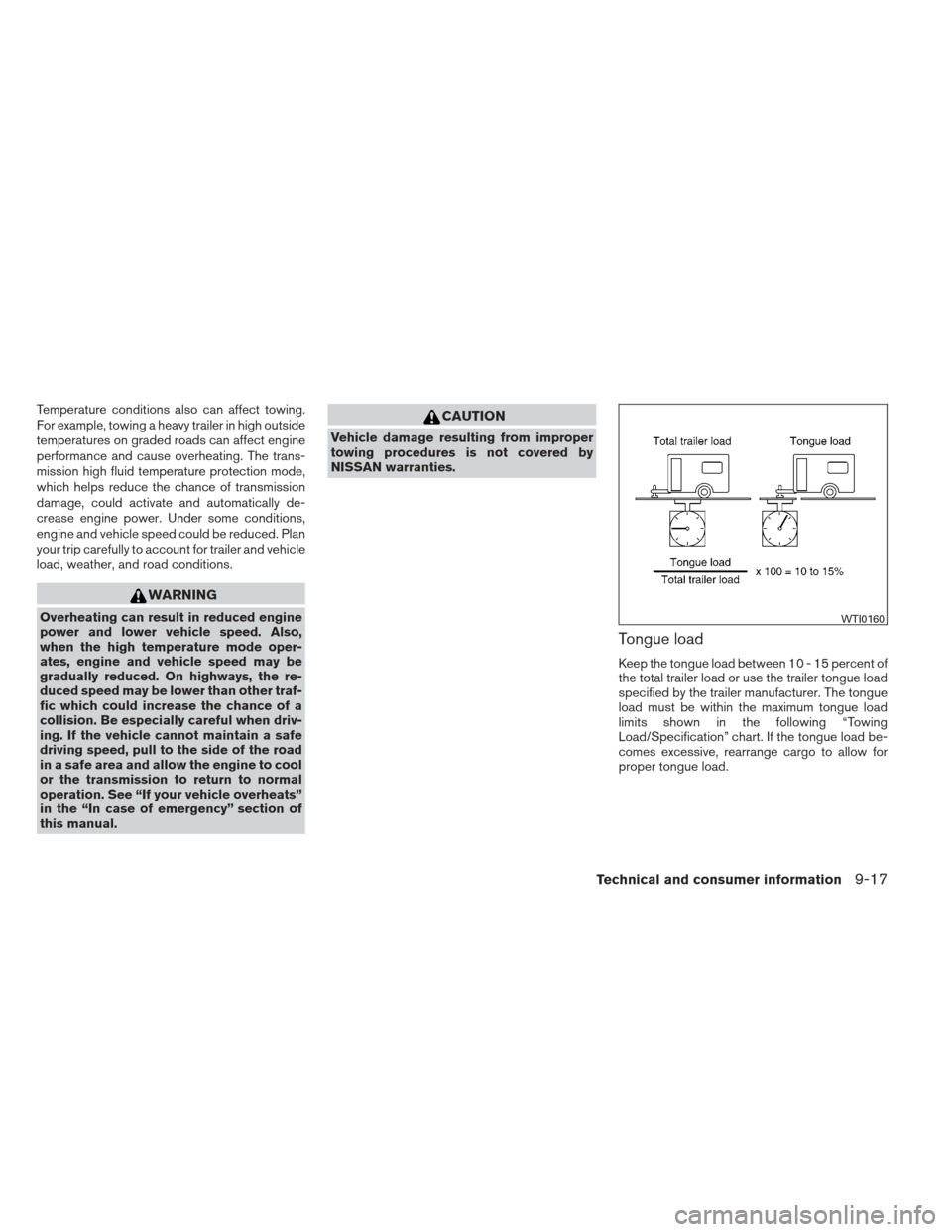
Tongue load
Keep the tongue load between 10 - 15 percent of
the total trailer load or use the trailer tongue load
specified by the trailer manufacturer. The tongue
load must be within the maximum tongue load
limits shown in the following “Towing
Load/Specification” chart. If the tongue load be-
comes excessive, rearrange cargo to allow for
proper tongue load.
WTI0160
Technical and consumer information9-17
Page 429 of 444
●When backing up, hold the bottom of the
steering wheel with one hand. Move your
hand in the direction in which you want the
trailer to go. Make small corrections and
back up slowly. If possible, have someone
guide you when you are backing up.
Always block the wheels on both vehicle and
trailer when parking. Parking on a slope is not
recommended; however, if you must do so:
CAUTION
If you move the shift selector to the P
(Park) position before blocking the
wheels and applying the parking brake,
transmission damage could occur.
1. Apply and hold the brake pedal.
2. Have someone place blocks on the downhill side of the vehicle and trailer wheels.
3. After the wheel blocks are in place, slowly release the brake pedal until the blocks ab-
sorb the vehicle load.
4. Apply the parking brake.
5. Shift the transmission into P (Park) .
6. Turn off the engine.
To drive away: 1. Start the vehicle. 2. Apply and hold the brake pedal.
3. Shift the transmission into gear.
4. Release the parking brake.
5. Drive slowly until the vehicle and trailer are
clear from the blocks.
6. Apply and hold the brake pedal.
7. Have someone retrieve and store the blocks. ● While going downhill, the weight of the
trailer pushing on the tow vehicle may de-
crease overall stability. Therefore, to main-
tain adequate control, reduce your speed
and use the manual shift mode (M5) . Avoid
long or repeated use of the brakes when
descending a hill, as this reduces their effec-
tiveness and could cause overheating. Shift-
ing the manual shift mode to M5 (5th) pro-
vides “engine braking” and reduces the need
to brake as frequently.
● If the engine coolant temperature rises to a
high temperature, refer to “If your vehicle
overheats” in the “In case of emergency”
section of this owner’s manual.
● Trailer towing requires more fuel than normal
circumstances.
● Avoid towing a trailer for your vehicle’s first
500 miles (805 km) . ●
For the first 500 miles (805 km) that you do
tow, do not drive over 50 MPH (80 km/h).
● Have your vehicle serviced more often than
at intervals specified in the recommended
Maintenance Schedule in the “NISSAN Ser-
vice and Maintenance Guide”.
● When making a turn, your trailer wheels will
be closer to the inside of the turn than your
vehicle wheels. To compensate for this,
make a larger than normal turning radius
during the turn.
● Crosswinds and rough roads will adversely
affect vehicle/trailer handling, possibly caus-
ing vehicle sway. When being passed by
larger vehicles, be prepared for possible
changes in crosswinds that could affect ve-
hicle handling.
Do the following if the trailer begins to sway: 1. Take your foot off the accelerator pedal to allow the vehicle to coast and steer as
straight ahead as the road conditions allow.
This combination will help stabilize the ve-
hicle.
– Do not correct trailer sway by steering or applying the brakes.
9-22Technical and consumer information
Page 430 of 444
2. When the trailer sway stops, gently apply thebrakes and pull to the side of the road in a
safe area.
3. Try to rearrange the trailer load so it is bal- anced as described earlier in this section.
● Be careful when passing other vehicles.
Passing while towing a trailer requires con-
siderably more distance than normal pass-
ing. Remember, the length of the trailer must
also pass the other vehicle before you can
safely change lanes.
● Downshift the transmission to a lower gear
for engine braking when driving down steep
or long hills. This will help slow the vehicle
without applying the brakes.
● Avoid holding the brake pedal down too long
or too frequently. This could cause the
brakes to overheat, resulting in reduced
braking efficiency.
● Increase your following distance to allow for
greater stopping distances while towing a
trailer. Anticipate stops and brake gradually.
● NISSAN recommends that the cruise con-
trol not be used while towing a trailer. ●
Some states or provinces have specific
regulations and speed limits for vehicles that
are towing trailers. Obey the local speed
limits.
● Check your hitch, trailer wiring harness con-
nections, and trailer wheel lug nuts after
50 miles (80 km) of travel and at every break.
● When launching a boat, don’t allow the wa-
ter level to go over the exhaust tail pipe or
rear bumper.
● Make sure you disconnect the trailer lights
before backing the trailer into the water or
the trailer lights may burn out.
When towing a trailer, transmission fluid
should be changed more frequently. For
additional information, see the “Mainte-
nance and do-it-yourself” section earlier in
this manual.
FLAT TOWING
Towing your vehicle with all four wheels on the
ground is sometimes called flat towing. This
method is sometimes used when towing a vehicle
behind a recreational vehicle, such as a motor
home.
CAUTION
● Failure to follow these guidelines can
result in severe transmission damage.
● Whenever flat towing your vehicle, al-
ways tow forward, never backward.
● DO NOT tow any automatic transmis-
sion vehicle with all four wheels on the
ground (flat towing) . Doing so WILL
DAMAGE internal transmission parts
due to lack of transmission lubrication.
● For emergency towing procedures refer
to “Towing recommended by NISSAN”
in the “In case of emergency” section of
this manual.
Continuously Variable Transmission
To tow a vehicle equipped with a continuously
variable transmission, an appropriate vehicle
dolly MUST be placed under the towed vehicle’s
drive wheels. Alwaysfollow the dolly manufac-
turer’s recommendations when using their prod-
uct.
Technical and consumer information9-23
Page 440 of 444
Power outlet.................2-38
Power rear windows .............2-44
Power steering fluid .............8-13
Power steering system ...........5-24
Power windows ...............2-43
Rear power windows ............2-44
Precautions Maintenanceprecautions...........8-5
Precautions on child
restraints .........1-20,1-26,1-30,1-34
Precautionsonseatbeltusage.......1-11
Precautions on supplemental restraint
system ....................1-37
Precautions when starting and driving ....5-2
Programmable features ..........4-9,4-24
Push starting ...................6-10
R
Radio Car phone or CB radio ..........4-104
Compact Disc (CD) changer ........4-66
FM-AM radio with compact disc
(CD) changer ................4-64
FM/AM/SAT radio with CD/DVD player . .4-76
FM/AM/SAT radio with compact disc
(CD) player ..................4-69
Steering wheel audio control switch . . .4-102
Readiness for inspection maintenance
(I/M) test .....................9-26
Rear power windows ..............2-44
Rearseat......................1-5
Rearsunshade .................2-49
RearViewMonitor................4-34 Rear window and outside mirror defroster
switch
.......................2-29
Recorders Eventdata..................9-26
Refrigerant recommendation ...........9-6
Registering your vehicle in another country . . .9-9
Reporting safety defects (US only) .......9-25
Resetting the fuel economy ........4-7,4-21
S
Safety Child safety rear door lock ..........3-6
Child seat belts .....1-20,1-26,1-30,1-34
Reporting safety defects (US only) .....9-25
Seat adjustment Front power seat adjustment .........1-3
Seatback pockets ................2-39
Seat belt Childsafety..................1-18
Infants and small children ..........1-19
Injured Person ................1-14
Largerchildren................1-19
Precautions on seat belt usage .......1-11
Pregnant women ...............1-14
Seatbeltextenders .............1-17
Seatbeltmaintenance............1-18
Seatbelts...................1-11
Shoulder belt height adjustment ......1-17
Three-point type with retractor .......1-14
Seat belt warning light ..............2-14
Seats Adjustment ...................1-2
Automatic drive positioner ..........3-28
Frontseats...................1-2 Heated seats
.............2-35,2-37
Rearseat....................1-5
Security indicator light ..............2-16
Security system (NISSAN vehicle immobilizer
system) , engine start ........2-27,3-3,5-10
Self-adjusting brakes ..............8-21
Service manual order form ...........9-27
Servicing air conditioner .............4-47
Setting button ...............4-9,4-24
Shifting Continuously Variable Transmission
(CVT).....................5-14
Shiftlockrelease.................5-17
Shoulder belt height adjustment ........
1-17
Spark plug replacement .............8-18
Speedometer ...................2-4
Spotlights(Seemaplight) ...........2-52
SRSwarninglabel................1-51
Starting Before starting the engine ..........5-11
Jump starting .................6-8
Precautions when starting and driving ....5-2
Push starting .................6-10
Starting the engine .............5-11
Steering Heated steering wheel ...........2-37
Power steering fluid .............8-13
Power steering system ...........5-24
Steering wheel audio control switch .....4-102
Stoplight.....................8-28
Storage......................2-38
Sunglasses case .................2-39
Sunglasses holder ................2-39
Sunroof (see Moonroof) .............2-46
Sun visors ....................3-24
Supplemental air bag warning light . . .1-51, 2-14
10-5