transmission NISSAN MAXIMA 2017 A36 / 8.G Owner's Manual
[x] Cancel search | Manufacturer: NISSAN, Model Year: 2017, Model line: MAXIMA, Model: NISSAN MAXIMA 2017 A36 / 8.GPages: 406, PDF Size: 4.66 MB
Page 364 of 406
Make sure that the secondary latch keeps the
hood from opening when the primary latch is
released.
When driving in areas using road salt or other
corrosive materials, check lubrication frequently.
Lights*:Clean the headlights on a regular basis.
Make sure that the headlights, stop lights, tail
lights, turn signal lights, and other lights are all
operating properly and installed securely. Also
check headlight aim.
Road wheel nuts (lug nuts)*: When checking
the tires, make sure no wheel nuts are missing,
and check for any loose wheel nuts. Tighten if
necessary.
Tire rotation*: Tires should be rotated every
5,000 miles (8,000 km).
Tires*: Check the pressure with a gauge often
and always prior to long distance trips. If neces-
sary, adjust the pressure in all tires, including the
spare, to the pressure specified. Check carefully
for damage, cuts or excessive wear.
Tire Pressure Monitoring System (TPMS)
transmitter components: Replace the TPMS
transmitter grommet seal, valve core and cap
when the tires are replaced due to wear or age. Wheel alignment and balance:
If the vehicle
should pull to either side while driving on a
straight and level road, or if you detect uneven or
abnormal tire wear, there may be a need for wheel
alignment. If the steering wheel or seat vibrates at
normal highway speeds, wheel balancing may be
needed.
For additional information regarding tires, refer to
“Important Tire Safety Information” (US) or “Tire
Safety Information” (Canada) in the Warranty In-
formation Booklet.
Windshield: Clean the windshield on a regular
basis. Check the windshield at least every six
months for cracks or other damage. Have a dam-
aged windshield repaired by a qualified repair
facility.
Windshield wiper blades*: Check for cracks
or wear if they do not wipe properly.
Inside the vehicle
The maintenance items listed here should be
checked on a regular basis, such as when per-
forming scheduled maintenance, cleaning the ve-
hicle, etc.
Accelerator pedal: Check the pedal for smooth
operation and make sure the pedal does not
catch or require uneven effort. Keep the floor mat
away from the pedal. Brake pedal:
Check the pedal for smooth op-
eration. If the brake pedal suddenly goes down
further than normal, the pedal feels spongy or the
vehicle seems to take longer to stop, have your
vehicle checked immediately. It is recommended
that you visit a NISSAN dealer for this service.
Keep the floor mat away from the pedal.
Brakes: Check that the brakes do not pull the
vehicle to one side when applied.
Continuously Variable Transmission (CVT)
P (Park) position mechanism: On a fairly
steep hill check that the vehicle is held securely
with the shift lever in the P (Park) position without
applying any brakes.
Parking brake: Check the parking brake opera-
tion regularly. The vehicle should be securely held
on a fairly steep hill with only the parking brake
applied. If the parking brake needs adjustment, it
is recommended that you visit a NISSAN dealer
for this service.
Seats: Check seat position controls such as
seat adjusters, seatback recliner, etc., to ensure
they operate smoothly and all latches lock se-
curely in every position. Check that the head
restraints/headrests move up and down
smoothly and the locks (if so equipped) hold
securely in all latched positions.
Maintenance and schedules9-3
Page 367 of 406
Engine coolant*:Replace coolant at the speci-
fied interval. When adding or replacing coolant,
be sure to use only Genuine NISSAN Long Life
Antifreeze/Coolant (blue) or equivalent with the
proper mixture. (For additional information on the
proper mixture for your area, refer to “Engine
cooling system” in the “Do-it-yourself” section of
this manual.)
NOTE: Mixing any other type of coolant or the use
of non-distilled water may reduce the recom-
mended service interval of the coolant.
Engine oil and oil filter: Replace engine oil
and oil filter at the specified intervals. For recom-
mended oil grade and viscosity refer to “Recom-
mended fluids/lubricants and capacities” in the
“Technical and consumer information” section of
this manual.
Fuel lines*: Check the fuel hoses, piping and
connections for leaks, looseness, or deteriora-
tion. Tighten connections or replace parts as
necessary.
Spark plugs: Replace at specified intervals. In-
stall new plugs of the same type as originally
equipped.CHASSIS AND BODY
MAINTENANCE:
Brake lines and cables: Visually inspect for
proper installation. Check for chafing, cracks,
deterioration, and signs of leaking. Replace any
deteriorated or damaged parts immediately.
Brake pads, rotors, drums and linings:
Check for wear, deterioration and fluid leaks.
Replace any deteriorated or damaged parts im-
mediately.
Exhaust system: Visually inspect the exhaust
pipes, muffler and hangers for leaks, cracks, de-
terioration, and damage. Tighten connections or
replace parts as necessary.
In-cabin microfilter: Replace at specified in-
tervals. When driving for prolonged periods in
dusty conditions, replace the filter more fre-
quently.
Steering gear and linkage, axle and sus-
pension parts, drive shaft boots: Check for
damage, looseness, and leakage of oil or grease.
Under severe driving conditions, inspect more
frequently. Tire rotation:
Tires should be rotated every
5,000 miles (8,000 km) according to the instruc-
tions under “General maintenance” in this sec-
tion. When rotating tires, check for damage and
uneven wear. Replace if necessary.
Transmission fluid/oil: Visually inspect for
signs of leakage at specified intervals.
If towing a trailer, using a camper or car-top
carrier, or driving on rough or muddy roads, re-
place the CVT fluid every 60,000 miles
(96,000 km) or request the dealer to inspect the
fluid deterioration data using a CONSULT. If the
deterioration data is more than 210000, replace
the CVT fluid.
9-6Maintenance and schedules
Page 379 of 406
The following are approximate capacities. The actual refill capacities may be slightly different. When refilling, follow the procedure
described in the “Do-it-yourself” section to determine the proper refill capacity.
Fluid typesCapacity (approximate) Recommended Fluids/Lubricants
Metric
Measure US
Measure Imperial
Measure
Fuel 68 L 18 gal 15 gal• For additional information, refer to “Fuel recommendation” in this
section.
Engine oil*1
Drain and refill
*1: For additional information, refer to
“Engine oil” in the “Do-it-yourself” sec-
tion of this manual. With oil filter
change 4.8 L 5-1/8 qt 4-1/4 qt • Genuine “Nissan Motor Oil 0W-20 SN” is recommended.
If the above motor oil is not available, use and equivalent motor oil that
matches the above grade and viscosity. For additional information, refer
to “Engine oil and oil filter recommendation” in this section.
• As an alternative to this recommended oil, SAE 5W-30 conventions
petroleum oils may be used and meet all specifications and requirements
necessary to maintain the New Vehicle Limited Warranty.
Without oil
filter change 4.5 L 4-3/4 qt 4 qt
Engine coolant
with reservoir 9.2 L 2-3/8 gal 2 gal• Pre-diluted Genuine NISSAN Long Life Antifreeze/Coolant (blue) or
equivalent
Continuously Variable Transmission (CVT) fluid ———• Genuine NISSAN CVT Fluid NS-3
• NISSAN recommends using Genuine NISSAN CVT Fluid NS-3 (or
equivalent) ONLY in NISSAN CVTs. Do not mix with other fluids. Using
fluids that are not equivalent to Genuine NISSAN CVT Fluid NS-3 may
damage the CVT. Damage caused by the use of fluids other than as rec-
ommended is not covered under NISSAN’s New Vehicle Limited
Warranty.
Power Steering Fluid (PSF) ———• Genuine NISSAN E-PSF or equivalent.
• Use of a power steering fluid other than Genuine NISSAN E-PSF will
prevent the power steering system from operating properly.
Brake fluid reservoir 0.43 L 1/8 gal 1/8 gal• Genuine NISSAN Super Heavy Duty Brake Fluid*2 or equivalent DOT 3
*2: Available in mainland USA through a NISSAN dealer.
Multi-purpose grease ——— • NLGI No. 2 (Lithium Soap base)
RECOMMENDED FLUIDS/
LUBRICANTS AND CAPACITIES
10-2Technical and consumer information
Page 393 of 406
MEASUREMENT OF WEIGHTS
Secure loose items to prevent weight
shifts that could affect the balance of your
vehicle. When the vehicle is loaded, drive
to a scale and weigh the front and the rear
wheels separately to determine axle
loads. Individual axle loads should not ex-
ceed either of the gross axle weight rat-
ings (GAWR) . The total of the axle loads
should not exceed the gross vehicle
weight rating (GVWR) . These ratings are
given on the vehicle certification label. If
weight ratings are exceeded, move or re-
move items to bring all weights below the
ratings.
Do not tow a trailer with your vehicle.
FLAT TOWING
Towing your vehicle with all four wheels on the
ground is sometimes called flat towing. This
method is sometimes used when towing a vehicle
behind a recreational vehicle, such as a motor
home.
CAUTION
●Failure to follow these guidelines can
result in severe transmission damage.
● Whenever flat towing your vehicle, al-
ways tow forward, never backward.
● Never tow your front wheel drive vehicle
with the front tires on the ground. Doing
so may cause serious and expensive
damage to the powertrain.
● DO NOT tow any continuously variable
transmission vehicle with all four
wheels on the ground (flat towing) . Do-
ing so WILL DAMAGE internal transmis-
sion parts due to lack of transmission
lubrication.
● For emergency towing procedures refer
to “Towing recommended by NISSAN”
in the “In case of emergency” section of
this manual.
Continuously Variable Transmission
To tow a vehicle equipped with a continuously
variable transmission, an appropriate vehicle
dolly MUST be placed under the towed vehicle’s
drive wheels. Alwaysfollow the dolly manufac-
turer’s recommendations when using their prod-
uct.
TOWING A TRAILER
10-16Technical and consumer information
Page 399 of 406
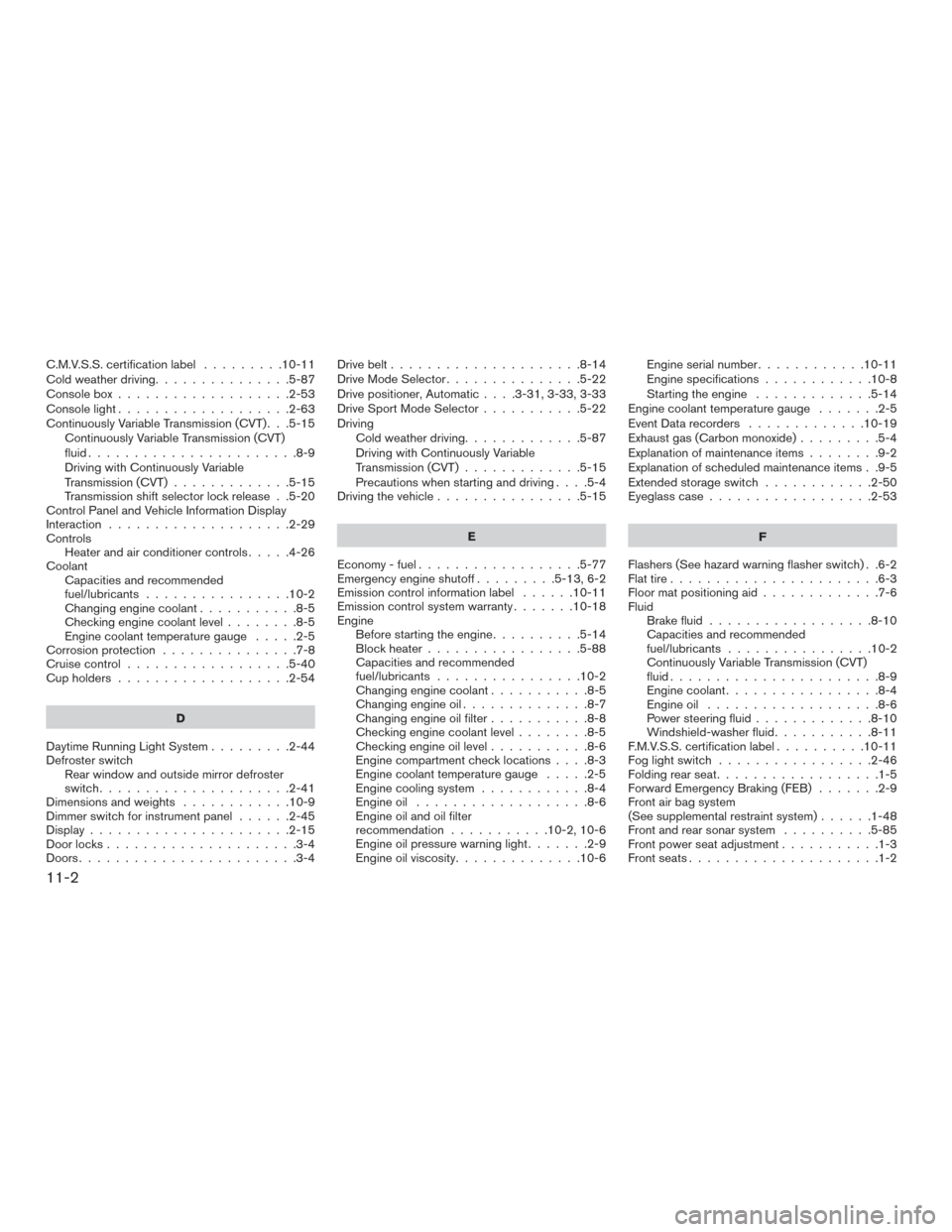
C.M.V.S.S. certification label.........10-11
Cold weather driving ...............5-87
Consolebox...................2-53
Consolelight...................2-63
Continuously Variable Transmission (CVT) . . .5-15 Continuously Variable Transmission (CVT)
fluid .......................8-9
Driving with Continuously Variable
Transmission (CVT) .............5-15
Transmission shift selector lock release . .5-20
Control Panel and Vehicle Information Display
Interaction ....................2-29
Controls Heater and air conditioner controls .....4-26
Coolant Capacities and recommended
fuel/lubricants ................10-2
Changing engine coolant ...........8-5
Checking engine coolant level ........8-5
Engine coolant temperature gauge .....2-5
Corrosionprotection ...............7-8
Cruisecontrol..................5-40
Cupholders...................2-54
D
Daytime Running Light System .........2-44
Defroster switch Rear window and outside mirror defroster
switch.....................2-41
Dimensionsandweights ............10-9
Dimmer switch for instrument panel ......2-45
Display......................2-15
Door locks .....................3-4
Doors ........................3-4 Drive belt
.....................8-14
Drive Mode Selector ...............5-22
Drive positioner, Automatic ....3-31,3-33,3-33
Drive Sport Mode Selector ...........5-22
Driving Cold weather driving .............5-87
Driving with Continuously Variable
Transmission (CVT) .............5-15
Precautions when starting and driving ....5-4
Driving the vehicle ................5-15
E
Economy - fuel ..................5-77
Emergency engine shutoff .........5-13,6-2
Emission control information label ......10-11
Emission control system warranty .......10-18
Engine Before starting the engine ..........5-14
Block heater .................5-88
Capacities and recommended
fuel/lubricants ................10-2
Changingenginecoolant...........8-5
Changingengineoil..............8-7
Changing engine oil filter ...........8-8
Checking engine coolant level ........8-5
Checking engine oil level ...........8-6
Engine compartment check locations ....8-3
Engine coolant temperature gauge .....2-5
Engine cooling system ............8-4
Engineoil ...................8-6
Engine oil and oil filter
recommendation ...........10-2,10-6
Engine oil pressure warning light .......2-9
Engine oil viscosity ..............10-6 Engine serial number
............10-11
Engine specifications ............10-8
Starting the engine .............5-14
Engine coolant temperature gauge .......2-5
Event Data recorders .............10-19
Exhaust gas (Carbon monoxide) .........5-4
Explanation of maintenance items ........9-2
Explanation of scheduled maintenance items . .9-5
Extended storage switch ............
2-50
Eyeglass case ..................2-53
F
Flashers (See hazard warning flasher switch) . .6-2
Flat tire .......................6-3
Floor mat positioning aid .............7-6
Fluid Brake fluid ..................8-10
Capacities and recommended
fuel/lubricants ................10-2
Continuously Variable Transmission (CVT)
fluid.......................8-9
Enginecoolant.................8-4
Engineoil ...................8-6
Power steering fluid .............8-10
Windshield-washer fluid ...........8-11
F.M.V.S.S. certification label ..........10-11
Foglightswitch .................2-46
Foldingrearseat..................1-5
Forward Emergency Braking (FEB) .......2-9
Front air bag system
(See supplemental restraint system) ......1-48
Front and rear sonar system ..........5-85
Front power seat adjustment ...........1-3
Frontseats.....................1-2
11-2
Page 403 of 406
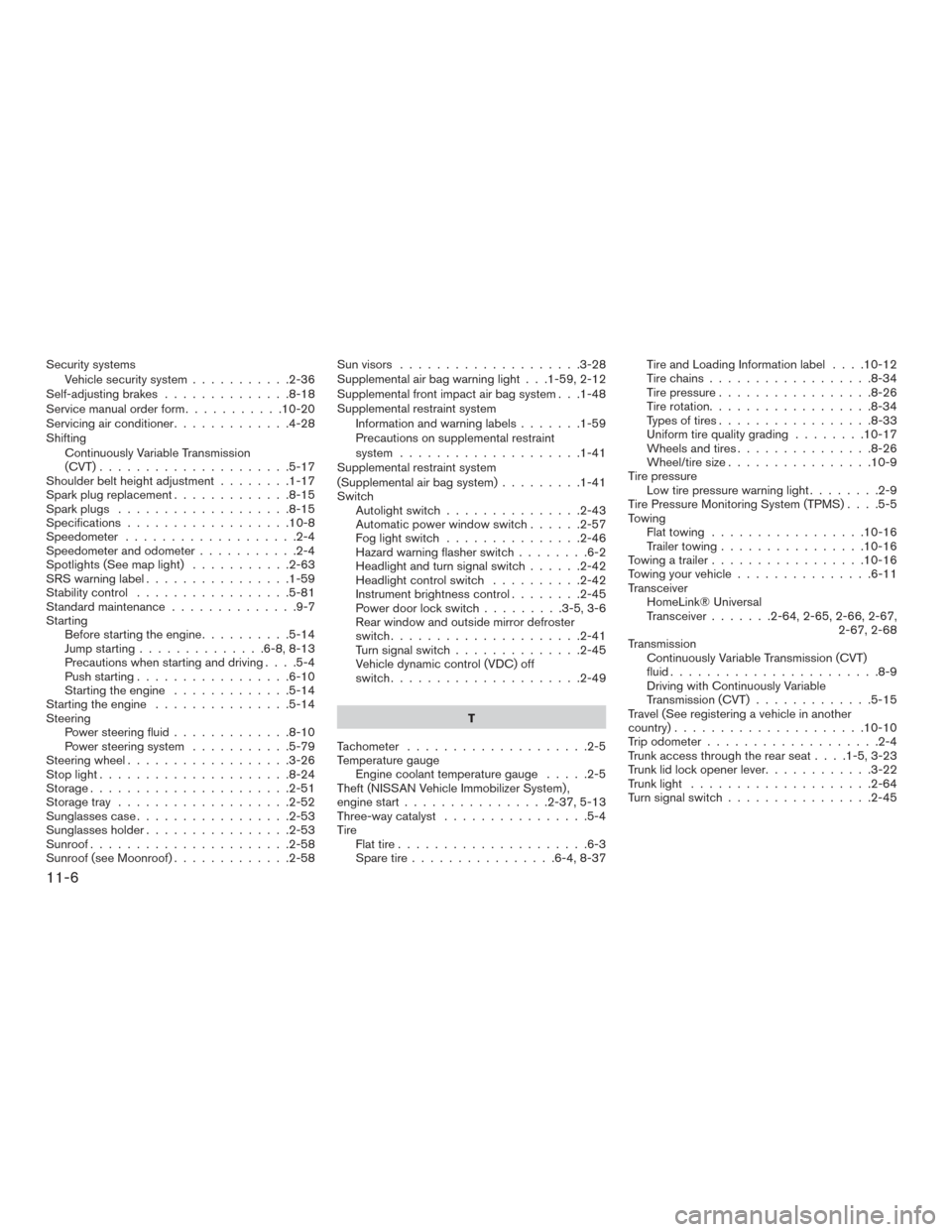
Security systemsVehicle security system ...........2-36
Self-adjusting brakes ..............8-18
Service manual order form ...........10-20
Servicing air conditioner .............4-28
Shifting Continuously Variable Transmission
(CVT) .....................5-17
Shoulder belt height adjustment ........1-17
Spark plug replacement .............8-15
Spark plugs ...................8-15
Specifications ..................10-8
Speedometer ...................2-4
Speedometer and odometer ...........2-4
Spotlights(Seemaplight) ...........2-63
SRS warning label ................1-59
Stability control .................5-81
Standardmaintenance..............9-7
Starting Before starting the engine ..........5-14
Jump starting ..............6-8,8-13
Precautions when starting and driving ....5-4
Push starting .................6-10
Starting the engine .............5-14
Starting the engine ...............5-14
Steering Power steering fluid .............8-10
Power steering system ...........5-79
Steering wheel ..................3-26
Stoplight.....................8-24
Storage......................2-51
Storage tray ...................2-52
Sunglassescase.................2-53
Sunglassesholder................2-53
Sunroof......................2-58
Sunroof (see Moonroof) .............2-58 Sun visors
....................3-28
Supplemental air bag warning light . . .1-59, 2-12
Supplemental front impact air bag system . . .1-48
Supplemental restraint system Information and warning labels .......1-59
Precautions on supplemental restraint
system ....................1-41
Supplemental restraint system
(Supplemental air bag system) .........1-41
Switch Autolightswitch...............2-43
Automatic power window switch ......2-57
Foglightswitch ...............2-46
Hazard warning flasher switch ........6-2
Headlight and turn signal switch ......2-42
Headlight control switch ..........2-42
Instrument brightness control ........2-45
Power door lock switch .........3-5,3-6
Rear window and outside mirror defroster
switch.....................2-41
Turn signal switch ..............2-45
Vehicle dynamic control (VDC) off
switch.....................2-49
T
Tachometer ....................2-5
Temperature gauge Engine coolant temperature gauge .....2-5
Theft (NISSAN Vehicle Immobilizer System) ,
engine start ................2-37,5-13
Three-way catalyst ................5-4
Tire Flat tire .....................6-3
Spare tire ................6-4,8-37 Tire and Loading Information label
....10-12
Tire chains ..................8-34
Tire pressure .................8-26
Tire rotation..................8-34
Types of tires .................
8-33
Uniform tire quality grading ........10-17
Wheels and tires ...............8-26
Wheel/tire size ................10-9
Tire pressure Low tire pressure warning light ........2-9
Tire Pressure Monitoring System (TPMS) ....5-5
Towing Flattowing.................10-16
Trailer towing ................10-16
Towing a trailer .................10-16
Towingyourvehicle...............6-11
Transceiver HomeLink® Universal
Transceiver .......2-64,2-65,2-66,2-67,
2-67, 2-68
Transmission Continuously Variable Transmission (CVT)
fluid.......................8-9
Driving with Continuously Variable
Transmission (CVT) .............5-15
Travel (See registering a vehicle in another
country) .....................10-10
Trip odometer ...................2-4
Trunkaccessthroughtherearseat....1-5,3-23
Trunklidlockopenerlever............3-22
Trunklight ....................2-64
Turn signal switch ................2-45
11-6