ECU NISSAN MAXIMA 2017 A36 / 8.G Repair Manual
[x] Cancel search | Manufacturer: NISSAN, Model Year: 2017, Model line: MAXIMA, Model: NISSAN MAXIMA 2017 A36 / 8.GPages: 406, PDF Size: 4.66 MB
Page 365 of 406
Seat belts:Check that all parts of the seat belt
system (for example, buckles, anchors, adjusters
and retractors) operate properly and smoothly,
and are installed securely. Check the belt web-
bing for cuts, fraying, wear or damage.
Steering wheel: Check for changes in the
steering system, such as excessive free play,
hard steering or strange noises.
Warning lights and chimes: Make sure all
warning lights and chimes are operating properly.
Windshield defroster: Check that the air
comes out of the defroster outlets properly and in
sufficient quantity when operating the heater or
air conditioner.
Windshield wiper and washer*: Check that
the wipers and washer operate properly and that
the wipers do not streak.
Under the hood and vehicle
The maintenance items listed here should be
checked periodically (for example, each time you
check the engine oil or refuel) .
Battery*: Check the fluid level in each cell. The
fluid should be at the bottom of the filler opening.
Vehicles operated in high temperatures or under
severe conditions require frequent checks of the
battery fluid level. NOTE:
Care should be taken to avoid situations
that can lead to potential battery discharge
and potential no-start conditions such as:
1. Installation or extended use of elec-
tronic accessories that consume bat-
tery power when the engine is not run-
ning (Phone chargers, GPS, DVD
players, etc.) .
2. Vehicle is not driven regularly and/or
only driven short distances.
In these cases, the battery may need to be
charged to maintain battery health.
Brake fluid level*: Make sure that the brake
fluid level is between the MAX and MIN lines on
the reservoir.
Engine coolant level*: Check the coolant level
when the engine is cold.
Engine drive belts*: Make sure the drive belts
are not frayed, worn, cracked or oily.
Engine oil level*: Check the level after parking
the vehicle on a level spot and turning off the
engine. Wait more than 15 minutes for the oil to
drain back into the oil pan. Exhaust system:
Make sure there are no loose
supports, cracks or holes. If the sound of the
exhaust seems unusual or there is a smell of
exhaust fumes, immediately have the exhaust
system inspected. It is recommended that you
visit a NISSAN dealer for this service. For addi-
tional information, refer to “Exhaust gas (carbon
monoxide)” in the “Starting and driving” section of
this manual.
Fluid leaks: Check under the vehicle for fuel, oil,
water or other fluid leaks after the vehicle has
been parked for a while. Water dripping from the
air conditioner after use is normal. If you should
notice any leaks or if fuel fumes are evident,
check for the cause and have it corrected imme-
diately.
Power steering fluid level* and lines: Check
the level when the fluid is cold, with the engine
off. Check the lines for proper attachment, leaks,
cracks, etc.
Radiator and hoses: Check the front of the
radiator and clean off any dirt, insects, leaves,
etc., that may have accumulated. Make sure the
hoses have no cracks, deformation, rot or loose
connections.
9-4Maintenance and schedules
Page 392 of 406
Steps for determining correct load
limit
1. Locate the statement “The combinedweight of occupants and cargo
should never exceed XXX lbs or XXX
kg” on your vehicle’s placard.
2. Determine the combined weight of the driver and passengers that will be
riding in your vehicle.
3. Subtract the combined weight of the driver and passengers from XXX lbs
or XXX kg.
4. The resulting figure equals the avail- able amount of cargo and luggage
load capacity. For example, if the
XXX amount equals 1,400 lbs. and
there will be five 150 lb. passengers
in your vehicle, the amount of avail-
able cargo and luggage load capac-
ity is 650 lbs. (1,400-750 (5 X 150)
= 650 lbs) or (640-340 (5 X 70) =
300 kg.)
5. Determine the combined weight of luggage and cargo being loaded on the vehicle. That weight may not
safely exceed the available cargo and
luggage load capacity calculated in
step 4.
Before driving a loaded vehicle, confirm
that you do not exceed the Gross Vehicle
Weight Rating (GVWR) or the Gross Axle
Weight Rating (GAWR) for your vehicle.
For additional information, refer to “Mea-
surement of weights” in this section.
Also check tires for proper inflation pres-
sures. For additional information, refer to
“Tire and Loading Information label” in this
section.
LOADING TIPS
● The GVW must not exceed GVWR
or GAWR as specified on the
F.M.V.S.S./C.M.V.S.S. certification
label.
● Do not load the front and rear axle to
the GAWR. Doing so will exceed the
GVWR.
WARNING
● Properly secure all cargo with
ropes or straps to help prevent it
from sliding or shifting. Do not
place cargo higher than the seat-
backs. In a sudden stop or colli-
sion, unsecured cargo could
cause personal injury.
● Do not load your vehicle any
heavier than the GVWR or the
maximum front and rear GAWRs.
If you do, parts of your vehicle can
break, tire damage could occur,
or it can change the way your
vehicle handles. This could result
in loss of control and cause per-
sonal injury.
● Overloading not only can shorten
the life of your vehicle and the
tire, but can also cause unsafe
vehicle handling and longer brak-
ing distances. This may cause a
premature tire failure which
could result in a serious accident
and personal injury. Failures
caused by overloading are not
covered by the vehicle’s warranty.
Technical and consumer information10-15
Page 393 of 406
MEASUREMENT OF WEIGHTS
Secure loose items to prevent weight
shifts that could affect the balance of your
vehicle. When the vehicle is loaded, drive
to a scale and weigh the front and the rear
wheels separately to determine axle
loads. Individual axle loads should not ex-
ceed either of the gross axle weight rat-
ings (GAWR) . The total of the axle loads
should not exceed the gross vehicle
weight rating (GVWR) . These ratings are
given on the vehicle certification label. If
weight ratings are exceeded, move or re-
move items to bring all weights below the
ratings.
Do not tow a trailer with your vehicle.
FLAT TOWING
Towing your vehicle with all four wheels on the
ground is sometimes called flat towing. This
method is sometimes used when towing a vehicle
behind a recreational vehicle, such as a motor
home.
CAUTION
●Failure to follow these guidelines can
result in severe transmission damage.
● Whenever flat towing your vehicle, al-
ways tow forward, never backward.
● Never tow your front wheel drive vehicle
with the front tires on the ground. Doing
so may cause serious and expensive
damage to the powertrain.
● DO NOT tow any continuously variable
transmission vehicle with all four
wheels on the ground (flat towing) . Do-
ing so WILL DAMAGE internal transmis-
sion parts due to lack of transmission
lubrication.
● For emergency towing procedures refer
to “Towing recommended by NISSAN”
in the “In case of emergency” section of
this manual.
Continuously Variable Transmission
To tow a vehicle equipped with a continuously
variable transmission, an appropriate vehicle
dolly MUST be placed under the towed vehicle’s
drive wheels. Alwaysfollow the dolly manufac-
turer’s recommendations when using their prod-
uct.
TOWING A TRAILER
10-16Technical and consumer information
Page 396 of 406

Sur/7/PCDB-BDPP/fc-
cp.aspx?lang=fra (French speakers)
Additional information concerning motor
vehicle safety may be obtained from Trans-
port Canada’s Road Safety Information
Centre at 1-800-333-0371 or online at
www.tc.gc.ca/roadsafety (English speak-
ers) or www.tc.gc.ca/securiteroutiere
(French speakers) .
To notify NISSAN of any safety concerns
please contact our Consumer Information
Centre toll free at 1-800-387-0122.
Due to legal requirements in some states and
Canadian Provinces, your vehicle may be re-
quired to be in what is called the “ready condi-
tion” for an Inspection/Maintenance (I/M) test of
the emission control system.
The vehicle is set to the “ready condition” when it
is driven through certain driving patterns. Usually,
the ready condition can be obtained by ordinary
usage of the vehicle.
If a powertrain system component is repaired or
the battery is disconnected, the vehicle may be
reset to a “not ready” condition. Before taking the
I/M test, check the vehicle’s
inspection/maintenance test readiness condi-
tion. Place the ignition switch in the ON position
without starting the hybrid system. If the Malfunc-
tion Indicator Light (MIL) comes on steady for
20 seconds and then blinks for 10 seconds , the
I/M test condition is “not ready”. If the MIL does
not blink after 20 seconds, the I/M test condition
is “ready”. It is recommended that you visit a
NISSAN dealer to set the “ready condition” or to
prepare the vehicle for testing.This vehicle is equipped with an EDR. The main
purpose of an EDR is to record, in certain colli-
sion or near collision-like situations, such as an
air bag deployment or hitting a road obstacle,
data that will assist in understanding how a vehi-
cle’s systems performed. The EDR is designed to
record data related to vehicle dynamics and
safety systems for a short period of time, typically
30 seconds or less. The EDR in this vehicle is
designed to record such data as:
● How various systems in your vehicle were
operating;
● Whether or not the driver and passenger
safety belts were buckled/fastened;
● How far (if at all) the driver was depressing
the accelerator and/or brake pedal; and,
● How fast the vehicle was traveling.
● Sounds are not recorded.
READINESS FOR INSPECTION/
MAINTENANCE (I/M) TEST EVENT DATA RECORDERS (EDR)
Technical and consumer information10-19
Page 398 of 406
11 Index
A
Active noise cancellation Active sound enhancement ........5-89
Air bag (See supplemental restraint
system) .....................1-41
Air bag system Front (See supplemental front impact
air bag system) ...............1-48
Airbagwarninglight...........1-59,2-12
Air bag warning light, supplemental . .1-59, 2-12
Aircleaner....................8-16
Air cleaner housing filter ............8-16
Air conditioner Air conditioner specification label ....10-12
Air conditioner system refrigerant and
oil recommendations ........10-2,10-7
Air conditioner system refrigerant
recommendations ..........10-2,10-7
Heater and air conditioner (automatic)
(if so equipped) ...............4-25
Heater and air conditioner controls ....4-26
Servicing air conditioner ..........4-28
Alarm system
(See vehicle security system) .........2-36
Anchor point locations .............1-25
Antenna .....................4-28
Antifreeze ....................5-87
Anti-lock brake warning light ..........2-7
Anti-lock Braking System (ABS) ........5-80
Apple CarPlay™ .................4-29
Armrests .....................1-6 AroundView®Monitor .............4-9
Audible reminders
...............2-14
Audio system ..................4-28
Radio ....................4-28
Autolight switch .................2-43
Automatic Automatic drive positioner . .3-31, 3-33, 3-33
Automatic power window switch .....2-57
Automatic anti-glare inside mirror .......3-29
Automatic door locks ..............3-6
Automatic drive positioner ....3-31,3-33,3-33
B
Battery ..................5-87,8-12
Chargewarninglight.............2-8
Battery replacement ..............8-21
Keyfob ...................8-21
NISSAN Intelligent Key® ..........8-21
Before starting the engine ...........5-14
Belt (See drive belt) ..............8-14
Blind Spot Warning (BSW) warning
system ......................5-23
Block heater Engine ....................5-88
Bluetooth® hands-free phone system ....4-30
Boosterseats..................1-38
Brake Anti-lock Braking System (ABS) ......5-80
Brake assist (for Intelligent cruise control
system) ...................5-81
Brake fluid ..................8-10 Brakelight(Seestoplight).........8-24
Brake system
................5-79
Brakewarninglight..............2-8
Brakewearindicators........2-14,8-18
Parking brake operation ..........5-21
Self-adjusting brakes ............8-18
Brake fluid ....................8-10
Brakes ......................8-18
Brake system ..................5-79
Break-inschedule ...............5-75
Brightness control Instrument panel ..............2-45
Bulb check/instrument panel ..........2-7
Bulbreplacement................8-24
C
Capacities and recommended
fuel/lubricants ..................
10-2
Cargo (See vehicle loading information). . .10-13
Car phone or CB radio .............4-29
Check tire pressure ...............2-26
Child restraints .......1-18,1-19,1-21,1-23
LATCH (Lower Anchors and Tethers for
CHildren) System ..............1-23
Precautions on child
restraints ........1-21,1-27,1-33,1-38
Top tether strap anchor point locations . .1-25
Child safety rear door lock ............3-6
Chimes, audible reminders ...........2-14
Cleaning exterior and interior .......7-2,7-4
Climate control seat switch ..........2-46
Page 401 of 406
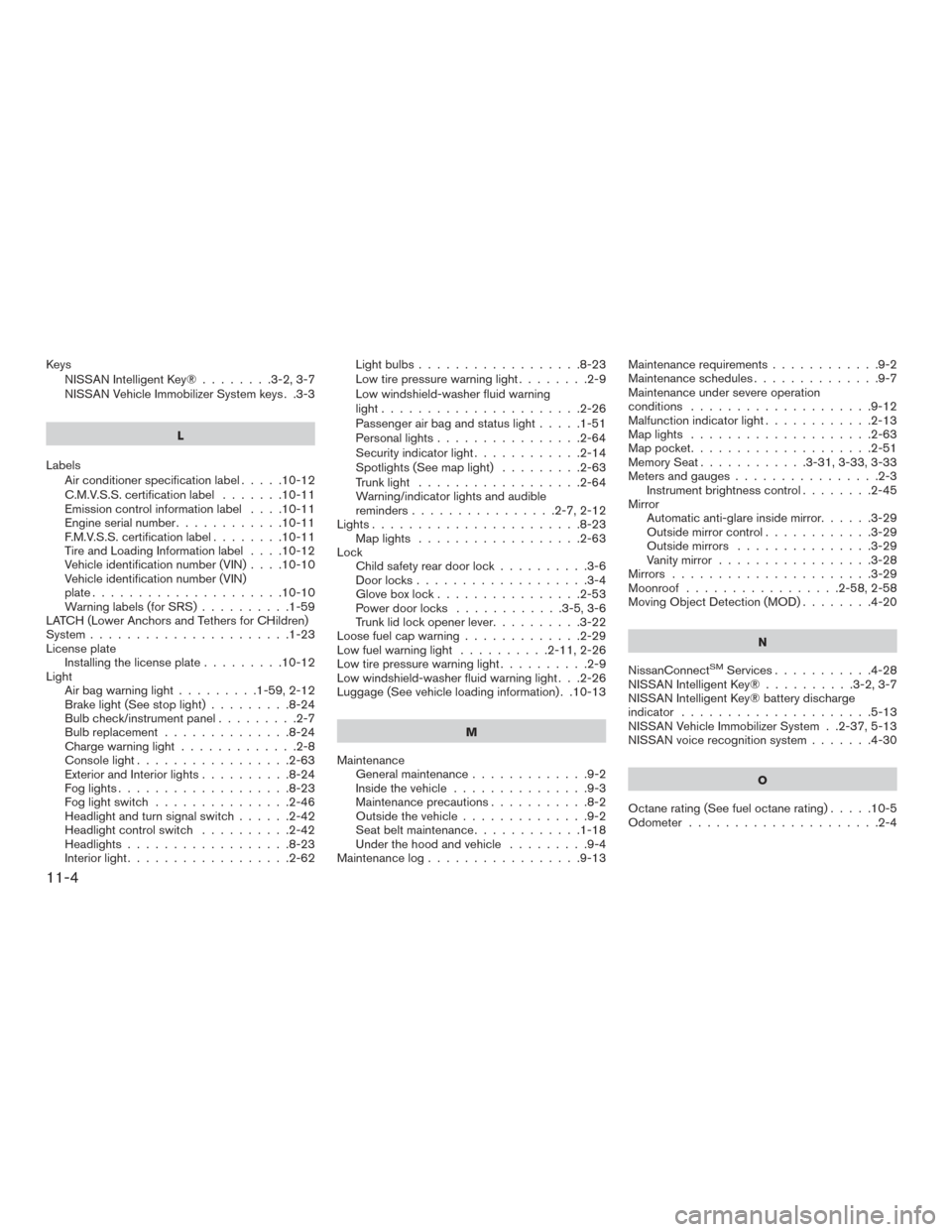
KeysNISSAN Intelligent Key® ........3-2,3-7
NISSAN Vehicle Immobilizer System keys . .3-3
L
Labels Air conditioner specification label .....10-12
C.M.V.S.S. certification label .......10-11
Emissioncontrolinformationlabel ....10-11
Engine serial number ............10-11
F.M.V.S.S. certification label ........10-11
Tire and Loading Information label ....10-12
Vehicle identification number (VIN) ....10-10
Vehicle identification number (VIN)
plate .....................10-10
Warning labels (for SRS) ..........1-59
LATCH (Lower Anchors and Tethers for CHildren)
System ......................1-23
License plate Installing the license plate .........10-12
Light Airbagwarninglight.........1-59,2-12
Brake light (See stop light) .........8-24
Bulb check/instrument panel .........2-7
Bulb replacement ..............8-24
Charge warning light .............2-8
Console light .................2-63
ExteriorandInteriorlights..........8-24
Foglights...................8-23
Foglightswitch ...............2-46
Headlight and turn signal switch ......2-42
Headlight control switch ..........2-42
Headlights ..................8-23
Interiorlight..................2-62 Lightbulbs..................8-23
Low tire pressure warning light
........2-9
Low windshield-washer fluid warning
light......................2-26
Passenger air bag and status light .....1-51
Personal lights ................2-64
Security indicator light ............2-14
Spotlights(Seemaplight) .........2-63
Trunklight ..................2-64
Warning/indicator lights and audible
reminders ................2-7,2-12
Lights.......................8-23 Maplights ..................2-63
Lock Child safety rear door lock ..........3-6
Door locks ...................3-4
Gloveboxlock................2-53
Power door locks ............3-5,3-6
Trunk lid lock opener lever ..........3-22
Loose fuel cap warning .............2-29
Lowfuelwarninglight ..........2-11,2-26
Low tire pressure warning light ..........2-9
Low windshield-washer fluid warning light . . .2-26
Luggage (See vehicle loading information) . .10-13
M
Maintenance Generalmaintenance.............9-2
Insidethevehicle...............9-3
Maintenance precautions ...........8-2
Outside the vehicle ..............9-2
Seatbeltmaintenance............1-18
Underthehoodandvehicle .........9-4
Maintenancelog.................9-13 Maintenance requirements
............9-2
Maintenance schedules ..............9-7
Maintenance under severe operation
conditions ....................9-12
Malfunction indicator light ............2-13
Maplights ....................2-63
Mappocket....................2-51
Memory Seat ............3-31,3-33,3-33
Meters and gauges ................2-3
Instrument brightness control ........2-45
Mirror Automatic anti-glare inside mirror ......3-29
Outside mirror control ............3-29
Outside mirrors ...............3-29
V
anity mirror .................3-28
Mirrors ......................3-29
Moonroof .................2-58,2-58
Moving Object Detection (MOD) ........4-20
N
NissanConnect
SMServices ...........4-28
NISSAN Intelligent Key® ..........3-2,3-7
NISSAN Intelligent Key® battery discharge
indicator .....................5-13
NISSAN Vehicle Immobilizer System . .2-37, 5-13
NISSAN voice recognition system .......4-30
O
Octane rating (See fuel octane rating) .....10-5
Odometer .....................2-4
11-4
Page 402 of 406
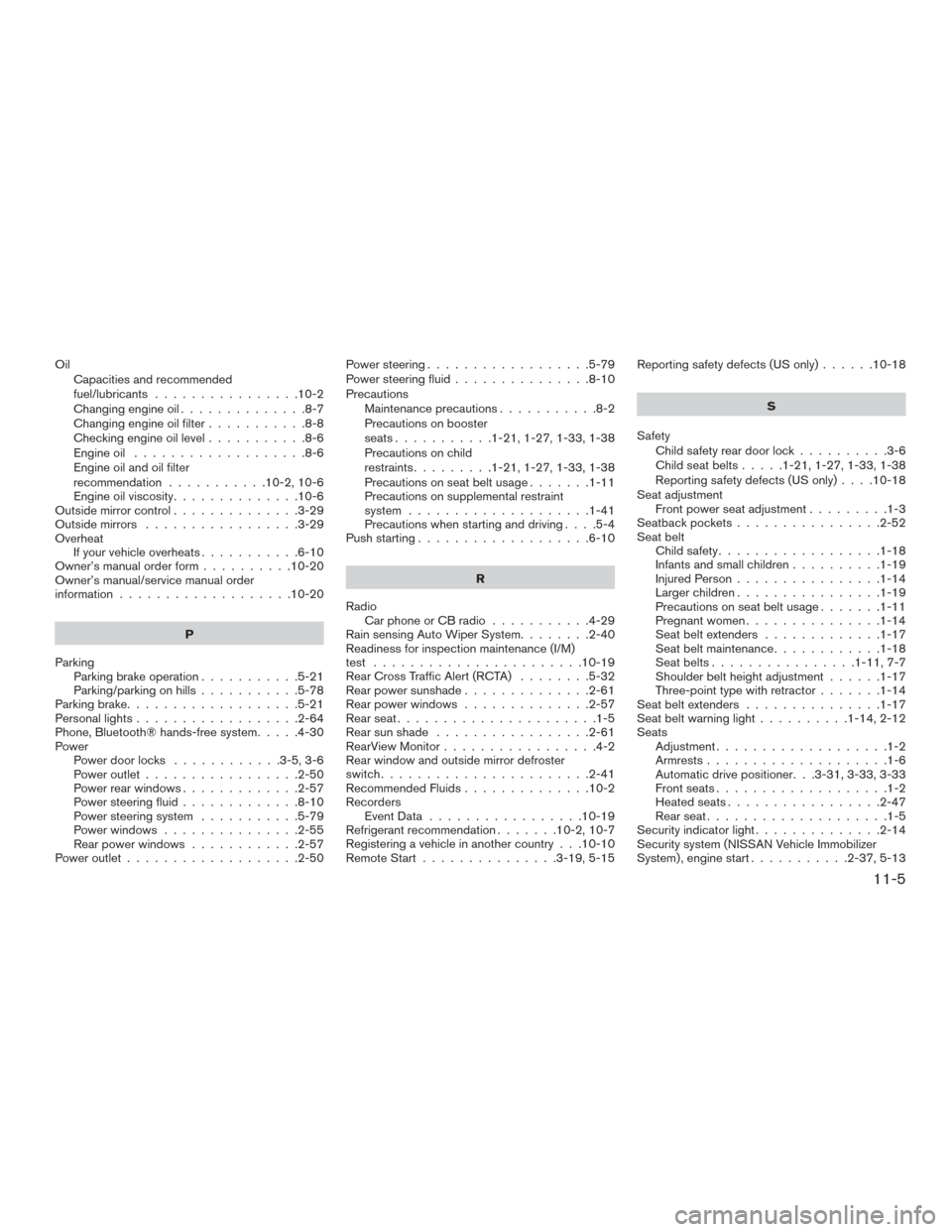
OilCapacities and recommended
fuel/lubricants ................10-2
Changing engine oil ..............8-7
Changing engine oil filter ...........8-8
Checking engine oil level ...........8-6
Engine oil ...................8-6
Engine oil and oil filter
recommendation ...........10-2,10-6
Engine oil viscosity ..............10-6
Outside mirror control ..............3-29
Outside mirrors .................3-29
Overheat Ifyourvehicleoverheats...........6-10
Owner’s manual order form ..........10-20
Owner’s manual/service manual order
information ...................10-20
P
Parking Parking brake operation ...........5-21
Parking/parking on hills ...........5-78
Parking brake ...................5-21
Personallights..................2-64
Phone, Bluetooth® hands-free system .....4-30
Power Power door locks ............3-5,3-6
Power outlet .................2-50
Power rear windows .............2-57
Power steering fluid .............8-10
Power steering system ...........5-79
Power windows ...............2-55
Rear power windows ............2-57
Power outlet ...................2-50 Power steering
..................5-79
Power steering fluid ...............8-10
Precautions Maintenance precautions ...........8-2
Precautions on booster
seats...........1-21,1-27,1-33,1-38
Precautions on child
restraints .........1-21,1-27,1-33,1-38
Precautions on seat belt usage .......1-11
Precautions on supplemental restraint
system ....................1-41
Precautions when starting and driving ....5-4
Push starting ...................6-10
R
Radio Car phone or CB radio ...........4-29
Rain sensing Auto Wiper System ........2-40
Readiness for inspection maintenance (I/M)
test .......................10-19
Rear Cross Traffic Alert (RCTA) ........5-32
Rear power sunshade ..............2-61
Rear power windows ..............2-57
Rearseat......................1-5
Rear sun shade .................2-61
RearView Monitor .................4-2
Rear window and outside mirror defroster
switch .......................2-41
Recommended Fluids ..............10-2
Recorders EventData .................10-19
Refrigerant recommendation .......10-2,10-7
Registering a vehicle in another country . . .10-10
Remote Start ...............3-19,5-15 Reporting safety defects (US only)
......10-18
S
Safety Child safety rear door lock ..........3-6
Child seat belts .....
1-21,1-27,1-33,1-38
Reporting safety defects (US only) ....10-18
Seat adjustment Front power seat adjustment .........1-3
Seatbackpockets................2-52
Seat belt Child safety ..................1-18
Infants and small children ..........1-19
Injured Person ................1-14
Largerchildren................1-19
Precautions on seat belt usage .......1-11
Pregnant women ...............1-14
Seatbeltextenders .............1-17
Seatbeltmaintenance............1-18
Seatbelts................1-11,7-7
Shoulder belt height adjustment ......1-17
Three-point type with retractor .......1-14
Seat belt extenders ...............1-17
Seatbeltwarninglight..........1-14,2-12
Seats Adjustment ...................1-2
Armrests....................1-6
Automatic drive positioner. . .3-31, 3-33, 3-33
Frontseats...................1-2
Heatedseats.................2-47
Rearseat....................1-5
Security indicator light ..............2-14
Security system (NISSAN Vehicle Immobilizer
System) , engine start ...........2-37,5-13
11-5
Page 403 of 406
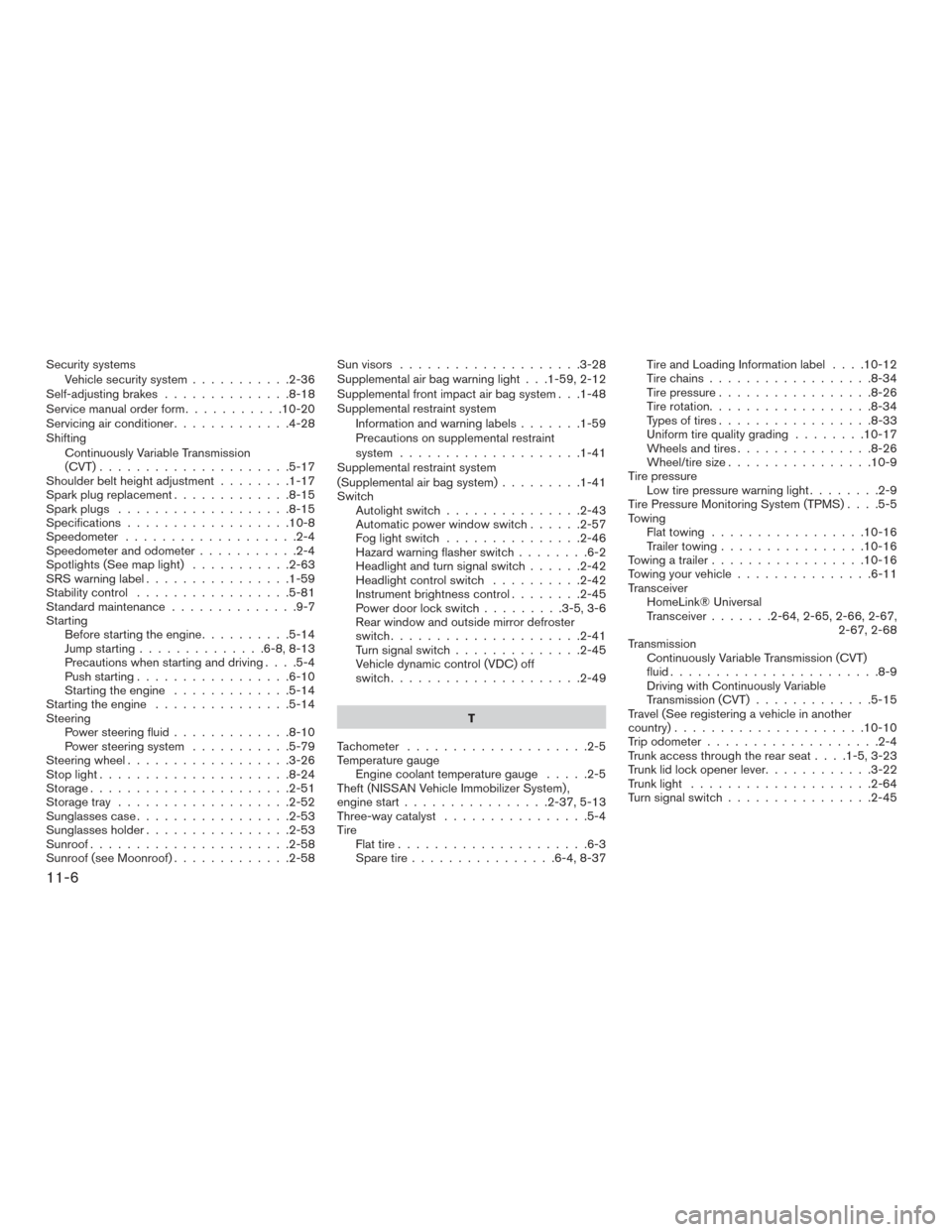
Security systemsVehicle security system ...........2-36
Self-adjusting brakes ..............8-18
Service manual order form ...........10-20
Servicing air conditioner .............4-28
Shifting Continuously Variable Transmission
(CVT) .....................5-17
Shoulder belt height adjustment ........1-17
Spark plug replacement .............8-15
Spark plugs ...................8-15
Specifications ..................10-8
Speedometer ...................2-4
Speedometer and odometer ...........2-4
Spotlights(Seemaplight) ...........2-63
SRS warning label ................1-59
Stability control .................5-81
Standardmaintenance..............9-7
Starting Before starting the engine ..........5-14
Jump starting ..............6-8,8-13
Precautions when starting and driving ....5-4
Push starting .................6-10
Starting the engine .............5-14
Starting the engine ...............5-14
Steering Power steering fluid .............8-10
Power steering system ...........5-79
Steering wheel ..................3-26
Stoplight.....................8-24
Storage......................2-51
Storage tray ...................2-52
Sunglassescase.................2-53
Sunglassesholder................2-53
Sunroof......................2-58
Sunroof (see Moonroof) .............2-58 Sun visors
....................3-28
Supplemental air bag warning light . . .1-59, 2-12
Supplemental front impact air bag system . . .1-48
Supplemental restraint system Information and warning labels .......1-59
Precautions on supplemental restraint
system ....................1-41
Supplemental restraint system
(Supplemental air bag system) .........1-41
Switch Autolightswitch...............2-43
Automatic power window switch ......2-57
Foglightswitch ...............2-46
Hazard warning flasher switch ........6-2
Headlight and turn signal switch ......2-42
Headlight control switch ..........2-42
Instrument brightness control ........2-45
Power door lock switch .........3-5,3-6
Rear window and outside mirror defroster
switch.....................2-41
Turn signal switch ..............2-45
Vehicle dynamic control (VDC) off
switch.....................2-49
T
Tachometer ....................2-5
Temperature gauge Engine coolant temperature gauge .....2-5
Theft (NISSAN Vehicle Immobilizer System) ,
engine start ................2-37,5-13
Three-way catalyst ................5-4
Tire Flat tire .....................6-3
Spare tire ................6-4,8-37 Tire and Loading Information label
....10-12
Tire chains ..................8-34
Tire pressure .................8-26
Tire rotation..................8-34
Types of tires .................
8-33
Uniform tire quality grading ........10-17
Wheels and tires ...............8-26
Wheel/tire size ................10-9
Tire pressure Low tire pressure warning light ........2-9
Tire Pressure Monitoring System (TPMS) ....5-5
Towing Flattowing.................10-16
Trailer towing ................10-16
Towing a trailer .................10-16
Towingyourvehicle...............6-11
Transceiver HomeLink® Universal
Transceiver .......2-64,2-65,2-66,2-67,
2-67, 2-68
Transmission Continuously Variable Transmission (CVT)
fluid.......................8-9
Driving with Continuously Variable
Transmission (CVT) .............5-15
Travel (See registering a vehicle in another
country) .....................10-10
Trip odometer ...................2-4
Trunkaccessthroughtherearseat....1-5,3-23
Trunklidlockopenerlever............3-22
Trunklight ....................2-64
Turn signal switch ................2-45
11-6
Page 404 of 406
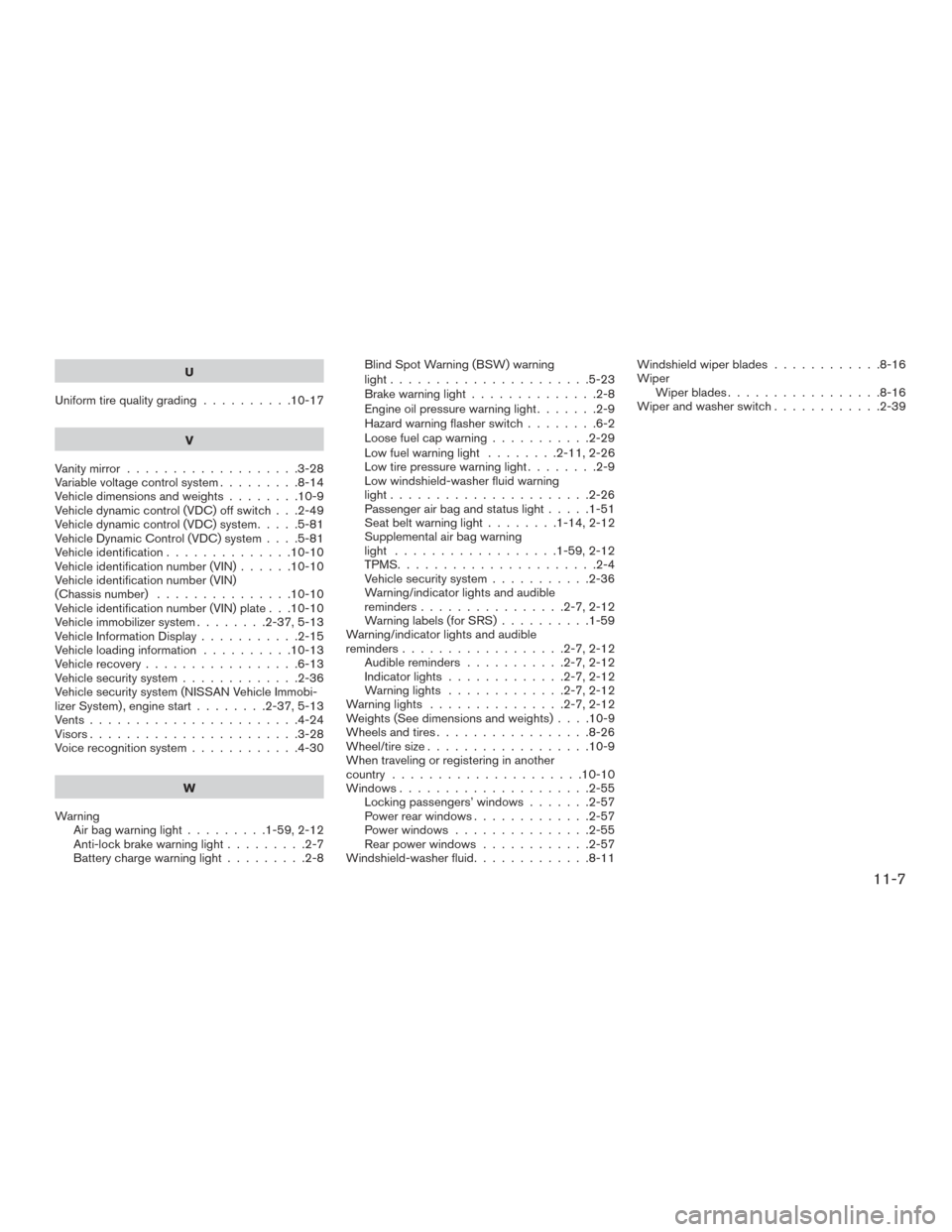
U
Uniform tire quality grading ..........10-17
V
Vanity mirror ...................3-28
Variable voltage control system .........8-14
Vehicledimensionsandweights........10-9
Vehicle dynamic control (VDC) off switch . . .2-49
Vehicle dynamic control (VDC) system .....5-81
Vehicle Dynamic Control (VDC) system ....5-81
Vehicle identification ..............10-10
Vehicle identification number (VIN) ......10-10
Vehicle identification number (VIN)
(Chassis number) ...............10-10
Vehicle identification number (VIN) plate . . .10-10
Vehicle immobilizer system ........2-37,5-13
Vehicle Information Display ...........2-15
Vehicleloadinginformation ..........10-13
Vehicle recovery .................6-13
Vehicle security system .............2-36
Vehicle security system (NISSAN Vehicle Immobi-
lizer System) , engine start ........2-37,5-13
Vents.......................4-24
Visors.......................3-28
Voice recognition system ............4-30
W
Warning Airbagwarninglight.........1-59,2-12
Anti-lock brake warning light .........2-7
Battery charge warning light .........2-8Blind Spot Warning (BSW) warning
light......................5-23
Brake warning light
..............2-8
Engine oil pressure warning light .......2-9
Hazard warning flasher switch ........6-2
Loose fuel cap warning ...........2-29
Lowfuelwarninglight ........2-11,2-26
Low tire pressure warning light ........2-9
Low windshield-washer fluid warning
light......................2-26
Passenger air bag and status light .....1-51
Seatbeltwarninglight........1-14,2-12
Supplemental air bag warning
light ..................1-59,2-12
TPMS ......................2-4
Vehicle security system ...........2-36
Warning/indicator lights and audible
reminders................2-7,2-12
Warning labels (for SRS) ..........1-59
Warning/indicator lights and audible
reminders..................2-7,2-12 Audible reminders ...........2-7,2-12
Indicatorlights.............2-7,2-12
Warninglights .............2-7,2-12
Warninglights ...............2-7,2-12
Weights(Seedimensionsandweights)....10-9
Wheels and tires .................8-26
Wheel/tire size ..................10-9
When traveling or registering in another
country .....................10-10
Windows .....................2-55
Locking passengers’ windows .......2-57
Power rear windows .............2-57
Power windows ...............2-55
Rear power windows ............2-57
Windshield-washer fluid .............8-11 Windshieldwiperblades............8-16
Wiper
Wiperblades.................8-16
Wiper and washer switch ............2-39
11-7