climate control NISSAN MAXIMA 2023 User Guide
[x] Cancel search | Manufacturer: NISSAN, Model Year: 2023, Model line: MAXIMA, Model: NISSAN MAXIMA 2023Pages: 494, PDF Size: 5.7 MB
Page 232 of 494
OPERATING TIPS
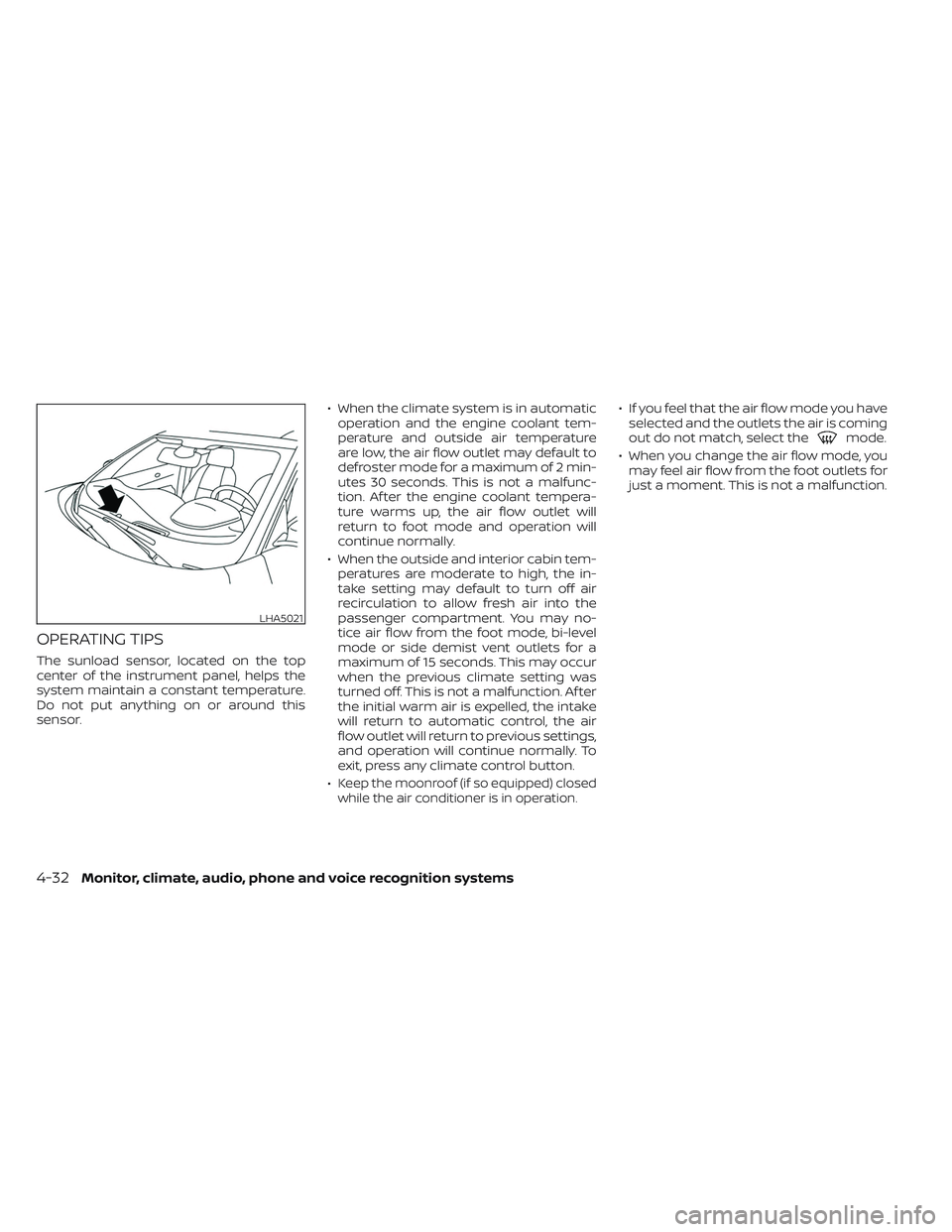
The sunload sensor, located on the top
center of the instrument panel, helps the
system maintain a constant temperature.
Do not put anything on or around this
sensor.• When the climate system is in automatic
operation and the engine coolant tem-
perature and outside air temperature
are low, the air flow outlet may default to
defroster mode for a maximum of 2 min-
utes 30 seconds. This is not a malfunc-
tion. Af ter the engine coolant tempera-
ture warms up, the air flow outlet will
return to foot mode and operation will
continue normally.
• When the outside and interior cabin tem- peratures are moderate to high, the in-
take setting may default to turn off air
recirculation to allow fresh air into the
passenger compartment. You may no-
tice air flow from the foot mode, bi-level
mode or side demist vent outlets for a
maximum of 15 seconds. This may occur
when the previous climate setting was
turned off. This is not a malfunction. Af ter
the initial warm air is expelled, the intake
will return to automatic control, the air
flow outlet will return to previous settings,
and operation will continue normally. To
exit, press any climate control button.
•
Keep the moonroof (if so equipped) closed
while the air conditioner is in operation.
• If you feel that the air flow mode you have selected and the outlets the air is coming
out do not match, select the
mode.
• When you change the air flow mode, you may feel air flow from the foot outlets for
just a moment. This is not a malfunction.
LHA5021
4-32Monitor, climate, audio, phone and voice recognition systems
Page 234 of 494
When installing a CB, ham radio or car
phone in your vehicle, be sure to observe
the following precautions; otherwise, the
new equipment may adversely affect the
engine control system and other electronic
parts.
WARNING
• A cellular phone should not be used
for any purpose while driving so full
attention may be given to vehicle
operation. Some jurisdictions pro-
hibit the use of cellular phones while
driving.
• If you must make a call while your
vehicle is in motion, the hands free
cellular phone operational mode
(if so equipped) is highly recom-
mended. Exercise extreme caution at
all times so full attention may be
given to vehicle operation.
• If you are unable to devote full atten-
tion to vehicle operation while talk-
ing on the phone, pull off the road to
a safe location and stop your vehicle.
CAUTION
• Keep the antenna as far away as pos-
sible from the electronic control
modules.
• Keep the antenna wire more than 8 in
(20 cm) away from the electronic
control system harnesses. Do not
route the antenna wire next to any
harness.
• Adjust the antenna standing-wave
ratio as recommended by the
manufacturer.
• Connect the ground wire from the CB
radio chassis to the body.
• For additional information, it is rec-
ommended that you visit a NISSAN
dealer. “Made for iPod”, “Made for iPhone” and
“Made for iPad” mean that an electronic
accessory has been designed to connect
specifically to iPod, iPhone or iPad, respec-
tively, and has been certified by the devel-
oper to meet Apple performance stan-
dards. Apple is not responsible for the
operation of this device or its compliance
with safety and regulatory standards.
Please note that the use of this accessory
with iPod, iPhone or iPad may affect wire-
less performance.
iPad, iPhone, iPod classic, iPod nano, iPod
shuffle and iPod touch are trademarks of
Apple Inc., registered in the U.S. and other
countries. Lightning is a trademark of
Apple Inc.
CAR PHONE OR CB RADIO
iPod®/iPhone®
4-34Monitor, climate, audio, phone and voice recognition systems
Page 471 of 494
Do not tow a trailer with your vehicle.
FLAT TOWING
Towing your vehicle with all four wheels on
the ground is sometimes called flat towing.
This method is sometimes used when
towing a vehicle behind a recreational ve-
hicle, such as a motor home.
CAUTION
•
Failure to follow these guidelines can
result in severe transmission damage.
• Whenever flat towing your vehicle,
always tow forward, never backward.
•
Never tow your front wheel drive ve-
hicle with the front tires on the ground.
Doing so may cause serious and ex-
pensive damage to the powertrain.
• DO NOT tow any continuously vari-
able transmission vehicle with all
four wheels on the ground (flat tow-
ing). Doing so WILL DAMAGE internal
transmission parts due to lack of
transmission lubrication.
•
For emergency towing procedures see
“Towing recommended by NISSAN”
(P. 6-12).
Continuously Variable
Transmission
To tow a vehicle equipped with a continu-
ously variable transmission, an appropriate
vehicle dolly MUSTbe placed under the
towed vehicle's drive wheels. Alwaysfollow
the dolly manufacturer's recommenda-
tions when using their product. DOT (Department of Transportation) Qual-
ity Grades: All passenger car tires must
conform to federal safety requirements in
addition to these grades.
Quality grades can be found where appli-
cable on the tire sidewall between tread
shoulder and maximum section width.
For example:
Treadwear 200 Traction AA Temperature A
Treadwear
The treadwear grade is a comparative rat-
ing based on the wear rate of the tire when
tested under controlled conditions on a
specified government test course. For ex-
ample, a tire graded 150 would wear one
and one-half (1 1/2) times as well on the
government course as a tire graded 100.
The relative performance of tires depends
upon the actual conditions of their use,
however, and may depart significantly from
the norm due to variations in driving habits,
service practices and differences in road
characteristics and climate.
TOWING A TRAILER
UNIFORM TIRE QUALITY GRADING
Technical and consumer information10-19
Page 477 of 494
11 Index
A
Activenoisecancellation...........5-125Active sound enhancement .......5-125
ActiveRideControl(ARC)............5 -119
Air bag (See supplemental restraint
system) ........................ .1-41
Air bag system ...................1-49
Front (See supplemental front impact
air bag system) .................1-49
Air bag warning light, supplemental . . . .1-62
Airbagwarninglight.............. .1-62
Air cleaner housing filter .............8-17
Air cleaner .......................8-17
Air conditioner ....................4-30
Air conditioner operation ..........4-30
Air conditioner specification label . . .10-13
Air conditioner system refrigerant and
oil recommendations .........10-2,10-8
Air conditioner system refrigerant
recommendations ...........10-2,10-8
Heater and air conditioner (automatic)
(if so equipped) .................4-29
Heater and air conditioner controls . .4-30
Servicing air conditioner ..........4-33
Alarm system (See vehicle security
system) .........................2-40
Anchor point locations ..............1-26
Antenna ........................4-33
Anti-lock Braking System (ABS) .......5-114
Antifreeze ......................5-124 Armrests........................
.1-6
Autolightswitch...................2-47
Automatic anti-glare inside mirror .....3-27
Automatic door locks ...............3-5
Automatic Emergency Braking (AEB)
with Pedestrian Detection ...........5-85
Automatic Emergency Braking (AEB) . . .2-12
Automatic.......................2-71 Automaticpowerwindowswitch....2-71
B
Battery replacement ...............8-22
Keyfob.......................8-22
NISSAN Intelligent Key® ...........8-22
Battery ........................5-124 Charge warning light .............2-10
Before starting the engine ...........5-14
Belt(Seedrivebelt) ................8-16
Blind Spot Warning (BSW) ............5-37
Booster seats ................... .1-38
Brake Assist .....................5 -115
Brakefluid.......................8-12
Brake system ....................5 -113
Brake..........................5 -114
Anti-lock Braking System (ABS) .....5-114
Brakefluid.....................8-12
Brakelight(Seestoplight).........8-25
Brake system ..................5 -113
Brakewarninglight...............2-9 Brakewearindicators ........2-16,8-19
Parking brake operation
..........5-22
Self-adjustingbrakes.............8-19
Brakes..........................8-19
Break-in schedule ................5-109
Brightness control .................2-52
Instrument panel ...............2-52
Bulb check/instrument panel .........2-9
Bulb replacement .................8-25
C
C.M.V.S.S. certification label ..........10-12
Capacities and recommended
fuel/lubricants....................10-2
Car phone or CB radio ..............4-34
Cargo (See vehicle loading
information).....................10-15
Check tire pressure ................2-30
Childrestraints................... .1-19
LATCH (Lower Anchors and Tethers
forCHildren)System .............1-23
Precautions on child
restraints..............1-28, 1-34, 1-38
Top tether strap anchor point
locations..................... .1-26
Child safety rear door lock ............3-6
Cleaningexteriorandinterior .........7-2
Climatecontrolseatswitch..........2-54
Cold weather driving ..............5-124