low oil pressure NISSAN MAXIMA 2023 User Guide
[x] Cancel search | Manufacturer: NISSAN, Model Year: 2023, Model line: MAXIMA, Model: NISSAN MAXIMA 2023Pages: 494, PDF Size: 5.7 MB
Page 432 of 494
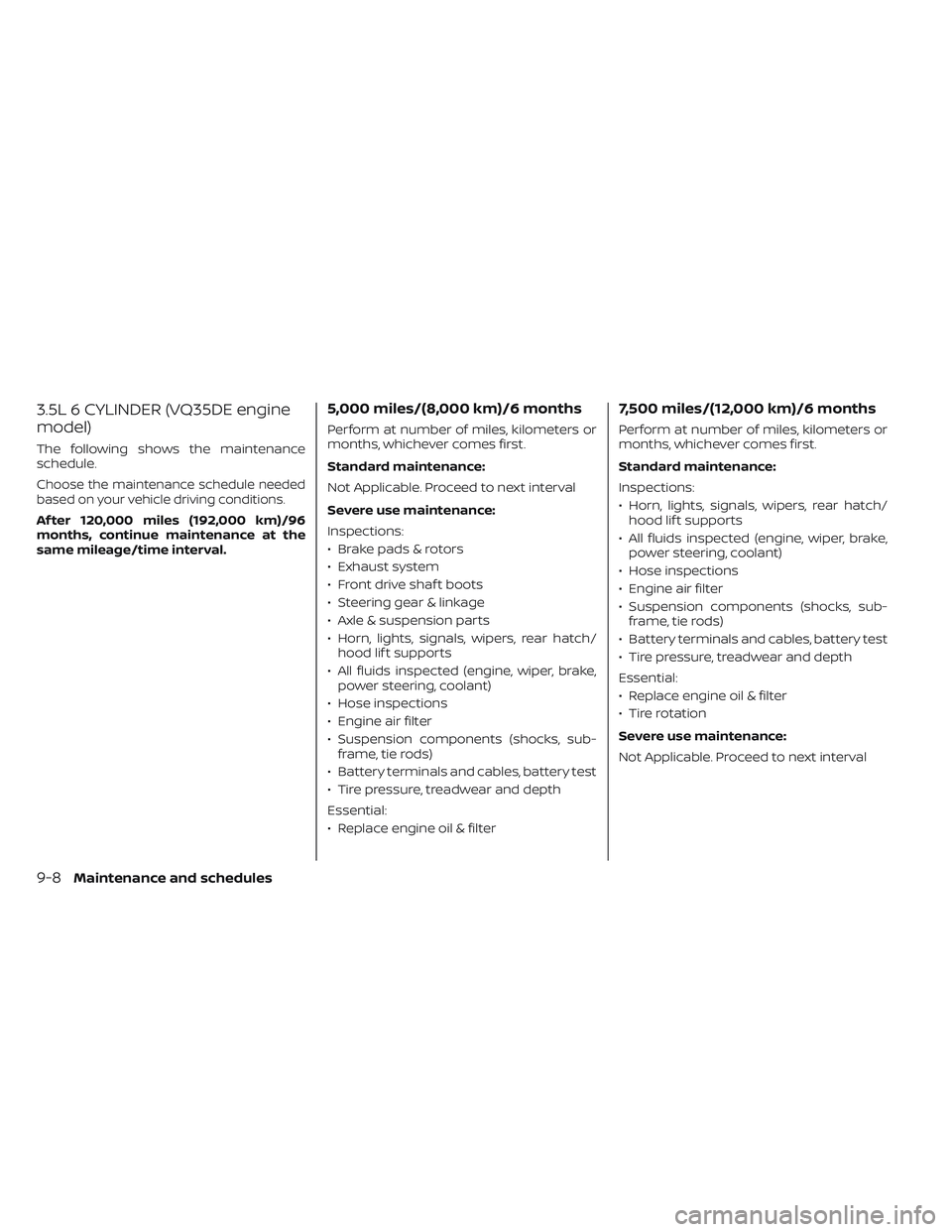
3.5L 6 CYLINDER (VQ35DE engine
model)
The following shows the maintenance
schedule.
Choose the maintenance schedule needed
based on your vehicle driving conditions.
Af ter 120,000 miles (192,000 km)/96
months, continue maintenance at the
same mileage/time interval.
5,000 miles/(8,000 km)/6 months
Perform at number of miles, kilometers or
months, whichever comes first.
Standard maintenance:
Not Applicable. Proceed to next interval
Severe use maintenance:
Inspections:
• Brake pads & rotors
• Exhaust system
• Front drive shaf t boots
• Steering gear & linkage
• Axle & suspension parts
• Horn, lights, signals, wipers, rear hatch/hood lif t supports
• All fluids inspected (engine, wiper, brake, power steering, coolant)
• Hose inspections
• Engine air filter
• Suspension components (shocks, sub- frame, tie rods)
• Battery terminals and cables, battery test
• Tire pressure, treadwear and depth
Essential:
• Replace engine oil & filter
7,500 miles/(12,000 km)/6 months
Perform at number of miles, kilometers or
months, whichever comes first.
Standard maintenance:
Inspections:
• Horn, lights, signals, wipers, rear hatch/ hood lif t supports
• All fluids inspected (engine, wiper, brake, power steering, coolant)
• Hose inspections
• Engine air filter
• Suspension components (shocks, sub- frame, tie rods)
• Battery terminals and cables, battery test
• Tire pressure, treadwear and depth
Essential:
• Replace engine oil & filter
• Tire rotation
Severe use maintenance:
Not Applicable. Proceed to next interval
9-8Maintenance and schedules
Page 477 of 494
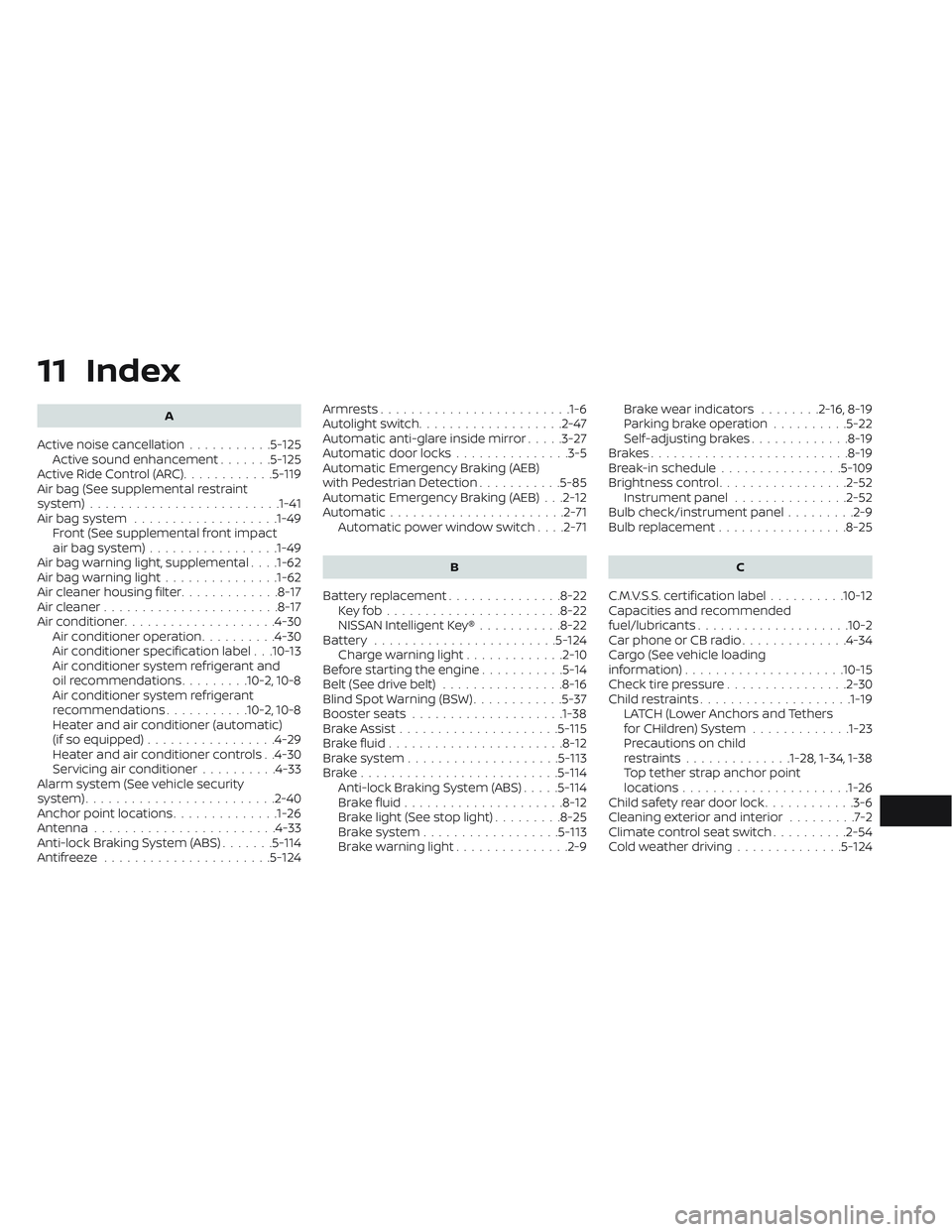
11 Index
A
Activenoisecancellation...........5-125Active sound enhancement .......5-125
ActiveRideControl(ARC)............5 -119
Air bag (See supplemental restraint
system) ........................ .1-41
Air bag system ...................1-49
Front (See supplemental front impact
air bag system) .................1-49
Air bag warning light, supplemental . . . .1-62
Airbagwarninglight.............. .1-62
Air cleaner housing filter .............8-17
Air cleaner .......................8-17
Air conditioner ....................4-30
Air conditioner operation ..........4-30
Air conditioner specification label . . .10-13
Air conditioner system refrigerant and
oil recommendations .........10-2,10-8
Air conditioner system refrigerant
recommendations ...........10-2,10-8
Heater and air conditioner (automatic)
(if so equipped) .................4-29
Heater and air conditioner controls . .4-30
Servicing air conditioner ..........4-33
Alarm system (See vehicle security
system) .........................2-40
Anchor point locations ..............1-26
Antenna ........................4-33
Anti-lock Braking System (ABS) .......5-114
Antifreeze ......................5-124 Armrests........................
.1-6
Autolightswitch...................2-47
Automatic anti-glare inside mirror .....3-27
Automatic door locks ...............3-5
Automatic Emergency Braking (AEB)
with Pedestrian Detection ...........5-85
Automatic Emergency Braking (AEB) . . .2-12
Automatic.......................2-71 Automaticpowerwindowswitch....2-71
B
Battery replacement ...............8-22
Keyfob.......................8-22
NISSAN Intelligent Key® ...........8-22
Battery ........................5-124 Charge warning light .............2-10
Before starting the engine ...........5-14
Belt(Seedrivebelt) ................8-16
Blind Spot Warning (BSW) ............5-37
Booster seats ................... .1-38
Brake Assist .....................5 -115
Brakefluid.......................8-12
Brake system ....................5 -113
Brake..........................5 -114
Anti-lock Braking System (ABS) .....5-114
Brakefluid.....................8-12
Brakelight(Seestoplight).........8-25
Brake system ..................5 -113
Brakewarninglight...............2-9 Brakewearindicators ........2-16,8-19
Parking brake operation
..........5-22
Self-adjustingbrakes.............8-19
Brakes..........................8-19
Break-in schedule ................5-109
Brightness control .................2-52
Instrument panel ...............2-52
Bulb check/instrument panel .........2-9
Bulb replacement .................8-25
C
C.M.V.S.S. certification label ..........10-12
Capacities and recommended
fuel/lubricants....................10-2
Car phone or CB radio ..............4-34
Cargo (See vehicle loading
information).....................10-15
Check tire pressure ................2-30
Childrestraints................... .1-19
LATCH (Lower Anchors and Tethers
forCHildren)System .............1-23
Precautions on child
restraints..............1-28, 1-34, 1-38
Top tether strap anchor point
locations..................... .1-26
Child safety rear door lock ............3-6
Cleaningexteriorandinterior .........7-2
Climatecontrolseatswitch..........2-54
Cold weather driving ..............5-124
Page 483 of 494
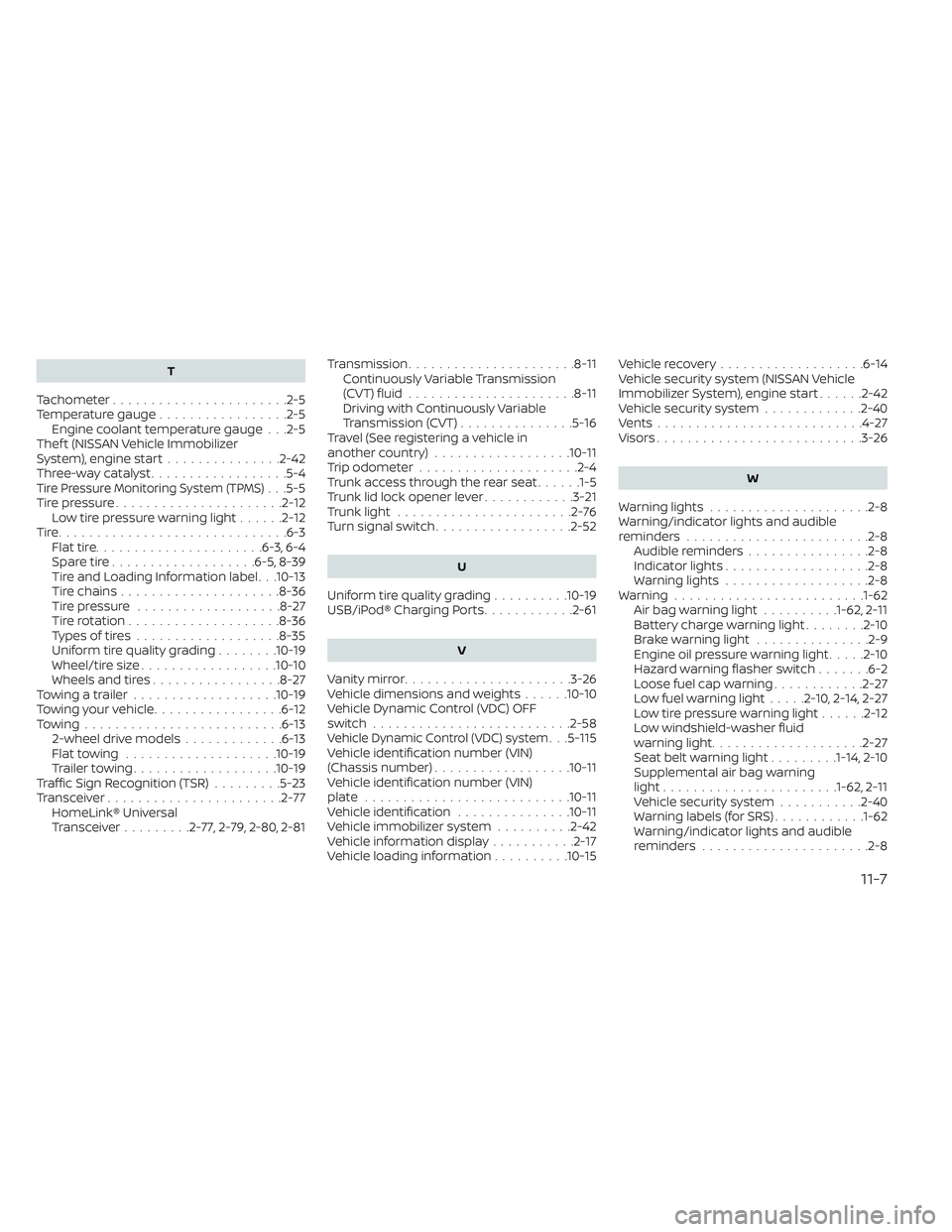
T
Tachometer.......................2-5
Temperature gauge .................2-5
Engine coolant temperature gauge . . .2-5
Thef t (NISSAN Vehicle Immobilizer
System), engine start ...............2-42
Three-waycatalyst..................5-4
Tire Pressure Monitoring System (TPMS)...5-5
Tire pressure ......................2-12
Low tire pressure warning light ......2-12
Tire..............................6-3 Flattire......................6-3,6-4
Spare tire ...................6-5,8-39
Tire and Loading Information label . . .10-13
Tire chains .....................8-36
Tirepressure ...................8-27
Tirerotation....................8-36
Types of tires ...................8-35
Uniform tire quality grading ........10-19
Wheel/tire size ..................10-10
Wheels and tires .................8-27
Towingatrailer ...................10-19
Towingyourvehicle.................6-12
Towing..........................6-13 2-wheel drive models .............6-13
Flattowing ....................10-19
Trailertowing...................10-19
Traffic Sign Recognition (TSR) .........5-23
Transceiver .......................2-77
HomeLink® Universal
Transceiver .........2-77,2-79,2-80,2-81 Transmission
......................8-11
Continuously Variable Transmission
(CVT) fluid ......................8-11
Driving with Continuously Variable
Transmission (CVT) ...............5-16
Travel (See registering a vehicle in
another country) ..................10-11
Trip odometer .....................2-4
Trunk access through the rear seat ......1-5
Trunk lid lock opener lever ............3-21
Trunklight .......................2-76
Turn signal switch ..................2-52
U
Uniform tire quality grading ..........10-19
USB/iPod® Charging Ports ............2-61
V
Vanitymirror......................3-26
Vehicle dimensions and weights ......10-10
Vehicle Dynamic Control (VDC) OFF
switch ..........................2-58
Vehicle Dynamic Control (VDC) system. . .5-115
Vehicle identification number (VIN)
(Chassis number) ..................10-11
Vehicle identification number (VIN)
plate ...........................10-11
Vehicle identification ...............10-11
Vehicle immobilizer system ..........2-42
Vehicleinformationdisplay...........2-17
Vehicle loading information ..........10-15Vehiclerecovery...................6-14
Vehicle security system (NISSAN Vehicle
Immobilizer System), engine start
......2-42
Vehicle security system .............2-40
Vents...........................4-27
Visors.......................... .3-26
W
Warninglights .....................2-8
Warning/indicator lights and audible
reminders........................2-8
Audible reminders ................2-8
Indicatorlights...................2-8
Warninglights ...................2-8
Warning ........................ .1-62
Airbagwarninglight ..........1-62, 2-11
Battery charge warning light ........2-10
Brakewarninglight .............. .2-9
Engine oil pressure warning light .....2-10
Hazard warning flasher switch .......6-2
Loose fuel cap warning ............2-27
Lowfuelwarninglight.....2-10, 2-14, 2-27
Lowtirepressurewarninglight......2-12
Low windshield-washer fluid
warninglight....................2-27
Seatbeltwarninglight.........1-14, 2-10
Supplemental air bag warning
light...................... .1-62, 2-11
Vehicle security system ...........2-40
Warning labels (for SRS) ............1-62
Warning/indicator lights and audible
reminders ......................2-8
11-7
Page 492 of 494
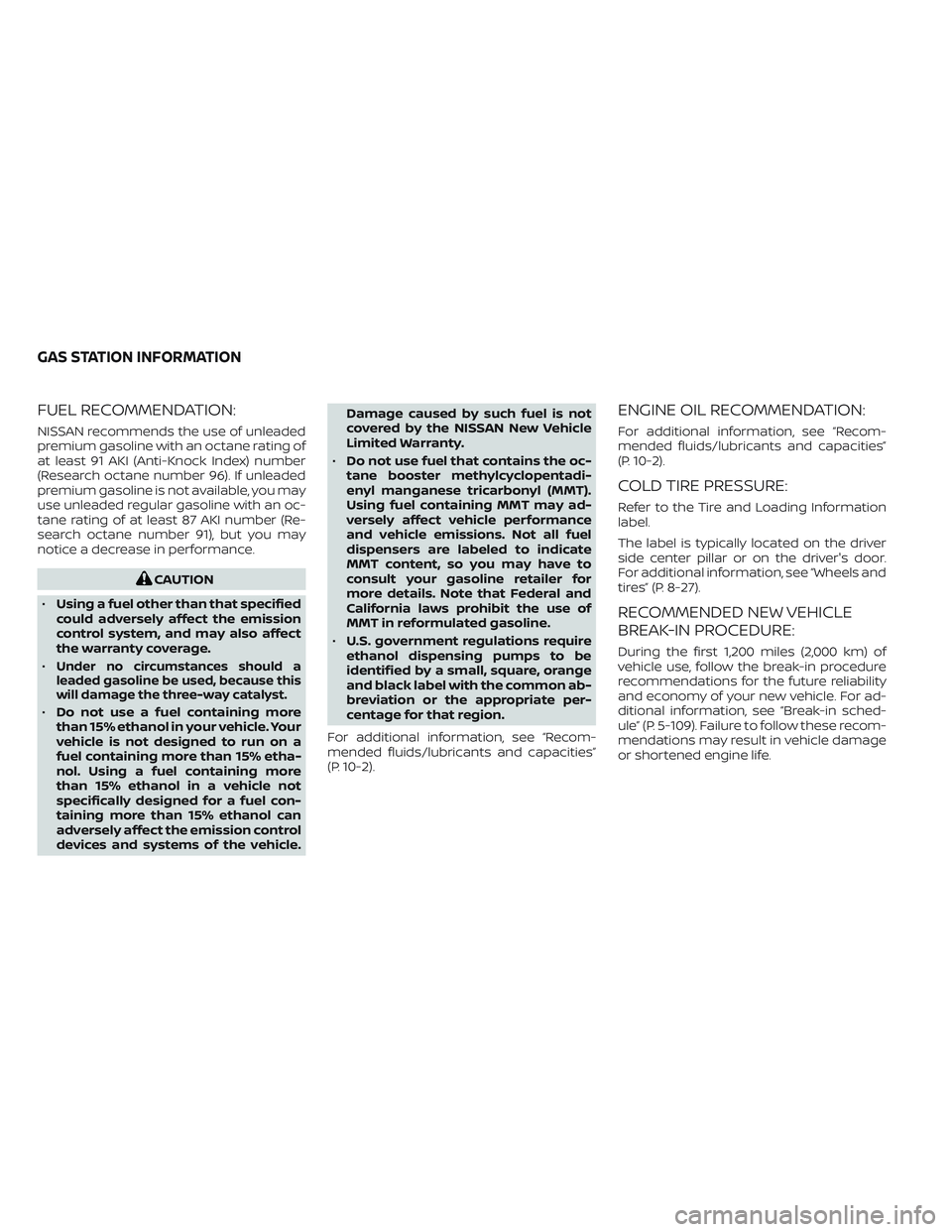
FUEL RECOMMENDATION:
NISSAN recommends the use of unleaded
premium gasoline with an octane rating of
at least 91 AKI (Anti-Knock Index) number
(Research octane number 96). If unleaded
premium gasoline is not available, you may
use unleaded regular gasoline with an oc-
tane rating of at least 87 AKI number (Re-
search octane number 91), but you may
notice a decrease in performance.
CAUTION
• Using a fuel other than that specified
could adversely affect the emission
control system, and may also affect
the warranty coverage.
•
Under no circumstances should a
leaded gasoline be used, because this
will damage the three-way catalyst.
• Do not use a fuel containing more
than 15% ethanol in your vehicle. Your
vehicle is not designed to run on a
fuel containing more than 15% etha-
nol. Using a fuel containing more
than 15% ethanol in a vehicle not
specifically designed for a fuel con-
taining more than 15% ethanol can
adversely affect the emission control
devices and systems of the vehicle. Damage caused by such fuel is not
covered by the NISSAN New Vehicle
Limited Warranty.
• Do not use fuel that contains the oc-
tane booster methylcyclopentadi-
enyl manganese tricarbonyl (MMT).
Using fuel containing MMT may ad-
versely affect vehicle performance
and vehicle emissions. Not all fuel
dispensers are labeled to indicate
MMT content, so you may have to
consult your gasoline retailer for
more details. Note that Federal and
California laws prohibit the use of
MMT in reformulated gasoline.
• U.S. government regulations require
ethanol dispensing pumps to be
identified by a small, square, orange
and black label with the common ab-
breviation or the appropriate per-
centage for that region.
For additional information, see “Recom-
mended fluids/lubricants and capacities”
(P. 10-2).
ENGINE OIL RECOMMENDATION:
For additional information, see “Recom-
mended fluids/lubricants and capacities”
(P. 10-2).
COLD TIRE PRESSURE:
Refer to the Tire and Loading Information
label.
The label is typically located on the driver
side center pillar or on the driver's door.
For additional information, see “Wheels and
tires” (P. 8-27).
RECOMMENDED NEW VEHICLE
BREAK-IN PROCEDURE:
During the first 1,200 miles (2,000 km) of
vehicle use, follow the break-in procedure
recommendations for the future reliability
and economy of your new vehicle. For ad-
ditional information, see “Break-in sched-
ule” (P. 5-109). Failure to follow these recom-
mendations may result in vehicle damage
or shortened engine life.
GAS STATION INFORMATION