tires NISSAN MAXIMA 2023 Service Manual
[x] Cancel search | Manufacturer: NISSAN, Model Year: 2023, Model line: MAXIMA, Model: NISSAN MAXIMA 2023Pages: 494, PDF Size: 5.7 MB
Page 430 of 494
NOTE:
NISSAN does not advocate the use of
non-OEM approved af termarket flush-
ing systems and strongly advises
against performing these services on a
NISSAN product. Many of the af termar-
ket flushing systems use non-OEM ap-
proved chemicals or solvents, the use of
which has not been validated by NISSAN.
For recommended fuel, lubricants, fluids,
grease, and refrigerant, see “Recom-
mended fluids/lubricants and capaci-
ties” (P. 10-2).
EMISSION CONTROL SYSTEM
MAINTENANCE:
Engine drive belts*:Check engine drive
belts for wear, fraying or cracking and for
proper tension. Replace any damaged
drive belts.
Engine air filter: Replace at specified inter-
vals. When driving for prolonged periods in
dusty conditions, check/replace the filter
more frequently.
Engine coolant*: Replace coolant at the
specified interval. When adding or replac-
ing coolant, be sure to use only Genuine NISSAN Long Life Antifreeze/Coolant (blue)
or equivalent with the proper mixture. (For
additional information on the proper mix-
ture for your area, see “Engine cooling sys-
tem” (P. 8-5.)
NOTE: Mixing any other type of coolant or
the use of non-distilled water may reduce
the recommended service interval of the
coolant.
Engine oil and oil filter:
Replace engine oil
and oil filter at the specified intervals. For
recommended oil grade and viscosity,
see “Recommended fluids/lubricants and
capacities” (P. 10-2).
Fuel tank vapor vent system*: Check
vapor lines for leaks or looseness. Tighten
connections or replace parts as necessary.
Fuel lines/connection*: Check the fuel
hoses, piping and connections for leaks,
looseness, or deterioration. Tighten con-
nections or replace parts as necessary.
Spark plugs: Replace at specified intervals.
Install new plugs of the same type as origi-
nally equipped.
CHASSIS AND BODY MAINTENANCE:
Brake lines and cables: Visually inspect for
proper installation. Check for chafing,
cracks, deterioration, and signs of leaking.
Replace any deteriorated or damaged
parts immediately.
Brake pads and rotors:
Check for wear, de-
terioration and fluid leaks. Replace any dete-
riorated or damaged parts immediately.
Exhaust system: Visually inspect the ex-
haust pipes, muffler and hangers for leaks,
cracks, deterioration, and damage. Tighten
connections or replace parts as necessary.
In-cabin microfilter: Replace at specified
intervals. When driving for prolonged peri-
ods in dusty conditions, replace the filter
more frequently.
Steering gear and linkage, axle and sus-
pension parts, drive shaf t boots: Check
for damage, looseness, and leakage of oil
or grease. Under severe driving conditions,
inspect more frequently.
Tire rotation: Rotate tires at the specified
interval shown in the maintenance sched-
ule. When rotating tires, check for damage
and uneven wear. Replace if necessary.
9-6Maintenance and schedules
Page 453 of 494
10 Technical and consumer information
Recommended fluids/lubricants and
capacities...................................... 10-2
Fuel recommendation ......................10-4
Engine oil and oil filter
recommendations .......................... 10-7
Air conditioner system refrigerant and
oil recommendations .......................10-8
Specifications .................................. 10-9
Engine ...................................... 10-9
Wheels and tires ........................... 10-10
Dimensions and weights ...................10-10
When traveling or registering in another
country ........................................ 10-11
Vehicle identification ........................... 10-11
Vehicle Identification Number (VIN)
plate ........................................ 10-11
Vehicle identification number (chassis
number) .................................... 10-11
Engine serial number ......................10-12
F.M.V.S.S./C.M.V.S.S. certification label ........10-12 Emission control information label
.........10-12
Tire and Loading Information label .........10-13
Air conditioner specification label ..........10-13
Installing front license plate ...................10-14
Vehicle loading information ...................10-15
Terms ...................................... 10-15
Vehicle load capacity ....................... 10-15
Loading tips ................................ 10-17
Measurement of weights ...................10-18
Towing a trailer ................................ 10-19
Flat towing ................................. 10-19
Uniform tire quality grading ...................10-19
Emission control system warranty ............10-20
Reporting safety defects ......................10-21
Readiness for Inspection/Maintenance (I/M)
test ........................................... 10-22
Event Data Recorders (EDR) ...................10-22
Owner's Manual/Service Manual order
information ................................... 10-23
Page 462 of 494
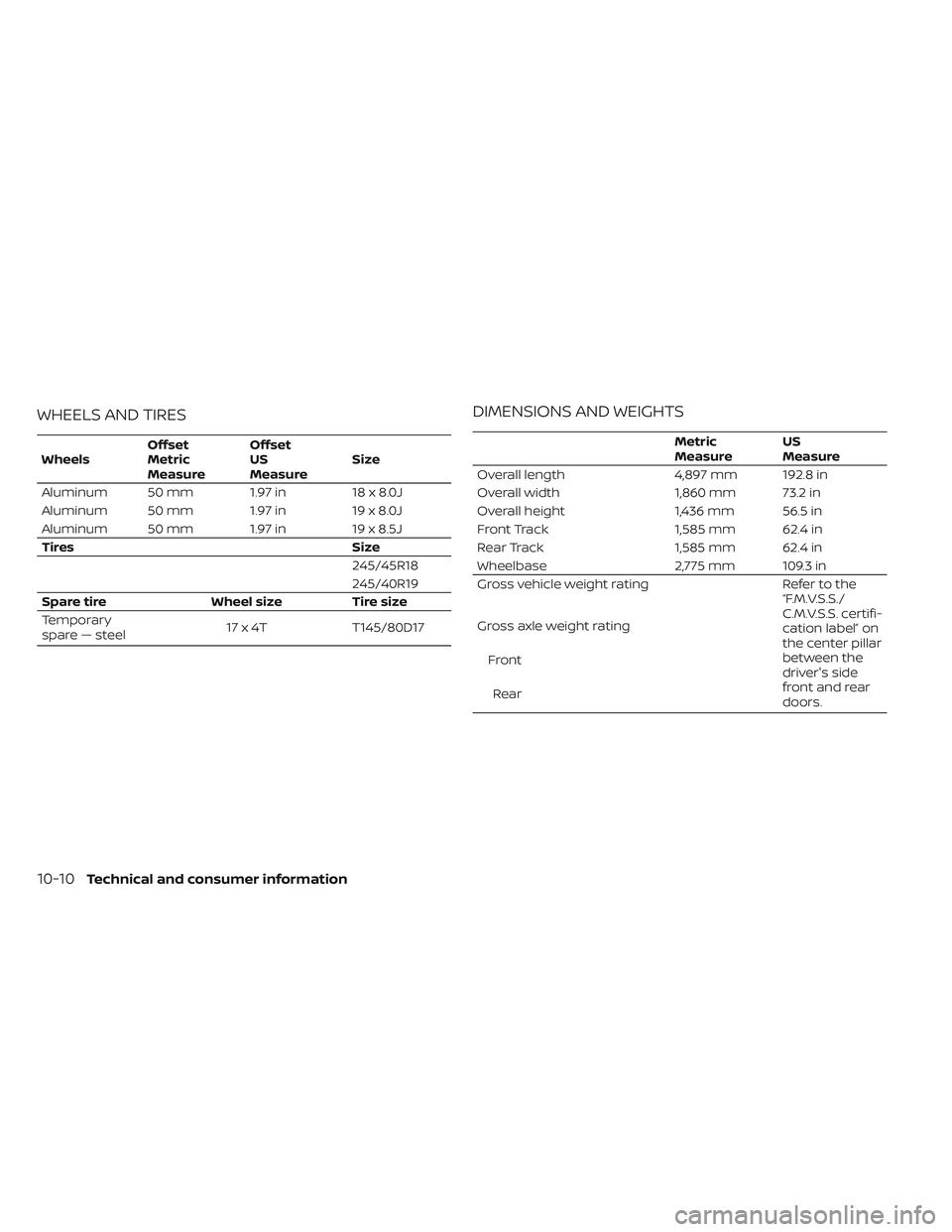
WHEELS AND TIRES
WheelsOffset
Metric
MeasureOffset
US
Measure
Size
Aluminum 50 mm 1.97 in 18 x 8.0J
Aluminum 50 mm 1.97 in 19 x 8.0J
Aluminum 50 mm 1.97 in 19 x 8.5J
Tires Size 245/45R18
245/40R19
Spare tire Wheel size Tire size
Temporary
spare — steel 17 x 4T T145/80D17
DIMENSIONS AND WEIGHTS
Metric
MeasureUS
Measure
Overall length 4,897 mm 192.8 in
Overall width 1,860 mm 73.2 in
Overall height 1,436 mm 56.5 in
Front Track 1,585 mm 62.4 in
Rear Track 1,585 mm 62.4 in
Wheelbase 2,775 mm 109.3 in
Gross vehicle weight rating Refer to the “F.M.V.S.S./
C.M.V.S.S. certifi-
cation label” on
the center pillar
between the
driver's side
front and rear
doors.
Gross axle weight rating
FrontRear
10-10Technical and consumer information
Page 469 of 494
1. Locate the statement “The com-bined weight of occupants and
cargo should never exceed XXX kg
or XXX lbs.” on your vehicle’s
placard.
2. Determine the combined weight of the driver and passengers that
will be riding in your vehicle.
3. Subtract the combined weight of the driver and passengers from
XXX kg or XXX lbs.
4. The resulting figure equals the available amount of cargo and
luggage load capacity. For ex-
ample, if the “XXX ” amount equals
1400 lbs. and there will be five 150
lb. passengers in your vehicle, the
amount of available cargo and
luggage load capacity is 650 lbs.
(1400-750 (5 X 150) = 650 lbs.) 5. Determine the combined weight
of luggage and cargo being
loaded on the vehicle. That weight
may not safely exceed the avail-
able cargo and luggage load ca-
pacity calculated in step 4.
6. If your vehicle will be towing a trailer, load from your trailer will be
transferred to your vehicle. Con-
sult this manual to determine
how this reduces the available
cargo and luggage load capacity
of your vehicle.
Towing a trailer with a vehicle that is
not intended for towing may result in
an accident involving injury or death.
WARNING
Do not tow a trailer with your vehicle.
Towing a trailer may result in an acci-
dent involving injury or death.
Before driving a loaded vehicle, con-
firm that you do not exceed the
Gross Vehicle Weight Rating (GVWR)
or the Gross Axle Weight Rating
(GAWR) for your vehicle. For addi-
tional information, see “Measure-
ment of weights” (P. 10-18).
Also check tires for proper inflation
pressures. For additional informa-
tion, see “Tire and Loading Informa-
tion label” (P. 10-13).
LOADING TIPS
• The GVW must not exceed GVWR or GAWR as specified on the F.M.V.S.S./
C.M.V.S.S. certification label.
• Do not load the front and rear axle to the GAWR. Doing so will exceed
the GVWR.
Technical and consumer information10-17
Page 471 of 494
Do not tow a trailer with your vehicle.
FLAT TOWING
Towing your vehicle with all four wheels on
the ground is sometimes called flat towing.
This method is sometimes used when
towing a vehicle behind a recreational ve-
hicle, such as a motor home.
CAUTION
•
Failure to follow these guidelines can
result in severe transmission damage.
• Whenever flat towing your vehicle,
always tow forward, never backward.
•
Never tow your front wheel drive ve-
hicle with the front tires on the ground.
Doing so may cause serious and ex-
pensive damage to the powertrain.
• DO NOT tow any continuously vari-
able transmission vehicle with all
four wheels on the ground (flat tow-
ing). Doing so WILL DAMAGE internal
transmission parts due to lack of
transmission lubrication.
•
For emergency towing procedures see
“Towing recommended by NISSAN”
(P. 6-12).
Continuously Variable
Transmission
To tow a vehicle equipped with a continu-
ously variable transmission, an appropriate
vehicle dolly MUSTbe placed under the
towed vehicle's drive wheels. Alwaysfollow
the dolly manufacturer's recommenda-
tions when using their product. DOT (Department of Transportation) Qual-
ity Grades: All passenger car tires must
conform to federal safety requirements in
addition to these grades.
Quality grades can be found where appli-
cable on the tire sidewall between tread
shoulder and maximum section width.
For example:
Treadwear 200 Traction AA Temperature A
Treadwear
The treadwear grade is a comparative rat-
ing based on the wear rate of the tire when
tested under controlled conditions on a
specified government test course. For ex-
ample, a tire graded 150 would wear one
and one-half (1 1/2) times as well on the
government course as a tire graded 100.
The relative performance of tires depends
upon the actual conditions of their use,
however, and may depart significantly from
the norm due to variations in driving habits,
service practices and differences in road
characteristics and climate.
TOWING A TRAILER
UNIFORM TIRE QUALITY GRADING
Technical and consumer information10-19
Page 472 of 494
Traction AA, A, B and C
The traction grades, from highest to lowest,
are AA, A, B, and C. Those grades represent
the tire's ability to stop on wet pavement as
measured under controlled conditions on
specified government test surfaces of as-
phalt and concrete. A tire marked C may
have poor traction performance.
WARNING
The traction grade assigned to this tire
is based on straight-ahead braking
traction tests, and does not include ac-
celeration, cornering, hydroplaning, or
peak traction characteristics.
Temperature A, B and C
The temperature grades are A (the high-
est), B, and C, representing the tire’s resis-
tance to the generation of heat, and its
ability to dissipate heat when tested under
controlled conditions on a specified indoor
laboratory test wheel. Sustained high tem-
perature can cause the material of the tire
to degenerate and reduce tire life, and ex-
cessive temperature can lead to sudden
tire failure. The grade C corresponds to a level of performance which all passenger
car tires must meet under the Federal Mo-
tor Safety Standard No. 109. Grades B and A
represent higher levels of performance on
the laboratory test wheel than the mini-
mum required by law.
WARNING
The temperature grade for this tire is
established for a tire that is properly
inflated and not overloaded. Excessive
speed, under-inflation, or excessive
loading, either separately or in combi-
nation, can cause heat build-up and
possible tire failure. Your NISSAN vehicle is covered by the fol-
lowing emission warranties:
For USA
1. Emission Defects Warranty
2. Emissions Performance WarrantyDetails of this warranty may be found with
other vehicle warranties in your Warranty In-
formation Booklet which comes with your
NISSAN vehicle. If you did not receive a War-
ranty Information Booklet, or it is lost, you
may obtain a replacement by writing to:
• Nissan North America, Inc.
Consumer Affairs Department
P.O. Box 685003
Franklin, TN 37068-5003
For Canada
Emission Control System Warranty
Details of this warranty may be found with
other vehicle warranties in your Warranty In-
formation Booklet which comes with your
NISSAN vehicle. If you did not receive a War-
ranty Information Booklet, or it is lost, you
may obtain a replacement by writing to:
• Nissan Canada Inc. 5290 Orbitor Drive
Mississauga, Ontario, L4W 4Z5
EMISSION CONTROL SYSTEM
WARRANTY
10-20Technical and consumer information
Page 483 of 494
T
Tachometer.......................2-5
Temperature gauge .................2-5
Engine coolant temperature gauge . . .2-5
Thef t (NISSAN Vehicle Immobilizer
System), engine start ...............2-42
Three-waycatalyst..................5-4
Tire Pressure Monitoring System (TPMS)...5-5
Tire pressure ......................2-12
Low tire pressure warning light ......2-12
Tire..............................6-3 Flattire......................6-3,6-4
Spare tire ...................6-5,8-39
Tire and Loading Information label . . .10-13
Tire chains .....................8-36
Tirepressure ...................8-27
Tirerotation....................8-36
Types of tires ...................8-35
Uniform tire quality grading ........10-19
Wheel/tire size ..................10-10
Wheels and tires .................8-27
Towingatrailer ...................10-19
Towingyourvehicle.................6-12
Towing..........................6-13 2-wheel drive models .............6-13
Flattowing ....................10-19
Trailertowing...................10-19
Traffic Sign Recognition (TSR) .........5-23
Transceiver .......................2-77
HomeLink® Universal
Transceiver .........2-77,2-79,2-80,2-81 Transmission
......................8-11
Continuously Variable Transmission
(CVT) fluid ......................8-11
Driving with Continuously Variable
Transmission (CVT) ...............5-16
Travel (See registering a vehicle in
another country) ..................10-11
Trip odometer .....................2-4
Trunk access through the rear seat ......1-5
Trunk lid lock opener lever ............3-21
Trunklight .......................2-76
Turn signal switch ..................2-52
U
Uniform tire quality grading ..........10-19
USB/iPod® Charging Ports ............2-61
V
Vanitymirror......................3-26
Vehicle dimensions and weights ......10-10
Vehicle Dynamic Control (VDC) OFF
switch ..........................2-58
Vehicle Dynamic Control (VDC) system. . .5-115
Vehicle identification number (VIN)
(Chassis number) ..................10-11
Vehicle identification number (VIN)
plate ...........................10-11
Vehicle identification ...............10-11
Vehicle immobilizer system ..........2-42
Vehicleinformationdisplay...........2-17
Vehicle loading information ..........10-15Vehiclerecovery...................6-14
Vehicle security system (NISSAN Vehicle
Immobilizer System), engine start
......2-42
Vehicle security system .............2-40
Vents...........................4-27
Visors.......................... .3-26
W
Warninglights .....................2-8
Warning/indicator lights and audible
reminders........................2-8
Audible reminders ................2-8
Indicatorlights...................2-8
Warninglights ...................2-8
Warning ........................ .1-62
Airbagwarninglight ..........1-62, 2-11
Battery charge warning light ........2-10
Brakewarninglight .............. .2-9
Engine oil pressure warning light .....2-10
Hazard warning flasher switch .......6-2
Loose fuel cap warning ............2-27
Lowfuelwarninglight.....2-10, 2-14, 2-27
Lowtirepressurewarninglight......2-12
Low windshield-washer fluid
warninglight....................2-27
Seatbeltwarninglight.........1-14, 2-10
Supplemental air bag warning
light...................... .1-62, 2-11
Vehicle security system ...........2-40
Warning labels (for SRS) ............1-62
Warning/indicator lights and audible
reminders ......................2-8
11-7
Page 484 of 494
Weights (See dimensions and
weights) ........................10-10
Wheel/tire size....................10-10
Wheels and tires ...................8-27
When traveling or registering in
another country ...................10-11
Windows ........................2-69 Locking passengers' windows ......2-70
Powerrearwindows..............2-70
Powerwindows.................2-69
Rearpowerwindows .............2-70
Windshield wiper blades .............8-18
Windshield-washer fluid .............8-12
Wiper and washer switch ............2-43
Wiper...........................8-18 Wiper blades ....................8-18
11-8
Page 492 of 494
FUEL RECOMMENDATION:
NISSAN recommends the use of unleaded
premium gasoline with an octane rating of
at least 91 AKI (Anti-Knock Index) number
(Research octane number 96). If unleaded
premium gasoline is not available, you may
use unleaded regular gasoline with an oc-
tane rating of at least 87 AKI number (Re-
search octane number 91), but you may
notice a decrease in performance.
CAUTION
• Using a fuel other than that specified
could adversely affect the emission
control system, and may also affect
the warranty coverage.
•
Under no circumstances should a
leaded gasoline be used, because this
will damage the three-way catalyst.
• Do not use a fuel containing more
than 15% ethanol in your vehicle. Your
vehicle is not designed to run on a
fuel containing more than 15% etha-
nol. Using a fuel containing more
than 15% ethanol in a vehicle not
specifically designed for a fuel con-
taining more than 15% ethanol can
adversely affect the emission control
devices and systems of the vehicle. Damage caused by such fuel is not
covered by the NISSAN New Vehicle
Limited Warranty.
• Do not use fuel that contains the oc-
tane booster methylcyclopentadi-
enyl manganese tricarbonyl (MMT).
Using fuel containing MMT may ad-
versely affect vehicle performance
and vehicle emissions. Not all fuel
dispensers are labeled to indicate
MMT content, so you may have to
consult your gasoline retailer for
more details. Note that Federal and
California laws prohibit the use of
MMT in reformulated gasoline.
• U.S. government regulations require
ethanol dispensing pumps to be
identified by a small, square, orange
and black label with the common ab-
breviation or the appropriate per-
centage for that region.
For additional information, see “Recom-
mended fluids/lubricants and capacities”
(P. 10-2).
ENGINE OIL RECOMMENDATION:
For additional information, see “Recom-
mended fluids/lubricants and capacities”
(P. 10-2).
COLD TIRE PRESSURE:
Refer to the Tire and Loading Information
label.
The label is typically located on the driver
side center pillar or on the driver's door.
For additional information, see “Wheels and
tires” (P. 8-27).
RECOMMENDED NEW VEHICLE
BREAK-IN PROCEDURE:
During the first 1,200 miles (2,000 km) of
vehicle use, follow the break-in procedure
recommendations for the future reliability
and economy of your new vehicle. For ad-
ditional information, see “Break-in sched-
ule” (P. 5-109). Failure to follow these recom-
mendations may result in vehicle damage
or shortened engine life.
GAS STATION INFORMATION