belt NISSAN MAXIMA PLATINUM 2018 Owner's Manual
[x] Cancel search | Manufacturer: NISSAN, Model Year: 2018, Model line: MAXIMA PLATINUM, Model: NISSAN MAXIMA PLATINUM 2018Pages: 428, PDF Size: 4.54 MB
Page 79 of 428
∙ Tampering with the side air bag sys-tem may result in serious personal in-
jury. For example, do not change the
front seats by placing material near
the seatbacks or by installing addi-
tional trim material, such as seat cov-
ers, around the side air bag.
∙ It is recommended that you visit a NISSAN dealer for work on and around
the side air bag and curtain air bag
system. It is also recommended that
you visit a NISSAN dealer for installa-
tion of electrical equipment. The SRS
wiring harnesses* should not be
modified or disconnected. Unauthor-
ized electrical test equipment and
probing devices should not be used
on the side air bag or curtain air bag
systems.
*The SRS wiring harness or connectors
are yellow or orange for easy identifica-
tion.
When selling your vehicle, we request that
you inform the buyer about the side air
bags and curtain air bag system and guide
the buyer to the appropriate sections in
this Owner’s Manual.Seat belt with pretensioner(s)
(front seats)
Page 80 of 428
When pretensioner(s) activate, smoke is re-
leased and a loud noise may be heard. This
smoke is not harmful and does not indi-
cate a fire. Care should be taken not to
inhale it, as it may cause irritation and
choking. Those with a history of a breath-
ing condition should get fresh air promptly.
Af ter the pretensioner(s’) activation, load
limiters allow the seat belt to release web-
bing (if necessary) to reduce forces against
the chest.
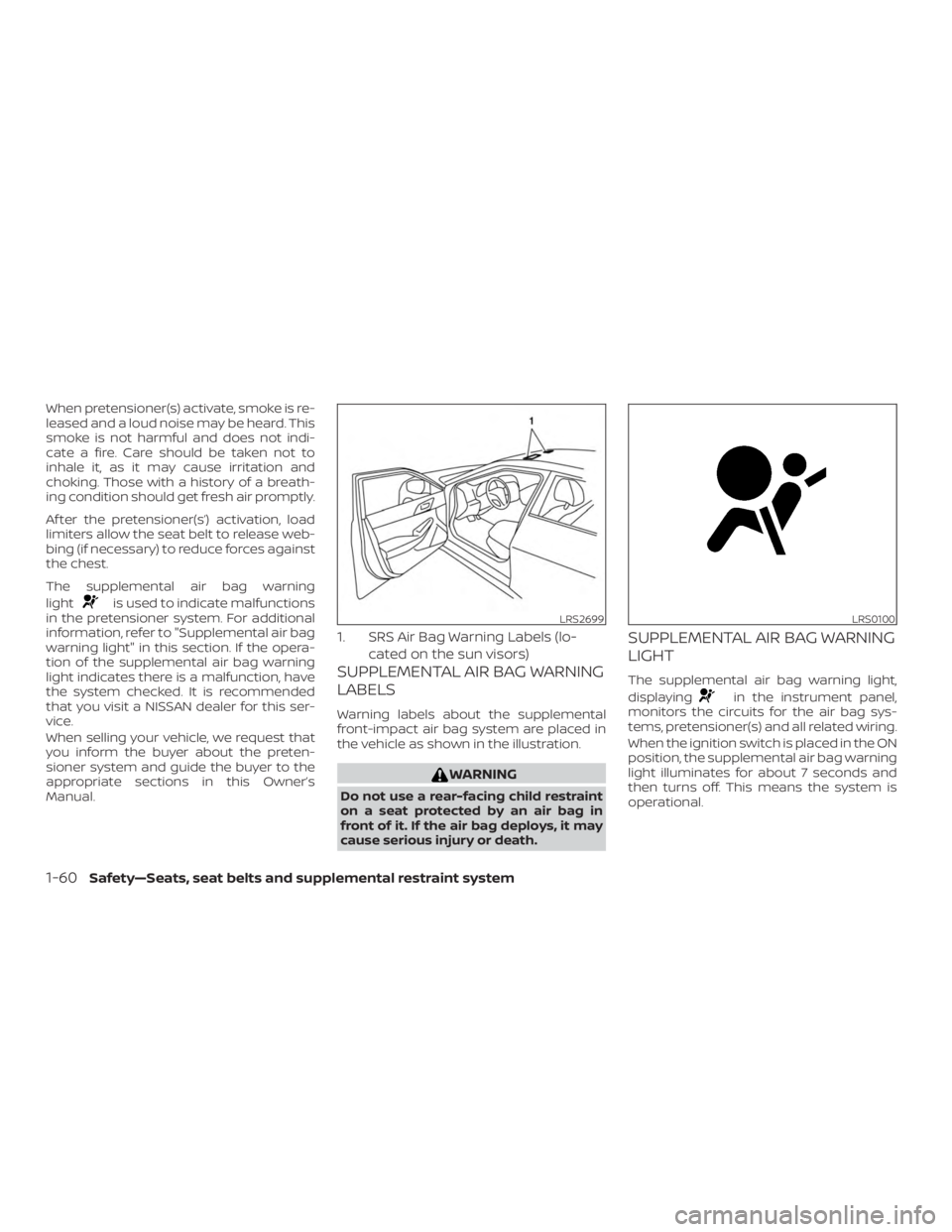
The supplemental air bag warning
light
Page 82 of 428
∙ If there is an impact to your vehiclefrom any direction, your Occupant
Classification Sensor (OCS) should be
checked to verif y it is still functioning
correctly. It is recommended that you
visit a NISSAN dealer for this service.
The OCS should be checked even if no
air bags deploy as a result of the im-
pact. Failure to verif y proper OCS
function may result in an improper air
bag deployment resulting in injury or
death.
1-62Safety—Seats, seat belts and supplemental restraint system
Page 98 of 428
tion properly. For additional information, re-
fer to “Supplemental Restraint System
(SRS)” in the “Safety—Seats, seat belts and
supplemental restraint system” section of
this manual.
Page 233 of 428
Seat belts help reduce the risk of injury in
collisions and rollovers.In a rollover crash,
an unbelted or improperly belted person
is significantly more likely to be injured
or killed than a person properly wearing
a seat belt.
OFF-ROAD RECOVERY
While driving, the right side or lef t side
wheels may unintentionally leave the road
surface. If this occurs, maintain control of
the vehicle by following the procedure be-
low. Please note that this procedure is only
a general guide. The vehicle must be driven
as appropriate based on the conditions of
the vehicle, road and traffic.
1. Remain calm and do not overreact.
2. Do not apply the brakes.
3. Maintain a firm grip on the steering wheel with both hands and try to hold a
straight course.
4. When appropriate, slowly release the accelerator pedal to gradually slow the
vehicle.
5. If there is nothing in the way, steer the vehicle to follow the road while vehicle
speed is reduced. Do not attempt to drive the vehicle back onto the road
surface until vehicle speed is reduced.
6. When it is safe to do so, gradually turn the steering wheel until both tires re-
turn to the road surface. When all tires
are on the road surface, steer the ve-
hicle to stay in the appropriate driving
lane.
∙ If you decide that it is not safe to re- turn the vehicle to the road surface
based on vehicle, road or traffic con-
ditions, gradually slow the vehicle to a
stop in a safe place off the road.
RAPID AIR PRESSURE LOSS
Rapid air pressure loss or a “blow-out” can
occur if the tire is punctured or is damaged
due to hitting a curb or pothole. Rapid air
pressure loss can also be caused by driving
on under-inflated tires.
Rapid air pressure loss can affect the han-
dling and stability of the vehicle, especially
at highway speeds.
Help prevent rapid air pressure loss by
maintaining the correct air pressure and
visually inspecting the tires for wear and
damage. For additional information, refer
to “Wheels and tires” in the “Do-it-yourself ”
section of this manual. If a tire rapidly loses air pressure or “blows-out” while driving,
maintain control of the vehicle by following
the procedure below. Please note that this
procedure is only a general guide. The ve-
hicle must be driven as appropriate based
on the conditions of the vehicle, road and
traffic.
Page 341 of 428
When installing Genuine NISSAN floor mats,
follow the installation instructions provided
with the mat and the following:1. With the ignition in the OFF position, the shif t lever in P (Park) position and with
the parking brake fully applied, position
the floor mat in the floorwell so that the
floor mat grommet holes are aligned
with the hook(s).
2. Secure the grommet holes into the hook(s) and ensure that the floor mat is
properly positioned.
3. Make sure the floor mat does not inter- fere with pedal operation. With the igni-
tion still in the OFF position, the shif t
lever in the P (Park) position and with
the parking brake applied, fully apply
and release all pedals. The floor mat
must not interfere with pedal opera-
tion or prevent the pedal from return-
ing to its normal position.
It is recommended that you visit a NISSAN
dealer for details about installing the floor
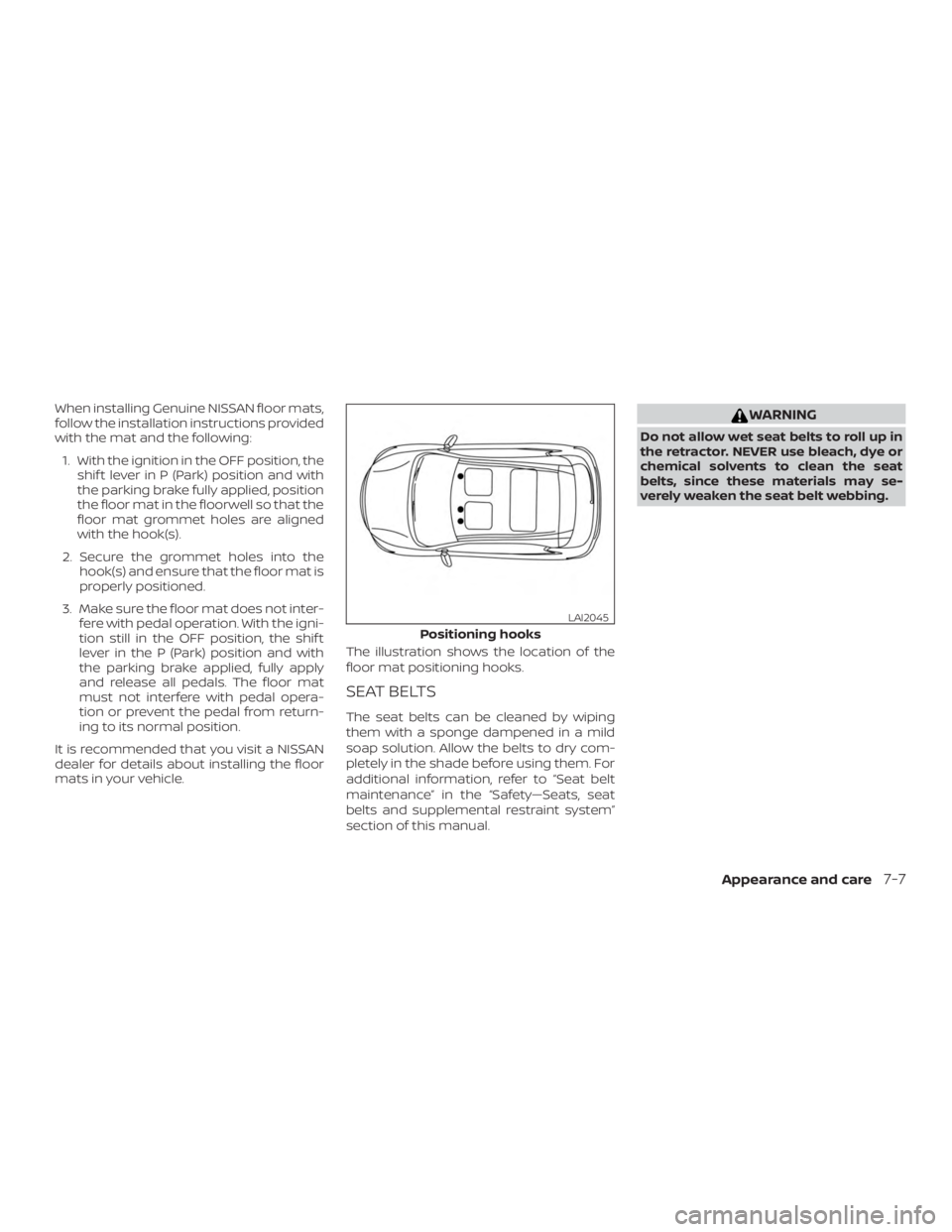
mats in your vehicle. The illustration shows the location of the
floor mat positioning hooks.
SEAT BELTS
The seat belts can be cleaned by wiping
them with a sponge dampened in a mild
soap solution. Allow the belts to dry com-
pletely in the shade before using them. For
additional information, refer to “Seat belt
maintenance” in the “Safety—Seats, seat
belts and supplemental restraint system”
section of this manual.
Page 356 of 428
Vehicles operated in high temperatures or
under severe conditions require frequent
checks of the battery fluid level.
JUMP STARTING
If jump starting is necessary, refer to “Jump
starting” in the “In case of emergency” sec-
tion of this manual. If the engine does not
start by jump starting, the battery may
have to be replaced. It is recommended
that you visit a NISSAN dealer for this ser-
vice.
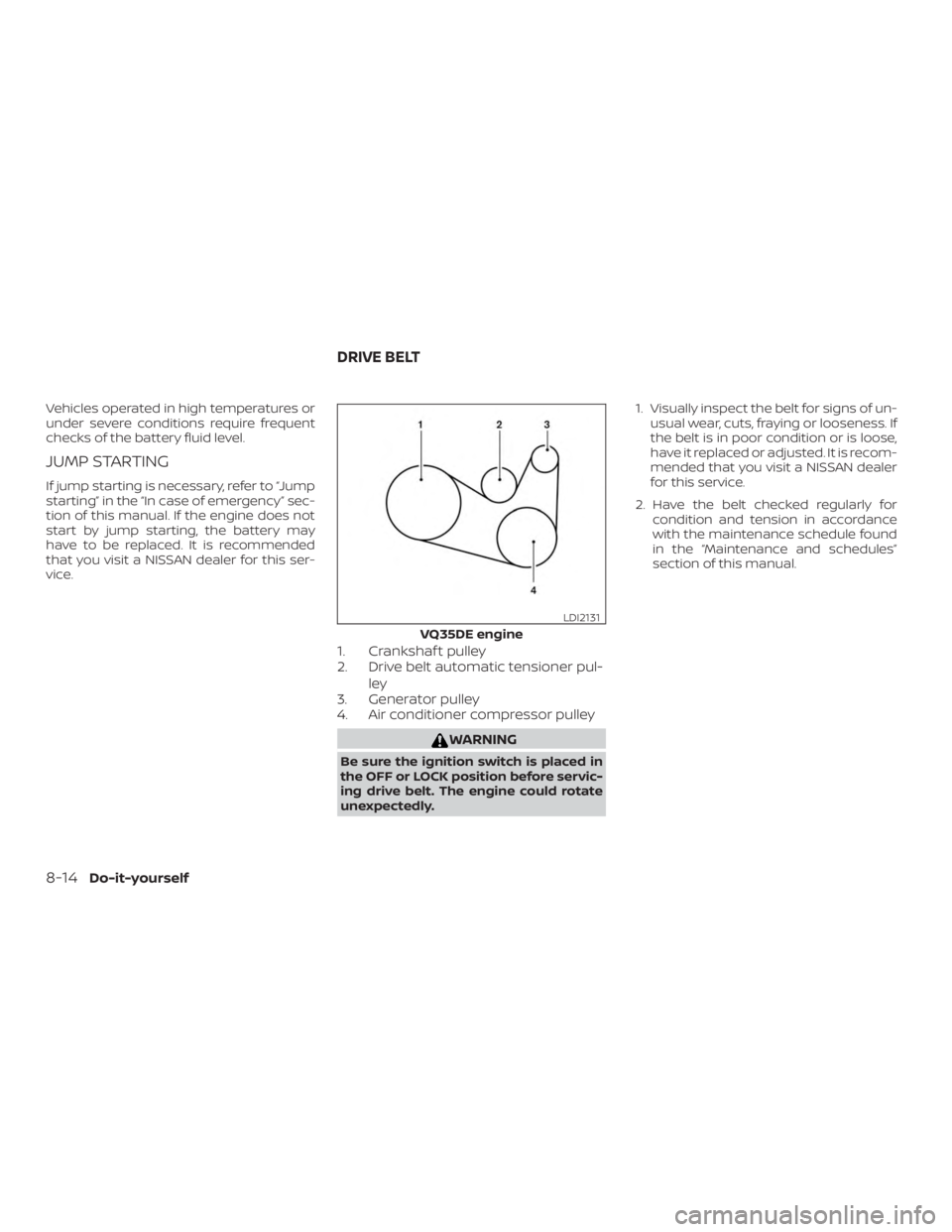
1. Crankshaf t pulley
2. Drive belt automatic tensioner pul-ley
3. Generator pulley
4. Air conditioner compressor pulley
Page 409 of 428
WARNING
∙ It is extremely dangerous to ride in a cargo area inside a ve-
hicle. In a collision, people riding
in these areas are more likely to
be seriously injured or killed.
∙ Do not allow people to ride in any area of your vehicle that is
not equipped with seats and
seat belts.
∙ Be sure everyone in your vehicle is in a seat and using a seat belt
properly.
TERMS
It is important to familiarize yourself
with the following terms before
loading your vehicle:
∙ Curb Weight (actual weight of your vehicle) - vehicle weight in-
cluding: standard and optional
equipment, fluids, emergency
tools, and spare tire assembly.
This weight does notinclude
passengers and cargo. ∙ GVW (Gross Vehicle Weight) - curb
weight plus the combined weight
of passengers and cargo.
∙ GVWR (Gross Vehicle Weight Rat- ing) - maximum total combined
weight of the unloaded vehicle,
passengers, luggage, hitch, trailer
tongue load and any other op-
tional equipment. This informa-
tion is located on the
F.M.V.S.S./C.M.V.S.S. certification
label.
∙ GAWR (Gross Axle Weight Rating) - maximum weight (load) limit
specified for the front or rear axle.
This information is located on the
F.M.V.S.S./C.M.V.S.S. certification
label.
∙ GCWR (Gross Combined Weight rating) - The maximum total
weight rating of the vehicle, pas-
sengers, cargo, and trailer. ∙ Vehicle Capacity Weight, Load
limit, Total load capacity - maxi-
mum total weight limit specified
of the load (passengers and
cargo) for the vehicle. This is the
maximum combined weight of
occupants and cargo that can be
loaded into the vehicle. If the ve-
hicle is used to tow a trailer, the
trailer tongue weight must be in-
cluded as part of the cargo load.
This information is located on the
Tire and Loading Information la-
bel.
∙ Cargo capacity - permissible weight of cargo, the subtracted
weight of occupants from the
load limit.
VEHICLE LOADING INFORMATION
Technical and consumer information10-13
Page 418 of 428
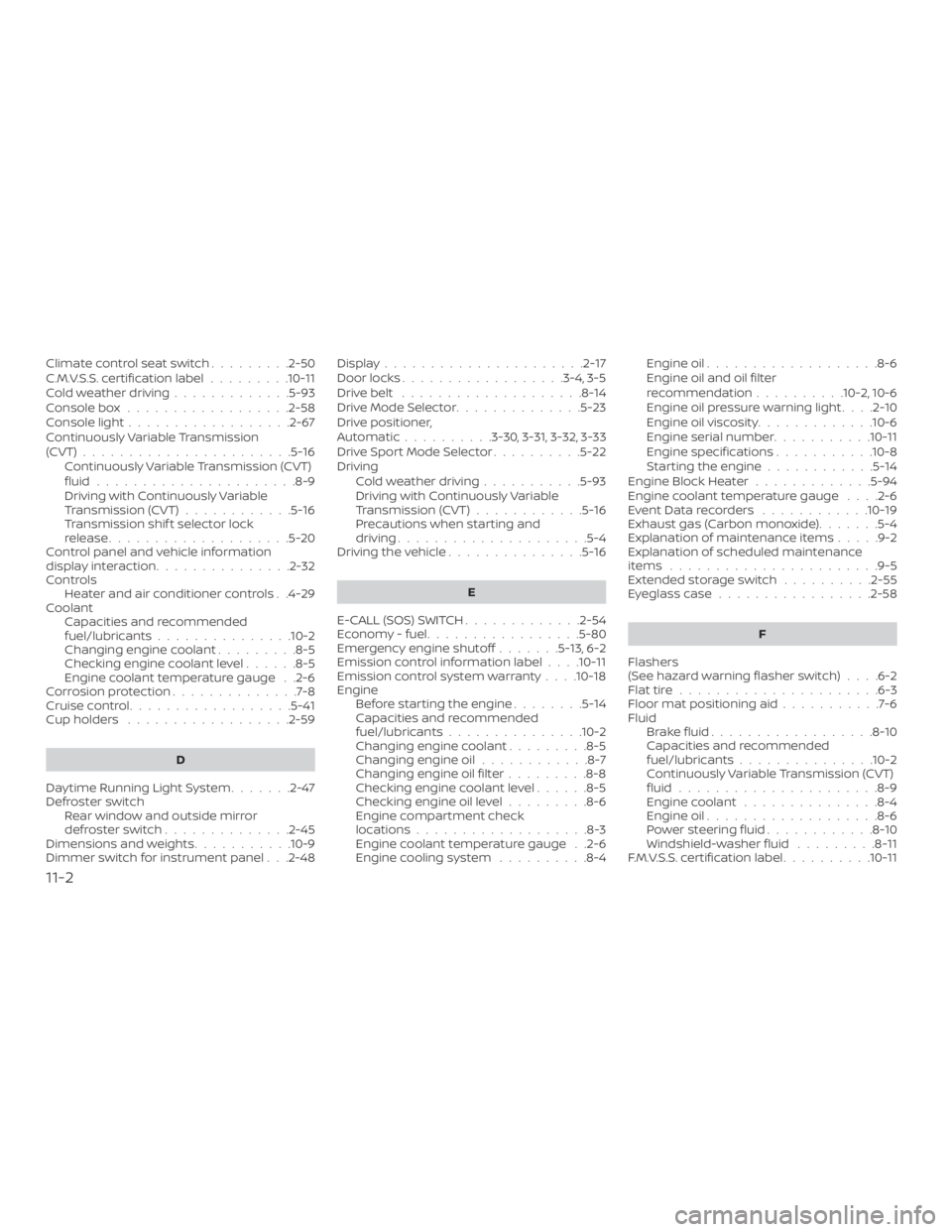
Climatecontrolseatswitch.........2-50
C.M.V.S.S. certification label.........10-11
Coldweatherdriving.............5-93
Console box ..................2-58
Console light ..................2-67
Continuously Variable Transmission
(CVT) .......................5-16
Continuously Variable Transmission (CVT)
fluid......................8-9
Driving with Continuously Variable
Transmission (CVT) ............5-16
Transmission shif t selector lock
release....................5-20
Control panel and vehicle information
displayinteraction...............2-32
Controls Heater and air conditioner controls . .4-29
Coolant Capacities and recommended
fuel/lubricants...............10-2
Changing engine coolant .........8-5
Checking engine coolant level ......8-5
Engine coolant temperature gauge . .2-6
Corrosionprotection..............7-8
Cruisecontrol..................5-41
Cupholders ..................2-59
D
Daytime Running Light System .......2-47
Defroster switch Rear window and outside mirror
defrosterswitch..............2-45
Dimensions and weights ...........10-9
Dimmer switch for instrument panel . . .2-48 Display......................2-17
Door locks
..................3-4,3-5
Drivebelt ....................8-14
Drive Mode Selector ..............5-23
Drive positioner,
Automatic..........3-30,3-31,3-32,3-33
Drive Sport Mode Selector ..........5-22
Driving Cold weather driving ...........5-93
Driving with Continuously Variable
Transmission (CVT) ............5-16
Precautions when starting and
driving.....................5-4
Drivingthevehicle...............5-16
E
E-CALL (SOS) SWITCH .............2-54
Economy - fuel .................5-80
Emergency engine shutoff .......5-13,6-2
Emission control information label . . . .10-11
Emission control system warranty . . . .10-18
Engine Before starting the engine ........5-14
Capacities and recommended
fuel/lubricants...............10-2
Changing engine coolant .........8-5
Changing engine oil ............8-7
Changing engine oil filter .........8-8
Checking engine coolant level ......8-5
Checking engine oil level .........8-6
Engine compartment check
locations...................8-3
Engine coolant temperature gauge . .2-6
Engine cooling system ..........8-4 Engine oil
...................8-6
Engine oil and oil filter
recommendation ..........10-2,10-6
Engine oil pressure warning light . . . .2-10
Engine oil viscosity .............10-6
Engine serial number ...........10-11
Engine specifications ...........10-8
Starting the engine ............5-14
Engine Block Heater .............5-94
Engine coolant temperature gauge ....2-6
EventDatarecorders ............10-19
Exhaust gas (Carbon monoxide) .......5-4
Explanation of maintenance items .....9-2
Explanation of scheduled maintenance
items .......................9-5
Extended storage switch ..........2-55
Eyeglasscase.................2-58
F
Flashers
(Seehazardwarningflasherswitch)....6-2
Flattire......................6-3
Floormatpositioningaid...........7-6
Fluid Brakefluid..................8-10
Capacities and recommended
fuel/lubricants...............10-2
Continuously Variable Transmission (CVT)
f
luid......................8-9
Engine coolant ...............8-4
Engine oil ...................8-6
Powersteeringfluid............8-10
Windshield-washer fluid .........8-11
F.M.V.S.S. certification label ..........10-11
11-2
Page 420 of 428
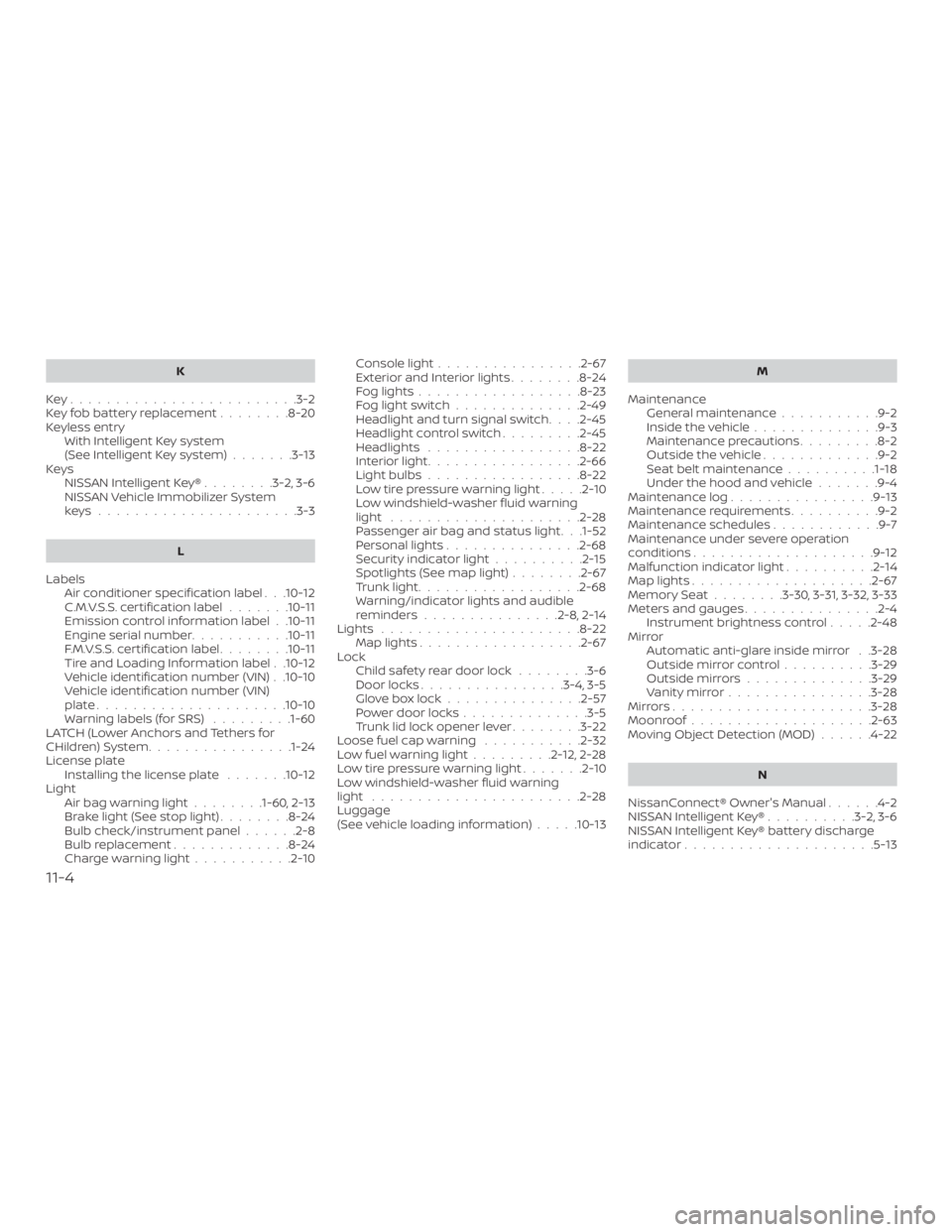
K
Key.........................3-2
Key fob battery replacement ........8-20
Keyless entry With Intelligent Key system
(See Intelligent Key system) .......3-13
Keys NISSAN Intelligent Key® ........3-2,3-6
NISSAN Vehicle Immobilizer System
keys......................3-3
L
Labels Air conditioner specification label . . .10-12
C.M.V.S.S. certification label .......10-11
Emission control information label . .10-11
Engine serial number ...........10-11
F.M.V.S.S. certification label ........10-11
Tire and Loading Information label . .10-12
Vehicle identification number (VIN) . .10-10
Vehicle identification number (VIN)
plate.....................10-10
Warning labels (for SRS) .........1-60
LATCH (Lower Anchors and Tethers for
CHildren)System............... .1-24
License plate Installing the license plate .......10-12
Light Airbagwarninglight........1-60, 2-13
Brakelight(Seestoplight)........8-24
Bulb check/instrument panel ......2-8
Bulb replacement .............8-24
Charge warning light ...........2-10 Console light
................2-67
ExteriorandInteriorlights........8-24
Foglights..................8-23
Foglightswitch..............2-49
Headlight and turn signal switch ....2-45
Headlightcontrolswitch.........2-45
Headlights .................8-22
Interiorlight.................2-66
Lightbulbs.................8-22
Low tire pressure warning light .....2-10
Low windshield-washer fluid warning
light .....................2-28
Passenger air bag and status light. . .1-52
Personal lights ...............2-68
Security indicator light ..........2-15
Spotlights(Seemaplight)........2-67
Trunklight..................2-68
Warning/indicator lights and audible
reminder s...............2-8,2-14
Lights ......................8-22 Maplights..................2-67
Lock Child safety rear door lock ........3-6
Door locks ................3-4,3-5
Gloveboxlock...............2-57
Power door locks ..............3-5
Trunk lid lock opener lever ........3-22
Loose fuel cap warning ...........2-32
Lowfuelwarninglight.........2-12,2-28
Low tire pressure warning light .......2-10
Low windshield-washer fluid warning
light .......................2-28
Luggage
(See vehicle loading information) .....10-13 M
Maintenance General maintenance ...........9-2
Insidethevehicle..............9-3
Maintenance precautions .........8-2
Outsidethevehicle.............9-2
Seat belt maintenance ..........1-18
Under the hood and vehicle .......9-4
Maintenance log ................9-13
Maintenance requirements ..........9-2
Maintenance schedules ............9-7
Maintenance under severe operation
conditions....................9-12
Malfunctionindicatorlight..........2-14
Maplights....................2-67
Memory Seat ........3-30,3-31,3-32,3-33
Meters and gauges ...............2-4
Instrument brightness control .....2-48
Mirror Automatic anti-glare inside mirror . .3-28
Outsidemirrorcontrol..........3-29
Outsidemirrors..............3-29
Vanitymirror................3-28
Mirrors......................3-28
Moonroof ....................2-63
Moving Object Detection (MOD) ......4-22
N
NissanConnect® Owner's Manual ......4-2
NISSAN Intelligent Key® ..........
3-2,3-6
NISSAN Intelligent Key® battery discharge
indicator.....................5-13
11-4