belt NISSAN MICRA 2012 User Guide
[x] Cancel search | Manufacturer: NISSAN, Model Year: 2012, Model line: MICRA, Model: NISSAN MICRA 2012Pages: 293, PDF Size: 2.98 MB
Page 36 of 293
– Infants and children should never beheld on anyone’s lap. Even the stron-
gest adult cannot resist the forces of
a collision.
– Do not put a seat belt around both a child and another passenger.
– NISSAN recommends that all child restraints be installed in the rear
seat. Studies show that children are
safer when properly restrained in the
rear seat than in the front seat. If you
must install a forward-facing child
restraint in the front seat, refer to
“Forward-facing child restraint in-
stallation using the seat belts” in this
section.
– Even with the NISSAN Advanced Air Bag System, never install a rear-
facing child restraint in the front seat.
An inflating air bag could seriously
injure or kill a child. A rear-facing
child restraint must only be used in
the rear seat.
– Be sure to purchase a child restraint that will fit the child and vehicle.
Some child restraints may not fit
properly in your vehicle. – Child restraint anchor points are de-
signed to withstand loads from child
restraints that are properly fitted.
– Never use the anchor points for adult seat belts or harnesses.
– A child restraint with a top tether strap should not be used in the front
passenger seat.
– Keep seatbacks as upright as pos- sible after fitting the child restraint.
– Infants and children should always be placed in an appropriate child re-
straint while in the vehicle.
● When the child restraint is not in use,
keep it secured with the LATCH system
or a seat belt. In a sudden stop or colli-
sion, loose objects can injure occupants
or damage the vehicle.
Page 37 of 293
●If the combined weight of the child and child
restraint is less than 65 lbs (29.5 kg) , you
may use either the LATCH anchors or the
seat belt to install the child restraint (not both
at the same time) .
● If the combined weight of the child and child
restraint is greater than 65 lbs, (29.5 kg) use
the vehicle’s seat belt (not the lower an-
chors) to install the child restraint.
● Be sure to follow the child restraint manufac-
turer’s instructions for installation.
All Canadian provinces or territories re-
quire that infants and small children be
restrained in an approved child restraint at
all times while the vehicle is being oper-
ated. Canadian law requires the top tether
strap on forward-facing child restraints be
secured to the designated anchor point on
the vehicle.
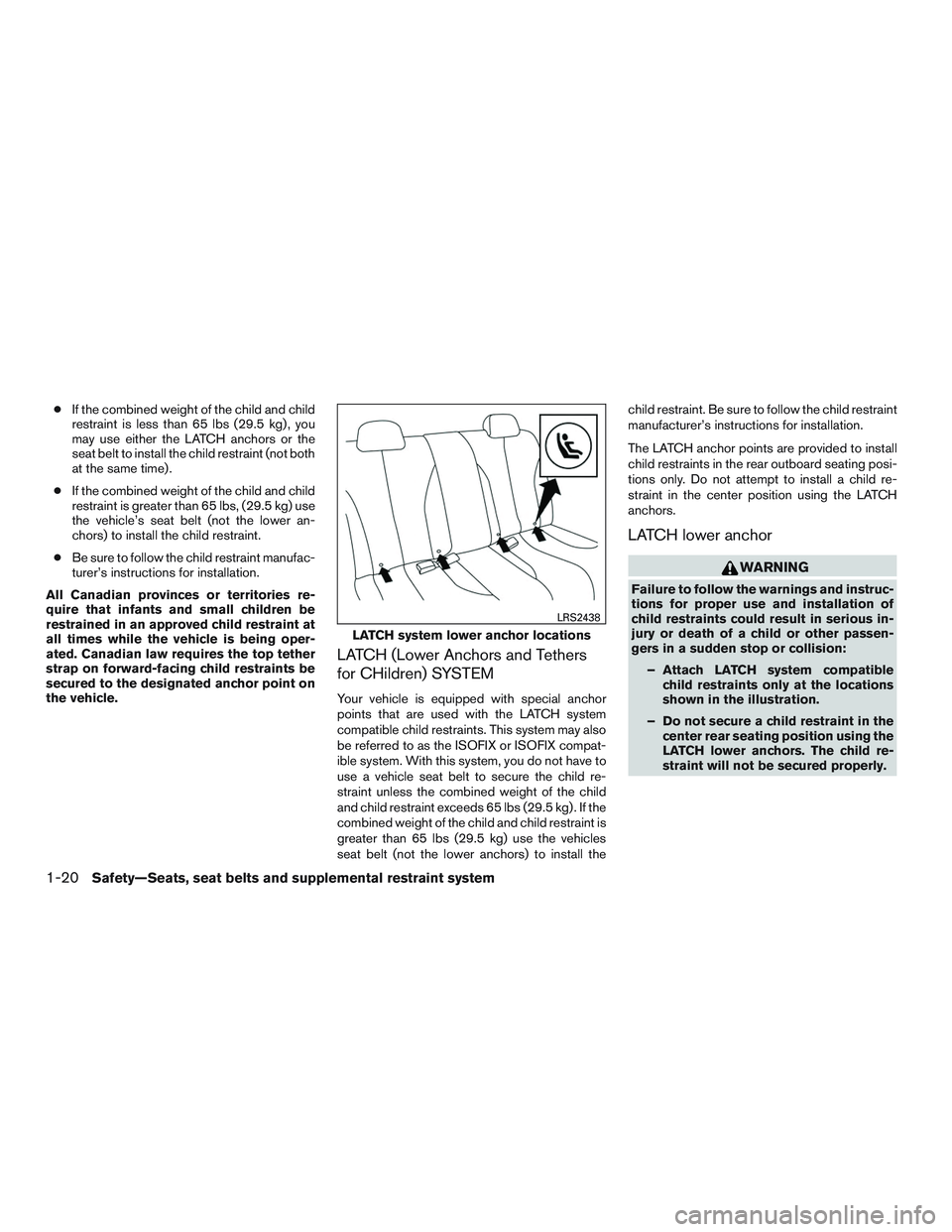
LATCH (Lower Anchors and Tethers
for CHildren) SYSTEM
Your vehicle is equipped with special anchor
points that are used with the LATCH system
compatible child restraints. This system may also
be referred to as the ISOFIX or ISOFIX compat-
ible system. With this system, you do not have to
use a vehicle seat belt to secure the child re-
straint unless the combined weight of the child
and child restraint exceeds 65 lbs (29.5 kg) . If the
combined weight of the child and child restraint is
greater than 65 lbs (29.5 kg) use the vehicles
seat belt (not the lower anchors) to install the child restraint. Be sure to follow the child restraint
manufacturer’s instructions for installation.
The LATCH anchor points are provided to install
child restraints in the rear outboard seating posi-
tions only. Do not attempt to install a child re-
straint in the center position using the LATCH
anchors.
LATCH lower anchor
Page 38 of 293
– Inspect the lower anchors by insert-ing your fingers into the lower anchor
area. Feel to make sure there are no
obstructions over the anchors such
as seat belt webbing or seat cushion
material. The child restraint will not
be secured properly if the lower an-
chors are obstructed.
– Child restraint anchorages are de- signed to withstand only those loads
imposed by correctly fitted child re-
straints. Under no circumstances are
they to be used to attach adult seat
belts, or other items or equipment to
the vehicle. Doing so could damage
the child restraint anchorages. The
child restraint will not be properly
installed using the damaged anchor-
age, and a child could be seriously
injured or killed in a collision.
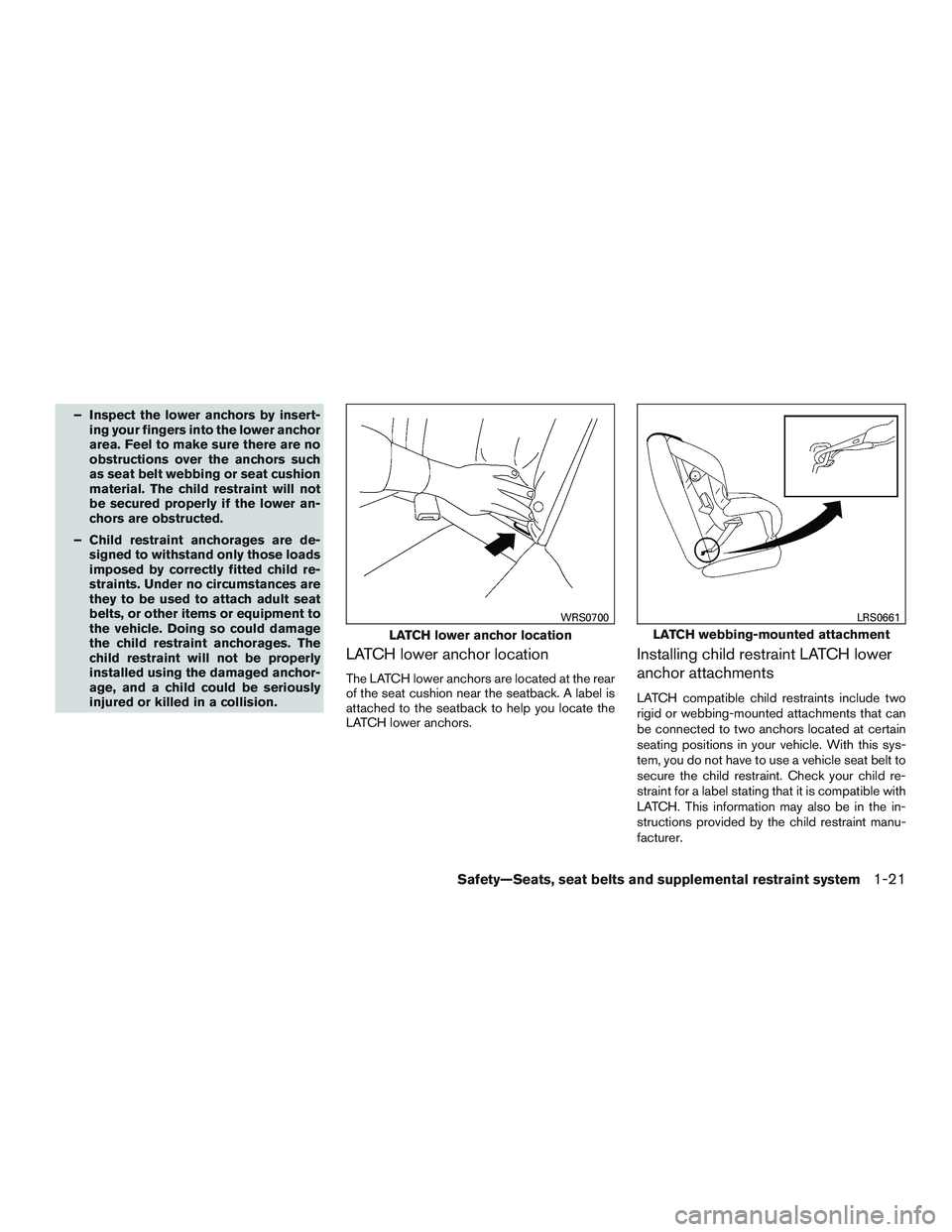
LATCH lower anchor location
The LATCH lower anchors are located at the rear
of the seat cushion near the seatback. A label is
attached to the seatback to help you locate the
LATCH lower anchors.
Installing child restraint LATCH lower
anchor attachments
LATCH compatible child restraints include two
rigid or webbing-mounted attachments that can
be connected to two anchors located at certain
seating positions in your vehicle. With this sys-
tem, you do not have to use a vehicle seat belt to
secure the child restraint. Check your child re-
straint for a label stating that it is compatible with
LATCH. This information may also be in the in-
structions provided by the child restraint manu-
facturer.
Page 42 of 293
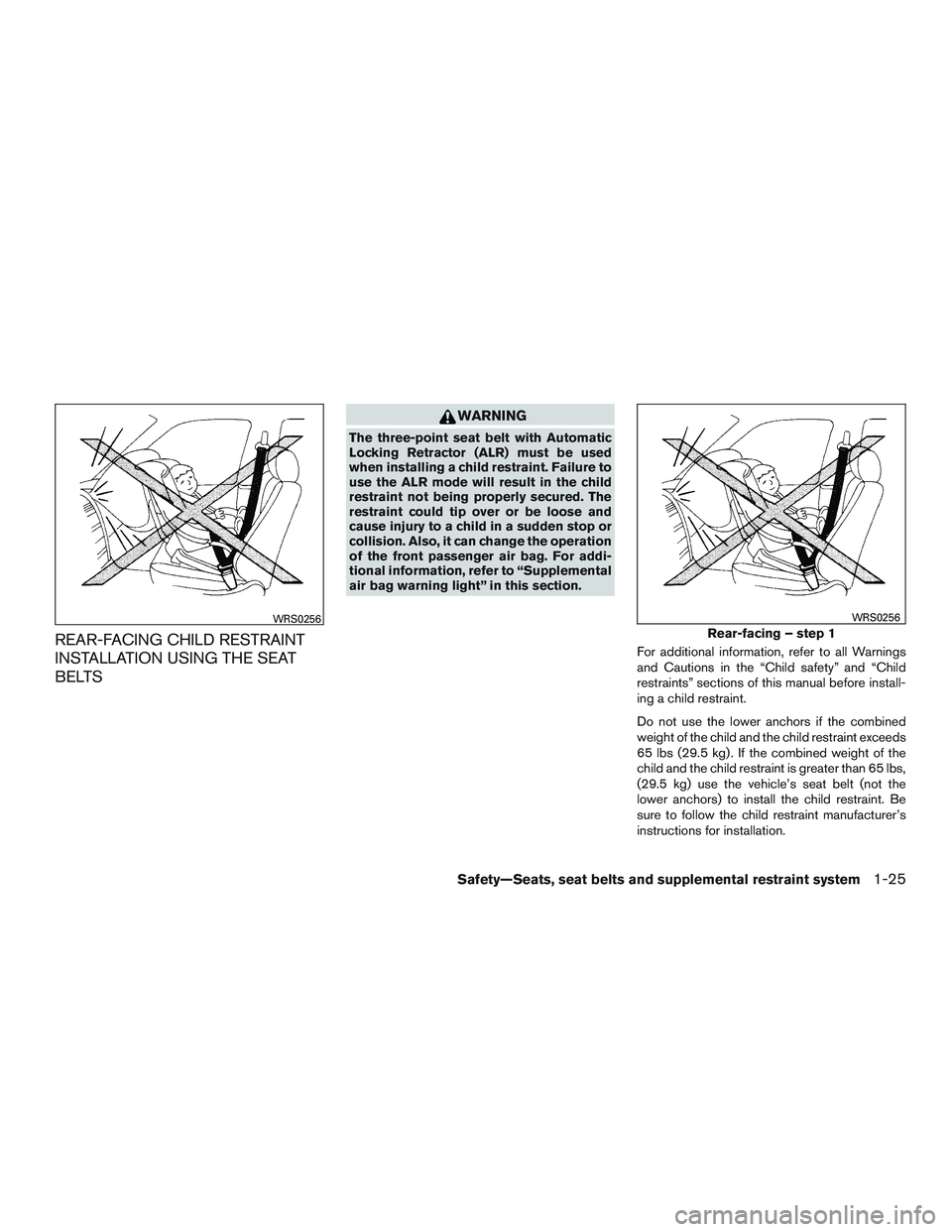
REAR-FACING CHILD RESTRAINT
INSTALLATION USING THE SEAT
BELTS
Page 58 of 293
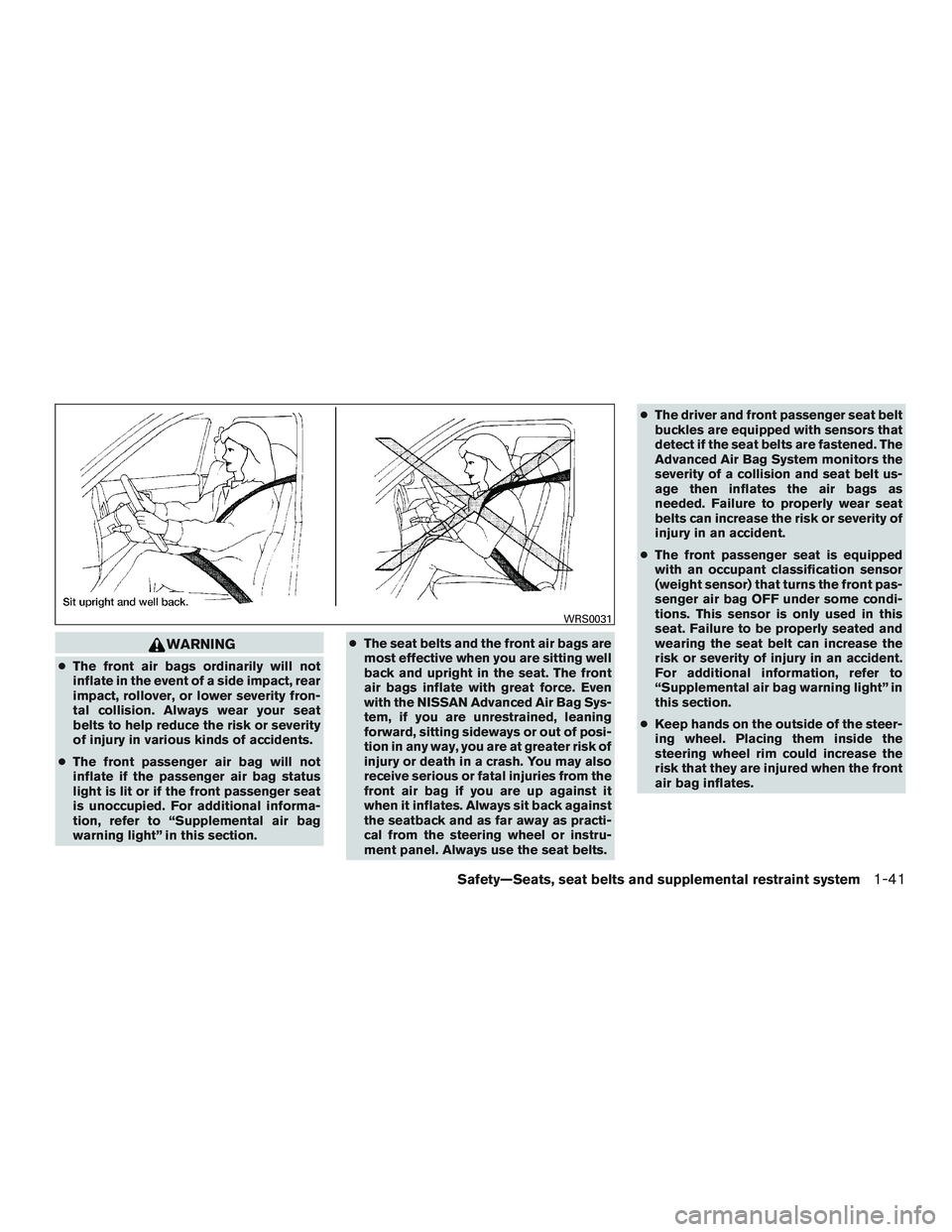
WARNING
●The front air bags ordinarily will not
inflate in the event of a side impact, rear
impact, rollover, or lower severity fron-
tal collision. Always wear your seat
belts to help reduce the risk or severity
of injury in various kinds of accidents.
● The front passenger air bag will not
inflate if the passenger air bag status
light is lit or if the front passenger seat
is unoccupied. For additional informa-
tion, refer to “Supplemental air bag
warning light” in this section. ●
The seat belts and the front air bags are
most effective when you are sitting well
back and upright in the seat. The front
air bags inflate with great force. Even
with the NISSAN Advanced Air Bag Sys-
tem, if you are unrestrained, leaning
forward, sitting sideways or out of posi-
tion in any way, you are at greater risk of
injury or death in a crash. You may also
receive serious or fatal injuries from the
front air bag if you are up against it
when it inflates. Always sit back against
the seatback and as far away as practi-
cal from the steering wheel or instru-
ment panel. Always use the seat belts. ●
The driver and front passenger seat belt
buckles are equipped with sensors that
detect if the seat belts are fastened. The
Advanced Air Bag System monitors the
severity of a collision and seat belt us-
age then inflates the air bags as
needed. Failure to properly wear seat
belts can increase the risk or severity of
injury in an accident.
● The front passenger seat is equipped
with an occupant classification sensor
(weight sensor) that turns the front pas-
senger air bag OFF under some condi-
tions. This sensor is only used in this
seat. Failure to be properly seated and
wearing the seat belt can increase the
risk or severity of injury in an accident.
For additional information, refer to
“Supplemental air bag warning light” in
this section.
● Keep hands on the outside of the steer-
ing wheel. Placing them inside the
steering wheel rim could increase the
risk that they are injured when the front
air bag inflates.
Page 62 of 293
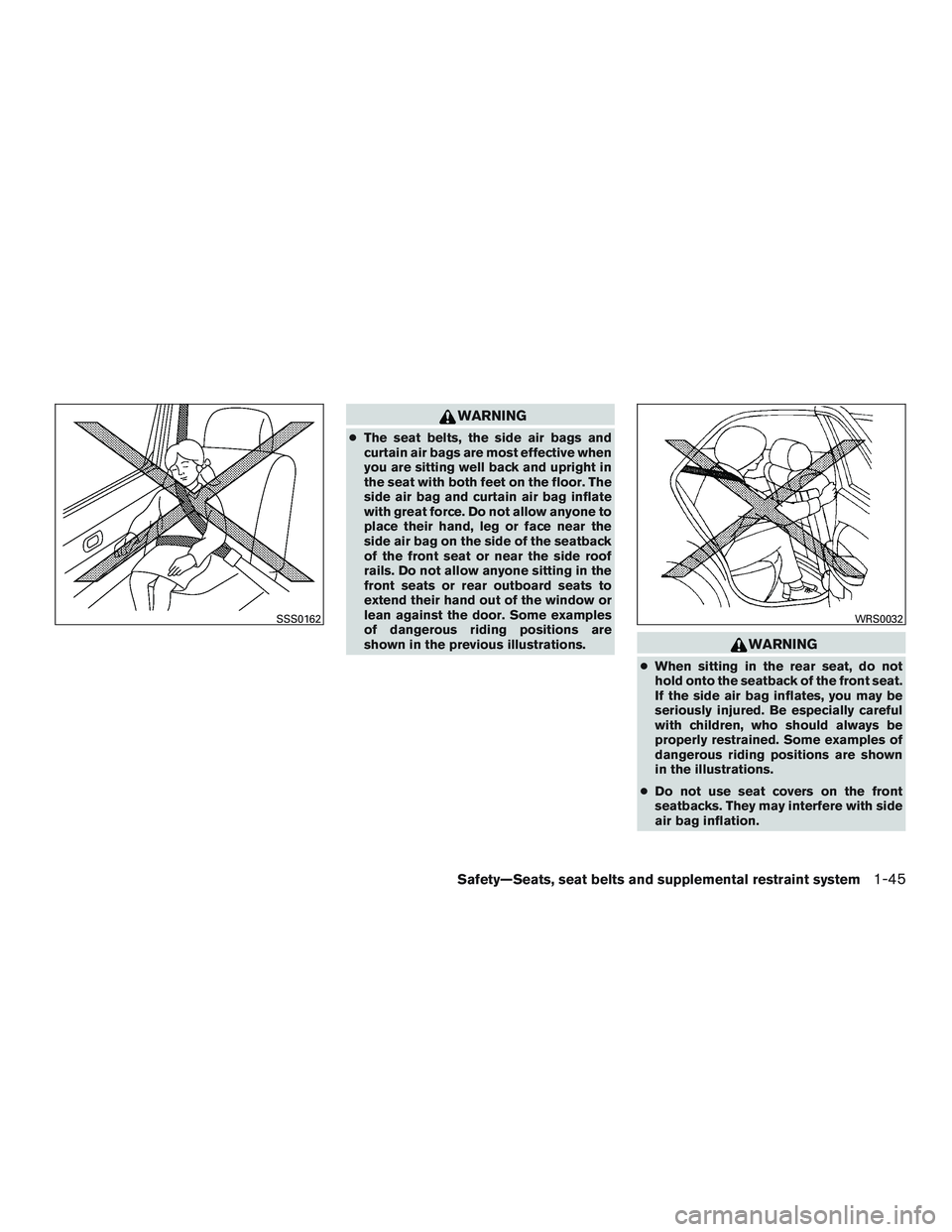
WARNING
●The seat belts, the side air bags and
curtain air bags are most effective when
you are sitting well back and upright in
the seat with both feet on the floor. The
side air bag and curtain air bag inflate
with great force. Do not allow anyone to
place their hand, leg or face near the
side air bag on the side of the seatback
of the front seat or near the side roof
rails. Do not allow anyone sitting in the
front seats or rear outboard seats to
extend their hand out of the window or
lean against the door. Some examples
of dangerous riding positions are
shown in the previous illustrations.
Page 64 of 293
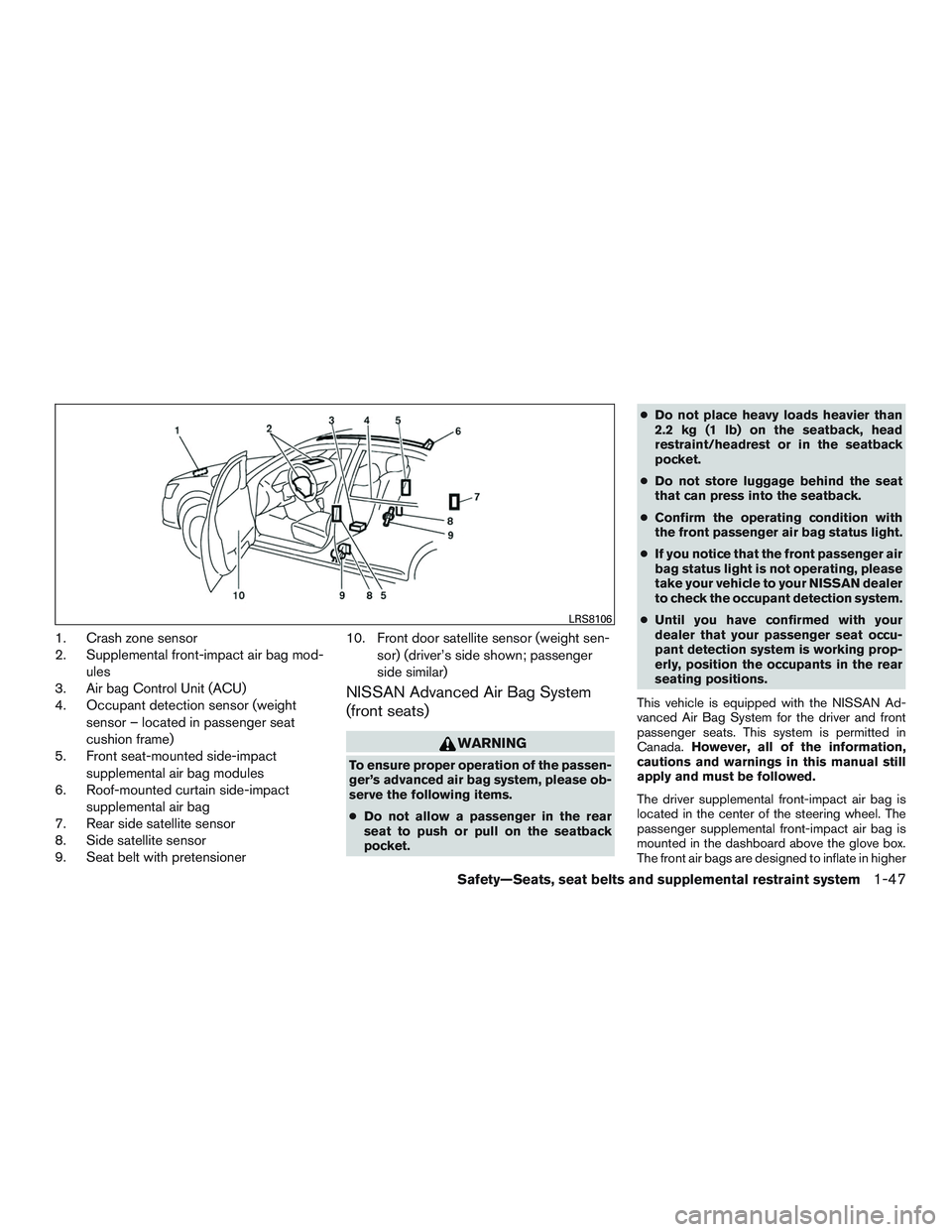
1. Crash zone sensor
2. Supplemental front-impact air bag mod-ules
3. Air bag Control Unit (ACU)
4. Occupant detection sensor (weight
sensor – located in passenger seat
cushion frame)
5. Front seat-mounted side-impact
supplemental air bag modules
6. Roof-mounted curtain side-impact
supplemental air bag
7. Rear side satellite sensor
8. Side satellite sensor
9. Seat belt with pretensioner 10. Front door satellite sensor (weight sen-
sor) (driver’s side shown; passenger
side similar)
NISSAN Advanced Air Bag System
(front seats)
Page 69 of 293
●Work on and around the front air bag
system should be done by a NISSAN
dealer. Installation of electrical equip-
ment should also be done by a NISSAN
dealer. The Supplemental Restraint
System (SRS) wiring harnesses* should
not be modified or disconnected. Unau-
thorized electrical test equipment and
probing devices should not be used on
the air bag system.
● A cracked windshield should be re-
placed immediately by a qualified repair
facility. A cracked windshield could af-
fect the function of the supplemental air
bag system.
*The SRS wiring harness connectors are
yellow and orange for easy identification.
When selling your vehicle, we request that you
inform the buyer about the front air bag system
and guide the buyer to the appropriate sections
in this Owner’s Manual.
FRONT SEAT-MOUNTED SIDE-
IMPACT SUPPLEMENTAL AIR BAG
AND ROOF-MOUNTED CURTAIN
SIDE-IMPACT SUPPLEMENTAL AIR
BAG SYSTEMS
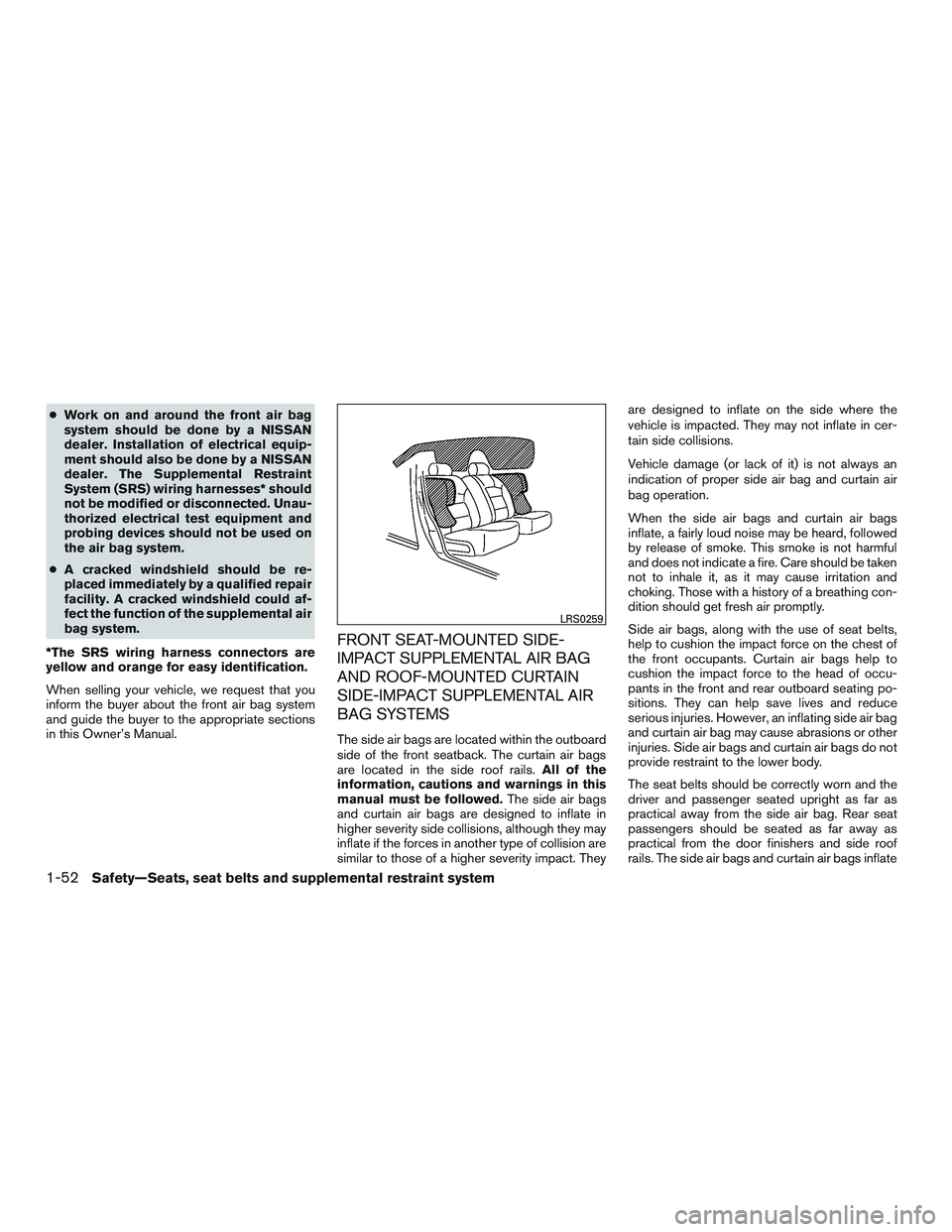
The side air bags are located within the outboard
side of the front seatback. The curtain air bags
are located in the side roof rails. All of the
information, cautions and warnings in this
manual must be followed. The side air bags
and curtain air bags are designed to inflate in
higher severity side collisions, although they may
inflate if the forces in another type of collision are
similar to those of a higher severity impact. They are designed to inflate on the side where the
vehicle is impacted. They may not inflate in cer-
tain side collisions.
Vehicle damage (or lack of it) is not always an
indication of proper side air bag and curtain air
bag operation.
When the side air bags and curtain air bags
inflate, a fairly loud noise may be heard, followed
by release of smoke. This smoke is not harmful
and does not indicate a fire. Care should be taken
not to inhale it, as it may cause irritation and
choking. Those with a history of a breathing con-
dition should get fresh air promptly.
Side air bags, along with the use of seat belts,
help to cushion the impact force on the chest of
the front occupants. Curtain air bags help to
cushion the impact force to the head of occu-
pants in the front and rear outboard seating po-
sitions. They can help save lives and reduce
serious injuries. However, an inflating side air bag
and curtain air bag may cause abrasions or other
injuries. Side air bags and curtain air bags do not
provide restraint to the lower body.
The seat belts should be correctly worn and the
driver and passenger seated upright as far as
practical away from the side air bag. Rear seat
passengers should be seated as far away as
practical from the door finishers and side roof
rails. The side air bags and curtain air bags inflate
Page 71 of 293
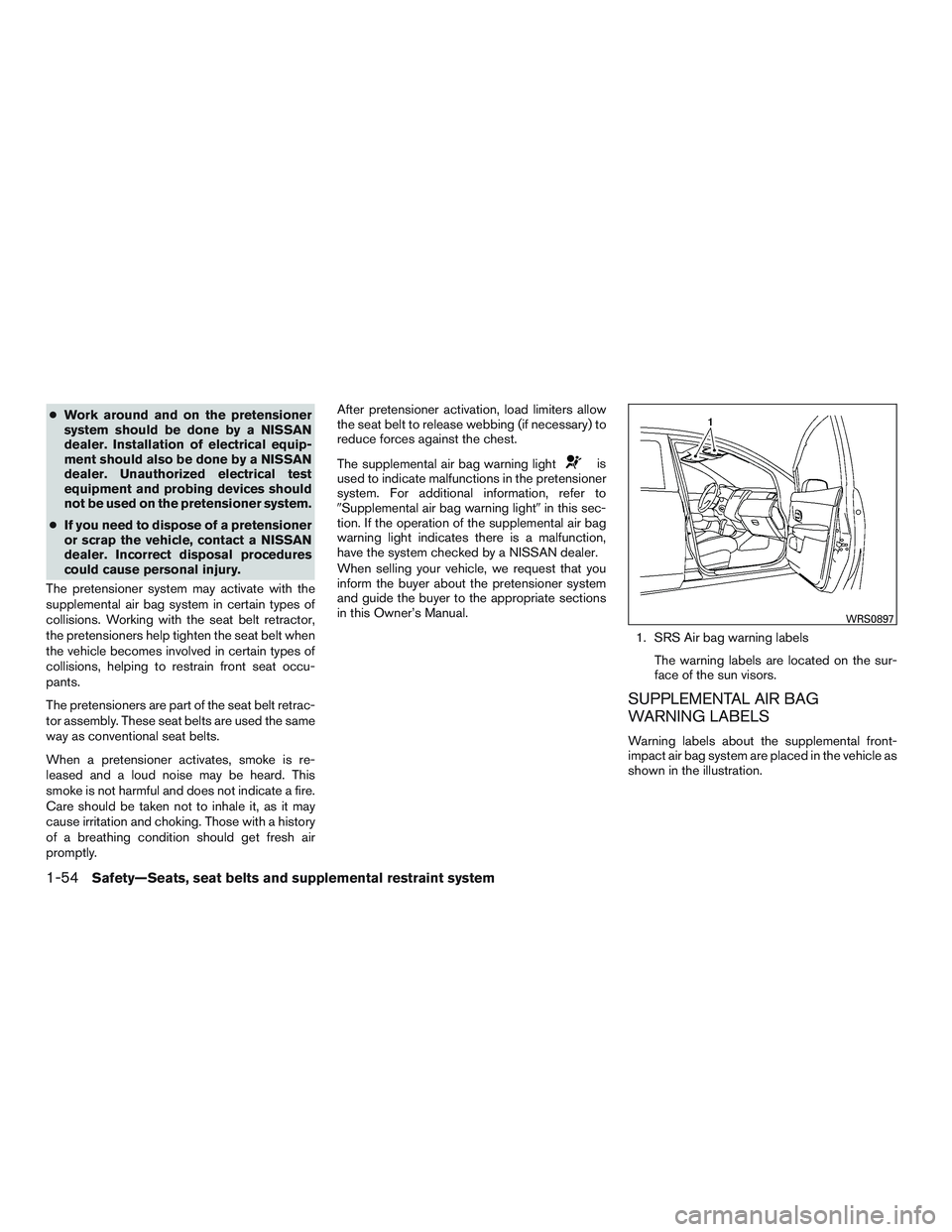
●Work around and on the pretensioner
system should be done by a NISSAN
dealer. Installation of electrical equip-
ment should also be done by a NISSAN
dealer. Unauthorized electrical test
equipment and probing devices should
not be used on the pretensioner system.
● If you need to dispose of a pretensioner
or scrap the vehicle, contact a NISSAN
dealer. Incorrect disposal procedures
could cause personal injury.
The pretensioner system may activate with the
supplemental air bag system in certain types of
collisions. Working with the seat belt retractor,
the pretensioners help tighten the seat belt when
the vehicle becomes involved in certain types of
collisions, helping to restrain front seat occu-
pants.
The pretensioners are part of the seat belt retrac-
tor assembly. These seat belts are used the same
way as conventional seat belts.
When a pretensioner activates, smoke is re-
leased and a loud noise may be heard. This
smoke is not harmful and does not indicate a fire.
Care should be taken not to inhale it, as it may
cause irritation and choking. Those with a history
of a breathing condition should get fresh air
promptly. After pretensioner activation, load limiters allow
the seat belt to release webbing (if necessary) to
reduce forces against the chest.
The supplemental air bag warning light
Page 73 of 293
WARNING
●Once a front air bag, side air bag or
curtain air bags have inflated, the air
bag module will not function again and
must be replaced. Additionally, if any of
the front air bags inflate, the activated
pretensioners must also be replaced.
The air bag module and pretensioner
should be replaced by an NISSAN
dealer. The air bag module and preten-
sioner cannot be repaired.
● The front air bag, side air bag and cur-
tain air bag systems and the preten-
sioner system should be inspected by
an NISSAN dealer if there is any dam-
age to the front end or side portion of
the vehicle.
● The front air bag, side air bag and cur-
tain air bag systems and the preten-
sioner system should be inspected by
an NISSAN dealer if there is any dam-
age to the front end or side portion of
the vehicle.
● If you need to dispose of a supplemen-
tal air bag or pretensioner or scrap the
vehicle, contact an NISSAN dealer. In-
correct disposal procedures could
cause personal injury.
1-56Safety—Seats, seat belts and supplemental restraint system