Car seat NISSAN MICRA 2013 Owners Manual
[x] Cancel search | Manufacturer: NISSAN, Model Year: 2013, Model line: MICRA, Model: NISSAN MICRA 2013Pages: 293, PDF Size: 2.98 MB
Page 29 of 293
●Be sure the seat belt tongue is securely
fastened to the proper buckle.
● Do not wear the seat belt inside out or
twisted. Doing so may reduce its
effectiveness.
● Do not allow more than one person to
use the same seat belt.
● Never carry more people in the vehicle
than there are seat belts.
● If the seat belt warning light glows con-
tinuously while the ignition is turned
ON with all doors closed and all seat
belts fastened, it may indicate a mal-
function in the system. Have the system
checked by a NISSAN dealer.
● No changes should be made to the seat
belt system. For example, do not modify
the seat belt, add material, or install
devices that may change the seat belt
routing or tension. Doing so may affect
the operation of the seat belt system.
Modifying or tampering with the seat
belt system may result in serious per-
sonal injury. ●
Once a seat belt pretensioner has acti-
vated, it cannot be reused and must be
replaced together with the retractor.
See your NISSAN dealer.
● Removal and installation of preten-
sioner system components should be
done by a NISSAN dealer.
● All seat belt assemblies, including re-
tractors and attaching hardware, should
be inspected after any collision by a
NISSAN dealer. NISSAN recommends
that all seat belt assemblies in use dur-
ing a collision be replaced unless the
collision was minor and the belts show
no damage and continue to operate
properly. Seat belt assemblies not in
use during a collision should also be
inspected and replaced if either dam-
age or improper operation is noted.
● All child restraints and attaching hard-
ware should be inspected after any col-
lision. Always follow the restraint
manufacturer’s inspection instructions
and replacement recommendations.
The child restraints should be replaced
if they are damaged.PREGNANT WOMEN
NISSAN recommends that pregnant women use
seat belts. The seat belt should be worn snug and
always position the lap belt as low as possible
around the hips, not the waist. Place the shoulder
belt over your shoulder and across your chest.
Never run the lap/shoulder belt over your ab-
dominal area. Contact your doctor for specific
recommendations.
INJURED PERSONS
NISSAN recommends that injured persons use
seat belts. Check with your doctor for specific
recommendations.
THREE-POINT TYPE SEAT BELT
WITH RETRACTOR
Page 33 of 293
WARNING
●Only NISSAN seat belt extenders, made
by the same company which made the
original equipment seat belts, should
be used with NISSAN seat belts.
● Adults and children who can use the
standard seat belt should not use an
extender. Such unnecessary use could
result in serious personal injury in the
event of an accident.
● Never use seat belt extenders to install
child restraints. If the child restraint is
not secured properly, the child could be
seriously injured in a collision or a sud-
den stop.
SEAT BELT MAINTENANCE
● To clean the seat belt webbing, apply a
mild soap solution or any solution recom-
mended for cleaning upholstery or carpet.
Then wipe with a cloth and allow the seat
belts to dry in the shade. Do not allow the
seat belts to retract until they are completely
dry.
● If dirt builds up in the shoulder belt
guide of the seat belt anchors, the seat
belts may retract slowly. Wipe the shoulder
belt guide with a clean, dry cloth. ●
Periodically check to see that the seat
belt and the metal components, such as
buckles, tongues, retractors, flexible wires
and anchors, work properly. If loose parts,
deterioration, cuts or other damage on the
webbing is found, the entire seat belt as-
sembly should be replaced.
Page 69 of 293
●Work on and around the front air bag
system should be done by a NISSAN
dealer. Installation of electrical equip-
ment should also be done by a NISSAN
dealer. The Supplemental Restraint
System (SRS) wiring harnesses* should
not be modified or disconnected. Unau-
thorized electrical test equipment and
probing devices should not be used on
the air bag system.
● A cracked windshield should be re-
placed immediately by a qualified repair
facility. A cracked windshield could af-
fect the function of the supplemental air
bag system.
*The SRS wiring harness connectors are
yellow and orange for easy identification.
When selling your vehicle, we request that you
inform the buyer about the front air bag system
and guide the buyer to the appropriate sections
in this Owner’s Manual.
FRONT SEAT-MOUNTED SIDE-
IMPACT SUPPLEMENTAL AIR BAG
AND ROOF-MOUNTED CURTAIN
SIDE-IMPACT SUPPLEMENTAL AIR
BAG SYSTEMS
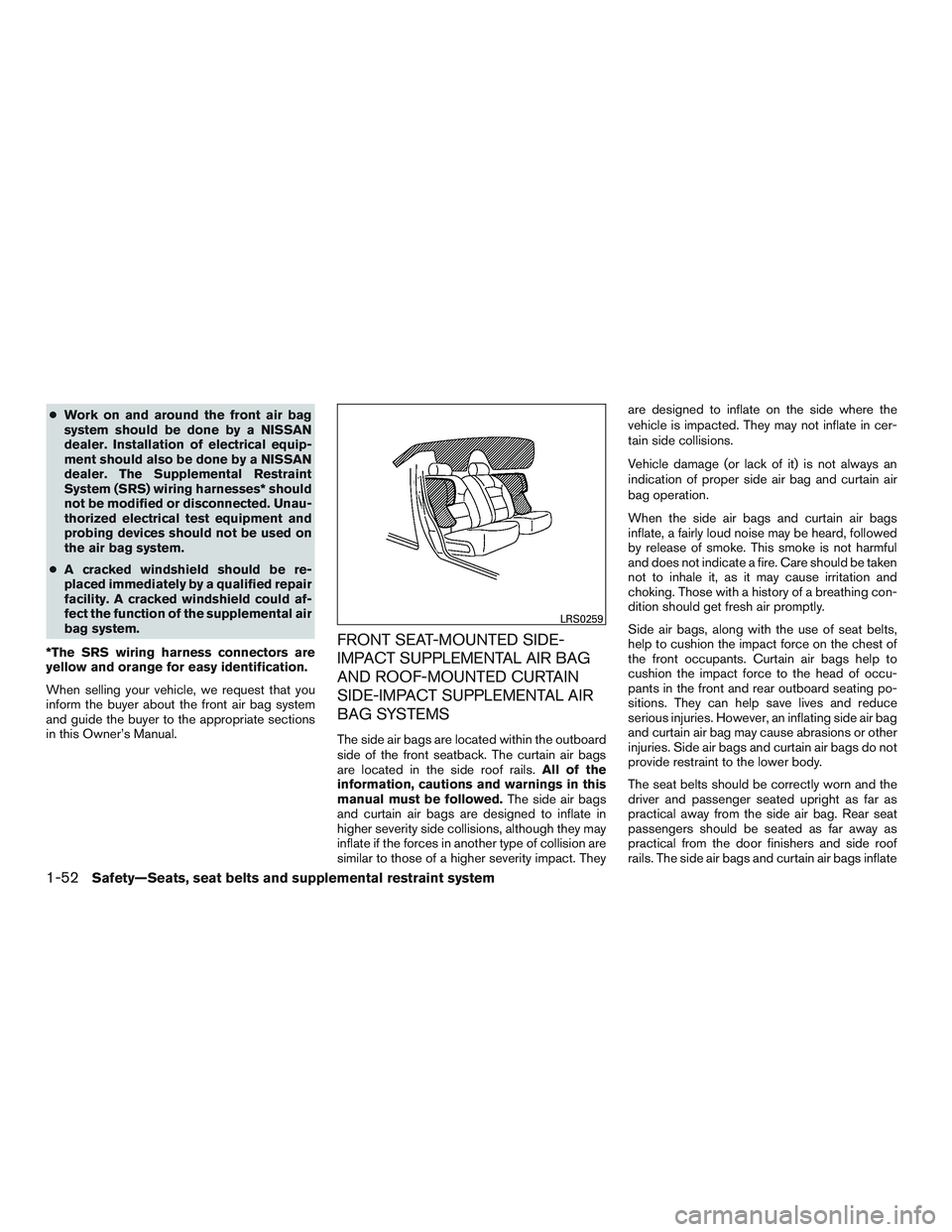
The side air bags are located within the outboard
side of the front seatback. The curtain air bags
are located in the side roof rails. All of the
information, cautions and warnings in this
manual must be followed. The side air bags
and curtain air bags are designed to inflate in
higher severity side collisions, although they may
inflate if the forces in another type of collision are
similar to those of a higher severity impact. They are designed to inflate on the side where the
vehicle is impacted. They may not inflate in cer-
tain side collisions.
Vehicle damage (or lack of it) is not always an
indication of proper side air bag and curtain air
bag operation.
When the side air bags and curtain air bags
inflate, a fairly loud noise may be heard, followed
by release of smoke. This smoke is not harmful
and does not indicate a fire. Care should be taken
not to inhale it, as it may cause irritation and
choking. Those with a history of a breathing con-
dition should get fresh air promptly.
Side air bags, along with the use of seat belts,
help to cushion the impact force on the chest of
the front occupants. Curtain air bags help to
cushion the impact force to the head of occu-
pants in the front and rear outboard seating po-
sitions. They can help save lives and reduce
serious injuries. However, an inflating side air bag
and curtain air bag may cause abrasions or other
injuries. Side air bags and curtain air bags do not
provide restraint to the lower body.
The seat belts should be correctly worn and the
driver and passenger seated upright as far as
practical away from the side air bag. Rear seat
passengers should be seated as far away as
practical from the door finishers and side roof
rails. The side air bags and curtain air bags inflate
Page 71 of 293
●Work around and on the pretensioner
system should be done by a NISSAN
dealer. Installation of electrical equip-
ment should also be done by a NISSAN
dealer. Unauthorized electrical test
equipment and probing devices should
not be used on the pretensioner system.
● If you need to dispose of a pretensioner
or scrap the vehicle, contact a NISSAN
dealer. Incorrect disposal procedures
could cause personal injury.
The pretensioner system may activate with the
supplemental air bag system in certain types of
collisions. Working with the seat belt retractor,
the pretensioners help tighten the seat belt when
the vehicle becomes involved in certain types of
collisions, helping to restrain front seat occu-
pants.
The pretensioners are part of the seat belt retrac-
tor assembly. These seat belts are used the same
way as conventional seat belts.
When a pretensioner activates, smoke is re-
leased and a loud noise may be heard. This
smoke is not harmful and does not indicate a fire.
Care should be taken not to inhale it, as it may
cause irritation and choking. Those with a history
of a breathing condition should get fresh air
promptly. After pretensioner activation, load limiters allow
the seat belt to release webbing (if necessary) to
reduce forces against the chest.
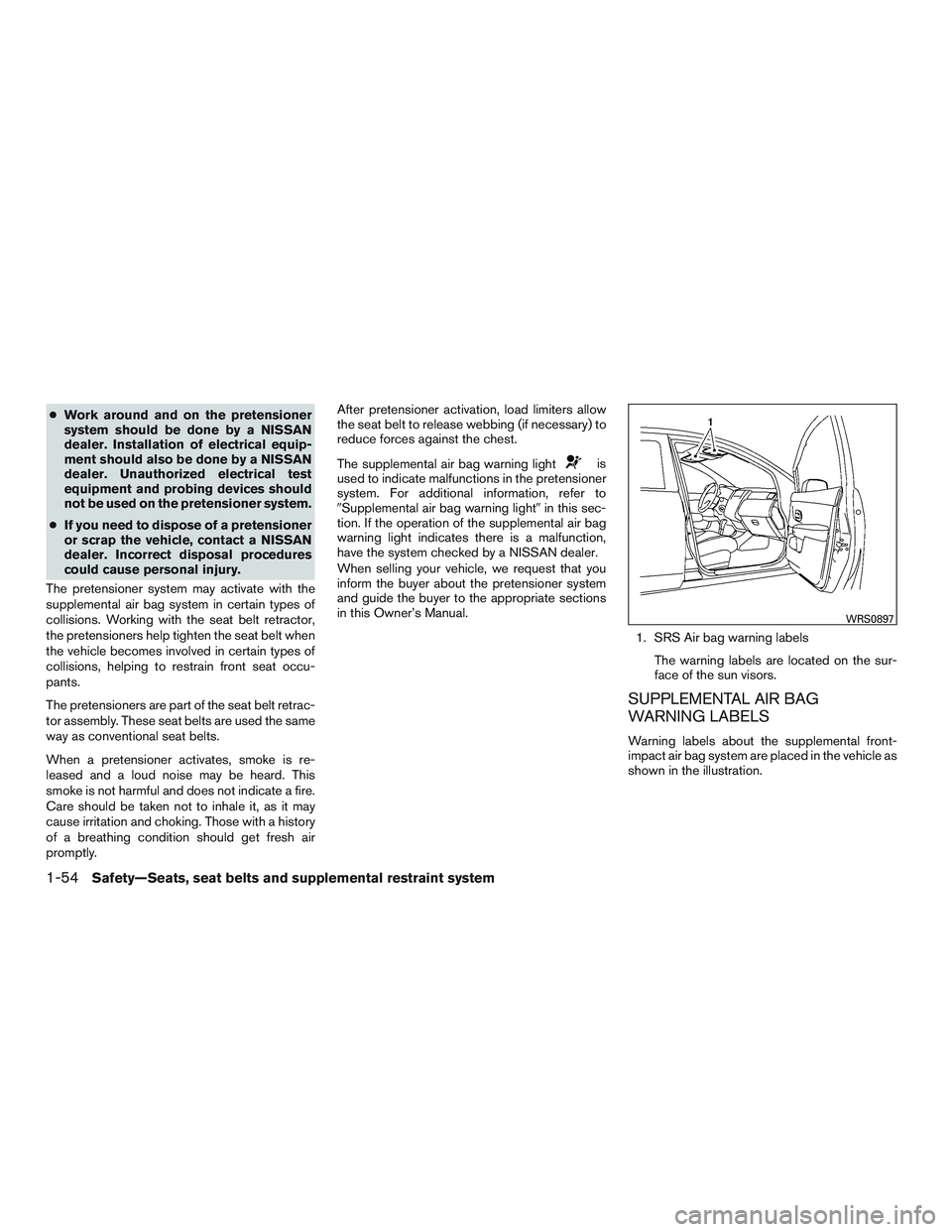
The supplemental air bag warning light
Page 175 of 293
WARNING
●Do not leave children or adults who
would normally require the assistance
of others alone in your vehicle. Pets
should also not be left alone. They
could accidentally injure themselves or
others through inadvertent operation of
the vehicle. Also, on hot, sunny days,
temperatures in a closed vehicle could
quickly become high enough to cause
severe or possibly fatal injuries to
people or animals.
● Properly secure all cargo to help pre-
vent it from sliding or shifting. Do not
place cargo higher than the seatbacks.
In a sudden stop or collision, unsecured
cargo could cause personal injury.
EXHAUST GAS (carbon monoxide)
Page 219 of 293
Occasionally remove loose dust from the interior
trim, plastic parts and seats using a vacuum
cleaner or soft bristled brush. Wipe the vinyl and
leather surfaces with a clean, soft cloth damp-
ened in mild soap solution, then wipe clean with a
dry, soft cloth.
Regular care and cleaning is required in order to
maintain the appearance of the leather.
Before using any fabric protector, read the manu-
facturer’s recommendations. Some fabric pro-
tectors contain chemicals that may stain or
bleach the seat material.
Use a cloth dampened only with water to clean
the meter and gauge lens.
Page 278 of 293
WARNING
● It is extremely dangerous to ride
in a cargo area inside a vehicle. In
a collision, people riding in these
areas are more likely to be seri-
ously injured or killed.
● Do not allow people to ride in any
area of your vehicle that is not
equipped with seats and seat
belts.
● Be sure everyone in your vehicle
is in a seat and using a seat belt
properly.
TERMS
It is important to familiarize yourself with
the following terms before loading your
vehicle:
● Curb Weight (actual weight of your
vehicle) - vehicle weight including:
standard and optional equipment, flu-
ids, emergency tools, and spare tire
assembly. This weight does notin-
clude passengers and cargo. ●
GVW (Gross Vehicle Weight) - curb
weight plus the combined weight of
passengers and cargo.
● GVWR (Gross Vehicle Weight Rat-
ing) - maximum total combined
weight of the unloaded vehicle, pas-
sengers, luggage, hitch, trailer
tongue load and any other optional
equipment. This information is lo-
cated on the C.M.V.S.S. certification
label.
● GAWR (Gross Axle Weight Rating) -
maximum weight (load) limit specified
for the front or rear axle. This informa-
tion is located on the C.M.V.S.S. cer-
tification label.
● GCWR (Gross Combined Weight
rating) - The maximum total weight
rating of the vehicle, passengers,
cargo, and trailer. ●
Vehicle Capacity Weight, Load limit,
Total load capacity - maximum total
weight limit specified of the load
(passengers and cargo) for the ve-
hicle. This is the maximum combined
weight of occupants and cargo that
can be loaded into the vehicle. If the
vehicle is used to tow a trailer, the
trailer tongue weight must be in-
cluded as part of the cargo load. This
information is located on the Tire and
Loading Information label.
● Cargo capacity - permissible weight
of cargo, the subtracted weight of
occupants from the load limit.DETERMINING VEHICLE LOAD
CAPACITY
The load capacity of this vehicle is deter-
mined by weight, not by available cargo
space. For example, a luggage rack, bike
carrier, cartop carrier or similar equipment
does not increase load carrying capacity
of your vehicle.
VEHICLE LOADING INFORMATION
Technical and consumer information9-13
Page 287 of 293
Child restraints.......1-16,1-17,1-18,1-20
LATCH (Lower Anchors and Tethers for
CHildren) System ..............1-20
Precautions on child
restraints.........1-18,1-25,1-31,1-36
Top tether strap anchor point locations . .1-22
Child safety rear door lock ............3-5
Chimes, audible reminders ...........2-12
Cleaningexteriorandinterior...........7-2
Clock.......................4-33 (models without navigation system) ....4-33
Clockset.....................4-33
Clock set/adjustment ..............4-33
Clutch Clutch fluid ..................8-12
C.M.V.S.S. certification label ..........9-11
Cold weather driving ...............5-24
Compact disc (CD) player ........4-34,4-38
Controls Audiocontrols(steeringwheel).......4-44
Heater and air conditioner controls . .4-7, 4-15
Coolant Capacities and recommended
fuel/lubricants .................9-2
Changing engine coolant ...........8-8
Checking engine coolant level ........8-8
Corrosionprotection ...............7-5
Cruisecontrol..................5-15
Cupholders................2-22,2-23
Curtain side-impact air bag system
(See supplemental side air bag and curtain
side-impact air bag system) ...........1-52 D
Daytime light system ...............2-18
Defroster switch Rear window defroster switch .......2-16
Dimensionsandweights.............9-9
Dimmer switch for instrument panel ......2-18
Door locks .....................3-3
Door open warning light .............2-8
Drive belt .....................8-15
Driving Cold weather driving .............5-24
Driving with automatic transmission .....5-8
Driving with manual transmission ......5-12
Precautions when starting and driving ....5-2
Driving the vehicle .................5-8
E
Economy - fuel ..................5-17
Emission control information label .......9-11
Emission control system warranty .......9-18
Engine Before starting the engine ..........5-7
Block heater .................5-25
Capacities and recommended
fuel/lubricants .................9-2
Changingenginecoolant...........8-8
Changingengineoil.............8-10
Changing engine oil filter ..........8-11
Checking engine coolant level ........8-8
Checking engine oil level ...........8-9
Engine compartment check locations ....8-6
Engine cooling system ............8-7 Engineoil ...................8-9
Engine oil and oil filter recommendation . . .9-6
Engine oil pressure warning light
.......2-8
Engine oil viscosity ..............9-6
Engine serial number ............9-11
Engine specifications .............9-8
Starting the engine ..............5-7
Event data recorders ..............9-19
Exhaust gas (Carbon monoxide) .........5-2
Explanation of maintenance items ........8-2
Extended
storage switch ............8-23
F
Flashers (See hazard warning flasher switch) . .6-2
Flat tire .......................6-2
Floor mat positioning aid .............7-5
Fluid Automatic transmission fluid (ATF) .....8-11
Brake fluid ..................8-12
Capacities and recommended
fuel/lubricants.................9-2
Clutch fluid ..................8-12
Enginecoolant.................8-7
Engineoil ...................8-9
Front air bag system
(See supplemental restraint system) ......1-47
Frontseats.....................1-2
Fuel Capacities and recommended
fuel/lubricants.................9-2
Fuel economy ................5-17
Fuel-filler cap .................3-11
Fuel-filler door lock opener lever ......3-11
Fuel-filler lid .................3-11
10-2
Page 289 of 293
Fuel-filler door lock opener lever......3-11
Power door locks ...............3-4
Lowfuelwarninglight...............2-9
Low windshield-washer fluid warning light . . .2-9
Luggage (See vehicle loading information) . .9-13
M
Maintenance Generalmaintenance.............8-2
Insidethevehicle...............8-3
Maintenanceprecautions...........8-5
Outsidethevehicle..............8-2
Seat belt maintenance ............1-16
Under the hood and vehicle .........8-4
Maintenance requirements ............8-2
Malfunctionindicatorlight............2-11
Manual front seat adjustment ...........1-2
Manual windows .................2-26
Map pocket ....................2-21
Meters and gauges ................2-3
Instrument brightness control ........2-18
Mirror Inside mirror .................3-14
Outside mirror control ............3-15
Outside mirrors ...............3-15
Vanity mirror .................3-14
Mirrors ......................3-14
Multi-remote control system
(See remote keyless entry system) ........3-6 N
NISSAN vehicle immobilizer
system .................2-13,3-2,5-7
O
Octane rating (See fuel octane rating) ......9-5
Odometer .....................2-4
Oil Capacities and recommended
fuel/lubricants .................9-2
Changingengineoil.............8-10
Changing engine oil filter ..........8-11
Checking engine oil level ...........8-9
Engineoil ...................8-9
Engine oil and oil filter recommendation . . .9-6
Engine oil viscosity ..............9-6
Oneshotcall...................4-49
Outside mirror control ..............3-15
Outside mirrors .................3-15
Overdrive switch .................5-12
Overheat If your vehicle overheats ...........6-12
Owner’s manual order form ...........9-20
Owner’s manual/service manual order
information ....................9-20
P
Parking Parking brake operation ...........5-14
Parking/parking on hills ...........5-18
Phone, Bluetooth® hands-free system .....4-46Power
Power door locks ...............3-4
Poweroutlet.................2-21
Power rear windows .............2-26
Power steering system ...........5-19
Power windows ...............2-24
Rear power windows ............2-26
Poweroutlet...................2-21
Power steering ..................5-19
Precautions Maintenance precautions ...........8-5
Precautions on booster
seats...........1-18,1-25,1-31,1-36
Precautions on child
restraints .........1-18,1-25,1-31,1-36
Precautionsonseatbeltusage.......1-10
Precautions on supplemental restraint
system ....................1-40
Precautions when starting and driving ....5-2
Push starting ...................6-12
R
Radio CarphoneorCBradio ...........4-45
FM-AM
radio with compact disc (CD)
player.....................4-31
FM/AM/SAT radio with compact disc (CD)
player.....................4-35
Steering wheel audio control switch ....4-44
Readiness for inspection maintenance (I/M)
test........................9-19
Rear power windows ..............2-26
Rearseat......................1-4
RearView Monitor ..............4-2,4-3
10-4