engine NISSAN MICRA 2015 Owner´s Manual
[x] Cancel search | Manufacturer: NISSAN, Model Year: 2015, Model line: MICRA, Model: NISSAN MICRA 2015Pages: 293, PDF Size: 3.21 MB
Page 271 of 293
ENGINE OIL AND OIL FILTER
RECOMMENDATIONS
Selecting the correct oil
It is essential to choose the correct grade, quality
and viscosity engine oil to ensure satisfactory
engine life and performance. For additional infor-
mation, refer to “Recommended fluids/lubricants
and capacities” in this section. NISSAN recom-
mends the use of an energy conserving oil in
order to improve fuel economy.
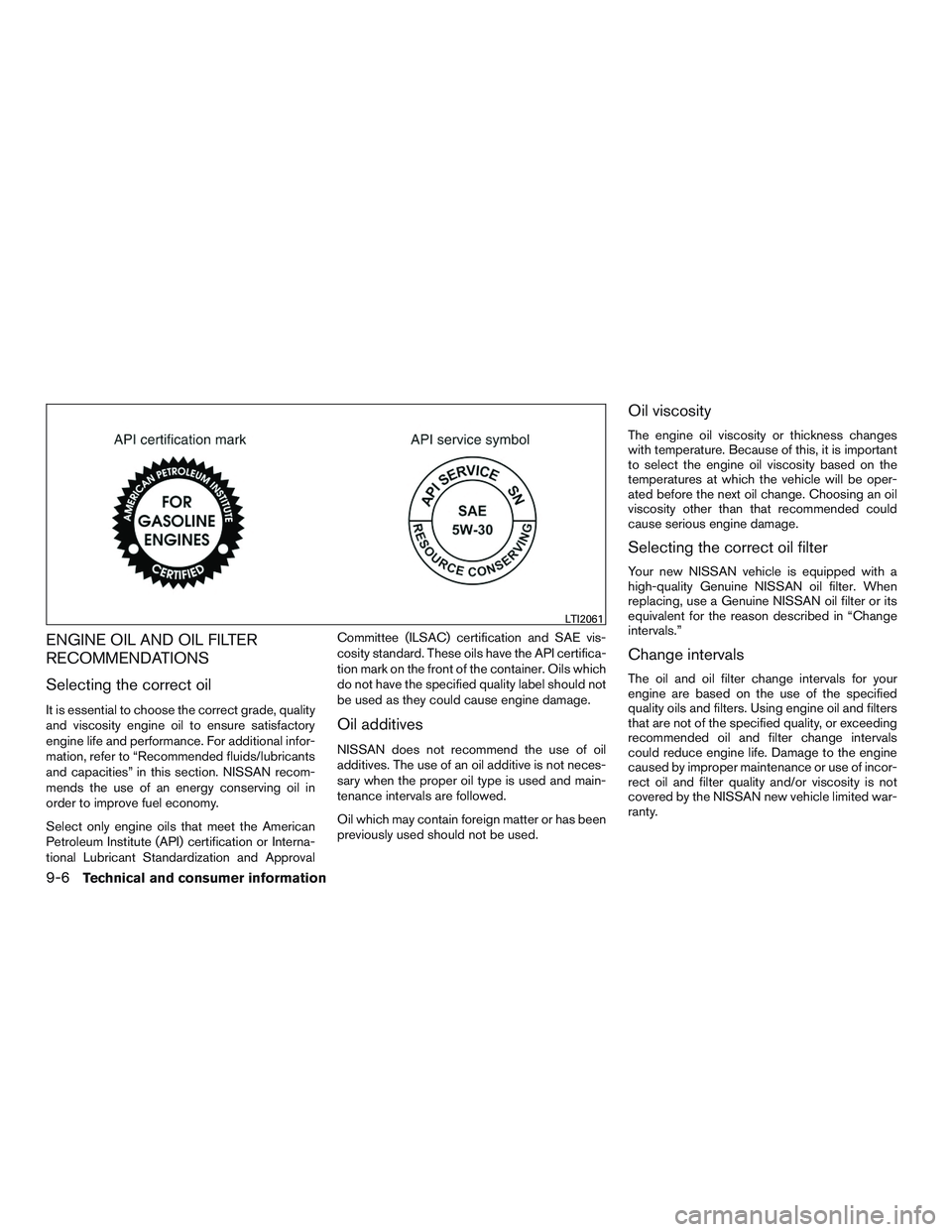
Select only engine oils that meet the American
Petroleum Institute (API) certification or Interna-
tional Lubricant Standardization and ApprovalCommittee (ILSAC) certification and SAE vis-
cosity standard. These oils have the API certifica-
tion mark on the front of the container. Oils which
do not have the specified quality label should not
be used as they could cause engine damage.Oil additives
NISSAN does not recommend the use of oil
additives. The use of an oil additive is not neces-
sary when the proper oil type is used and main-
tenance intervals are followed.
Oil which may contain foreign matter or has been
previously used should not be used.
Oil viscosity
The engine oil viscosity or thickness changes
with temperature. Because of this, it is important
to select the engine oil viscosity based on the
temperatures at which the vehicle will be oper-
ated before the next oil change. Choosing an oil
viscosity other than that recommended could
cause serious engine damage.
Selecting the correct oil filter
Your new NISSAN vehicle is equipped with a
high-quality Genuine NISSAN oil filter. When
replacing, use a Genuine NISSAN oil filter or its
equivalent for the reason described in “Change
intervals.”
Change intervals
The oil and oil filter change intervals for your
engine are based on the use of the specified
quality oils and filters. Using engine oil and filters
that are not of the specified quality, or exceeding
recommended oil and filter change intervals
could reduce engine life. Damage to the engine
caused by improper maintenance or use of incor-
rect oil and filter quality and/or viscosity is not
covered by the NISSAN new vehicle limited war-
ranty.
LTI2061
9-6Technical and consumer information
Page 272 of 293
Your engine was filled with a high-quality engine
oil when it was built. You do not have to change
the oil before the first recommended change
interval. Oil and filter change intervals depend
upon how you use your vehicle.
Operation under the following conditions may
require more frequent oil and filter changes:● repeated short distance driving at cold out-
side temperatures
● driving in dusty conditions
● extensive idling
● towing a trailer
● stop and go commuting
For additional information, refer to the “NISSAN
Service and Maintenance Guide” for the mainte-
nance schedule.
AIR CONDITIONER SYSTEM (if so
equipped) REFRIGERANT AND OIL
RECOMMENDATIONS
The air conditioner system in your NISSAN
vehicle must be charged with the refriger-
ant HFC-134a (R-134a) and the oil, NISSAN
A/C system oil Type R or the exact equiva-
lents.
CAUTION
The use of any other refrigerant or oil will
cause severe damage to the air condition-
ing system and will require the replace-
ment of all air conditioner system
components.
The refrigerant HFC-134a (R-134a) in your
NISSAN vehicle does not harm the earth’s ozone
layer. Although this refrigerant does not affect the
earth’s atmosphere, certain government regula-
tions require the recovery and recycling of any
refrigerant during automotive air conditioner sys-
tem service. A NISSAN dealer has the trained
technicians and equipment needed to recover
and recycle your air conditioner system refriger-
ant.
Contact a NISSAN dealer when servicing your air
conditioner system.
Technical and consumer information9-7
Page 273 of 293
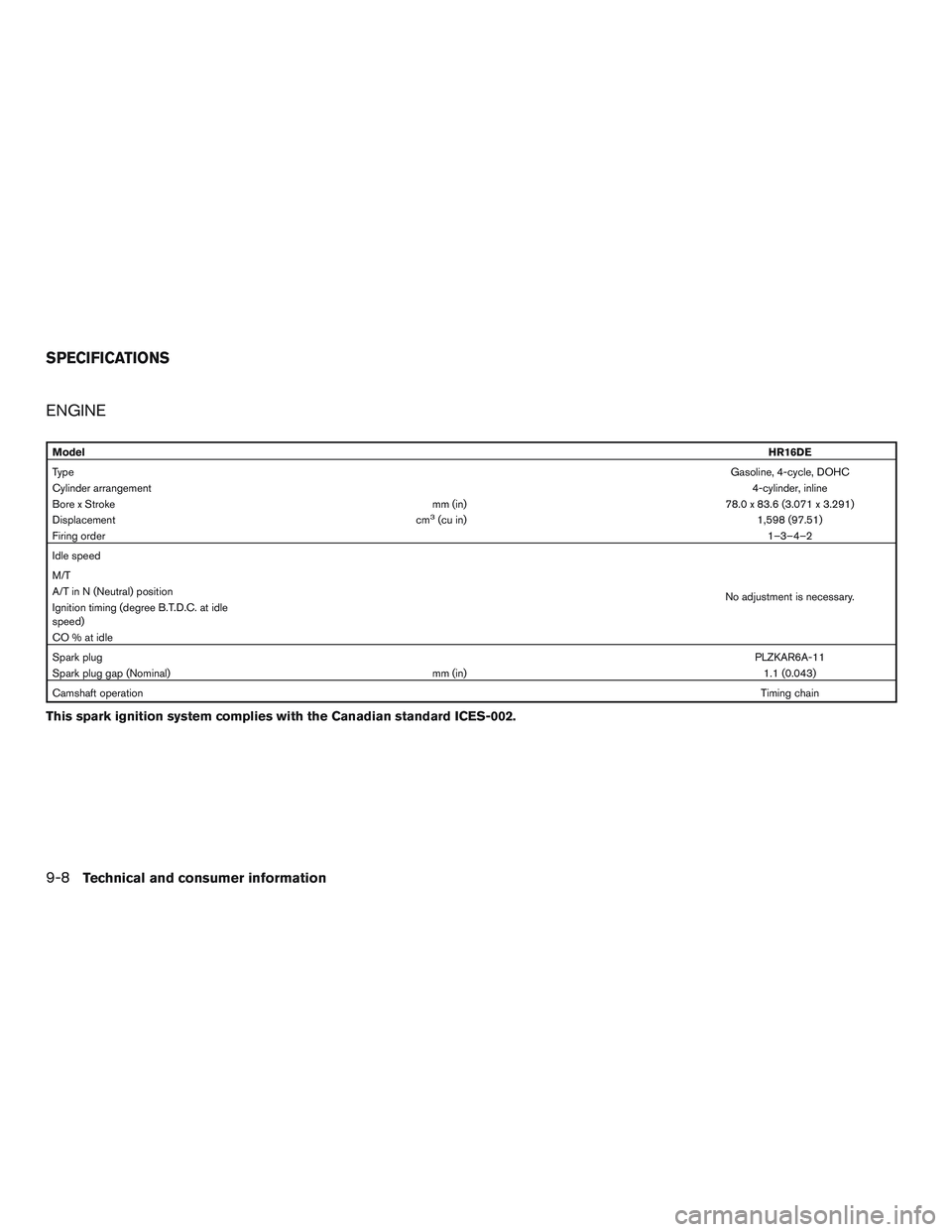
ENGINE
ModelHR16DE
Type Gasoline, 4-cycle, DOHC
Cylinder arrangement 4-cylinder, inline
Bore x Stroke mm (in)78.0 x 83.6 (3.071 x 3.291)
Displacement cm
3(cu in)1,598 (97.51)
Firing order 1–3–4–2
Idle speed
No adjustment is necessary.
M/T
A/T in N (Neutral) position
Ignition timing (degree B.T.D.C. at idle
speed)
CO%atidle
Spark plug
PLZKAR6A-11
Spark plug gap (Nominal) mm (in)1.1 (0.043)
Camshaft operation Timing chain
This spark ignition system complies with the Canadian standard ICES-002.
SPECIFICATIONS
9-8Technical and consumer information
Page 275 of 293
When planning to drive your NISSAN ve-
hicle in another country,you should first find
out if the fuel available is suitable for your vehi-
cle’s engine.
Using fuel with an octane rating that is too low
may cause engine damage. All gasoline vehicles
must be operated with unleaded gasoline. There-
fore, avoid taking your vehicle to areas where
appropriate fuel is not available.
When transferring the registration of your
vehicle to another country, state, province
or district, it may be necessary to modify the
vehicle to meet local laws and regulations.
The laws and regulations for motor vehicle emis-
sion control and safety standards vary according
to the country, state, province or district; there-
fore, vehicle specifications may differ.
When any vehicle is to be taken into an-
other country, state, province or district and
registered, its modifications, transporta-
tion and registration are the responsibility
of the user. NISSAN is not responsible for
any inconvenience that may result.
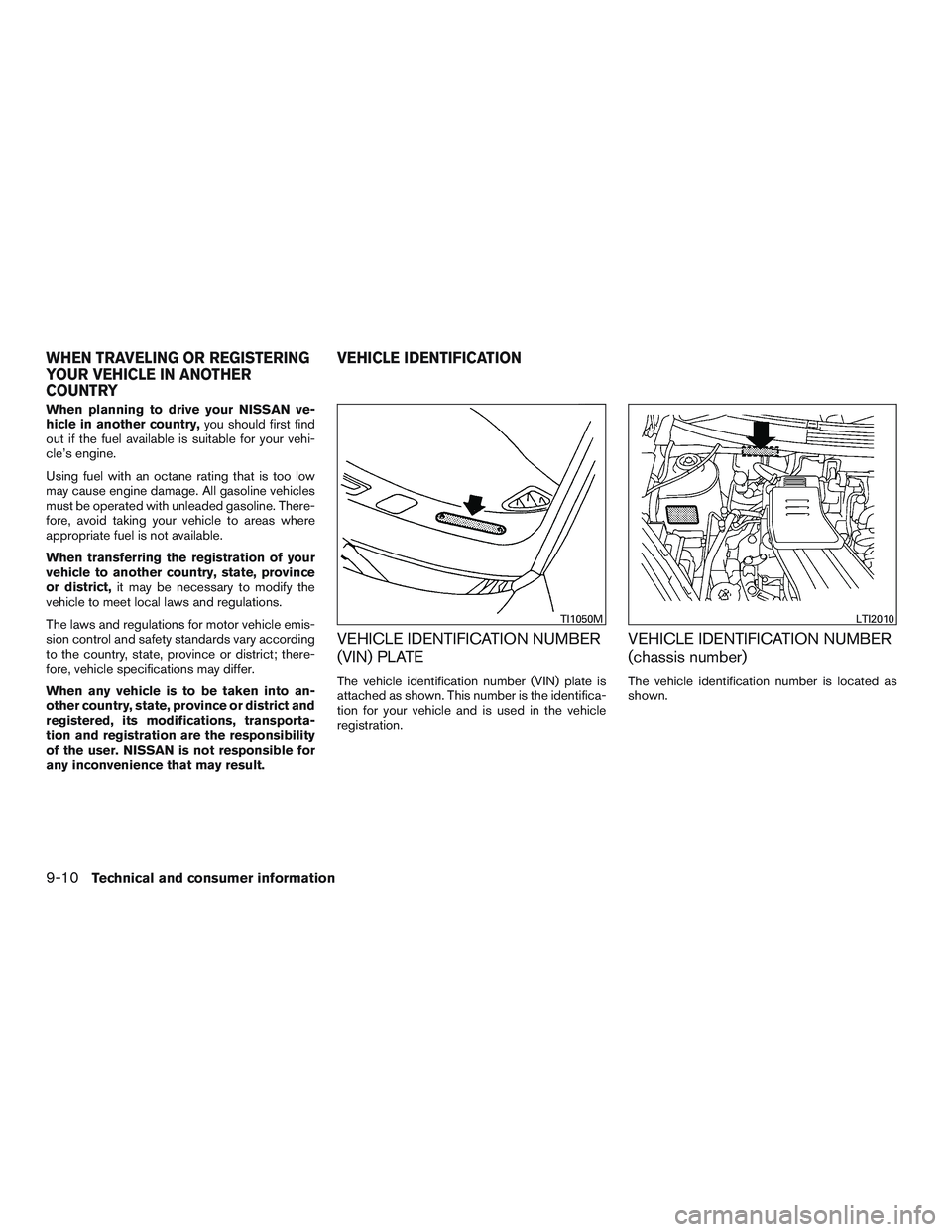
VEHICLE IDENTIFICATION NUMBER
(VIN) PLATE
The vehicle identification number (VIN) plate is
attached as shown. This number is the identifica-
tion for your vehicle and is used in the vehicle
registration.
VEHICLE IDENTIFICATION NUMBER
(chassis number)
The vehicle identification number is located as
shown.
TI1050MLTI2010
WHEN TRAVELING OR REGISTERING
YOUR VEHICLE IN ANOTHER
COUNTRY VEHICLE IDENTIFICATION
9-10Technical and consumer information
Page 276 of 293
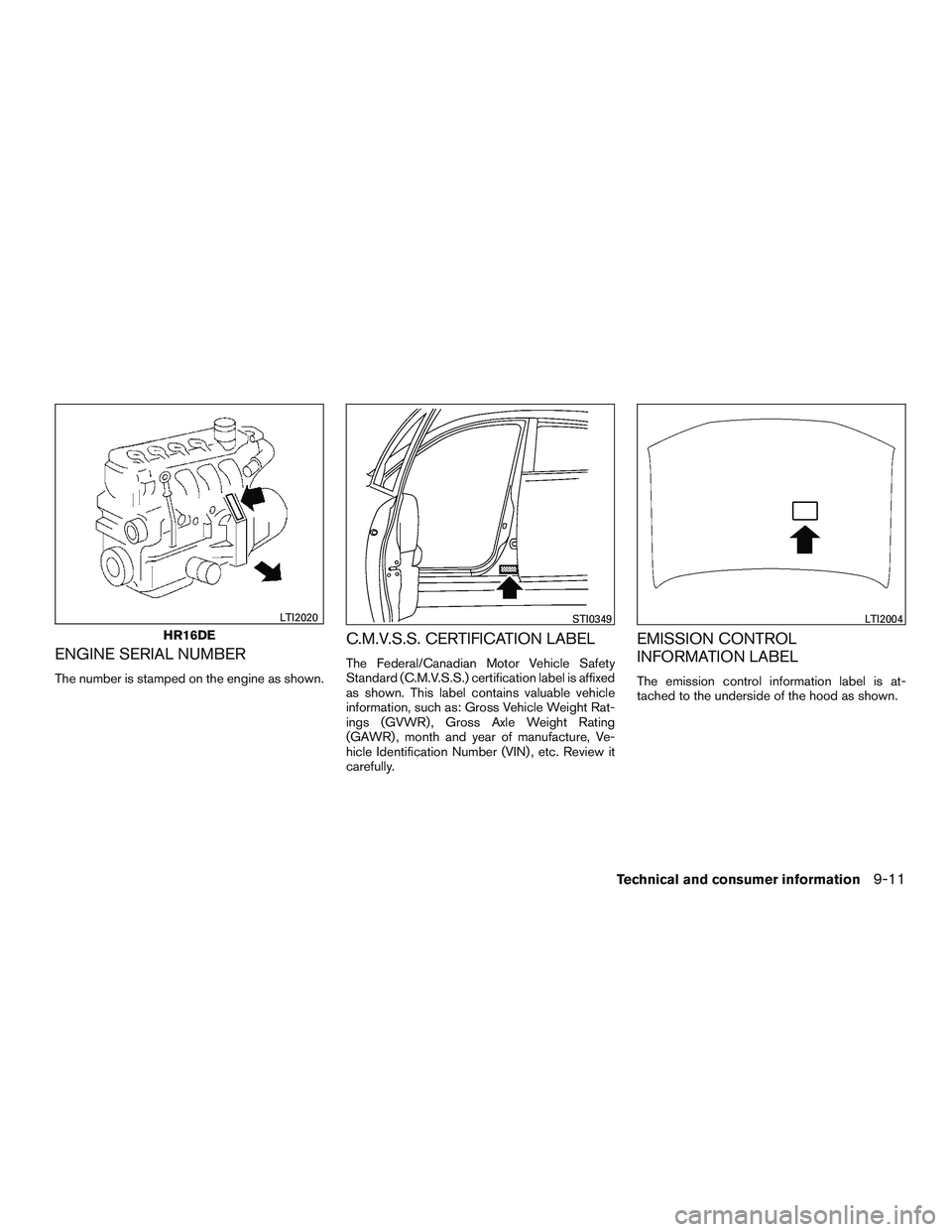
ENGINE SERIAL NUMBER
The number is stamped on the engine as shown.
C.M.V.S.S. CERTIFICATION LABEL
The Federal/Canadian Motor Vehicle Safety
Standard (C.M.V.S.S.) certification label is affixed
as shown. This label contains valuable vehicle
information, such as: Gross Vehicle Weight Rat-
ings (GVWR) , Gross Axle Weight Rating
(GAWR) , month and year of manufacture, Ve-
hicle Identification Number (VIN) , etc. Review it
carefully.
EMISSION CONTROL
INFORMATION LABEL
The emission control information label is at-
tached to the underside of the hood as shown.
HR16DE
LTI2020STI0349LTI2004
Technical and consumer information9-11
Page 281 of 293
●Overloading and improper load-
ing not only can shorten the life
of your vehicle and the tire, but
can also cause unsafe vehicle
handling and longer braking dis-
tances. This may cause a prema-
ture tire failure which could result
in a serious accident and per-
sonal injury. Failures caused by
overloading are not covered by
the vehicle’s warranty.
MEASUREMENT OF WEIGHTS
Secure loose items to prevent weight
shifts that could affect the balance of your
vehicle. When the vehicle is loaded, drive
to a scale and weigh the front and the rear
wheels separately to determine axle
loads. Individual axle loads should not ex-
ceed either of the gross axle weight rat-
ings (GAWR) . The total of the axle loads
should not exceed the gross vehicle
weight rating (GVWR) . These ratings are
given on the vehicle certification label. If
weight ratings are exceeded, move or re-
move items to bring all weights below the
ratings.
Do not tow a trailer with your vehicle.
FLAT TOWING
Towing your vehicle with all four wheels on the
ground is sometimes called flat towing. This
method is sometimes used when towing a vehicle
behind a recreational vehicle, such as a motor
home.
CAUTION
● Failure to follow these guidelines can
result in severe transmission damage.
● Whenever flat towing your vehicle, al-
ways tow forward, never backward.
● DO NOT tow any automatic transmis-
sion vehicle with all four wheels on the
ground (flat towing) . Doing so WILL
DAMAGE internal transmission parts
due to lack of transmission lubrication.
● For additional information, refer to
“Towing recommended by NISSAN” in
the “In case of emergency” section of
this manual.
Manual Transmission (if so equipped)
● Always tow with the manual transmission in
Neutral.
● After towing 805 km (500 miles) , start and
idle the engine with the transmission in Neu-
tral for two minutes. Failure to idle the engine
after every 805 km (500 miles) of towing
may cause damage to internal transmission
parts.
Automatic Transmission (if so
equipped)
To tow a vehicle equipped with an automatic
transmission, an appropriate vehicle dolly MUST
be placed under the towed vehicle’s drive
wheels. Always follow the dolly manufacturer’s
recommendations when using their product.
TOWING A TRAILER
9-16Technical and consumer information
Page 284 of 293
Due to legal requirements in some Canadian
Provinces, your vehicle may be required to be in
what is called the “ready condition” for an
Inspection/Maintenance (I/M) test of the emis-
sion control system.
The vehicle is set to the “ready condition” when it
is driven through certain driving patterns. Usually,
the ready condition can be obtained by ordinary
usage of the vehicle.
If a powertrain system component is repaired or the
battery is disconnected, the vehicle may be reset to
a “not ready” condition. Before taking the I/M test,
check the vehicle’s inspection/maintenance test
readiness condition. Place the ignition switch in the
ON position without starting the engine. If the
Malfunction Indicator Light (MIL) comes on steady
for 20 seconds and then blinks for 10 seconds, the
I/M test condition is “not ready”. If the MIL does not
blink after 20 seconds, the I/M test condition is
“ready”. Contact a NISSAN dealer to set the “ready
condition” or to prepare the vehicle for testing.
This vehicle is equipped with an Event Data Re-
corder (EDR) . The main purpose of an EDR is to
record, in certain crash or near crash-like situa-
tions, such as an air bag deployment or hitting a
road obstacle, data that will assist in understand-
ing how a vehicle’s systems performed. The EDR
is designed to record data related to vehicle
dynamics and safety systems for a short period of
time, typically 30 seconds or less. The EDR in this
vehicle is designed to record such data as:● How various systems in your vehicle were
operating;
● Whether or not the driver and passenger
safety belts were buckled/fastened;
● How far (if at all) the driver was depressing
the accelerator and/or brake pedal; and,
● How fast the vehicle was traveling.
● Sounds are not recorded. These data can help provide a better understand-
ing of the circumstances in which crashes and
injuries occur. NOTE: EDR data are recorded by
your vehicle only if a nontrivial crash situation
occurs; no data are recorded by the EDR under
normal driving conditions and no personal data
(e.g. name, gender, age and crash location) are
recorded. However, other parties, such as law
enforcement, could combine the EDR data with
the type of personally identifying data routinely
acquired during a crash investigation.
To read data recorded by an EDR, special equip-
ment is required and access to the vehicle or the
EDR is needed. In addition to the vehicle manu-
facturer and NISSAN dealer, other parties, such
as law enforcement, that have the special equip-
ment, can read the information if they have ac-
cess to the vehicle or the EDR. EDR data will only
be accessed with the consent of the vehicle
owner or lessee or as otherwise required or per-
mitted by law.
READINESS FOR INSPECTION/
MAINTENANCE (I/M) TEST
EVENT DATA RECORDERS (EDR)
Technical and consumer information9-19
Page 286 of 293
10 Index
A
ABS (Anti-lock Braking System) ........5-20
Air bag (See supplemental restraint
system) .....................1-40
Air bag system Front (See supplemental front impact
air bag system) ...............1-47
Side and curtain (See supplemental side air
bag and curtain side-impact air
bag system) .................1-52
Airbagwarninglabels.............1-54
Airbagwarninglight...........1-55,2-10
Air bag warning light, supplemental . .1-55, 2-10
Air cleaner housing filter ............8-16
Air conditioner Air conditioner operation ......4-10,4-18
Air conditioner service ...........4-23
Air conditioner specification label .....9-12
Air conditioner system refrigerant and
oil recommendations .............9-7
Filter .....................8-17
Heater and air conditioner controls. .4-7, 4-15
Servicing air conditioner ..........4-23
Airflowcharts..............4-11,4-19
Alarm system
(See vehicle security system) .........2-13
Anchor point locations .............1-22
Antenna .....................4-45
Anti-lock brake warning light ..........2-8
Anti-lock Braking System (ABS) ........5-20
Audible reminders ...............2-12 Audio system
..................4-23
AMradioreception.............4-24
Compact disc (CD) player .....4-34,4-38
FM-AM radio with compact disc (CD)
player ....................4-31
FM/AM/SAT radio with compact disc (CD)
player ....................4-35
FMradioreception.............4-23
iPod® Player ................4-42
iPod® player operation ...........4-42
Radio ....................4-23
Steering wheel audio control switch . . .4-44
USB interface ................4-40
USB (Universal Serial Bus) Connection
Port .....................4-40
Automatic Automatic transmission fluid (ATF) ....8-11
Automatic transmission position indicator
light .....................2-10
Driving with automatic transmission .....5-8
Transmission shift selector lock release . .5-11
Automatic door locks ..............3-5
AUXjack.................4-35,4-39
B
Battery ..................5-24,8-13
Chargewarninglight.............2-8
Battery replacement Keyfob ...................8-24
Before starting the engine ............5-7
Belt (See drive belt) ..............8-15 Block heater
Engine ....................5-25
Bluetooth® hands-free phone system ....4-46
Boosterseats..................1-36
Brake Anti-lock Braking System (ABS) ......5-20
Brake fluid ..................8-12
Brakelight(Seestoplight).........8-29
Brake system ................5-19
Brakewarninglight..............2-8
Brakewearindicators........2-12,8-19
Parking brake operation ..........5-14
Self-adjusting brakes ............8-19
Brake fluid ....................8-12
Brakes ......................8-19
Brake system ..................5-19
Break-inschedule ...............5-16
Brightness control Instrument panel ..............2-18
Bulb check/instrument panel ..........2-7
Bulbreplacement................8-29
C
Capacities and recommended
fuel/lubricants ...................9-2
Cargo (See vehicle loading information) . . .9-13
Car phone or CB radio .............4-45
CDcareandcleaning .............4-43
CD player (See audio system) .....4-34,4-38
Page 287 of 293
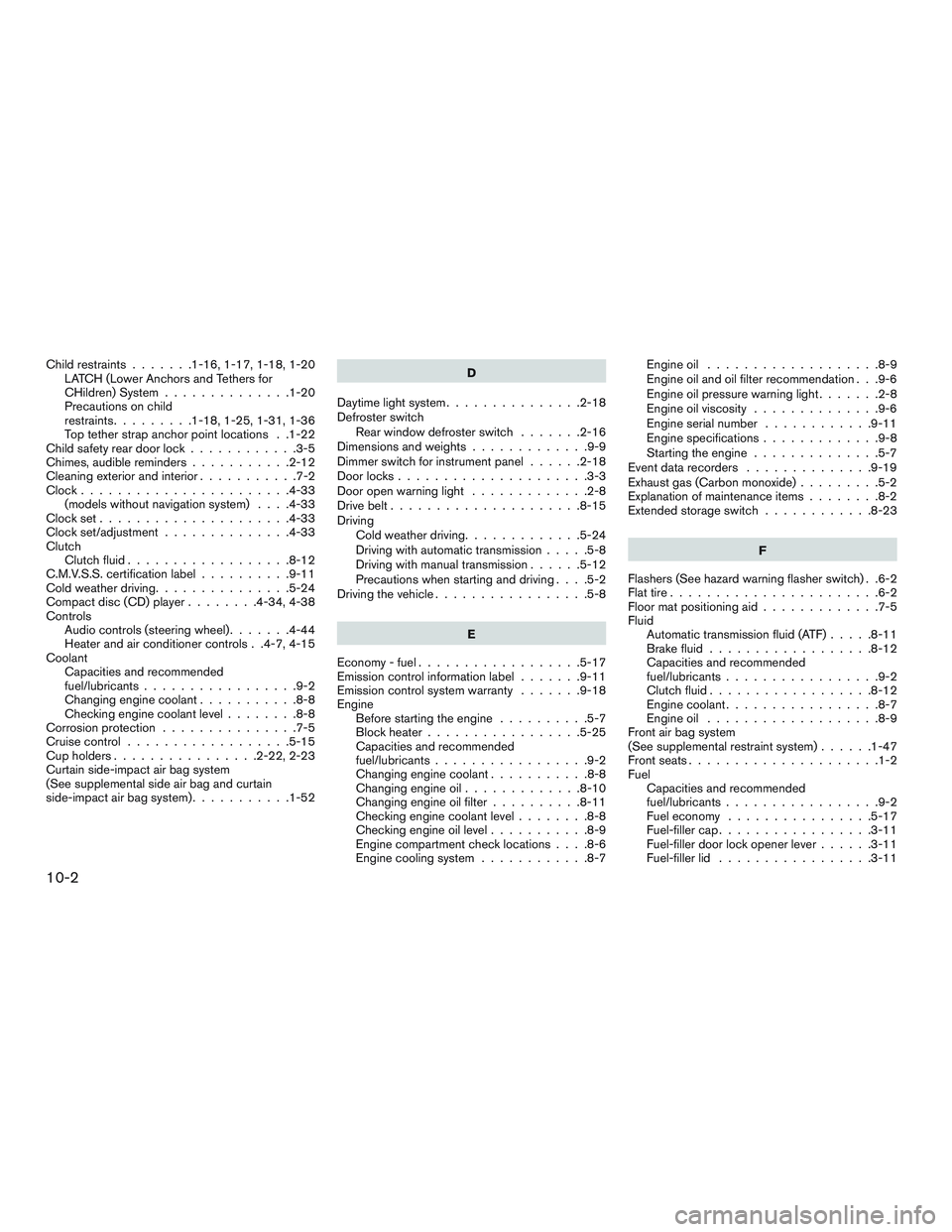
Child restraints.......1-16,1-17,1-18,1-20
LATCH (Lower Anchors and Tethers for
CHildren) System ..............1-20
Precautions on child
restraints.........1-18,1-25,1-31,1-36
Top tether strap anchor point locations . .1-22
Child safety rear door lock ............3-5
Chimes, audible reminders ...........2-12
Cleaningexteriorandinterior...........7-2
Clock.......................4-33 (models without navigation system) ....4-33
Clockset.....................4-33
Clock set/adjustment ..............4-33
Clutch Clutch fluid ..................8-12
C.M.V.S.S. certification label ..........9-11
Cold weather driving ...............5-24
Compact disc (CD) player ........4-34,4-38
Controls Audiocontrols(steeringwheel).......4-44
Heater and air conditioner controls . .4-7, 4-15
Coolant Capacities and recommended
fuel/lubricants .................9-2
Changing engine coolant ...........8-8
Checking engine coolant level ........8-8
Corrosionprotection ...............7-5
Cruisecontrol..................5-15
Cupholders................2-22,2-23
Curtain side-impact air bag system
(See supplemental side air bag and curtain
side-impact air bag system) ...........1-52 D
Daytime light system ...............2-18
Defroster switch Rear window defroster switch .......2-16
Dimensionsandweights.............9-9
Dimmer switch for instrument panel ......2-18
Door locks .....................3-3
Door open warning light .............2-8
Drive belt .....................8-15
Driving Cold weather driving .............5-24
Driving with automatic transmission .....5-8
Driving with manual transmission ......5-12
Precautions when starting and driving ....5-2
Driving the vehicle .................5-8
E
Economy - fuel ..................5-17
Emission control information label .......9-11
Emission control system warranty .......9-18
Engine Before starting the engine ..........5-7
Block heater .................5-25
Capacities and recommended
fuel/lubricants .................9-2
Changingenginecoolant...........8-8
Changingengineoil.............8-10
Changing engine oil filter ..........8-11
Checking engine coolant level ........8-8
Checking engine oil level ...........8-9
Engine compartment check locations ....8-6
Engine cooling system ............8-7 Engineoil ...................8-9
Engine oil and oil filter recommendation . . .9-6
Engine oil pressure warning light
.......2-8
Engine oil viscosity ..............9-6
Engine serial number ............9-11
Engine specifications .............9-8
Starting the engine ..............5-7
Event data recorders ..............9-19
Exhaust gas (Carbon monoxide) .........5-2
Explanation of maintenance items ........8-2
Extended
storage switch ............8-23
F
Flashers (See hazard warning flasher switch) . .6-2
Flat tire .......................6-2
Floor mat positioning aid .............7-5
Fluid Automatic transmission fluid (ATF) .....8-11
Brake fluid ..................8-12
Capacities and recommended
fuel/lubricants.................9-2
Clutch fluid ..................8-12
Enginecoolant.................8-7
Engineoil ...................8-9
Front air bag system
(See supplemental restraint system) ......1-47
Frontseats.....................1-2
Fuel Capacities and recommended
fuel/lubricants.................9-2
Fuel economy ................5-17
Fuel-filler cap .................3-11
Fuel-filler door lock opener lever ......3-11
Fuel-filler lid .................3-11
10-2
Page 288 of 293
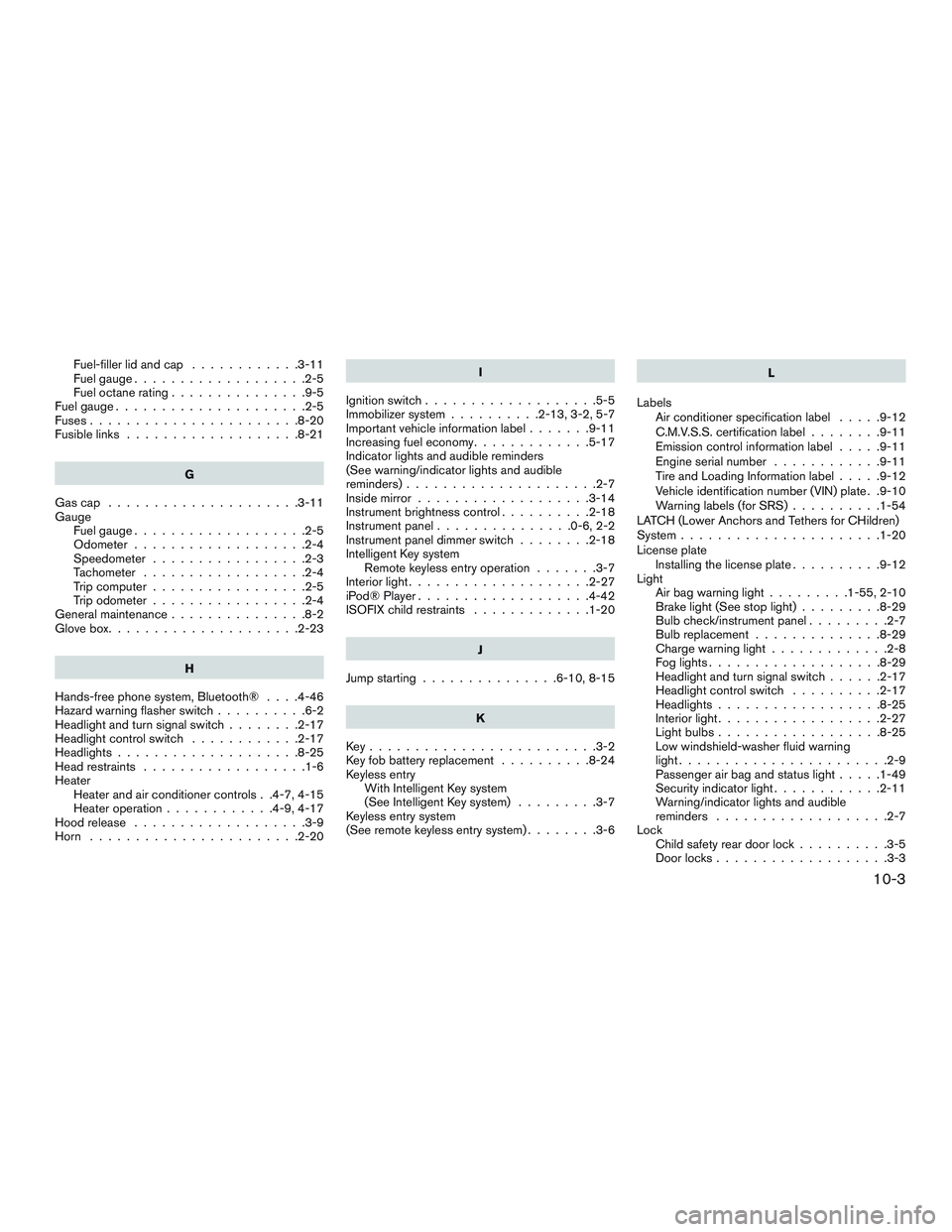
Fuel-filler lid and cap............3-11
Fuel gauge ...................2-5
Fuel octane rating ...............9-5
Fuel gauge .....................2-5
Fuses.......................8-20
Fusible links ...................8-21
G
Gascap .....................3-11
Gauge Fuel gauge ...................2-5
Odometer ...................2-4
Speedometer .................2-3
Tachometer ..................2-4
Trip computer .................2-5
Trip odometer .................2-4
General maintenance ...............8-2
Glovebox.....................2-23
H
Hands-free phone system, Bluetooth® ....4-46
Hazard warning flasher switch ..........6-2
Headlight and turn signal switch ........2-17
Headlightcontrolswitch ............2-17
Headlights....................8-25
Head restraints ..................1-6
Heater Heater and air conditioner controls . .4-7, 4-15
Heater operation ............4-9,4-17
Hood release ...................3-9
Horn .......................2-20 I
Ignition switch ...................5-5
Immobilizer system ..........2-13,3-2,5-7
Important vehicle information label .......9-11
Increasing fuel economy .............5-17
Indicator lights and audible reminders
(See warning/indicator lights and audible
reminders) .....................2-7
Inside mirror ...................3-14
Instrument brightness control ..........2-18
Instrument panel ...............0-6,2-2
Instrument panel dimmer switch ........2-18
Intelligent Key system Remote keyless entry operation .......3-7
Interiorlight....................2-27
iPod® Player ...................4-42
ISOFIX child restraints .............1-20
J
Jump starting ...............6-10,8-15
K
Key.........................3-2
Key fob battery replacement ..........8-24
Keyless entry With Intelligent Key system
(See Intelligent Key system) .........3-7
Keyless entry system
(See remote keyless entry system) ........3-6 L
Labels Air conditioner specification label .....9-12
C.M.V.S.S. certification label ........9-11
Emission control information label .....9-11
Engine serial number ............9-11
Tire and Loading Information label .....9-12
Vehicle identification number (VIN) plate . .9-10
Warning labels (for SRS) ..........1-54
LATCH (Lower Anchors and Tethers for CHildren)
System ......................1-20
License plate Installing the license plate ..........9-12
Light A
irbagwarninglight.........1-55,2-10
Brake light (See stop light) .........8-29
Bulb check/instrument panel .........2-7
Bulb replacement ..............8-29
Charge warning light .............2-8
Foglights...................8-29
Headlightandturnsignalswitch......2-17
Headlight control switch ..........2-17
Headlights..................8-25
Interior light ..................2-27
Lightbulbs..................8-25
Low windshield-washer fluid warning
light.......................2-9
Passenger air bag and status light .....1-49
Security indicator light ............2-11
Warning/indicator lights and audible
reminders ...................2-7
Lock Child safety rear door lock ..........3-5
Doorlocks...................3-3
10-3