warning NISSAN MICRA 2016 Owner´s Manual
[x] Cancel search | Manufacturer: NISSAN, Model Year: 2016, Model line: MICRA, Model: NISSAN MICRA 2016Pages: 299, PDF Size: 3.54 MB
Page 267 of 299
Other Tire-related Terminology
In addition to the many terms that are
defined throughout this section, Intended
Outboard Sidewall is (1) the sidewall that
contains a whitewall, bears white lettering
or bears manufacturer, brand, and/or
model name molding that is higher or
deeper than the same molding on the
other sidewall of the tire, or (2) the out-
ward facing sidewall of an asymmetrical
tire that has a particular side that must
always face outward when mounted on a
vehicle.
TYPES OF TIRES
WARNING
●When changing or replacing tires, be
sure all four tires are of the same type
(i.e., Summer, All Season or Snow) and
construction. A NISSAN dealer may be
able to help you with information about
tire type, size, speed rating and
availability. ●
Replacement tires may have a lower
speed rating than the factory equipped
tires, and may not match the potential
maximum vehicle speed. Never exceed
the maximum speed rating of the tire.
● For additional information regarding
tires, refer to “Tire Safety Information”
(Canada) in the Warranty Information
Booklet.
All season tires
NISSAN specifies All Season tires on some mod-
els to provide good performance all year, includ-
ing snowy and icy road conditions. All Season
tires are identified by ALL SEASON and/or M&S
on the tire sidewall. Snow tires have better snow
traction than All Season tires and may be more
appropriate in some areas.
Summer tires
NISSAN specifies summer tires on some models
to provide superior performance on dry roads.
Summer tire performance is substantially re-
duced in snow and ice. Summer tires do not have
the tire traction rating “M&S” on the tire sidewall.
If you plan to operate your vehicle in snowy or icy
conditions, NISSAN recommends the use of
SNOW tires or ALL SEASON tires on all four
wheels.
Snow tires
If snow tires are needed, it is necessary to select
tires equivalent in size and load rating to the
original equipment tires. If you do not, it can
adversely affect the safety and handling of your
vehicle.
Generally, snow tires have lower speed ratings
than factory equipped tires and may not match
the potential maximum vehicle speed. Never ex-
ceed the maximum speed rating of the tire.
If you install snow tires, they must be the same
size, brand, construction and tread pattern on all
four wheels.
For additional traction on icy roads, studded tires
may be used. However, some Canadian prov-
inces prohibit their use. Check local, state and
provincial laws before installing studded tires.
Skid and traction capabilities of studded snow
tires on wet or dry surfaces may be poorer than
that of non-studded snow tires.
8-38Maintenance and do-it-yourself
Page 268 of 299
TIRE CHAINS
CAUTION
Tire chains/cables should not be installed
on 185/60R15 or 185/55R16 tires. Installa-
tion of the tire chains/cables on
185/60R15 or 185/55R16 tires will cause
damage to the vehicle. Please use snow
tires instead of chains/cables if needed.
Never install tire chains on a TEMPORARY
USE ONLY spare tire.
CHANGING WHEELS AND TIRES
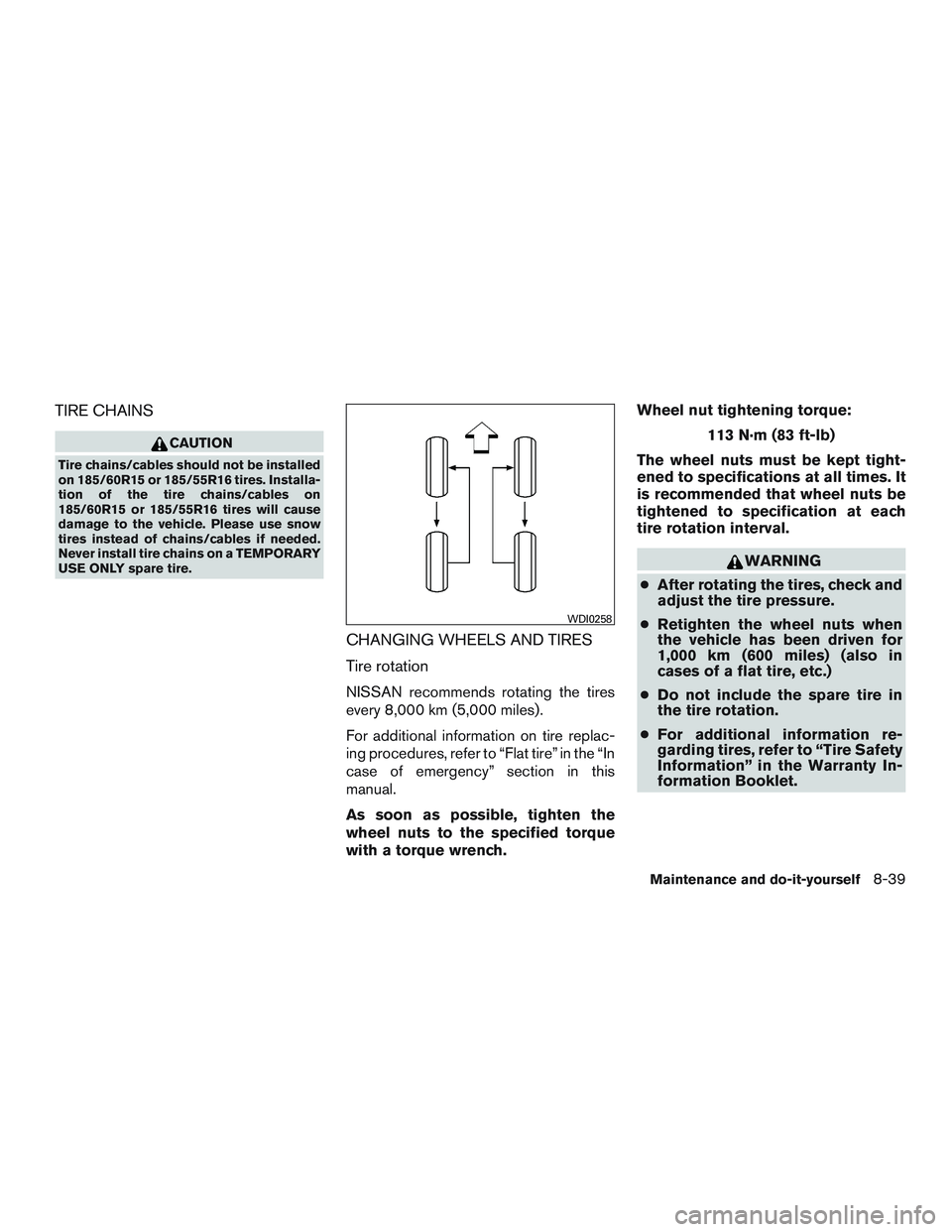
Tire rotation
NISSAN recommends rotating the tires
every 8,000 km (5,000 miles).
For additional information on tire replac-
ing procedures, refer to “Flat tire” in the “In
case of emergency” section in this
manual.
As soon as possible, tighten the
wheel nuts to the specified torque
with a torque wrench.Wheel nut tightening torque:
113 N·m (83 ft-lb)
The wheel nuts must be kept tight-
ened to specifications at all times. It
is recommended that wheel nuts be
tightened to specification at each
tire rotation interval.
WARNING
● After rotating the tires, check and
adjust the tire pressure.
● Retighten the wheel nuts when
the vehicle has been driven for
1,000 km (600 miles) (also in
cases of a flat tire, etc.)
● Do not include the spare tire in
the tire rotation.
● For additional information re-
garding tires, refer to “Tire Safety
Information” in the Warranty In-
formation Booklet.
WDI0258
Maintenance and do-it-yourself8-39
Page 269 of 299
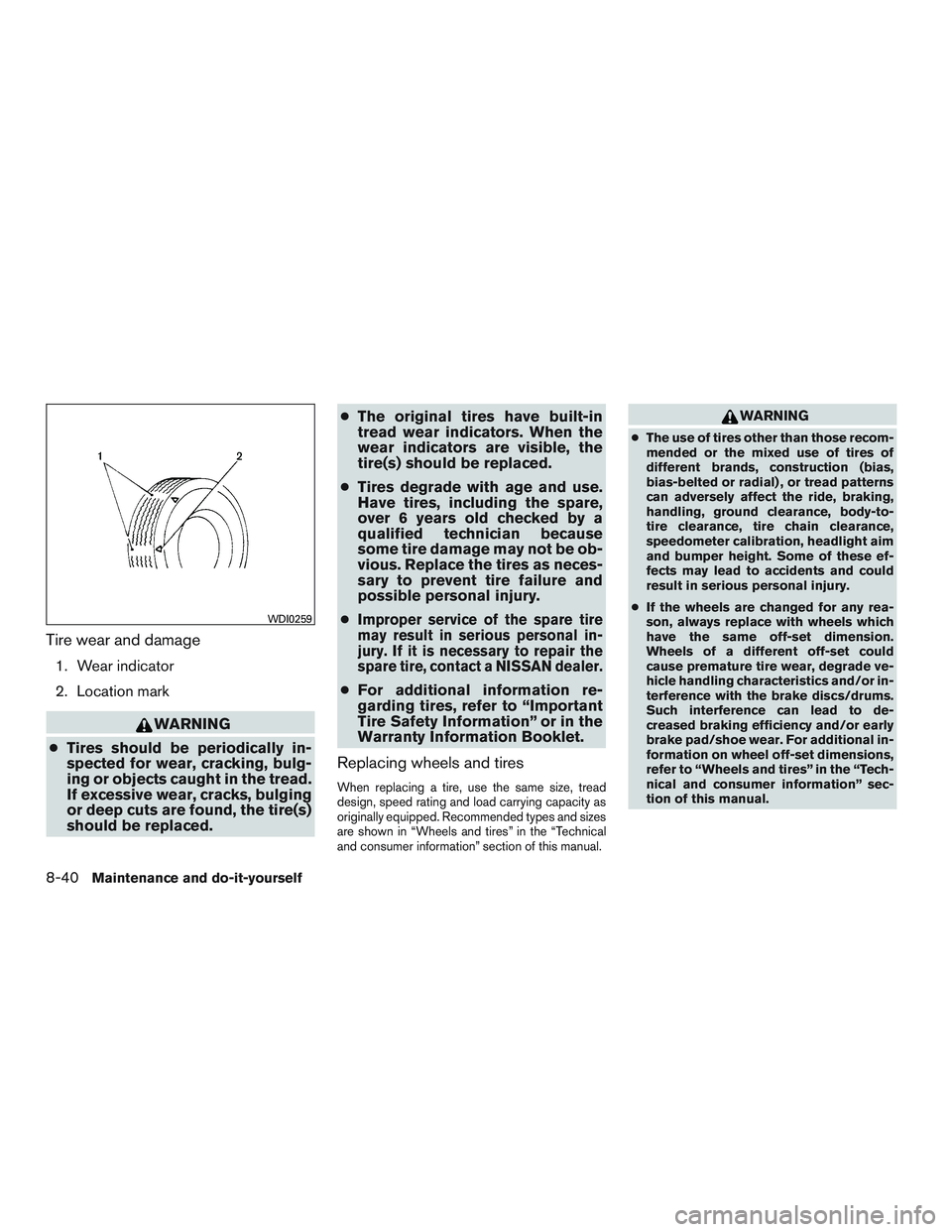
Tire wear and damage
1. Wear indicator
2. Location mark
WARNING
● Tires should be periodically in-
spected for wear, cracking, bulg-
ing or objects caught in the tread.
If excessive wear, cracks, bulging
or deep cuts are found, the tire(s)
should be replaced. ●
The original tires have built-in
tread wear indicators. When the
wear indicators are visible, the
tire(s) should be replaced.
● Tires degrade with age and use.
Have tires, including the spare,
over 6 years old checked by a
qualified technician because
some tire damage may not be ob-
vious. Replace the tires as neces-
sary to prevent tire failure and
possible personal injury.
●
Improper service of the spare tire
may result in serious personal in-
jury. If it is necessary to repair the
spare tire, contact a NISSAN dealer.
● For additional information re-
garding tires, refer to “Important
Tire Safety Information” or in the
Warranty Information Booklet.
Replacing wheels and tires
When replacing a tire, use the same size, tread
design, speed rating and load carrying capacity as
originally equipped. Recommended types and sizes
are shown in “Wheels and tires” in the “Technical
and consumer information” section of this manual.
WARNING
● The use of tires other than those recom-
mended or the mixed use of tires of
different brands, construction (bias,
bias-belted or radial) , or tread patterns
can adversely affect the ride, braking,
handling, ground clearance, body-to-
tire clearance, tire chain clearance,
speedometer calibration, headlight aim
and bumper height. Some of these ef-
fects may lead to accidents and could
result in serious personal injury.
● If the wheels are changed for any rea-
son, always replace with wheels which
have the same off-set dimension.
Wheels of a different off-set could
cause premature tire wear, degrade ve-
hicle handling characteristics and/or in-
terference with the brake discs/drums.
Such interference can lead to de-
creased braking efficiency and/or early
brake pad/shoe wear. For additional in-
formation on wheel off-set dimensions,
refer to “Wheels and tires” in the “Tech-
nical and consumer information” sec-
tion of this manual.
WDI0259
8-40Maintenance and do-it-yourself
Page 270 of 299
●Do not install a damaged or deformed
wheel or tire even if it has been re-
paired. Such wheels or tires could have
structural damage and could fail with-
out warning.
● The use of retread tires is not
recommended.
Wheel balance
Unbalanced wheels may affect vehicle handling
and tire life. Even with regular use, wheels can get
out of balance. Therefore, they should be bal-
anced as required.
Wheel balance service should be per-
formed with the wheels off the vehicle.
Spin balancing the wheels on the vehicle
could lead to mechanical damage.
● For additional information regarding
tires, refer to “Tire Safety Information”
in the Warranty Information Booklet.
Care of wheels
● Wash the wheels when washing the vehicle
to maintain their appearance.
● Clean the inner side of the wheels when the
wheel is changed or the underside of the
vehicle is washed. ●
Do not use abrasive cleaners when washing
the wheels.
● Inspect wheel rims regularly for dents or
corrosion. Such damage may cause loss of
pressure or poor seal at the tire bead.
● NISSAN recommends waxing the road
wheels to protect against road salt in areas
where it is used during winter.
Spare tire (TEMPORARY USE ONLY
spare tire)
Since the spare tire is not equipped with the
TPMS, when a spare tire is mounted (TEMPO-
RARY USE ONLY or conventional) , the TPMS
will not function.
Observe the following precautions if the TEM-
PORARY USE ONLY spare tire must be used.
Otherwise, your vehicle could be damaged or
involved in an accident:
WARNING
● The spare tire should be used for emer-
gency use only. It should be replaced
with the standard tire at the first oppor-
tunity to avoid possible tire or differen-
tial damage. ●
Drive carefully while the TEMPORARY
USE ONLY spare tire is installed. Avoid
sharp turns and abrupt braking while
driving.
● Periodically check spare tire inflation
pressure. Always keep the pressure of
the TEMPORARY USE ONLY spare tire
at 60 psi (420 kPa, 4.2 bar) .
● With the TEMPORARY USE ONLY spare
tire installed do not drive the vehicle at
speeds faster than 50 mph (80 km/h).
●
When driving on roads covered with
snow or ice, the TEMPORARY USE ONLY
spare tire should be used on the rear
wheels and the original tire used on the
front wheels (drive wheels) . Use tire
chains only on the front (original) tires.
● Tire tread of the TEMPORARY USE
ONLY spare tire will wear at a faster rate
than the standard tire. Replace the
spare tire as soon as the tread wear
indicators appear.
● Do not use the spare tire on other
vehicles.
● Do not use more than one spare tire at
the same time.
● Do not tow a trailer when the TEMPO-
RARY USE ONLY spare tire is installed.
Maintenance and do-it-yourself8-41
Page 284 of 299
WARNING
● It is extremely dangerous to ride
in a cargo area inside a vehicle. In
a collision, people riding in these
areas are more likely to be seri-
ously injured or killed.
● Do not allow people to ride in any
area of your vehicle that is not
equipped with seats and seat
belts.
● Be sure everyone in your vehicle
is in a seat and using a seat belt
properly.
TERMS
It is important to familiarize yourself with
the following terms before loading your
vehicle:
● Curb Weight (actual weight of your
vehicle) - vehicle weight including:
standard and optional equipment, flu-
ids, emergency tools, and spare tire
assembly. This weight does notin-
clude passengers and cargo. ●
GVW (Gross Vehicle Weight) - curb
weight plus the combined weight of
passengers and cargo.
● GVWR (Gross Vehicle Weight Rat-
ing) - maximum total combined
weight of the unloaded vehicle, pas-
sengers, luggage, hitch, trailer
tongue load and any other optional
equipment. This information is lo-
cated on the C.M.V.S.S. certification
label.
● GAWR (Gross Axle Weight Rating) -
maximum weight (load) limit specified
for the front or rear axle. This informa-
tion is located on the C.M.V.S.S. cer-
tification label.
● GCWR (Gross Combined Weight
rating) - The maximum total weight
rating of the vehicle, passengers,
cargo, and trailer. ●
Vehicle Capacity Weight, Load limit,
Total load capacity - maximum total
weight limit specified of the load
(passengers and cargo) for the ve-
hicle. This is the maximum combined
weight of occupants and cargo that
can be loaded into the vehicle. If the
vehicle is used to tow a trailer, the
trailer tongue weight must be in-
cluded as part of the cargo load. This
information is located on the Tire and
Loading Information label.
● Cargo capacity - permissible weight
of cargo, the subtracted weight of
occupants from the load limit.DETERMINING VEHICLE LOAD
CAPACITY
The load capacity of this vehicle is deter-
mined by weight, not by available cargo
space. For example, a luggage rack, bike
carrier, cartop carrier or similar equipment
does not increase load carrying capacity
of your vehicle.
VEHICLE LOADING INFORMATION
Technical and consumer information9-13
Page 286 of 299
Steps for determining correct load
limit
1. Locate the statement “The combinedweight of occupants and cargo
should never exceed XXX lbs or XXX
kg” on your vehicle’s placard.
2. Determine the combined weight of the driver and passengers that will be
riding in your vehicle.
3. Subtract the combined weight of the driver and passengers from XXX lbs
or XXX kg.
4. The resulting figure equals the avail- able amount of cargo and luggage
load capacity. For example, if the
XXX amount equals 1,400 lbs. and
there will be five 150 lb. passengers
in your vehicle, the amount of avail-
able cargo and luggage load capac-
ity is 650 lbs. (1,400-750 (5 X 150)
= 650 lbs) or (640-340 (5 X 70) =
300 kg.) 5. Determine the combined weight of
luggage and cargo being loaded on
the vehicle. That weight may not
safely exceed the available cargo and
luggage load capacity calculated in
step 4.
Before driving a loaded vehicle, confirm
that you do not exceed the Gross Vehicle
Weight Rating (GVWR) or the Gross Axle
Weight Rating (GAWR) for your vehicle.
For additional information, refer to “Mea-
surement of weights” in this section of the
manual.
Also check tires for proper inflation pres-
sures. For additional information, refer to
“Tire and Loading Information label” in this
section of the manual.
LOADING TIPS
● The GVW must not exceed GVWR
or GAWR as specified on the
C.M.V.S.S. certification label.
● Do not load the front and rear axle to
the GAWR. Doing so will exceed the
GVWR.
WARNING
● Properly secure all cargo with
ropes or straps to help prevent it
from sliding or shifting. Do not
place cargo higher than the seat-
backs. In a sudden stop or colli-
sion, unsecured cargo could
cause personal injury.
● Do not load your vehicle any
heavier than the GVWR or the
maximum front and rear GAWRs.
If you do, parts of your vehicle can
break, tire damage could occur,
or it can change the way your
vehicle handles. This could result
in loss of control and cause per-
sonal injury.
Technical and consumer information9-15
Page 288 of 299
DOT (Department of Transportation) Quality
Grades: All passenger car tires must conform to
federal safety requirements in addition to these
grades.
Quality grades can be found where applicable on
the tire sidewall between tread shoulder and
maximum section width. For example:
Treadwear 200 Traction AA Temperature A
Treadwear
The treadwear grade is a comparative rating
based on the wear rate of the tire when tested
under controlled conditions on a specified gov-
ernment test course. For example, a tire graded
150 would wear one and one-half (1 1/2) times
as well on the government course as a tire graded
100. The relative performance of tires depends
upon the actual conditions of their use, however,
and may depart significantly from the norm due to
variations in driving habits, service practices and
differences in road characteristics and climate.
Traction AA, A, B and C
The traction grades, from highest to lowest, are
AA, A, B, and C. Those grades represent the
tire’s ability to stop on wet pavement as mea-
sured under controlled conditions on specified
government test surfaces of asphalt and con-
crete. A tire marked C may have poor traction
performance.WARNING
The traction grade assigned to this tire is
based on straight-ahead braking traction
tests, and does not include acceleration,
cornering, hydroplaning, or peak traction
characteristics.
Temperature A, B and C
The temperature grades are A (the highest) , B,
and C, representing the tire’s resistance to the
generation of heat, and its ability to dissipate heat
when tested under controlled conditions on a
specified indoor laboratory test wheel. Sustained
high temperature can cause the material of the
tire to degenerate and reduce tire life, and exces-
sive temperature can lead to sudden tire failure.
The grade C corresponds to a level of perfor-
mance which all passenger car tires must meet
under the Federal Motor Safety Standard No.
109. Grades B and A represent higher levels of
performance on the laboratory test wheel than
the minimum required by law.
WARNING
The temperature grade for this tire is es-
tablished for a tire that is properly inflated
and not overloaded. Excessive speed,
under-inflation, or excessive loading, ei-
ther separately or in combination, can
cause heat build-up and possible tire
failure.
UNIFORM TIRE QUALITY GRADING
Technical and consumer information9-17
Page 292 of 299
10 Index
A
ABS (Anti-lock Braking System) ........5-21
Air bag (See supplemental restraint system). .1-39
Air bag system Front (See supplemental front impact air bag
system) ...................1-46
Side and curtain (See supplemental
side air bag and curtain side-impact air bag
system) ...................1-53
Airbagwarninglabels.............1-55
Airbagwarninglight...........1-56,2-10
Air bag warning light, supplemental . .1-56, 2-10
Air cleaner housing filter ............8-17
Air conditioner Air conditioner operation ......4-12,4-20
Air conditioner service ...........4-25
Air conditioner specification label .....9-12
Air conditioner system refrigerant and oil
recommendations ..............9-7
Air conditioner system refrigerant
recommendations ..............9-7
Filter .....................8-17
Heater and air conditioner controls. .4-9, 4-17
Servicing air conditioner ..........4-25
Airflowcharts..............4-13,4-21
Alarm system
(See vehicle security system) .........2-13
Anchor point locations .............1-23
Antenna .....................4-47
Anti-lock brake warning light ..........2-8
Anti-lock Braking System (ABS) ........5-21Audible reminders
...............2-13
Audio system ..................4-25
AMradioreception.............4-26
Compact disc (CD) player .....4-36,4-40
FM-AM radio with compact disc (CD)
player ....................4-33
FM/AM/SAT radio with compact disc (CD)
player ....................4-37
FMradioreception.............4-25
iPod® Player ................4-44
iPod® player operation ...........4-44
Radio ....................4-25
Steering wheel audio control switch . . .4-46
USB interface ................4-42
USB (Universal Serial Bus) Connection
Port .....................4-42
Automatic Automatic power window switch .....2-28
Automatic transmission fluid (ATF) ....8-11
Automatic transmission position indicator
light .....................2-10
Driving with automatic transmission .....5-8
Transmission shift lever lock release ....5-11
Automatic door locks ..............3-5
AUXjack.................4-37,4-41
B
Battery ..................5-25,8-13
Chargewarninglight.............2-8
Battery replacement Keyfob................8-22,8-23 Before starting the engine
............5-7
Belt (See drive belt) ..............8-15
Block heater Engine ....................5-26
Bluetooth® hands-free phone system ....4-48
Boosterseats..................1-36
Brake Anti-lock Braking System (ABS) ......5-21
Brake assist (for Intelligent cruise control
system) ...................5-22
Brake fluid ..................8-12
Brakelight(Seestoplight).........8-28
Brake system ................5-21
Brakewarninglight..............2-8
Brakewearindicators........2-13,8-19
Parking brake operation ..........5-14
Self-adjusting brakes ............8-19
Brake fluid ....................8-12
Brakes ......................8-19
Brake system ..................5-21
Break-inschedule ...............5-16
Brightness control Instrument panel ..............2-20
Bulb check/instrument panel ..........2-8
Bulbreplacement................8-28
C
Capacities and recommended
fuel/lubricants ...................9-2
Cargo (See vehicle loading information) . . .9-13
Car phone or CB radio .............4-48
Page 293 of 299
CD care and cleaning..............4-46
CD player (See audio system) ......4-36,4-40
Child restraints .......1-17,1-17,1-19,1-21
LATCH (Lower Anchors and Tethers for
CHildren) System ..............1-21
Precautions on child
restraints.........1-19,1-25,1-31,1-36
Top tether strap anchor point locations . .1-23
Child safety rear door lock ............3-5
Chimes, audible reminders ...........2-13
Cleaningexteriorandinterior........7-2,7-4
Clock setting
(models without Navigation System) . .4-35, 4-38
Clutch Clutch fluid ..................8-12
C.M.V.S.S. certification label ..........9-11
Cold weather driving ...............5-25
Compact disc (CD) player ........4-36,4-40
Controls Audiocontrols(steeringwheel).......4-46
Heater and air conditioner controls . .4-9, 4-17
Coolant Capacities and recommended
fuel/lubricants .................9-2
Changing engine coolant ...........8-8
Checking engine coolant level ........8-8
Corrosionprotection ...............7-5
Cruisecontrol..................5-15
Cupholders................2-23,2-24
Curtain side-impact air bag system
(See supplemental side air bag and curtain
side-impact air bag system) ...........1-53 D
Daytime light system ...............2-19
Defroster switch Rear window and outside mirror defroster
switch.....................2-17
Dimensionsandweights.............9-9
Dimmer switch for instrument panel ......2-20
Door locks .....................3-3
Door open warning light .............2-8
Doors ........................3-3
Drive belt .....................8-15
Driving Cold weather driving .............5-25
Driving with automatic transmission .....5-8
Driving with manual transmission ......5-13
Precautions when starting and driving ....5-2
Driving the vehicle .................5-8
E
Economy - fuel ..................5-18
Emission control information label .......9-11
Emission control system warranty .......9-18
Engine Before starting the engine ..........5-7
Block heater .................5-26
Capacities and recommended
fuel/lubricants .................9-2
Changingenginecoolant...........8-8
Changingengineoil.............8-10
Changing engine oil filter ..........8-11
Checking engine coolant level ........8-8
Checking engine oil level ...........8-9 Engine compartment check locations
....8-6
Engine cooling system ............8-7
Engineoil ...................8-9
Engine oil and oil filter recommendation . . .9-6
Engine oil pressure warning light .......2-8
Engine oil viscosity ..............9-7
Engine serial number ............9-11
Engine specifications .............9-8
Starting the engine ..............5-7
Event Data recorders ..............9-19
Exhaust gas (Carbon monoxide) .........5-2
Explanation of maintenance items ........8-2
Extended storage switch ............
8-22
F
Flashers (See hazard warning flasher switch) . .6-2
Flat tire .......................6-2
Floor mat positioning aid .............7-5
Fluid Automatic transmission fluid (ATF) .....8-11
Brake fluid ..................8-12
Capacities and recommended
fuel/lubricants.................9-2
Clutch fluid ..................8-12
Enginecoolant.................8-7
Engineoil ...................8-9
Front air bag system
(See supplemental restraint system) ......1-46
Frontseats.....................1-2
Fuel Capacities and recommended
fuel/lubricants.................9-2
Fuel economy ................5-18
Fuel-filler cap .................3-10
10-2
Page 294 of 299
Fuel-filler lid.................3-10
Fuel gauge ...................2-5
Fuel octane rating ...............9-5
Fuel recommendation .............9-4
Fuel Cell Vehicle (FCV) System Tirepressure.................8-33
Fuel-filler door ..................3-10
Fuel gauge .....................2-5
Fuses.......................8-20
Fusible links ...................8-20
G
Gascap .....................3-10
Gauge Fuel gauge ...................2-5
Odometer ...................2-4
Speedometer .................2-4
Tachometer ..................2-5
Trip computer .................2-6
Trip odometer .................2-4
General maintenance ...............8-2
Glovebox.....................2-23
H
Hands-free phone system, Bluetooth® ....4-48
Hazard warning flasher switch ..........6-2
Headlight and turn signal switch ........2-18
Headlightcontrolswitch ............2-18
Headlights....................8-24
Head restraints ..................1-6
Heater Heater and air conditioner controls . .4-9, 4-17 Heater operation
...........4-11,4-19
Hood ........................3-8
Horn .......................2-21
I
Ignition switch ...................5-5
Immobilizer system .............2-13,5-7
Important vehicle information label .......9-11
Increasing fuel economy .............5-18
Indicator lights and audible reminders
(See warning/indicator lights and audible
reminders) ...............2-7,2-8,2-10
Instrument brightness control ..........2-20
Instrument panel ...............0-6,2-2
Instrument panel dimmer switch ........2-20
Interiorlight....................2-28
iPod® Player ...................4-44
ISOFIX child restraints .............1-21
J
Jump starting ...............6-10,8-15
K
Key.........................3-2
Key fob battery replacement .......8-22,8-23
Keyless entry Without Intelligent Key system
(See remote keyless entry system) . . .3-5, 3-6
Keys NISSAN Vehicle Immobilizer System keys . .3-2 L
Labels Air conditioner specification label .....9-12
C.M.V.S.S. certification label ........9-11
Emission control information label .....9-11
Engine serial number ............9-11
Tire and Loading Information label .....9-12
Vehicle identification number (VIN) .....9-10
Vehicle identification number (VIN) plate . .9-10
Warning labels (for SRS) ..........1-55
LATCH (Lower Anchors and Tethers for CHildren)
System ......................1-21
License plate Installing
the license plate ..........9-12
Light Airbagwarninglight.........1-56,2-10
Brake light (See stop light) .........8-28
Bulb check/instrument panel .........2-8
Bulb replacement ..............8-28
Charge warning light .............2-8
Exterior and Interior lights ..........8-28
Foglights...................8-28
Headlightandturnsignalswitch......2-18
Headlight control switch ..........2-18
Headlights..................8-24
Interior light ..................2-28
Lightbulbs..................8-24
Low windshield-washer fluid warning light..2-9
Passenger air bag and status light .....1-48
Security indicator light ............2-12
Warning/indicator lights and audible
reminders .............2-7,2-8,2-10
Lights.......................8-24
10-3