driver seat adjustment NISSAN MICRA 2016 Owner´s Manual
[x] Cancel search | Manufacturer: NISSAN, Model Year: 2016, Model line: MICRA, Model: NISSAN MICRA 2016Pages: 299, PDF Size: 3.54 MB
Page 18 of 299
1 Safety—Seats, seat belts and
supplemental restraint system
Seats............................................1-2
Front manual seat adjustment . . ..................1-3
Armrest (if so equipped for driver’s seat) ..........1-4
Folding rear seat ...............................1-4
Head restraints/headrests ..........................1-6
Adjustable head restraint/headrest
components ...................................1-7
Non-adjustable head restraint/headrest
components ...................................1-7
Remove .......................................1-7
Install .........................................1-8
Adjust .........................................1-8
Seat belts ....................................... 1-10
Precautions on seat belt usage ..................1-10
Seat belt warning light ......................... 1-12
Pregnant women .............................. 1-13
Injured persons ................................ 1-13
Three-point type seat belt with retractor ..........1-13
Seat belt extenders ............................ 1-16
Seat belt maintenance ......................... 1-16Child safety
...................................... 1-17
Infants ........................................ 1-17
Small children ................................. 1-18
Larger children ................................ 1-18
Child restraints ................................... 1-19
Precautions on child restraints ..................1-19
LATCH (Lower Anchors and Tethers for
CHildren) system .............................. 1-21
Rear-facing child restraint installation using
LATCH....................................... 1-24
Rear-facing child restraint installation using
the seat belts ................................. 1-25
Forward-facing child restraint installation
using LATCH .................................. 1-28
Forward-facing child restraint installation
using the seat belts ............................ 1-31
Booster seats ................................. 1-36
Supplemental Restraint System (SRS) ..............1-39
Precautions on SRS ........................... 1-39
Supplemental air bag warning labels .............1-55
Supplemental air bag warning light ..............1-56
Page 19 of 299
WARNING
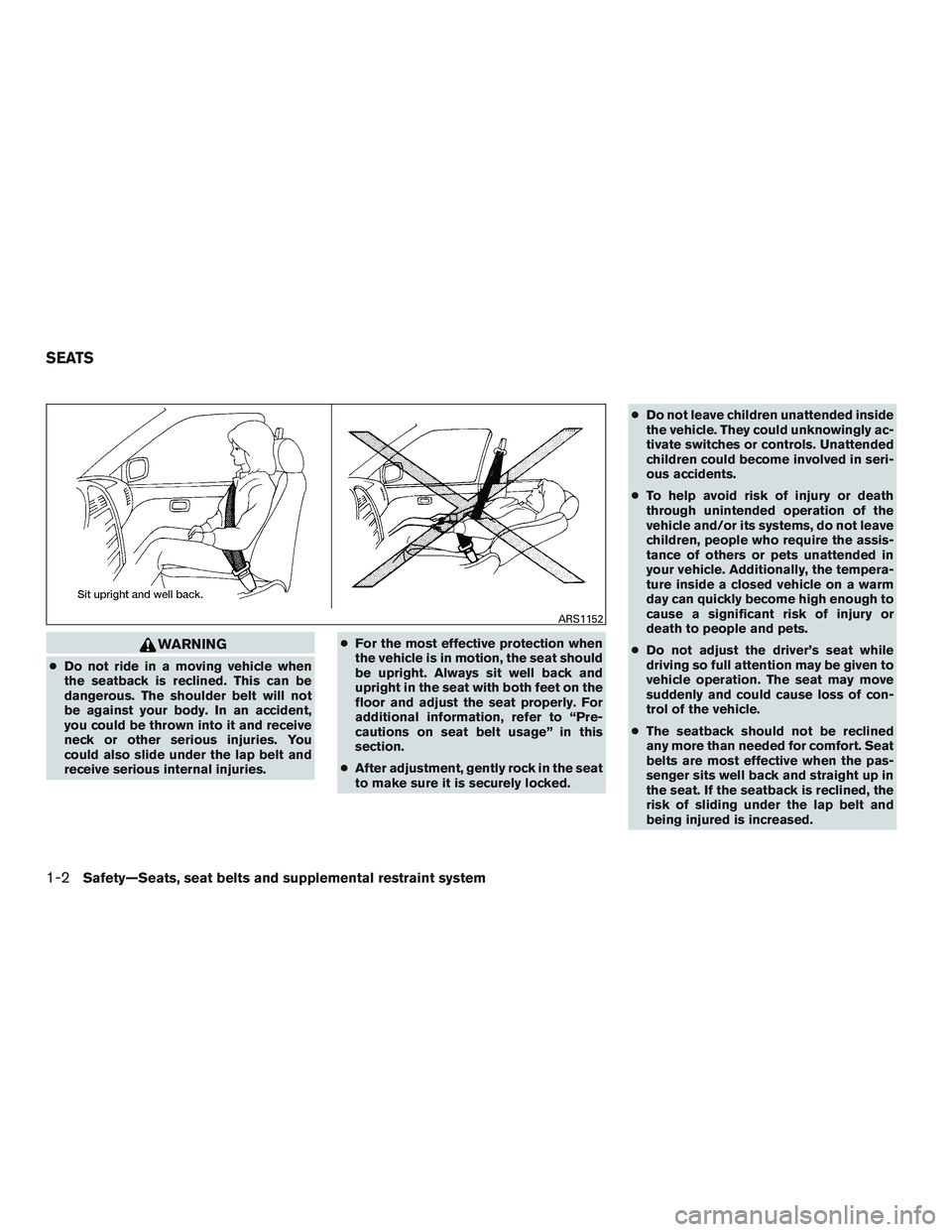
●Do not ride in a moving vehicle when
the seatback is reclined. This can be
dangerous. The shoulder belt will not
be against your body. In an accident,
you could be thrown into it and receive
neck or other serious injuries. You
could also slide under the lap belt and
receive serious internal injuries. ●
For the most effective protection when
the vehicle is in motion, the seat should
be upright. Always sit well back and
upright in the seat with both feet on the
floor and adjust the seat properly. For
additional information, refer to “Pre-
cautions on seat belt usage” in this
section.
● After adjustment, gently rock in the seat
to make sure it is securely locked. ●
Do not leave children unattended inside
the vehicle. They could unknowingly ac-
tivate switches or controls. Unattended
children could become involved in seri-
ous accidents.
● To help avoid risk of injury or death
through unintended operation of the
vehicle and/or its systems, do not leave
children, people who require the assis-
tance of others or pets unattended in
your vehicle. Additionally, the tempera-
ture inside a closed vehicle on a warm
day can quickly become high enough to
cause a significant risk of injury or
death to people and pets.
● Do not adjust the driver’s seat while
driving so full attention may be given to
vehicle operation. The seat may move
suddenly and could cause loss of con-
trol of the vehicle.
● The seatback should not be reclined
any more than needed for comfort. Seat
belts are most effective when the pas-
senger sits well back and straight up in
the seat. If the seatback is reclined, the
risk of sliding under the lap belt and
being injured is increased.
ARS1152
SEATS
1-2Safety—Seats, seat belts and supplemental restraint system
Page 33 of 299
WARNING
●After adjustment, release the adjust-
ment button and try to move the shoul-
der belt anchor up and down to make
sure it is securely fixed in position.
● The shoulder belt anchor height should
be adjusted to the position best for you.
Failure to do so may reduce the effec-
tiveness of the entire restraint system
and increase the chance or severity of
injury in an accident.
SEAT BELT EXTENDERS
If, because of body size or driving position, it is
not possible to properly fit the lap/shoulder belt
and fasten it, an extender that is compatible with
the installed seat belts is available for purchase.
The extender adds approximately 200 mm (8 in)
of length and may be used for either the driver or
front passenger seating position. See a NISSAN
dealer for assistance with purchasing an ex-
tender if an extender is required.
WARNING
● Only NISSAN seat belt extenders, made
by the same company which made the
original equipment seat belts, should
be used with NISSAN seat belts.
● Adults and children who can use the
standard seat belt should not use an
extender. Such unnecessary use could
result in serious personal injury in the
event of an accident.
● Never use seat belt extenders to install
child restraints. If the child restraint is
not secured properly, the child could be
seriously injured or killed in a collision
or a sudden stop.
SEAT BELT MAINTENANCE
● To clean the seat belt webbing, apply a
mild soap solution or any solution recom-
mended for cleaning upholstery or carpet.
Then wipe with a cloth and allow the seat
belts to dry in the shade. Do not allow the
seat belts to retract until they are completely
dry. ●
If dirt builds up in the shoulder belt
guide of the seat belt anchors, the seat
belts may retract slowly. Wipe the shoulder
belt guide with a clean, dry cloth.
● Periodically check to see that the seat
belt and the metal components, such as
buckles, tongues, retractors, flexible wires
and anchors, work properly. If loose parts,
deterioration, cuts or other damage on the
webbing is found, the entire seat belt as-
sembly should be replaced.
1-16Safety—Seats, seat belts and supplemental restraint system