steering NISSAN MICRA 2016 Owner´s Manual
[x] Cancel search | Manufacturer: NISSAN, Model Year: 2016, Model line: MICRA, Model: NISSAN MICRA 2016Pages: 299, PDF Size: 3.54 MB
Page 13 of 299
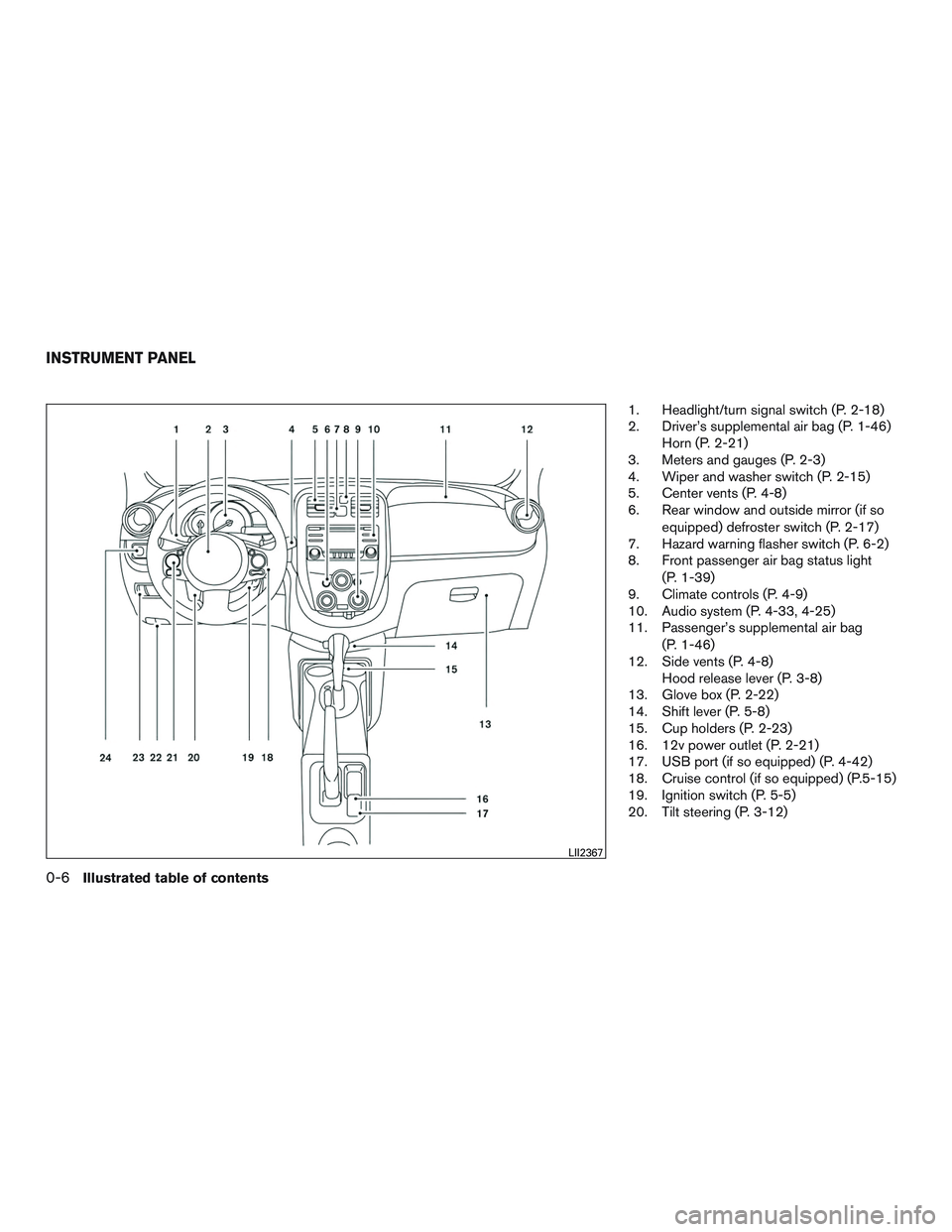
1. Headlight/turn signal switch (P. 2-18)
2. Driver’s supplemental air bag (P. 1-46)Horn (P. 2-21)
3. Meters and gauges (P. 2-3)
4. Wiper and washer switch (P. 2-15)
5. Center vents (P. 4-8)
6. Rear window and outside mirror (if so
equipped) defroster switch (P. 2-17)
7. Hazard warning flasher switch (P. 6-2)
8. Front passenger air bag status light
(P. 1-39)
9. Climate controls (P. 4-9)
10. Audio system (P. 4-33, 4-25)
11. Passenger’s supplemental air bag
(P. 1-46)
12. Side vents (P. 4-8) Hood release lever (P. 3-8)
13. Glove box (P. 2-22)
14. Shift lever (P. 5-8)
15. Cup holders (P. 2-23)
16. 12v power outlet (P. 2-21)
17. USB port (if so equipped) (P. 4-42)
18. Cruise control (if so equipped) (P.5-15)
19. Ignition switch (P. 5-5)
20. Tilt steering (P. 3-12)
LII2367
INSTRUMENT PANEL
0-6Illustrated table of contents
Page 16 of 299
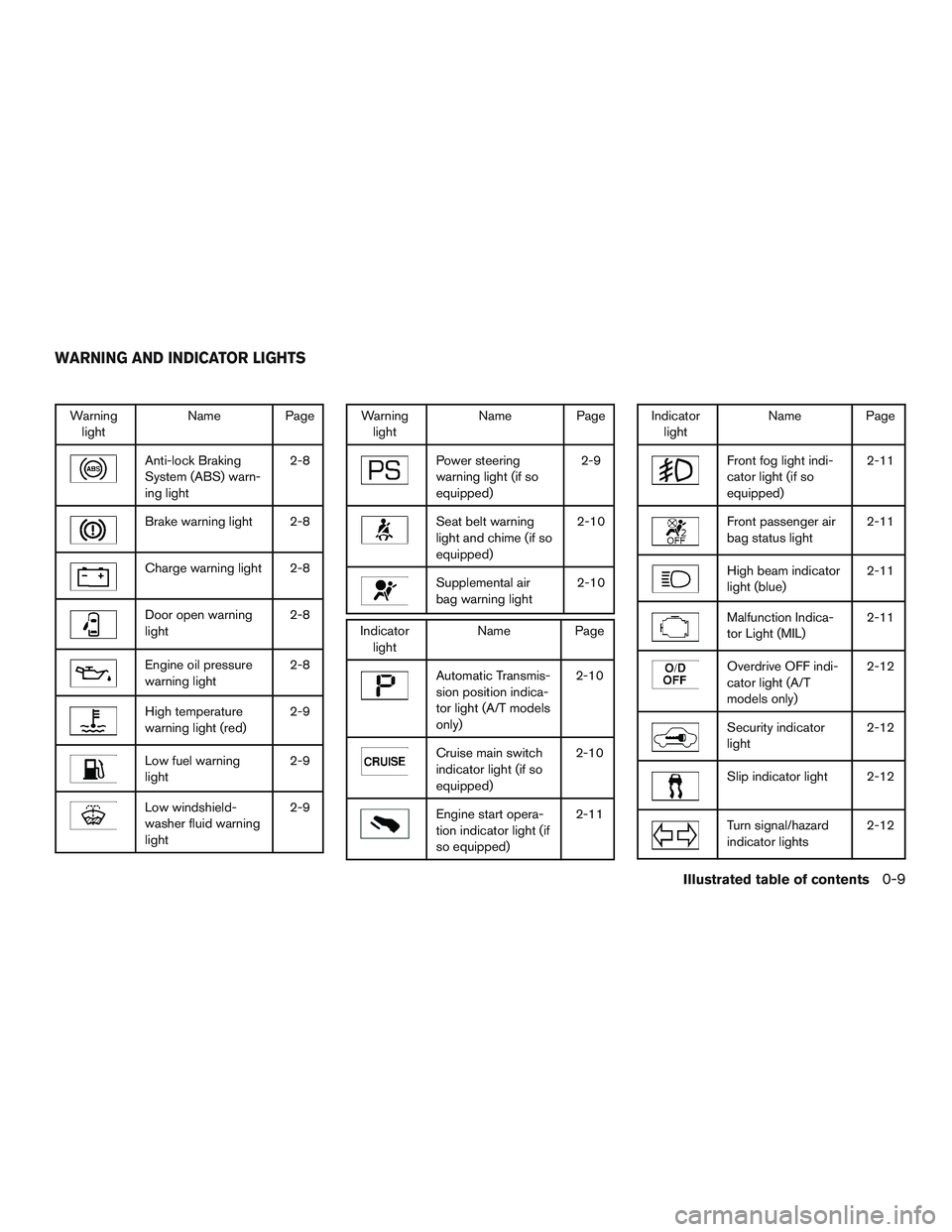
Warninglight Name Page
Anti-lock Braking
System (ABS) warn-
ing light 2-8
Brake warning light 2-8
Charge warning light 2-8
Door open warning
light
2-8
Engine oil pressure
warning light2-8
High temperature
warning light (red)2-9
Low fuel warning
light2-9
Low windshield-
washer fluid warning
light2-9
Warning
light Name Page
Power steering
warning light (if so
equipped) 2-9
Seat belt warning
light and chime (if so
equipped)2-10
Supplemental air
bag warning light
2-10
Indicator
light Name Page
Automatic Transmis-
sion position indica-
tor light (A/T models
only) 2-10
Cruise main switch
indicator light (if so
equipped)
2-10
Engine start opera-
tion indicator light (if
so equipped)2-11
Indicator
light Name Page
Front fog light indi-
cator light (if so
equipped) 2-11
Front passenger air
bag status light
2-11
High beam indicator
light (blue)2-11
Malfunction Indica-
tor Light (MIL)2-11
Overdrive OFF indi-
cator light (A/T
models only)2-12
Security indicator
light
2-12
Slip indicator light 2-12
Turn signal/hazard
indicator lights2-12
WARNING AND INDICATOR LIGHTS
Illustrated table of contents0-9
Page 56 of 299
PRECAUTIONS ON SRS
This SRS section contains important information
concerning the following systems:● Driver and front passenger supplemental
front-impact air bag (NISSAN Advanced Air
Bag System)
● Front seat-mounted side-impact supple-
mental air bag
● Roof-mounted curtain side-impact supple-
mental air bag
● Seat belt with pretensioner(s) (front seats)
Supplemental front-impact air bag system
The NISSAN Advanced Air Bag System can help
cushion the impact force to the head and chest of
the driver and front passenger in certain frontal
collisions.
Front seat-mounted side-impact supple-
mental air bag system
This system can help cushion the impact force to
the chest area of the driver and front passenger in
certain side impact collisions. The side air bags
are designed to inflate on the side where the
vehicle is impacted. Roof-mounted curtain side-impact and
supplemental air bag system
This system can help cushion the impact force to
the head of occupants in front and rear outboard
seating positions in certain side-impact colli-
sions. The curtain air bags are designed to inflate
on the side where the vehicle is impacted.
The SRS is designed to
supplementthe crash
protection provided by the driver and front pas-
senger seat belts and is not a substitutefor
them. Seat belts should always be correctly worn
and the occupant seated a suitable distance
away from the steering wheel, instrument panel
and door finishers. For additional information
about instructions and precautions on seat belt
usage, refer to “Seat belts” in this section.
The supplemental air bags operate only
when the ignition switch is in the ON posi-
tion.
After placing the ignition switch in the ON
position, the supplemental air bag warning
light illuminates. The supplemental air bag
warning light will turn off after about 7 sec-
onds if the system is operational.
SUPPLEMENTAL RESTRAINT
SYSTEM (SRS)
Safety—Seats, seat belts and supplemental restraint system1-39
Page 57 of 299
WARNING
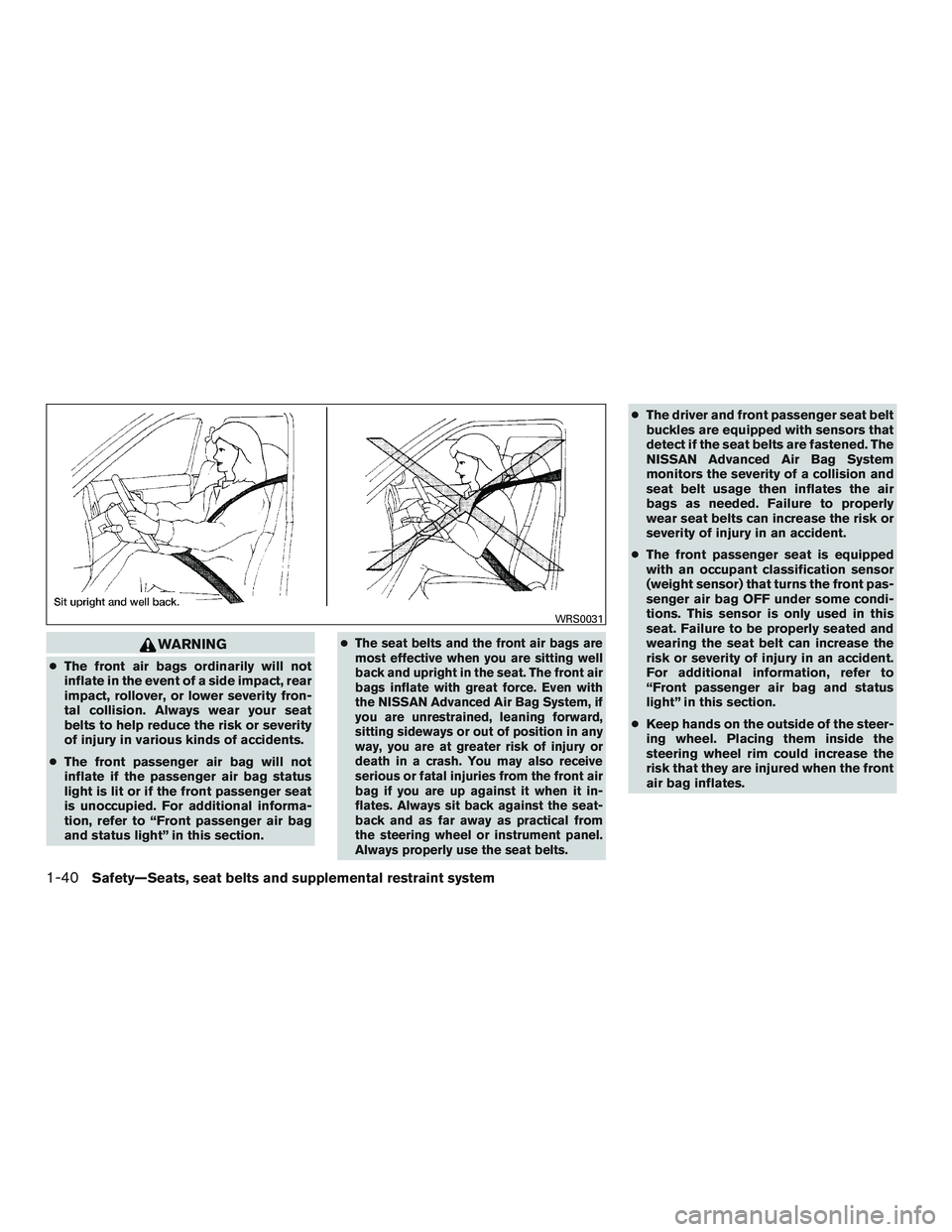
●The front air bags ordinarily will not
inflate in the event of a side impact, rear
impact, rollover, or lower severity fron-
tal collision. Always wear your seat
belts to help reduce the risk or severity
of injury in various kinds of accidents.
● The front passenger air bag will not
inflate if the passenger air bag status
light is lit or if the front passenger seat
is unoccupied. For additional informa-
tion, refer to “Front passenger air bag
and status light” in this section. ●
The seat belts and the front air bags are
most effective when you are sitting well
back and upright in the seat. The front air
bags inflate with great force. Even with
the NISSAN Advanced Air Bag System, if
you are unrestrained, leaning forward,
sitting sideways or out of position in any
way, you are at greater risk of injury or
death in a crash. You may also receive
serious or fatal injuries from the front air
bag if you are up against it when it in-
flates. Always sit back against the seat-
back and as far away as practical from
the steering wheel or instrument panel.
Always properly use the seat belts.
● The driver and front passenger seat belt
buckles are equipped with sensors that
detect if the seat belts are fastened. The
NISSAN Advanced Air Bag System
monitors the severity of a collision and
seat belt usage then inflates the air
bags as needed. Failure to properly
wear seat belts can increase the risk or
severity of injury in an accident.
● The front passenger seat is equipped
with an occupant classification sensor
(weight sensor) that turns the front pas-
senger air bag OFF under some condi-
tions. This sensor is only used in this
seat. Failure to be properly seated and
wearing the seat belt can increase the
risk or severity of injury in an accident.
For additional information, refer to
“Front passenger air bag and status
light” in this section.
● Keep hands on the outside of the steer-
ing wheel. Placing them inside the
steering wheel rim could increase the
risk that they are injured when the front
air bag inflates.
WRS0031
1-40Safety—Seats, seat belts and supplemental restraint system
Page 64 of 299
The driver supplemental front-impact air bag is
located in the center of the steering wheel. The
front passenger supplemental front-impact air
bag is mounted in the dashboard above the glove
box. The front air bags are designed to inflate in
higher severity frontal collisions, although they
may inflate if the forces in another type of collision
are similar to those of a higher severity frontal
impact. They may not inflate in certain frontal
collisions. Vehicle damage (or lack of it) is not
always an indication of proper front air bag sys-
tem operation.
The NISSAN Advanced Air Bag System monitors
information from the crash zone sensor, the Air
bag Control Unit (ACU) , seat belt buckle sensors
and occupant classification sensor (weight sen-
sor) . Inflator operation is based on the severity of
a collision and seat belt usage for the driver. For
the front passenger, the occupant classification
sensors are also monitored. Based on informa-
tion from the sensors, only one front air bag may
inflate in a crash, depending on the crash severity
and whether the front occupants are belted or
unbelted. Additionally, the front passenger air
bag may be automatically turned off under some
conditions, depending on the weight detected on
the front passenger seat and how the seat belt is
used. If the front passenger air bag is OFF, the
front passenger air bag status light will be illumi-
nated (if the seat is unoccupied, the light will notbe illuminated, but the air bag will be off) . For
additional information, refer to “Front passenger
air bag and status light” in this section. One front
air bag inflating does not indicate improper per-
formance of the system.
If you have any questions about your air bag
system, please contact NISSAN or a NISSAN
dealer. If you are considering modification of your
vehicle due to a disability, you may also contact
NISSAN. Contact information is contained in the
front of this Owner’s Manual.
When a front air bag inflates, a fairly loud noise
may be heard, followed by the release of smoke.
This smoke is not harmful and does not indicate a
fire. Care should be taken to not inhale it, as it may
cause irritation and choking. Those with a history
of a breathing condition should get fresh air
promptly.
Front air bags, along with the use of seat belts,
help to cushion the impact force on the face and
chest of the front occupants. They can help save
lives and reduce serious injuries. However, an
inflating front air bag may cause facial abrasions
or other injuries. Front air bags do not provide
restraint to the lower body.
Even with NISSAN Advanced Air Bags, seat
belts should be correctly worn and the driver and
front passenger seated upright as far as practical
away from the steering wheel or instrumentpanel. The front air bags inflate quickly in order to
help protect the front occupants. Because of this,
the force of the front air bag inflating can increase
the risk of injury if the occupant is too close to, or
is against, the front air bag module during infla-
tion.
The front air bags deflate quickly after a collision.
The front air bags operate only when the
ignition switch is placed in the ON position.
After placing the ignition switch in the ON
position, the supplemental air bag warning
light illuminates. The supplemental air bag
warning light will turn off after about 7 sec-
onds if the system is operational.
Safety—Seats, seat belts and supplemental restraint system1-47
Page 69 of 299
NOTE:
A system check will be performed during
which the front passenger air bag status
light will remain lit for about 7 seconds
initially.
If the light is still OFF after this, the small adult,
child or child restraint should be repositioned in
the rear seat and the vehicle should be checked
by a NISSAN dealer as soon as possible.
Other supplemental front-impact air bag
precautions
WARNING
●Do not place any objects on the steering
wheel pad or on the instrument panel.
Also, do not place any objects between
any occupant and the steering wheel or
instrument panel. Such objects may be-
come dangerous projectiles and cause
injury if the front air bags inflate.
● Immediately after inflation, several
front air bag system components will be
hot. Do not touch them; you may se-
verely burn yourself. ●
No unauthorized changes should be
made to any components or wiring of
the supplemental air bag system. This is
to prevent accidental inflation of the
supplemental air bag or damage to the
supplemental air bag system.
● Do not make unauthorized changes to
your vehicle’s electrical system, sus-
pension system or front end structure.
This could affect proper operation of
the front air bag system.
● Tampering with the front air bag system
may result in serious personal injury.
Tampering includes changes to the
steering wheel and the instrument
panel assembly by placing material
over the steering wheel pad and above
the instrument panel or by installing
additional trim material around the air
bag system.
● Removing or modifying the front pas-
senger seat may affect the function of
the air bag system and result in serious
personal injury. ●
Modifying or tampering with the front
passenger seat may result in serious
personal injury. For example, do not
change the front seats by placing mate-
rial on the seat cushion or by installing
additional trim material, such as seat
covers, on the seat that are not specifi-
cally designed to assure proper air bag
operation. Additionally, do not stow any
objects under the front passenger seat
or the seat cushion and seatback. Such
objects may interfere with the proper
operation of the occupant classification
sensor (weight sensor) .
● No unauthorized changes should be
made to any components or wiring of
the seat belt system. This may affect the
front air bag system. Tampering with
the seat belt system may result in seri-
ous personal injury.
1-52Safety—Seats, seat belts and supplemental restraint system
Page 77 of 299
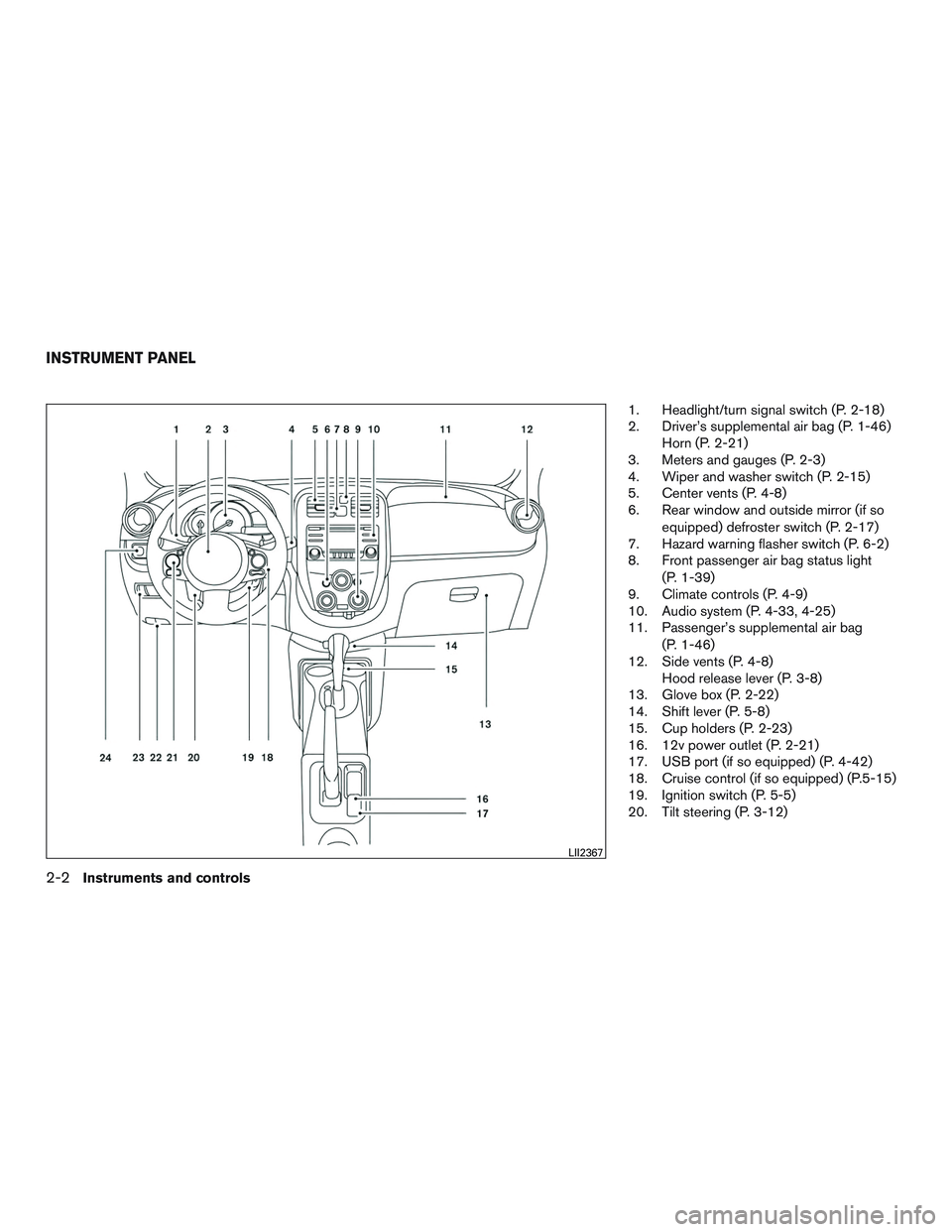
1. Headlight/turn signal switch (P. 2-18)
2. Driver’s supplemental air bag (P. 1-46)Horn (P. 2-21)
3. Meters and gauges (P. 2-3)
4. Wiper and washer switch (P. 2-15)
5. Center vents (P. 4-8)
6. Rear window and outside mirror (if so
equipped) defroster switch (P. 2-17)
7. Hazard warning flasher switch (P. 6-2)
8. Front passenger air bag status light
(P. 1-39)
9. Climate controls (P. 4-9)
10. Audio system (P. 4-33, 4-25)
11. Passenger’s supplemental air bag
(P. 1-46)
12. Side vents (P. 4-8) Hood release lever (P. 3-8)
13. Glove box (P. 2-22)
14. Shift lever (P. 5-8)
15. Cup holders (P. 2-23)
16. 12v power outlet (P. 2-21)
17. USB port (if so equipped) (P. 4-42)
18. Cruise control (if so equipped) (P.5-15)
19. Ignition switch (P. 5-5)
20. Tilt steering (P. 3-12)
LII2367
INSTRUMENT PANEL
2-2Instruments and controls
Page 82 of 299
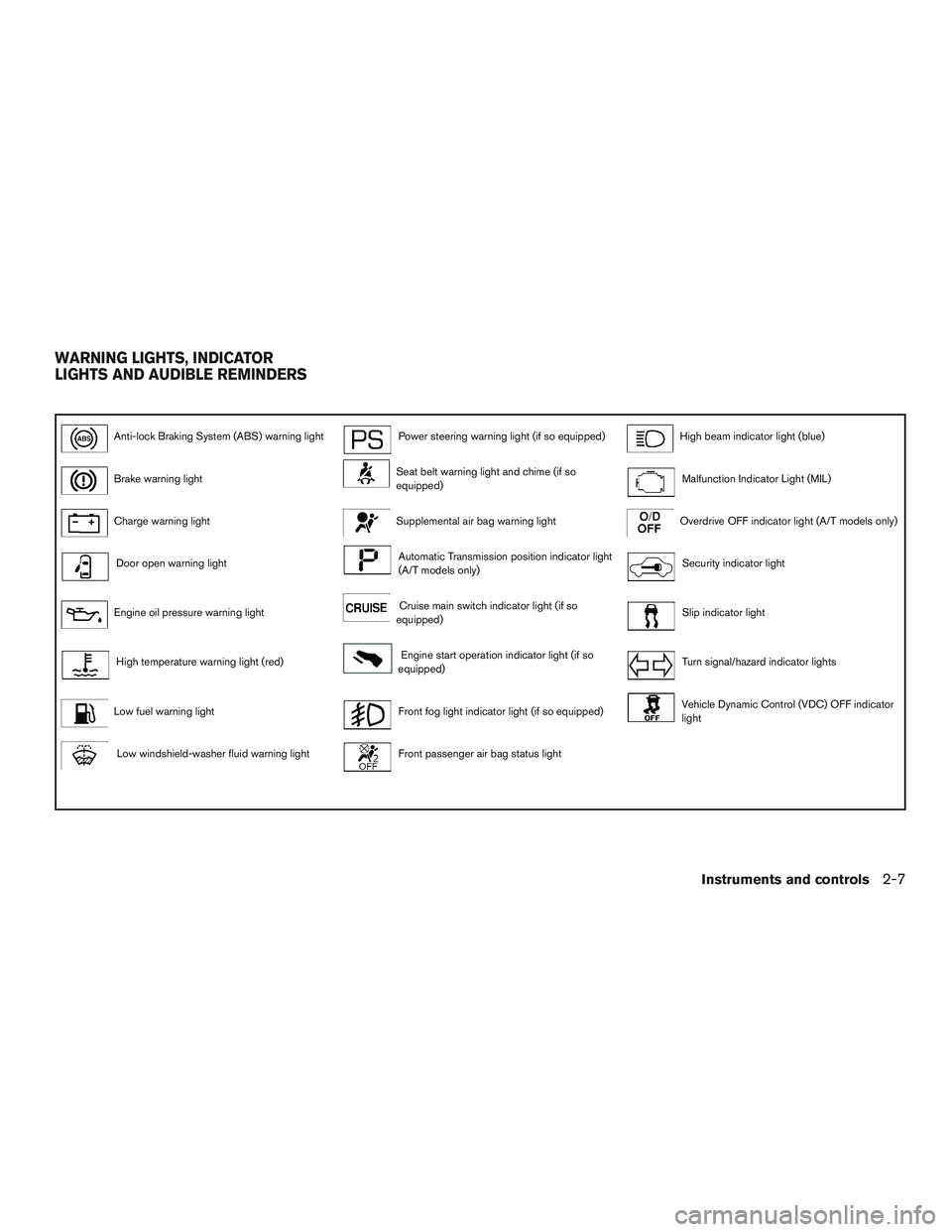
Anti-lock Braking System (ABS) warning lightPower steering warning light (if so equipped)High beam indicator light (blue)
Brake warning lightSeat belt warning light and chime (if so
equipped)Malfunction Indicator Light (MIL)
Charge warning lightSupplemental air bag warning lightOverdrive OFF indicator light (A/T models only)
Door open warning lightAutomatic Transmission position indicator light
(A/T models only)Security indicator light
Engine oil pressure warning lightCruise main switch indicator light (if so
equipped)Slip indicator light
High temperature warning light (red)Engine start operation indicator light (if so
equipped)Turn signal/hazard indicator lights
Low fuel warning lightFront fog light indicator light (if so equipped)Vehicle Dynamic Control (VDC) OFF indicator
light
Low windshield-washer fluid warning lightFront passenger air bag status light
WARNING LIGHTS, INDICATOR
LIGHTS AND AUDIBLE REMINDERS
Instruments and controls2-7
Page 84 of 299
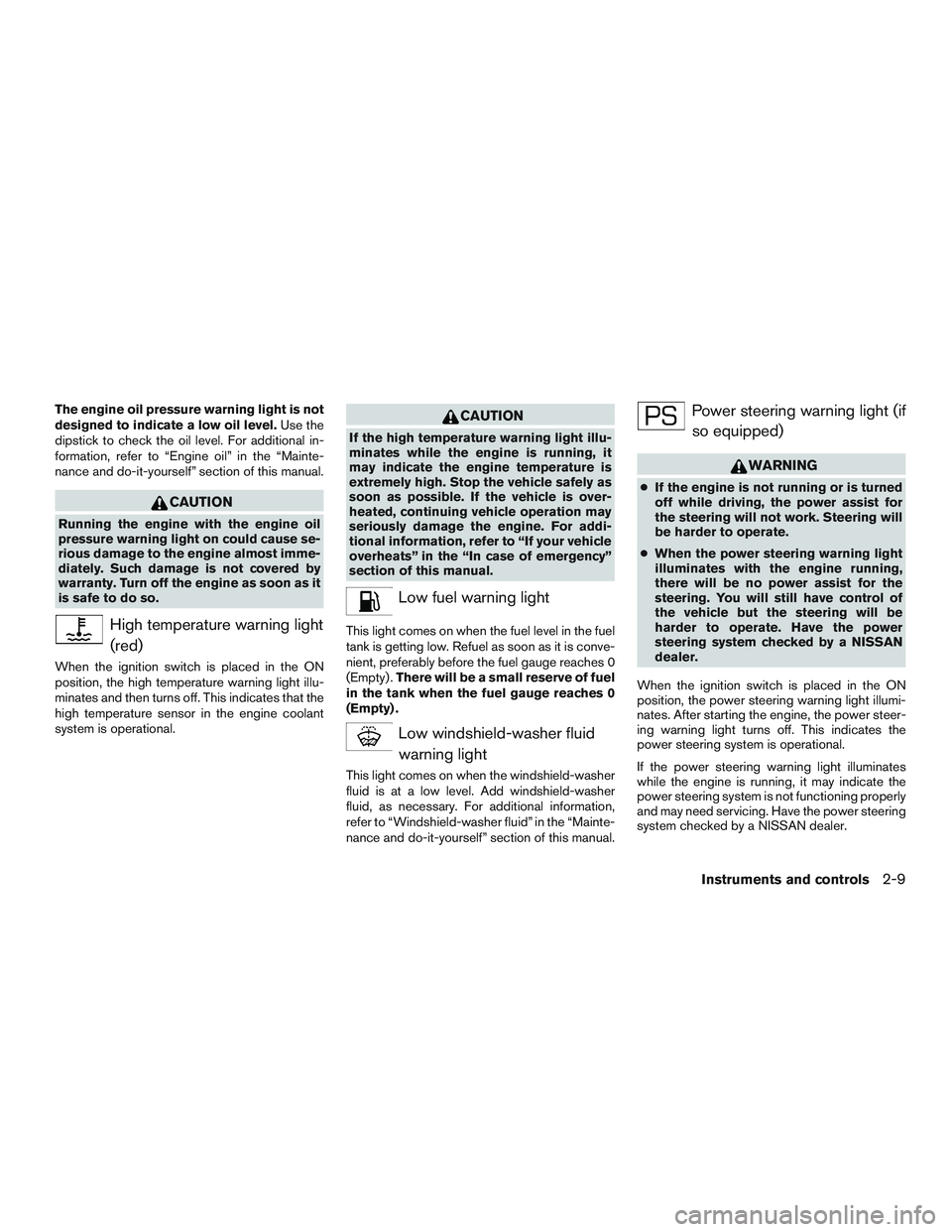
The engine oil pressure warning light is not
designed to indicate a low oil level.Use the
dipstick to check the oil level. For additional in-
formation, refer to “Engine oil” in the “Mainte-
nance and do-it-yourself” section of this manual.
CAUTION
Running the engine with the engine oil
pressure warning light on could cause se-
rious damage to the engine almost imme-
diately. Such damage is not covered by
warranty. Turn off the engine as soon as it
is safe to do so.
High temperature warning light
(red)
When the ignition switch is placed in the ON
position, the high temperature warning light illu-
minates and then turns off. This indicates that the
high temperature sensor in the engine coolant
system is operational.
CAUTION
If the high temperature warning light illu-
minates while the engine is running, it
may indicate the engine temperature is
extremely high. Stop the vehicle safely as
soon as possible. If the vehicle is over-
heated, continuing vehicle operation may
seriously damage the engine. For addi-
tional information, refer to “If your vehicle
overheats” in the “In case of emergency”
section of this manual.
Low fuel warning light
This light comes on when the fuel level in the fuel
tank is getting low. Refuel as soon as it is conve-
nient, preferably before the fuel gauge reaches 0
(Empty) . There will be a small reserve of fuel
in the tank when the fuel gauge reaches 0
(Empty) .
Low windshield-washer fluid
warning light
This light comes on when the windshield-washer
fluid is at a low level. Add windshield-washer
fluid, as necessary. For additional information,
refer to “Windshield-washer fluid” in the “Mainte-
nance and do-it-yourself” section of this manual.
Power steering warning light (ifso equipped)
WARNING
● If the engine is not running or is turned
off while driving, the power assist for
the steering will not work. Steering will
be harder to operate.
● When the power steering warning light
illuminates with the engine running,
there will be no power assist for the
steering. You will still have control of
the vehicle but the steering will be
harder to operate. Have the power
steering system checked by a NISSAN
dealer.
When the ignition switch is placed in the ON
position, the power steering warning light illumi-
nates. After starting the engine, the power steer-
ing warning light turns off. This indicates the
power steering system is operational.
If the power steering warning light illuminates
while the engine is running, it may indicate the
power steering system is not functioning properly
and may need servicing. Have the power steering
system checked by a NISSAN dealer.
Instruments and controls2-9
Page 85 of 299
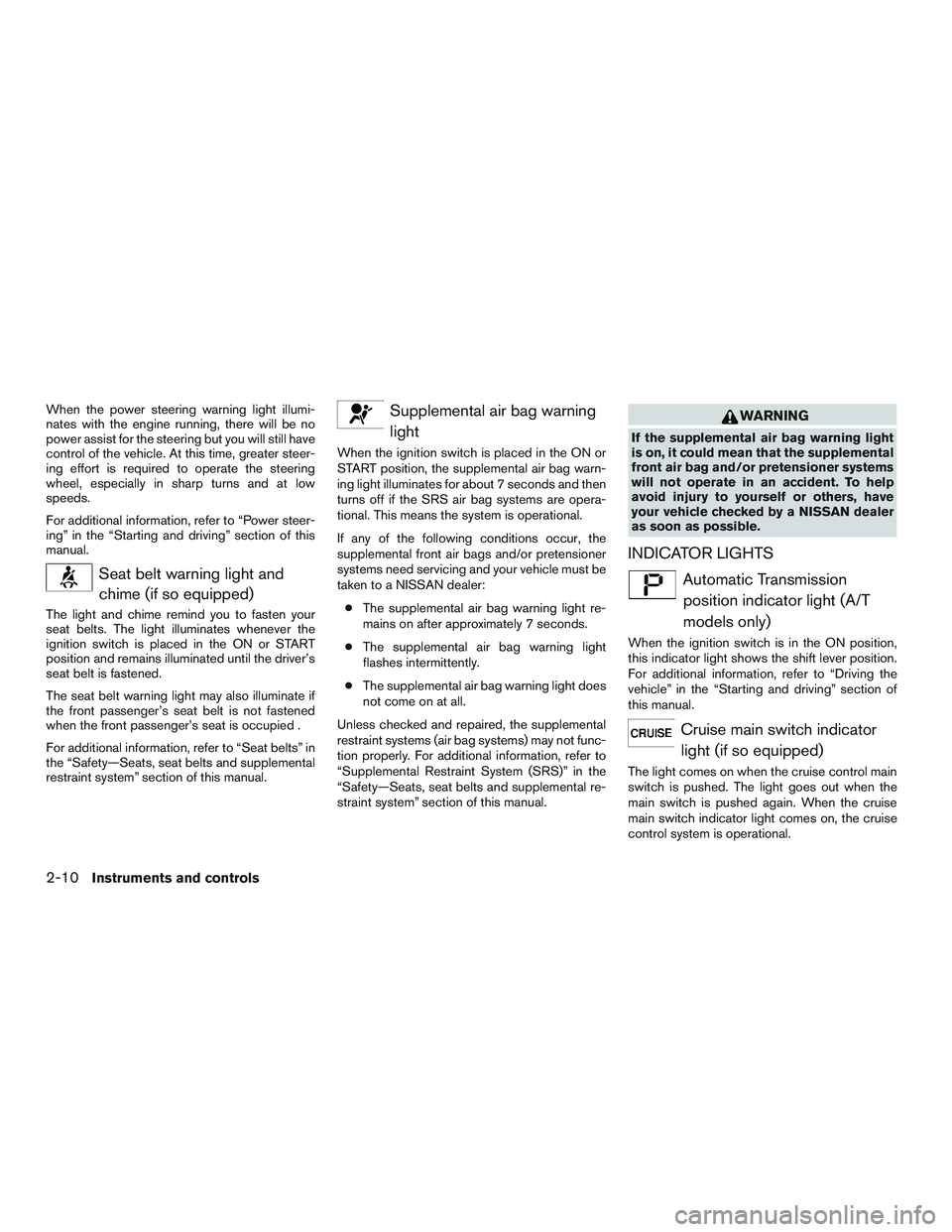
When the power steering warning light illumi-
nates with the engine running, there will be no
power assist for the steering but you will still have
control of the vehicle. At this time, greater steer-
ing effort is required to operate the steering
wheel, especially in sharp turns and at low
speeds.
For additional information, refer to “Power steer-
ing” in the “Starting and driving” section of this
manual.
Seat belt warning light andchime (if so equipped)
The light and chime remind you to fasten your
seat belts. The light illuminates whenever the
ignition switch is placed in the ON or START
position and remains illuminated until the driver’s
seat belt is fastened.
The seat belt warning light may also illuminate if
the front passenger’s seat belt is not fastened
when the front passenger’s seat is occupied .
For additional information, refer to “Seat belts” in
the “Safety—Seats, seat belts and supplemental
restraint system” section of this manual.
Supplemental air bag warning
light
When the ignition switch is placed in the ON or
START position, the supplemental air bag warn-
ing light illuminates for about 7 seconds and then
turns off if the SRS air bag systems are opera-
tional. This means the system is operational.
If any of the following conditions occur, the
supplemental front air bags and/or pretensioner
systems need servicing and your vehicle must be
taken to a NISSAN dealer:
● The supplemental air bag warning light re-
mains on after approximately 7 seconds.
● The supplemental air bag warning light
flashes intermittently.
● The supplemental air bag warning light does
not come on at all.
Unless checked and repaired, the supplemental
restraint systems (air bag systems) may not func-
tion properly. For additional information, refer to
“Supplemental Restraint System (SRS)” in the
“Safety—Seats, seat belts and supplemental re-
straint system” section of this manual.
WARNING
If the supplemental air bag warning light
is on, it could mean that the supplemental
front air bag and/or pretensioner systems
will not operate in an accident. To help
avoid injury to yourself or others, have
your vehicle checked by a NISSAN dealer
as soon as possible.
INDICATOR LIGHTS
Automatic Transmission position indicator light (A/T
models only)
When the ignition switch is in the ON position,
this indicator light shows the shift lever position.
For additional information, refer to “Driving the
vehicle” in the “Starting and driving” section of
this manual.
Cruise main switch indicatorlight (if so equipped)
The light comes on when the cruise control main
switch is pushed. The light goes out when the
main switch is pushed again. When the cruise
main switch indicator light comes on, the cruise
control system is operational.
2-10Instruments and controls