warning NISSAN MICRA 2017 Owner´s Manual
[x] Cancel search | Manufacturer: NISSAN, Model Year: 2017, Model line: MICRA, Model: NISSAN MICRA 2017Pages: 318, PDF Size: 3.73 MB
Page 272 of 318
●If the wheels are changed for any rea-
son, always replace with wheels which
have the same off-set dimension.
Wheels of a different off-set could
cause premature tire wear, degrade ve-
hicle handling characteristics and/or in-
terference with the brake discs/drums.
Such interference can lead to de-
creased braking efficiency and/or early
brake pad/shoe wear. For additional in-
formation on wheel off-set dimensions,
refer to “Wheels and tires” in the “Tech-
nical and consumer information” sec-
tion of this manual.
● Do not install a damaged or deformed
wheel or tire even if it has been re-
paired. Such wheels or tires could have
structural damage and could fail with-
out warning.
● The use of retread tires is not
recommended.
Wheel balance
Unbalanced wheels may affect vehicle handling
and tire life. Even with regular use, wheels can get
out of balance. Therefore, they should be bal-
anced as required. Wheel balance service should be per-
formed with the wheels off the vehicle.
Spin balancing the wheels on the vehicle
could lead to mechanical damage.
● For additional information regarding
tires, refer to “Tire Safety Information”
in the Warranty Information Booklet.
Care of wheels
● Wash the wheels when washing the vehicle
to maintain their appearance.
● Clean the inner side of the wheels when the
wheel is changed or the underside of the
vehicle is washed.
● Do not use abrasive cleaners when washing
the wheels.
● Inspect wheel rims regularly for dents or
corrosion. Such damage may cause loss of
pressure or poor seal at the tire bead.
● NISSAN recommends waxing the road
wheels to protect against road salt in areas
where it is used during winter.
Spare tire (TEMPORARY USE ONLY
spare tire)
Observe the following precautions if the TEM-
PORARY USE ONLY spare tire must be used.
Otherwise, your vehicle could be damaged or
involved in an accident:
WARNING
● The spare tire should be used for emer-
gency use only. It should be replaced
with the standard tire at the first oppor-
tunity to avoid possible tire or differen-
tial damage.
● Drive carefully while the TEMPORARY
USE ONLY spare tire is installed. Avoid
sharp turns and abrupt braking while
driving.
● Periodically check spare tire inflation
pressure. Always keep the pressure of
the TEMPORARY USE ONLY spare tire
at 60 psi (420 kPa, 4.2 bar) .
● With the TEMPORARY USE ONLY spare
tire installed do not drive the vehicle at
speeds faster than 50 mph (80 km/h).
Do-it-yourself8-39
Page 277 of 318
Seats:Check seat position controls such as
seat adjusters, seatback recliner, etc., to ensure
they operate smoothly and all latches lock se-
curely in every position. Check that the head
restraints/headrests move up and down
smoothly and the locks (if so equipped) hold
securely in all latched positions.
Seat belts: Check that all parts of the seat belt
system (for example, buckles, anchors, adjusters
and retractors) operate properly and smoothly,
and are installed securely. Check the belt web-
bing for cuts, fraying, wear or damage.
Steering wheel: Check for changes in the
steering system, such as excessive free play,
hard steering or strange noises.
Warning lights and chimes: Make sure all
warning lights and chimes are operating properly.
Windshield defroster: Check that the air
comes out of the defroster outlets properly and in
sufficient quantity when operating the heater or
air conditioner.
Windshield wiper and washer*: Check that
the wipers and washer operate properly and that
the wipers do not streak.Under the hood and vehicle
The maintenance items listed here should be
checked periodically (for example, each time you
check the engine oil or refuel) .
Battery* (for serviceable batteries): Check
the fluid level in each cell. It should be between
the MAX and MIN lines. Vehicles operated in high
temperatures or under severe conditions require
frequent checks of the battery fluid level.
NOTE:
Care should be taken to avoid situations
that can lead to potential battery discharge
and potential no-start conditions such as:
1. Installation or extended use of electronic accessories that consume battery power
when the engine is not running (Phone char-
gers, GPS, DVD players, etc.) .
2. Vehicle is not driven regularly and/or only driven short distances.
In these cases, the battery may need to be
charged to maintain battery health.
Brake and clutch (if so equipped) fluid
level*: Make sure that the brake and clutch fluid
levels are between the MIN and MAX lines on the
reservoir. Engine coolant level*:
Check the coolant level
when the engine is cold.
Engine drive belts*: Make sure the drive belts
are not frayed, worn, cracked or oily.
Engine oil level*: Check the level after parking
the vehicle on a level surface with the engine off.
Wait more than 15 minutes for the oil to drain
back into the oil pan.
Exhaust system: Make sure there are no loose
supports, cracks or holes. If the sound of the
exhaust seems unusual or there is a smell of
exhaust fumes, immediately have the exhaust
system inspected. It is recommended that you
visit a NISSAN dealer for this service. For addi-
tional information, refer to “Exhaust gas (carbon
monoxide)” in the “Starting and driving” section of
this manual.
Fluid leaks: Check under the vehicle for fuel, oil,
water or other fluid leaks after the vehicle has
been parked for a while. Water dripping from the
air conditioner after use is normal. If you should
notice any leaks or if fuel fumes are evident,
check for the cause and have it corrected imme-
diately.
9-4Maintenance and schedules
Page 302 of 318
WARNING
● It is extremely dangerous to ride
in a cargo area inside a vehicle. In
a collision, people riding in these
areas are more likely to be seri-
ously injured or killed.
● Do not allow people to ride in any
area of your vehicle that is not
equipped with seats and seat
belts.
● Be sure everyone in your vehicle
is in a seat and using a seat belt
properly.
TERMS
It is important to familiarize yourself with
the following terms before loading your
vehicle:
● Curb Weight (actual weight of your
vehicle) - vehicle weight including:
standard and optional equipment, flu-
ids, emergency tools, and spare tire
assembly. This weight does notin-
clude passengers and cargo. ●
GVW (Gross Vehicle Weight) - curb
weight plus the combined weight of
passengers and cargo.
● GVWR (Gross Vehicle Weight Rat-
ing) - maximum total combined
weight of the unloaded vehicle, pas-
sengers, luggage, hitch, trailer
tongue load and any other optional
equipment. This information is lo-
cated on the C.M.V.S.S. certification
label.
● GAWR (Gross Axle Weight Rating) -
maximum weight (load) limit specified
for the front or rear axle. This informa-
tion is located on the C.M.V.S.S. cer-
tification label.
● GCWR (Gross Combined Weight
rating) - The maximum total weight
rating of the vehicle, passengers,
cargo, and trailer. ●
Vehicle Capacity Weight, Load limit,
Total load capacity - maximum total
weight limit specified of the load
(passengers and cargo) for the ve-
hicle. This is the maximum combined
weight of occupants and cargo that
can be loaded into the vehicle. If the
vehicle is used to tow a trailer, the
trailer tongue weight must be in-
cluded as part of the cargo load. This
information is located on the Tire and
Loading Information label.
● Cargo capacity - permissible weight
of cargo, the subtracted weight of
occupants from the load limit.
VEHICLE LOADING INFORMATION
Technical and consumer information10-13
Page 305 of 318
5. Determine the combined weight ofluggage and cargo being loaded on
the vehicle. That weight may not
safely exceed the available cargo and
luggage load capacity calculated in
step 4.
Before driving a loaded vehicle, confirm
that you do not exceed the Gross Vehicle
Weight Rating (GVWR) or the Gross Axle
Weight Rating (GAWR) for your vehicle.
For additional information, refer to “Mea-
surement of weights” in this section.
Also check tires for proper inflation pres-
sures. For additional information, refer to
“Tire and Loading Information label” in this
section.
LOADING TIPS
● The GVW must not exceed GVWR
or GAWR as specified on the C.M-
.V.S.S. certification label.
● Do not load the front and rear axle to
the GAWR. Doing so will exceed the
GVWR.
WARNING
● Properly secure all cargo with
ropes or straps to help prevent it
from sliding or shifting. Do not
place cargo higher than the seat-
backs. In a sudden stop or colli-
sion, unsecured cargo could
cause personal injury.
● Do not load your vehicle any
heavier than the GVWR or the
maximum front and rear GAWRs.
If you do, parts of your vehicle can
break, tire damage could occur,
or it can change the way your
vehicle handles. This could result
in loss of control and cause per-
sonal injury. ●
Overloading and improper load-
ing not only can shorten the life
of your vehicle and the tire, but
can also cause unsafe vehicle
handling and longer braking dis-
tances. This may cause a prema-
ture tire failure which could result
in a serious accident and per-
sonal injury. Failures caused by
overloading are not covered by
the vehicle’s warranty.
MEASUREMENT OF WEIGHTS
Secure loose items to prevent weight
shifts that could affect the balance of your
vehicle. When the vehicle is loaded, drive
to a scale and weigh the front and the rear
wheels separately to determine axle
loads. Individual axle loads should not ex-
ceed either of the Gross Axle Weight
Ratings (GAWR) . The total of the axle
loads should not exceed the Gross Ve-
hicle Weight Rating (GVWR) . These rat-
ings are given on the vehicle certification
label. If weight ratings are exceeded,
move or remove items to bring all weights
below the ratings.
10-16
Technical and consumer information
Page 307 of 318
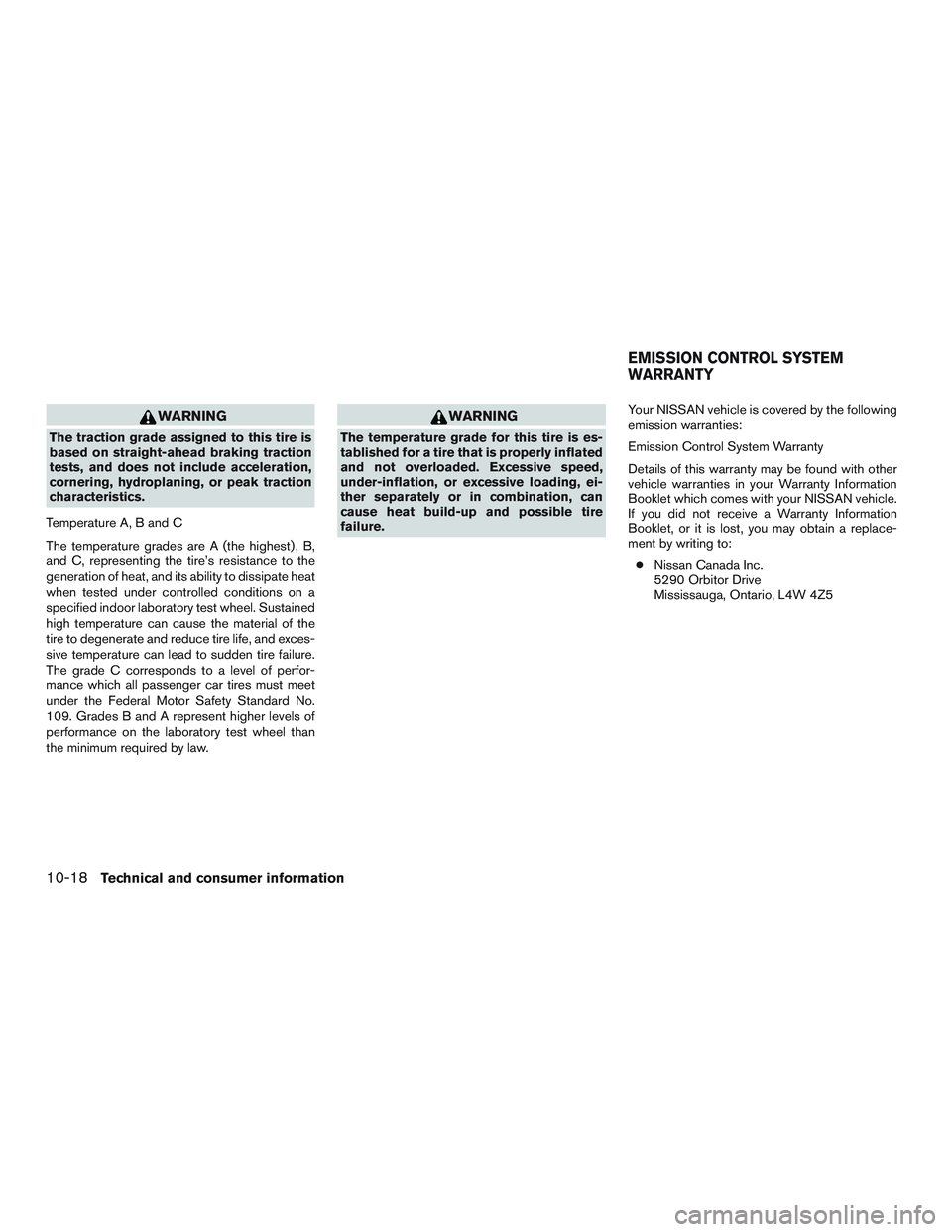
WARNING
The traction grade assigned to this tire is
based on straight-ahead braking traction
tests, and does not include acceleration,
cornering, hydroplaning, or peak traction
characteristics.
Temperature A, B and C
The temperature grades are A (the highest) , B,
and C, representing the tire’s resistance to the
generation of heat, and its ability to dissipate heat
when tested under controlled conditions on a
specified indoor laboratory test wheel. Sustained
high temperature can cause the material of the
tire to degenerate and reduce tire life, and exces-
sive temperature can lead to sudden tire failure.
The grade C corresponds to a level of perfor-
mance which all passenger car tires must meet
under the Federal Motor Safety Standard No.
109. Grades B and A represent higher levels of
performance on the laboratory test wheel than
the minimum required by law.
WARNING
The temperature grade for this tire is es-
tablished for a tire that is properly inflated
and not overloaded. Excessive speed,
under-inflation, or excessive loading, ei-
ther separately or in combination, can
cause heat build-up and possible tire
failure. Your NISSAN vehicle is covered by the following
emission warranties:
Emission Control System Warranty
Details of this warranty may be found with other
vehicle warranties in your Warranty Information
Booklet which comes with your NISSAN vehicle.
If you did not receive a Warranty Information
Booklet, or it is lost, you may obtain a replace-
ment by writing to:
● Nissan Canada Inc.
5290 Orbitor Drive
Mississauga, Ontario, L4W 4Z5
EMISSION CONTROL SYSTEM
WARRANTY
10-18Technical and consumer information
Page 310 of 318
11 Index
A
Air bag (See supplemental restraint
system) .....................1-41
Air bag system Front (See supplemental front impact
air bag system) ...............1-48
Side and curtain (See supplemental
side air bag and curtain side-impact
air bag system) ...............1-55
Airbagwarninglabels.............1-58
Airbagwarninglight...........1-58,2-10
Air bag warning light, supplemental . .1-58, 2-10
Air cleaner housing filter ............8-14
Air conditioner Air conditioner operation ......4-11,4-19
Air conditioner service ...........4-24
Air conditioner specification label ....10-12
Air conditioner system refrigerant and
oil recommendations ............10-7
Air conditioner system refrigerant
recommendations ..............10-7
Heater and air conditioner
controls ................4-8,4-16
Servicing air conditioner ..........4-24
Airflowcharts..............4-12,4-20
Alarm system
(See vehicle security system) .........2-13
Anchor point locations .............1-25
Antenna .....................4-46
Anti-lock brake warning light ..........2-8
Anti-lock Braking System (ABS) ........5-22Audible reminders
...............2-13
Audio system ..................4-24
AMradioreception.............4-25
Compact disc (CD) player .....4-35,4-39
FM/AM radio with compact disc (CD)
player.................4-32,4-36
FMradioreception.............4-24
iPod® Player ................4-43
iPod® player operation ...........4-43
Radio ....................4-24
Steering wheel audio control switch . . .4-45
USB interface ................4-41
USB (Universal Serial Bus) Connection
Port .....................4-41
Automatic Automatic power window switch .....2-27
Automatic transmission fluid (ATF) .....8-8
Automatic transmission position indicator
light .....................2-10
Driving with automatic transmission .....5-8
Transmission shift lever lock release ....5-11
Automatic door locks ..............3-5
AUXjack.................4-36,4-40
B
Battery ..................5-25,8-10
Chargewarninglight.............2-8
Battery replacement ..............8-20
Keyfob................8-20,8-20
Before starting the engine ............5-7
Belt (See drive belt) ..............8-12 Block heater
Engine ....................5-26
Bluetooth® hands-free phone system ....4-47
Boosterseats..................1-38
Brake Anti-lock Braking System (ABS) ......5-22
Brake assist (for Intelligent cruise control
system) ...................5-23
Brake fluid ..................8-9
Brakelight(Seestoplight).........8-26
Brake system ................5-21
Brakewarninglight..............2-8
Brakewearindicators........2-13,8-16
Parking brake operation ..........5-14
Self-adjusting brakes ............8-16
Brake fluid ....................8-9
Brakes ......................8-16
Brake system ..................5-21
Break-inschedule ...............5-17
Brightness control Instrument panel ..............2-19
Bulb check/instrument panel ..........2-7
Bulbreplacement................8-26
C
Capacities and recommended
fuel/lubricants ..................
10-2
Cargo (See vehicle loading information). . .10-13
Car phone or CB radio .............4-47
CDcareandcleaning .............4-45
CD player (See audio system) .....4-35,4-39
Page 311 of 318
Child restraints.......1-19,1-20,1-21,1-23
LATCH (Lower Anchors and Tethers for
CHildren) System ..............1-23
Precautions on child
restraints.........1-22,1-28,1-33,1-38
Top tether strap anchor point locations . .1-25
Child safety rear door lock ............3-5
Chimes, audible reminders ...........2-13
Cleaningexteriorandinterior........7-2,7-4
Clock setting
(models without Navigation System) . .4-34, 4-38
Clutch Clutch fluid ...................8-9
C.M.V.S.S. certification label .........10-11
Cold weather driving ...............5-25
Compact disc (CD) player ........4-35,4-39
Controls Audiocontrols(steeringwheel).......4-45
Heater and air conditioner controls . .4-8, 4-16
Coolant Capacities and recommended
fuel/lubricants ................10-2
Changing engine coolant ...........8-5
Checking engine coolant level ........8-5
Corrosionprotection ...............7-6
Cruisecontrol..................5-15
Cupholders................2-23,2-24
Curtain side-impact air bag system
(See supplemental side air bag and curtain
side-impact air bag system) ...........1-55
D
Daytime light system ...............2-18 Defroster switch
Rear window and outside mirror defroster
switch.....................2-17
Dimensionsandweights ............10-9
Dimmer switch for instrument panel ......2-19
Door locks .....................3-3
Door open warning light .............2-9
Doors ........................3-3
Drive belt .....................8-12
Driving Cold weather driving .............5-25
Driving with automatic transmission .....5-8
Driving with manual transmission ......5-13
Precautions when starting and driving ....5-2
Driving the vehicle .................5-8
E
Economy - fuel ..................5-18
Emission control information label ......10-11
Emission control system warranty .......10-18
Engine Before starting the engine ..........5-7
Block heater .................5-26
Capacities and recommended
fuel/lubricants ................10-2
Changingenginecoolant...........8-5
Changingengineoil..............8-7
Changing engine oil filter ...........8-8
Checking engine coolant level ........8-5
Checking engine oil level ...........8-6
Engine compartment check locations ....8-3
Engine cooling system ............8-4
Engineoil ...................8-6
Engine oil and oil filter recommendation . .10-6 Engine oil pressure warning light
.......2-9
Engine oil viscosity ..............10-7
Engine serial number ............10-11
Engine specifications ............10-8
Starting the engine ..............5-7
Event Data recorders .............10-20
Exhaust gas (Carbon monoxide) .........5-2
Explanation of maintenance items ........9-2
Explanation of scheduled maintenance items . .9-5
Extended storage switch ............8-19
F
Flashers (See hazard warning flasher switch) . .6-2
Flat tire .......................
6-2
Floor mat positioning aid .............7-5
Fluid Automatic transmission fluid (ATF) ......8-8
Brake fluid ...................8-9
Capacities and recommended
fuel/lubricants ................10-2
Clutch fluid ...................8-9
Enginecoolant.................8-4
Engineoil ...................8-6
Front air bag system
(See supplemental restraint system) ......1-48
Frontseats.....................1-2
Fuel Capacities and recommended
fuel/lubricants ................10-2
Fuel economy ................5-18
Fuel-filler cap .................3-10
Fuel-filler lid .................3-10
Fuelgauge...................2-5
Fuel octane rating ..............10-5
11-2
Page 312 of 318
Fuel recommendation............10-4
Loose fuel cap warning ............2-5
Fuel efficient driving tips .............5-17
Fuel-filler door ..................3-10
Fuel gauge .....................2-5
Fuses.......................8-17
Fusible links ...................8-17
G
Gascap .....................3-10
Gauge Fuel gauge ...................2-5
Odometer ...................2-4
Speedometer .................2-4
Tachometer ..................2-5
Trip computer .................2-6
Trip odometer .................2-4
General maintenance ...............9-2
Glovebox.....................2-23
H
Hands-free phone system, Bluetooth® ....4-47
Hazard warning flasher switch ..........6-2
Headlight and turn signal switch ........2-17
Headlightcontrolswitch ............2-17
Headlights....................8-21
Head restraints ..................1-6
Heater Heater and air conditioner controls . .4-8, 4-16
Heater operation ...........4-10,4-18
Hood ........................3-8
Horn .......................2-20 I
Ignition switch ...................5-5
Immobilizer system .............2-13,5-7
Important vehicle information label ......10-11
In-cabin microfilter ................8-14
Increasing fuel economy .............5-18
Indicator lights and audible reminders
(See warning/indicator lights and audible
reminders) ....................2-10
Instrument brightness control ..........2-19
Instrument panel ...............0-6,2-2
Instrument panel dimmer switch ........2-19
Interiorlight....................2-28
iPod® Player ...................4-43
ISOFIX child restraints .............1-23
J
Jump starting ...............6-10,8-12
K
Key.........................3-2
Key fob battery replacement .......8-20,8-20
Keyless entry Without Intelligent Key system
(See remote keyless entry system) . . .3-5, 3-6
Keys NISSAN Vehicle Immobilizer System keys . .3-2 L
Labels Air conditioner specification label .....10-12
C.M.V.S.S. certification label .......10-11
Emission control information label ....10-11
Engine serial number ............10-11
Tire and Loading Information label ....10-12
Vehicle identification number (VIN) ....10-10
Vehicle identification number (VIN)
plate .....................10-10
Warning labels (for SRS) ..........1-58
LATCH (Lower Anchors and Tethers for CHildren)
System ......................1-23
License plate Installing the license plate .........10-12
Light A
irbagwarninglight.........1-58,2-10
Brake light (See stop light) .........8-26
Bulb check/instrument panel .........2-7
Bulb replacement ..............8-26
Charge warning light .............2-8
Exterior and Interior lights ..........8-26
Foglights...................8-25
Headlightandturnsignalswitch......2-17
Headlight control switch ..........2-17
Headlights..................8-21
Interior light ..................2-28
Lightbulbs..................8-21
Low windshield-washer fluid warning
light.......................2-9
Passenger air bag and status light .....1-50
Security indicator light ............2-12
Warning/indicator lights and audible
reminders ...................2-10
11-3
Page 313 of 318
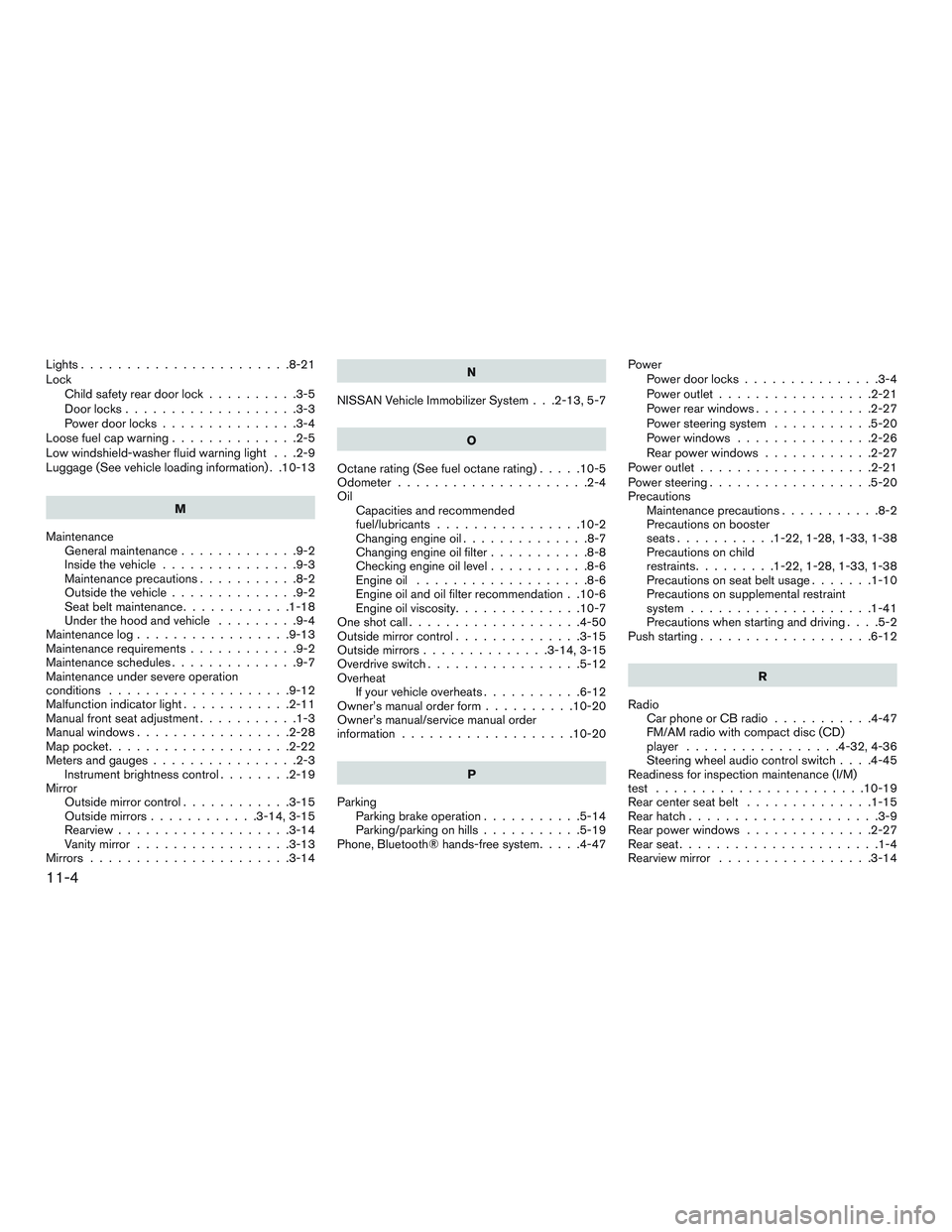
Lights.......................8-21
LockChild safety rear door lock ..........3-5
Door locks ...................3-3
Power door locks ...............3-4
Loose fuel cap warning ..............2-5
Low windshield-washer fluid warning light . . .2-9
Luggage (See vehicle loading information) . .10-13
M
Maintenance Generalmaintenance.............9-2
Insidethevehicle...............9-3
Maintenanceprecautions...........8-2
Outsidethevehicle..............9-2
Seat belt maintenance ............1-18
Under the hood and vehicle .........9-4
Maintenance log .................9-13
Maintenance requirements ............9-2
Maintenance schedules ..............9-7
Maintenance under severe operation
conditions ....................9-12
Malfunctionindicatorlight............2-11
Manual front seat adjustment ...........1-3
Manual windows .................2-28
Map pocket ....................2-22
Meters and gauges ................2-3
Instrument brightness control ........2-19
Mirror Outside mirror control ............3-15
Outside mirrors ............3-14,3-15
Rearview ...................3-14
Vanity mirror .................3-13
Mirrors ......................3-14 N
NISSAN Vehicle Immobilizer System . . .2-13, 5-7
O
Octane rating (See fuel octane rating) .....10-5
Odometer .....................2-4
Oil Capacities and recommended
fuel/lubricants ................10-2
Changingengineoil..............8-7
Changing engine oil filter ...........8-8
Checking engine oil level ...........8-6
Engineoil ...................8-6
Engine oil and oil filter recommendation . .10-6
Engine oil viscosity ..............10-7
Oneshotcall...................4-50
Outside mirror control ..............3-15
Outside mirrors ..............3-14,3-15
Overdrive switch .................5-12
Overheat If your vehicle overheats ...........6-12
Owner’s manual order form ..........10-20
Owner’s manual/service manual order
information ...................10-20
P
Parking Parking brake operation ...........5-14
Parking/parking on hills ...........5-19
Phone, Bluetooth® hands-free system .....4-47Power
Power door locks ...............3-4
Poweroutlet.................2-21
Power rear windows .............2-27
Power steering system ...........5-20
Power windows ...............2-26
Rear power windows ............2-27
Poweroutlet...................2-21
Power steering ..................5-20
Precautions Maintenance precautions ...........8-2
Precautions on booster
seats...........1-22,1-28,1-33,1-38
Precautions on child
restraints .........1-22,1-28,1-33,1-38
Precautionsonseatbeltusage.......1-10
Precautions
on supplemental restraint
system ....................1-41
Precautions when starting and driving ....5-2
Push starting ...................6-12
R
Radio CarphoneorCBradio ...........4-47
FM/AM radio with compact disc (CD)
player .................4-32,4-36
Steering wheel audio control switch ....4-45
Readiness for inspection maintenance (I/M)
test .......................10-19
Rearcenterseatbelt ..............1-15
Rear hatch .....................3-9
Rear power windows ..............2-27
Rearseat......................1-4
Rearview mirror .................3-14
11-4
Page 314 of 318
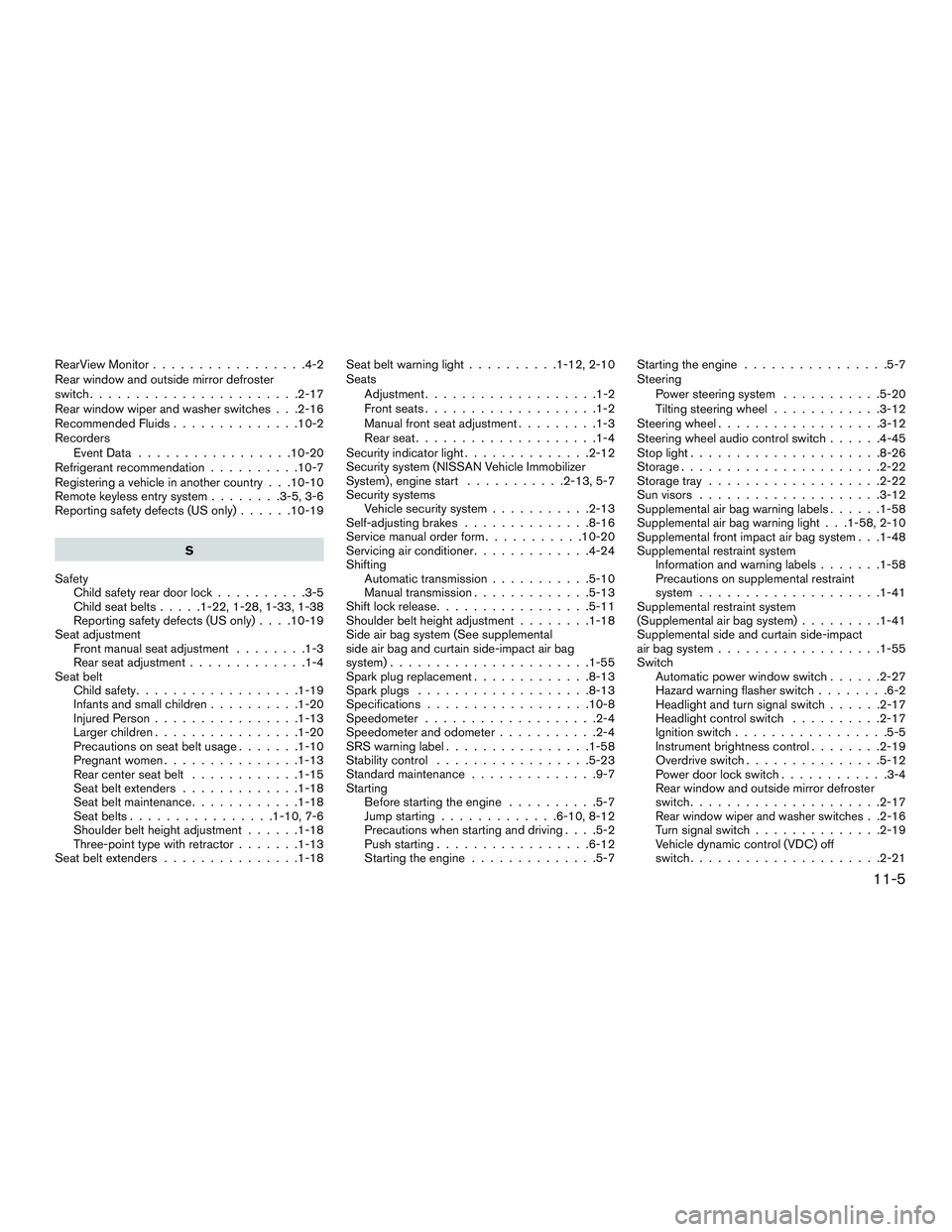
RearViewMonitor.................4-2
Rear window and outside mirror defroster
switch.......................2-17
Rear window wiper and washer switches . . .2-16
Recommended Fluids..............10-2
Recorders EventData .................10-20
Refrigerant recommendation ..........10-7
Registering a vehicle in another country . . .10-10
Remote keyless entry system ........3-5,3-6
Reporting safety defects (US only) ......10-19
S
Safety Child safety rear door lock ..........3-5
Childseatbelts.....1-22,1-28,1-33,1-38
Reporting safety defects (US only) ....10-19
Seat adjustment Front manual seat adjustment ........1-3
Rear seat adjustment .............1-4
Seat belt Child safety ..................1-19
Infantsandsmallchildren..........1-20
InjuredPerson................1-13
Largerchildren................1-20
Precautionsonseatbeltusage.......1-10
Pregnant women ...............1-13
Rear center seat belt ............1-15
Seat belt extenders .............1-18
Seat belt maintenance ............1-18
Seat belts ................1-10,7-6
Shoulder belt height adjustment ......1-18
Three-point type with retractor .......1-13
Seat belt extenders ...............1-18 Seat belt warning light
..........1-12,2-10
Seats Adjustment...................1-2
Front seats ...................1-2
Manual front seat adjustment .........1-3
Rear seat ....................1-4
Security indicator light ..............2-12
Security system (NISSAN Vehicle Immobilizer
System) , engine start ...........2-13,5-7
Security systems Vehicle security system ...........2-13
Self-adjusting brakes ..............8-16
Service manual order form ...........10-20
Servicing air conditioner .............4-24
Shifting Automatic transmission ...........5-10
Manual transmission .............5-13
Shift lock release .................5-11
Shoulder belt height adjustment ........1-18
Side air bag system (See supplemental
side air bag and curtain side-impact air bag
system) ......................1-55
Spark plug replacement .............8-13
Sparkplugs ...................8-13
Specifications ..................10-8
Speedometer ...................2-4
Speedometer and odometer ...........2-4
SRS warning label ................1-58
Stability control .................5-23
Standard maintenance ..............9-7
Starting Before starting the engine ..........5-7
Jump starting .............6-10,8-12
Precautions when starting and driving ....5-2
Push starting .................6-12
Starting the engine ..............5-7 Starting the engine
................5-7
Steering P
ower steering system ...........5-20
Tilting steering wheel ............3-12
Steeringwheel..................3-12
Steeringwheelaudiocontrolswitch......4-45
Stoplight.....................8-26
Storage......................2-22
Storage tray ...................2-22
Sun visors ....................3-12
Supplemental air bag warning labels ......1-58
Supplemental air bag warning light . . .1-58, 2-10
Supplemental front impact air bag system . . .1-48
Supplemental restraint system Information and warning labels .......1-58
Precautions on supplemental restraint
system ....................1-41
Supplemental restraint system
(Supplemental air bag system) .........1-41
Supplemental side and curtain side-impact
air bag system ..................1-55
Switch Automatic power window switch ......2-27
Hazard warning flasher switch ........6-2
Headlightandturnsignalswitch......2-17
Headlight control switch ..........2-17
Ignition switch .................5-5
Instrument brightness control ........2-19
Overdrive switch ...............5-12
Powerdoorlockswitch............3-4
Rear window and outside mirror defroster
switch.....................2-17
Rear window wiper and washer switches. .2-16
Turnsignalswitch..............2-19
Vehicle dynamic control (VDC) off
switch.....................2-21
11-5