check oil NISSAN MICRA 2017 Owner´s Manual
[x] Cancel search | Manufacturer: NISSAN, Model Year: 2017, Model line: MICRA, Model: NISSAN MICRA 2017Pages: 318, PDF Size: 3.73 MB
Page 277 of 318
Seats:Check seat position controls such as
seat adjusters, seatback recliner, etc., to ensure
they operate smoothly and all latches lock se-
curely in every position. Check that the head
restraints/headrests move up and down
smoothly and the locks (if so equipped) hold
securely in all latched positions.
Seat belts: Check that all parts of the seat belt
system (for example, buckles, anchors, adjusters
and retractors) operate properly and smoothly,
and are installed securely. Check the belt web-
bing for cuts, fraying, wear or damage.
Steering wheel: Check for changes in the
steering system, such as excessive free play,
hard steering or strange noises.
Warning lights and chimes: Make sure all
warning lights and chimes are operating properly.
Windshield defroster: Check that the air
comes out of the defroster outlets properly and in
sufficient quantity when operating the heater or
air conditioner.
Windshield wiper and washer*: Check that
the wipers and washer operate properly and that
the wipers do not streak.Under the hood and vehicle
The maintenance items listed here should be
checked periodically (for example, each time you
check the engine oil or refuel) .
Battery* (for serviceable batteries): Check
the fluid level in each cell. It should be between
the MAX and MIN lines. Vehicles operated in high
temperatures or under severe conditions require
frequent checks of the battery fluid level.
NOTE:
Care should be taken to avoid situations
that can lead to potential battery discharge
and potential no-start conditions such as:
1. Installation or extended use of electronic accessories that consume battery power
when the engine is not running (Phone char-
gers, GPS, DVD players, etc.) .
2. Vehicle is not driven regularly and/or only driven short distances.
In these cases, the battery may need to be
charged to maintain battery health.
Brake and clutch (if so equipped) fluid
level*: Make sure that the brake and clutch fluid
levels are between the MIN and MAX lines on the
reservoir. Engine coolant level*:
Check the coolant level
when the engine is cold.
Engine drive belts*: Make sure the drive belts
are not frayed, worn, cracked or oily.
Engine oil level*: Check the level after parking
the vehicle on a level surface with the engine off.
Wait more than 15 minutes for the oil to drain
back into the oil pan.
Exhaust system: Make sure there are no loose
supports, cracks or holes. If the sound of the
exhaust seems unusual or there is a smell of
exhaust fumes, immediately have the exhaust
system inspected. It is recommended that you
visit a NISSAN dealer for this service. For addi-
tional information, refer to “Exhaust gas (carbon
monoxide)” in the “Starting and driving” section of
this manual.
Fluid leaks: Check under the vehicle for fuel, oil,
water or other fluid leaks after the vehicle has
been parked for a while. Water dripping from the
air conditioner after use is normal. If you should
notice any leaks or if fuel fumes are evident,
check for the cause and have it corrected imme-
diately.
9-4Maintenance and schedules
Page 279 of 318
NOTE: Mixing any other type of coolant or
the use of non-distilled water may reduce
the recommended service interval of the
coolant.
Engine oil and oil filter:
Replace engine oil and oil filter at the specified
intervals. For recommended oil grade and viscos-
ity refer to “Recommended fluids/lubricants and
capacities” in the “Technical and consumer infor-
mation” section of this manual.
Engine valve clearance*:
Inspect only if valve noise increases. Adjust valve
clearance if necessary.
Evaporative emissions control vapour
lines*:
Check vapour lines for leaks or looseness.
Tighten connections or replace parts as neces-
sary.
Fuel filter:
Periodic maintenance is not required. (in-tank
type filter)
Fuel lines*:
Check the fuel hoses, piping and connections for
leaks, looseness, or deterioration. Tighten con-
nections or replace parts as necessary.Spark plugs:
Replace at specified intervals. Install new plugs
of the type as originally equipped.
CHASSIS AND BODY
MAINTENANCE:
Brake lines and cables:
Visually inspect for proper installation. Check for
chafing, cracks, deterioration, and signs of leak-
ing. Replace any deteriorated or damaged parts
immediately.
Brake pads, rotors, drums and linings:
Check for wear, deterioration and fluid leaks.
Replace any deteriorated or damaged parts im-
mediately.
Exhaust system:
Visually inspect the exhaust pipes, muffler and
hangers for leaks, cracks, deterioration, and dam-
age. Tighten connections or replace parts as
necessary.
In-cabin microfilter:
Replace at specified intervals. When driving for
prolonged periods in dusty conditions, replace
the filter more frequently.
Steering gear and linkage, axle and sus-
pension parts, drive shaft boots:Check for damage, looseness, and leakage of oil
or grease. Under severe driving conditions, in-
spect more frequently.
Tire rotation:
Tires should be rotated every 8,000 km
(5,000 miles) according to the instructions under
“General maintenance” in this section. When ro-
tating tires, check for damage and uneven wear.
Replace if necessary.
Transmission fluid/oil:
Visually inspect for signs of leakage at specified
intervals.
If towing a trailer, using a camper or car-top
carrier, or driving on rough or muddy roads:
● Replace the manual transaxle gear oil every
32,000 km (20,000 miles) or 24 months.
● Replace the CVT fluid every 96,000 km
(60,000 miles) or request the dealer to in-
spect the fluid deterioration data using a
CONSULT. If the deterioration data is more
than 210000, replace the CVT fluid. .
9-6Maintenance and schedules
Page 295 of 318
Incorrect ignition timing may result in spark
knock, after-run and/or overheating, which may
cause excessive fuel consumption or engine
damage. If any of the above symptoms are en-
countered, have your vehicle checked. It is rec-
ommended that you visit a NISSAN dealer for
servicing.
However, now and then you may notice
light spark knock for a short time while
accelerating or driving up hills. This is not a
cause for concern, because you get the
greatest fuel benefit when there is light
spark knock for a short time under heavy
engine load.
ENGINE OIL AND OIL FILTER
RECOMMENDATIONS
Selecting the correct oil
It is essential to choose the correct grade, quality
and viscosity engine oil to ensure satisfactory
engine life and performance. For additional infor-
mation, refer to “Recommended fluids/lubricants
and capacities” in this section. NISSAN recom-
mends the use of an energy conserving oil in
order to improve fuel economy.
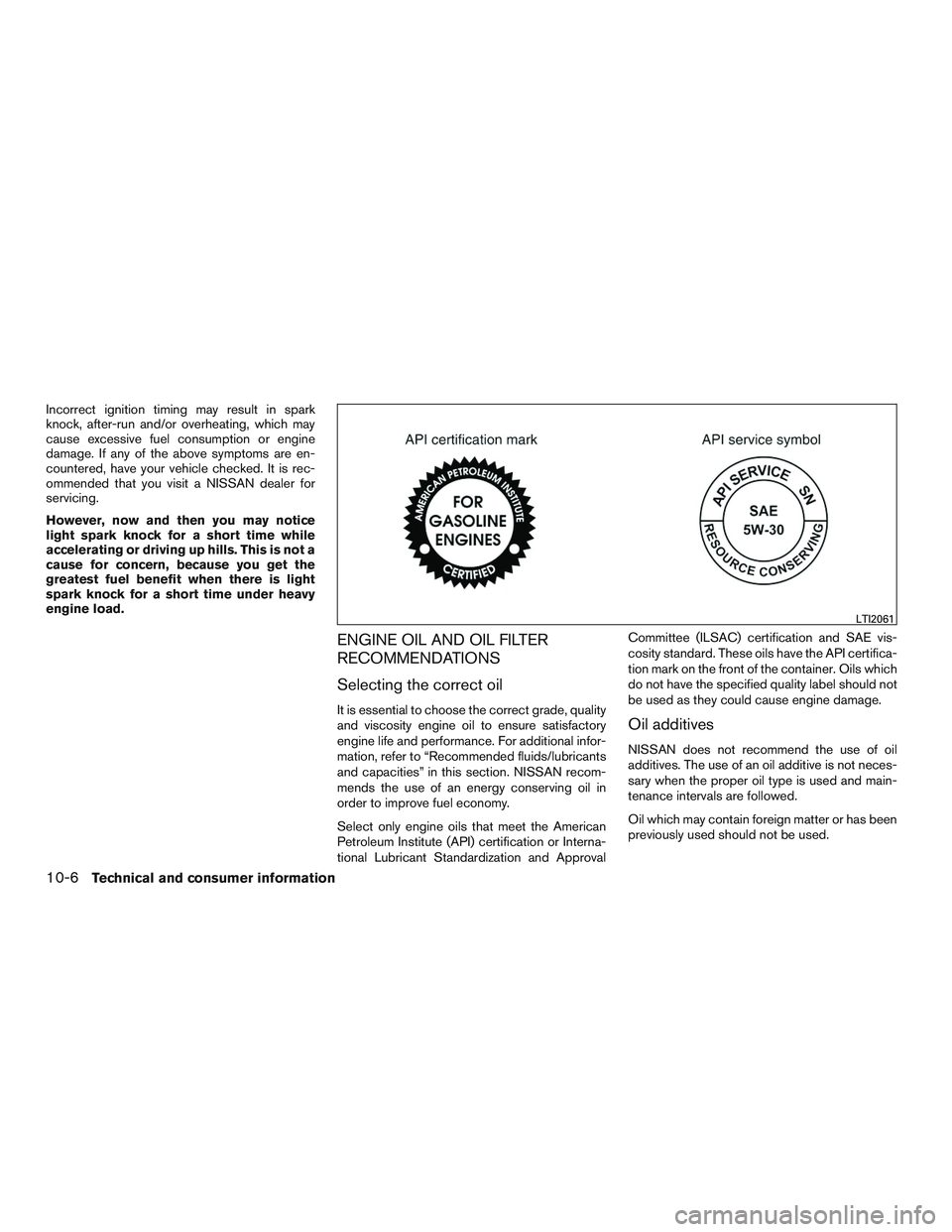
Select only engine oils that meet the American
Petroleum Institute (API) certification or Interna-
tional Lubricant Standardization and ApprovalCommittee (ILSAC) certification and SAE vis-
cosity standard. These oils have the API certifica-
tion mark on the front of the container. Oils which
do not have the specified quality label should not
be used as they could cause engine damage.Oil additives
NISSAN does not recommend the use of oil
additives. The use of an oil additive is not neces-
sary when the proper oil type is used and main-
tenance intervals are followed.
Oil which may contain foreign matter or has been
previously used should not be used.
LTI2061
10-6Technical and consumer information
Page 310 of 318
11 Index
A
Air bag (See supplemental restraint
system) .....................1-41
Air bag system Front (See supplemental front impact
air bag system) ...............1-48
Side and curtain (See supplemental
side air bag and curtain side-impact
air bag system) ...............1-55
Airbagwarninglabels.............1-58
Airbagwarninglight...........1-58,2-10
Air bag warning light, supplemental . .1-58, 2-10
Air cleaner housing filter ............8-14
Air conditioner Air conditioner operation ......4-11,4-19
Air conditioner service ...........4-24
Air conditioner specification label ....10-12
Air conditioner system refrigerant and
oil recommendations ............10-7
Air conditioner system refrigerant
recommendations ..............10-7
Heater and air conditioner
controls ................4-8,4-16
Servicing air conditioner ..........4-24
Airflowcharts..............4-12,4-20
Alarm system
(See vehicle security system) .........2-13
Anchor point locations .............1-25
Antenna .....................4-46
Anti-lock brake warning light ..........2-8
Anti-lock Braking System (ABS) ........5-22Audible reminders
...............2-13
Audio system ..................4-24
AMradioreception.............4-25
Compact disc (CD) player .....4-35,4-39
FM/AM radio with compact disc (CD)
player.................4-32,4-36
FMradioreception.............4-24
iPod® Player ................4-43
iPod® player operation ...........4-43
Radio ....................4-24
Steering wheel audio control switch . . .4-45
USB interface ................4-41
USB (Universal Serial Bus) Connection
Port .....................4-41
Automatic Automatic power window switch .....2-27
Automatic transmission fluid (ATF) .....8-8
Automatic transmission position indicator
light .....................2-10
Driving with automatic transmission .....5-8
Transmission shift lever lock release ....5-11
Automatic door locks ..............3-5
AUXjack.................4-36,4-40
B
Battery ..................5-25,8-10
Chargewarninglight.............2-8
Battery replacement ..............8-20
Keyfob................8-20,8-20
Before starting the engine ............5-7
Belt (See drive belt) ..............8-12 Block heater
Engine ....................5-26
Bluetooth® hands-free phone system ....4-47
Boosterseats..................1-38
Brake Anti-lock Braking System (ABS) ......5-22
Brake assist (for Intelligent cruise control
system) ...................5-23
Brake fluid ..................8-9
Brakelight(Seestoplight).........8-26
Brake system ................5-21
Brakewarninglight..............2-8
Brakewearindicators........2-13,8-16
Parking brake operation ..........5-14
Self-adjusting brakes ............8-16
Brake fluid ....................8-9
Brakes ......................8-16
Brake system ..................5-21
Break-inschedule ...............5-17
Brightness control Instrument panel ..............2-19
Bulb check/instrument panel ..........2-7
Bulbreplacement................8-26
C
Capacities and recommended
fuel/lubricants ..................
10-2
Cargo (See vehicle loading information). . .10-13
Car phone or CB radio .............4-47
CDcareandcleaning .............4-45
CD player (See audio system) .....4-35,4-39
Page 311 of 318
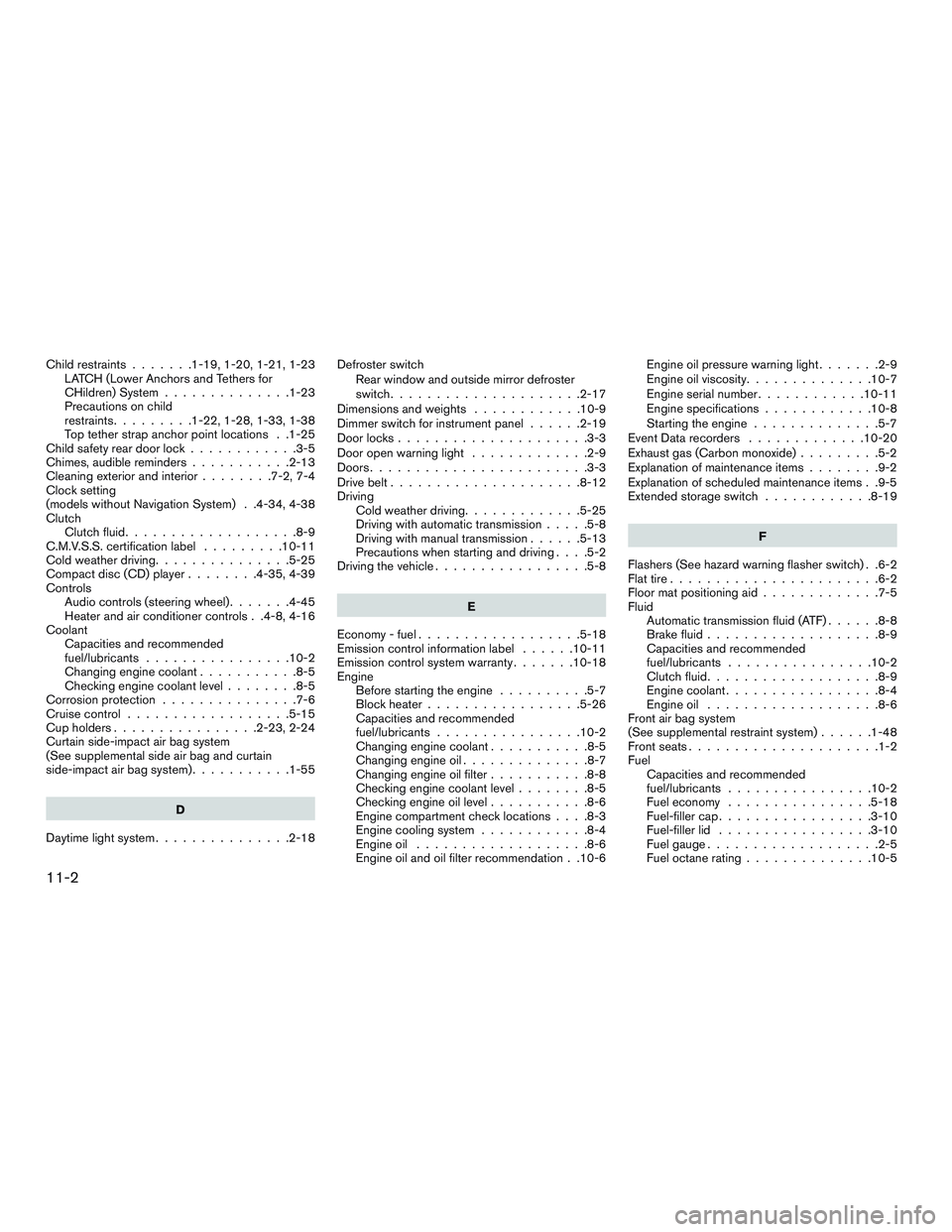
Child restraints.......1-19,1-20,1-21,1-23
LATCH (Lower Anchors and Tethers for
CHildren) System ..............1-23
Precautions on child
restraints.........1-22,1-28,1-33,1-38
Top tether strap anchor point locations . .1-25
Child safety rear door lock ............3-5
Chimes, audible reminders ...........2-13
Cleaningexteriorandinterior........7-2,7-4
Clock setting
(models without Navigation System) . .4-34, 4-38
Clutch Clutch fluid ...................8-9
C.M.V.S.S. certification label .........10-11
Cold weather driving ...............5-25
Compact disc (CD) player ........4-35,4-39
Controls Audiocontrols(steeringwheel).......4-45
Heater and air conditioner controls . .4-8, 4-16
Coolant Capacities and recommended
fuel/lubricants ................10-2
Changing engine coolant ...........8-5
Checking engine coolant level ........8-5
Corrosionprotection ...............7-6
Cruisecontrol..................5-15
Cupholders................2-23,2-24
Curtain side-impact air bag system
(See supplemental side air bag and curtain
side-impact air bag system) ...........1-55
D
Daytime light system ...............2-18 Defroster switch
Rear window and outside mirror defroster
switch.....................2-17
Dimensionsandweights ............10-9
Dimmer switch for instrument panel ......2-19
Door locks .....................3-3
Door open warning light .............2-9
Doors ........................3-3
Drive belt .....................8-12
Driving Cold weather driving .............5-25
Driving with automatic transmission .....5-8
Driving with manual transmission ......5-13
Precautions when starting and driving ....5-2
Driving the vehicle .................5-8
E
Economy - fuel ..................5-18
Emission control information label ......10-11
Emission control system warranty .......10-18
Engine Before starting the engine ..........5-7
Block heater .................5-26
Capacities and recommended
fuel/lubricants ................10-2
Changingenginecoolant...........8-5
Changingengineoil..............8-7
Changing engine oil filter ...........8-8
Checking engine coolant level ........8-5
Checking engine oil level ...........8-6
Engine compartment check locations ....8-3
Engine cooling system ............8-4
Engineoil ...................8-6
Engine oil and oil filter recommendation . .10-6 Engine oil pressure warning light
.......2-9
Engine oil viscosity ..............10-7
Engine serial number ............10-11
Engine specifications ............10-8
Starting the engine ..............5-7
Event Data recorders .............10-20
Exhaust gas (Carbon monoxide) .........5-2
Explanation of maintenance items ........9-2
Explanation of scheduled maintenance items . .9-5
Extended storage switch ............8-19
F
Flashers (See hazard warning flasher switch) . .6-2
Flat tire .......................
6-2
Floor mat positioning aid .............7-5
Fluid Automatic transmission fluid (ATF) ......8-8
Brake fluid ...................8-9
Capacities and recommended
fuel/lubricants ................10-2
Clutch fluid ...................8-9
Enginecoolant.................8-4
Engineoil ...................8-6
Front air bag system
(See supplemental restraint system) ......1-48
Frontseats.....................1-2
Fuel Capacities and recommended
fuel/lubricants ................10-2
Fuel economy ................5-18
Fuel-filler cap .................3-10
Fuel-filler lid .................3-10
Fuelgauge...................2-5
Fuel octane rating ..............10-5
11-2
Page 313 of 318
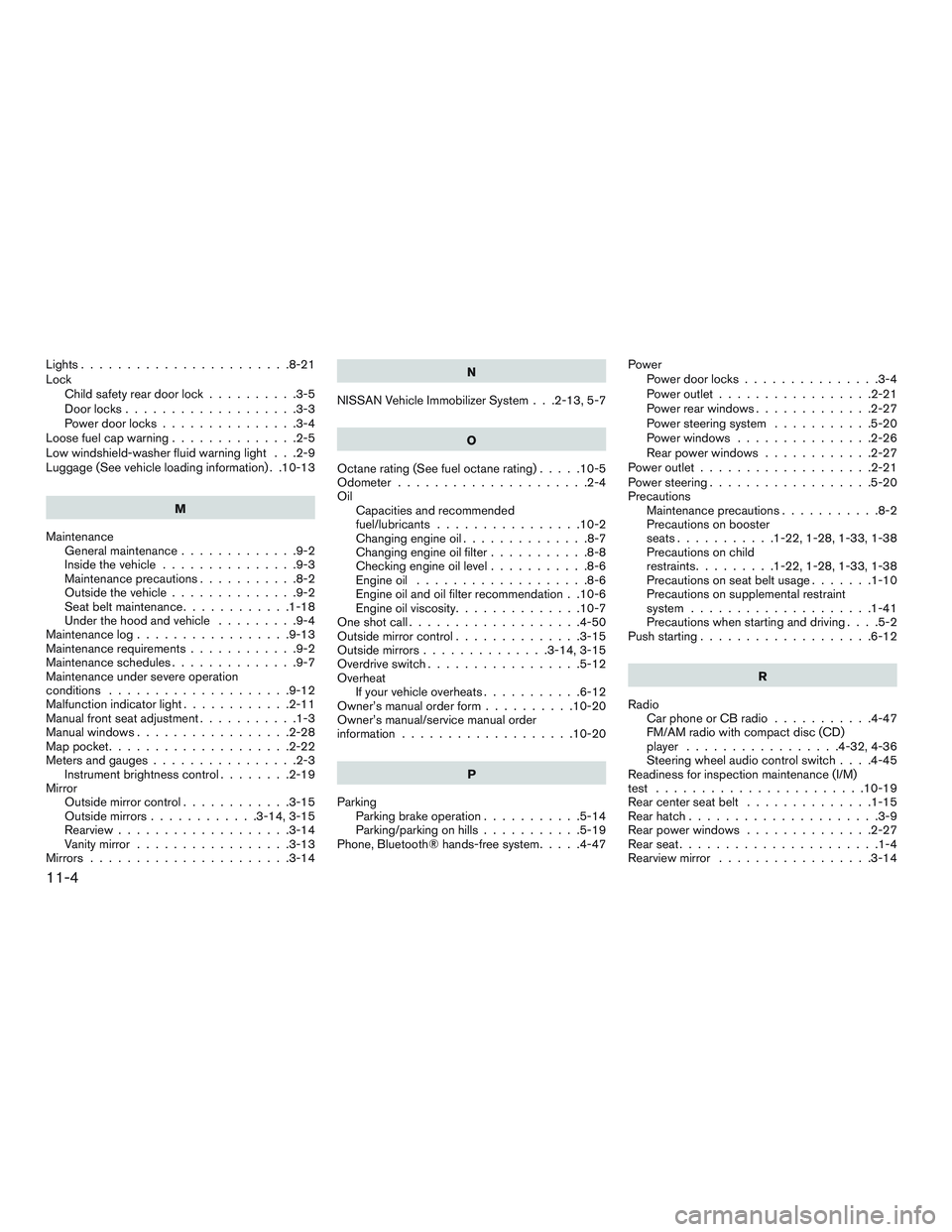
Lights.......................8-21
LockChild safety rear door lock ..........3-5
Door locks ...................3-3
Power door locks ...............3-4
Loose fuel cap warning ..............2-5
Low windshield-washer fluid warning light . . .2-9
Luggage (See vehicle loading information) . .10-13
M
Maintenance Generalmaintenance.............9-2
Insidethevehicle...............9-3
Maintenanceprecautions...........8-2
Outsidethevehicle..............9-2
Seat belt maintenance ............1-18
Under the hood and vehicle .........9-4
Maintenance log .................9-13
Maintenance requirements ............9-2
Maintenance schedules ..............9-7
Maintenance under severe operation
conditions ....................9-12
Malfunctionindicatorlight............2-11
Manual front seat adjustment ...........1-3
Manual windows .................2-28
Map pocket ....................2-22
Meters and gauges ................2-3
Instrument brightness control ........2-19
Mirror Outside mirror control ............3-15
Outside mirrors ............3-14,3-15
Rearview ...................3-14
Vanity mirror .................3-13
Mirrors ......................3-14 N
NISSAN Vehicle Immobilizer System . . .2-13, 5-7
O
Octane rating (See fuel octane rating) .....10-5
Odometer .....................2-4
Oil Capacities and recommended
fuel/lubricants ................10-2
Changingengineoil..............8-7
Changing engine oil filter ...........8-8
Checking engine oil level ...........8-6
Engineoil ...................8-6
Engine oil and oil filter recommendation . .10-6
Engine oil viscosity ..............10-7
Oneshotcall...................4-50
Outside mirror control ..............3-15
Outside mirrors ..............3-14,3-15
Overdrive switch .................5-12
Overheat If your vehicle overheats ...........6-12
Owner’s manual order form ..........10-20
Owner’s manual/service manual order
information ...................10-20
P
Parking Parking brake operation ...........5-14
Parking/parking on hills ...........5-19
Phone, Bluetooth® hands-free system .....4-47Power
Power door locks ...............3-4
Poweroutlet.................2-21
Power rear windows .............2-27
Power steering system ...........5-20
Power windows ...............2-26
Rear power windows ............2-27
Poweroutlet...................2-21
Power steering ..................5-20
Precautions Maintenance precautions ...........8-2
Precautions on booster
seats...........1-22,1-28,1-33,1-38
Precautions on child
restraints .........1-22,1-28,1-33,1-38
Precautionsonseatbeltusage.......1-10
Precautions
on supplemental restraint
system ....................1-41
Precautions when starting and driving ....5-2
Push starting ...................6-12
R
Radio CarphoneorCBradio ...........4-47
FM/AM radio with compact disc (CD)
player .................4-32,4-36
Steering wheel audio control switch ....4-45
Readiness for inspection maintenance (I/M)
test .......................10-19
Rearcenterseatbelt ..............1-15
Rear hatch .....................3-9
Rear power windows ..............2-27
Rearseat......................1-4
Rearview mirror .................3-14
11-4