child seat NISSAN MICRA 2017 Owner´s Manual
[x] Cancel search | Manufacturer: NISSAN, Model Year: 2017, Model line: MICRA, Model: NISSAN MICRA 2017Pages: 318, PDF Size: 3.73 MB
Page 69 of 318
If a malfunction occurs in the front passenger air
bag system, the supplemental air bag warning
light
, located in the meter and gauges area
of the instrument panel, will blink. Have the sys-
tem checked. It is recommended that you visit a
NISSAN dealer for this service.
Normal operation
In order for the occupant classification sensor
system to classify the front passenger based on
weight, please follow the precautions and steps
outlined below:
Precautions
● Make sure that there are no objects weigh-
ing over 2.2 lbs (1 kg) hanging on the seat or
placed in the seatback pocket.
● Make sure that a child restraint or other
object is not pressing against the rear of the
seatback.
● Make sure that a rear passenger is not push-
ing or pulling on the back of the front pas-
senger seat.
● Make sure that the front passenger seat or
seatback is not forced back against an ob-
ject on the seat or floor behind it.
● Make sure that there is no object placed
under the front passenger seat. Steps
1. Adjust the seat as outlined in the “Seats” section of this manual. Sit upright, leaning
against the seatback, and centered on the
seat cushion with your feet comfortably ex-
tended to the floor.
2. Make sure there are no objects on your lap.
3. Fasten the seat belt as outlined in the “Seat belts” section of this manual.
4. Remain in this position for 30 seconds al- lowing the system to classify the front pas-
senger before the vehicle is put into motion.
5. Ensure proper classification by checking the front passenger air bag status light.
NOTE:
This vehicle’s occupant classification sen-
sor system locks the classification during
driving so it is important that you confirm
that the front passenger is properly classi-
fied prior to driving. Also, the occupant
classification sensor system may recalcu-
late the weight of the occupant when the
vehicle comes to a stop (i.e. stop light, stop
sign, etc.) , so front passenger seat occu-
pants should continue to remain seated as
outlined above. Troubleshooting
If you think the front passenger air bag status light
is incorrect:
1. If the light is ON with no front passenger and no objects on the front passenger seat:
This may be due to the following conditions that
may be interfering with the weight sensors: ● An object weighing over 2.2 lbs (1 kg) hang-
ing on the seat or placed in the seatback
pocket.
● A child restraint or other object pressing
against the rear of the seatback.
● A rear passenger pushing or pulling on the
back of the front passenger seat.
● Forcing the front seat or seatback against an
object on the seat or floor behind it.
● An object placed under the front passenger
seat.
● An object placed between the seat cushion
and center console or between the seat
cushion and the door.
If the vehicle is moving, please come to a stop
when it is safe to do so. Check and correct any of
the above conditions. Restart the vehicle and
wait 1 minute.
1-52Safety—Seats, seat belts and supplemental restraint system
Page 70 of 318
NOTE:
A system check will be performed during
which the front passenger air bag status
light will remain lit for about 7 seconds
initially.
If the light is still ON after this, the vehicle should
be checked as soon as possible. It is recom-
mended that you visit a NISSAN dealer for this
service.2. If the light is ON with an adult occupying the front passenger seat:
● Occupant is a small adult — the air bag light
is functioning as intended. The front passen-
ger air bag is suppressed.
However, if the occupant is not a small adult, then
this may be due to the following conditions that
may be interfering with the weight sensors: ● Occupant is not sitting upright, leaning
against the seatback, and centered on the
seat cushion with his/her feet comfortably
extended to the floor.
● A child restraint or other object pressing
against the rear of the seatback.
● A rear passenger pushing or pulling on the
back of the front passenger seat. ●
Forcing the front seat or seatback against an
object on the seat or floor behind it.
● An object placed under the front passenger
seat.
● An object placed between the seat cushion
and center console or between the seat
cushion and the door.
If the vehicle is moving, please come to a stop
when it is safe to do so. Check and correct any of
the above conditions. Restart the vehicle and
wait 1 minute.
NOTE:
A system check will be performed during
which the front passenger air bag status
light will remain lit for about 7 seconds
initially.
If the light is still ON after this, the person should
be advised not to ride in the front passenger seat
and the vehicle should be checked as soon as
possible. It is recommended that you visit a
NISSAN dealer for this service. 3. If the light is OFF with a small adult, child or child restraint occupying the front passen-
ger seat. This may be due to the following conditions
that may be interfering with the weight sen-
sors:
● Small adult or child is not sitting upright,
leaning against the seatback, and centered
on the seat cushion with his/her feet com-
fortably extended to the floor.
● The child restraint is not properly installed,
as outlined in the “Child restraints” section of
this manual.
● An object weighing over 2.2 lbs (1 kg) hang-
ing on the seat or placed in the seatback
pocket.
● A child restraint or other object pressing
against the rear of the seatback.
● A rear passenger pushing or pulling on the
back of the front passenger seat.
● Forcing the front seat or seatback against an
object on the seat or floor behind it.
● An object placed under the front passenger
seat.
● An object placed between the seat cushion
and center console.
Safety—Seats, seat belts and supplemental restraint system1-53
Page 71 of 318
If the vehicle is moving, please come to a stop
when it is safe to do so. Check and correct any of
the above conditions. Restart the vehicle and
wait 1 minute.
NOTE:
A system check will be performed during
which the front passenger air bag status
light will remain lit for about 7 seconds
initially.
If the light is still OFF after this, the small adult,
child or child restraint should be repositioned in
the rear seat and the vehicle should be checked
as soon as possible. It is recommended that you
visit a NISSAN dealer for this service.
Other supplemental front-impact air bag
precautions
WARNING
●Do not place any objects on the steering
wheel pad or on the instrument panel.
Also, do not place any objects between
any occupant and the steering wheel or
instrument panel. Such objects may be-
come dangerous projectiles and cause
injury if the front air bags inflate. ●
Immediately after inflation, several
front air bag system components will be
hot. Do not touch them; you may se-
verely burn yourself.
● No unauthorized changes should be
made to any components or wiring of
the supplemental air bag system. This is
to prevent accidental inflation of the
supplemental air bag or damage to the
supplemental air bag system.
● Do not make unauthorized changes to
your vehicle’s electrical system, sus-
pension system or front end structure.
This could affect proper operation of
the front air bag system.
● Tampering with the front air bag system
may result in serious personal injury.
Tampering includes changes to the
steering wheel and the instrument
panel assembly by placing material
over the steering wheel pad and above
the instrument panel or by installing
additional trim material around the air
bag system.
● Removing or modifying the front pas-
senger seat may affect the function of
the air bag system and result in serious
personal injury. ●
Modifying or tampering with the front
passenger seat may result in serious
personal injury. For example, do not
change the front seats by placing mate-
rial on the seat cushion or by installing
additional trim material, such as seat
covers, on the seat that are not specifi-
cally designed to assure proper air bag
operation. Additionally, do not stow any
objects under the front passenger seat
or the seat cushion and seatback. Such
objects may interfere with the proper
operation of the occupant classification
sensor (weight sensor) .
● No unauthorized changes should be
made to any components or wiring of
the seat belt system. This may affect the
front air bag system. Tampering with
the seat belt system may result in seri-
ous personal injury.
1-54Safety—Seats, seat belts and supplemental restraint system
Page 75 of 318
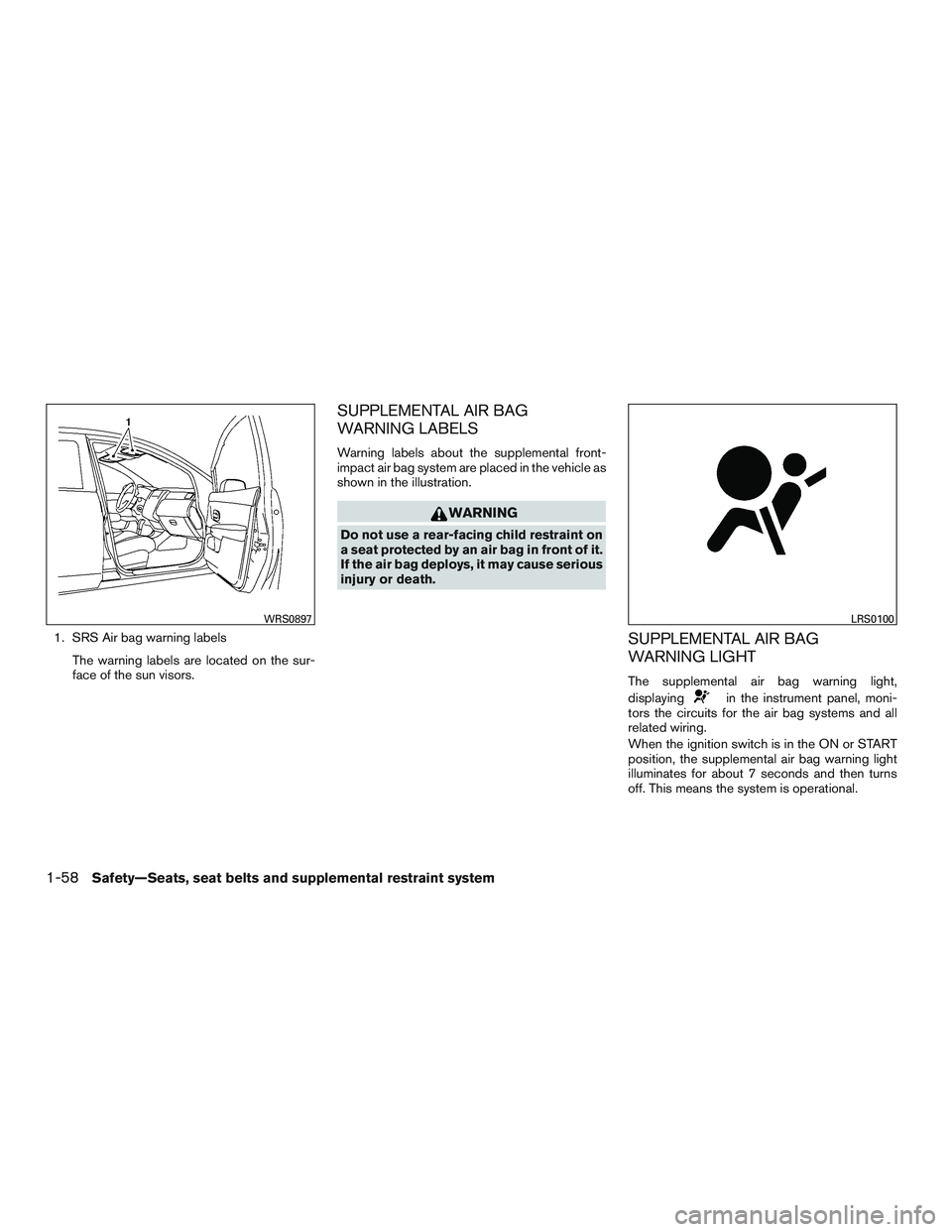
1. SRS Air bag warning labelsThe warning labels are located on the sur-
face of the sun visors.
SUPPLEMENTAL AIR BAG
WARNING LABELS
Warning labels about the supplemental front-
impact air bag system are placed in the vehicle as
shown in the illustration.
WARNING
Do not use a rear-facing child restraint on
a seat protected by an air bag in front of it.
If the air bag deploys, it may cause serious
injury or death.
SUPPLEMENTAL AIR BAG
WARNING LIGHT
The supplemental air bag warning light,
displaying
in the instrument panel, moni-
tors the circuits for the air bag systems and all
related wiring.
When the ignition switch is in the ON or START
position, the supplemental air bag warning light
illuminates for about 7 seconds and then turns
off. This means the system is operational.
WRS0897LRS0100
1-58Safety—Seats, seat belts and supplemental restraint system
Page 101 of 318
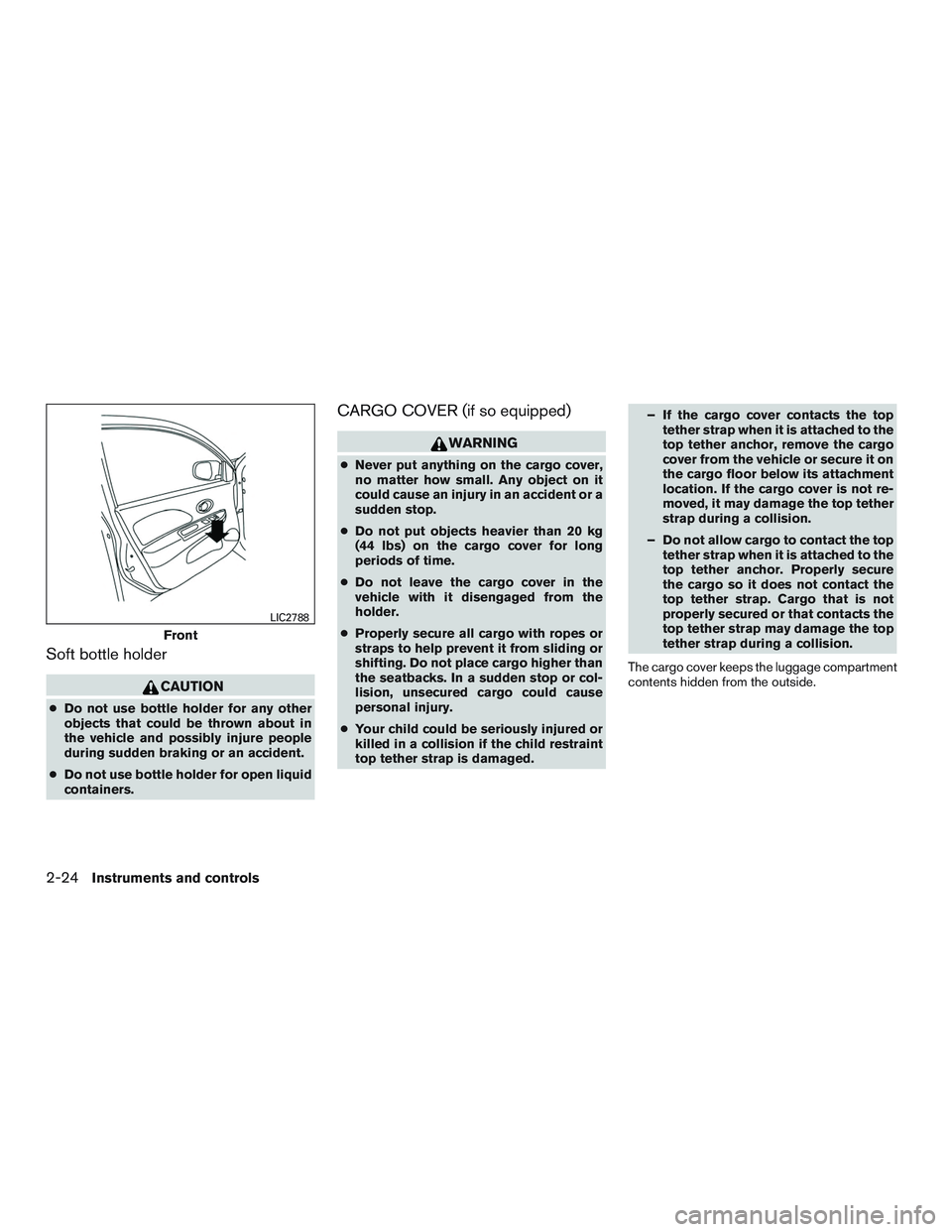
Soft bottle holder
CAUTION
●Do not use bottle holder for any other
objects that could be thrown about in
the vehicle and possibly injure people
during sudden braking or an accident.
● Do not use bottle holder for open liquid
containers.
CARGO COVER (if so equipped)
WARNING
● Never put anything on the cargo cover,
no matter how small. Any object on it
could cause an injury in an accident or a
sudden stop.
● Do not put objects heavier than 20 kg
(44 lbs) on the cargo cover for long
periods of time.
● Do not leave the cargo cover in the
vehicle with it disengaged from the
holder.
● Properly secure all cargo with ropes or
straps to help prevent it from sliding or
shifting. Do not place cargo higher than
the seatbacks. In a sudden stop or col-
lision, unsecured cargo could cause
personal injury.
● Your child could be seriously injured or
killed in a collision if the child restraint
top tether strap is damaged. – If the cargo cover contacts the top
tether strap when it is attached to the
top tether anchor, remove the cargo
cover from the vehicle or secure it on
the cargo floor below its attachment
location. If the cargo cover is not re-
moved, it may damage the top tether
strap during a collision.
– Do not allow cargo to contact the top tether strap when it is attached to the
top tether anchor. Properly secure
the cargo so it does not contact the
top tether strap. Cargo that is not
properly secured or that contacts the
top tether strap may damage the top
tether strap during a collision.
The cargo cover keeps the luggage compartment
contents hidden from the outside.
Front
LIC2788
2-24Instruments and controls
Page 183 of 318
WARNING
●Do not leave children or adults who
would normally require the assistance
of others alone in your vehicle. Pets
should also not be left alone. They
could accidentally injure themselves or
others through inadvertent operation of
the vehicle. Also, on hot, sunny days,
temperatures in a closed vehicle could
quickly become high enough to cause
severe or possibly fatal injuries to
people or animals.
● Properly secure all cargo to help pre-
vent it from sliding or shifting. Do not
place cargo higher than the seatbacks.
In a sudden stop or collision, unsecured
cargo could cause personal injury.
EXHAUST GAS (carbon monoxide)
WARNING
● Do not breathe exhaust gases; they
contain colorless and odorless carbon
monoxide. Carbon monoxide is danger-
ous. It can cause unconsciousness or
death. ●
If you suspect that exhaust fumes are
entering the vehicle, drive with all win-
dows fully open, and have the vehicle
inspected immediately.
● Do not run the engine in closed spaces
such as a garage.
● Do not park the vehicle with the engine
running for any extended length of time.
● Keep the rear vent windows, liftgates,
doors and trunk lids (if so equipped)
closed while driving, otherwise exhaust
gases could be drawn into the passen-
ger compartment. If you must drive with
one of these open, follow these
precautions:
1. Open all the windows.
2. Turn the air recirculation mode off and set the fan speed control to the
highest level to circulate the air.
● The exhaust system and body should be
inspected by a qualified mechanic
whenever:
a. The vehicle is raised for service.
b. You suspect that exhaust fumes are entering into the passenger
compartment. c. You notice a change in the sound of
the exhaust system.
d. You have had an accident involving damage to the exhaust system, un-
derbody, or rear of the vehicle.
THREE-WAY CATALYST
The three-way catalyst is an emission control
device installed in the exhaust system. Exhaust
gases in the three-way catalyst are burned at
high temperatures to help reduce pollutants.
WARNING
●The exhaust gas and the exhaust sys-
tem are very hot. Keep people, animals
or flammable materials away from the
exhaust system components.
● Do not stop or park the vehicle over
flammable materials such as dry grass,
waste paper or rags. They may ignite
and cause a fire.
● When parking, ensure that people or
inflammable materials are kept away
from the exhaust pipe.
PRECAUTIONS WHEN STARTING
AND DRIVING
5-2Starting and driving
Page 311 of 318
Child restraints.......1-19,1-20,1-21,1-23
LATCH (Lower Anchors and Tethers for
CHildren) System ..............1-23
Precautions on child
restraints.........1-22,1-28,1-33,1-38
Top tether strap anchor point locations . .1-25
Child safety rear door lock ............3-5
Chimes, audible reminders ...........2-13
Cleaningexteriorandinterior........7-2,7-4
Clock setting
(models without Navigation System) . .4-34, 4-38
Clutch Clutch fluid ...................8-9
C.M.V.S.S. certification label .........10-11
Cold weather driving ...............5-25
Compact disc (CD) player ........4-35,4-39
Controls Audiocontrols(steeringwheel).......4-45
Heater and air conditioner controls . .4-8, 4-16
Coolant Capacities and recommended
fuel/lubricants ................10-2
Changing engine coolant ...........8-5
Checking engine coolant level ........8-5
Corrosionprotection ...............7-6
Cruisecontrol..................5-15
Cupholders................2-23,2-24
Curtain side-impact air bag system
(See supplemental side air bag and curtain
side-impact air bag system) ...........1-55
D
Daytime light system ...............2-18 Defroster switch
Rear window and outside mirror defroster
switch.....................2-17
Dimensionsandweights ............10-9
Dimmer switch for instrument panel ......2-19
Door locks .....................3-3
Door open warning light .............2-9
Doors ........................3-3
Drive belt .....................8-12
Driving Cold weather driving .............5-25
Driving with automatic transmission .....5-8
Driving with manual transmission ......5-13
Precautions when starting and driving ....5-2
Driving the vehicle .................5-8
E
Economy - fuel ..................5-18
Emission control information label ......10-11
Emission control system warranty .......10-18
Engine Before starting the engine ..........5-7
Block heater .................5-26
Capacities and recommended
fuel/lubricants ................10-2
Changingenginecoolant...........8-5
Changingengineoil..............8-7
Changing engine oil filter ...........8-8
Checking engine coolant level ........8-5
Checking engine oil level ...........8-6
Engine compartment check locations ....8-3
Engine cooling system ............8-4
Engineoil ...................8-6
Engine oil and oil filter recommendation . .10-6 Engine oil pressure warning light
.......2-9
Engine oil viscosity ..............10-7
Engine serial number ............10-11
Engine specifications ............10-8
Starting the engine ..............5-7
Event Data recorders .............10-20
Exhaust gas (Carbon monoxide) .........5-2
Explanation of maintenance items ........9-2
Explanation of scheduled maintenance items . .9-5
Extended storage switch ............8-19
F
Flashers (See hazard warning flasher switch) . .6-2
Flat tire .......................
6-2
Floor mat positioning aid .............7-5
Fluid Automatic transmission fluid (ATF) ......8-8
Brake fluid ...................8-9
Capacities and recommended
fuel/lubricants ................10-2
Clutch fluid ...................8-9
Enginecoolant.................8-4
Engineoil ...................8-6
Front air bag system
(See supplemental restraint system) ......1-48
Frontseats.....................1-2
Fuel Capacities and recommended
fuel/lubricants ................10-2
Fuel economy ................5-18
Fuel-filler cap .................3-10
Fuel-filler lid .................3-10
Fuelgauge...................2-5
Fuel octane rating ..............10-5
11-2
Page 313 of 318
Lights.......................8-21
LockChild safety rear door lock ..........3-5
Door locks ...................3-3
Power door locks ...............3-4
Loose fuel cap warning ..............2-5
Low windshield-washer fluid warning light . . .2-9
Luggage (See vehicle loading information) . .10-13
M
Maintenance Generalmaintenance.............9-2
Insidethevehicle...............9-3
Maintenanceprecautions...........8-2
Outsidethevehicle..............9-2
Seat belt maintenance ............1-18
Under the hood and vehicle .........9-4
Maintenance log .................9-13
Maintenance requirements ............9-2
Maintenance schedules ..............9-7
Maintenance under severe operation
conditions ....................9-12
Malfunctionindicatorlight............2-11
Manual front seat adjustment ...........1-3
Manual windows .................2-28
Map pocket ....................2-22
Meters and gauges ................2-3
Instrument brightness control ........2-19
Mirror Outside mirror control ............3-15
Outside mirrors ............3-14,3-15
Rearview ...................3-14
Vanity mirror .................3-13
Mirrors ......................3-14 N
NISSAN Vehicle Immobilizer System . . .2-13, 5-7
O
Octane rating (See fuel octane rating) .....10-5
Odometer .....................2-4
Oil Capacities and recommended
fuel/lubricants ................10-2
Changingengineoil..............8-7
Changing engine oil filter ...........8-8
Checking engine oil level ...........8-6
Engineoil ...................8-6
Engine oil and oil filter recommendation . .10-6
Engine oil viscosity ..............10-7
Oneshotcall...................4-50
Outside mirror control ..............3-15
Outside mirrors ..............3-14,3-15
Overdrive switch .................5-12
Overheat If your vehicle overheats ...........6-12
Owner’s manual order form ..........10-20
Owner’s manual/service manual order
information ...................10-20
P
Parking Parking brake operation ...........5-14
Parking/parking on hills ...........5-19
Phone, Bluetooth® hands-free system .....4-47Power
Power door locks ...............3-4
Poweroutlet.................2-21
Power rear windows .............2-27
Power steering system ...........5-20
Power windows ...............2-26
Rear power windows ............2-27
Poweroutlet...................2-21
Power steering ..................5-20
Precautions Maintenance precautions ...........8-2
Precautions on booster
seats...........1-22,1-28,1-33,1-38
Precautions on child
restraints .........1-22,1-28,1-33,1-38
Precautionsonseatbeltusage.......1-10
Precautions
on supplemental restraint
system ....................1-41
Precautions when starting and driving ....5-2
Push starting ...................6-12
R
Radio CarphoneorCBradio ...........4-47
FM/AM radio with compact disc (CD)
player .................4-32,4-36
Steering wheel audio control switch ....4-45
Readiness for inspection maintenance (I/M)
test .......................10-19
Rearcenterseatbelt ..............1-15
Rear hatch .....................3-9
Rear power windows ..............2-27
Rearseat......................1-4
Rearview mirror .................3-14
11-4
Page 314 of 318
RearViewMonitor.................4-2
Rear window and outside mirror defroster
switch.......................2-17
Rear window wiper and washer switches . . .2-16
Recommended Fluids..............10-2
Recorders EventData .................10-20
Refrigerant recommendation ..........10-7
Registering a vehicle in another country . . .10-10
Remote keyless entry system ........3-5,3-6
Reporting safety defects (US only) ......10-19
S
Safety Child safety rear door lock ..........3-5
Childseatbelts.....1-22,1-28,1-33,1-38
Reporting safety defects (US only) ....10-19
Seat adjustment Front manual seat adjustment ........1-3
Rear seat adjustment .............1-4
Seat belt Child safety ..................1-19
Infantsandsmallchildren..........1-20
InjuredPerson................1-13
Largerchildren................1-20
Precautionsonseatbeltusage.......1-10
Pregnant women ...............1-13
Rear center seat belt ............1-15
Seat belt extenders .............1-18
Seat belt maintenance ............1-18
Seat belts ................1-10,7-6
Shoulder belt height adjustment ......1-18
Three-point type with retractor .......1-13
Seat belt extenders ...............1-18 Seat belt warning light
..........1-12,2-10
Seats Adjustment...................1-2
Front seats ...................1-2
Manual front seat adjustment .........1-3
Rear seat ....................1-4
Security indicator light ..............2-12
Security system (NISSAN Vehicle Immobilizer
System) , engine start ...........2-13,5-7
Security systems Vehicle security system ...........2-13
Self-adjusting brakes ..............8-16
Service manual order form ...........10-20
Servicing air conditioner .............4-24
Shifting Automatic transmission ...........5-10
Manual transmission .............5-13
Shift lock release .................5-11
Shoulder belt height adjustment ........1-18
Side air bag system (See supplemental
side air bag and curtain side-impact air bag
system) ......................1-55
Spark plug replacement .............8-13
Sparkplugs ...................8-13
Specifications ..................10-8
Speedometer ...................2-4
Speedometer and odometer ...........2-4
SRS warning label ................1-58
Stability control .................5-23
Standard maintenance ..............9-7
Starting Before starting the engine ..........5-7
Jump starting .............6-10,8-12
Precautions when starting and driving ....5-2
Push starting .................6-12
Starting the engine ..............5-7 Starting the engine
................5-7
Steering P
ower steering system ...........5-20
Tilting steering wheel ............3-12
Steeringwheel..................3-12
Steeringwheelaudiocontrolswitch......4-45
Stoplight.....................8-26
Storage......................2-22
Storage tray ...................2-22
Sun visors ....................3-12
Supplemental air bag warning labels ......1-58
Supplemental air bag warning light . . .1-58, 2-10
Supplemental front impact air bag system . . .1-48
Supplemental restraint system Information and warning labels .......1-58
Precautions on supplemental restraint
system ....................1-41
Supplemental restraint system
(Supplemental air bag system) .........1-41
Supplemental side and curtain side-impact
air bag system ..................1-55
Switch Automatic power window switch ......2-27
Hazard warning flasher switch ........6-2
Headlightandturnsignalswitch......2-17
Headlight control switch ..........2-17
Ignition switch .................5-5
Instrument brightness control ........2-19
Overdrive switch ...............5-12
Powerdoorlockswitch............3-4
Rear window and outside mirror defroster
switch.....................2-17
Rear window wiper and washer switches. .2-16
Turnsignalswitch..............2-19
Vehicle dynamic control (VDC) off
switch.....................2-21
11-5