fuel pressure NISSAN MICRA 2017 Owner´s Manual
[x] Cancel search | Manufacturer: NISSAN, Model Year: 2017, Model line: MICRA, Model: NISSAN MICRA 2017Pages: 318, PDF Size: 3.73 MB
Page 182 of 318
5 Starting and driving
Precautions when starting and driving................5-2
Exhaust gas (carbon monoxide) ..................5-2
Three-way catalyst ..............................5-2
Avoiding collision and rollover . . ..................5-3
Off-road recovery ...............................5-3
Rapid air pressure loss ..........................5-4
Drinking alcohol/drugs and driving ................5-4
Ignition switch .....................................5-5
Automatic transmission (if so equipped) ...........5-5
Manual transmission (if so equipped) .............5-6
Ignition switch positions .........................5-6
NISSAN Vehicle Immobilizer System ..............5-7
Before starting the engine ..........................5-7
Starting the engine ................................5-7
Driving the vehicle .................................5-8
Automatic transmission (if so equipped) ...........5-8
Manual transmission (if so equipped) ............5-13
Parking brake .................................... 5-14
Cruise control (if so equipped) .....................5-15
Precautions on cruise control . . .................5-15
Cruise control operations .......................5-16Break-in schedule
................................ 5-17
Fuel efficient driving tips ........................... 5-17
Increasing fuel economy ........................... 5-18
Parking/parking on hills ............................ 5-19
Power steering ................................... 5-20
Brake system .................................... 5-21
Brake precautions ............................. 5-21
Anti-lock Braking System (ABS) .................5-22
Brake assist .................................. 5-23
Vehicle Dynamic Control (VDC) system .............5-23
Brake force distribution ........................ 5-24
Cold weather driving .............................. 5-25
Freeing a frozen door lock ......................5-25
Antifreeze ..................................... 5-25
Battery ....................................... 5-25
Draining of coolant water .......................5-25
Tire equipment ................................ 5-26
Special winter equipment .......................5-26
Driving on snow or ice ......................... 5-26
Engine
block heater (if so equipped) .............5-26
Page 199 of 318
6.Plan for the Shortest Route
● Utilize a map or navigation system to de-
termine the best route to save time.
7. Avoid Idling
● Shutting off your engine when safe for
stops exceeding 30–60 seconds saves
fuel and reduces emissions.
8. Buy an Automated Pass for Toll Roads
● Automated passes permit drivers to use
special lanes to maintain cruising speed
through the toll and avoid stopping and
starting.
9. Winter Warm Up
● Limit idling time to minimize impact to fuel
economy.
● Vehicles typically need no more than
30 seconds of idling at start-up to effec-
tively circulate the engine oil before driv-
ing.
● Your vehicle will reach its ideal operating
temperature more quickly while driving
versus idling. 10.
Keeping your Vehicle Cool
● Park your vehicle in a covered parking
area or in the shade whenever possible.
● When entering a hot vehicle, opening the
windows will help to reduce the inside
temperature faster, resulting in reduced
demand on your A/C system. The following methods are recommended by
NISSAN to increase fuel economy on NISSAN
vehicles. All these recommendations can help
you to achieve a higher level of fuel economy in
your vehicle.
● Accelerate slowly and smoothly. Maintain
cruising speeds with a constant accelerator
position.
● Drive at moderate speeds on the highway.
Driving at high speed lowers fuel economy.
● Avoid unnecessary stopping and braking.
Maintain a safe distance behind other ve-
hicles.
● Use a proper gear range which suits road
conditions. On level roads, shift into high
gear as soon as possible.
● Avoid unnecessary engine idling.
● Keep your engine tuned up.
● Follow the recommended scheduled main-
tenance.
● Keep the tires inflated to the correct pres-
sure. Low tire pressure increases tire wear
and lowers fuel economy.
● Keep the wheels in correct alignment. Im-
proper alignment increases tire wear and
lowers fuel economy.
INCREASING FUEL ECONOMY
5-18Starting and driving
Page 235 of 318
When performing any inspection or maintenance
work on your vehicle, always take care to prevent
serious accidental injury to yourself or damage to
the vehicle. The following are general precau-
tions which should be closely observed.
WARNING
●Park the vehicle on a level surface, ap-
ply the parking brake securely and
block the wheels to prevent the vehicle
from moving. For manual transmission
models, move the shift lever to N (Neu-
tral) . For Automatic Transmission (A/T)
move the shift lever to P (Park)
● Be sure the ignition key is in the OFF or
LOCK position when performing any
parts replacement or repairs.
● Your vehicle is equipped with an auto-
matic engine cooling fan. It may come
on at any time without warning, even if
the ignition key is in the OFF position
and the engine is not running. To avoid
injury, always disconnect the negative
battery cable before working near the
fan.
● If you must work with the engine run-
ning, keep your hands, clothing, hair
and tools away from moving fans, belts
and any other moving parts. ●
It is advisable to secure or remove any
loose clothing and remove any jewelry,
such as rings, watches, etc. before
working on your vehicle.
● Always wear eye protection whenever
you work on your vehicle.
● If you must run the engine in an en-
closed space such as a garage, be sure
there is proper ventilation for exhaust
gases to escape.
● Never get under the vehicle while it is
supported only by a jack. If it is neces-
sary to work under the vehicle, support
it with safety stands.
● Keep smoking materials, flame and
sparks away from the fuel tank and
battery.
● On gasoline engine models, the fuel
filter or fuel lines should be serviced
because the fuel lines are under high
pressure even when the engine is off. It
is recommended that you visit a
NISSAN dealer for this service.
CAUTION
● Do not work under the hood while the
engine is hot. Turn the engine off and
wait until it cools down.
● Avoid contact with used engine oil and
coolant. Improperly disposed engine
oil, engine coolant and/or other vehicle
fluids can damage the environment. Al-
ways conform to local regulations for
disposal of vehicle fluid.
● Never leave the engine or automatic
transmission related component har-
nesses disconnected while the ignition
switch is in the ON position.
● Never connect or disconnect the battery
or any transistorized component while
the ignition switch is in the ON position.
This “Do-it-yourself” section gives instructions
regarding only those items which are relatively
easy for an owner to perform.
You should be aware that incomplete or improper
servicing may result in operating difficulties or
excessive emissions, and could affect warranty
coverage. If in doubt about any servicing, it
is recommended that you have it done by a
NISSAN dealer.
MAINTENANCE PRECAUTIONS
8-2Do-it-yourself
Page 256 of 318
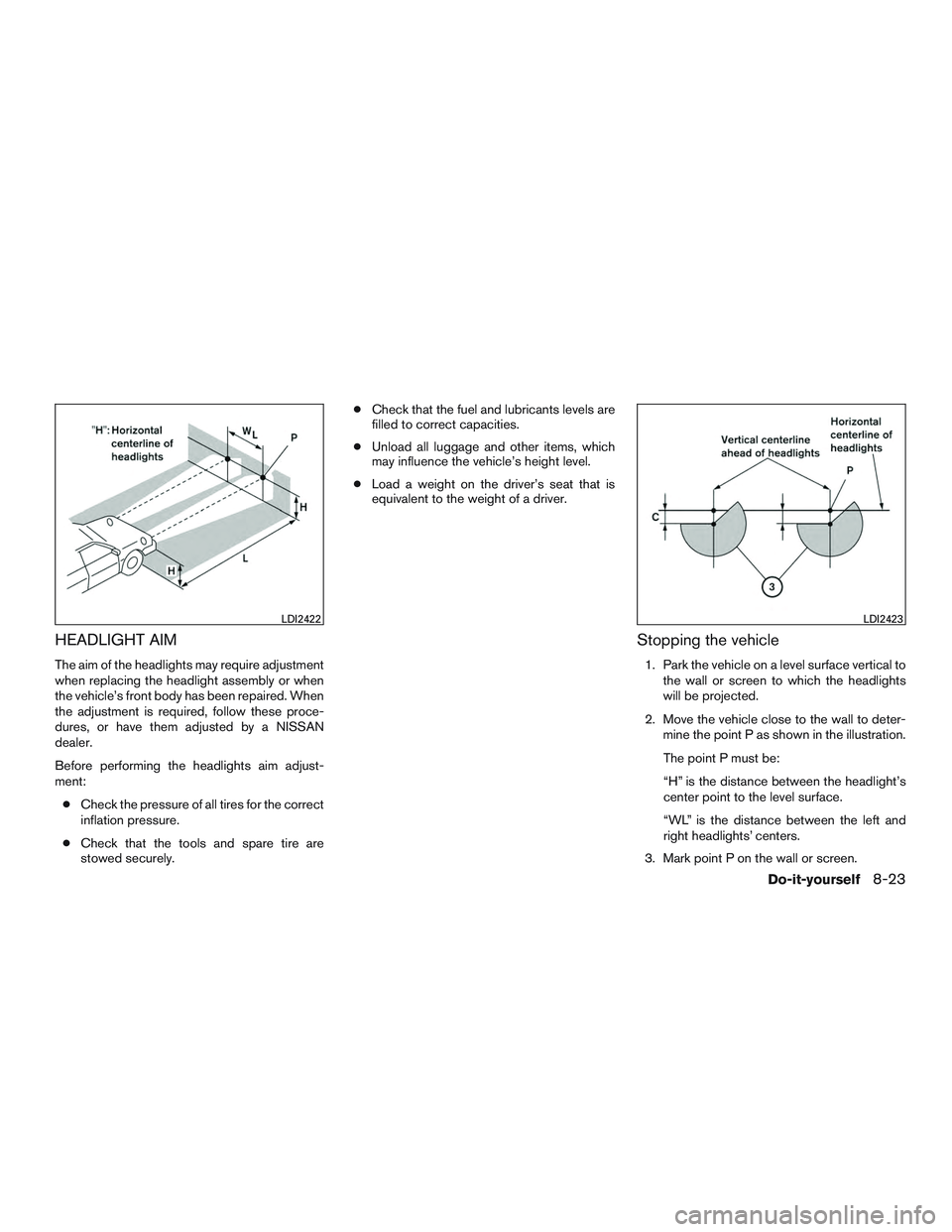
HEADLIGHT AIM
The aim of the headlights may require adjustment
when replacing the headlight assembly or when
the vehicle’s front body has been repaired. When
the adjustment is required, follow these proce-
dures, or have them adjusted by a NISSAN
dealer.
Before performing the headlights aim adjust-
ment:● Check the pressure of all tires for the correct
inflation pressure.
● Check that the tools and spare tire are
stowed securely. ●
Check that the fuel and lubricants levels are
filled to correct capacities.
● Unload all luggage and other items, which
may influence the vehicle’s height level.
● Load a weight on the driver’s seat that is
equivalent to the weight of a driver.
Stopping the vehicle
1. Park the vehicle on a level surface vertical to
the wall or screen to which the headlights
will be projected.
2. Move the vehicle close to the wall to deter- mine the point P as shown in the illustration.
The point P must be:
“H” is the distance between the headlight’s
center point to the level surface.
“WL” is the distance between the left and
right headlights’ centers.
3. Mark point P on the wall or screen.
LDI2422LDI2423
Do-it-yourself8-23
Page 311 of 318
Child restraints.......1-19,1-20,1-21,1-23
LATCH (Lower Anchors and Tethers for
CHildren) System ..............1-23
Precautions on child
restraints.........1-22,1-28,1-33,1-38
Top tether strap anchor point locations . .1-25
Child safety rear door lock ............3-5
Chimes, audible reminders ...........2-13
Cleaningexteriorandinterior........7-2,7-4
Clock setting
(models without Navigation System) . .4-34, 4-38
Clutch Clutch fluid ...................8-9
C.M.V.S.S. certification label .........10-11
Cold weather driving ...............5-25
Compact disc (CD) player ........4-35,4-39
Controls Audiocontrols(steeringwheel).......4-45
Heater and air conditioner controls . .4-8, 4-16
Coolant Capacities and recommended
fuel/lubricants ................10-2
Changing engine coolant ...........8-5
Checking engine coolant level ........8-5
Corrosionprotection ...............7-6
Cruisecontrol..................5-15
Cupholders................2-23,2-24
Curtain side-impact air bag system
(See supplemental side air bag and curtain
side-impact air bag system) ...........1-55
D
Daytime light system ...............2-18 Defroster switch
Rear window and outside mirror defroster
switch.....................2-17
Dimensionsandweights ............10-9
Dimmer switch for instrument panel ......2-19
Door locks .....................3-3
Door open warning light .............2-9
Doors ........................3-3
Drive belt .....................8-12
Driving Cold weather driving .............5-25
Driving with automatic transmission .....5-8
Driving with manual transmission ......5-13
Precautions when starting and driving ....5-2
Driving the vehicle .................5-8
E
Economy - fuel ..................5-18
Emission control information label ......10-11
Emission control system warranty .......10-18
Engine Before starting the engine ..........5-7
Block heater .................5-26
Capacities and recommended
fuel/lubricants ................10-2
Changingenginecoolant...........8-5
Changingengineoil..............8-7
Changing engine oil filter ...........8-8
Checking engine coolant level ........8-5
Checking engine oil level ...........8-6
Engine compartment check locations ....8-3
Engine cooling system ............8-4
Engineoil ...................8-6
Engine oil and oil filter recommendation . .10-6 Engine oil pressure warning light
.......2-9
Engine oil viscosity ..............10-7
Engine serial number ............10-11
Engine specifications ............10-8
Starting the engine ..............5-7
Event Data recorders .............10-20
Exhaust gas (Carbon monoxide) .........5-2
Explanation of maintenance items ........9-2
Explanation of scheduled maintenance items . .9-5
Extended storage switch ............8-19
F
Flashers (See hazard warning flasher switch) . .6-2
Flat tire .......................
6-2
Floor mat positioning aid .............7-5
Fluid Automatic transmission fluid (ATF) ......8-8
Brake fluid ...................8-9
Capacities and recommended
fuel/lubricants ................10-2
Clutch fluid ...................8-9
Enginecoolant.................8-4
Engineoil ...................8-6
Front air bag system
(See supplemental restraint system) ......1-48
Frontseats.....................1-2
Fuel Capacities and recommended
fuel/lubricants ................10-2
Fuel economy ................5-18
Fuel-filler cap .................3-10
Fuel-filler lid .................3-10
Fuelgauge...................2-5
Fuel octane rating ..............10-5
11-2
Page 315 of 318
T
Tachometer ....................2-5
Theft (NISSAN Vehicle Immobilizer System) ,
engine start .................2-13,5-7
Three-way catalyst ................5-2
Tilting steering wheel ..............3-12
Tire Flat tire .....................6-2
Spare tire ................6-3,8-39
Tire and Loading Information label ....10-12
Tire chains ..................8-37
Tirepressure .............8-31,8-31
Tirerotation..................8-37
Types of tires .................8-36
Uniform tire quality grading ........10-17
Wheels and tires ...........8-31,10-9
Wheel/tire size ................10-9
Towing Flattowing.................10-17
Trailertowing................10-17
Towing a trailer .................10-17
Towingyourvehicle...............6-13
Transmission Automatic transmission fluid (ATF) ......8-8
Driving with automatic transmission .....5-8
Driving with manual transmission ......5-13
Shiftleverlockrelease............5-11
Travel (See registering a vehicle in another
country) .....................10-10
Trip computer ...................2-6
Trip odometer ...................2-4
Turnsignalswitch................2-19 U
Uniform tire quality grading ..........10-17
USB interface ..................4-41
Audio file operation .............4-42
V
Vanity mirror ...................3-13
Vehicle dimensions and weights ........10-9
Vehicle dynamic control (VDC) off switch . . .2-21
Vehicle dynamic control (VDC) system .....5-23
Vehicle Dynamic Control (VDC) system ....5-23
Vehicle identification ..............10-10
Vehicle identification number (VIN) ......10-10
Vehicle identification number (VIN)
(Chassis number) ...............10-10
Vehicle identification number (VIN) plate . . .10-10
Vehicle immobilizer system ........2-13,5-7
Vehicle loading information ......10-13,10-14
Vehicle recovery .................6-15
Vehicle security system .............2-13
Vehicle security system (NISSAN Vehicle
Immobilizer System) , engine start .....2-13,5-7
Ventilators .....................4-8
Visors.......................3-12
Voice Prompt Interrupt ..............4-50
W
Warning Air bag warning light .........1-58,2-10
Anti-lock brake warning light .........2-8
Battery charge warning light .........2-8Brake warning light
..............2-8
Door open warning light ...........2-9
Engine oil pressure warning light .......2-9
Hazard warning flasher switch ........6-2
Loose fuel cap warning ............2-5
Low windshield-washer fluid warning
light...................... .2-9
Passenger air bag and status light .....
1-50
Seat belt warning light ........1-12,2-10
Supplemental air bag warning
light ..................1-58,2-10
Vehicle security system ...........2-13
Warning/indicator lights and audible
reminders ...................2-10
Warning labels (for SRS) ..........1-58
Warning/indicator lights and audible
reminders .....................2-10
Audible reminders ..............2-10
Indicatorlights................2-10
Warninglights................2-10
Warninglights..................2-10
Warning lights, indicator lights and audible
reminders .....................2-7
Washer switch Rear window wiper and washer
switches ...................2-16
Weights(Seedimensionsandweights)....10-9
Wheels and tires .............8-31,10-9
Wheel/tire size ..................10-9
When traveling or registering in another
country .....................10-10
Windows .....................2-26
Locking passengers’ windows .......2-27
Manual windows ...............2-28
Power rear windows .............2-27
Power windows ...............2-26
11-6
Page 317 of 318
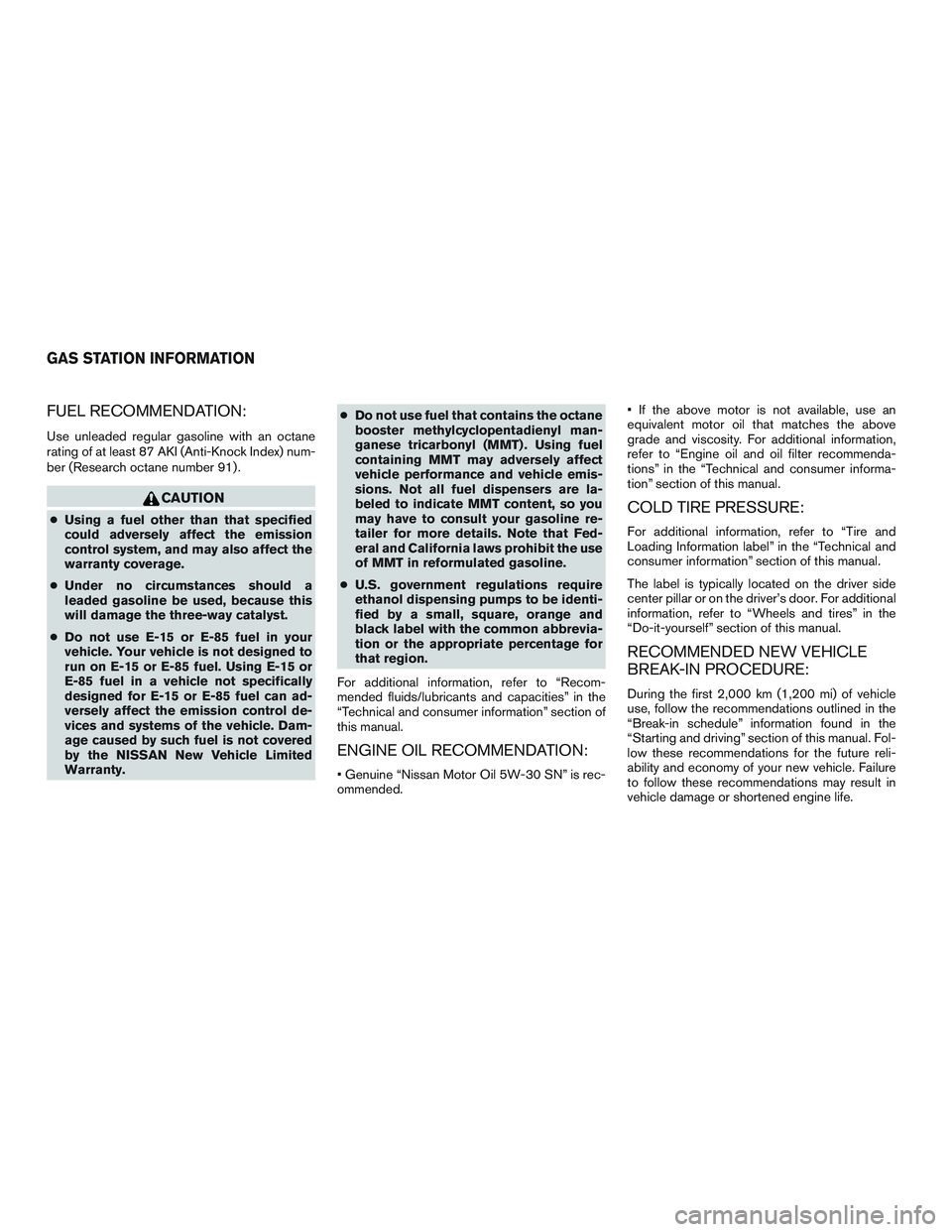
FUEL RECOMMENDATION:
Use unleaded regular gasoline with an octane
rating of at least 87 AKI (Anti-Knock Index) num-
ber (Research octane number 91) .
CAUTION
●Using a fuel other than that specified
could adversely affect the emission
control system, and may also affect the
warranty coverage.
● Under no circumstances should a
leaded gasoline be used, because this
will damage the three-way catalyst.
● Do not use E-15 or E-85 fuel in your
vehicle. Your vehicle is not designed to
run on E-15 or E-85 fuel. Using E-15 or
E-85 fuel in a vehicle not specifically
designed for E-15 or E-85 fuel can ad-
versely affect the emission control de-
vices and systems of the vehicle. Dam-
age caused by such fuel is not covered
by the NISSAN New Vehicle Limited
Warranty. ●
Do not use fuel that contains the octane
booster methylcyclopentadienyl man-
ganese tricarbonyl (MMT) . Using fuel
containing MMT may adversely affect
vehicle performance and vehicle emis-
sions. Not all fuel dispensers are la-
beled to indicate MMT content, so you
may have to consult your gasoline re-
tailer for more details. Note that Fed-
eral and California laws prohibit the use
of MMT in reformulated gasoline.
● U.S. government regulations require
ethanol dispensing pumps to be identi-
fied by a small, square, orange and
black label with the common abbrevia-
tion or the appropriate percentage for
that region.
For additional information, refer to “Recom-
mended fluids/lubricants and capacities” in the
“Technical and consumer information” section of
this manual.
ENGINE OIL RECOMMENDATION:
• Genuine “Nissan Motor Oil 5W-30 SN” is rec-
ommended. • If the above motor is not available, use an
equivalent motor oil that matches the above
grade and viscosity. For additional information,
refer to “Engine oil and oil filter recommenda-
tions” in the “Technical and consumer informa-
tion” section of this manual.
COLD TIRE PRESSURE:
For additional information, refer to “Tire and
Loading Information label” in the “Technical and
consumer information” section of this manual.
The label is typically located on the driver side
center pillar or on the driver’s door. For additional
information, refer to “Wheels and tires” in the
“Do-it-yourself” section of this manual.
RECOMMENDED NEW VEHICLE
BREAK-IN PROCEDURE:
During the first 2,000 km (1,200 mi) of vehicle
use, follow the recommendations outlined in the
“Break-in schedule” information found in the
“Starting and driving” section of this manual. Fol-
low these recommendations for the future reli-
ability and economy of your new vehicle. Failure
to follow these recommendations may result in
vehicle damage or shortened engine life.
GAS STATION INFORMATION