ECU NISSAN MICRA 2018 Owner´s Manual
[x] Cancel search | Manufacturer: NISSAN, Model Year: 2018, Model line: MICRA, Model: NISSAN MICRA 2018Pages: 330, PDF Size: 3.9 MB
Page 38 of 330
All Canadian provinces or territories require
the use of approved child restraints for in-
fants and small children. For additional in-
formation, refer to “Child restraints” in this
section.
A child restraint may be secured in the ve-
hicle by using either the LATCH (Lower An-
chors and Tethers for CHildren) system or
with the vehicle seat belt. For additional
information, refer to “Child restraints” in this
section.
NISSAN recommends that all pre-teens
and children be restrained in the rear
seat. Studies show that children are
safer when properly restrained in the
rear seat than in the front seat.
This is especially important because
your vehicle has a supplemental re-
straint system (air bag system) for the
front passenger. For additional informa-
tion, refer to “Supplemental Restraint
System (SRS)” in this section.
INFANTS
Infants up to at least 1 year old should be
placed in a rear-facing child restraint.
NISSAN recommends that infants be
placed in child restraints that comply with
Canadian Motor Vehicle Safety Standards.You should choose a child restraint that fits
your vehicle and always follow the manu-
facturer’s instructions for installation and
use.
SMALL CHILDREN
Children that are over 1 year old and weigh
at least 9 kg (20 lbs.) should remain in a
rear-facing child restraint as long as pos-
sible up to the height or weight limit of the
child restraint. Children who outgrow the
height or weight limit of the rear-facing
child restraint and are at least 1 year old
should be secured in a forward-facing child
restraint with a harness. Refer to the manu-
facturer’s instructions for minimum and
maximum weight and height recommen-
dations. NISSAN recommends that small
children be placed in child restraints that
comply with Canadian Motor Vehicle Safety
Standards. You should choose a child re-
straint that fits your vehicle and always fol-
low the manufacturer’s instructions for in-
stallation and use.
LARGER CHILDREN
Children should remain in a forward-facing
child restraint with a harness until they
reach the maximum height or weight limit
allowed by the child restraint manufac-
turer.
Once a child outgrows the height or weight
limit of the harness-equipped forward-
facing child restraint, NISSAN recommends
that the child be placed in a commercially
available booster seat to obtain proper
seat belt fit. For a seat belt to fit properly, the
booster seat should raise the child so that
the shoulder belt is properly positioned
across the chest and the top, middle por-
tion of the shoulder. The shoulder belt
should not cross the neck or face and
should not fall off the shoulder. The lap belt
should lie snugly across the lower hips or
upper thighs, not the abdomen. A booster
seat can only be used in seating positions
that have a three-point type seat belt. The
booster seat should fit the vehicle seat and
have a label certif ying that it complies with
Canadian Motor Vehicle Safety Standards.
Safety—Seats, seat belts and supplemental restraint system1-21
Page 41 of 330
– Be sure to purchase a child re-straint that will fit the child and ve-
hicle. Some child restraints may
not fit properly in your vehicle.
– Child restraint anchorages are de- signed to withstand only those
loads imposed by correctly fitted
child restraints. Under no circum-
stances are they to be used to at-
tach adult seat belts, or other items
or equipment to the vehicle. Doing
so could damage the child re-
straint anchorages. The child re-
straint will not be properly in-
stalled using the damaged
anchorage, and a child could be se-
riously injured or killed in a
collision.
– Never use the anchor points for adult seat belts or harnesses.
– A child restraint with a top tether strap should not be used in the
front passenger seat.
– Keep seatbacks as upright as pos- sible af ter fitting the child
restraint. – Infants and children should always
be placed in an appropriate child
restraint while in the vehicle.
∙ When the child restraint is not in use, keep it secured with the LATCH system
or a seat belt. In a sudden stop or col-
lision, loose objects can injure occu-
pants or damage the vehicle.
CAUTION
A child restraint in a closed vehicle can
become very hot. Check the seating
surface and buckles before placing a
child in the child restraint.
This vehicle is equipped with a universal
child restraint anchor system, referred to
as the LATCH (Lower Anchors and Tethers
for CHildren) system. Some child restraints
include rigid or webbing-mounted attach-
ments that can be connected to these an-
chors. For additional information, refer to
“LATCH (Lower Anchors and Tethers for
CHildren) system” in this section.
If you do not have a LATCH compatible
child restraint, the vehicle seat belts can be
used. Several manufacturers offer child re-
straints for infants and children of various
sizes. When selecting any child restraint,
keep the following points in mind:
∙ Choose only a restraint with a label cer- tif ying that it complies with Canadian
Motor Vehicle Safety Standard 213.
∙ Check the child restraint in your vehicle to be sure it is compatible with the vehi-
cle’s seat and seat belt system.
∙ If the child restraint is compatible with your vehicle, place your child in the child
restraint and check the various adjust-
ments to be sure the child restraint is
compatible with your child. Choose a
child restraint that is designed for your
child’s height and weight. Always follow
all recommended procedures.
∙ If the combined weight of the child and child restraint is less than 65 lbs (29.5 kg),
you may use either the LATCH anchors
or the seat belt to install the child re-
straint (not both at the same time).
∙ If the combined weight of the child and child restraint is greater than 65 lbs
(29.5 kg), use the vehicle’s seat belt (not
the lower anchors) to install the child
restraint.
1-24Safety—Seats, seat belts and supplemental restraint system
Page 42 of 330
∙ Be sure to follow the child restraintmanufacturer’s instructions for installa-
tion.
All Canadian provinces or territories re-
quire that infants and small children be
restrained in an approved child restraint
at all times while the vehicle is being op-
erated. Canadian law requires the top
tether strap on forward-facing child re-
straints be secured to the designated
anchor point on the vehicle.
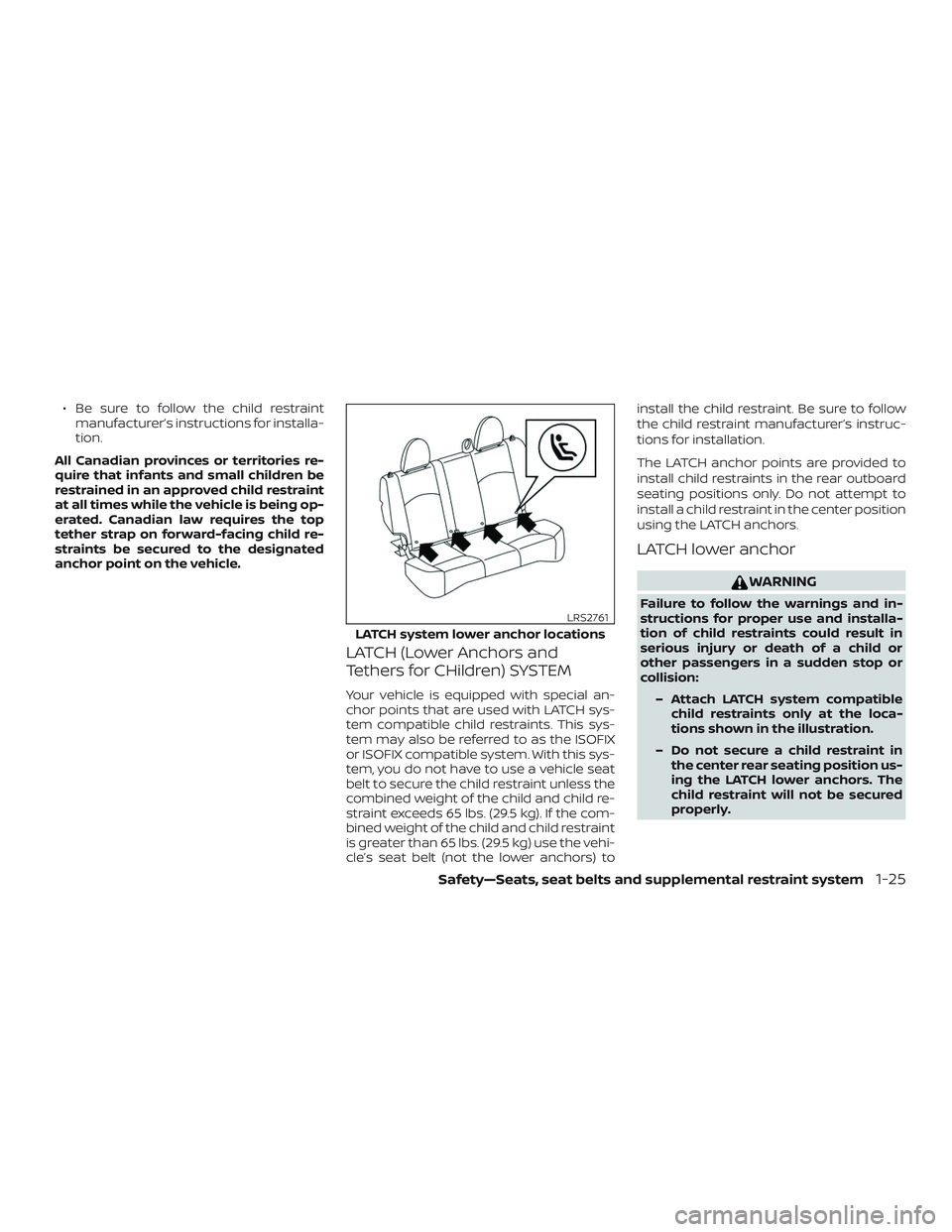
LATCH (Lower Anchors and
Tethers for CHildren) SYSTEM
Your vehicle is equipped with special an-
chor points that are used with LATCH sys-
tem compatible child restraints. This sys-
tem may also be referred to as the ISOFIX
or ISOFIX compatible system. With this sys-
tem, you do not have to use a vehicle seat
belt to secure the child restraint unless the
combined weight of the child and child re-
straint exceeds 65 lbs. (29.5 kg). If the com-
bined weight of the child and child restraint
is greater than 65 lbs. (29.5 kg) use the vehi-
cle’s seat belt (not the lower anchors) to install the child restraint. Be sure to follow
the child restraint manufacturer’s instruc-
tions for installation.
The LATCH anchor points are provided to
install child restraints in the rear outboard
seating positions only. Do not attempt to
install a child restraint in the center position
using the LATCH anchors.
LATCH lower anchor
WARNING
Failure to follow the warnings and in-
structions for proper use and installa-
tion of child restraints could result in
serious injury or death of a child or
other passengers in a sudden stop or
collision:
– Attach LATCH system compatiblechild restraints only at the loca-
tions shown in the illustration.
– Do not secure a child restraint in the center rear seating position us-
ing the LATCH lower anchors. The
child restraint will not be secured
properly.
LATCH system lower anchor locations
LRS2761
Safety—Seats, seat belts and supplemental restraint system1-25
Page 43 of 330
– Inspect the lower anchors by in-serting your fingers into the lower
anchor area. Feel to make sure
there are no obstructions over the
anchors such as seat belt webbing
or seat cushion material. The child
restraint will not be secured prop-
erly if the lower anchors are
obstructed.
Child restraint anchorages are de-
signed to withstand only those loads
imposed by correctly fitted child re-
straints. Under no circumstances are
they to be used to attach adult seat
belts, or other items or equipment to
the vehicle. Doing so could damage the
child restraint anchorages. The child re-
straint will not be properly installed us-
ing the damaged anchorage, and a
child could be seriously injured or killed
in a collision.
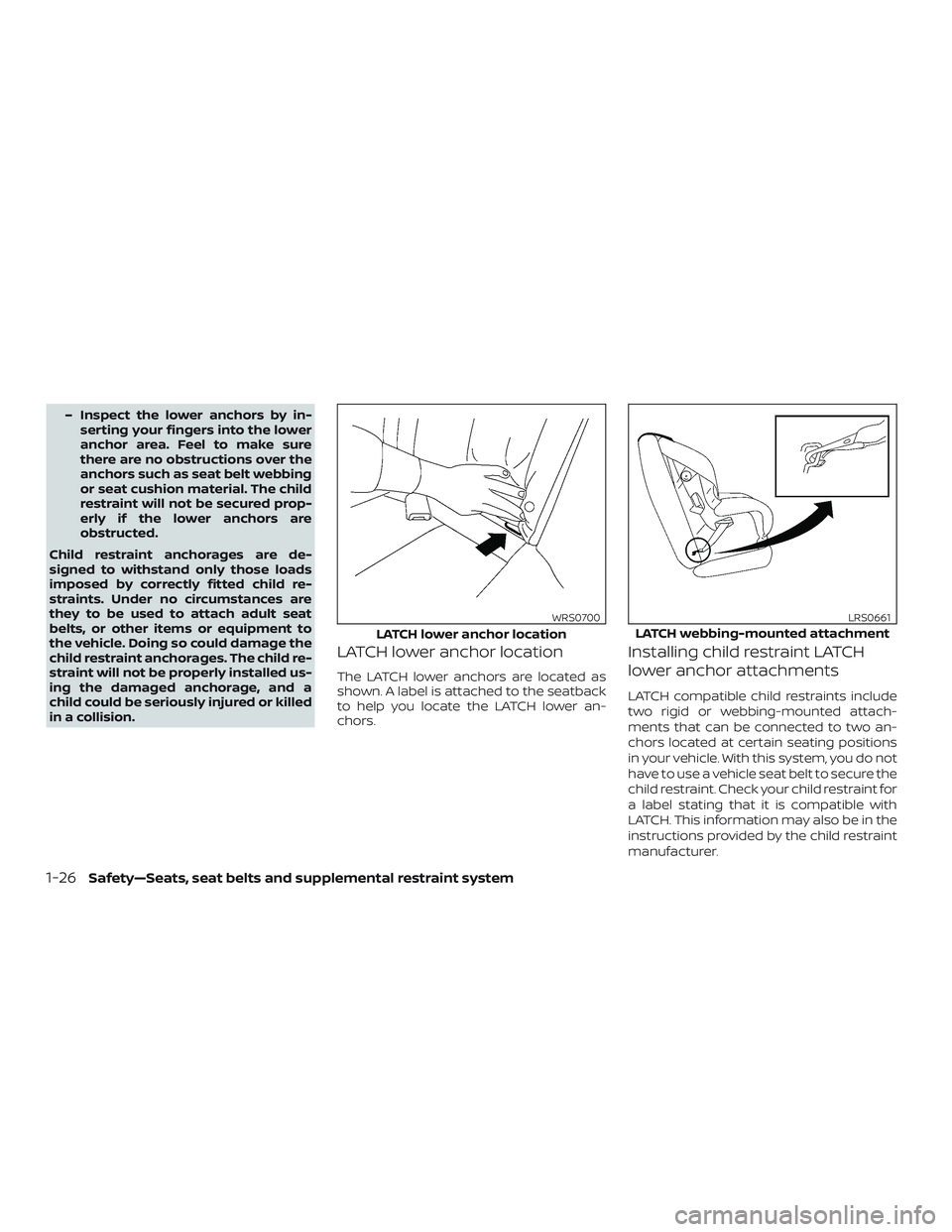
LATCH lower anchor location
The LATCH lower anchors are located as
shown. A label is attached to the seatback
to help you locate the LATCH lower an-
chors.
Installing child restraint LATCH
lower anchor attachments
LATCH compatible child restraints include
two rigid or webbing-mounted attach-
ments that can be connected to two an-
chors located at certain seating positions
in your vehicle. With this system, you do not
have to use a vehicle seat belt to secure the
child restraint. Check your child restraint for
a label stating that it is compatible with
LATCH. This information may also be in the
instructions provided by the child restraint
manufacturer.
LATCH lower anchor location
WRS0700
LATCH webbing-mounted attachment
LRS0661
1-26Safety—Seats, seat belts and supplemental restraint system
Page 45 of 330
Top tether anchor point locations
WARNING
Child restraint anchorages are de-
signed to withstand only those loads
imposed by correctly fitted child re-
straints. Under no circumstances are
they to be used to attach adult seat
belts, or other items or equipment to
the vehicle. Doing so could damage the
child restraint anchorages. The child re-
straint will not be properly installed us-
ing the damaged anchorage, and a
child could be seriously injured or killed
in a collision.
The child restraint top tether strap must be
used when installing the child restraint with
the LATCH lower anchor attachments or
seat belts. For additional information, refer
to “Installing top tether strap” in this sec-
tion.
If you have any questions when install-
ing a top tether strap child restraint, it is
recommended that you visit a NISSAN
dealer for this service.
REAR-FACING CHILD RESTRAINT
INSTALLATION USING LATCH
For additional information, refer to all Warn-
ings and Cautions in the “Child safety” and
“Child restraints” sections of this manual
before installing a child restraint.
Do not use the lower anchors if the com-
bined weight of the child and the child re-
straint exceeds 65 lbs (29.5 kg). If the com-
bined weight of the child and the child
restraint is greater than 65 lbs (29.5 kg), use
the vehicle’s seat belt (not the lower an-
chors) to install the child restraint. Be sure
to follow the child restraint manufacturer’s
instructions for installation.
Follow these steps to install a rear-facing
child restraint using the LATCH system: 1. Position the child restraint on the seat. Always follow the child restraint manu-
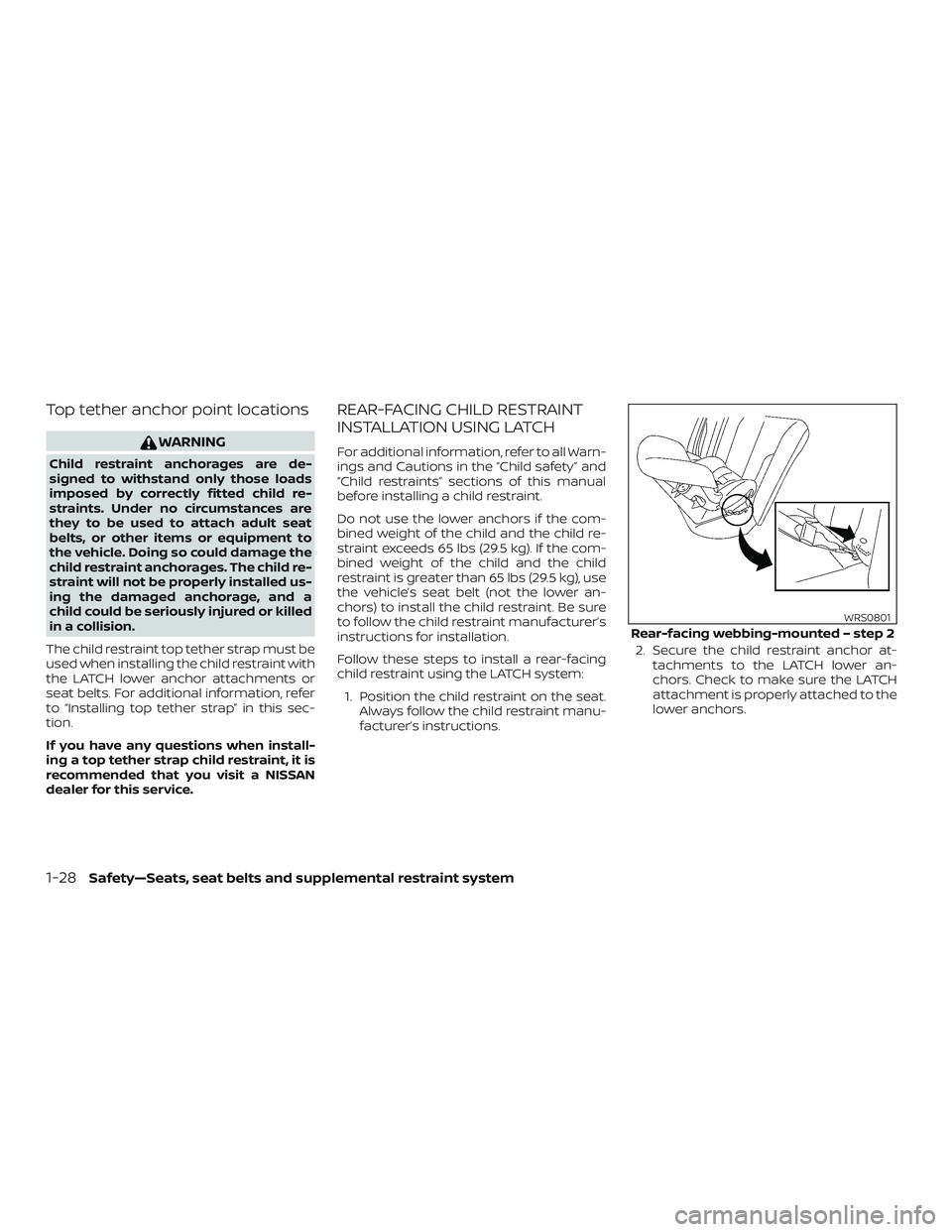
facturer’s instructions. 2. Secure the child restraint anchor at-
tachments to the LATCH lower an-
chors. Check to make sure the LATCH
attachment is properly attached to the
lower anchors.
Rear-facing webbing-mounted – step 2
WRS0801
1-28Safety—Seats, seat belts and supplemental restraint system
Page 46 of 330
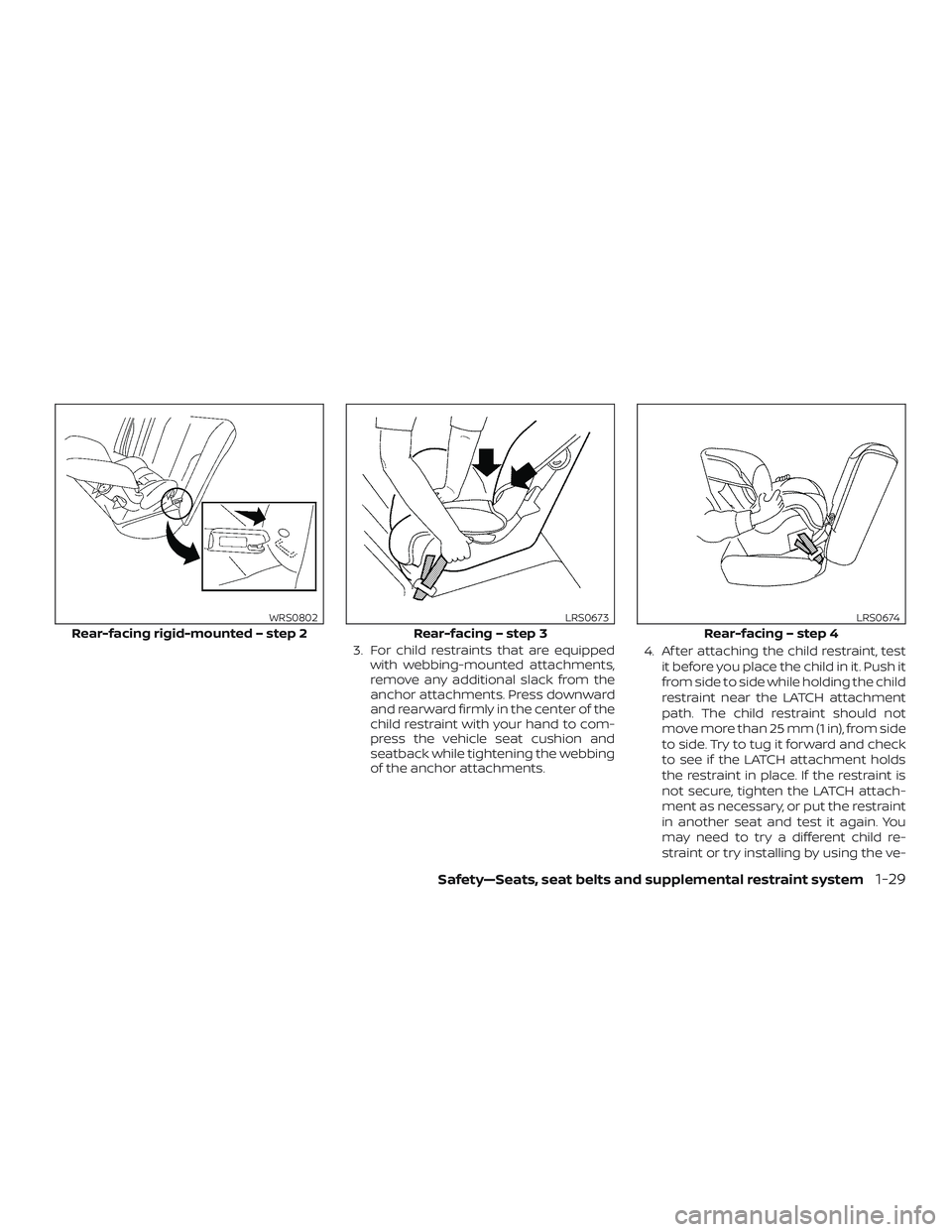
3. For child restraints that are equippedwith webbing-mounted attachments,
remove any additional slack from the
anchor attachments. Press downward
and rearward firmly in the center of the
child restraint with your hand to com-
press the vehicle seat cushion and
seatback while tightening the webbing
of the anchor attachments. 4. Af ter attaching the child restraint, test
it before you place the child in it. Push it
from side to side while holding the child
restraint near the LATCH attachment
path. The child restraint should not
move more than 25 mm (1 in), from side
to side. Try to tug it forward and check
to see if the LATCH attachment holds
the restraint in place. If the restraint is
not secure, tighten the LATCH attach-
ment as necessary, or put the restraint
in another seat and test it again. You
may need to try a different child re-
straint or try installing by using the ve-
Rear-facing rigid-mounted – step 2
WRS0802
Rear-facing – step 3
LRS0673
Rear-facing – step 4
LRS0674
Safety—Seats, seat belts and supplemental restraint system1-29
Page 47 of 330
hicle seat belt (if applicable). Not all
child restraints fit in all types of vehicles.
5. Check to make sure the child restraint is properly secured prior to each use. If
the child restraint is loose, repeat
steps 1 through 4.
REAR-FACING CHILD RESTRAINT
INSTALLATION USING THE SEAT
BELTS
WARNING
The three-point seat belt with Auto-
matic Locking Retractor (ALR) must be
used when installing a child restraint.
Failure to use the ALR mode will result in
the child restraint not being properly
secured. The restraint could tip over or
be loose and cause injury to a child in a
sudden stop or collision.
For additional information, refer to all Warn-
ings and Cautions in the “Child safety” and
“Child restraints” sections of this manual
before installing a child restraint. Do not use the lower anchors if the com-
bined weight of the child and the child re-
straint exceeds 65 lbs (29.5 kg). If the com-
bined weight of the child and the child
restraint is greater than 65 lbs (29.5 kg), use
the vehicle’s seat belt (not the lower an-
chors) to install the child restraint. Be sure
to follow the child restraint manufacturer’s
instructions for installation.
Follow these steps to install a rear-facing
child restraint using the vehicle seat belts in
the rear seats:
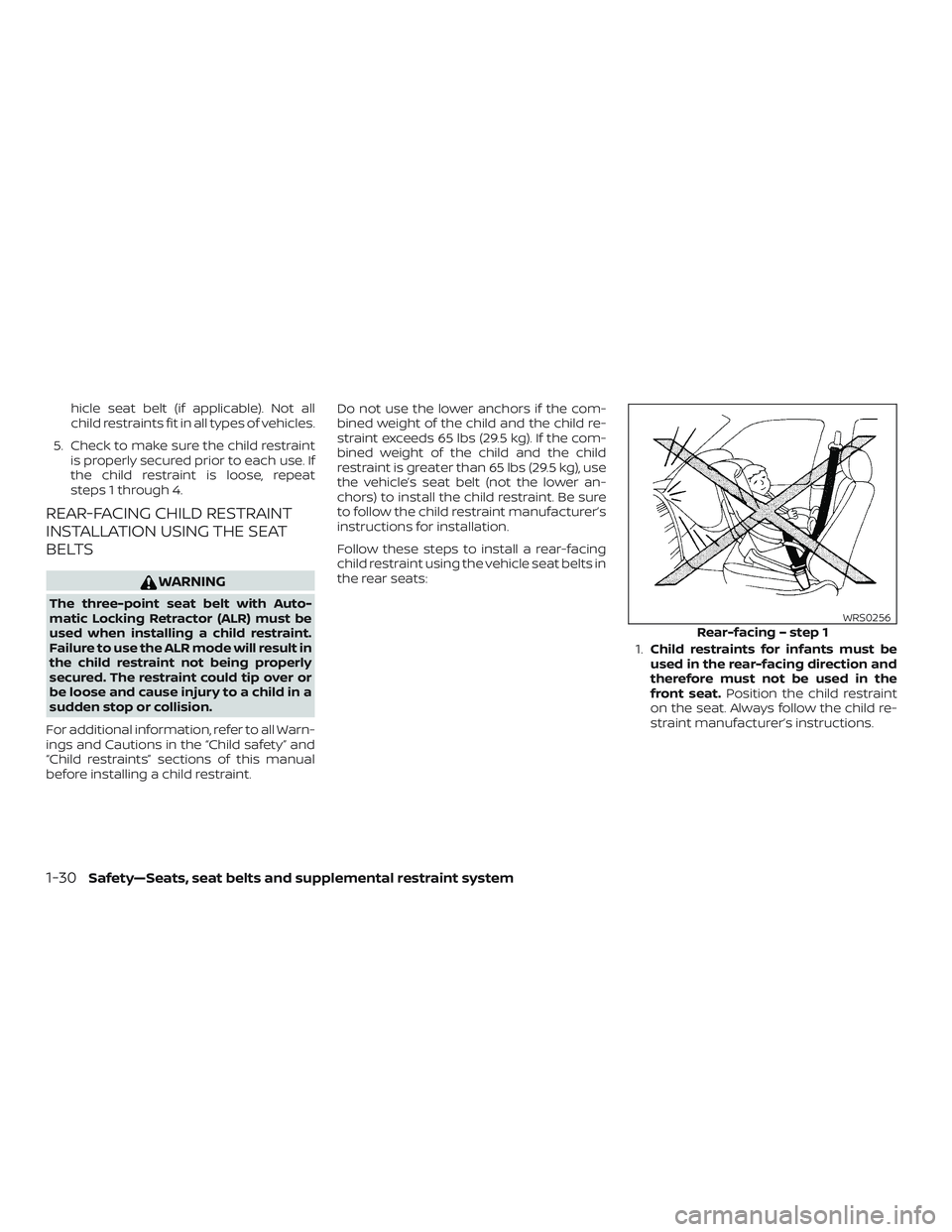
1.Child restraints for infants must be
used in the rear-facing direction and
therefore must not be used in the
front seat. Position the child restraint
on the seat. Always follow the child re-
straint manufacturer’s instructions.
Rear-facing – step 1WRS0256
1-30Safety—Seats, seat belts and supplemental restraint system
Page 49 of 330
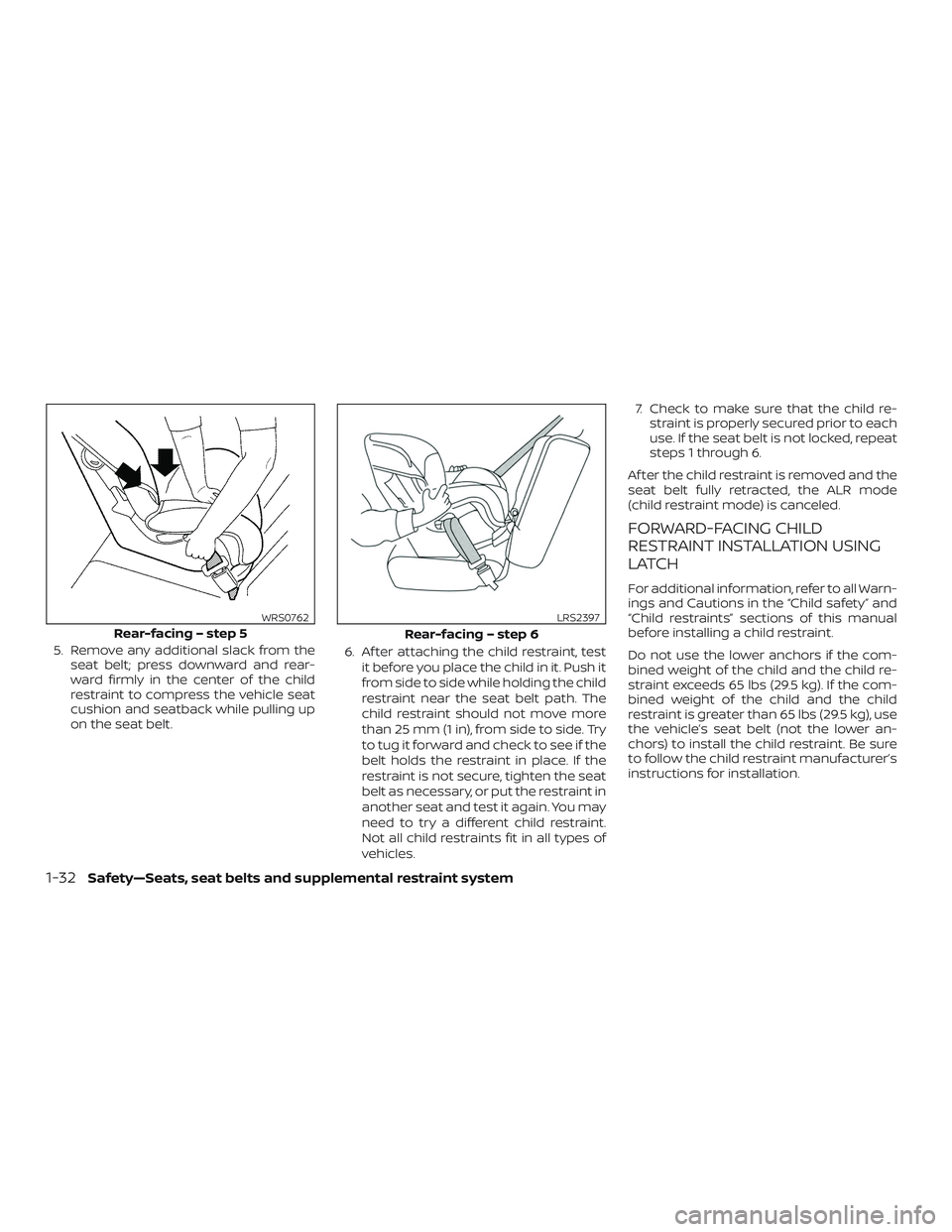
5. Remove any additional slack from theseat belt; press downward and rear-
ward firmly in the center of the child
restraint to compress the vehicle seat
cushion and seatback while pulling up
on the seat belt. 6. Af ter attaching the child restraint, test
it before you place the child in it. Push it
from side to side while holding the child
restraint near the seat belt path. The
child restraint should not move more
than 25 mm (1 in), from side to side. Try
to tug it forward and check to see if the
belt holds the restraint in place. If the
restraint is not secure, tighten the seat
belt as necessary, or put the restraint in
another seat and test it again. You may
need to try a different child restraint.
Not all child restraints fit in all types of
vehicles. 7. Check to make sure that the child re-
straint is properly secured prior to each
use. If the seat belt is not locked, repeat
steps 1 through 6.
Af ter the child restraint is removed and the
seat belt fully retracted, the ALR mode
(child restraint mode) is canceled.
FORWARD-FACING CHILD
RESTRAINT INSTALLATION USING
LATCH
For additional information, refer to all Warn-
ings and Cautions in the “Child safety” and
“Child restraints” sections of this manual
before installing a child restraint.
Do not use the lower anchors if the com-
bined weight of the child and the child re-
straint exceeds 65 lbs (29.5 kg). If the com-
bined weight of the child and the child
restraint is greater than 65 lbs (29.5 kg), use
the vehicle’s seat belt (not the lower an-
chors) to install the child restraint. Be sure
to follow the child restraint manufacturer’s
instructions for installation.
Rear-facing – step 5
WRS0762
Rear-facing – step 6
LRS2397
1-32Safety—Seats, seat belts and supplemental restraint system
Page 50 of 330
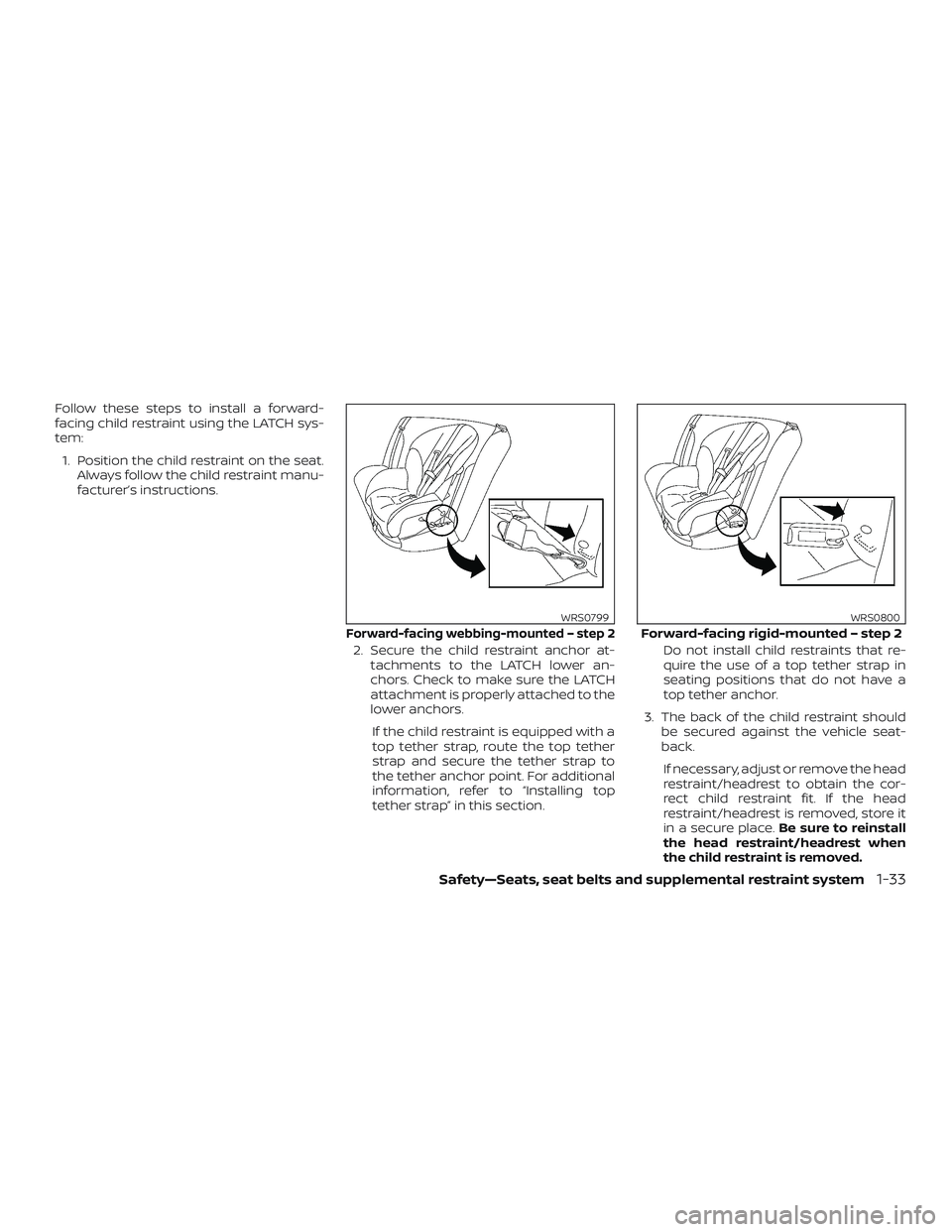
Follow these steps to install a forward-
facing child restraint using the LATCH sys-
tem:1. Position the child restraint on the seat. Always follow the child restraint manu-
facturer’s instructions.
2. Secure the child restraint anchor at-tachments to the LATCH lower an-
chors. Check to make sure the LATCH
attachment is properly attached to the
lower anchors.
If the child restraint is equipped with a
top tether strap, route the top tether
strap and secure the tether strap to
the tether anchor point. For additional
information, refer to “Installing top
tether strap” in this section. Do not install child restraints that re-
quire the use of a top tether strap in
seating positions that do not have a
top tether anchor.
3. The back of the child restraint should be secured against the vehicle seat-
back.
If necessary, adjust or remove the head
restraint/headrest to obtain the cor-
rect child restraint fit. If the head
restraint/headrest is removed, store it
in a secure place. Be sure to reinstall
the head restraint/headrest when
the child restraint is removed.
Forward-facing webbing-mounted – step 2
WRS0799
Forward-facing rigid-mounted – step 2
WRS0800
Safety—Seats, seat belts and supplemental restraint system1-33
Page 51 of 330
For additional information about head
restraint/headrest adjustment, refer to
“Head restraints/headrests” in this sec-
tion.
If the seating position does not have
an adjustable head restraint/headrest
and it is interfering with the proper
child restraint fit, try another seating
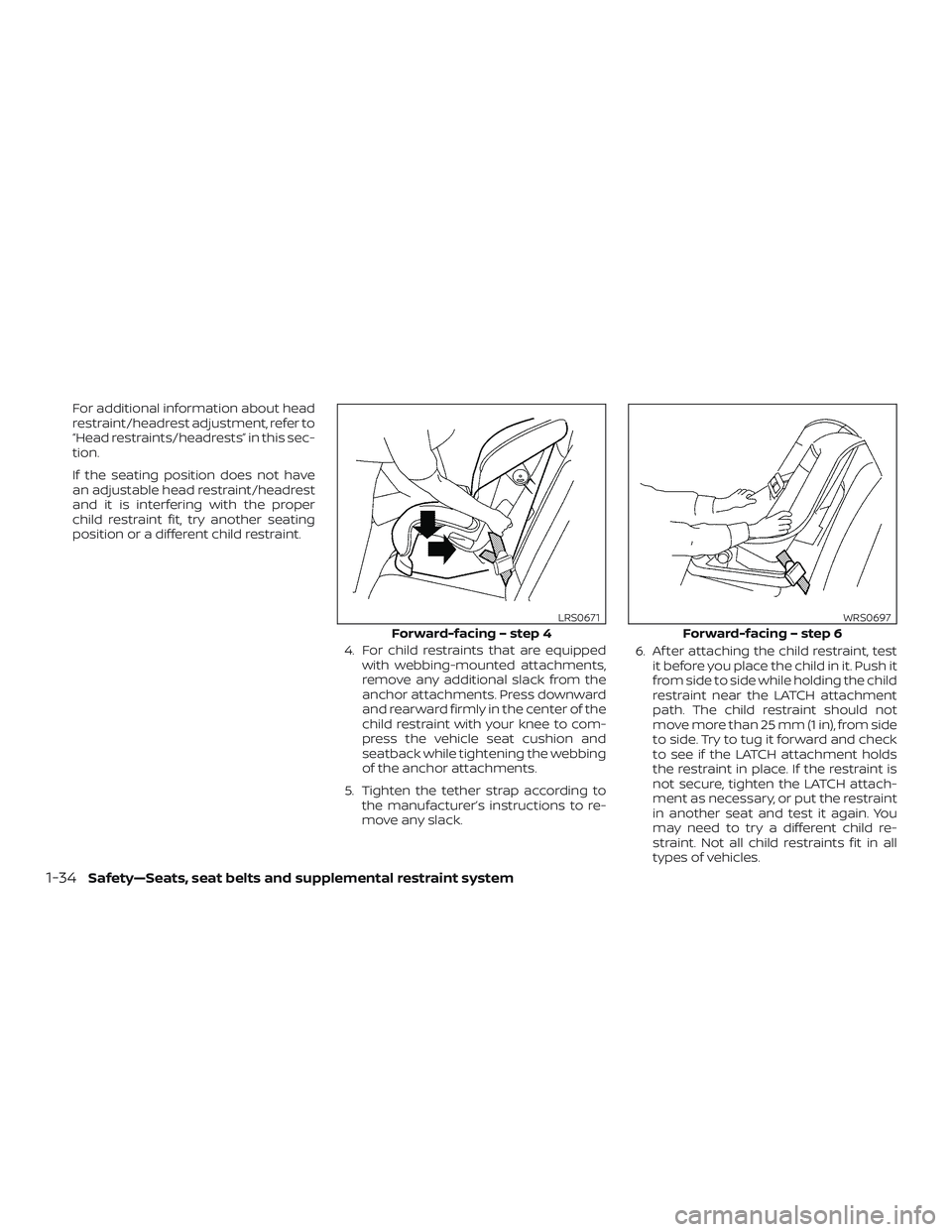
position or a different child restraint.4. For child restraints that are equippedwith webbing-mounted attachments,
remove any additional slack from the
anchor attachments. Press downward
and rearward firmly in the center of the
child restraint with your knee to com-
press the vehicle seat cushion and
seatback while tightening the webbing
of the anchor attachments.
5. Tighten the tether strap according to the manufacturer’s instructions to re-
move any slack. 6. Af ter attaching the child restraint, test
it before you place the child in it. Push it
from side to side while holding the child
restraint near the LATCH attachment
path. The child restraint should not
move more than 25 mm (1 in), from side
to side. Try to tug it forward and check
to see if the LATCH attachment holds
the restraint in place. If the restraint is
not secure, tighten the LATCH attach-
ment as necessary, or put the restraint
in another seat and test it again. You
may need to try a different child re-
straint. Not all child restraints fit in all
types of vehicles.
Forward-facing – step 4
LRS0671
Forward-facing – step 6
WRS0697
1-34Safety—Seats, seat belts and supplemental restraint system