page 2 NISSAN MICRA 2018 Owner´s Manual
[x] Cancel search | Manufacturer: NISSAN, Model Year: 2018, Model line: MICRA, Model: NISSAN MICRA 2018Pages: 330, PDF Size: 3.9 MB
Page 196 of 330
AUTOMATIC TRANSMISSION
(if so equipped)
The automatic transmission in your vehicle
is electronically controlled to produce
maximum power and smooth operation.
The recommended operating procedures
for this transmission are shown on the fol-
lowing pages. Follow these procedures for
maximum vehicle performance and driv-
ing enjoyment.
WARNING
∙ Do not depress the accelerator pedalwhile shif ting from P (Park) or N (Neu-
tral) to R (Reverse), D (Drive), 2 or 1.
Always depress the brake pedal until
shif ting is completed. Failure to do so
could cause you to lose control and
have an accident.
∙ The cold engine idle speed is high, so use caution when shif ting the trans-
mission into a forward or reverse po-
sition before the engine has warmed
up.
∙ Avoid revving up the engine while the vehicle is stopped. This could cause
unexpected vehicle movement. ∙ Do not downshif t abruptly on slippery
roads. This may cause a loss of
control.
CAUTION
∙ Never shif t to either the P (Park) or R(Reverse) position while the vehicle is
moving forward and P (Park) or D
(Drive) position while the vehicle is re-
versing. This could cause an accident
or damage the transmission.
∙ Except in an emergency, do not shif t to the N (Neutral) position while driv-
ing. Coasting with the transmission in
the N (Neutral) position may cause se-
rious damage to the transmission.
∙ Start the engine in either the P (Park) or N (Neutral) position. The engine will
not start in any other position. If it
does, have your vehicle checked. It is
recommended that you visit a NISSAN
dealer for this service.
∙ Shif t into the P (Park) position and ap- ply the parking brake when at a
standstill for longer than a short wait-
ing period. ∙ Keep the engine at idling speed while
shif ting from the N (Neutral) position
to any driving position.
∙ To avoid possible damage to your ve- hicle; when stopping the vehicle on an
uphill grade, do not hold the vehicle by
depressing the accelerator pedal. The
foot brake should be used for this
purpose.
Starting the vehicle
1. Af ter starting the engine, fully depress the foot brake pedal before moving the
shif t lever out of the P (Park) position.
2. Keep the foot brake pedal depressed and move the shif t lever to a drive po-
sition.
3. Release the parking brake, the foot brake pedal, and then gradually start
the vehicle in motion.
The automatic transmission is designed
so the foot brake pedal MUST be de-
pressed before shif ting from P (Park) to
any drive position while the ignition
switch is in the ON position.
DRIVING THE VEHICLE
Starting and driving5-9
Page 295 of 330
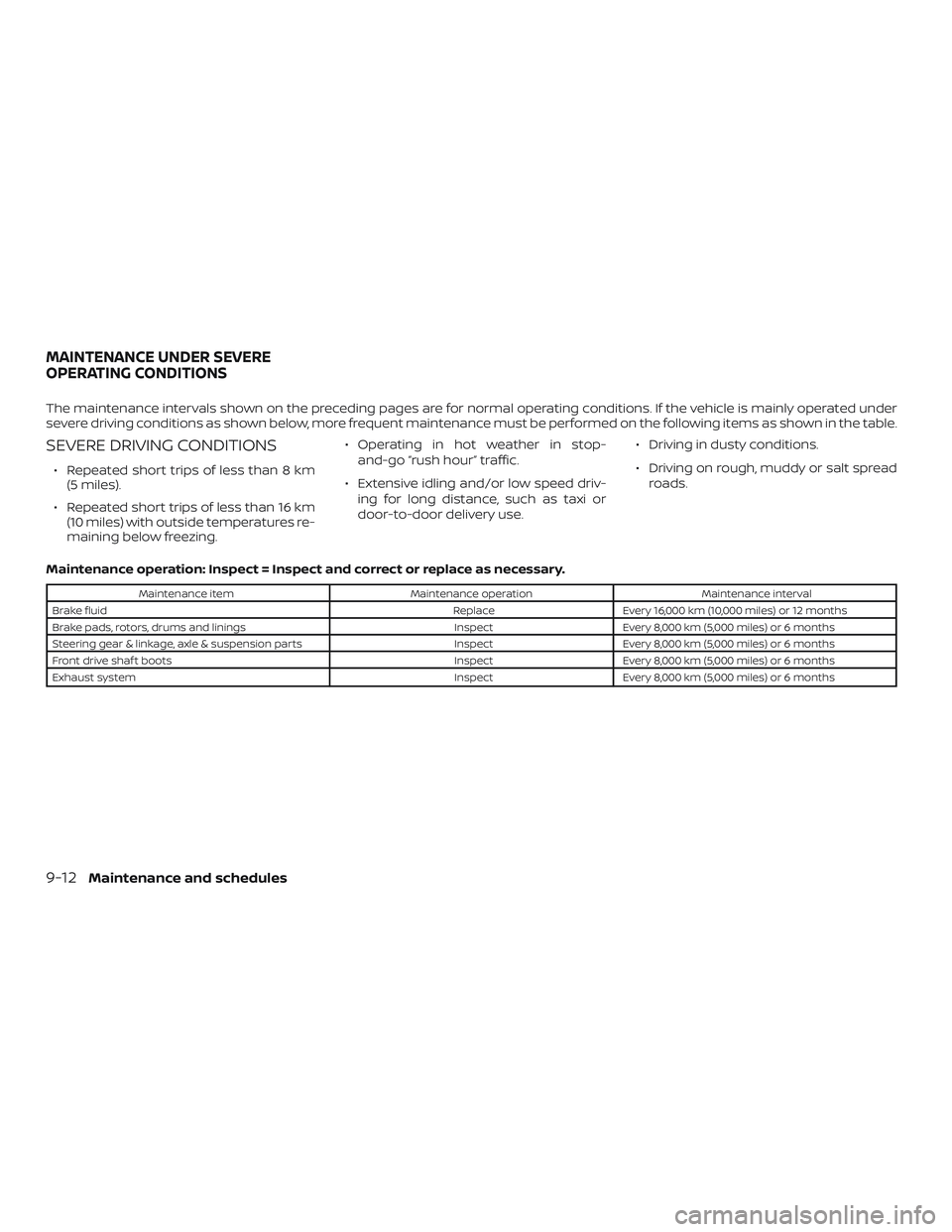
The maintenance intervals shown on the preceding pages are for normal operating conditions. If the vehicle is mainly operated under
severe driving conditions as shown below, more frequent maintenance must be performed on the following items as shown in the table.
SEVERE DRIVING CONDITIONS
∙ Repeated short trips of less than 8 km(5 miles).
∙ Repeated short trips of less than 16 km (10 miles) with outside temperatures re-
maining below freezing. ∙ Operating in hot weather in stop-
and-go “rush hour” traffic.
∙ Extensive idling and/or low speed driv- ing for long distance, such as taxi or
door-to-door delivery use. ∙ Driving in dusty conditions.
∙ Driving on rough, muddy or salt spread
roads.
Maintenance operation: Inspect = Inspect and correct or replace as necessary.
Maintenance item Maintenance operation Maintenance interval
Brake fluid ReplaceEvery 16,000 km (10,000 miles) or 12 months
Brake pads, rotors, drums and linings InspectEvery 8,000 km (5,000 miles) or 6 months
Steering gear & linkage, axle & suspension parts InspectEvery 8,000 km (5,000 miles) or 6 months
Front drive shaf t boots InspectEvery 8,000 km (5,000 miles) or 6 months
Exhaust system InspectEvery 8,000 km (5,000 miles) or 6 months
MAINTENANCE UNDER SEVERE
OPERATING CONDITIONS
9-12Maintenance and schedules