fuel NISSAN MICRA 2018 Owner´s Manual
[x] Cancel search | Manufacturer: NISSAN, Model Year: 2018, Model line: MICRA, Model: NISSAN MICRA 2018Pages: 330, PDF Size: 3.9 MB
Page 300 of 330
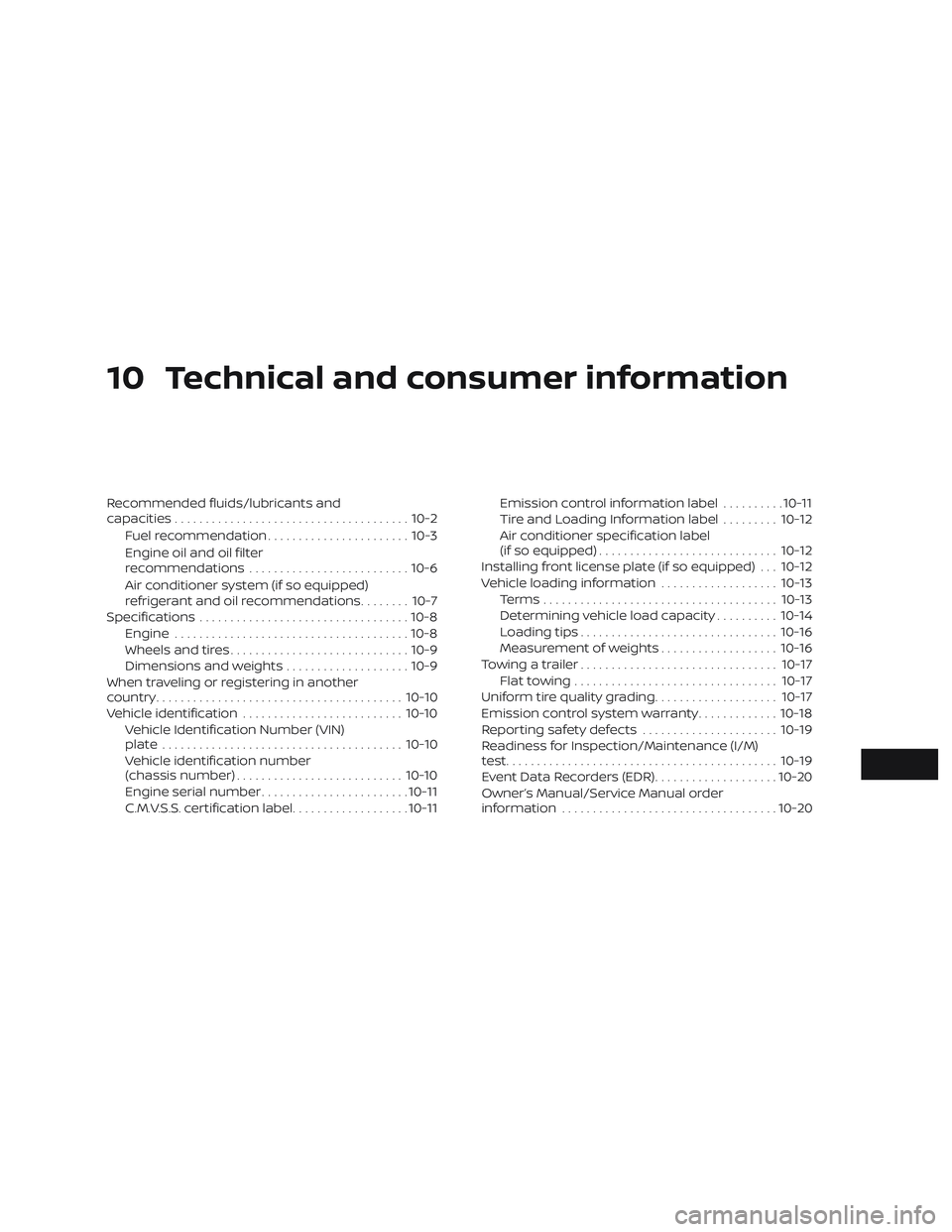
10 Technical and consumer information
Recommended fluids/lubricants and
capacities...................................... 10-2
Fuel recommendation ....................... 10-3
Engine oil and oil filter
recommendations .......................... 10-6
Air conditioner system (if so equipped)
refrigerant and oil recommendations ........10-7
Specifications .................................. 10-8
Engine ...................................... 10-8
Wheels and tires ............................. 10-9
Dimensions and weights ....................10-9
When traveling or registering in another
country ........................................ 10-10
Vehicle identification .......................... 10-10
Vehicle Identification Number (VIN)
plate ....................................... 10-10
Vehicle identification number
(chassis number) ........................... 10-10
Engine serial number ........................ 10-11
C.M.V.S.S. certification label ...................10-11Emission control information label
..........10-11
Tire and Loading Information label .........10-12
Air conditioner specification label
(if so equipped) ............................. 10-12
Installing front license plate (if so equipped) . . . 10-12
Vehicle loading information ...................10-13
Terms ...................................... 10-13
Determining vehicle load capacity ..........10-14
Loading tips ................................ 10-16
Measurement of weights ...................10-16
Towing a trailer ................................ 10-17
Flat towing ................................. 10-17
Uniform tire quality grading ....................10-17
Emission control system warranty .............10-18
Reporting safety defects ......................10-19
Readiness for Inspection/Maintenance (I/M)
test ............................................ 10-19
Event Data Recorders (EDR) ....................10-20
Owner’s Manual/Service Manual order
information ................................... 10-20
Page 301 of 330
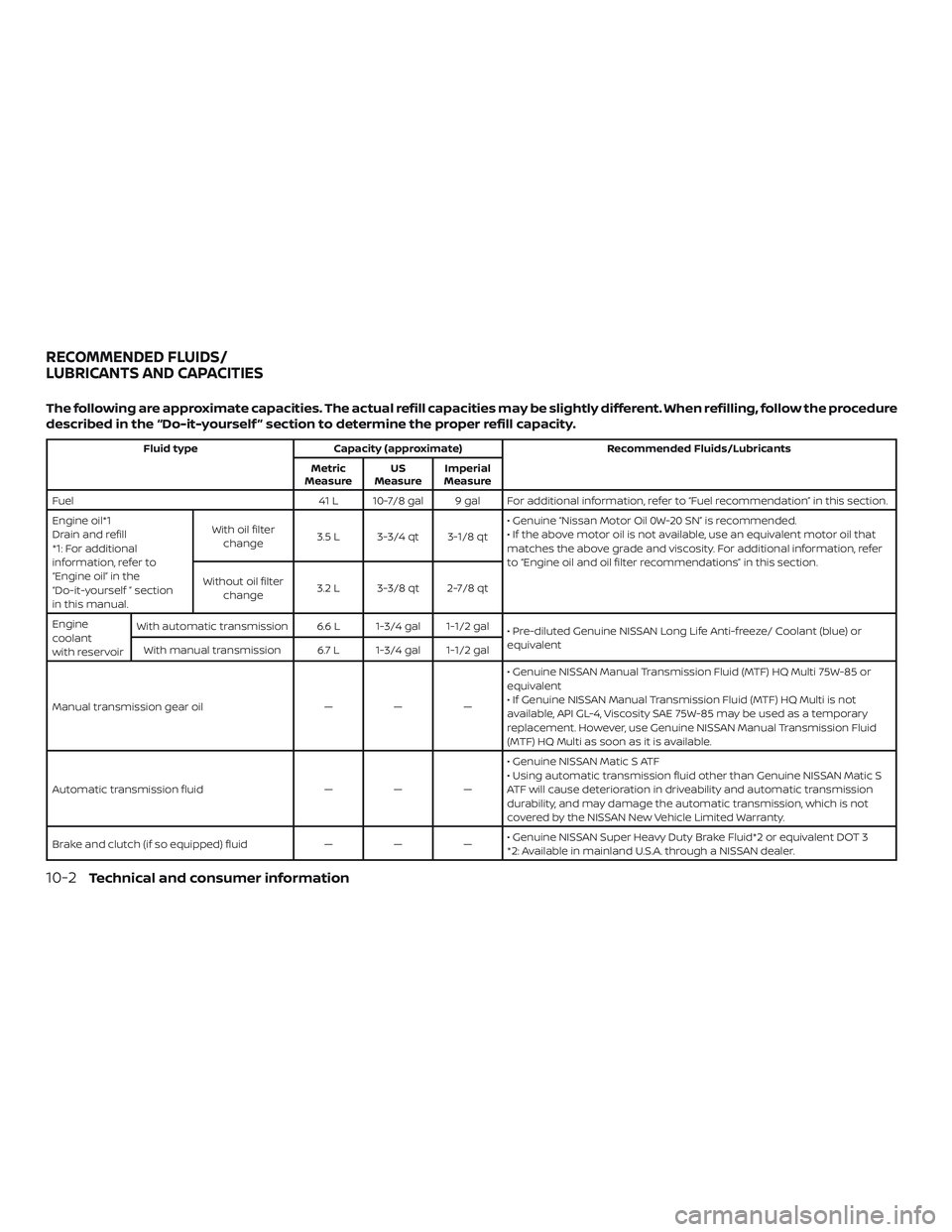
The following are approximate capacities. The actual refill capacities may be slightly different. When refilling, follow the procedure
described in the “Do-it-yourself ” section to determine the proper refill capacity.
Fluid typeCapacity (approximate) Recommended Fluids/Lubricants
Metric
Measure US
Measure Imperial
Measure
Fuel 41 L 10-7/8 gal 9 gal For additional information, refer to “Fuel recommendation” in this section.
Engine oil*1
Drain and refill
*1: For additional
information, refer to
“Engine oil” in the
“Do-it-yourself ” section
in this manual. With oil filter
change 3.5 L 3-3/4 qt 3-1/8 qt • Genuine “Nissan Motor Oil 0W-20 SN” is recommended.
• If the above motor oil is not available, use an equivalent motor oil that
matches the above grade and viscosity. For additional information, refer
to “Engine oil and oil filter recommendations” in this section.
Without oil filter change 3.2 L 3-3/8 qt 2-7/8 qt
Engine
coolant
with reservoir With automatic transmission 6.6 L 1-3/4 gal 1-1/2 gal
• Pre-diluted Genuine NISSAN Long Life Anti-freeze/ Coolant (blue) or
equivalent
With manual transmission 6.7 L 1-3/4 gal 1-1/2 gal
Manual transmission gear oil ———• Genuine NISSAN Manual Transmission Fluid (MTF) HQ Multi 75W-85 or
equivalent
• If Genuine NISSAN Manual Transmission Fluid (MTF) HQ Multi is not
available, API GL-4, Viscosity SAE 75W-85 may be used as a temporary
replacement. However, use Genuine NISSAN Manual Transmission Fluid
(MTF) HQ Multi as soon as it is available.
Automatic transmission fluid ———• Genuine NISSAN Matic S ATF
• Using automatic transmission fluid other than Genuine NISSAN Matic S
ATF will cause deterioration in driveability and automatic transmission
durability, and may damage the automatic transmission, which is not
covered by the NISSAN New Vehicle Limited Warranty.
Brake and clutch (if so equipped) fluid ———• Genuine NISSAN Super Heavy Duty Brake Fluid*2 or equivalent DOT 3
*2: Available in mainland U.S.A. through a NISSAN dealer.
RECOMMENDED FLUIDS/
LUBRICANTS AND CAPACITIES
10-2Technical and consumer information
Page 302 of 330
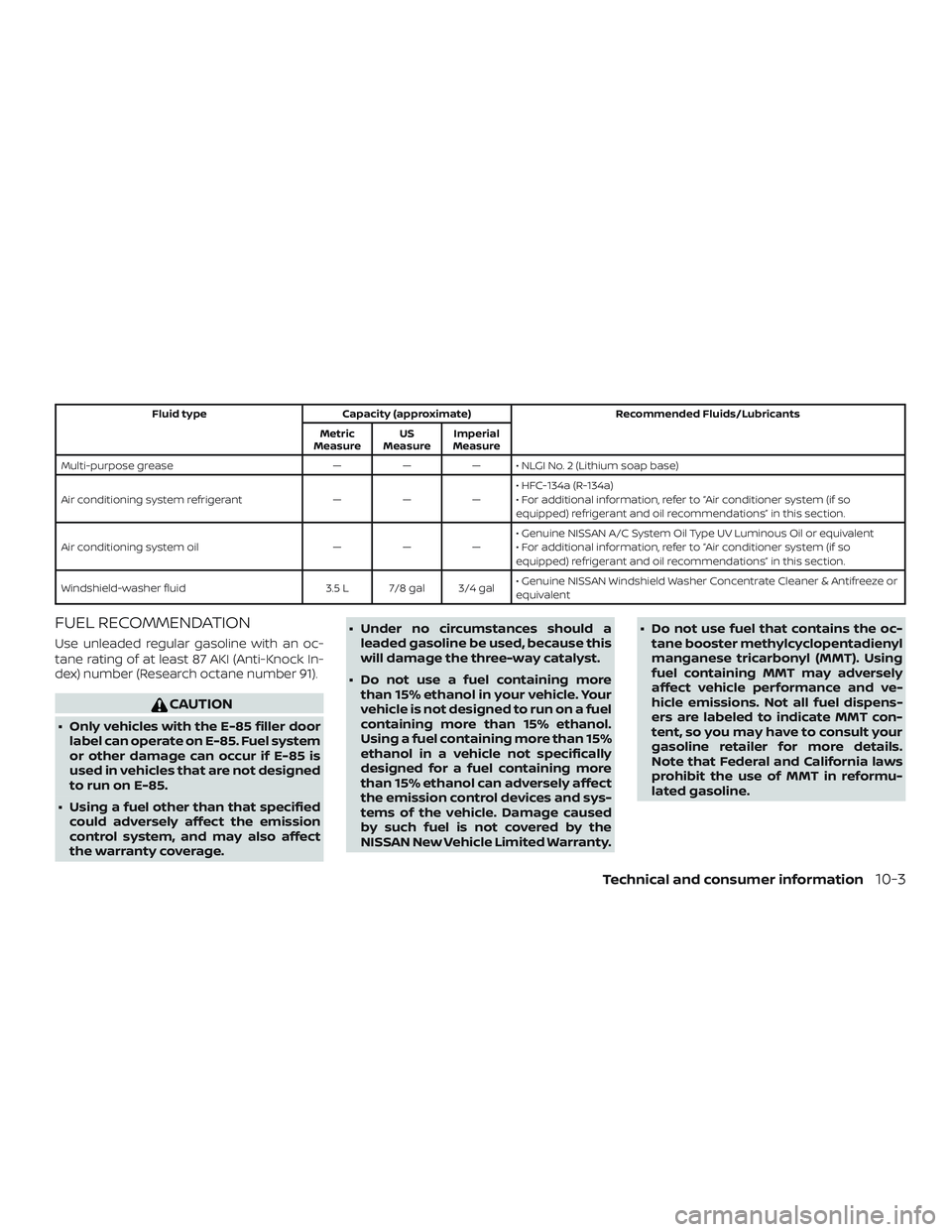
Fluid typeCapacity (approximate) Recommended Fluids/Lubricants
Metric
Measure US
Measure Imperial
Measure
Multi-purpose grease ——— • NLGI No. 2 (Lithium soap base)
Air conditioning system refrigerant ———• HFC-134a (R-134a)
• For additional information, refer to “Air conditioner system (if so
equipped) refrigerant and oil recommendations” in this section.
Air conditioning system oil ———• Genuine NISSAN A/C System Oil Type UV Luminous Oil or equivalent
• For additional information, refer to “Air conditioner system (if so
equipped) refrigerant and oil recommendations” in this section.
Windshield-washer fluid 3.5 L 7/8 gal 3/4 gal• Genuine NISSAN Windshield Washer Concentrate Cleaner & Antifreeze or
equivalent
FUEL RECOMMENDATION
Use unleaded regular gasoline with an oc-
tane rating of at least 87 AKI (Anti-Knock In-
dex) number (Research octane number 91).
CAUTION
∙ Only vehicles with the E-85 filler door
label can operate on E-85. Fuel system
or other damage can occur if E-85 is
used in vehicles that are not designed
to run on E-85.
∙ Using a fuel other than that specified could adversely affect the emission
control system, and may also affect
the warranty coverage. ∙ Under no circumstances should a
leaded gasoline be used, because this
will damage the three-way catalyst.
∙ Do not use a fuel containing more than 15% ethanol in your vehicle. Your
vehicle is not designed to run on a fuel
containing more than 15% ethanol.
Using a fuel containing more than 15%
ethanol in a vehicle not specifically
designed for a fuel containing more
than 15% ethanol can adversely affect
the emission control devices and sys-
tems of the vehicle. Damage caused
by such fuel is not covered by the
NISSAN New Vehicle Limited Warranty. ∙ Do not use fuel that contains the oc-
tane booster methylcyclopentadienyl
manganese tricarbonyl (MMT). Using
fuel containing MMT may adversely
affect vehicle performance and ve-
hicle emissions. Not all fuel dispens-
ers are labeled to indicate MMT con-
tent, so you may have to consult your
gasoline retailer for more details.
Note that Federal and California laws
prohibit the use of MMT in reformu-
lated gasoline.
Technical and consumer information10-3
Page 303 of 330
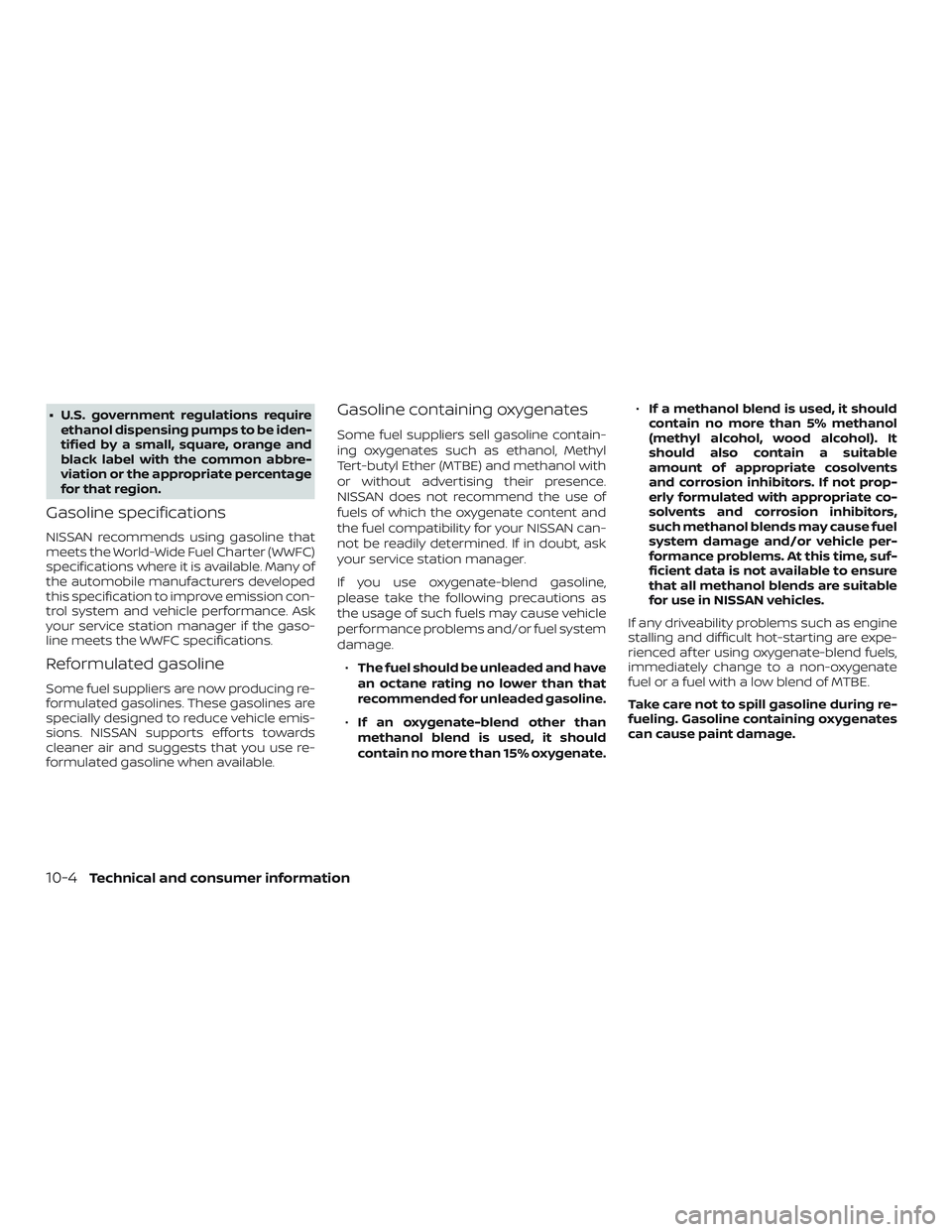
∙ U.S. government regulations requireethanol dispensing pumps to be iden-
tified by a small, square, orange and
black label with the common abbre-
viation or the appropriate percentage
for that region.
Gasoline specifications
NISSAN recommends using gasoline that
meets the World-Wide Fuel Charter (WWFC)
specifications where it is available. Many of
the automobile manufacturers developed
this specification to improve emission con-
trol system and vehicle performance. Ask
your service station manager if the gaso-
line meets the WWFC specifications.
Reformulated gasoline
Some fuel suppliers are now producing re-
formulated gasolines. These gasolines are
specially designed to reduce vehicle emis-
sions. NISSAN supports efforts towards
cleaner air and suggests that you use re-
formulated gasoline when available.
Gasoline containing oxygenates
Some fuel suppliers sell gasoline contain-
ing oxygenates such as ethanol, Methyl
Tert-butyl Ether (MTBE) and methanol with
or without advertising their presence.
NISSAN does not recommend the use of
fuels of which the oxygenate content and
the fuel compatibility for your NISSAN can-
not be readily determined. If in doubt, ask
your service station manager.
If you use oxygenate-blend gasoline,
please take the following precautions as
the usage of such fuels may cause vehicle
performance problems and/or fuel system
damage.
∙ The fuel should be unleaded and have
an octane rating no lower than that
recommended for unleaded gasoline.
∙ If an oxygenate-blend other than
methanol blend is used, it should
contain no more than 15% oxygenate. ∙
If a methanol blend is used, it should
contain no more than 5% methanol
(methyl alcohol, wood alcohol). It
should also contain a suitable
amount of appropriate cosolvents
and corrosion inhibitors. If not prop-
erly formulated with appropriate co-
solvents and corrosion inhibitors,
such methanol blends may cause fuel
system damage and/or vehicle per-
formance problems. At this time, suf-
ficient data is not available to ensure
that all methanol blends are suitable
for use in NISSAN vehicles.
If any driveability problems such as engine
stalling and difficult hot-starting are expe-
rienced af ter using oxygenate-blend fuels,
immediately change to a non-oxygenate
fuel or a fuel with a low blend of MTBE.
Take care not to spill gasoline during re-
fueling. Gasoline containing oxygenates
can cause paint damage.
10-4Technical and consumer information
Page 304 of 330
E–15 fuel
E-15 fuel is a mixture of approximately 15%
fuel ethanol and 85% unleaded gasoline.
E-15 can only be used in vehicles designed
to run on E-15 fuel. U.S. government regula-
tions require fuel ethanol dispensing
pumps to be identified with small, square,
orange and black label with the common
abbreviation or the appropriate percent-
age for that region.
E–85 fuel
E-85 fuel is a mixture of approximately 85%
fuel ethanol and 15% unleaded gasoline.
E-85 can only be used in a Flexible Fuel
Vehicle (FFV). Do not use E-85 in your ve-
hicle. U.S. government regulations require
fuel ethanol dispensing pumps to be iden-
tified by a small, square, orange and black
label with the common abbreviation or the
appropriate percentage for that region.
Fuel containing MMT
MMT, or methylcyclopentadienyl manga-
nese tricarbonyl, is an octane boosting ad-
ditive. NISSAN does not recommend the
use of fuel containing MMT. Such fuel may
adversely affect vehicle performance, in-
cluding the emissions control system. Note
that while some fuel pumps label MMT
content, not all do, so you may have to
consult your gasoline retailer for more de-
tails.
Af termarket fuel additives
NISSAN does not recommend the use of
any af termarket fuel additives (for ex-
ample, fuel injector cleaner, octane
booster, intake valve deposit removers,
etc.) which are sold commercially. Many of
these additives intended for gum, varnish
or deposit removal may contain active sol-
vents or similar ingredients that can be
harmful to the fuel system and engine.
Octane rating tips
Using unleaded gasoline with an octane
rating lower than recommended can
cause persistent, heavy “spark knock.”
(“Spark knock” is a metallic rapping
noise.) If severe, this can lead to engine
damage. If you detect a persistent heavy
spark knock even when using gasoline
of the stated octane rating, or if you hear
steady spark knock while holding a
steady speed on level roads, it is recom-
mended that you have a NISSAN dealer
correct the condition. Failure to correct
the condition is misuse of the vehicle, for
which NISSAN is not responsible.
Incorrect ignition timing may result in
spark knock, af ter-run and/or overheating,
which may cause excessive fuel consump-
tion or engine damage. If any of the above
symptoms are encountered, have your ve-
hicle checked. It is recommended that you
visit a NISSAN dealer for servicing.
However, now and then you may notice
light spark knock for a short time while
accelerating or driving up hills. This is not
a cause for concern, because you get the
greatest fuel benefit when there is light
spark knock for a short time under heavy
engine load.
Technical and consumer information10-5
Page 305 of 330
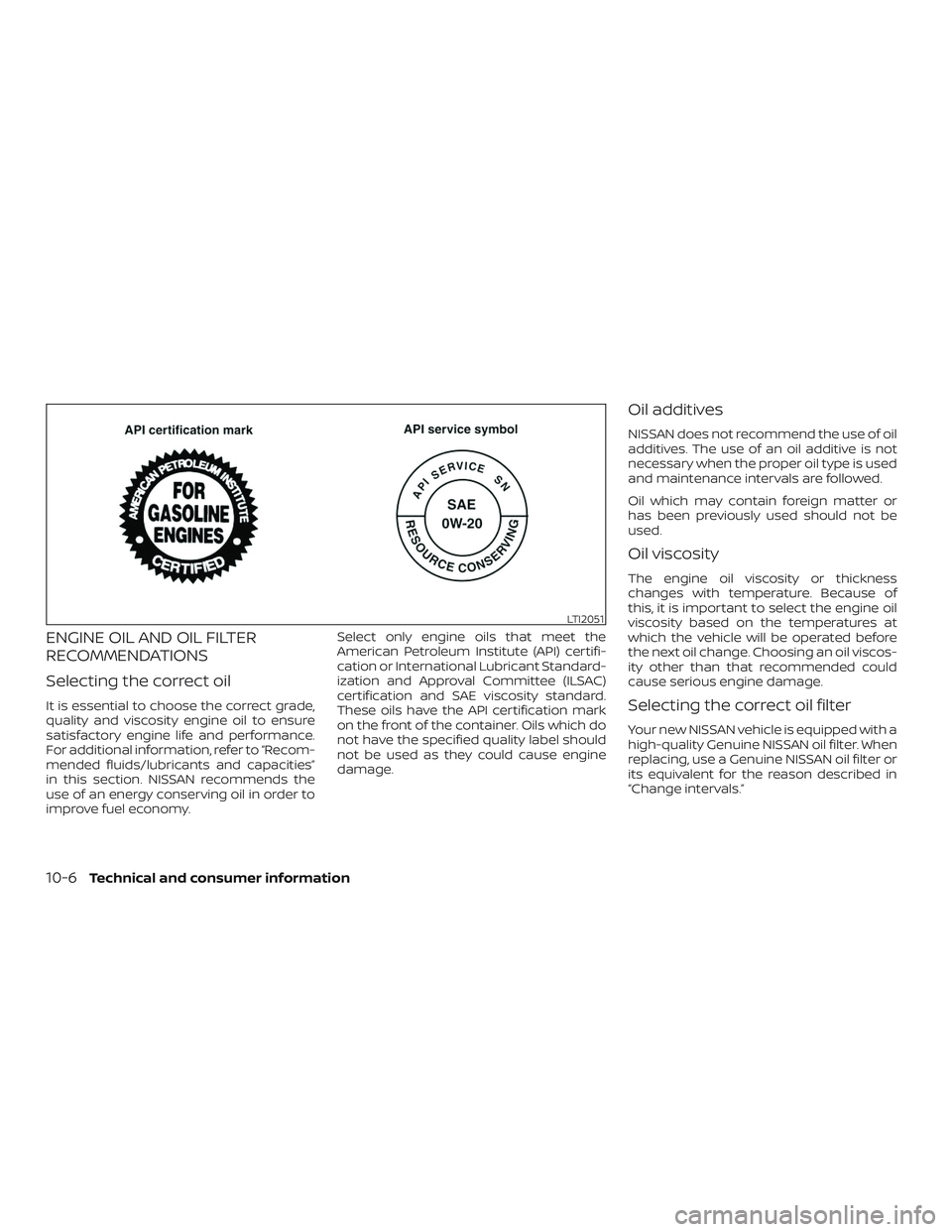
ENGINE OIL AND OIL FILTER
RECOMMENDATIONS
Selecting the correct oil
It is essential to choose the correct grade,
quality and viscosity engine oil to ensure
satisfactory engine life and performance.
For additional information, refer to “Recom-
mended fluids/lubricants and capacities”
in this section. NISSAN recommends the
use of an energy conserving oil in order to
improve fuel economy.Select only engine oils that meet the
American Petroleum Institute (API) certifi-
cation or International Lubricant Standard-
ization and Approval Committee (ILSAC)
certification and SAE viscosity standard.
These oils have the API certification mark
on the front of the container. Oils which do
not have the specified quality label should
not be used as they could cause engine
damage.
Oil additives
NISSAN does not recommend the use of oil
additives. The use of an oil additive is not
necessary when the proper oil type is used
and maintenance intervals are followed.
Oil which may contain foreign matter or
has been previously used should not be
used.
Oil viscosity
The engine oil viscosity or thickness
changes with temperature. Because of
this, it is important to select the engine oil
viscosity based on the temperatures at
which the vehicle will be operated before
the next oil change. Choosing an oil viscos-
ity other than that recommended could
cause serious engine damage.
Selecting the correct oil filter
Your new NISSAN vehicle is equipped with a
high-quality Genuine NISSAN oil filter. When
replacing, use a Genuine NISSAN oil filter or
its equivalent for the reason described in
“Change intervals.”
LTI2051
10-6Technical and consumer information
Page 309 of 330
When planning to drive your NISSAN ve-
hicle in another country,you should first
find out if the fuel available is suitable for
your vehicle's engine.
Using fuel with an octane rating that is too
low may cause engine damage. All gaso-
line vehicles must be operated with un-
leaded gasoline. Therefore, avoid taking
your vehicle to areas where appropriate
fuel is not available.
When transferring the registration of
your vehicle to another country, state,
province or district, it may be necessary
to modif y the vehicle to meet local laws
and regulations.
The laws and regulations for motor vehicle
emission control and safety standards
vary according to the country, state, prov-
ince or district; therefore, vehicle specifica-
tions may differ.
When any vehicle is to be taken into an-
other country, state, province or district
and registered, its modifications, trans-
portation and registration are the re-
sponsibility of the user. NISSAN is not re-
sponsible for any inconvenience that
may result.
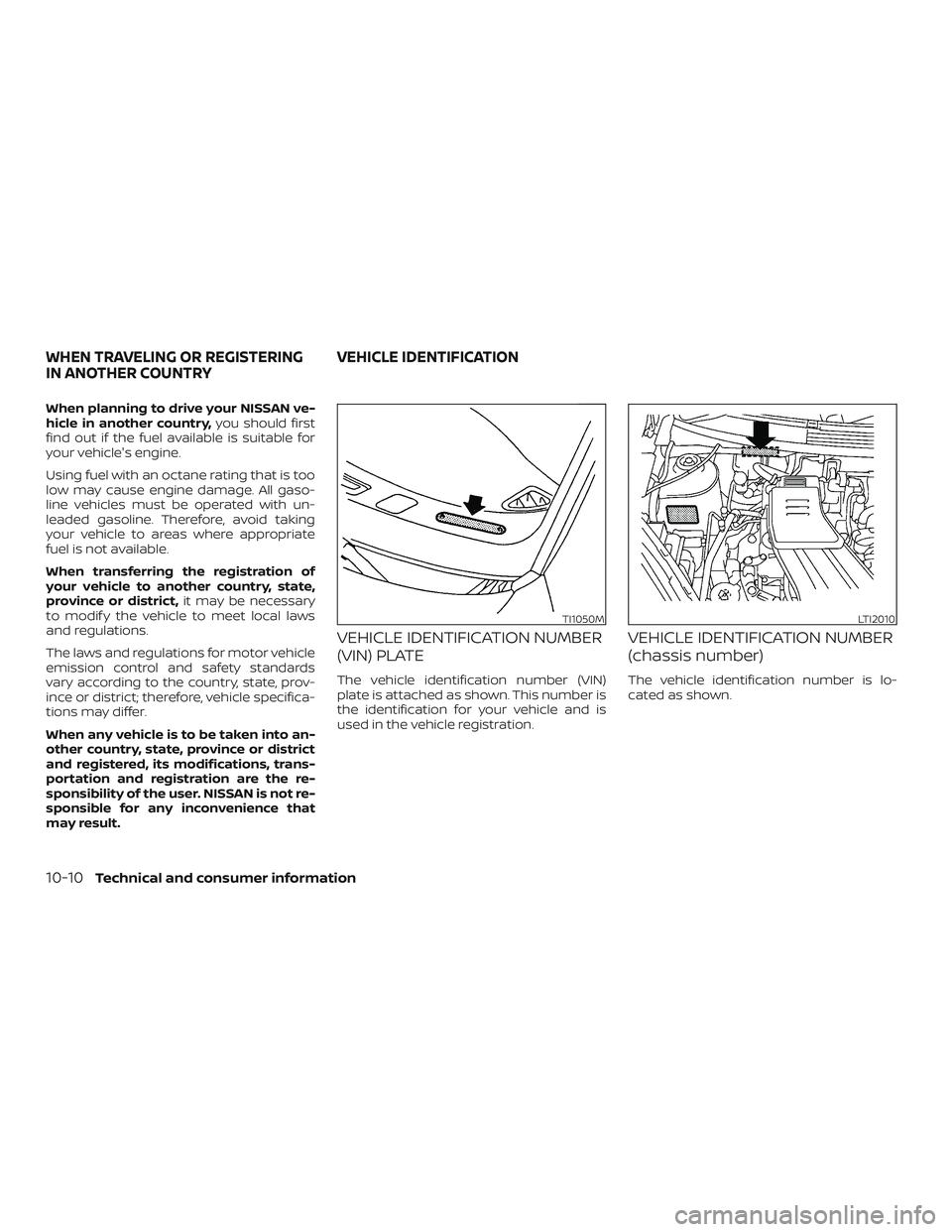
VEHICLE IDENTIFICATION NUMBER
(VIN) PLATE
The vehicle identification number (VIN)
plate is attached as shown. This number is
the identification for your vehicle and is
used in the vehicle registration.
VEHICLE IDENTIFICATION NUMBER
(chassis number)
The vehicle identification number is lo-
cated as shown.
TI1050MLTI2010
WHEN TRAVELING OR REGISTERING
IN ANOTHER COUNTRY VEHICLE IDENTIFICATION
10-10Technical and consumer information
Page 320 of 330
11 Index
A
Air bag (See supplemental restraint
system) .................... .1-44
Air bag system Front (See supplemental front
impact air bag system) .........1-54
Air bag warning labels ............1-62
Airbagwarninglight..........1-63, 2-11
Air bag warning light,
supplemental ..............1-63, 2-11
Air cleaner housing filter ..........8-15
Air conditioner Air conditioner operation ........4-18
Air conditioner service ..........4-23
Air conditioner specification label . .10-12
Air conditioner system refrigerant
and oil recommendations .......10-7
Air conditioner system refrigerant
recommendations ............10-7
Heater and air conditioner
controls...................4-15
Servicing air conditioner ........4-23
Air flow charts ..............4-12,4-19
Alarm system (See vehicle
security system) ...............2-14
Anchor point locations ...........1-28
Antenna ....................4-46
Anti-lock brake warning light ........2-9
Anti-lock Braking System (ABS) ......5-22
Audible reminders ..............2-14
Audio system .................4-23 AMradioreception............4-24
Compact disc (CD) player
....4-34,4-39
FM/AM radio with compact disc (CD)
player.................4-31,4-36
FMradioreception............4-23
iPod®Player................4-42
iPod® player operation .........4-42
Radio ....................4-23
Steering wheel audio control
switch ...................4-45
USBinterface...............4-40
USB (Universal Serial Bus)
Connection Port .............4-40
Automatic Automatic power window switch . . .2-29
Automatic transmission fluid (ATF). . .8-9
Automatic transmission position
indicatorlight...............2-12
Driving with automatic
transmission ................5-9
Transmission shif t lever lock
release ...................5-12
Automatic door locks .............3-6
AUXjack.................4-35,4-40
B
Battery..................5-26,8-11 Charge warning light ...........2-9
Battery replacement .............8-21
Keyfob................8-21,8-21
Before starting the engine ..........5-7Belt(Seedrivebelt)..............8-14
Block heater
Engine ...................5-28
Bluetooth® hands-free phone system . .4-47
Booster seats .................1-41
Brake Anti-lock Braking System (ABS) ....5-22
Brakefluid..................8-9
Brakelight(Seestoplight).......8-27
Brakesystem...............5-22
Brakewarninglight............2-9
Brakewearindicators.......2-14, 8-17
Parking brake operation .........5-15
Self-adjustingbrakes ..........8-17
Brakeassist................. .5-24
Brakefluid....................8-9
Brakes......................8-17
Brakesystem.................5-22
Break-in schedule ...............5-17
Brightness control Instrument panel .............2-20
Bulb check/instrument panel ........2-8
Bulb replacement ..............
8
-27
C
Capacities and recommended
fuel/lubricants.................10-2
Cargo (See vehicle
loading information) ............10-13
Car phone or CB radio ............4-47
CDcareandcleaning............4-44
Page 321 of 330
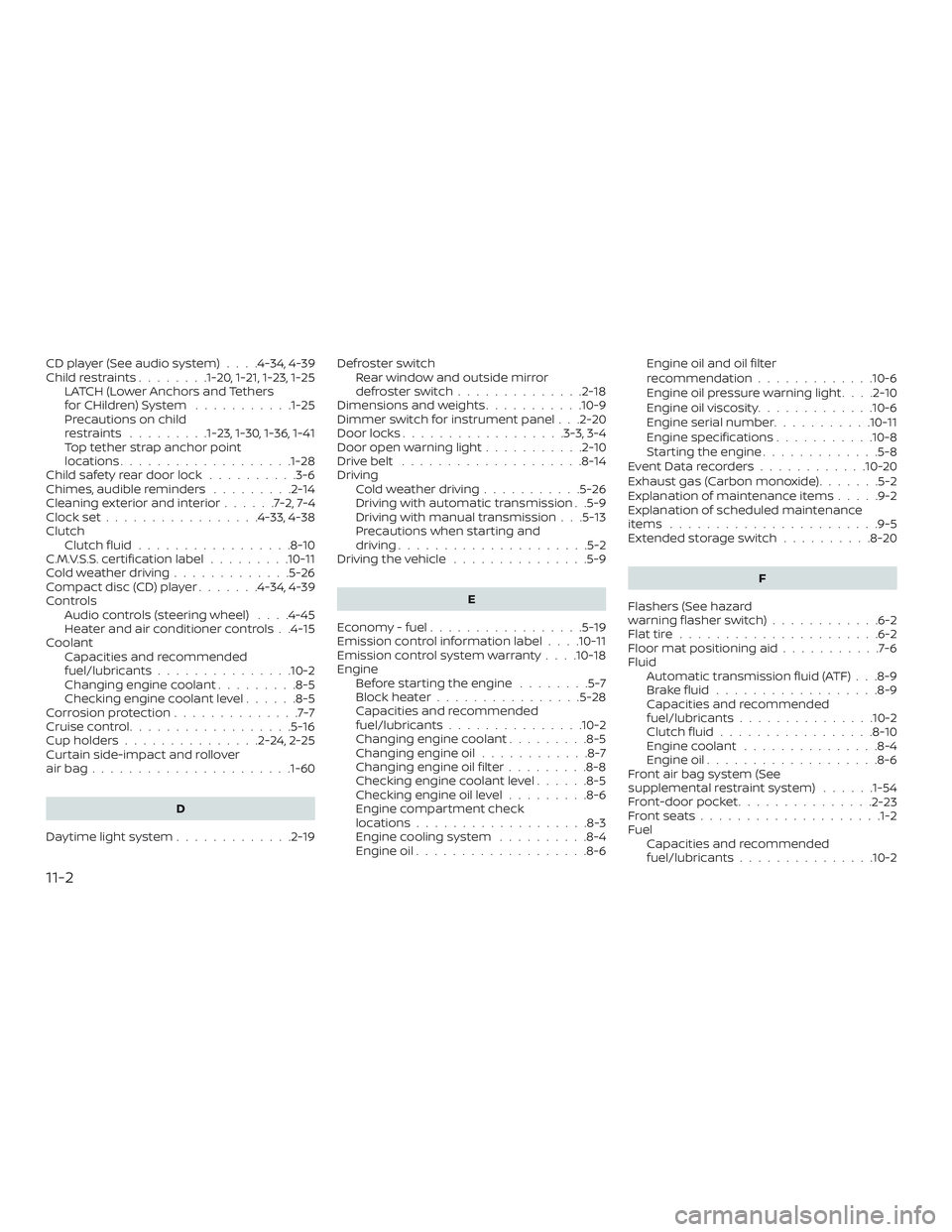
CD player (See audio system)....4-34,4-39
Childrestraints........1-20, 1-21, 1-23, 1-25 LATCH (Lower Anchors and Tethers
forCHildren)System ...........1-25
Precautions on child
restraints .........1-23, 1-30, 1-36, 1-41
Top tether strap anchor point
locations.................. .1-28
Child safety rear door lock ..........3-6
Chimes, audible reminders .........2-14
Cleaningexteriorandinterior......7-2,7-4
Clockset.................4-33,4-38
Clutch Clutchfluid.................8-10
C.M.V.S.S. certification label .........10-11
Coldweatherdriving.............5-26
Compact disc (CD) player .......4-34,4-39
Controls Audio controls (steering wheel) ....4-45
Heater and air conditioner controls . .4-15
Coolant Capacities and recommended
fuel/lubricants...............10-2
Changing engine coolant .........8-5
Checking engine coolant level ......8-5
Corrosionprotection..............7-7
Cruisecontrol..................5-16
Cupholders...............2-24,2-25
Curtain side-impact and rollover
airbag......................1-60
D
Daytime light system .............2-19 Defroster switch
Rear window and outside mirror
defrosterswitch..............2-18
Dimensions and weights ...........10-9
Dimmer switch for instrument panel . . .2-20
Door locks ..................3-3,3-4
Door open warning light ...........2-10
Drivebelt ....................8-14
Driving Cold weather driving ...........5-26
Driving with automatic transmission . .5-9
Driving with manual transmission . . .5-13
Precautions when starting and
driving.....................5-2
Drivingthevehicle ...............5-9
E
Economy - fuel .................5-19
Emission control information label . . . .10-11
Emission control system warranty . . . .10-18
Engine Before starting the engine ........5-7
Blockheater................5-28
Capacities and recommended
fuel/lubricants...............10-2
Changing engine coolant .........8-5
Changing engine oil ............8-7
Changing engine oil filter .........8-8
Checking engine coolant level ......8-5
Checking engine oil level .........8-6
Engine compartment check
locations...................8-3
Engine cooling system ..........8-4
Engine oil ...................8-6 Engine oil and oil filter
recommendation
.............10-6
Engine oil pressure warning light . . . .2-10
Engine oil viscosity .............10-6
Engine serial number ...........10-11
Engine specifications ...........10-8
Starting the engine .............5-8
EventDatarecorders............10-20
Exhaust gas (Carbon monoxide) .......5-2
Explanation of maintenance items .....9-2
Explanation of scheduled maintenance
items .......................9-5
Extended storage switch ..........8-20
F
Flashers (See hazard
warningflasherswitch)............6-2
Flattire......................6-2
Floormatpositioningaid...........7-6
Fluid Automatic transmission fluid (ATF) . . .8-9
Brakefluid..................8-9
Capacities and recommended
fuel/lubricants...............10-2
Clutchfluid.................8-10
Engine coolant ...............8-4
Engine oil ...................8-6
Front air bag system (See
supplemental restraint system) ......1-54
Front-door pocket ...............
2
-23
Frontseats....................1-2
Fuel Capacities and recommended
fuel/lubricants...............10-2
11-2
Page 322 of 330
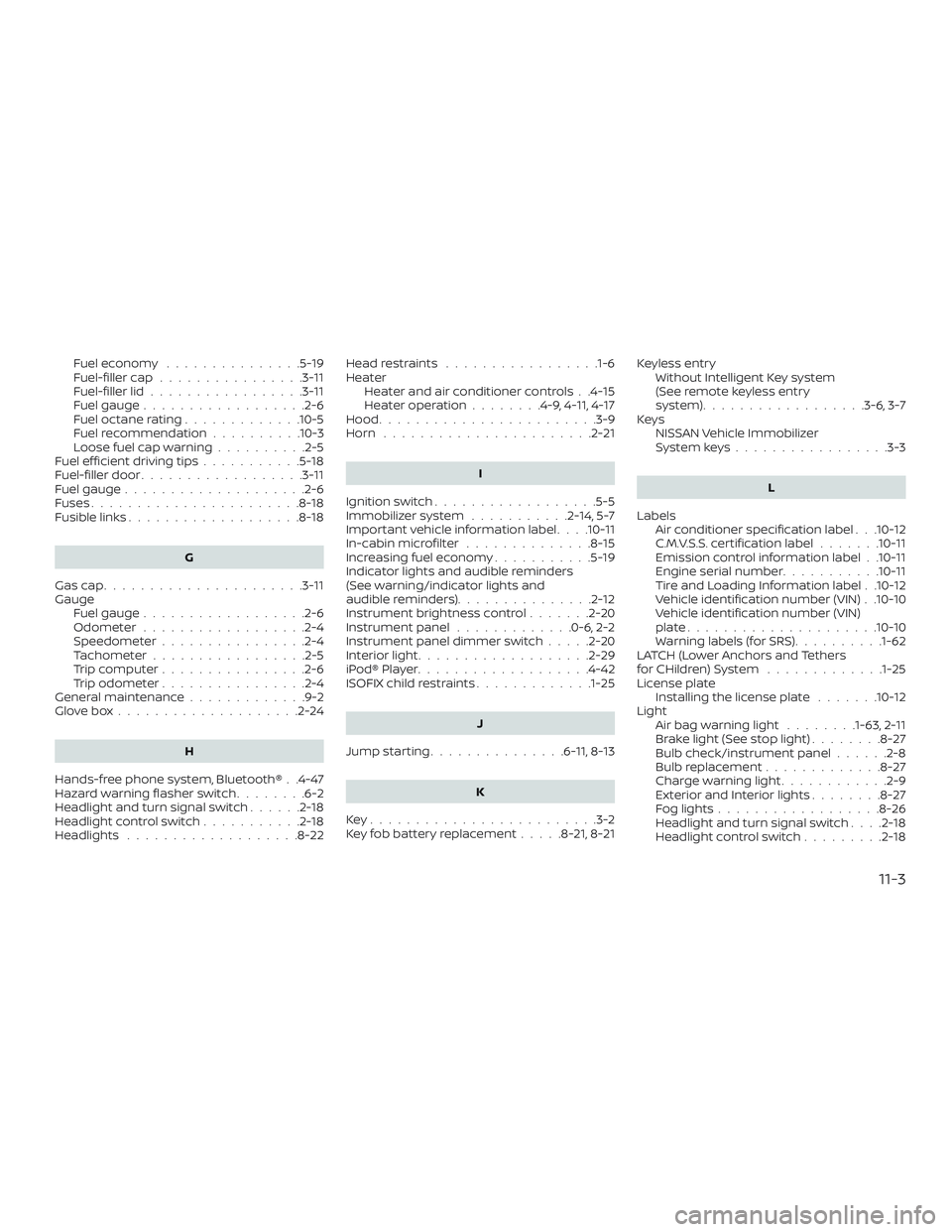
Fuel economy...............5-19
Fuel-filler cap ................3-11
Fuel-filler lid .................3-11
Fuel gauge ..................2-6
Fueloctanerating.............10-5
Fuel recommendation ..........10-3
Loose fuel cap warning ..........2-5
Fuelefficientdrivingtips...........5-18
Fuel-filler door ..................3-11
Fuel gauge ....................2-6
Fuses .......................8-18
Fusiblelinks...................8-18
G
Gascap......................3-11
Gauge Fuel gauge ..................2-6
Odometer ..................2-4
Speedometer ................2-4
Tachometer .................2-5
Trip computer ................2-6
Trip odometer ................2-4
General maintenance .............9-2
Glovebox....................2-24
H
Hands-free phone system, Bluetooth® . .4-47
Hazard warning flasher switch ........6-2
Headlight and turn signal switch ......2-18
Headlightcontrolswitch...........2-18
Headlights ...................8-22 Headrestraints .................1-6
Heater
Heater and air conditioner controls . .4-15
Heater operation ........4-9,4-11, 4-17
Hood ........................3-9
Horn .......................2-21
I
Ignition switch ..................5-5
Immobilizer system ...........2-14,5-7
Important vehicle information label . . . .10-11
In-cabinmicrofilter ..............8-15
Increasing fuel economy ...........5-19
Indicator lights and audible reminders
(See warning/indicator lights and
audible reminders) ...............2-12
Instrument brightness control .......2-20
Instrument panel .............0-6,2-2
Instrument panel dimmer switch .....2-20
Interiorlight...................2-29
iPod®Player...................4-42
ISOFIX child restraints .............1-25
J
Jumpstarting...............6 -11, 8-13
K
Key.........................3-2
Key fob battery replacement .....8-21,8-21Keyless entry
Without Intelligent Key system
(See remote keyless entry
system)..................3-6, 3-7
Keys NISSAN Vehicle Immobilizer
Systemkeys.................3-3
L
Labels Air conditioner specification label . . .10-12
C.M.V.S.S. certification label .......10-11
Emission control information label . .10-11
Engine serial number ...........10-11
Tire and Loading Information label . .10-12
Vehicle identification number (VIN) . .10-10
Vehicle identification number (VIN)
plate.....................10-10
Warning labels (for SRS) ..........1-62
LATCH (Lower Anchors and Tethers
forCHildren)System .............1-25
License plate Installing the license plate .......10-12
Light Airbagwarninglight ........1-63, 2-11
B
rakelight(Seestoplight)........8-27
Bulb check/instrument panel ......2-8
Bulb replacement .............8-27
Charge warning light ............2-9
ExteriorandInteriorlights........8-27
Foglights..................8-26
Headlight and turn signal switch ....2-18
Headlightcontrolswitch.........2-18
11-3