steering wheel NISSAN MICRA 2018 Owner´s Manual
[x] Cancel search | Manufacturer: NISSAN, Model Year: 2018, Model line: MICRA, Model: NISSAN MICRA 2018Pages: 330, PDF Size: 3.9 MB
Page 214 of 330
DRAINING OF COOLANT WATER
If the vehicle is to be lef t outside without
anti-freeze, drain the cooling system, in-
cluding the engine block. Refill before oper-
ating the vehicle. For additional informa-
tion, refer to “Changing engine coolant” in
the “Do-it-yourself ” section of this manual.
TIRE EQUIPMENT
1. SUMMER tires have a tread designed toprovide superior performance on dry
pavement. However, the performance
of these tires will be substantially re-
duced in snowy and icy conditions. If
you operate your vehicle on snowy or
icy roads, NISSAN recommends the use
of MUD & SNOW or ALL SEASON TIRES
on all four wheels. It is recommended
that you visit a NISSAN dealer for the tire
type, size, speed rating and availability
information.
2. For additional traction on icy roads, studded tires may be used. However,
some U.S. states and Canadian prov-
inces prohibit their use. Check local,
state and provincial laws before install-
ing studded tires. Skid and traction capabilities of studded
snow tires on wet or dry surfaces may be
poorer than that of non-studded snow
tires.
3. Tire chains may be used. For additional information, refer to “Tire chains” in the
“Do-it-yourself ” section of this manual.
SPECIAL WINTER EQUIPMENT
It is recommended that the following items
be carried in the vehicle during winter:
∙ A scraper and stiff-bristled brush to re- move ice and snow from the windows
and wiper blades.
∙ A sturdy, flat board to be placed under the jack to give it firm support.
∙ A shovel to dig the vehicle out of snow- drif ts.
∙ Extra washer fluid to refill the windshield-washer fluid reservoir.
DRIVING ON SNOW OR ICE
WARNING
∙ Wet ice (0°C, 32°F and freezing rain),very cold snow or ice can be slick and
very hard to drive on. The vehicle will
have much less traction or “grip” un-
der these conditions. Try to avoid driv-
ing on wet ice until the road is salted
or sanded.
∙ Whatever the condition, drive with caution. Accelerate and slow down
with care. If accelerating or down-
shif ting too fast, the drive wheels will
lose even more traction.
∙ Allow more stopping distance under these conditions. Braking should be
started sooner than on dry pavement.
∙ Allow greater following distances on slippery roads.
∙ Watch for slippery spots (glare ice). These may appear on an otherwise
clear road in shaded areas. If a patch
of ice is seen ahead, brake before
reaching it. Try not to brake while on
the ice, and avoid any sudden steering
maneuvers.
Starting and driving5-27
Page 230 of 330
2WD models with automatic
transmission
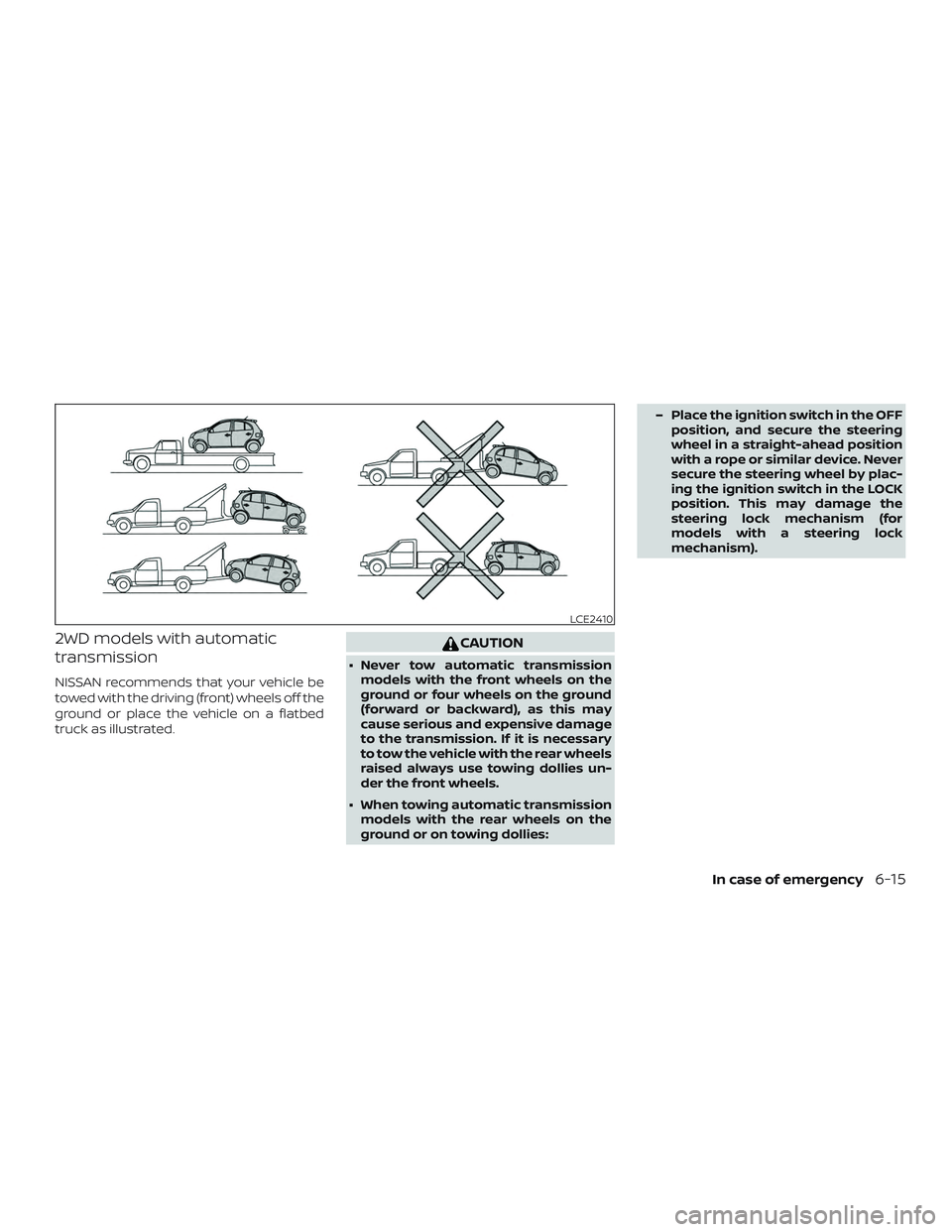
NISSAN recommends that your vehicle be
towed with the driving (front) wheels off the
ground or place the vehicle on a flatbed
truck as illustrated.
CAUTION
∙ Never tow automatic transmissionmodels with the front wheels on the
ground or four wheels on the ground
(forward or backward), as this may
cause serious and expensive damage
to the transmission. If it is necessary
to tow the vehicle with the rear wheels
raised always use towing dollies un-
der the front wheels.
∙ When towing automatic transmission models with the rear wheels on the
ground or on towing dollies: – Place the ignition switch in the OFF
position, and secure the steering
wheel in a straight-ahead position
with a rope or similar device. Never
secure the steering wheel by plac-
ing the ignition switch in the LOCK
position. This may damage the
steering lock mechanism (for
models with a steering lock
mechanism).
LCE2410
In case of emergency6-15
Page 232 of 330
∙ Do not use the vehicle tie-downs totow or free a stuck vehicle.
∙ Only use devices specifically designed for vehicle recovery and follow the
manufacturer’s instructions.
∙ Always pull the recovery device straight out from the front of the ve-
hicle. Never pull at an angle.
∙ Route recovery devices so they do not touch any part of the vehicle except
the attachment point.
If your vehicle is stuck in sand, snow, mud,
etc., use a tow strap or other device de-
signed specifically for vehicle recovery. Al-
ways follow the manufacturer’s instruc-
tions for the recovery device.Rocking a stuck vehicle
WARNING
∙ Stand clear of a stuck vehicle.
∙ Do not spin your tires at high speed. This could cause them to explode and
result in serious injury. Parts of your
vehicle could also overheat and be
damaged.
If your vehicle is stuck in sand, snow, mud,
etc., use the following procedure: 1. Make sure the area in front and behind the vehicle is clear of obstructions.
2. Turn the steering wheel right and lef t to clear an area around the front tires.
3. Slowly rock the vehicle forward and backward.
∙ Shif t back and forth between R (Re- verse) and D (Drive) (automatic trans-
mission models) or 1st (Low) and R
(Reverse) (manual transmission
models). ∙ Apply the accelerator as little as pos-
sible to maintain the rocking motion.
∙ Release the accelerator pedal before shif ting between R (Reverse) and D
(Drive) (automatic transmission
models) or 1st (Low) and R (Reverse)
(manual transmission models).
∙ Do not spin the tires above 55 km/h (35 mph).
4. If the vehicle cannot be freed af ter a few tries, contact a professional towing
service to remove the vehicle.
In case of emergency6-17
Page 287 of 330
Seats:Check seat position controls such
as seat adjusters, seatback recliner, etc., to
ensure they operate smoothly and all
latches lock securely in every position.
Check that the head restraints/headrests
move up and down smoothly and the locks
(if so equipped) hold securely in all latched
positions.
Seat belts: Check that all parts of the seat
belt system (for example, buckles, anchors,
adjusters and retractors) operate properly
and smoothly, and are installed securely.
Check the belt webbing for cuts, fraying,
wear or damage.
Steering wheel: Check for changes in the
steering system, such as excessive free
play, hard steering or strange noises.
Warning lights and chimes: Make sure all
warning lights and chimes are operating
properly.
Windshield defroster: Check that the air
comes out of the defroster outlets properly
and in sufficient quantity when operating
the heater or air conditioner.
Windshield wiper and washer*: Check
that the wipers and washer operate prop-
erly and that the wipers do not streak.Under the hood and vehicle
The maintenance items listed here should
be checked periodically (for example, each
time you check the engine oil or refuel).
Battery* (for serviceable batteries):
Check the fluid level in each cell. The fluid
should be at the bottom of the filler open-
ing. Vehicles operated in high tempera-
tures or under severe conditions require
frequent checks of the battery fluid level.
NOTE:
Care should be taken to avoid situations
that can lead to potential battery dis-
charge and potential no-start conditions
such as:
1. Installation or extended use of elec-
tronic accessories that consume bat-
tery power when the engine is not
running (Phone chargers, GPS, DVD
players, etc.).
2. Vehicle is not driven regularly and/or
only driven short distances.
In these cases, the battery may need to
be charged to maintain battery health. Brake and clutch (if so equipped) fluid
level*:
Make sure that the brake and clutch
fluid levels are between the MIN and MAX
lines on the reservoir.
Engine coolant level*: Check the coolant
level when the engine is cold.
Engine drive belts*: Make sure the drive
belts are not frayed, worn, cracked or oily.
Engine oil level*: Check the level af ter
parking the vehicle on a level surface with
the engine off. Wait more than 15 minutes
for the oil to drain back into the oil pan.
Exhaust system: Make sure there are no
loose supports, cracks or holes. If the
sound of the exhaust seems unusual or
there is a smell of exhaust fumes, immedi-
ately have the exhaust system inspected. It
is recommended that you visit a NISSAN
dealer for this service. For additional infor-
mation, refer to “Exhaust gas (carbon mon-
oxide)” in the “Starting and driving” section
of this manual.
Fluid leaks: Check under the vehicle for
fuel, oil, water or other fluid leaks af ter the
vehicle has been parked for a while. Water
dripping from the air conditioner af ter use
is normal. If you should notice any leaks or if
9-4Maintenance and schedules
Page 320 of 330
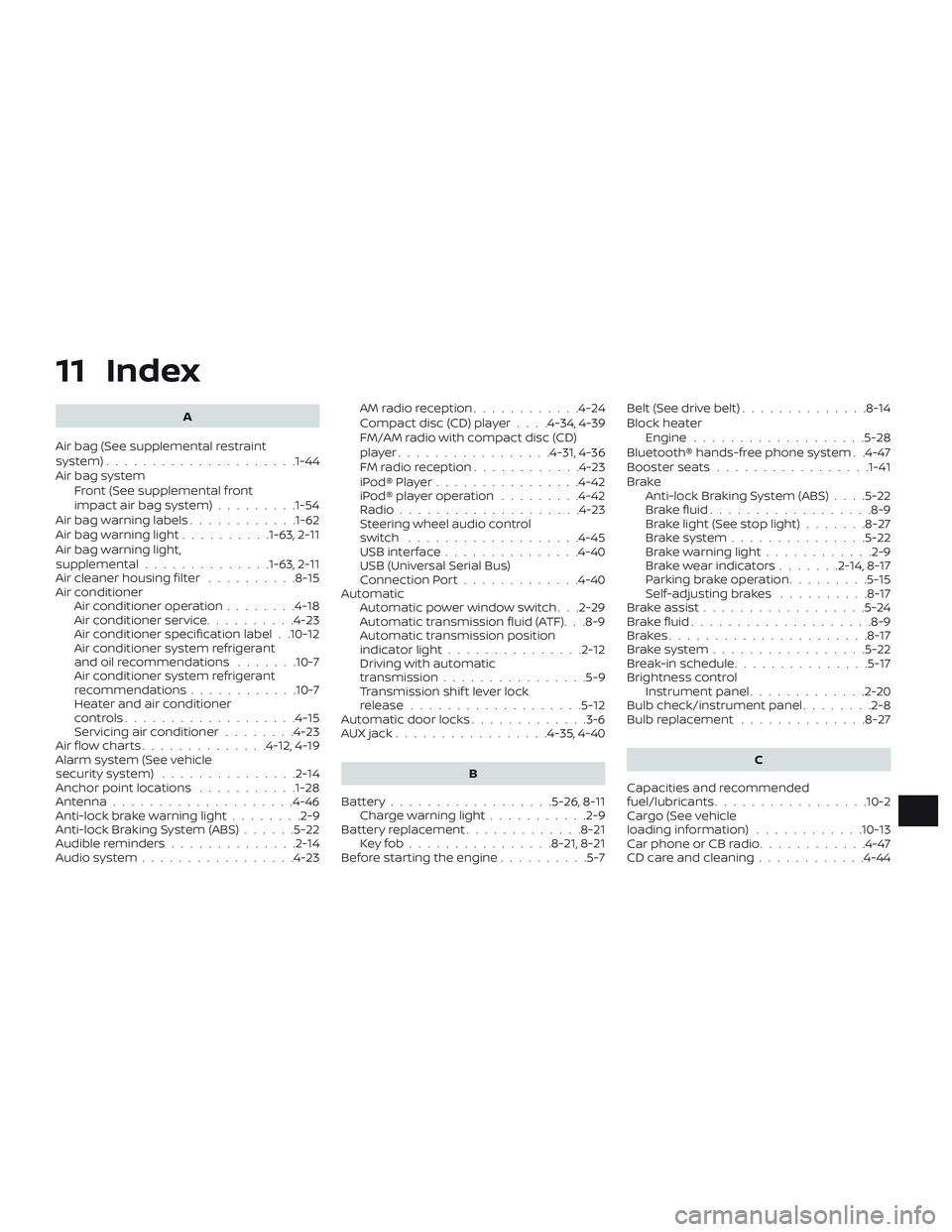
11 Index
A
Air bag (See supplemental restraint
system) .................... .1-44
Air bag system Front (See supplemental front
impact air bag system) .........1-54
Air bag warning labels ............1-62
Airbagwarninglight..........1-63, 2-11
Air bag warning light,
supplemental ..............1-63, 2-11
Air cleaner housing filter ..........8-15
Air conditioner Air conditioner operation ........4-18
Air conditioner service ..........4-23
Air conditioner specification label . .10-12
Air conditioner system refrigerant
and oil recommendations .......10-7
Air conditioner system refrigerant
recommendations ............10-7
Heater and air conditioner
controls...................4-15
Servicing air conditioner ........4-23
Air flow charts ..............4-12,4-19
Alarm system (See vehicle
security system) ...............2-14
Anchor point locations ...........1-28
Antenna ....................4-46
Anti-lock brake warning light ........2-9
Anti-lock Braking System (ABS) ......5-22
Audible reminders ..............2-14
Audio system .................4-23 AMradioreception............4-24
Compact disc (CD) player
....4-34,4-39
FM/AM radio with compact disc (CD)
player.................4-31,4-36
FMradioreception............4-23
iPod®Player................4-42
iPod® player operation .........4-42
Radio ....................4-23
Steering wheel audio control
switch ...................4-45
USBinterface...............4-40
USB (Universal Serial Bus)
Connection Port .............4-40
Automatic Automatic power window switch . . .2-29
Automatic transmission fluid (ATF). . .8-9
Automatic transmission position
indicatorlight...............2-12
Driving with automatic
transmission ................5-9
Transmission shif t lever lock
release ...................5-12
Automatic door locks .............3-6
AUXjack.................4-35,4-40
B
Battery..................5-26,8-11 Charge warning light ...........2-9
Battery replacement .............8-21
Keyfob................8-21,8-21
Before starting the engine ..........5-7Belt(Seedrivebelt)..............8-14
Block heater
Engine ...................5-28
Bluetooth® hands-free phone system . .4-47
Booster seats .................1-41
Brake Anti-lock Braking System (ABS) ....5-22
Brakefluid..................8-9
Brakelight(Seestoplight).......8-27
Brakesystem...............5-22
Brakewarninglight............2-9
Brakewearindicators.......2-14, 8-17
Parking brake operation .........5-15
Self-adjustingbrakes ..........8-17
Brakeassist................. .5-24
Brakefluid....................8-9
Brakes......................8-17
Brakesystem.................5-22
Break-in schedule ...............5-17
Brightness control Instrument panel .............2-20
Bulb check/instrument panel ........2-8
Bulb replacement ..............
8
-27
C
Capacities and recommended
fuel/lubricants.................10-2
Cargo (See vehicle
loading information) ............10-13
Car phone or CB radio ............4-47
CDcareandcleaning............4-44
Page 321 of 330
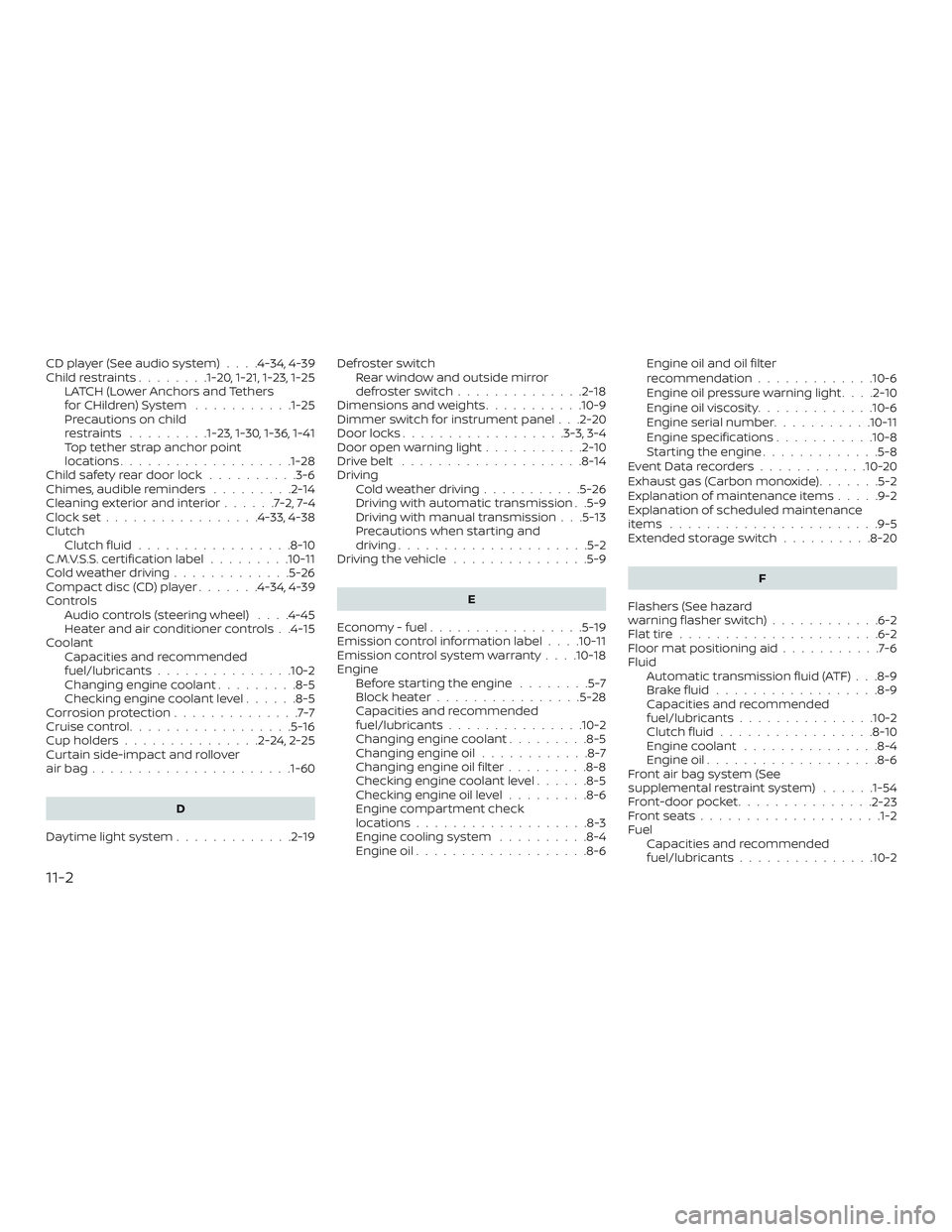
CD player (See audio system)....4-34,4-39
Childrestraints........1-20, 1-21, 1-23, 1-25 LATCH (Lower Anchors and Tethers
forCHildren)System ...........1-25
Precautions on child
restraints .........1-23, 1-30, 1-36, 1-41
Top tether strap anchor point
locations.................. .1-28
Child safety rear door lock ..........3-6
Chimes, audible reminders .........2-14
Cleaningexteriorandinterior......7-2,7-4
Clockset.................4-33,4-38
Clutch Clutchfluid.................8-10
C.M.V.S.S. certification label .........10-11
Coldweatherdriving.............5-26
Compact disc (CD) player .......4-34,4-39
Controls Audio controls (steering wheel) ....4-45
Heater and air conditioner controls . .4-15
Coolant Capacities and recommended
fuel/lubricants...............10-2
Changing engine coolant .........8-5
Checking engine coolant level ......8-5
Corrosionprotection..............7-7
Cruisecontrol..................5-16
Cupholders...............2-24,2-25
Curtain side-impact and rollover
airbag......................1-60
D
Daytime light system .............2-19 Defroster switch
Rear window and outside mirror
defrosterswitch..............2-18
Dimensions and weights ...........10-9
Dimmer switch for instrument panel . . .2-20
Door locks ..................3-3,3-4
Door open warning light ...........2-10
Drivebelt ....................8-14
Driving Cold weather driving ...........5-26
Driving with automatic transmission . .5-9
Driving with manual transmission . . .5-13
Precautions when starting and
driving.....................5-2
Drivingthevehicle ...............5-9
E
Economy - fuel .................5-19
Emission control information label . . . .10-11
Emission control system warranty . . . .10-18
Engine Before starting the engine ........5-7
Blockheater................5-28
Capacities and recommended
fuel/lubricants...............10-2
Changing engine coolant .........8-5
Changing engine oil ............8-7
Changing engine oil filter .........8-8
Checking engine coolant level ......8-5
Checking engine oil level .........8-6
Engine compartment check
locations...................8-3
Engine cooling system ..........8-4
Engine oil ...................8-6 Engine oil and oil filter
recommendation
.............10-6
Engine oil pressure warning light . . . .2-10
Engine oil viscosity .............10-6
Engine serial number ...........10-11
Engine specifications ...........10-8
Starting the engine .............5-8
EventDatarecorders............10-20
Exhaust gas (Carbon monoxide) .......5-2
Explanation of maintenance items .....9-2
Explanation of scheduled maintenance
items .......................9-5
Extended storage switch ..........8-20
F
Flashers (See hazard
warningflasherswitch)............6-2
Flattire......................6-2
Floormatpositioningaid...........7-6
Fluid Automatic transmission fluid (ATF) . . .8-9
Brakefluid..................8-9
Capacities and recommended
fuel/lubricants...............10-2
Clutchfluid.................8-10
Engine coolant ...............8-4
Engine oil ...................8-6
Front air bag system (See
supplemental restraint system) ......1-54
Front-door pocket ...............
2
-23
Frontseats....................1-2
Fuel Capacities and recommended
fuel/lubricants...............10-2
11-2
Page 324 of 330
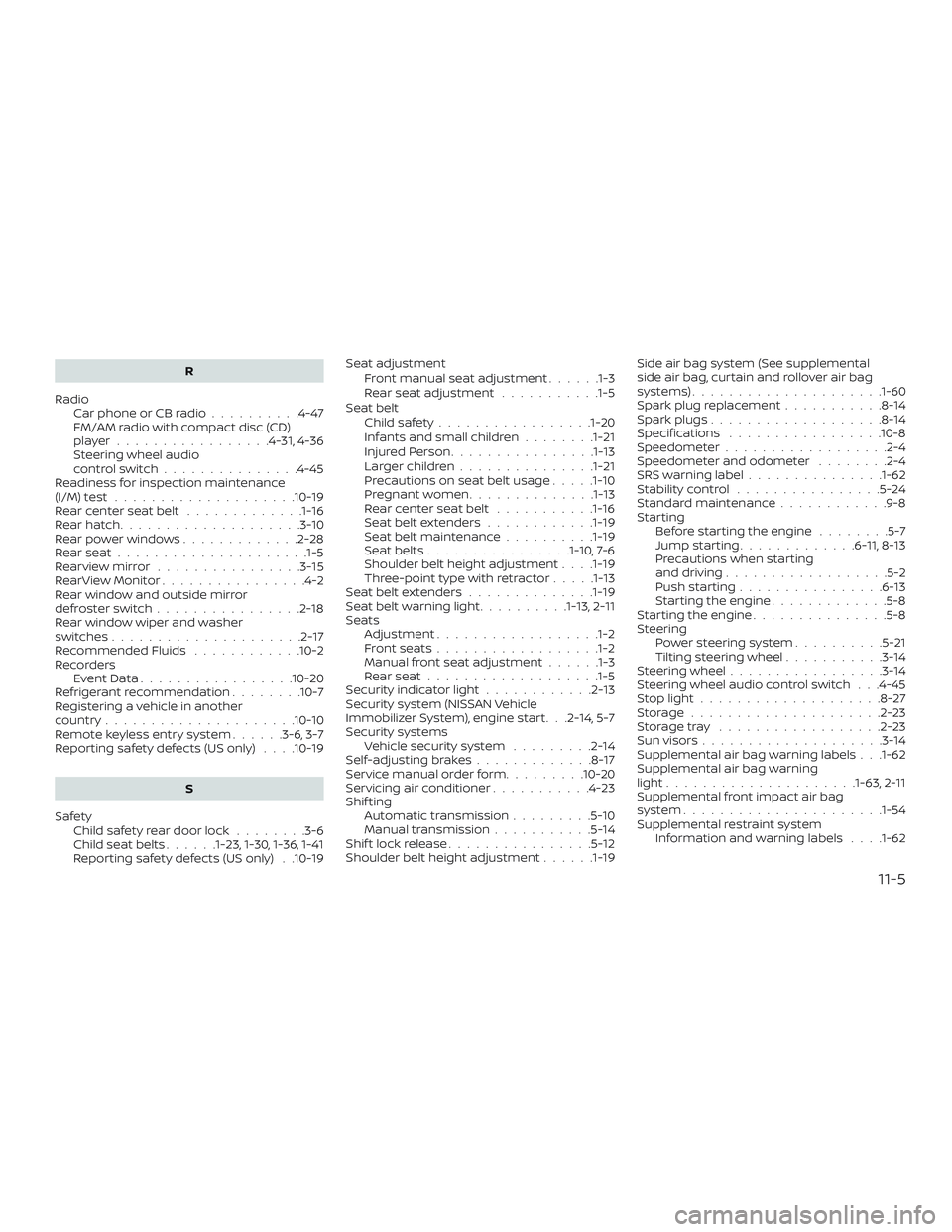
R
Radio Car phone or CB radio ..........4-47
FM/AM radio with compact disc (CD)
player.................4-31,4-36
Steering wheel audio
controlswitch...............4-45
Readiness for inspection maintenance
(I/M)test....................10-19
Rearcenterseatbelt .............1-16
Rearhatch....................3-10
Rearpowerwindows.............2-28
Rearseat.....................1-5
Rearviewmirror ................3-15
RearViewMonitor................4-2
Rear window and outside mirror
defrosterswitch................2-18
Rear window wiper and washer
switches .....................2-17
Recommended Fluids ............10-2
Recorders EventData.................10-20
Refrigerant recommendation ........10-7
Registering a vehicle in another
country .....................10-10
Remote keyless entry system ......3-6,3-7
Reporting safety defects (US only) . . . .10-19
S
Safety Child safety rear door lock ........3-6
Childseatbelts......1-23, 1-30, 1-36, 1-41
Reporting safety defects (US only) . .10-19 Seat adjustment
Front manual seat adjustment ......1-3
Rear seat adjustment ...........1-5
Seat belt Childsafety.................1-20
Infants and small children ........1-21
InjuredPerson............... .1-13
Largerchildren.............. .1-21
Precautions on seat belt usage .....1-10
Pregnant women ..............1-13
Rearcenterseatbelt ...........1-16
Seat belt extenders ............1-19
Seat belt maintenance ..........1-19
Seatbelts................1-10, 7-6
Shoulder belt height adjustment . . . .1-19
Three-pointtypewithretractor.....1-13
Seat belt extenders ..............1-19
Seatbeltwarninglight..........1-13, 2-11
Seats Adjustment ..................1-2
Frontseats..................1-2
Manual front seat adjustment ......1-3
Rearseat...................1-5
Security indicator light ............2-13
Security system (NISSAN Vehicle
Immobilizer System), engine start . . .2-14, 5-7
Security systems Vehicle security system .........2-14
Self-adjustingbrakes.............8-17
Service manual order form .........10-20
Servicing air conditioner ...........4-23
Shif ting Automatic transmission .........5-10
Manual transmission ...........5-14
Shiftlockrelease................5-12
Shoulder belt height adjustment ......1-19Side air bag system (See supplemental
side air bag, curtain and rollover air bag
s
y
stems).....................1-60
Spark plug replacement ...........8-14
Spark plugs ...................8-14
Specifications .................10-8
Speedometer ..................2-4
Speedometer and odometer ........2-4
SRS warning label ...............1-62
Stability control ................5-24
Standard maintenance ............9-8
Starting Before starting the engine ........5-7
Jumpstarting.............6 -11, 8-13
Precautions when starting
anddriving..................5-2
Push starting ................6-13
Starting the engine .............5-8
Starting the engine ...............5-8
Steering Power steering system ..........5-21
Tilting steering wheel ...........3-14
Steering wheel .................3-14
Steering wheel audio control switch . . .4-45
Stoplight....................8-27
Storage.....................2-23
Storagetray ..................2-23
Sunvisors....................3-14
Supplemental air bag warning labels . . .1-62
Supplemental air bag warning
light.................... .1-63, 2-11
Supplemental front impact air bag
system......................1-54
Supplemental restraint system Information and warning labels . . . .1-62
11-5
Page 325 of 330
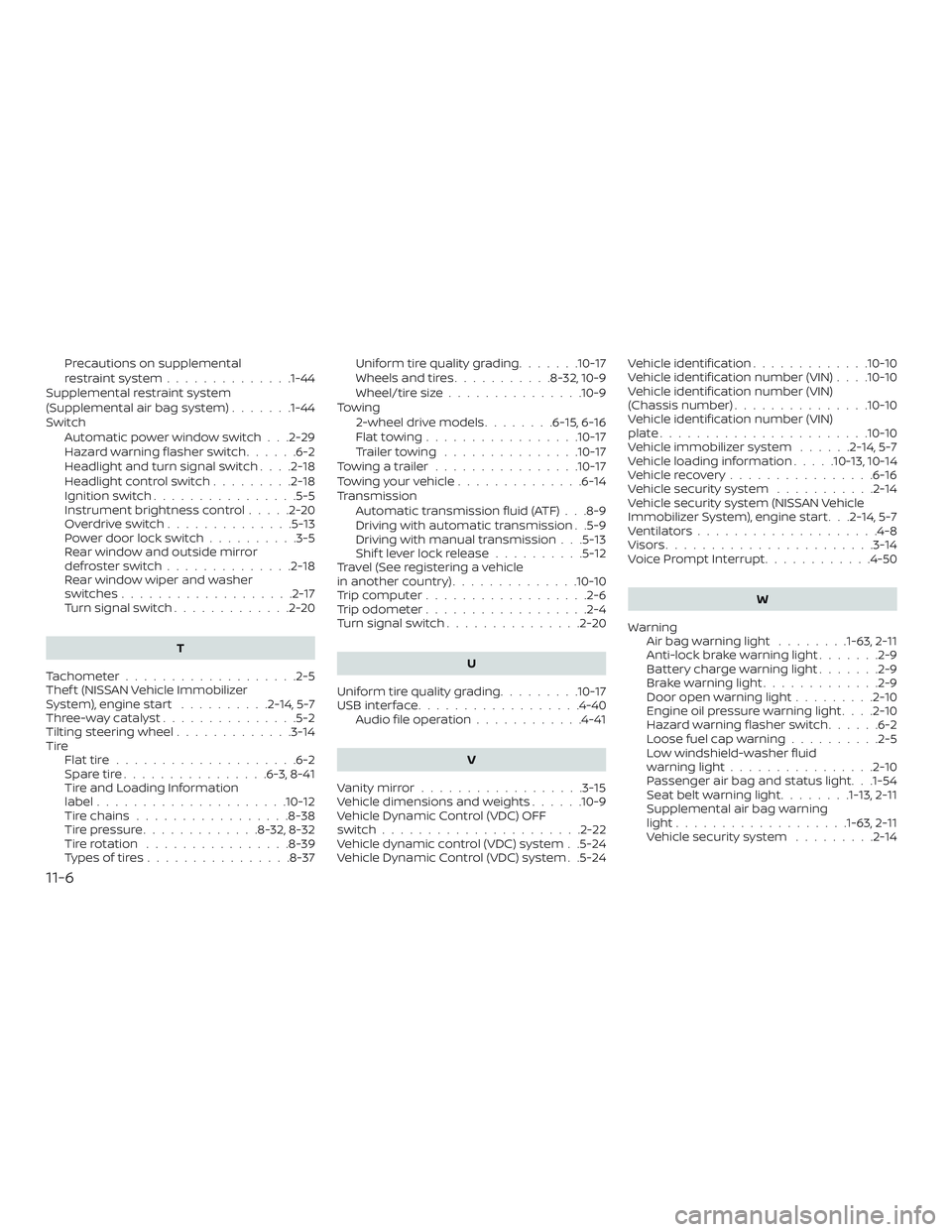
Precautions on supplemental
restraint system..............1-44
Supplemental restraint system
(Supplemental air bag system) .......1-44
Switch Automatic power window switch . . .2-29
Hazard warning flasher switch ......6-2
Headlight and turn signal switch ....2-18
Headlightcontrolswitch.........2-18
Ignition switch ................5-5
Instrument brightness control .....2-20
Overdriveswitch..............5-13
Power door lock switch ..........3-5
Rear window and outside mirror
defrosterswitch..............2-18
Rear window wiper and washer
switches ...................2-17
Turn signal switch .............2-20
T
Tachometer ...................2-5
Thef t (NISSAN Vehicle Immobilizer
System), engine start ..........2-14,5-7
Three-waycatalyst...............5-2
Tilting steering wheel .............3-14
Tire Flattire....................6-2
Spare tire ................6-3,8-41
Tire and Loading Information
label .....................10-12
Tire chains .................8-38
Tire pressure .............8-32,8-32
Tirerotation ................8-39
Types of tires ................8-37 Uniform tire quality grading
.......10-17
Wheels and tires ...........8-32,10-9
Wheel/tire size ...............10-9
Towing 2-wheel drive models ........6-15,6-16
Flattowing.................10-17
Trailertowing ...............10-17
Towingatrailer................10-17
Towingyourvehicle..............6-14
Transmission Automatic transmission fluid (ATF) . . .8-9
Driving with automatic transmission . .5-9
Driving with manual transmission . . .5-13
Shiftleverlockrelease..........5-12
Travel (See registering a vehicle
in another country) ..............10-10
Trip computer ..................2-6
Trip odometer ..................2-4
Turn signal switch ...............2-20
U
Uniform tire quality grading .........10-17
USBinterface..................4-40 Audio file operation ............4-41
V
Vanitymirror..................3-15
Vehicle dimensions and weights ......10-9
Vehicle Dynamic Control (VDC) OFF
switch......................2-22
Vehicle dynamic control (VDC) system . .5-24
Vehicle Dynamic Control (VDC) system . .5-24 Vehicle identification
.............10-10
Vehicle identification number (VIN) . . . .10-10
Vehicle identification number (VIN)
(Chassis number) ...............10-10
Vehicle identification number (VIN)
plate.......................10-10
Vehicle immobilizer system ......2-14,5-7
Vehicle loading information .....10-13,10-14
Vehiclerecovery................6-16
Vehicle security system ...........2-14
Vehicle security system (NISSAN Vehicle
Immobilizer System), engine start . . .2-14, 5-7
Ventilators ....................4-8
Visors.......................3-14
Voice Prompt Interrupt ............4-50
W
Warning Airbagwarninglight ........1-63, 2-11
Anti-lock brake warning light .......2-9
Battery charge warning light .......2-9
Brakewarninglight.............2-9
Door open warning light .........2-10
Engine oil pressure warning light . . . .2-10
Hazard warning flasher switch ......6-2
L o
osefuelcapwarning..........2-5
Low windshield-washer fluid
warninglight............... .2-10
Passenger air bag and status light. . .1-54
Seatbeltwarninglight........1-13, 2-11
Supplemental air bag warning
light.................. .1-63, 2-11
Vehicle security system .........2-14
11-6