seats NISSAN MICRA 2020 User Guide
[x] Cancel search | Manufacturer: NISSAN, Model Year: 2020, Model line: MICRA, Model: NISSAN MICRA 2020Pages: 346, PDF Size: 3.76 MB
Page 78 of 346
WARNING
∙ Do not place any objects near theseatback of the front seats. Also, do
not place any objects (an umbrella,
bag, etc.) between the front door fin-
isher and the front seat. Such objects
may become dangerous projectiles
and cause injury if a side air bag
inflates.
∙ Right af ter inflation, several side air bag and curtain air bag system com-
ponents will be hot. Do not touch
them; you may severely burn yourself.
∙ No unauthorized changes should be made to any components or wiring of
the side air bag and curtain air bag
systems. This is to prevent damage to
or accidental inflation of the side air
bag and curtain air bag systems.
∙ Do not make unauthorized changes to your vehicle’s electrical system,
suspension system or side panel. This
could affect proper operation of the
curtain air bag systems. ∙ Tampering with the side air bag sys-
tem may result in serious personal in-
jury. For example, do not change the
front seats by placing material near
the seatbacks or by installing addi-
tional trim material, such as seat cov-
ers, around the side air bag.
∙ It is recommended that you visit a NISSAN dealer for work around and on
the side air bag and curtain air bag
system. It is also recommended that
you visit a NISSAN dealer for installa-
tion of electrical equipment. The SRS
wiring harnesses* should not be
modified or disconnected. Unauthor-
ized electrical test equipment and
probing devices should not be used
on the side air bag or curtain air bag
systems.
* The SRS wiring harness or connectors
are yellow or orange for easy identifica-
tion.
When selling your vehicle, we request that
you inform the buyer about the side air bag
and curtain air bag systems and guide the
buyer to the appropriate sections in this
Owner’s Manual.
Seat belt with pretensioner(s)
(front seats)
Page 251 of 346
If you choose to use a tire dressing, take the
following precautions:∙ Use a water-based tire dressing. The coating on the tire dissolves more easily
than with an oil-based tire dressing.
∙ Apply a light coat of tire dressing to help prevent it from entering the tire
tread/grooves (where it would be diffi-
cult to remove).
∙ Wipe off excess tire dressing using a dry towel. Make sure the tire dressing is
completely removed from the tire
tread/grooves.
∙ Allow the tire dressing to dry as recom- mended by the tire dressing manufac-
turer. Occasionally remove loose dust from the
interior trim, plastic parts and seats using a
vacuum cleaner or sof t bristled brush. Wipe
the vinyl and leather (if so equipped) sur-
faces with a clean, sof t cloth dampened in
mild soap solution, then wipe clean with a
dry, sof t cloth.
Regular care and cleaning is required in
order to maintain the appearance of the
leather (if so equipped).
Before using any fabric protector, read the
manufacturer’s recommendations. Some
fabric protectors contain chemicals that
may stain or bleach the seat material.
Use a cloth dampened only with water to
clean the meter and gauge lens.
Page 327 of 346
WARNING
∙ It is extremely dangerous to ride in a cargo area inside a ve-
hicle. In a collision, people riding
in these areas are more likely to
be seriously injured or killed.
∙ Do not allow people to ride in any area of your vehicle that is
not equipped with seats and
seat belts.
∙ Be sure everyone in your vehicle is in a seat and using a seat belt
properly.
TERMS
It is important to familiarize yourself
with the following terms before
loading your vehicle:
∙ Curb Weight (actual weight of your vehicle) - vehicle weight in-
cluding: standard parts, fluids,
emergency tools, and spare tire
assembly. This weight does not
include passengers and cargo. ∙ GVW (Gross Vehicle Weight) - curb
weight plus the combined weight
of passengers and cargo.
∙ GVWR (Gross Vehicle Weight Rat- ing) - maximum total combined
weight of the unloaded vehicle,
passengers, luggage, hitch, trailer
tongue load and any other op-
tional equipment. This informa-
tion is located on the C.M.V.S.S.
certification label.
∙ GAWR (Gross Axle Weight Rating) - maximum weight (load) limit
specified for the front or rear axle.
This information is located on the
C.M.V.S.S. certification label.
∙ GCWR (Gross Combined Weight rating) - The maximum total
weight rating of the vehicle, pas-
sengers, cargo, and trailer. ∙ Vehicle Capacity Weight, Load
limit, Total load capacity - maxi-
mum total weight limit specified
of the load (passengers and
cargo) for the vehicle. This is the
maximum combined weight of
occupants and cargo that can be
loaded into the vehicle. If the ve-
hicle is used to tow a trailer, the
trailer tongue weight must be in-
cluded as part of the cargo load.
This information is located on the
Tire and Loading Information la-
bel.
∙ Cargo capacity - permissible weight of cargo, the subtracted
weight of occupants from the
load limit.
VEHICLE LOADING INFORMATION
10-14Technical and consumer information
Page 338 of 346
Capacities and recommended
fuel/lubricants...............10-2
Clutchfluid.................8-10
Engine coolant...............8-4
Engine oil ...................8-6
Front air bag system
(See supplemental restraint system) . . .1-54
Front-door pocket ...............2-23
Frontseats................... .1-2
Fuel Capacities and recommended
fuel/lubricants...............10-2
Fuel economy ...............5-20
Fuel-filler cap ................3-11
Fuel-filler lid .................3-11
Fuel gauge ..................2-6
Fueloctanerating.............10-6
Fuel recommendation ..........10-4
Loose fuel cap warning ..........2-5
Fuelefficientdrivingtips...........5-19
Fuel-filler door ..................3-11
Fuel gauge ....................2-6
Fuses .......................8-18
Fusiblelinks...................8-18
G
Gascap......................3-11
Gauge Fuel gauge ..................2-6
Odometer ..................2-4
Speedometer ................2-4
Tachometer .................2-5
Trip computer ................2-6
Trip odometer ................2-4 General maintenance
.............9-2
Glovebox....................2-24
H
Hands-free phone system, Bluetooth® . .4-51
Hazard warning flasher switch ........6-2
Headlight and turn signal switch ......2-18
Headlightcontrolswitch...........2-18
Headlights ...................8-22
Headrestraints .................1-6
Heater Heater and air conditioner controls . .4-20
Heater operation .......4-14,4-16,4-22
Hood ........................3-9
Horn .......................2-21
I
Ignition switch ..................5-5
Immobilizer system ...........2-14,5-7
Important vehicle information label . . .10-12
In-cabinmicrofilter ..............8-15
Increasing fuel economy ..........5-20
Indicator lights and audible reminders
(See warning/indicator lights and audible
reminders) ....................2-11
Instrument brightness control .......2-20
Instrument panel .............0-6,2-2
Instrument panel dimmer switch .....2-20
Interiorlight...................2-29
iPod®Player ..................4-40
ISOFIX child restraints .............1-25 J
Jumpstarting...............6 -11, 8-13
K
Key........................ .3-2
Key fob battery replacement .....8-21,8-21
Keyless entry Without Intelligent Key system
(See remote keyless entry system) . . .3-7
Keyless entry system
(See remote keyless entry system) .....3-6
Keys NISSAN Vehicle Immobilizer System
keys......................3-3
L
Labels Air conditioner specification label . . .10-13
C.M.V.S.S. certification label .......10-12
Emission control information label . .10-12
Engine serial number ..........10-12
Tire and Loading Information label . .10-13
Vehicle identification number (VIN) . .10-11
V
ehicle identification number (VIN)
plate.....................10-11
Warning labels (for SRS) ..........1-62
LATCH (Lower Anchors and Tethers for
CHildren)System................1-25
Launch bar menu ................4-6
License plate Installing the license plate .......10-13
11-3
Page 340 of 346
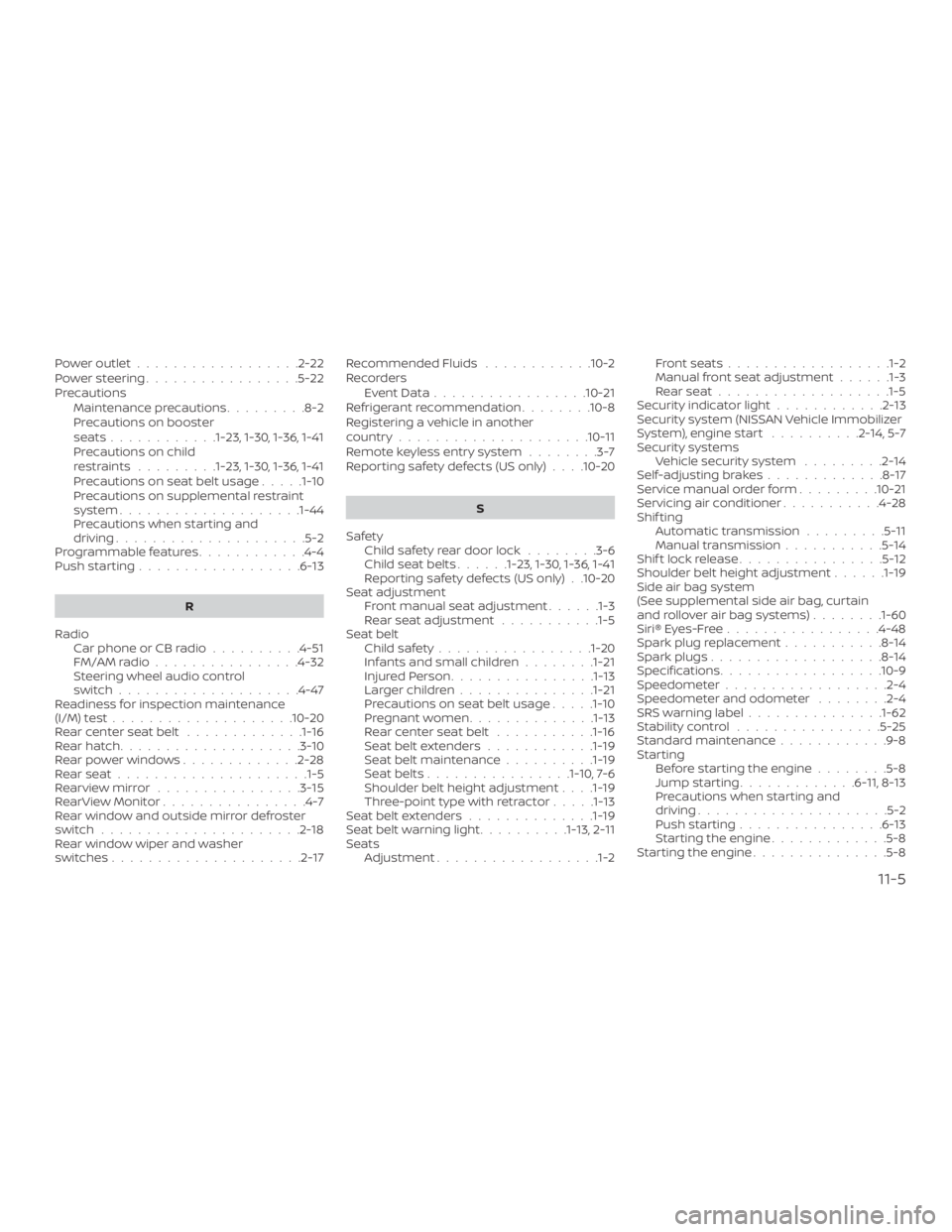
Poweroutlet..................2-22
Powersteering.................5-22
PrecautionsMaintenance precautions .........8-2
Precautions on booster
seats............1-23, 1-30, 1-36, 1-41
Precautions on child
restraints .........1-23, 1-30, 1-36, 1-41
Precautions on seat belt usage .....1-10
Precautions on supplemental restraint
system ....................1-44
Precautions when starting and
driving.....................5-2
Programmable features ............4-4
Push starting ..................6-13
R
Radio Car phone or CB radio ..........4-51
FM/AMradio................4-32
Steering wheel audio control
switch....................4-47
Readiness for inspection maintenance
(I/M)test....................10-20
Rearcenterseatbelt .............1-16
Rearhatch....................3-10
Rearpowerwindows.............2-28
Rearseat.................... .1-5
Rearviewmirror ................3-15
RearViewMonitor................4-7
Rear window and outside mirror defroster
switch......................2-18
Rear window wiper and washer
switches .....................2-17 Recommended Fluids
............10-2
Recorders EventData.................10-21
Refrigerant recommendation ........10-8
Registering a vehicle in another
country .....................10-11
Remote keyless entry system ........3-7
Reporting safety defects (US only) . . . .10-20
S
Safety Child safety rear door lock ........3-6
Childseatbelts......1-23, 1-30, 1-36, 1-41
Reporting safety defects (US only) . .10-20
Seat adjustment Front manual seat adjustment ......1-3
Rear seat adjustment ...........1-5
Seat belt Childsafety................ .1-20
Infants and small children ........1-21
InjuredPerson............... .1-13
Largerchildren.............. .1-21
Precautions on seat belt usage .....1-10
Pregnant women ..............1-13
Rearcenterseatbelt ...........1-16
Seat belt extenders ............1-19
Seat belt maintenance ..........1-19
Seatbelts................1-10, 7-6
Shoulder belt height adjustment . . . .1-19
Three-pointtypewithretractor.....1-13
Seat belt extenders ..............1-19
Seatbeltwarninglight..........1-13, 2-11
Seats Adjustment ..................1-2 Frontseats..................1-2
Manual front seat adjustment
......1-3
R
earseat...................1-5
Security indicator light ............2-13
Security system (NISSAN Vehicle Immobilizer
System), engine start ..........2-14, 5-7
Security systems Vehicle security system .........2-14
Self-adjustingbrakes.............8-17
Service manual order form .........10-21
Servicing air conditioner ...........4-28
Shif ting Automatic transmission .........5-11
Manual transmission ...........5-14
Shiftlockrelease................5-12
Shoulder belt height adjustment ......1-19
Side air bag system
(See supplemental side air bag, curtain
and rollover air bag systems) ........1-60
Siri® Eyes-Free .................4-48
Spark plug replacement ...........8-14
Spark plugs ...................8-14
Specifications ..................10-9
Speedometer ..................2-4
Speedometer and odometer ........2-4
SRS warning label ...............1-62
Stability control ................5-25
Standard maintenance ............9-8
Starting Before starting the engine ........5-8
Jumpstarting.............6 -11, 8-13
Precautions when starting and
driving .....................5-2
Push starting ................6-13
Starting the engine .............5-8
Starting the engine ...............5-8
11-5