remove seats NISSAN MURANO 2009 Owner´s Manual
[x] Cancel search | Manufacturer: NISSAN, Model Year: 2009, Model line: MURANO, Model: NISSAN MURANO 2009Pages: 443, PDF Size: 3.95 MB
Page 20 of 443
Black plate (18,1)
Model "Z51-D" EDITED: 2007/ 10/ 2
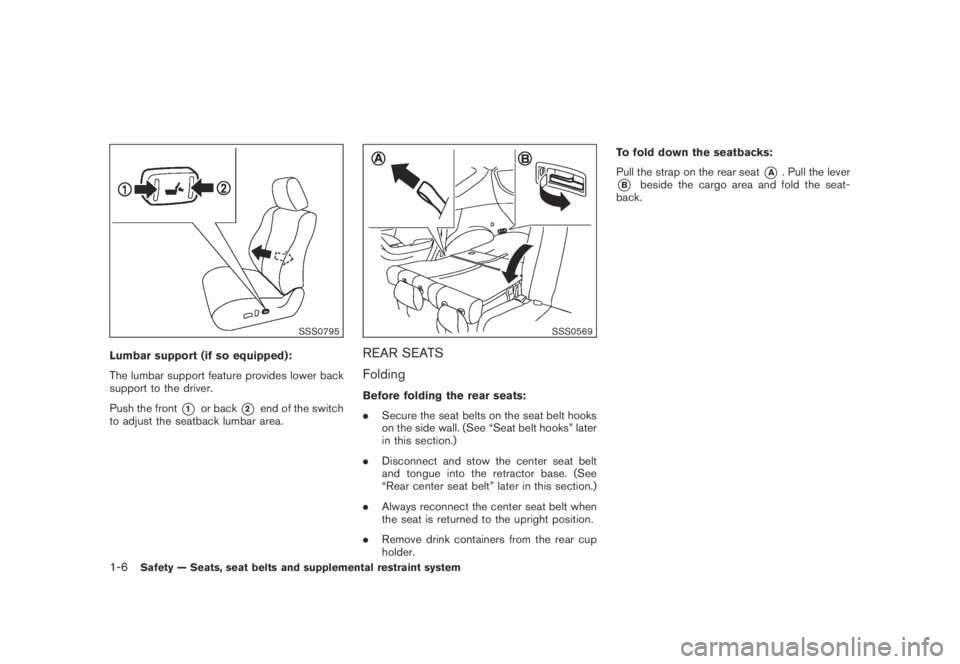
SSS0795
Lumbar support (if so equipped):
The lumbar support feature provides lower back
support to the driver.
Push the front
*1or back*2end of the switch
to adjust the seatback lumbar area.
SSS0569
REAR SEATS
Folding
Before folding the rear seats:
.Secure the seat belts on the seat belt hooks
on the side wall. (See “Seat belt hooks” later
in this section.)
.Disconnect and stow the center seat belt
and tongue into the retractor base. (See
“Rear center seat belt” later in this section.)
.Always reconnect the center seat belt when
the seat is returned to the upright position.
.Remove drink containers from the rear cup
holder.To fold down the seatbacks:
Pull the strap on the rear seat
*A. Pull the lever
*Bbeside the cargo area and fold the seat-
back.
1-6Safety — Seats, seat belts and supplemental restraint system
Page 22 of 443
Black plate (20,1)
Model "Z51-D" EDITED: 2007/ 10/ 2
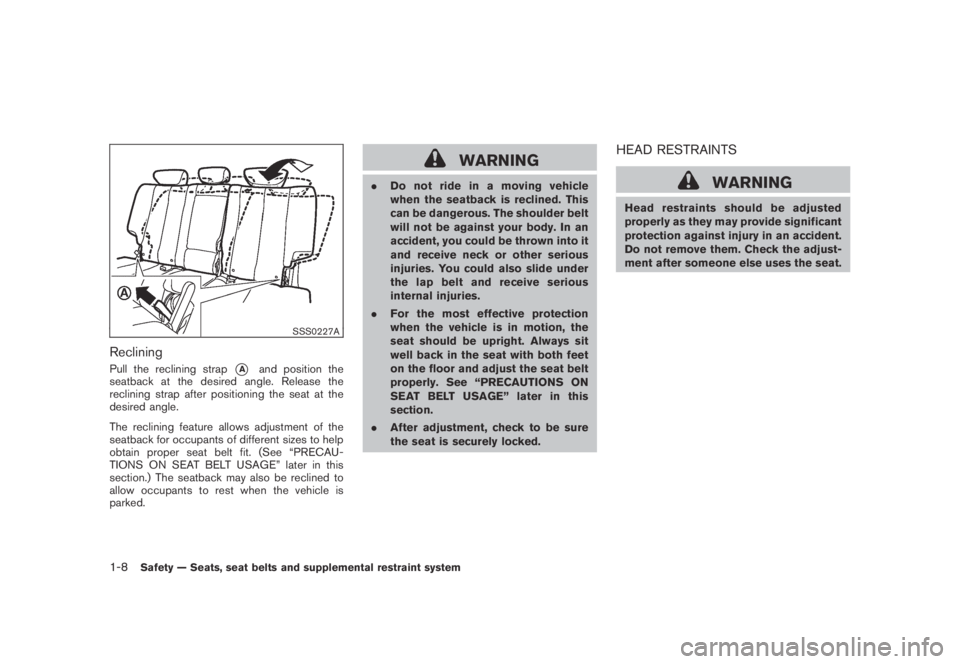
SSS0227A
Reclining
Pull the reclining strap*Aand position the
seatback at the desired angle. Release the
reclining strap after positioning the seat at the
desired angle.
The reclining feature allows adjustment of the
seatback for occupants of different sizes to help
obtain proper seat belt fit. (See “PRECAU-
TIONS ON SEAT BELT USAGE” later in this
section.) The seatback may also be reclined to
allow occupants to rest when the vehicle is
parked.
WARNING
.Do not ride in a moving vehicle
when the seatback is reclined. This
can be dangerous. The shoulder belt
will not be against your body. In an
accident, you could be thrown into it
and receive neck or other serious
injuries. You could also slide under
the lap belt and receive serious
internal injuries.
.For the most effective protection
when the vehicle is in motion, the
seat should be upright. Always sit
well back in the seat with both feet
on the floor and adjust the seat belt
properly. See “PRECAUTIONS ON
SEAT BELT USAGE” later in this
section.
.After adjustment, check to be sure
the seat is securely locked.
HEAD RESTRAINTS
WARNING
Head restraints should be adjusted
properly as they may provide significant
protection against injury in an accident.
Do not remove them. Check the adjust-
ment after someone else uses the seat.
1-8Safety — Seats, seat belts and supplemental restraint system
Page 39 of 443
Black plate (37,1)
Model "Z51-D" EDITED: 2007/ 10/ 2
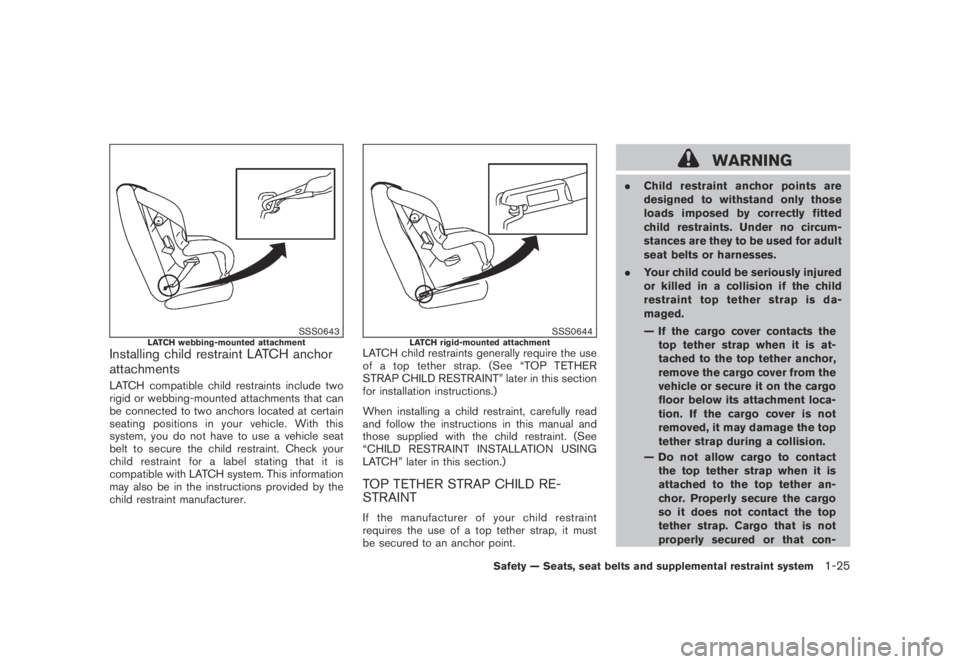
SSS0643LATCH webbing-mounted attachmentInstalling child restraint LATCH anchor
attachments
LATCH compatible child restraints include two
rigid or webbing-mounted attachments that can
be connected to two anchors located at certain
seating positions in your vehicle. With this
system, you do not have to use a vehicle seat
belt to secure the child restraint. Check your
child restraint for a label stating that it is
compatible with LATCH system. This information
may also be in the instructions provided by the
child restraint manufacturer.
SSS0644LATCH rigid-mounted attachmentLATCH child restraints generally require the use
of a top tether strap. (See “TOP TETHER
STRAP CHILD RESTRAINT” later in this section
for installation instructions.)
When installing a child restraint, carefully read
and follow the instructions in this manual and
those supplied with the child restraint. (See
“CHILD RESTRAINT INSTALLATION USING
LATCH” later in this section.)
TOP TETHER STRAP CHILD RE-
STRAINT
If the manufacturer of your child restraint
requires the use of a top tether strap, it must
be secured to an anchor point.
WARNING
.Child restraint anchor points are
designed to withstand only those
loads imposed by correctly fitted
child restraints. Under no circum-
stances are they to be used for adult
seat belts or harnesses.
.Your child could be seriously injured
or killed in a collision if the child
restraint top tether strap is da-
maged.
— If the cargo cover contacts the
top tether strap when it is at-
tached to the top tether anchor,
remove the cargo cover from the
vehicle or secure it on the cargo
floor below its attachment loca-
tion. If the cargo cover is not
removed, it may damage the top
tether strap during a collision.
— Do not allow cargo to contact
the top tether strap when it is
attached to the top tether an-
chor. Properly secure the cargo
so it does not contact the top
tether strap. Cargo that is not
properly secured or that con-
Safety — Seats, seat belts and supplemental restraint system1-25
Page 40 of 443
Black plate (38,1)
Model "Z51-D" EDITED: 2007/ 10/ 2
tacts the top tether strap may
damage the top tether strap
during a collision.
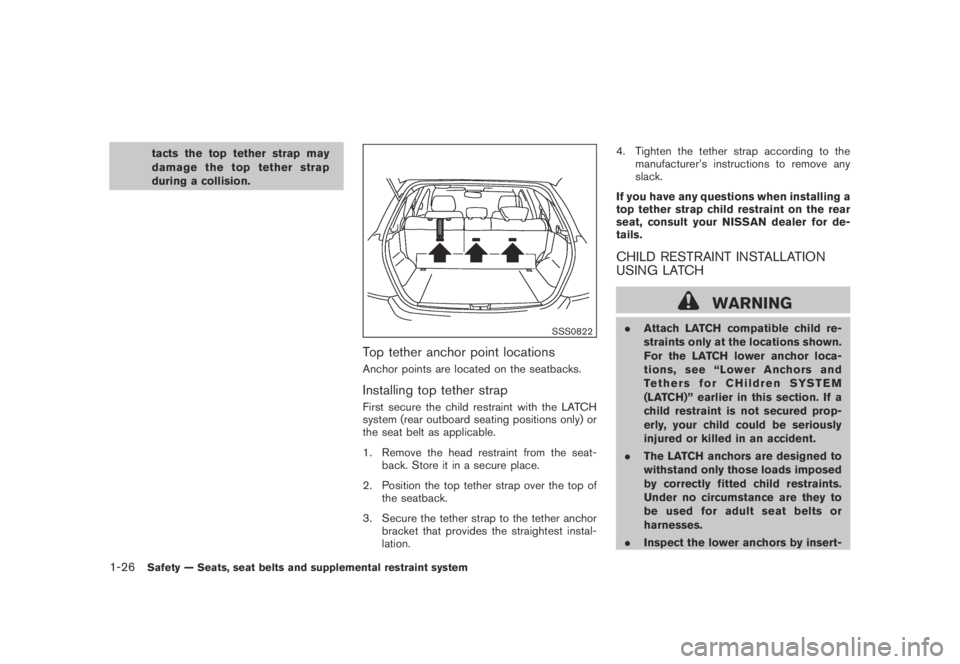
SSS0822
Top tether anchor point locations
Anchor points are located on the seatbacks.
Installing top tether strap
First secure the child restraint with the LATCH
system (rear outboard seating positions only) or
the seat belt as applicable.
1. Remove the head restraint from the seat-
back. Store it in a secure place.
2. Position the top tether strap over the top of
the seatback.
3. Secure the tether strap to the tether anchor
bracket that provides the straightest instal-
lation.4. Tighten the tether strap according to the
manufacturer’s instructions to remove any
slack.
If you have any questions when installing a
top tether strap child restraint on the rear
seat, consult your NISSAN dealer for de-
tails.
CHILD RESTRAINT INSTALLATION
USING LATCH
WARNING
.Attach LATCH compatible child re-
straints only at the locations shown.
For the LATCH lower anchor loca-
tions, see “Lower Anchors and
Tethers for CHildren SYSTEM
(LATCH)” earlier in this section. If a
child restraint is not secured prop-
erly, your child could be seriously
injured or killed in an accident.
.The LATCH anchors are designed to
withstand only those loads imposed
by correctly fitted child restraints.
Under no circumstance are they to
be used for adult seat belts or
harnesses.
.Inspect the lower anchors by insert-
1-26Safety — Seats, seat belts and supplemental restraint system
Page 41 of 443
Black plate (39,1)
Model "Z51-D" EDITED: 2007/ 10/ 2
ing your fingers into the lower
anchor area and feeling to make
sure there are no obstructions over
the LATCH anchors, such as seat
belt webbing or seat cushion mate-
rial. The child restraint will not be
secured properly if the LATCH an-
chors are obstructed.
Front-facing
Follow these steps to install a front-facing child
restraint using LATCH:
1. Adjust the rear seatback to the upright
position.
2. Position the child restraint on the seat.
Always follow the child restraint manufac-
turer’s instructions.
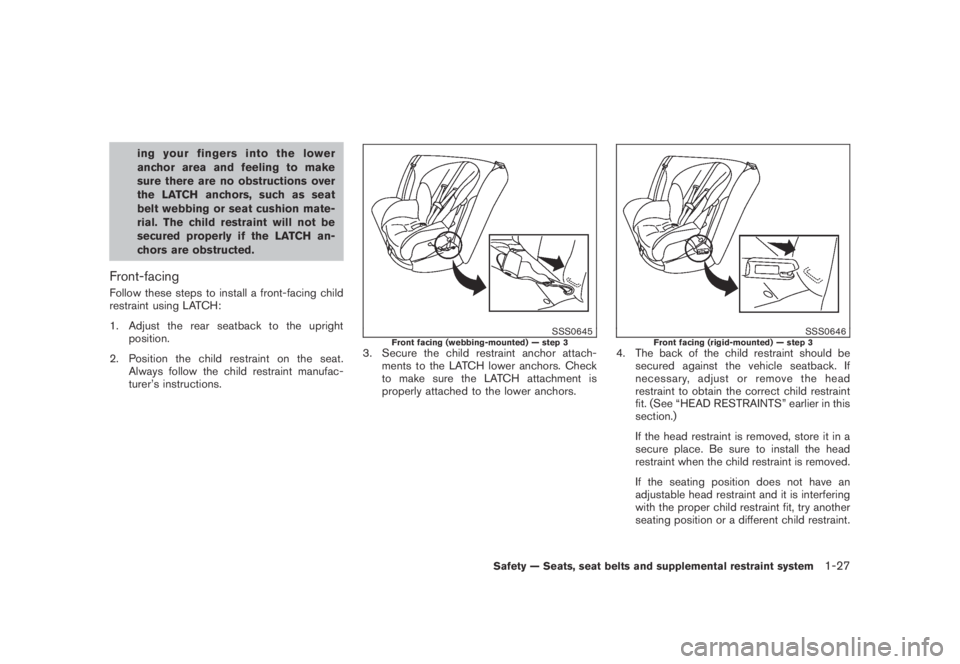
SSS0645Front facing (webbing-mounted) — step 33. Secure the child restraint anchor attach-
ments to the LATCH lower anchors. Check
to make sure the LATCH attachment is
properly attached to the lower anchors.
SSS0646Front facing (rigid-mounted) — step 34. The back of the child restraint should be
secured against the vehicle seatback. If
necessary, adjust or remove the head
restraint to obtain the correct child restraint
fit. (See “HEAD RESTRAINTS” earlier in this
section.)
If the head restraint is removed, store it in a
secure place. Be sure to install the head
restraint when the child restraint is removed.
If the seating position does not have an
adjustable head restraint and it is interfering
with the proper child restraint fit, try another
seating position or a different child restraint.
Safety — Seats, seat belts and supplemental restraint system1-27
Page 42 of 443
Black plate (40,1)
Model "Z51-D" EDITED: 2007/ 10/ 2
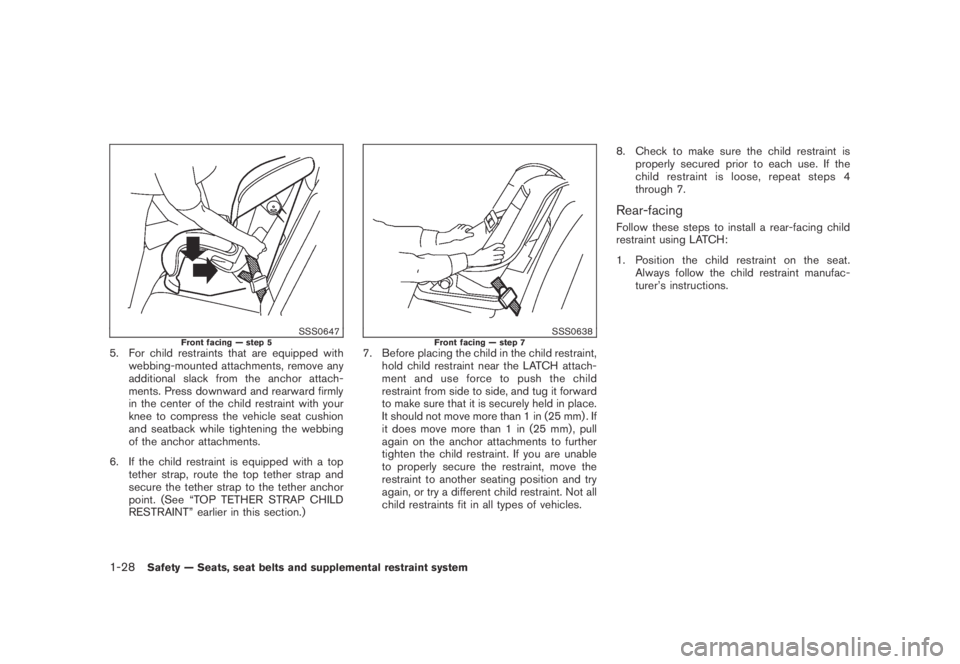
SSS0647Front facing — step 55. For child restraints that are equipped with
webbing-mounted attachments, remove any
additional slack from the anchor attach-
ments. Press downward and rearward firmly
in the center of the child restraint with your
knee to compress the vehicle seat cushion
and seatback while tightening the webbing
of the anchor attachments.
6. If the child restraint is equipped with a top
tether strap, route the top tether strap and
secure the tether strap to the tether anchor
point. (See “TOP TETHER STRAP CHILD
RESTRAINT” earlier in this section.)
SSS0638Front facing — step 77. Before placing the child in the child restraint,
hold child restraint near the LATCH attach-
ment and use force to push the child
restraint from side to side, and tug it forward
to make sure that it is securely held in place.
It should not move more than 1 in (25 mm) . If
it does move more than 1 in (25 mm) , pull
again on the anchor attachments to further
tighten the child restraint. If you are unable
to properly secure the restraint, move the
restraint to another seating position and try
again, or try a different child restraint. Not all
child restraints fit in all types of vehicles.8. Check to make sure the child restraint is
properly secured prior to each use. If the
child restraint is loose, repeat steps 4
through 7.
Rear-facing
Follow these steps to install a rear-facing child
restraint using LATCH:
1. Position the child restraint on the seat.
Always follow the child restraint manufac-
turer’s instructions.
1-28Safety — Seats, seat belts and supplemental restraint system
Page 43 of 443
Black plate (41,1)
Model "Z51-D" EDITED: 2007/ 10/ 2
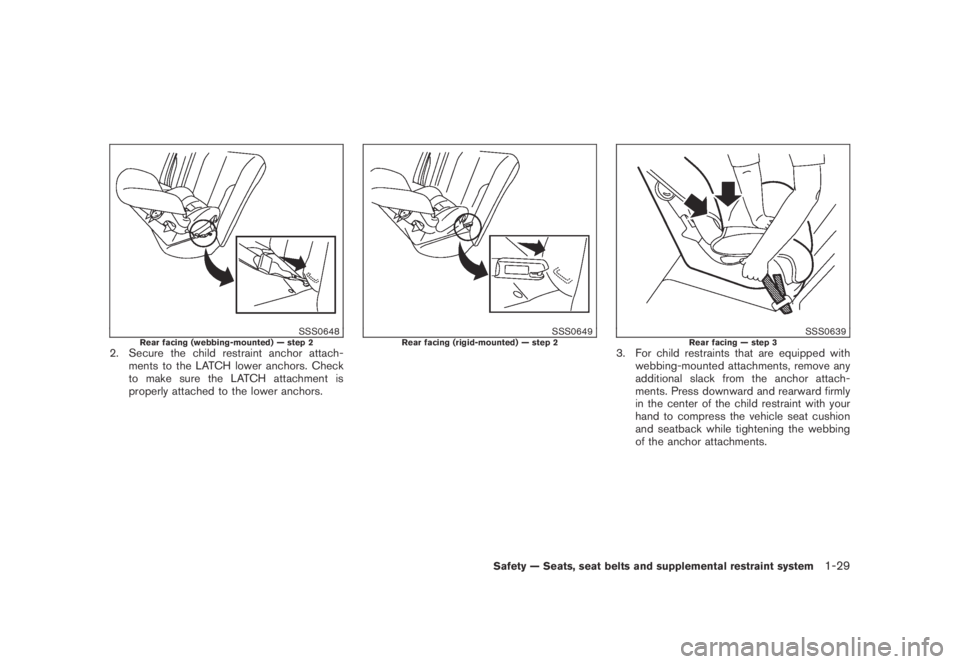
SSS0648Rear facing (webbing-mounted) — step 22. Secure the child restraint anchor attach-
ments to the LATCH lower anchors. Check
to make sure the LATCH attachment is
properly attached to the lower anchors.
SSS0649Rear facing (rigid-mounted) — step 2SSS0639Rear facing — step 33. For child restraints that are equipped with
webbing-mounted attachments, remove any
additional slack from the anchor attach-
ments. Press downward and rearward firmly
in the center of the child restraint with your
hand to compress the vehicle seat cushion
and seatback while tightening the webbing
of the anchor attachments.
Safety — Seats, seat belts and supplemental restraint system1-29
Page 46 of 443
Black plate (44,1)
Model "Z51-D" EDITED: 2007/ 10/ 2
2. Position the child restraint on the seat.
Always follow the child restraint manufac-
turer’s instructions.
The back of the child restraint should be
secured against the seatback. If necessary,
adjust or remove the head restraint (front
passenger seat only) to obtain the correct
child restraint fit. (See “HEAD RE-
STRAINTS” earlier in this section.)
If the head restraint is removed, store it in a
secure place. Be sure to install the head
restraint when the child restraint is removed.
If the seating position does not have an
adjustable head restraint and it is interfering
with the proper child restraint fit, try another
seating position or a different child restraint.
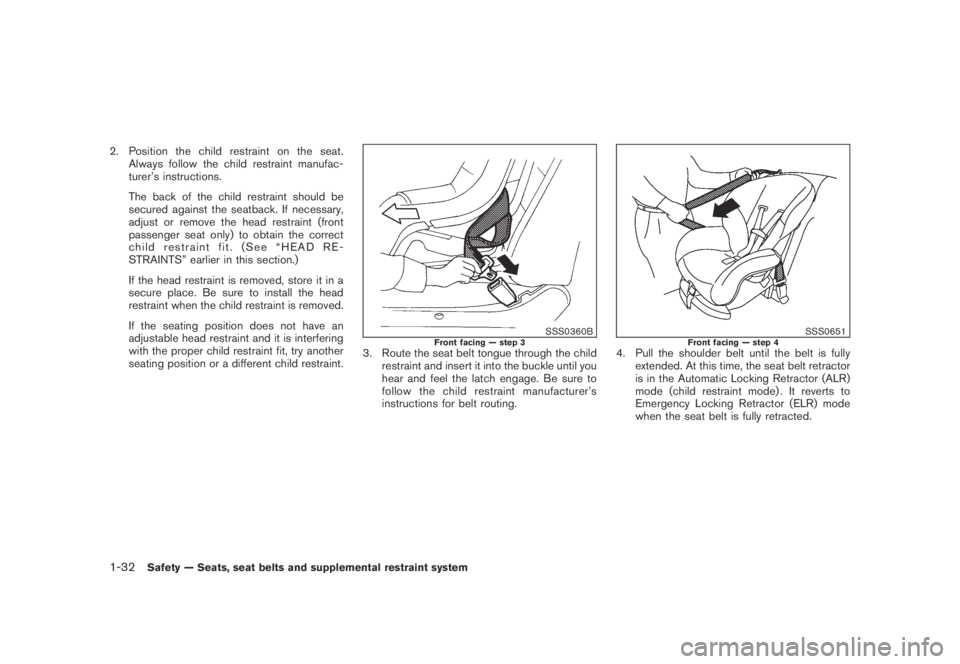
SSS0360BFront facing — step 33. Route the seat belt tongue through the child
restraint and insert it into the buckle until you
hear and feel the latch engage. Be sure to
follow the child restraint manufacturer’s
instructions for belt routing.
SSS0651Front facing — step 44. Pull the shoulder belt until the belt is fully
extended. At this time, the seat belt retractor
is in the Automatic Locking Retractor (ALR)
mode (child restraint mode) . It reverts to
Emergency Locking Retractor (ELR) mode
when the seat belt is fully retracted.
1-32Safety — Seats, seat belts and supplemental restraint system
Page 47 of 443
Black plate (45,1)
Model "Z51-D" EDITED: 2007/ 10/ 2
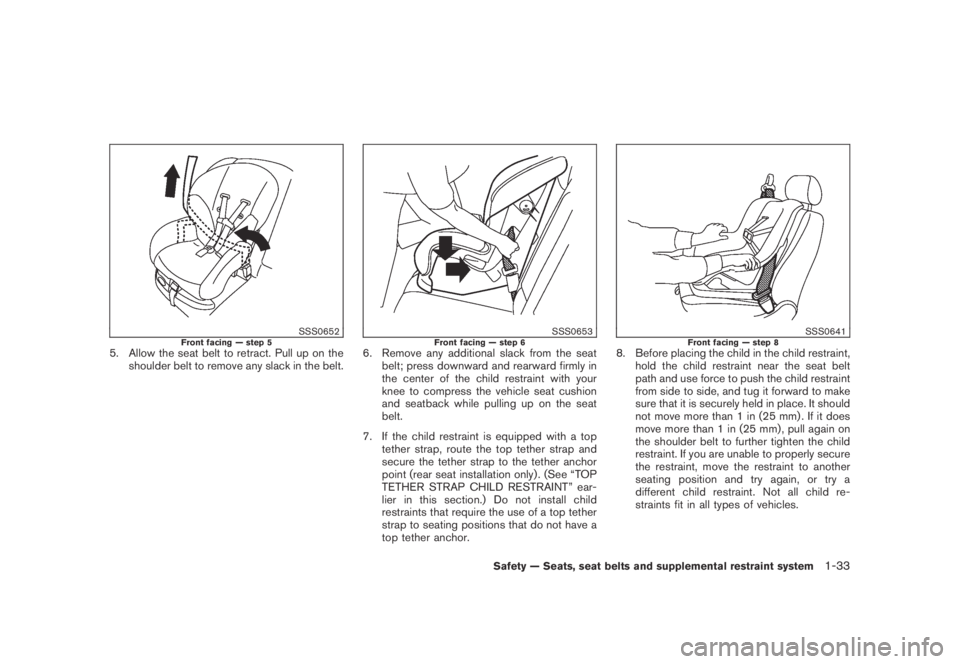
SSS0652Front facing — step 55. Allow the seat belt to retract. Pull up on the
shoulder belt to remove any slack in the belt.
SSS0653Front facing — step 66. Remove any additional slack from the seat
belt; press downward and rearward firmly in
the center of the child restraint with your
knee to compress the vehicle seat cushion
and seatback while pulling up on the seat
belt.
7. If the child restraint is equipped with a top
tether strap, route the top tether strap and
secure the tether strap to the tether anchor
point (rear seat installation only) . (See “TOP
TETHER STRAP CHILD RESTRAINT” ear-
lier in this section.) Do not install child
restraints that require the use of a top tether
strap to seating positions that do not have a
top tether anchor.
SSS0641Front facing — step 88. Before placing the child in the child restraint,
hold the child restraint near the seat belt
path and use force to push the child restraint
from side to side, and tug it forward to make
sure that it is securely held in place. It should
not move more than 1 in (25 mm) . If it does
move more than 1 in (25 mm) , pull again on
the shoulder belt to further tighten the child
restraint. If you are unable to properly secure
the restraint, move the restraint to another
seating position and try again, or try a
different child restraint. Not all child re-
straints fit in all types of vehicles.
Safety — Seats, seat belts and supplemental restraint system1-33
Page 48 of 443
Black plate (46,1)
Model "Z51-D" EDITED: 2007/ 10/ 2
9. Check that the retractor is in the ALR mode
by trying to pull more seat belt out of the
retractor. If you cannot pull any more belt
webbing out of the retractor, the retractor is
in the ALR mode.
10. Check to make sure the child restraint is
properly secured prior to each use. If the
seat belt is not locked, repeat steps 3
through 9.
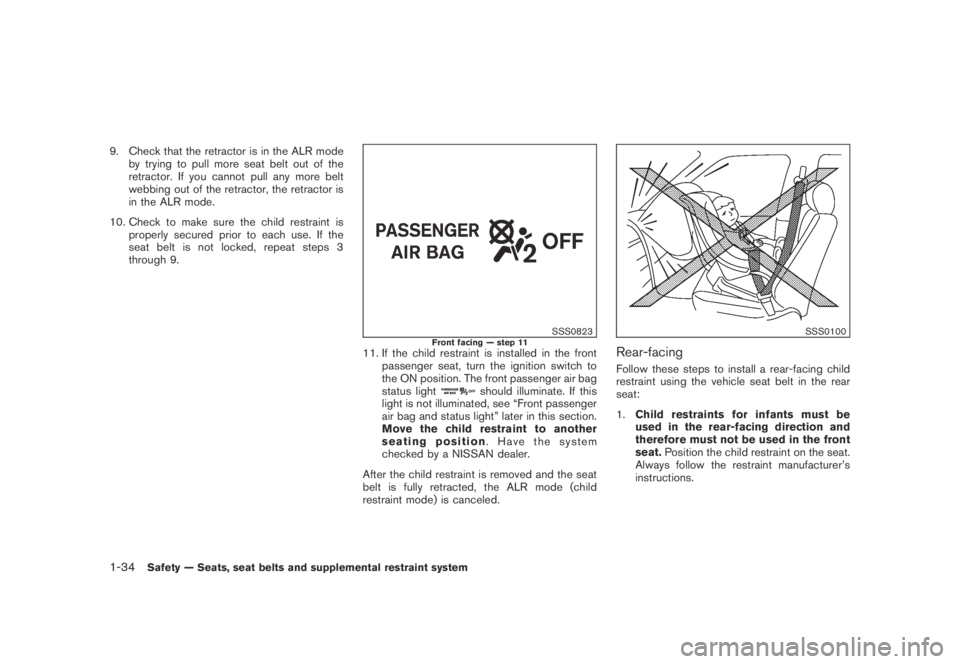
SSS0823Front facing — step 1111. If the child restraint is installed in the front
passenger seat, turn the ignition switch to
the ON position. The front passenger air bag
status light
should illuminate. If this
light is not illuminated, see “Front passenger
air bag and status light” later in this section.
Move the child restraint to another
seating position. Have the system
checked by a NISSAN dealer.
After the child restraint is removed and the seat
belt is fully retracted, the ALR mode (child
restraint mode) is canceled.
SSS0100
Rear-facing
Follow these steps to install a rear-facing child
restraint using the vehicle seat belt in the rear
seat:
1.Child restraints for infants must be
used in the rear-facing direction and
therefore must not be used in the front
seat.Position the child restraint on the seat.
Always follow the restraint manufacturer’s
instructions.
1-34Safety — Seats, seat belts and supplemental restraint system